

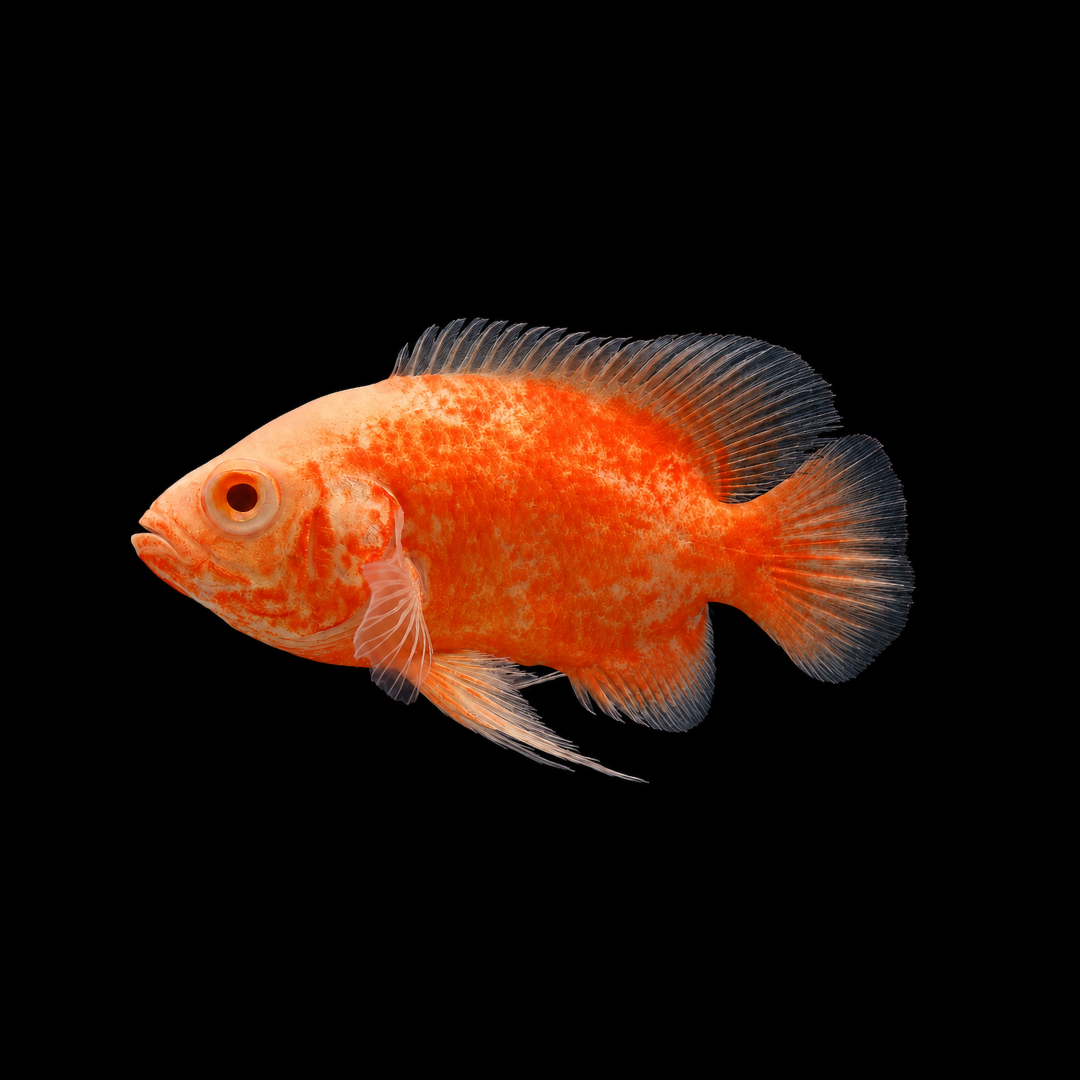
解説 / Description
アルビノルビーレッドオスカーは、南米原産の大型シクリッドであるオスカー、Astronotus ocellatusのアルビノ系・赤色系として流通する観賞用品種です。流通名に厳密な統一規格はありませんが、メラニンの沈着が乏しい白色からクリーム色の体表に、橙色から赤色が広く現れる個体がこの名で扱われます。赤みを帯びた瞳もアルビノ個体の特徴です。成魚は30cmを超えることがあり、食べる量と排泄量が多く、底砂やレイアウトを動かすほど力強く行動します。また、反復した給餌の合図などを学習できることが知られ、飼育下では人の動きに対してよく反応する個体も見られます。十分な水量、強力なろ過、規則的な水換えを長期にわたって維持することが、この魚を安定して飼育するための基本です。 The Albino Ruby Red Oscar is an ornamental form of the South American cichlid Astronotus ocellatus, marketed within albino and strongly red-colored lines. Trade names are not governed by a single formal breed standard, but fish sold under this name typically show a white to creamy body with reduced melanin deposition and broad orange to red coloration. Reddish eyes are also characteristic of albino individuals. Adults can exceed 30 cm, eat heavily, produce substantial waste, and are strong enough to move substrate and aquarium décor. Oscars are capable of learning repeated feeding cues, and many captive individuals become highly responsive to activity around the aquarium. Ample water volume, strong filtration, and consistent water changes are the foundations of stable long-term care.
基本情報 / Basic Information
| 学名 / Scientific Name | Astronotus ocellatus |
|---|---|
| 通称 / Common Name | アルビノルビーレッドオスカー、アルビノレッドオスカー、ルビーレッドオスカー。流通上はスーパーレッドなど近縁の名称が使われることもありますが、名称の基準は販売者や育種系統によって一定ではありません。Albino Ruby Red Oscar, Albino Red Oscar, and Ruby Red Oscar. Related trade names such as Super Red may also be used, although naming standards vary among breeders and sellers. |
| 分類 / Family | シクリッド科 Cichlidae、アストロノータス属 Astronotus。現在、Astronotus ocellatusは有効種として扱われています。Family Cichlidae, genus Astronotus. Astronotus ocellatus is currently treated as a valid species. |
| 英名 / English Name | Albino Ruby Red Oscar / Albino Red Oscar |
| 分布 / Distribution | 原種のAstronotus ocellatusは南米のアマゾン川流域に分布し、ブラジル、ボリビア、コロンビア、フランス領ギアナ、ペルーから記録されています。流れの緩やかな浅場などを利用する淡水魚です。アルビノルビーレッドオスカーそのものは自然分布する地域個体群ではなく、飼育下で維持されている観賞用品種です。Wild Astronotus ocellatus is distributed in the Amazon River basin of South America, with records from Brazil, Bolivia, Colombia, French Guiana, and Peru. It inhabits freshwater environments including relatively quiet shallow waters. The Albino Ruby Red Oscar itself is not a naturally occurring geographic population but an ornamental form maintained in captivity. |
| 最大体長 / Max Size | 最大45cm前後の記録があります。飼育下では30cm前後からそれ以上に成長することを前提に、終生飼育の設備を選びます。Published records reach roughly 45 cm. Aquarium planning should assume an adult size of around 30 cm or more and provide space for larger individuals. |
| 寿命 / Lifespan | 飼育下では10年前後からそれ以上の長期飼育例が広く知られていますが、寿命を裏付ける学術的なデータは多くありません。短期間で飼い切れる魚ではないため、長期の終生飼育を前提に迎えます。Captive Oscars are widely known to live for around a decade or longer, although published scientific longevity data are limited. They should therefore be acquired with long-term lifelong care in mind. |
飼育環境 / Aquarium Environment
| 水槽サイズ / Tank Size | 単独での終生飼育は、120×60×45cm程度の120cmワイド水槽、約320L級以上を基本に考えます。90cm規格水槽、約180L級は成長途中の個体には使えても、30cmを超える成魚の終生飼育には余裕が乏しくなります。特に奥行きは重要で、成魚が無理なく反転できる幅を確保してください。複数飼育や大型魚との混泳では、さらに大きな水量と底面積が必要です。For lifelong housing of a single adult, a 120 × 60 × 45 cm aquarium of roughly 320 L or larger is a practical baseline. A standard 90 cm aquarium of roughly 180 L may be usable while the fish is growing, but it provides little long-term room for an adult exceeding 30 cm. Tank depth is especially important so the fish can turn freely. Multiple Oscars or large tank mates require substantially greater volume and floor space. |
|---|---|
| 水温 / Temperature | 通常管理では24〜28℃程度を目安に、急激な温度変化を避けて安定させます。 For routine maintenance, approximately 24–28°C is a practical range. Keep the temperature stable and avoid rapid changes. |
| 水質 / Water Quality | 弱酸性から中性を中心に、pH6.0〜7.5程度を目安とします。数値を無理に合わせるより、アンモニアと亜硝酸塩を検出されない状態に保ち、硝酸塩や溶存有機物を水換えで蓄積させないことが重要です。大型魚らしく排泄量が多いため、十分に立ち上がった生物ろ過と高い循環能力が欠かせません。Slightly acidic to neutral water, around pH 6.0–7.5, is a useful target. Rather than chasing exact numbers, the priority is keeping ammonia and nitrite undetectable and preventing nitrate and dissolved organic waste from accumulating through regular water changes. Because Oscars produce heavy waste, mature biological filtration and strong circulation are essential. |
| レイアウト / Layout | 掃除を優先するならベアタンク、底砂を使うなら薄敷きが実用的です。オスカーは砂利をくわえて動かしたり、流木や小物の位置を変えたりするため、重く不安定な石組みや割れやすい装飾は避けます。流木を使う場合は確実に沈下・固定し、水草はアヌビアス類やミクロソリウム類などを流木や石に活着させる方法が比較的向きます。ただし、丈夫な水草でも個体によっては引き抜かれることがあります。A bare-bottom tank is practical when ease of cleaning is the priority; if substrate is used, a thin layer is easier to maintain. Oscars often pick up gravel and move décor, so unstable rockwork and fragile ornaments should be avoided. Driftwood should be safely waterlogged and secured. Tough epiphytes such as Anubias and Microsorum can be attached to wood or stone, although even robust plants may be uprooted by some individuals. |
| 注意点 / Precautions | 大食漢で水を汚しやすいため、ろ過能力を小型魚水槽の感覚で考えないことが重要です。週1回を基本に30〜50%程度の換水を行い、給餌量や水質検査結果に応じて頻度を調整します。ヒーターや吸水口は体当たりで動かされないよう保護・固定し、飛び出し防止のためフタも確実に設置します。The most important point is not to size filtration as if this were a small-fish aquarium. Oscars eat heavily and foul the water quickly. As a general routine, change roughly 30–50% of the water weekly and adjust frequency according to feeding load and test results. Protect and secure heaters and filter intakes against impact, and use a secure lid to reduce the risk of jumping. |
餌と給餌 / Feeding
| 餌の種類 / Diet | 主食は大型シクリッド用の高品質な人工飼料を基本とします。補助的に冷凍エビ、オキアミ、昆虫類、冷凍アカムシなどを組み合わせると食性に変化をつけられます。赤色の発現を支えるカロテノイドを含む飼料は発色維持に役立ちますが、色揚げ成分だけを重視せず、タンパク質、脂質、ビタミン、ミネラルの総合的な栄養バランスを優先します。一般流通の金魚やメダカをそのまま活餌として与える方法は、病原体や寄生虫を持ち込む危険があるため推奨しません。Use a high-quality formulated pellet for large cichlids as the staple diet. Frozen shrimp, krill, insects, and frozen bloodworms can be offered as supplementary foods for variety. Diets containing carotenoids can help maintain red coloration, but overall nutritional balance—including protein, fat, vitamins, and minerals—matters more than color enhancers alone. Unquarantined feeder goldfish or medaka from general retail sources are not recommended because they can introduce pathogens and parasites. |
|---|---|
| 給餌のポイント / Feeding Tips | 幼魚は成長に応じて少量を1日2〜3回、成魚は1日1回程度を目安に、短時間で食べ切れる量を与えます。体型や活動量、水質を見ながら量と頻度を調整してください。食欲が非常に強いため、ねだる行動をそのまま必要量と判断すると過給餌になりやすい点に注意します。人工飼料は酸化やビタミン劣化を避けるため新鮮なうちに使い切ります。アスタキサンチンなどの色素成分は赤色の見え方を支えますが、遺伝的な発色範囲そのものを餌だけで作り変えることはできません。Juveniles can be offered two to three small meals per day according to growth, while adults are generally managed around one measured meal per day, adjusted to body condition, activity, and water quality. Their appetite is strong, so begging behavior should not be treated as proof that more food is needed. Use formulated diets while they are fresh to reduce oxidation and vitamin loss. Pigments such as astaxanthin can support the intensity of red coloration, but diet cannot create a genetically absent color pattern. |
性格と混泳 / Temperament and Tank Mates
| 性格 / Temperament | 好奇心が強く、飼育者の接近、給餌容器、日々の時間帯などを学習して反応する個体が多い魚です。その一方で、シクリッドらしい縄張り意識と力強さを備え、気分や成熟段階によって攻撃性が大きく変わることがあります。口をかみ合わせるリップロッキングや、尾びれで水を強く打つ威嚇行動が見られることもあります。人に慣れた姿と、魚同士に見せる闘争性は別の性質として考える必要があります。Oscars are inquisitive and many individuals learn to respond to their keeper, feeding containers, and daily routines. At the same time, they retain the territoriality and physical strength typical of large cichlids, and aggression can change markedly with maturity and social conditions. Displays may include lip-locking and forceful tail-slapping. A fish that is highly personable toward humans can still be aggressive toward other fish, so these traits should be evaluated separately. |
|---|---|
| 混泳の相性 / Compatibility | 口に入る大きさの小魚は捕食対象になるため、小型魚との混泳には向きません。同程度以上の体格で水質条件が合う大型魚と飼育される例はありますが、相性には大きな個体差があり、成功が保証される組み合わせはありません。体格差、縄張り、餌の競合を個別に判断し、十分な水量と逃げ場を確保します。混泳を行う場合は、いつでも隔離できるセパレーターまたは別水槽を準備しておくことが重要です。Small fish that fit into an Oscar’s mouth are potential prey, so housing with small fishes is unsuitable. Some large fishes of comparable or greater size can be maintained with Oscars when their water requirements are compatible, but compatibility varies greatly between individuals and no combination is guaranteed. Size differences, territorial behavior, and feeding competition must be assessed case by case, with ample water volume and retreat space. A divider or separate aquarium should be available for emergency isolation. |
病気と対策 / Diseases and Prevention
| かかりやすい病気 / Common Diseases | 大型シクリッドで特に注意したいのが、頭部の感覚孔周辺に小さな陥没やびらんが生じる頭部穴あき病(HITH)です。Spironucleus属などの鞭毛虫が関与した症例が報告されていますが、すべての病変を単一の病原体だけで説明できるわけではなく、飼育環境や栄養状態も含めて評価する必要があります。そのほか、導入時の白点病、擦り傷に続く細菌感染、消化管寄生虫など一般的な観賞魚疾患にも注意が必要です。A major concern in large cichlids is hole-in-the-head disease (HITH), which produces pits or erosive lesions around sensory pores of the head. Cases involving flagellates of the genus Spironucleus have been reported, but not every lesion can be explained by a single pathogen, so husbandry and nutritional status also need to be evaluated. Oscars may also develop common aquarium problems such as ich after stressful introduction, bacterial infection following injuries, and intestinal parasites. |
|---|---|
| 対策と予防 / Prevention | 予防の中心は、十分なろ過、規則的な水換え、過密と過給餌の回避、新しい生体や活餌の検疫、栄養の偏りを防ぐことです。頭部の陥没、白い粘液便、食欲低下などが見られた場合は、まず水質を確認して異常があれば速やかに改善し、必要に応じて隔離します。HITHでは見た目だけで原因を決めつけず、飼育環境と感染症の両面から考えることが重要です。治療薬の選択や投与量は病原体、魚体重、水温、製剤によって変わるため、重症例や改善しない症状では魚類を診療できる獣医師など専門家への相談が安全です。Prevention centers on adequate filtration, regular water changes, avoiding overcrowding and overfeeding, quarantining new fish and live foods, and maintaining a balanced diet. If head pits, pale stringy feces, or appetite loss appear, first test the water and correct any abnormal conditions promptly, isolating the fish if necessary. With HITH, the visible lesion alone should not be used to assume a single cause; both husbandry and infectious disease need to be considered. Drug choice and dosage vary with the suspected pathogen, body mass, temperature, and formulation, so severe or persistent cases are best evaluated by a veterinarian or other qualified aquatic-animal health professional. |
増やし方(繁殖) / Breeding
| 雌雄の判別 / Sexing | 通常時の外見だけで確実に判別するのは困難です。産卵期には生殖突起の形が判断材料となり、一般にメスでは太く丸みを帯び、オスでは細く見える傾向があります。ただし観察だけで常に確実に判定できるとは限らないため、体格や発色だけを根拠に雌雄を断定するのは避けます。Reliable sexing from normal external appearance is difficult. During breeding condition, the genital papilla can provide a useful clue: it is generally broader and rounder in females and narrower in males. Even then, visual assessment is not always definitive, and body size or color alone should not be used for sexing. |
|---|---|
| 繁殖形態 / Reproduction | 基質産卵型で、ペアが平らな石や産卵床を清掃して粘着性の卵を産み付けます。雌雄ともに卵や仔魚を守る双親性保護を行うシクリッドで、産卵数は親魚の大きさや状態によって数百〜数千個に達することがあります。水温などの条件によりますが、卵は数日で孵化し、その後しばらくして稚魚が自由遊泳を始めます。Oscars are substrate spawners. A pair cleans a flat stone or other spawning surface and lays adhesive eggs, after which both parents guard the eggs and young. Depending on parental size and condition, a spawn may contain several hundred to several thousand eggs. Hatching occurs after several days depending on temperature, followed later by the free-swimming stage. |
| 繁殖のポイント / Breeding Tips | 最大の難関は相性の良いペアを得ることです。幼魚を複数匹から育てて自然なペア形成を待つ方法がありますが、成長に伴って広大な飼育スペースと複数水槽が必要になります。ペアには平らな石やスレートなど明確な産卵床を用意し、水質を安定させます。繁殖期の親魚は攻撃性が著しく高まるため、他魚との同居は避けるのが安全です。孵化後は親魚による子育てを観察できますが、ストレスによる食卵・食仔が起こることもあるため、繁殖成績を優先する場合は状況に応じて卵や稚魚を分離します。稚魚には孵化したてのブラインシュリンプや細かくした高品質飼料を与えます。The main challenge is obtaining a compatible pair. One method is to raise a group of juveniles and allow natural pair formation, although this requires substantial space and multiple tanks as the fish grow. Provide a clear spawning surface such as a flat stone or slate and keep water conditions stable. Breeding pairs become highly aggressive, so housing them with other fish is risky. Parental care can be observed after hatching, but stressed parents may eat eggs or fry; if maximum fry survival is the goal, eggs or free-swimming fry may need to be separated depending on behavior. Newly hatched brine shrimp and finely crushed high-quality prepared foods are suitable for growing fry. |
雑学と豆知識 / Trivia and Fun Facts
| 1. 海の魚として記載された意外な出発点 / 1. A Freshwater Fish First Described in a Marine Genus | オスカーの学名の歴史をたどると、最初から現在のAstronotus ocellatusだったわけではありません。1831年、ルイ・アガシはこの魚をLobotes ocellatusとして記載し、その記載では産地が「Atlantic」と誤って示されていました。のちに分類が整理され、現在は淡水性のシクリッド科アストロノータス属、Astronotus ocellatusとして有効種とされています。つまり、古い学名をたどると、当時の標本情報と現在の分類学的理解の間に大きなずれがあったことが分かります。The Oscar did not begin its scientific history under the name Astronotus ocellatus. In 1831, Louis Agassiz described it as Lobotes ocellatus, and the original record listed the locality as “Atlantic” in error. Its classification was later revised, and it is now treated as the valid freshwater cichlid Astronotus ocellatus. In other words, the early name and locality record show how far historical specimen information could differ from modern taxonomic understanding. |
|---|---|
| 2. 学名に残る“目玉模様” / 2. The Eyespot Preserved in Its Scientific Name | 種小名ocellatusは、眼のような斑紋を示す「眼状斑」に由来します。野生型のオスカーでは尾柄部に橙色で縁取られた黒い眼状斑が見られます。野外観察をもとにした研究では、この斑紋が尾部を頭部のように見せることで、ヒレを狙うピラニア類からの攻撃を受けにくくするという仮説が支持されています。一方、赤色系やアルビノ系の改良個体では眼状斑が目立ちにくいことがあります。見た目から消えかけた特徴が、種小名には今も残っているという点は、この魚の野生型と改良品種を結ぶ興味深い手掛かりです。The species name ocellatus refers to an eye-like marking or ocellus. Wild-type Oscars show a dark caudal eyespot edged with orange. Field-based research has supported the hypothesis that this marking makes the tail region resemble a head and can reduce attacks by fin-nipping piranhas. In red and albino ornamental forms, the classic eyespot may be much less conspicuous. A feature that can be difficult to see in a modern Albino Ruby Red Oscar therefore remains preserved in the species name. |
| 3. 赤色系・アルビノ系は選択交配で維持されてきた / 3. Red and Albino Forms Are Maintained Through Selective Breeding | 野生型のオスカーは暗褐色を基調に赤橙色の斑紋を持ちますが、観賞魚では赤色が広く現れる系統やアルビノ系統が選択交配によって維持されてきました。アルビノ個体では黒褐色のメラニン沈着が少ないため、残る赤や橙が淡い体表の上で強く見えます。ルビーレッド、スーパーレッド、レッドチリなどの名称は流通上使われる呼び名で、共通の公的な品種規格があるわけではありません。そのため、同じ名称でも赤色の範囲や濃さ、成長後の模様には個体差があります。Wild Oscars have a dark base color with red-orange markings, while ornamental breeding has maintained lines with broader red coloration as well as albino forms. In albino fish, reduced dark melanin deposition allows the remaining red and orange coloration to stand out more strongly against a pale body. Names such as Ruby Red, Super Red, and Red Chili are trade names rather than universally regulated breed standards. As a result, fish sold under the same name can differ considerably in the extent, intensity, and adult pattern of red coloration. |
| 4. アルビノの白さは“色素細胞が全部ない”という意味ではない / 4. Albinism Does Not Mean the Absence of Every Pigment Cell | 魚の体色は、黒色系のメラノフォア、赤色系のエリスロフォア、黄色系のザンソフォア、光を反射するイリドフォアなど、複数の色素細胞の組み合わせで作られます。アルビノオスカーではメラニンの沈着が大きく低下しますが、赤や黄の色素まで一律に失われるわけではありません。そのため、淡い地肌の上に赤色がはっきり残る配色が成立します。野生型とアルビノ型の皮膚を比較した研究では、メラノフォアの形態やメラニン沈着に差があり、色素形成に関わる複数の遺伝子経路にも発現差が見つかっています。これは、アルビノの体色が単に「黒色だけが抜けた」というより、色素細胞の成熟や色素沈着の仕組み全体の違いとして現れていることを示しています。ただし、特定の一つの遺伝子だけでアルビノ形質の原因が確定したという意味ではありません。Fish coloration is produced by several kinds of pigment cells, including melanophores for dark pigments, erythrophores for reds, xanthophores for yellows, and reflective iridophores. In albino Oscars, melanin deposition is greatly reduced, but red and yellow pigmentation is not necessarily lost in the same way. This allows red coloration to remain conspicuous against a pale background. A study comparing wild and albino Oscar skin found differences in melanophore morphology and melanin deposition, together with expression differences in multiple pigmentation-related pathways. In practical terms, the albino appearance reflects broader differences in pigment-cell development and pigment deposition rather than a simple removal of black color. The study did not establish a single gene as the definitive cause of the albino phenotype. |
| 5. “水中の犬”と呼ばれる理由 / 5. Why Oscars Are Nicknamed “Water Dogs” | オスカーは海外の愛好家から“Water Dog”と呼ばれることがあります。これは学術的な呼称ではなく、人の動きや給餌の合図によく反応する姿から生まれた愛称です。オスカーでは視覚刺激を使った学習実験が行われており、反復によって課題を学習できることも示されています。飼育下では砂利を運び、流木や小物を押して位置を変えることもあるため、水槽内の環境に積極的に働きかける魚として存在感があります。犬と同じ認知能力を持つという意味ではありませんが、日々の刺激に対する反応が見えやすいことが、この愛称が長く使われる理由の一つでしょう。Oscar keepers sometimes call the species a “Water Dog.” This is a hobby nickname rather than a scientific term, inspired by the fish’s conspicuous responses to human activity and feeding cues. Visual-learning experiments in Oscars have shown that they can learn repeated discrimination tasks. In aquaria they may also carry gravel and push wood or other objects, actively modifying their surroundings. The nickname does not imply canine-level cognition, but it reflects how visible and individual their responses to daily stimuli can be. |
| 6. 色揚げは“赤を作る魔法”ではなく、持っている発色を支える栄養管理 / 6. Color-Enhancing Foods Support Existing Pigmentation Rather Than Creating It | 赤色系オスカーでは、アスタキサンチンなどのカロテノイドを含む飼料がよく使われます。魚類は多くのカロテノイドを食物から取り込むため、適切な栄養条件では赤や橙の彩度が見えやすくなります。ただし、餌だけで赤色の分布範囲や遺伝的な模様を自由に変えられるわけではありません。さらに、色揚げ成分を大量に与えるより、鮮度の良い主食、ビタミン、ミネラル、適切な脂質を含む食事を長期に安定して与える方が、体色と健康の両方にとって重要です。美しい発色は、遺伝、栄養、水質、ストレスの少ない環境が重なった結果として現れるものと考えると分かりやすいでしょう。Carotenoid-rich foods, including those containing astaxanthin, are commonly used for red Oscar strains. Because fish obtain many carotenoids from the diet, appropriate nutrition can make red and orange coloration appear more saturated. However, food cannot freely redraw the genetically determined distribution of red pigment. More importantly, long-term color and health depend on a fresh staple diet with balanced vitamins, minerals, protein, and lipids rather than excessive use of color-enhancing ingredients. The most convincing coloration is best understood as the combined result of genetics, nutrition, water quality, and low chronic stress. |
まとめ / Conclusion
アルビノルビーレッドオスカーは、淡い体表に広がる赤色と、大型シクリッドらしい力強い体つきを併せ持ちます。その発色や健康を長く保つために大切なのは、色揚げだけを追うことではなく、成魚の大きさに見合う水槽、十分なろ過、規則的な水換え、偏りのない給餌を継続することです。幼魚の小ささだけで設備を決めず、成長後まで見据えて飼育環境を整えることが欠かせません。 The Albino Ruby Red Oscar combines broad red coloration over a pale body with the powerful build of a large cichlid. Long-term color and health depend not on color-enhancing food alone, but on an adult-sized aquarium, adequate filtration, regular water changes, and a balanced diet. The aquarium should be planned for the fish’s mature size rather than the size of the juvenile at purchase.
安定した環境では、給餌の合図に反応したり、水槽内の物を動かしたりと、オスカーらしい行動を日々観察できます。大きな体と強い力、魚同士では攻撃性を見せることがある性質まで含めて尊重しながら付き合うことで、鮮やかな赤色だけではない、この魚ならではの存在感を長く楽しめるでしょう。 In a stable environment, an Oscar can show characteristic behaviors such as responding to feeding cues and moving objects around the aquarium. By respecting its large size, physical strength, and the possibility of aggression toward other fish, the keeper can appreciate a presence that extends well beyond its red coloration alone.

気になる道具や飼い方を見つけてみませんか?
 アイのアクアグッズ案内金魚を長く楽しむ飼育用品|水槽・フィルター・エアレーション・水換え道具の特徴や使い方、選ぶときのポイントをアイが紹介します。記事はコチラ →
 アイのアクアグッズ案内カルキ抜き・水質調整剤の選び方|水換えと水槽の種類に合わせて選ぶ道具の特徴や使い方、選ぶときのポイントをアイが紹介します。記事はコチラ →
 アイのアクアグッズ案内エンゼルフィッシュの飼育用品|高さのある水槽・ろ過・水草・餌の選び方道具の特徴や使い方、選ぶときのポイントをアイが紹介します。記事はコチラ →
 アイのアクアグッズ案内水草の肥料の選び方|底床用・液肥・メネデールの使い分け道具の特徴や使い方、選ぶときのポイントをアイが紹介します。記事はコチラ →
さまざまな飼育テーマをご紹介。リンク先の記事には広告・商品紹介が含まれます。
案内・紹介記事一覧へ →分布マップ
原種のオスカー(Astronotus ocellatus)は南米のアマゾン川流域に分布し、ブラジル、ボリビア、コロンビア、フランス領ギアナ、ペルーから記録されています。以下の地図は原種の分布地域を概略的に示しています。アルビノルビーレッドオスカー自体は、飼育下で維持される観賞用品種です。
※この地図は記事に記載された分布地域をもとにした概略表示です。マーカーは分布域を把握しやすくするために設定した代表地点であり、実際の採集地点や個体の確認地点を示すものではありません。
参考文献
- Fricke, R., Eschmeyer, W. N. & Van der Laan, R. (eds.). Eschmeyer’s Catalog of Fishes: Astronotus. California Academy of Sciences. California Academy of Sciences
- Pérez Lozano, A., Lasso-Alcalá, O. M., Bittencourt, P. S., Taphorn, D. C., Perez, N. & Farias, I. P. (2022). A new species of Astronotus (Teleostei, Cichlidae) from the Orinoco River and Gulf of Paria basins, northern South America. ZooKeys, 1113, 111–152. https://doi.org/10.3897/zookeys.1113.81240
- CABI. Astronotus ocellatus (oscar). CABI Compendium. CABI Digital Library
- Ornamental Aquatic Trade Association (OATA). (2022). How to care for American cichlids. OATA care sheet
- Fracalossi, D. M., Allen, M. E., Nichols, D. K. & Oftedal, O. T. (1998). Oscars, Astronotus ocellatus, Have a Dietary Requirement for Vitamin C. The Journal of Nutrition, 128(10), 1745–1751. https://doi.org/10.1093/jn/128.10.1745
- Paes, M. C. F., Makino, L. C., Vasquez, L. A., Fernandes, J. B. K., Valentin, F. N. & Nakaghi, L. S. O. (2015). Induced reproduction and early development histology of Oscar Astronotus ocellatus (Agassiz, 1831). Zygote, 23(2), 237–246. https://doi.org/10.1017/S0967199413000476
- Paull, G. C. & Matthews, R. A. (2001). Spironucleus vortens, a possible cause of hole-in-the-head disease in cichlids. Diseases of Aquatic Organisms, 45(3), 197–202. https://doi.org/10.3354/dao045197
- Petty, B. D., Francis-Floyd, R. & Yanong, R. P. E. Management of Aquarium Fish. Merck Veterinary Manual. Full review May 2022; updated September 2024. Merck Veterinary Manual




コメント