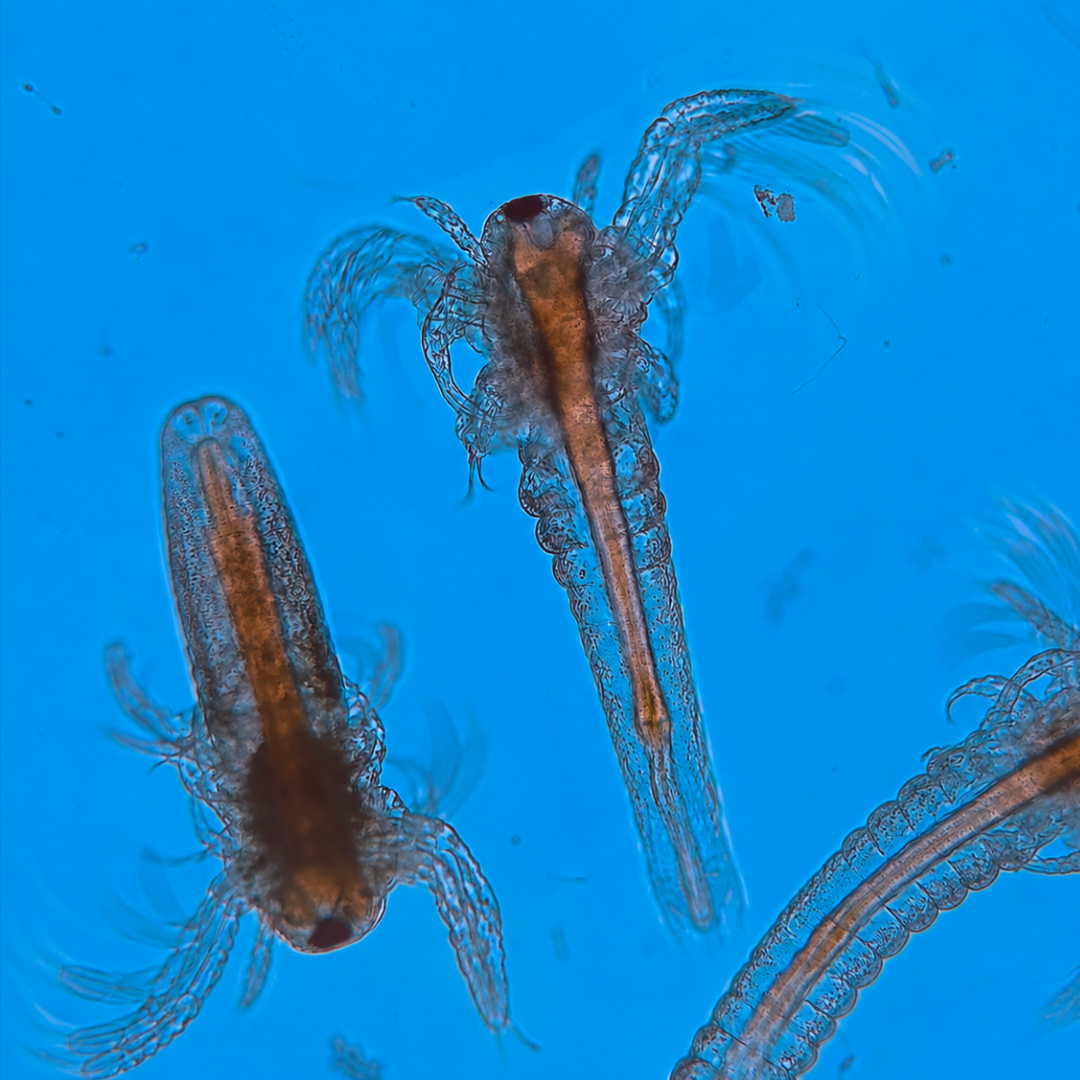
アルテミアは、一般にブラインシュリンプとも呼ばれる小型の甲殻類です。高塩分の塩湖や塩田、沿岸の塩水だまりなどに適応し、乾燥に強い耐久卵をつくることで知られています。アクアリウムでは、孵化直後のノープリウス幼生がメダカ、金魚、ベタ、熱帯魚、海産魚などの稚魚にとって扱いやすい初期餌料として利用されます。小さくよく動くため稚魚の摂餌反応を引き出しやすく、卵黄嚢を持つ孵化直後の幼生は、人工飼料にまだ慣れていない稚魚を育てるうえで頼りになる存在です。Artemia, commonly known as brine shrimp, are small crustaceans adapted to hypersaline lakes, salt ponds, and coastal brine pools. They are especially well known for producing drought-resistant dormant eggs, or cysts. In aquariums, newly hatched nauplii are widely used as practical first food for fry of medaka, goldfish, bettas, tropical fish, and marine fish. Their tiny size and active movement stimulate feeding responses, and the yolk-rich newly hatched nauplii are particularly useful for young fry that are not yet ready to accept prepared foods.
節足動物門 甲殻亜門 鰓脚綱 無甲目(ホウネンエビ目) ホウネンエビモドキ科(アルテミア科)Phylum Arthropoda, Subphylum Crustacea, Class Branchiopoda, Order Anostraca, Family Artemiidae
英名 / English Name
Brine shrimp
分布 / Distribution
世界各地の高塩分の内陸塩湖、塩田、沿岸の塩水だまりなど。観賞魚用・養殖用として日本で流通する耐久卵は、アメリカ、中国、ベトナムなど複数の産地に由来しますが、品質や幼生サイズは産地だけでなくロットにも左右されます。Hypersaline inland salt lakes, salt ponds, and coastal brine pools in many regions of the world. Cysts sold in Japan for aquarium and aquaculture use come from several origins, including the United States, China, and Vietnam. Hatch rate and nauplius size vary not only by origin but also by lot.
最大体長 / Max Size
成体で約1〜1.5cm。孵化直後のノープリウス幼生は産地やロットにより差がありますが、一般に数百µmほどです。Adults reach about 1 to 1.5 cm. Newly hatched nauplii vary by origin and lot, but are generally several hundred micrometers long.
寿命 / Lifespan
飼育環境が安定していれば数週間〜3ヶ月ほどが目安です。餌料として使う場合は、栄養価が高い孵化直後から数日以内に利用されることが多くなります。Under stable culture conditions, they generally live for several weeks to about three months. When used as live food, they are usually fed within the first few days after hatching, when their nutritional value is most useful for fry.
飼育環境 / Aquarium Environment
水槽サイズ / Tank Size
孵化だけなら500mL〜2L程度のペットボトル式ハッチャーや浅い皿で十分です。成体まで観察する場合は小型容器でも可能ですが、水量に余裕を持たせるなら30cm規格水槽程度が扱いやすくなります。水量が少ないほど水質と塩分濃度が変わりやすいため、初めて長期飼育する場合は少し余裕のある容器が安心です。For hatching only, a 500 mL to 2 L bottle-type hatcher or a shallow dish is sufficient. For observing them to adulthood, small containers can work, but a standard 30 cm tank provides more stable water volume and easier management. Smaller volumes change more quickly in water quality and salinity, so beginners will find a slightly larger container more forgiving.
水温 / Temperature
孵化をそろえたい場合は、おおむね26〜30℃、実用上は28℃前後が扱いやすい目安です。低温では孵化までの時間が延び、タイミングがばらつきやすくなります。成体の長期飼育ではより広い温度帯に耐えますが、急変を避けて安定させることが大切です。For even hatching, about 26 to 30°C is a useful range, with around 28°C being practical for most home setups. Lower temperatures slow hatching and make timing less uniform. Adults tolerate a wider temperature range, but stability and avoidance of sudden changes are more important than chasing a single number.
水質 / Water Quality
家庭での孵化では、塩分濃度2.5〜3.0%前後、pH 8.0〜8.5の弱アルカリ性を目安にします。FAO資料では孵化に適した塩分が系統ごとに異なり、一般的には15〜70g/Lの範囲にあるとされるため、製品説明がある場合はその条件を優先します。酸素要求量が高いので、エアレーション式では卵が底にたまらない程度に撹拌します。For home hatching, a salinity of about 2.5 to 3.0% and a weakly alkaline pH of 8.0 to 8.5 are practical targets. FAO material notes that optimal salinity is strain-specific and generally falls within 15 to 70 g/L, so product instructions should take priority when available. Oxygen demand is high, and aerated hatchers should keep cysts suspended without allowing them to settle on the bottom.
レイアウト / Layout
孵化容器は底砂や装飾を入れないベアタンク管理が基本です。幼生は光に集まりやすいため、孵化後は一方向から光を当てると回収しやすくなります。光は孵化開始の刺激にも関係しますが、詳細な生理的役割は完全には解明されていないため、強い直射日光ではなく、安定した室内照明や小型ライトを利用する程度で十分です。A bare container without substrate or decorations is best for hatching. Nauplii tend to gather toward light, so illuminating from one side after hatching makes harvesting easier. Light is also involved in triggering hatching, although its exact physiological role is not fully understood. Stable indoor lighting or a small lamp is usually enough; harsh direct sunlight is not needed.
注意点 / Precautions
耐久卵は乾燥には強い一方で、高温と湿気には弱く、開封後の結露や吸湿で孵化率が下がることがあります。小分けにして密閉し、冷蔵庫で保管すると扱いやすくなります。孵化後の殻や未孵化卵は稚魚の消化の負担になることがあるため、給餌前に幼生だけをできるだけ分離します。海外から生きた水産動物や孵化可能な卵を直接入手する場合は、対象や用途によって検疫・輸入許可が関係することがあるため、一般飼育では国内流通品を利用するのが安全です。Although cysts tolerate dryness, they are vulnerable to heat and moisture, and condensation or humidity after opening can reduce hatch rate. Dividing them into small sealed portions and storing them in a refrigerator makes them easier to manage. Empty shells and unhatched cysts may burden fry digestion, so separate nauplii as much as possible before feeding. When importing live aquatic animals or hatchable eggs directly from overseas, quarantine or import permission may apply depending on the item and purpose, so domestic retail products are the safer choice for ordinary aquarium use.
餌と給餌 / Feeding
餌の種類 / Diet
孵化直後の幼生は卵黄嚢の栄養でしばらく生きるため、稚魚への給餌用としては餌を与えず早めに使うのが基本です。成体まで育てる場合は、微細藻類、クロレラ、植物プランクトン、市販のアルテミア用フード、または水に溶いた少量のきな粉・小麦粉・パン酵母などを利用できます。Newly hatched nauplii live for a short time on their yolk reserves, so when used as fry food they are usually fed soon after hatching without additional feeding. For raising Artemia to adulthood, microalgae, chlorella, phytoplankton, commercial Artemia foods, or very small amounts of finely suspended soybean flour, wheat flour, or baker’s yeast can be used.
給餌のポイント / Feeding Tips
稚魚には食べ切れる量をこまめに与えます。淡水魚の稚魚に与える場合は、スポイトや茶こしで回収した幼生を淡水で軽くすすぎ、塩分の持ち込みを抑えます。海産魚の仔稚魚では、DHAやEPAなどの高度不飽和脂肪酸を補うため、孵化後の幼生に専用の栄養強化飼料を食べさせる二次培養が用いられます。家庭の淡水魚繁殖では、孵化直後の幼生を新鮮なうちに使うだけでも十分役立ちます。Feed fry small amounts that they can finish quickly. For freshwater fry, collect nauplii with a pipette or fine strainer and rinse them lightly in freshwater to reduce salt carryover. In marine larviculture, nauplii are often enriched after hatching with diets containing highly unsaturated fatty acids such as DHA and EPA. For most home freshwater breeding, freshly hatched nauplii used promptly are already very useful.
性格と混泳 / Temperament and Tank Mates
性格 / Temperament
攻撃性はなく、水中を泳ぎながら微細な餌をこし取って食べる穏やかな生き物です。群れで漂うように泳ぎ、成長につれて体の節や胸脚が見えるようになるため、観察対象としても楽しめます。Artemia are non-aggressive animals that swim through the water while filtering fine food particles. Their drifting group movement and the gradual appearance of body segments and swimming appendages make them enjoyable subjects for observation.
混泳の相性 / Compatibility
魚との混泳では、ほとんどの場合は餌として食べられます。長期飼育や観察を目的にする場合は、魚や大型の甲殻類とは分けて単独で管理します。高塩分環境を必要とするため、一般的な淡水魚水槽で同居させる生き物ではありません。With fish, Artemia will almost always be eaten as food. For long-term culture or observation, keep them separately from fish and larger crustaceans. Because they require saline water, they are not suitable tank mates for ordinary freshwater community aquariums.
病気と対策 / Diseases and Prevention
かかりやすい病気 / Common Diseases
観賞魚のように病名で管理されることは少なく、問題の多くは水質悪化、酸欠、過密、餌の与えすぎ、細菌の増殖に由来します。孵化率の低下は、卵の劣化、保管中の湿気、低温、pH不足、酸素不足、光量不足、または製品ロットの差で起こります。They are not usually managed by named diseases in the way ornamental fish are. Most problems come from poor water quality, oxygen deficiency, overcrowding, overfeeding, or bacterial growth. Poor hatch rates are often linked to degraded cysts, moisture during storage, low temperature, insufficient pH, lack of oxygen, inadequate light, or differences between product lots.
対策と予防 / Prevention
孵化容器は清潔に保ち、使用後はよく洗って乾燥させます。孵化時は適切な塩分、pH、水温、光、酸素をそろえ、古い卵や湿気を吸った卵の使用を避けます。長期飼育では過密を避け、少量給餌と部分換水を組み合わせて、水が腐敗しない状態を保ちます。家庭で薬品を使ってデカプセル化する場合は、残留塩素の中和や換気などの管理が必要になるため、不安がある場合は市販の殻無し製品を使う方が安全です。Keep hatching containers clean, wash them well after use, and dry them thoroughly. During hatching, provide suitable salinity, pH, temperature, light, and oxygen, and avoid old or moisture-damaged cysts. In long-term culture, prevent overcrowding and combine light feeding with partial water changes to keep the water from fouling. If using chemicals for decapsulation at home, neutralizing residual chlorine and ensuring good ventilation are necessary, so commercial shell-free products are safer when in doubt.
増やし方(繁殖) / Breeding
雌雄の判別 / Sexing
成体になると雄は頭部付近に発達した把握器を持ち、雌をつかんでペアになります。雌は腹部側に卵嚢を持つため、体が十分に成長すると比較的見分けやすくなります。Adult males develop clasping structures near the head and use them to hold females during pairing. Females have a brood pouch on the ventral side, making sexing relatively easy once they are mature.
繁殖形態 / Reproduction
環境が安定していると、雌は体内で胚を発生させ、泳げる幼生として産む卵胎生の形をとります。餌不足、酸素不足、塩分変化などの環境ストレスが強まると、発生を止めた耐久卵を産む卵生へ切り替わることがあります。流通品には種や系統の違いがあるため、繁殖のしやすさや耐久卵の出方は一様ではありません。Under stable conditions, females produce free-swimming larvae through an ovoviviparous mode. Under stronger environmental stress such as food shortage, low oxygen, or salinity changes, they may switch to oviparity and release dormant cysts with development arrested. Because commercial strains and species differ, ease of reproduction and cyst production are not always uniform.
繁殖のポイント / Breeding Tips
世代をつなげたい場合は、急激な水質変化を避け、微細な餌を少量ずつ与え、過密にならないようにします。耐久卵を得たい場合は環境ストレスが関係しますが、家庭飼育では無理に悪化させるよりも、成体を安定して維持し、交尾や幼生の成長を観察する方が失敗しにくくなります。To maintain generations, avoid sudden water quality changes, feed small amounts of fine food, and prevent overcrowding. Environmental stress is involved in cyst production, but in home culture it is usually more reliable to keep adults stable and observe pairing and larval growth rather than deliberately worsening conditions.
雑学と豆知識 / Trivia and Fun Facts
1. 乾いた卵が水で目覚める仕組み / 1. How dry cysts awaken in water
アルテミアの耐久卵は、発生を一時的に止めた休眠状態で長く保たれます。乾燥に耐える力には、トレハロースやストレス耐性に関わるタンパク質など、複数の仕組みが関係すると考えられています。水分を失った細胞では膜やタンパク質が傷みやすくなりますが、トレハロースは細胞内の構造を守る助けになるとされます。再び水に触れると代謝が動き出し、胚は蓄えられた成分を使いながら殻を破って孵化へ向かいます。Artemia cysts can remain for long periods with development paused in a dormant state. Their desiccation tolerance is thought to involve several mechanisms, including trehalose and stress-protective proteins. When cells lose water, membranes and proteins can be damaged, and trehalose is considered one of the molecules that helps stabilize cellular structures. Once rehydrated, metabolism resumes and the embryo uses stored resources as it breaks out of the cyst.
2. シーモンキーとして親しまれた生き物 / 2. A creature loved as Sea-Monkeys
アルテミアは研究や養殖の世界だけでなく、教育玩具としても広く知られてきました。日本ではテンヨーが1971年5月に「シーモンキー」を発売し、水を用意して卵を入れると小さな生き物が現れる体験が、多くの子どもたちに強い印象を残しました。目に見えないほど小さな耐久卵から命が動き出す様子は、休眠という生命現象を家庭で体感できる貴重な入口でもありました。Artemia are known not only in research and aquaculture, but also as educational pets. In Japan, Tenyo released Sea-Monkey in May 1971, and the experience of adding eggs to prepared water and watching tiny animals appear left a strong impression on many children. Seeing life begin from almost invisible cysts offered a memorable way to encounter the biological phenomenon of dormancy at home.
3. 宇宙実験にも使われた小さな甲殻類 / 3. A tiny crustacean used in space experiments
耐久卵の強さは宇宙生物学でも注目されました。NASAの記録には、ブラインシュリンプが微小重力下での発生を調べるモデルとして使われ、スペースシャトル・アトランティスのSTS-37およびSTS-43で軌道上実験が行われたことが記されています。宇宙放射線や微小重力の影響を調べるうえで、必要な時に発生を再開できる耐久卵は扱いやすいモデルになりました。The resilience of Artemia cysts also attracted attention in space biology. NASA records describe brine shrimp as a model for studying development under microgravity, with orbital experiments conducted aboard Space Shuttle Atlantis during STS-37 and STS-43. Because cysts can restart development when needed, they became a practical model for examining the effects of space radiation and microgravity.
4. 産地で変わるサイズと使い道 / 4. Origin affects size and use
ブラインシュリンプの耐久卵は、産地やロットによって孵化率、幼生サイズ、脂質組成が変わります。小さな幼生はベタやアピストグラマなど口の小さな稚魚に向き、大きめの幼生は摂餌力のある稚魚に使いやすくなります。海産魚の育成では、DHAやEPAなどの高度不飽和脂肪酸を補うため、孵化後の幼生に栄養強化飼料を食べさせる二次培養が行われます。Brine shrimp cysts differ by origin and lot in hatch rate, nauplius size, and lipid composition. Smaller nauplii suit tiny-mouthed fry such as bettas and Apistogramma, while larger nauplii are easier to use for fry with stronger feeding ability. In marine fish culture, nauplii are often enriched after hatching with diets containing highly unsaturated fatty acids such as DHA and EPA.
5. 殻を取り除くデカプセル化 / 5. Decapsulation removes the shell
孵化後に残る殻は、稚魚が誤って食べると消化の負担になることがあります。その対策として、次亜塩素酸ナトリウムなどで外殻を化学的に取り除くデカプセル化という方法があります。殻がない卵は分離がしやすく、表面の雑菌を減らせる利点もあります。ただし家庭で処理する場合は薬品管理が難しいため、市販の殻無しブラインシュリンプやデカプセル製品を利用する方が安全で扱いやすいです。Empty shells left after hatching can burden fry digestion if accidentally eaten. Decapsulation is a technique that chemically removes the outer shell, often using sodium hypochlorite. Shell-free cysts are easier to separate and can reduce surface bacteria. However, chemical handling can be difficult at home, so commercial decapsulated brine shrimp products are usually safer and easier to use.
まとめ / Conclusion
アルテミアは、乾いた耐久卵から水の中で一斉に泳ぎ出す、小さくても力強い生命力を持った甲殻類です。塩分、水温、pH、光、酸素を整えるひと手間によって、稚魚が追いかけやすい生きた餌を必要な時に用意できます。人工飼料にまだ慣れない小さな魚たちにとって、その動きと大きさは成長の最初の一歩を支える大切な刺激になります。Artemia are small crustaceans with remarkable resilience, emerging from dry cysts into clouds of swimming nauplii when conditions are right. With a little care in salinity, temperature, pH, light, and oxygen, they provide live food that fry can chase and eat at just the right time. For tiny fish not yet ready for prepared foods, their movement and size offer an important first stimulus for growth.
成体まで育てれば、ただの餌ではなく、塩水の中で泳ぎ、食べ、ペアをつくり、次の世代へつながる生き物としての姿も見えてきます。稚魚を育てる場面でも、生命の不思議を観察する場面でも、アルテミアは水槽の小さな命をそっと支えてくれる心強い存在です。When raised to adulthood, they reveal more than their role as food: they swim, feed, pair, and continue their life cycle in saline water. Whether used for raising fry or observing the wonder of dormant life awakening, Artemia remain reliable little partners that quietly support life in the aquarium.
WoRMS Editorial Board. Artemia Leach, 1819. World Register of Marine Species.
分類データベースを開く主に支える内容:学名、属名、分類上の位置づけ、Artemia spp. として扱う根拠。
OBIS. Artemia Leach, 1819. Ocean Biodiversity Information System.
分布・分類データを開く主に支える内容:世界的な分布、出現記録、分類データの補助確認。
Van Stappen, G. 1996. Introduction, biology and ecology of Artemia. In Lavens, P. & Sorgeloos, P. Manual on the Production and Use of Live Food for Aquaculture. FAO Fisheries Technical Paper No. 361.
FAO資料を開く主に支える内容:高塩分環境への適応、生息環境、食性、捕食者を避ける生態、卵胎生と耐久卵形成の切り替え。
Lavens, P. & Sorgeloos, P. 1996. Use of cysts. Manual on the Production and Use of Live Food for Aquaculture. FAO Fisheries Technical Paper No. 361.
FAO資料を開く主に支える内容:孵化条件、塩分・水温・pH・酸素・光、耐久卵の保管、デカプセル化、消毒、孵化率低下の注意点。
Sorgeloos, P., Dhert, P. & Candreva, P. 2001. Use of the brine shrimp, Artemia spp., in marine fish larviculture. Aquaculture, 200, 147-159.
論文PDFを開く主に支える内容:仔稚魚用初期餌料としての利用、栄養強化、デカプセル化、細菌負荷やVibrioなど衛生管理上の注意点。
Abatzopoulos, T. J., Beardmore, J. A., Clegg, J. S. & Sorgeloos, P. eds. 2002. Artemia: Basic and Applied Biology. Biology of Aquatic Organisms, Vol. 1. Springer.
Springerの書誌情報を開く主に支える内容:形態、生理、分類、分布、休眠、繁殖、極限環境への適応に関する総合的背景。
Gajardo, G. M. & Beardmore, J. A. 2012. The brine shrimp Artemia: adapted to critical life conditions. Frontiers in Physiology, 3:185.
DOIを開く主に支える内容:高塩分・低酸素などの過酷環境への適応、耐久卵、休眠、環境ストレスへの生理的応答。



 アイのアクアグッズ案内水槽のコケ掃除|道具の選び方とお掃除生体の得意・不得意道具の特徴や使い方、選ぶときのポイントをアイが紹介します。記事はコチラ →
 アイのアクアグッズ案内エンゼルフィッシュの飼育用品|高さのある水槽・ろ過・水草・餌の選び方道具の特徴や使い方、選ぶときのポイントをアイが紹介します。記事はコチラ →
 アイのアクアグッズ案内コリドラスのもふもふ時間を楽しむ|餌・底砂・お掃除用品の選び方コリドラスのもふもふする食事風景を楽しむために。沈む餌2種類の違い、口元に配慮した底砂、食べ残しを回収する道具を、アクアグッズナビゲーターのアイが紹介します。記事はコチラ →
 アイのアクアグッズ案内エーハイム、安いのと高いのは何が違う? コタロウと見比べる外部フィルター道具の特徴や使い方、選ぶときのポイントをアイが紹介します。記事はコチラ →




コメント