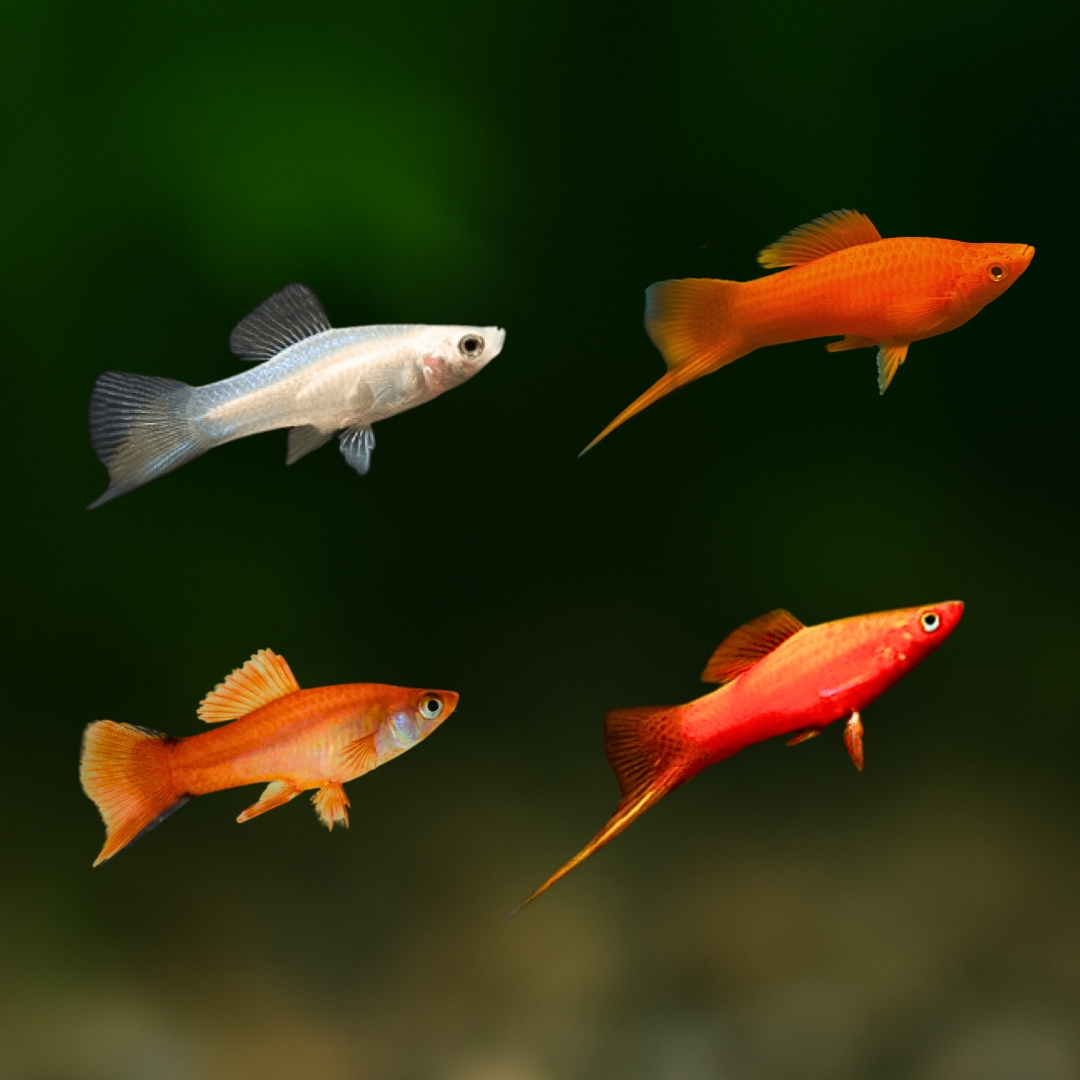
ソードテールは、成熟したオスの尾鰭下端が剣のように長く伸びることで知られる、メキシコ南部から中央アメリカにかけて原産する卵胎生魚です。日本でも古くから親しまれてきた代表的な熱帯魚で、丈夫で繁殖しやすく、赤、紅白、ブラック、ライヤーテールなど多彩な改良品種が流通しています。活発に泳ぐため水槽内での存在感が強く、適切な水質と広めの遊泳空間を用意すれば、初心者からベテランまで楽しめる魅力的な魚です。The swordtail is a livebearing fish native to southern Mexico and Central America, best known for the mature male’s elongated lower caudal fin that resembles a sword. It has long been a familiar tropical fish in Japan, valued for its hardiness, ease of breeding, and many cultivated varieties such as red, kohaku, black, and lyretail forms. Because it is an active swimmer with a strong presence in the aquarium, it can be enjoyed by beginners and experienced aquarists alike when given suitable water conditions and enough swimming space.
基本情報 / Basic Information
学名 / Scientific Name
Xiphophorus hellerii (Heckel, 1848)
通称 / Common Name
ソードテール、グリーンソードテール、赤ソード、紅白ソードテール、ブラックソードテールなどSwordtail, green swordtail, red swordtail, kohaku swordtail, black swordtail
分類 / Family
条鰭綱 カダヤシ目 カダヤシ科 キシフォフォルス属Class Actinopterygii, order Cyprinodontiformes, family Poeciliidae, genus Xiphophorus
英名 / English Name
Swordtail, Green Swordtail
分布 / Distribution
自然分布は、メキシコのベラクルス州ナウトラ川水系周辺から、中央アメリカを経てホンジュラス北西部にかけてとされます。流れのある河川や小川、水草の茂る水路、温暖な湧水、池などに見られ、淡水を中心に汽水環境にも耐性があります。Its native range is generally given as the area around the Nautla River system in Veracruz, Mexico, through parts of Central America to northwestern Honduras. It occurs in rivers, streams, vegetated canals, warm springs, and ponds, and although primarily freshwater, it can tolerate brackish conditions.
最大体長 / Max Size
文献上はオスで全長約14cm、メスで全長約16cmに達する記録があります。水槽内で一般に流通する個体は5〜7cm前後が多いものの、良好な環境ではより大きく成長します。Published records give a maximum total length of about 14 cm for males and about 16 cm for females. Aquarium specimens are often sold and kept at around 5 to 7 cm, but they can grow larger under good conditions.
寿命 / Lifespan
一般的には3〜5年程度が目安です。水質の安定、過密の回避、栄養バランスのよい給餌によって長期飼育が期待できます。Usually around 3 to 5 years. Stable water quality, avoiding overcrowding, and balanced feeding support a longer life.
飼育環境 / Aquarium Environment
水槽サイズ / Tank Size
ペアや少数飼育なら45cm規格水槽以上が目安ですが、活発に泳ぎ、オスがメスや他魚を追うことがあるため、複数飼育や混泳では60cm規格水槽、水量約60L以上を推奨します。大型化する系統や群れで楽しむ場合は、90cm規格水槽以上にすると安定しやすくなります。A standard 45 cm tank is a practical minimum for a pair or small group, but because swordtails are active swimmers and males may chase females or tank mates, a standard 60 cm tank of about 60 L or larger is recommended for groups or community setups. Large strains or larger groups are more stable in a standard 90 cm tank or larger.
水温 / Temperature
日常管理では22〜28℃前後を基本にし、繁殖や育成では24〜26℃前後が扱いやすい範囲です。短期的にはより広い温度に耐える報告もありますが、水槽では急変を避け、ヒーターで安定させることを優先します。For routine care, about 22 to 28°C is a good basic range, with 24 to 26°C being convenient for breeding and rearing. Reports indicate that the species can tolerate a wider range for limited periods, but in aquaria stability is more important than testing temperature limits.
水質 / Water Quality
中性から弱アルカリ性、pH 7.0〜8.0前後を好み、総硬度は中硬水寄り、目安としてdH 9〜19程度が適しています。日本の水道水は地域によって軟水傾向があるため、長期飼育ではサンゴ砂を少量ろ過槽に入れるなどして、pHの急降下を防ぎ、ミネラルを補うと安定しやすくなります。弱酸性でも短期的に飼える場合はありますが、長期管理では酸性に傾けすぎないことが大切です。Swordtails prefer neutral to slightly alkaline water, around pH 7.0 to 8.0, with moderate hardness, roughly dH 9 to 19 as a guide. Since tap water in many parts of Japan tends to be soft, adding a small amount of coral sand to the filter can help buffer pH and provide minerals. They may survive mildly acidic conditions for a time, but long-term care is safer when the water is not allowed to become too acidic.
レイアウト / Layout
前面から中央には遊泳スペースを確保し、後景や側面に水草を植えて隠れ場所を作るレイアウトが向いています。ウィローモス、マツモ、アナカリス、有茎草などを組み合わせると、追われた個体や稚魚の逃げ場になります。水草を強く食害する魚ではありませんが、植物質を好むため柔らかい新芽をつつくことがあります。A layout with open swimming space in the front and middle, plus plants along the back and sides, works well. Willow moss, hornwort, Egeria, and stem plants provide shelter for chased individuals and fry. Swordtails are not major plant destroyers, but they may peck at tender shoots because they appreciate vegetable matter.
注意点 / Precautions
オスは成熟するとメスを追い続けることがあるため、オス1匹に対してメス2〜3匹以上の比率にすると負担を分散できます。よく跳ねるためフタを用意し、過密飼育や水質悪化を避けます。また、繁殖力と環境適応力が高く、海外では定着例もあるため、飼育個体を野外へ放流してはいけません。Mature males may chase females persistently, so keeping one male with two or three or more females helps distribute stress. Use a lid because they may jump, and avoid overcrowding or deteriorating water quality. Because of their high reproductive ability and environmental tolerance, and because established introduced populations are known overseas, captive fish must never be released into the wild.
餌と給餌 / Feeding
餌の種類 / Diet
雑食性で、フレークフード、顆粒飼料、タブレットフードをよく食べます。自然下では水生昆虫、小型甲殻類、ミミズや線虫などの小動物、藻類、珪藻、水草片などを幅広く摂食します。飼育下では人工飼料を主食にし、スピルリナ配合飼料、冷凍アカムシ、ブラインシュリンプ、細かくした植物質の餌を補助的に与えるとよいでしょう。They are omnivorous and readily accept flakes, granules, and tablet foods. In nature they feed on aquatic insects, small crustaceans, worms, algae, diatoms, and plant fragments. In aquaria, use prepared foods as the staple and supplement with spirulina-based foods, frozen bloodworms, brine shrimp, and finely prepared vegetable matter.
給餌のポイント / Feeding Tips
一度に大量に与えるより、数分で食べきれる量を1日1〜2回に分けて与えます。食欲旺盛なため与えすぎると水質悪化や肥満につながります。植物質を含む餌を定期的に取り入れると腸内環境を整えやすく、赤系品種では発色維持にも役立ちます。稚魚にはブラインシュリンプの孵化幼生や、細かくすりつぶしたフレークフードが適します。Feed small portions that are consumed within a few minutes, once or twice daily, rather than giving a large amount at once. They have a strong appetite, so overfeeding can lead to poor water quality and obesity. Regular vegetable matter supports digestion and may help maintain coloration in red strains. Fry do well on newly hatched brine shrimp or finely crushed flake food.
性格と混泳 / Temperament and Tank Mates
性格 / Temperament
基本的には丈夫で活発な性格ですが、成熟したオスは繁殖行動が強くなり、メスや同程度の大きさの魚を追うことがあります。一部の改良品種では比較的温和とされることもありますが、系統差だけで判断せず、個体差、水槽サイズ、隠れ場所の有無を重視します。Swordtails are generally hardy and active, but mature males may show strong reproductive behavior and chase females or similarly sized fish. Some cultivated forms are often considered gentler, but temperament should not be judged by strain alone; individual variation, tank size, and the availability of cover are important.
混泳の相性 / Compatibility
プラティ、モーリー、グッピー、コリドラス、温和なテトラ類、ラスボラ類などとの混泳に向きます。ただし、ヒレの長い魚や非常におとなしい魚、小型すぎる魚は追われたり稚魚が捕食されたりすることがあります。ライヤーテールのオスは交尾器も伸長して通常交尾が難しくなる場合があるため、繁殖目的では通常鰭のオスや繁殖可能な系統を用いる必要があります。They are compatible with platies, mollies, guppies, Corydoras, peaceful tetras, and rasboras. However, very shy fish, very small fish, or long-finned species may be chased, and fry may be eaten. In lyretail males, the gonopodium may also elongate and make normal mating difficult, so breeding often requires a normal-finned male or a line known to remain fertile.
病気と対策 / Diseases and Prevention
かかりやすい病気 / Common Diseases
丈夫な魚ですが、輸入直後の疲労や水質悪化、酸性に傾いた水では、カラムナリス症、尾ぐされ病、口ぐされ病、白点病、肌荒れ、ヒレをたたむ不調が見られることがあります。ヒレが白く溶ける、口元が白濁する、体を底砂にこすりつける、水槽の隅でじっとするなどは早期発見のサインです。They are hardy fish, but after import stress, poor water quality, or overly acidic water, they may develop columnaris, fin rot, mouth rot, ich, skin irritation, or clamped fins. Early warning signs include whitening or melting fins, a cloudy mouth area, scratching against gravel, and remaining motionless in a corner.
対策と予防 / Prevention
予防の基本は、水質を中性から弱アルカリ性で安定させ、過密と餌の与えすぎを避け、定期的な換水を行うことです。新しく迎えた個体は可能であれば隔離観察し、輸入直後の痩せやヒレの傷を確認します。細菌性の症状が疑われる場合は、早期に隔離し、観賞魚用の抗菌剤による薬浴や塩水浴を検討します。薬剤の使用は製品説明に従い、水草やろ過バクテリアへの影響にも注意します。Prevention depends on stable neutral to slightly alkaline water, avoiding overcrowding and overfeeding, and performing regular water changes. New fish should be quarantined when possible and checked for thinness or fin damage. If bacterial symptoms are suspected, isolate the fish early and consider treatment with aquarium antibacterial medication or a salt bath. Follow product instructions and consider possible effects on plants and beneficial bacteria.
増やし方(繁殖) / Breeding
雌雄の判別 / Sexing
オスは臀鰭が棒状の交接器であるゴノポディウムに変化し、成熟すると尾鰭下端が剣状に伸びます。メスは臀鰭が扇形で、体がやや大きく、妊娠すると腹部後方に黒っぽい妊娠マークが見えることがあります。ただし、ソードテールには成熟の遅いオスが存在し、長くメスのように見えた個体が後からオスの特徴を現すことがあります。Males have an anal fin modified into a rod-like gonopodium, and mature males develop the characteristic sword on the lower caudal fin. Females have a fan-shaped anal fin, are often larger-bodied, and may show a dark gravid spot near the rear of the abdomen when pregnant. However, late-maturing males occur in swordtails, and individuals that long resemble females may later develop male traits.
繁殖形態 / Reproduction
卵胎生です。メスは体内で受精卵を保持し、孵化してすぐ泳げる稚魚を直接出産します。妊娠期間は水温や栄養状態により変わりますが、一般的には24〜30日前後、条件によってはそれ以上かかることもあります。大型のメスでは1回に20〜200匹ほどの稚魚を産むことがあります。They are livebearers. The female retains fertilized eggs internally and gives birth to free-swimming fry. Gestation varies with temperature and nutrition, but is commonly around 24 to 30 days and may be longer under some conditions. Large females may produce about 20 to 200 fry in one brood.
繁殖のポイント / Breeding Tips
親魚は稚魚を捕食するため、繁殖を狙う場合は産卵箱や隔離ケースを使うか、ウィローモスやマツモなどの細かい水草を多めに入れて逃げ場を作ります。出産が近いメスは腹部が大きくなり、底や水草の陰でじっとする、ガラス面を上下するなど落ち着かない行動を見せることがあります。生まれた稚魚は比較的大きく、ブラインシュリンプの孵化幼生や細かく砕いた人工飼料を初期から食べられます。Adults may eat fry, so use a breeding box or isolation case, or provide dense fine-leaved plants such as willow moss and hornwort. A female near birth becomes noticeably swollen and may rest near the bottom or among plants, or swim restlessly up and down the glass. Newborn fry are relatively large and can eat newly hatched brine shrimp or finely crushed prepared foods from the start.
雑学と豆知識 / Trivia and Fun Facts
1. 学名に込められた「剣を持つ者」 / 1. The “sword bearer” hidden in the scientific name
属名の Xiphophorus は、ギリシャ語で剣を意味する xiphos と、運ぶ・持つという意味の phoros に由来するとされます。つまり名前そのものが「剣を持つ者」を表しており、成熟したオスの尾鰭がまるで小さな剣のように伸びる姿をそのまま映した学名です。種小名 hellerii は採集者カール・バルトロメウス・ヘラーにちなむ献名で、文献や流通名では Xiphophorus helleri と i が1つの綴りも見かけますが、現在の標準的な学名表記では Xiphophorus hellerii が用いられます。The genus name Xiphophorus is derived from Greek words often interpreted as xiphos, meaning sword, and phoros, meaning bearer. In other words, the name itself means “sword bearer,” reflecting the mature male’s sword-like extension of the lower caudal fin. The species name hellerii honors the collector Karl Bartholomäus Heller. The spelling Xiphophorus helleri, with one i, is still often seen in literature and the aquarium trade, but the standard current spelling is Xiphophorus hellerii.
2. 日本の熱帯魚史に残る先駆者 / 2. A pioneer in the history of tropical fishkeeping in Japan
ソードテールは、日本の熱帯魚文化を語るうえで特別な位置にあります。国内の古い観賞魚文献では、1916年に秋山吉五郎によって輸入された魚として紹介されることがあり、これはグッピーの初期輸入記録よりも早い時期にあたるとされます。まだ熱帯魚という存在そのものが珍しかった大正時代、剣を持つオスと、卵ではなく泳げる稚魚を産む繁殖様式は、当時の愛好家に強い驚きを与えたはずです。現在では一般的な魚に見えるソードテールですが、日本の水槽文化の入口に立っていた魚のひとつといえます。The swordtail holds a special place in the history of tropical fishkeeping in Japan. Older Japanese aquarium literature sometimes presents it as a fish imported by Yoshigoro Akiyama in 1916, which is considered earlier than some early records for guppies. In the Taisho era, when tropical fish themselves were still unusual, a male with a sword and a fish that gave birth to swimming fry rather than laying eggs must have seemed remarkable. Although swordtails are familiar today, they can be regarded as one of the fish standing near the doorway of Japan’s aquarium culture.
3. 「性転換」の噂と成熟の遅いオス / 3. The sex-change legend and late-maturing males
ソードテールには、メスがオスに変わるという話が古くからあります。実際に、長い間メスのように見えていた個体の尾が後から伸び、オスらしい姿になることがあります。ただし、一般的な水槽飼育で見られる多くの例は、自然な完全性転換と断定するより、成熟が非常に遅いオスをメスと見誤ったものとして説明されることが多くなっています。研究では、オスの成熟時期やサイズが環境や社会的な手がかりに応じて変わり得ることも示されており、水槽の中で起きているのは、性成熟のタイミングに幅を持つソードテールならではの生理的なドラマといえます。Swordtails have long been associated with stories of females changing into males. Indeed, an individual that appears female for a long time may later grow a sword and take on male characteristics. However, many aquarium cases are now more cautiously explained as late-maturing males that were mistaken for females, rather than as confirmed complete natural sex change. Studies also indicate that the timing and size at male maturation can respond to environmental and social cues, making this a physiological drama of flexible maturation rather than a simple transformation story.
4. 観賞魚であり、生命科学のモデルでもある / 4. Both an aquarium fish and a model for life science
ソードテールの仲間は、観賞魚としてだけでなく、遺伝学や腫瘍研究の世界でも重要な役割を果たしてきました。近縁のプラティとの交雑で黒色腫が発生する現象は、がん遺伝子や制御遺伝子の働きを理解するための研究材料となりました。後に xmrk と呼ばれる遺伝子が関わることが明らかになり、小さな観賞魚の体内で起きる色素細胞の変化が、脊椎動物の病気や進化を考える手がかりになったのです。Relatives of the swordtail have played important roles not only as aquarium fish but also in genetics and tumor research. The occurrence of melanoma in hybrids with closely related platies became a valuable model for understanding oncogenes and regulatory genes. Later, a gene known as xmrk was identified as a key factor. Thus, changes in pigment cells within a small aquarium fish helped provide clues for thinking about disease and evolution in vertebrates.
5. 美しさの裏にある外来種リスク / 5. The invasive risk behind the beauty
ソードテールは丈夫でよく増えるため、飼育魚としては大きな魅力があります。しかし、その強さは野外に出たときには問題にもなります。高い繁殖力、雑食性、淡水から汽水まで利用できる環境耐性を持つため、世界各地で人為的な導入や観賞魚の放流に由来すると考えられる定着が報告されています。ヨーロッパでは温かい湧水由来の水域で繁殖個体群が確認された例もあり、冬でも水温が下がりにくい場所では熱帯魚が生き残る可能性が示唆されます。飼育者にとって大切なのは、美しい魚を最後まで責任を持って飼い、絶対に野外へ放さないことです。The swordtail’s hardiness and strong reproductive ability are major attractions in the aquarium. Yet the same strengths can become problems if the fish enters natural waters. Its high fecundity, omnivorous diet, and tolerance of freshwater to brackish conditions have led to established introduced populations in various regions, often linked to human-mediated introduction or aquarium release. In Europe, a breeding population has been confirmed in warm spring-fed waters, suggesting that tropical aquarium fish may survive where winter water temperatures remain high. For aquarists, the essential responsibility is to keep these beautiful fish to the end of their lives and never release them outdoors.
まとめ / Conclusion
ソードテールは、剣状に伸びるオスの尾鰭、卵胎生による繁殖、多彩な改良品種、そして日本の熱帯魚史における古い導入記録を持つ、見どころの多い観賞魚です。飼育では中性から弱アルカリ性の安定した水質、十分な遊泳スペース、メスを多めにした群れ作り、植物質を含むバランスのよい給餌がポイントになります。The swordtail is a highly rewarding aquarium fish, notable for the male’s sword-like caudal fin, livebearing reproduction, many cultivated varieties, and an early place in the history of tropical fishkeeping in Japan. Successful care depends on stable neutral to slightly alkaline water, adequate swimming space, a group structure with more females than males, and balanced feeding that includes vegetable matter.
丈夫で増えやすい一方、親魚による稚魚の捕食、オスの追尾行動、酸性に傾いた水や水質悪化による不調には注意が必要です。また、環境適応力が高い魚であるため、飼いきれなくなった個体を野外へ放すことは決して行ってはいけません。適切な管理と終生飼育の意識を持つことで、ソードテールの美しさと奥深い生態を長く楽しむことができます。Although hardy and prolific, swordtails require attention to fry predation by adults, persistent chasing by males, and health problems caused by overly acidic or deteriorating water. Because they are highly adaptable fish, unwanted individuals must never be released into the wild. With proper care and a commitment to lifelong responsibility, aquarists can enjoy both the beauty and the fascinating biology of swordtails for many years.
U.S. Geological Survey. Nonindigenous Aquatic Species Database. Green Swordtail, Xiphophorus hellerii Species Profile.
水草のある流れの速い河川、温暖な湧水、池、水路などの生息環境、および観賞魚放流・養殖施設逸出に由来する導入経路の整理に参照。https://nas.er.usgs.gov/queries/factsheet.aspx?SpeciesID=869
Maddern, M. G., Gill, H. S. & Morgan, D. L. 2011. Biology and invasive potential of the introduced swordtail Xiphophorus hellerii Heckel (Poeciliidae) in Western Australia. Aquatic Conservation: Marine and Freshwater Ecosystems.
西オーストラリアにおける定着個体群の生物学的特徴と侵略的外来種としての潜在性に参照。https://onlinelibrary.wiley.com/doi/10.1002/aqc.1186
Meyer, A., Morrissey, J. M. & Schartl, M. 1994. Recurrent origin of a sexually selected trait in Xiphophorus fishes inferred from a molecular phylogeny. Nature 368: 539–542.
オスの剣状尾鰭を性選択形質として扱う進化学的背景に参照。https://www.nature.com/articles/368539a0
Rosenthal, G. G. & Evans, C. S. 1998. Female preference for swords in Xiphophorus helleri reflects a bias for large apparent size. Proceedings of the National Academy of Sciences 95(8): 4431–4436.
メスが剣状尾鰭を持つオスを好む行動学的背景、ソードの性的シグナルとしての解釈に参照。https://www.pnas.org/doi/10.1073/pnas.95.8.4431
Walling, C. A., Royle, N. J., Lindström, J. & Metcalfe, N. B. 2007. Green swordtails alter their age at maturation in response to the population level of male ornamentation. Biology Letters 3(2): 144–146.
成熟時期の可塑性、いわゆる「遅発オス」や性成熟タイミングの説明に参照。https://pmc.ncbi.nlm.nih.gov/articles/PMC2375941/
Monroe, J. D., et al. 2021. Xmrks the Spot: Fish Models for Investigating Epidermal Growth Factor Receptor Signaling in Cancer. Cells 10(6): 1331.
キシフォフォルス属の黒色腫研究、Xmrk、EGFR系シグナル、腫瘍モデルとしての位置づけに参照。https://pmc.ncbi.nlm.nih.gov/articles/PMC8150686/
Du, K., et al. 2024. Phylogenomic analyses of all species of swordtail fishes (genus Xiphophorus) show that hybridization preceded speciation. Nature Communications.
キシフォフォルス属全体の系統ゲノム解析、ソード形質、交雑、xmrk関連の進化的背景に参照。https://www.nature.com/articles/s41467-024-50852-6



 アイのアクアグッズ案内水槽の中に波がある!? コタロウと探る、サンゴがゆらゆら揺れる秘密道具の特徴や使い方、選ぶときのポイントをアイが紹介します。記事はコチラ →
 アイのアクアグッズ案内カルキ抜き・水質調整剤の選び方|水換えと水槽の種類に合わせて選ぶ道具の特徴や使い方、選ぶときのポイントをアイが紹介します。記事はコチラ →



コメント