

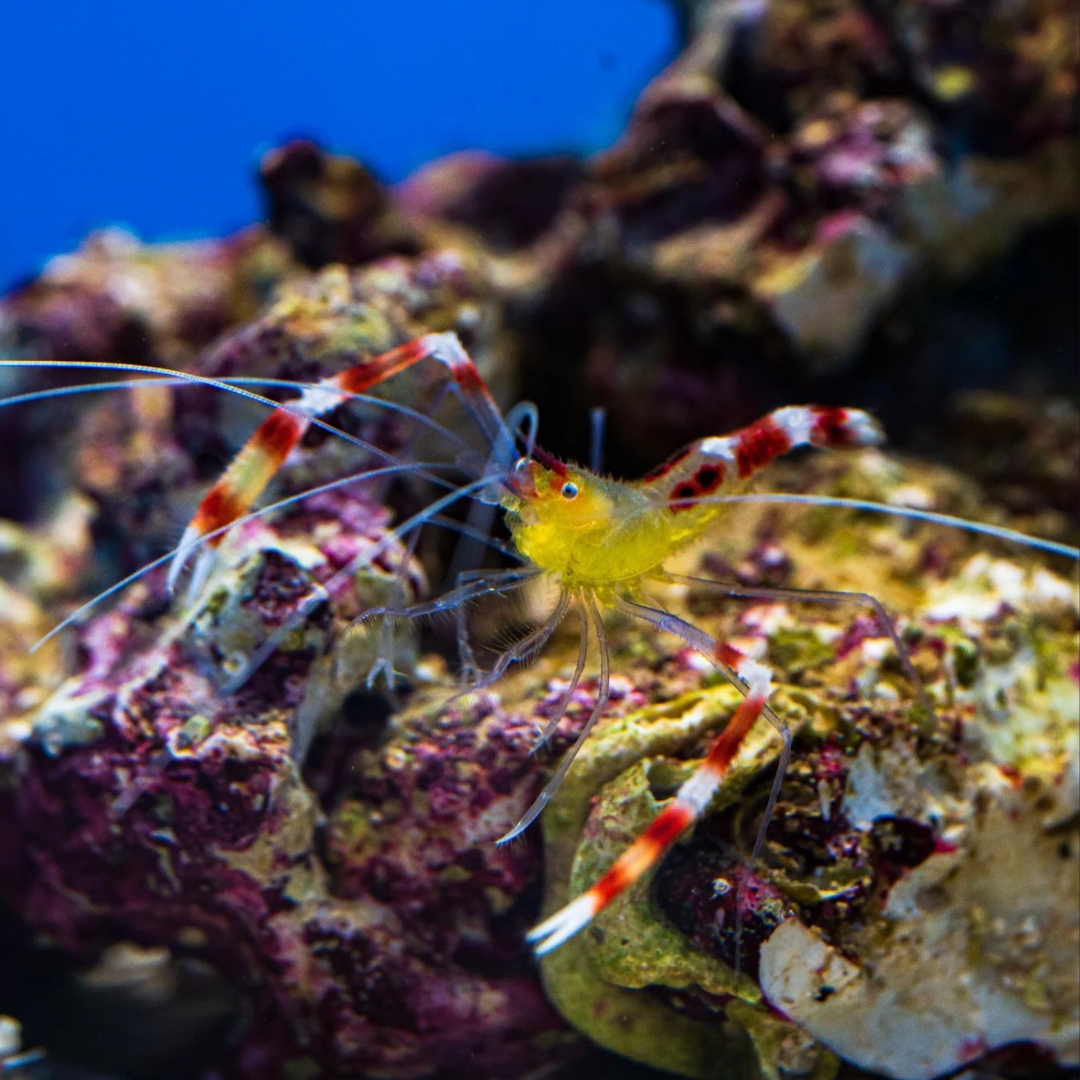
解説 / Description
キイロオトヒメエビは、黄色を基調とした体色と青紫色を帯びる脚部が印象的な、オトヒメエビ科の小型海水性甲殻類です。白く長い触角を岩陰から伸ばす姿や、大きく発達した第3歩脚を前に構える姿が魅力で、リーフタンクや小型海水水槽のアクセントとして扱われます。飼育そのものは特別に難しい種類ではありませんが、甲殻類らしく水温、比重、pHの急変に弱く、脱皮を安全に行える安定した環境と隠れ家が欠かせません。 Stenopus cyanoscelis is a small marine stenopodidean shrimp with a yellow body and bluish-purple leg accents. Its long white antennae and oversized third pair of claws make it an attractive accent animal for reef aquariums and small marine tanks. It is not exceptionally difficult to keep when conditions are stable, but like many crustaceans it is sensitive to sudden changes in temperature, salinity, and pH. Stable water quality and secure hiding places are essential for safe molting.
基本情報 / Basic Information
| 学名 / Scientific Name | Stenopus cyanoscelis Goy, 1984 |
|---|---|
| 通称 / Common Name | キイロオトヒメエビ、ブルーレッグボクサーシュリンプ、ゴールデンボクサーシュリンプBlue-leg boxer shrimp, golden boxer shrimp, blue-legged coral shrimp |
| 分類 / Family | 節足動物門、甲殻亜門、軟甲綱、十脚目、オトヒメエビ下目、オトヒメエビ科、オトヒメエビ属Phylum Arthropoda, Subphylum Crustacea, Class Malacostraca, Order Decapoda, Infraorder Stenopodidea, Family Stenopodidae, Genus Stenopus |
| 英名 / English Name | Blue-leg Boxer Shrimp / Golden Boxer Shrimp |
| 分布 / Distribution | インド太平洋の岩礁・サンゴ礁域に分布する海水性のエビです。岩の隙間など、身を隠せる場所を利用します。An Indo-Pacific marine shrimp associated with rocky and coral reef habitats, where it uses crevices and other sheltered spaces. |
| 最大体長 / Max Size | おおむね5〜6cm前後。ただし流通個体はこれより小さいサイズで入荷することが多いです。Roughly around 5 to 6 cm, although specimens in the aquarium trade are often smaller. |
| 寿命 / Lifespan | 飼育下では2〜3年程度が目安です。導入時の水合わせ、脱皮不全の予防、安定した水質管理によって大きく左右されます。In captivity, about 2 to 3 years is a practical guideline. Longevity depends strongly on acclimation, prevention of molting problems, and stable water quality. |
飼育環境 / Aquarium Environment
| 水槽サイズ / Tank Size | 小型種のため、単独または相性の確認できたペアなら45cm規格水槽前後から飼育候補になります。ただし水量が少ないほど水温と比重が変動しやすいため、初心者には60cm規格水槽以上の安定した海水水槽が安心です。Because this is a small species, a single shrimp or a confirmed compatible pair can be considered for aquariums around the 45 cm standard size. However, smaller tanks fluctuate more easily, so a 60 cm standard aquarium or larger is more forgiving for beginners. |
|---|---|
| 水温 / Temperature | 24〜27℃を目安に、急変を避けて管理します。高水温が続く夏場は酸欠や脱皮トラブルのリスクも上がるため、水槽用クーラーや室温管理を検討してください。 Keep the temperature around 24 to 27°C and avoid sudden changes. In hot summer conditions, low oxygen and molting problems become more likely, so room-temperature control or an aquarium chiller may be needed. |
| 水質 / Water Quality | 比重1.023〜1.025、pH8.0〜8.4前後を目安に、アンモニアと亜硝酸が検出されない安定した海水環境を維持します。カルシウム、マグネシウム、ヨウ素などは脱皮と外骨格形成に関わるため、添加剤を使う場合は測定しながら過剰添加を避けてください。Maintain stable marine water with a specific gravity around 1.023 to 1.025 and pH around 8.0 to 8.4, with no detectable ammonia or nitrite. Calcium, magnesium, and iodine are relevant to molting and exoskeleton formation; when using supplements, test the water and avoid overdosing. |
| レイアウト / Layout | ライブロックや枝状レイアウトで、体をすっぽり隠せる暗い隙間を複数作ります。脱皮直後は特に無防備なため、魚が簡単に入り込めない細いシェルターがあると安心です。開けた砂地だけの水槽には向きません。Provide live rock or branching structures with several dark crevices where the shrimp can hide completely. Narrow shelters that larger fish cannot enter are especially valuable immediately after molting. A bare open-sand layout is unsuitable. |
| 注意点 / Precautions | 導入時は水温と比重の急変を避け、点滴法で時間をかけて水合わせします。甲殻類は銅に弱いため、本種がいる水槽へ銅系の魚病薬を入れてはいけません。魚の治療は必ず別の治療水槽で行います。During introduction, avoid sudden changes in temperature and salinity; slow drip acclimation is recommended. Crustaceans are sensitive to copper, so copper-based fish medications must not be used in a tank containing this shrimp. Treat sick fish in a separate hospital tank. |
餌と給餌 / Feeding
| 餌の種類 / Diet | 肉食寄りの雑食性です。海水魚用の沈下性人工飼料、冷凍ブラインシュリンプ、冷凍コペポーダ、アサリやエビの細かな切り身などを食べます。魚の食べ残しも拾いますが、残餌に頼りすぎると栄養不足や水質悪化につながります。It is an omnivore with a carnivorous tendency. It accepts sinking marine pellets, frozen brine shrimp, frozen copepods, and finely chopped clam or shrimp. It will scavenge leftovers, but relying only on leftovers can lead to poor nutrition and water-quality problems. |
|---|---|
| 給餌のポイント / Feeding Tips | 混泳水槽では週に数回、様子を見ながら少量を追加します。単独飼育や痩せが見られる場合は、ピンセットやスポイトで隠れ家の近くに少量を届けると食べやすくなります。水を汚しやすい冷凍餌は、与えすぎないことが大切です。In a community marine tank, offer small supplemental feedings several times a week as needed. For a single-species tank or a thin individual, place a small amount near its shelter with tweezers or a pipette. Frozen foods can pollute the water, so avoid overfeeding. |
性格と混泳 / Temperament and Tank Mates
| 性格 / Temperament | 基本的には岩陰を好む臆病な面がありますが、テリトリー意識は強い種類です。大きなハサミは主に威嚇や同種間の争いに使われ、落ち着いた環境では隠れ家の入口で触角を伸ばす姿を観察できます。It tends to be shy and shelter-oriented, but it can be strongly territorial. The large claws are used mainly for display, defense, and disputes with other shrimps. In a calm aquarium it often rests at the entrance of a shelter with its antennae extended. |
|---|---|
| 混泳の相性 / Compatibility | 同種同士は、相性が確認されたペア以外では争う可能性が高いため避けます。小型エビ、ヤドカリ、ごく小さな底生魚は被害を受けるおそれがあります。一方で、モンガラカワハギ、大型ベラ、フグ、ハタなど甲殻類を食べる魚とは混泳できません。相手は、本種を食べず、夜間に底で無防備に眠らない中型以上の穏やかな海水魚が候補です。Do not keep multiple individuals together unless they are a confirmed compatible pair. Small shrimps, hermit crabs, and very small bottom-dwelling fish may be at risk. Conversely, triggerfish, large wrasses, puffers, groupers, and other crustacean-eating fishes may prey on this shrimp. Suitable tank mates are peaceful, larger marine fishes that neither eat shrimps nor sleep defenselessly on the bottom. |
病気と対策 / Diseases and Prevention
| かかりやすい病気 / Common Diseases | 魚の白点病のような病気よりも、水合わせ失敗、浸透圧ショック、脱皮不全、脱皮直後の捕食やストレスが主なトラブルです。古い殻から抜けきれない、脱皮後に体が柔らかいまま弱る、脚やハサミを失うといった問題が起こることがあります。The main problems are not fish diseases such as marine ich, but acclimation failure, osmotic shock, molting failure, and stress or predation immediately after molting. It may fail to emerge fully from the old shell, remain weak and soft after molting, or lose legs or claws. |
|---|---|
| 対策と予防 / Prevention | 急な比重変化を避け、安定したpHと水温を維持します。脱皮を支える水質要素は不足にも過剰にも注意し、定期的な換水と測定を基本にします。脱皮直後は触らず、隠れ家から無理に出さないでください。銅系薬剤は致命的になり得るため厳禁です。Avoid sudden salinity changes and maintain stable pH and temperature. Elements involved in molting should be neither deficient nor overdosed; regular water changes and testing are the safest foundation. Do not handle the shrimp or force it out of hiding after molting. Copper-based medication can be fatal and must be avoided. |
増やし方(繁殖) / Breeding
| 雌雄の判別 / Sexing | 一般に近縁のオトヒメエビ類ではメスがやや大きく、成熟したメスは腹部に卵を抱えることで確認できます。ただし小型個体や未抱卵個体の雌雄判別は簡単ではないため、販売時点でペアとして管理されている個体を選ぶのが現実的です。In related stenopodidean shrimps, females are often somewhat larger, and a mature female can be recognized when she carries eggs under the abdomen. However, sexing small or non-berried individuals is not easy, so selecting a pair already managed as a pair by a retailer is more practical. |
|---|---|
| 繁殖形態 / Reproduction | 雌雄ペアで交尾し、メスが腹部に卵を抱える抱卵型です。水槽内で抱卵まで見られることはありますが、孵化した幼生は非常に小さく、稚エビまで育てるには専用の幼生飼育設備と餌料管理が必要です。It reproduces through a male-female pair, with the female carrying eggs beneath the abdomen. Egg carrying may be observed in aquariums, but the larvae are very small and require dedicated larval-rearing equipment and careful live-food management to reach the juvenile stage. |
| 繁殖のポイント / Breeding Tips | 抱卵やふ化が見られても、そのまま観賞用水槽で幼生が育つとは限りません。Tsujiら(2015)の40日間の飼育実験では、幼生の成長段階によって適した餌が変わることが示され、初期にワムシを与え、途中からアルテミア幼生を導入する給餌方法が提案されました。これは初期幼生を育てる研究であり、家庭の水槽で容易に繁殖できるという意味ではありません。Egg carrying or hatching does not mean that larvae will survive in a display aquarium. A 40-day experiment by Tsuji and colleagues (2015) found that suitable prey changed as larvae developed, suggesting rotifers initially followed by the introduction of Artemia nauplii. The study concerns early larval rearing; it does not establish an easy home-breeding method. |
雑学と豆知識 / Trivia and Fun Facts
| 1. 「ボクサー」の名前は大きな第3歩脚から / 1. The “boxer” name comes from the oversized third legs | オトヒメエビ類の大きなハサミは、一般的なエビで目立つ第1歩脚ではなく、第3歩脚が発達したものです。前方に構える姿がボクシンググローブを思わせるため、英名ではボクサーシュリンプと呼ばれます。華やかな見た目に目を奪われがちですが、この体のつくりこそがオトヒメエビ類らしさを示す大きな特徴です。In stenopodidean shrimps, the conspicuous claws are formed by the third pair of walking legs rather than the first pair that often draws attention in many other shrimps. Their forward-facing stance resembles boxing gloves, which explains the name “boxer shrimp.” Beyond its color, this body plan is one of the clearest signs of its stenopodidean identity. |
|---|---|
| 2. 学名の「cyanoscelis」は青い脚を連想させる名前 / 2. “cyanoscelis” refers to bluish legs | 種小名のcyanoscelisは、青を意味する語と脚を意味する語に由来すると説明されることがあります。和名のキイロオトヒメエビは黄色い体色に注目した名前ですが、学名や英名では脚の青紫色が強調されます。同じ生き物でも、どの特徴を切り取るかで名前の印象が変わる好例です。The species epithet cyanoscelis is commonly explained as referring to bluish legs. The Japanese name emphasizes the yellow body, while the scientific and English names draw attention to the bluish-purple leg accents. It is a good example of how different names can highlight different visual features of the same animal. |
| 3. クリーナーとしての魅力はあるが、過度な期待は禁物 / 3. It is attractive as a cleaner, but expectations should be realistic | オトヒメエビ類は魚の体表に付く寄生虫や傷んだ組織をついばむクリーナーとして知られます。ただし、家庭水槽で魚病の治療役になるわけではありません。水槽内で見られるクリーニング行動は魅力的な観察ポイントですが、病気の予防や治療は水質管理、検疫、適切な治療水槽での対応が基本です。Stenopodidean shrimps are known as cleaners that may pick parasites or damaged tissue from fishes. However, they should not be treated as a cure for fish disease in home aquariums. Cleaning behavior is fascinating to observe, but disease prevention and treatment still depend on water quality, quarantine, and appropriate hospital-tank care. |
| 4. 美しさとは裏腹に、混泳には慎重さが必要 / 4. Despite its beauty, compatibility requires caution | 黄色い体と白い触角は繊細な印象を与えますが、テリトリーに入る小型甲殻類や小さな底生魚には強く出ることがあります。反対に、甲殻類を食べる魚にとっては本種自身が餌になります。キイロオトヒメエビを主役にするなら、同居相手を増やすより、岩陰と安定した水質を整えることを優先した方が長期飼育につながります。Its yellow body and white antennae give it a delicate appearance, but it can be assertive toward small crustaceans and tiny bottom-dwelling fishes that enter its territory. At the same time, it can become prey for fishes that naturally eat crustaceans. If this shrimp is the focus of the aquarium, prioritizing shelters and stable water quality over adding many tank mates is the better route to long-term success. |
| 5. 繁殖研究はサステナブルな流通への手がかり / 5. Breeding research points toward more sustainable availability | 本種の流通は野生採集個体に依存している部分が大きいと考えられるため、人工繁殖技術の進展には大きな意味があります。幼生の口器や遊泳能力に合った餌を段階的に与える発想は、単なる飼育テクニックではなく、観賞用海水生物をより持続的に楽しむための研究課題でもあります。Because availability is believed to rely heavily on wild-collected animals, progress in captive-breeding techniques is important. The idea of matching live foods to larval mouthpart development and swimming ability is not just a husbandry trick; it is part of a broader effort to make marine ornamental keeping more sustainable. |
まとめ / Conclusion
キイロオトヒメエビは、黄色と青紫色のコントラスト、白く長い触角、オトヒメエビ類らしい大きなハサミが魅力の小型海水エビです。飼育では、比重、水温、pHを急変させないこと、脱皮直後に身を守れる隠れ家を用意すること、銅系薬剤を水槽に入れないことが基本になります。 Stenopus cyanoscelis is a small marine shrimp valued for its yellow and bluish-purple contrast, long white antennae, and the oversized claws typical of stenopodidean shrimps. The basics of care are to avoid sudden changes in salinity, temperature, and pH, provide shelters for post-molt safety, and keep copper-based medications out of the aquarium.
一方で、同種や小型甲殻類への攻撃性、捕食魚に食べられるリスク、幼生飼育の難しさなど、見た目だけでは分かりにくい注意点もあります。安定したリーフタンクに、単独または相性の確認できたペアで迎えれば、岩陰から触角を伸ばす姿や独特の構えをじっくり楽しめる、個性的な観賞生物になるでしょう。 At the same time, its aggression toward conspecifics and small crustaceans, vulnerability to predatory fishes, and the difficulty of larval rearing are important cautions that are not obvious from its appearance. In a stable reef aquarium, kept singly or as a confirmed pair, it can become a distinctive display animal whose antenna-waving and boxer-like posture are rewarding to observe.

気になる道具や飼い方を見つけてみませんか?
 アイのアクアグッズ案内小型カラシンの群れを楽しむ|餌と水換えから考える飼育用品ガイド小型カラシンの群れを眺める時間を、もっと楽しく。泳ぐ余白、餌の食べ方、続けやすい水換えを軸に、日本で揃えやすい用品の選び方を紹介します。記事はコチラ →
 アイのアクアグッズ案内金魚を長く楽しむ飼育用品|水槽・フィルター・エアレーション・水換え道具の特徴や使い方、選ぶときのポイントをアイが紹介します。記事はコチラ →
さまざまな飼育テーマをご紹介。リンク先の記事には広告・商品紹介が含まれます。
案内・紹介記事一覧へ →参考文献・参照資料
この記事の分類、分布、生息環境、飼育条件、繁殖、病気や注意点を支えるために、学術論文、分類データベース、専門書、研究機関系資料を中心に選定しています。店舗・通販ページ、個人ブログ、まとめサイトは除外しました。
分類・学名・近縁種
- DecaNet eds. “Stenopus Latreille, 1819.” World Register of Marine Species. オトヒメエビ属の分類上の位置づけと受容名の確認に使用。
- DecaNet eds. “Stenopodidae Claus, 1872.” World Register of Marine Species. オトヒメエビ科が十脚目、オトヒメエビ下目に属することの確認に使用。
- Saito, T., Okuno, J. & Chan, T.-Y. 2009. “New species of Stenopus (Crustacea: Decapoda: Stenopodidae) from the Indo-West Pacific, with a redefinition of the genus.” The Raffles Bulletin of Zoology, Supplement 20: 109–120. オトヒメエビ属の再定義、近縁種との比較、属内分類の確認に使用。
- De Grave, S. & Fransen, C.H.J.M. 2011. “Carideorum catalogus: the recent species of the dendrobranchiate, stenopodidean, procarididean and caridean shrimps (Crustacea: Decapoda).” Zoologische Mededelingen, 85(9): 195–589. 十脚甲殻類カタログとして、学名・分類の補助確認に使用。
- Goy, J.W. 1984. “Stenopus cyanoscelis.” In Debelius, H. Armoured Knights of the Sea. Aquaprint. キイロオトヒメエビの原記載・命名に関する基礎資料として参照。
分布・生息環境・生態
- Saito, T., Okuno, J. & Chan, T.-Y. 2009. “New species of Stenopus (Crustacea: Decapoda: Stenopodidae) from the Indo-West Pacific, with a redefinition of the genus.” The Raffles Bulletin of Zoology, Supplement 20: 109–120. インド西太平洋産オトヒメエビ属の分布・形態比較の根拠として使用。
- Limbaugh, C., Pederson, H. & Chace, F.A. Jr. 1961. “Shrimps that clean fishes.” Bulletin of Marine Science of the Gulf and Caribbean, 11(2): 237–257. オトヒメエビ類を含むクリーナーシュリンプの生態的役割を説明するための古典的研究として参照。
- Becker, J.H.A., Curtis, L.M. & Grutter, A.S. 2005. “Cleaner shrimp use a rocking dance to advertise cleaning service to clients.” Current Biology, 15(8): 760–764. クリーナーシュリンプが魚に清掃行動を示す際のシグナル行動を説明する補助資料として使用。
- Johnson, V.R. Jr. 1977. “Individual recognition in the banded shrimp Stenopus hispidus (Olivier).” Animal Behaviour, 25: 418–428. 同属種の個体認識やペア関係、縄張り性を説明する際の比較資料として参照。
飼育条件・水質・薬剤への注意
- Calado, R. 2008. Marine Ornamental Shrimp: Biology, Aquaculture and Conservation. Wiley-Blackwell. 観賞用海水エビの飼育、水質管理、繁殖、保全を横断的に扱う専門書として、飼育条件の目安と注意点の基礎資料に使用。
- Spotte, S. 1992. Captive Seawater Fishes: Science and Technology. Wiley-Interscience. 海水水槽の水質、ろ過、塩分管理、閉鎖循環飼育の基礎資料として参照。
- Tullock, J.H. 1997. Natural Reef Aquariums: Simplified Approaches to Creating Living Saltwater Microcosms. Microcosm. リーフアクアリウムでの環境設計、ライブロック、隠れ家、混泳上の配慮を説明するための補助資料として使用。
- National Research Council. 2011. Guide for the Care and Use of Laboratory Animals, 8th ed. National Academies Press. 水生動物を含む飼育動物の環境安定性、薬剤・水質変化への配慮を記述する際の一般的な管理原則として参照。
- U.S. Environmental Protection Agency. “Aquatic Life Criteria – Copper.” 銅が水生生物に毒性を示し得ることを説明するため、銅系薬剤を無脊椎動物水槽で避ける注意喚起の補助資料として参照。
繁殖・幼生飼育
- Calado, R. 2008. Marine Ornamental Shrimp: Biology, Aquaculture and Conservation. Wiley-Blackwell. 海産観賞用エビの抱卵、幼生飼育、餌料系列、商業繁殖上の難しさを説明する基礎資料として使用。
- Tsuji, H., Zeng, C., Romano, N., Southgate, P.C. & Ye, H. (2015). Development of larval culture methods for blue-legged gold coral banded shrimp Stenopus cyanoscelis: effects of prey type and prey density. Fisheries Science 81:731–736. 初期幼生の餌の種類・密度を比較した40日間の実験。
- Hoff, F.H. 1996. Conditioning, Spawning and Rearing of Fish with Emphasis on Marine Clownfish. Aquaculture Consultants. 海産観賞生物の親個体管理、ワムシ・アルテミアを用いた初期餌料管理の一般的な補助資料として参照。
注記:キイロオトヒメエビ単独を対象にした飼育・病気・混泳の査読文献は多くありません。そのため、種固有の分類・繁殖研究と、同属種および海水観賞用エビ全般の信頼できる資料を組み合わせて、記事本文の根拠を構成しています。




コメント