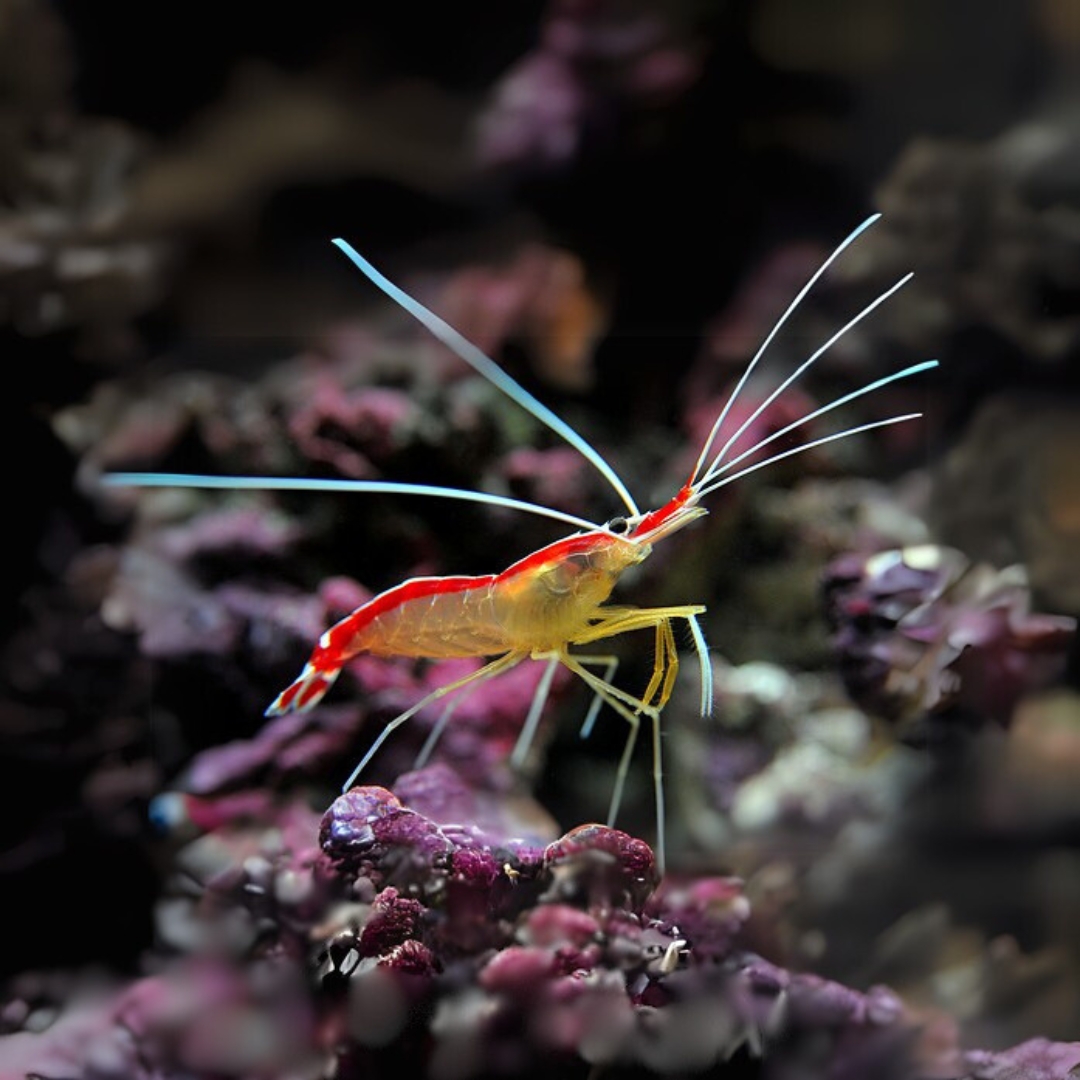
スカンクシュリンプは、海水アクアリウムで長く親しまれてきた代表的なクリーナーシュリンプです。半透明の淡い体に赤と白の縦線が走り、長く白い触角を振りながら魚に近づく姿は、見た目の美しさだけでなく、サンゴ礁で培われた共生行動そのものを水槽内で観察できる魅力があります。魚の体表や口まわりを掃除する行動で知られますが、白点病などの治療生体として過信するのではなく、安定した水質、慎重な水合わせ、銅系薬剤を避ける管理が長期飼育の基本になります。The skunk cleaner shrimp is one of the most familiar cleaner shrimps in marine aquariums. Its translucent pale body, red-and-white dorsal stripes, and long white antennae make it both beautiful and behaviorally fascinating, allowing aquarists to observe reef-style cleaning symbiosis at home. Although it may clean fish surfaces and mouth areas, it should not be treated as a cure for marine ich or other outbreaks. Long-term success depends on stable water quality, careful acclimation, and strict avoidance of copper-based medications.
紅海を含むインド太平洋の熱帯海域に広く分布します。日本のアクアリウム資料では日本南部近海を含めて扱われることがありますが、本文では主にインド太平洋産のクリーナーシュリンプとして紹介します。サンゴ礁や岩礁の洞窟、岩の隙間、オーバーハング下などに生息します。It is widely distributed in tropical Indo-Pacific waters, including the Red Sea. Japanese aquarium references may include waters around southern Japan, but this article treats it primarily as an Indo-Pacific cleaner shrimp. It inhabits reef and rocky areas, especially caves, crevices, and overhangs.
最大体長 / Max Size
おおむね5〜6cm前後。国内流通ではSサイズ約3〜4cm、Mサイズ約4〜5cmの個体がよく見られます。Usually around 5–6 cm. In Japanese aquarium trade, S-size individuals of about 3–4 cm and M-size individuals of about 4–5 cm are common.
寿命 / Lifespan
一般的には約2〜3年。水質が安定し、脱皮に必要なミネラルが保たれた環境では、それ以上の長期飼育も期待できます。Generally about 2–3 years. Longer maintenance may be possible in stable aquariums with suitable mineral balance for molting.
飼育環境 / Aquarium Environment
水槽サイズ / Tank Size
単独または少数なら30〜45cmクラスの小型海水水槽から飼育できますが、水質安定性を考えると60cm規格水槽以上が扱いやすいです。複数匹を入れる場合や魚のクリーニング行動を観察したい場合は、60cm規格水槽から90cm規格水槽以上を目安にすると安心です。A single or small number can be kept in small marine tanks of around 30–45 cm, but a standard 60 cm aquarium or larger is easier because water quality is more stable. For multiple individuals or for observing cleaning behavior with fish, a standard 60 cm to 90 cm aquarium or larger is recommended.
水温 / Temperature
24〜27℃を目安に管理します。22〜28℃程度までは許容されますが、急変に弱いため、夏はクーラー、冬はヒーターで安定させます。Maintain around 24–27°C. It may tolerate roughly 22–28°C, but sudden changes are risky, so use a chiller in summer and a heater in winter when needed.
水質 / Water Quality
比重1.023〜1.025、塩分33〜35ppt前後、pH8.0〜8.3を目安にします。幼生飼育などの専門的な条件では33〜37ppt程度が示されることもありますが、一般的なリーフタンクでは急変を避けることが最優先です。新規導入時は点滴法で時間をかけて水合わせを行い、アンモニア、亜硝酸が検出される不安定な水槽には導入しないでください。Aim for a specific gravity of 1.023–1.025, salinity around 33–35 ppt, and pH 8.0–8.3. More specialized larval-rearing conditions may cite about 33–37 ppt, but in a typical reef aquarium avoiding sudden changes is the priority. Use drip acclimation during introduction and do not add it to unstable aquariums where ammonia or nitrite is detectable.
レイアウト / Layout
ライブロックや岩組みで隠れ家を作り、脱皮直後に落ち着ける暗がりや隙間を確保します。水槽内では定位置にとどまり、触角を振って魚を誘うようなクリーニングステーションを形成することがあります。サンゴ水槽にも向きますが、サンゴに与えた餌を奪うことがあるため、給餌時の観察が大切です。Provide live rock or rockwork with secure caves and shaded crevices, especially for resting after molts. In aquariums, it may occupy a fixed area and form a cleaning station where it waves its antennae to attract fish. It is generally suitable for reef tanks, but it may steal food from corals, so feeding should be monitored.
注意点 / Precautions
銅イオンを含む薬剤や多くの魚病薬に非常に弱いため、本種がいる本水槽で薬浴を行ってはいけません。白点病などの治療が必要な魚は、別の治療水槽へ隔離します。また、脱皮不全を防ぐため、急な比重変化を避け、定期的な水換えでカルシウム、マグネシウム、ヨウ素などの微量元素が極端に不足しないよう管理します。添加剤は過剰投与せず、測定値を見ながら控えめに使います。It is highly sensitive to copper ions and many fish medications, so medicating the display tank is unsafe. Fish requiring treatment for marine ich or other diseases should be moved to a separate hospital tank. To reduce failed molts, avoid abrupt salinity changes and maintain calcium, magnesium, iodine, and other trace elements through regular water changes. Use supplements conservatively and according to test results.
餌と給餌 / Feeding
餌の種類 / Diet
人工飼料、冷凍ブラインシュリンプ、イサザアミ、細かくしたエビやイカ、乾燥クリルなどを食べます。野生下では魚の体表や口中、エラ周辺の寄生虫、粘液、傷んだ組織などを食べるクリーナーとして知られますが、水槽内では通常の甲殻類向けの雑食性給餌で維持できます。It accepts prepared foods, frozen brine shrimp, mysids, finely chopped shrimp or squid, and dried krill. In the wild it is known for eating parasites, mucus, and damaged tissue from fish surfaces, mouths, and gill areas, but in aquariums it can be maintained on a varied omnivorous diet suitable for marine crustaceans.
給餌のポイント / Feeding Tips
魚の餌を拾うだけでも生きられることはありますが、痩せを防ぐために小さな沈下性の餌を直接届く場所へ与えると安心です。サンゴへ給餌する前に本種へ少量の餌を与えておくと、サンゴの口から餌を奪う行動を抑えやすくなります。水を汚さないよう、短時間で食べ切れる量にします。It may survive by scavenging fish food, but direct feeding with small sinking foods helps prevent weight loss. Feeding the shrimp a small portion before target-feeding corals can reduce food-stealing from coral mouths. Offer only what it can consume quickly to avoid polluting the water.
性格と混泳 / Temperament and Tank Mates
性格 / Temperament
温和で、健康な魚を積極的に襲うことはほとんどありません。人にも慣れやすく、手やピンセットから餌を受け取ることもあります。大型魚や捕食性魚が近づくと、白い脚を動かして自分がクリーナーであることを示すような行動をとることがあります。It is peaceful and rarely attacks healthy fish. It often becomes bold in captivity and may take food from fingers or tweezers. When large or predatory fish approach, it may perform conspicuous leg movements that function as cleaner signals.
混泳の相性 / Compatibility
小型から中型の温和な海水魚、リーフタンクの多くの無脊椎動物と相性がよいです。ただし、モンガラカワハギ類、フグ類、大型ベラ類、捕食性の強いハタ類など、甲殻類を食べる魚とは危険です。複数飼育は可能ですが、狭い水槽では脱皮直後の弱い個体がストレスを受けないよう、隠れ家を十分に用意します。It is compatible with many peaceful small to medium marine fish and many reef-tank invertebrates. However, it is at risk with crustacean-eating fish such as triggerfish, puffers, large wrasses, and strongly predatory groupers. Multiple individuals can be kept, but provide enough shelters so freshly molted shrimp are not stressed in confined tanks.
病気と対策 / Diseases and Prevention
かかりやすい病気 / Common Diseases
魚のような白点病にかかる生体ではありませんが、急な水質変化によるショック、脱皮不全、輸送ストレス、銅や薬剤による中毒が大きなリスクになります。脱皮直後は殻が柔らかく、隠れられない環境では他の生体からの干渉を受けやすくなります。It does not contract marine ich in the same way fish do, but major risks include shock from sudden water-quality changes, failed molts, shipping stress, and poisoning from copper or medications. Immediately after molting, its shell is soft and it is vulnerable if it cannot hide.
対策と予防 / Prevention
導入時は温度合わせだけで済ませず、点滴法で比重とpHの差をゆっくり縮めます。水換えを定期的に行い、カルシウムやヨウ素などの微量元素を保ちます。魚病薬を使う場合は必ず病魚を別水槽へ移し、本水槽には銅系薬剤を入れないことが最重要です。During introduction, do not rely only on temperature matching; use drip acclimation to gradually equalize salinity and pH. Perform regular water changes and maintain trace elements such as calcium and iodine. If fish medications are needed, move the sick fish to a separate hospital tank and never add copper-based medication to the display tank.
増やし方(繁殖) / Breeding
雌雄の判別 / Sexing
本種は雄性先熟の同時的雌雄同体として知られ、若い時期はまず雄として成熟し、その後、雄としての機能を保ちながら雌としても抱卵できる段階へ移行します。そのため、一般的な魚のように外見だけで固定的なオスとメスを見分ける考え方は当てはまりにくいです。This species is known as a protandric simultaneous hermaphrodite. It first matures as a male, then later gains female reproductive function while retaining male function. Therefore, the usual idea of identifying fixed males and females by appearance does not apply well.
繁殖形態 / Reproduction
成熟した2匹がそろうと、互いに精子を交換し、どちらの個体も腹肢に有精卵を抱えることがあります。抱卵周期はおおむね2〜3週間で、卵は最初は緑色を帯び、発生が進むと褐色から透明感のある色へ変わり、夜間にゾエア幼生として放出されます。When two mature individuals are present, they can exchange sperm, and either individual may carry fertilized eggs under the abdomen. Brooding usually follows a cycle of about 2–3 weeks. Eggs begin greenish, become brownish to more translucent as they develop, and larvae are released at night as zoeae.
繁殖のポイント / Breeding Tips
抱卵までは水槽内でも比較的よく見られますが、稚エビまで育てる難易度は非常に高いです。幼生期間が約5〜6か月と長く、ワムシ、栄養強化アルテミア、細かな配合餌などを成長段階に合わせて切り替える必要があります。幼生は水流や汚れに弱いため、専用の育成容器、微弱な循環水流、こまめな底掃除、安定した水質管理が不可欠です。Egg carrying is relatively common in aquariums, but raising larvae to juveniles is very difficult. The larval period can last about 5–6 months, requiring stage-appropriate foods such as rotifers, enriched Artemia, and finely prepared diets. Larvae are sensitive to turbulence and fouling, so dedicated rearing chambers, gentle circulation, frequent bottom cleaning, and stable water quality are essential.
雑学と豆知識 / Trivia and Fun Facts
1. 名前の由来はアンボン島 / 1. Named after Ambon Island
学名の種小名 amboinensis は、インドネシアのアンボン島、古い表記ではアンボイナに由来します。初期の文献では Hippolysmata vittata var. amboinensis として扱われた記録があり、現在は Lysmata amboinensis として整理されています。小さなエビの名前の中にも、19世紀の標本採集と分類学の歴史が残されています。The species name amboinensis comes from Ambon Island in Indonesia, historically called Amboina. Early literature treated it as Hippolysmata vittata var. amboinensis, while current usage recognizes it as Lysmata amboinensis. Even its name preserves a piece of nineteenth-century collecting and taxonomic history.
2. 大西洋のそっくりさんとの見分け方 / 2. How to tell it from its Atlantic look-alike
大西洋にはよく似た Lysmata grabhami がいます。両種は赤と白の背中の線、長い白い触角などがよく似ていますが、スカンクシュリンプでは背中の白線が尾の手前で途切れ、尾肢に白い斑点が入る点が識別の手がかりになります。見た目のわずかな違いに加え、分子系統解析でも別種として扱われています。The Atlantic species Lysmata grabhami looks very similar, sharing red-and-white dorsal stripes and long white antennae. In the skunk cleaner shrimp, however, the white dorsal stripe is interrupted near the tail, and the tail fan bears white spots. Along with these stable color-pattern differences, molecular studies support treating them as separate species.
3. クリーナーであることを魚に知らせるサイン / 3. Signals that advertise its cleaner role
サンゴ礁では、白い触角を振る行動が魚への看板のように働きます。魚が鰭を広げたり鰓蓋を開いたりして静止すると、エビは体表や口まわりへ乗り移って掃除を始めます。捕食者になり得る魚に対しては、白い脚を揺らすレッグ・ロッキングのような行動をより目立たせ、自分が餌ではなく掃除役であることを伝えていると考えられています。On reefs, the white antennae work like a visual signboard for fish. When a client fish pauses, spreads its fins, or opens its gill covers, the shrimp moves onto the body or mouth area and begins cleaning. Toward potential predators, it may emphasize conspicuous leg-rocking movements, signaling that it is a cleaner rather than prey.
4. 白点病の治療役としては過信しない / 4. Do not overestimate it as a disease cure
スカンクシュリンプは魚の体表を掃除し、寄生虫対策の一助になる可能性があります。また、単生類の卵や幼生を食べる研究報告もあります。ただし、海水白点病の爆発的な発生を単独で治す生体ではありません。病気の予防は安定した水質、検疫、適切な給餌が基本であり、発症した魚には隔離水槽での治療が必要になります。水槽の人気者である一方、医者そのものではなく、健康管理を支える補助役として考えるのが現実的です。The skunk cleaner shrimp may help by cleaning fish surfaces and may contribute to parasite management. Studies also report that it can consume eggs and larvae of some monogenean parasites. However, it cannot cure a serious marine ich outbreak by itself. Prevention should rely on stable water quality, quarantine, and proper feeding, while infected fish require treatment in a separate hospital tank. It is a beloved aquarium helper, not a complete substitute for medical management.
5. 抱卵は見られても、稚エビまで育てるのは別世界 / 5. Egg carrying is common; raising juveniles is another challenge
成熟した2匹を飼うと、腹部に緑色の卵を抱える姿を見られることがあります。しかし、孵化した幼生はすぐに親と同じ姿になるわけではなく、長いプランクトン生活を送ります。飼育下では成体に近い姿へ進むまで約6か月前後かかるとされ、数か月にわたる餌の切り替え、水質維持、微弱な水流設計が必要です。繁殖は海水甲殻類飼育の中でも高度な挑戦といえます。Keeping two mature individuals may lead to the sight of green eggs carried under the abdomen. However, the larvae do not immediately become miniature adults; they undergo a long planktonic period. In captivity, development toward the adult-like form is often described as taking roughly six months, requiring months of careful feeding transitions, water-quality control, and gentle circulation. Breeding is one of the more advanced challenges in marine crustacean husbandry.
まとめ / Conclusion
スカンクシュリンプは、美しい色彩、魚を掃除する共生行動、人に慣れやすい性格を兼ね備えた、海水アクアリウムを象徴する甲殻類です。水温24〜27℃、比重1.023〜1.025、pH8.0前後の安定した環境を維持し、導入時の点滴水合わせと薬剤への注意を徹底すれば、初心者にも比較的扱いやすい生体といえます。The skunk cleaner shrimp is an iconic marine aquarium crustacean, combining vivid coloration, cleaning symbiosis, and a bold, approachable personality. With stable conditions around 24–27°C, specific gravity 1.023–1.025, and pH around 8.0, plus careful drip acclimation and strict medication caution, it is relatively manageable even for developing marine aquarists.
一方で、白点病を完全に治す生体として過信したり、銅系薬剤を本水槽へ入れたりすると大きな失敗につながります。脱皮のための隠れ家と微量元素を整え、相性のよい魚と組み合わせれば、長い白い触角を揺らすクリーニングステーションの主役として、水槽に生き生きとした物語を加えてくれるでしょう。At the same time, overreliance on it as a cure for marine ich or adding copper-based medication to the display tank can lead to serious losses. Provide shelters and trace elements for safe molting, choose compatible tank mates, and this shrimp can become the centerpiece of a living cleaning station, adding both function and story to the aquarium.
De Grave, S. and Fransen, C.H.J.M. (2011). Carideorum catalogus: the recent species of the Dendrobranchiate, Stenopodidean, Procarididean and Caridean Shrimps (Crustacea: Decapoda). Zoologische Mededelingen, 85(9), 195-589.
用途:スカンクシュリンプの現在の学名、シノニム、十脚目・コエビ下目における分類整理を確認する基礎資料。 資料ページ
WoRMS Editorial Board. World Register of Marine Species: Lysmata amboinensis (de Man, 1888).
用途:有効学名、命名者、分類階級、海産生物としての登録状況を確認するための国際的データベース。 WoRMS taxon record
De Man, J.G. (1888). Bericht über die von Herrn Dr. J. Brock im indischen Archipel gesammelten Decapoden und Stomatopoden. Archiv für Naturgeschichte, 53(2), 215-600.
用途:本種の原記載およびタイプ産地に関する歴史的背景を確認するための古典的分類文献。
分布・生息環境・クリーニング行動
World Association of Zoos and Aquariums. Pacific Cleaner Shrimp (Lysmata amboinensis).
用途:紅海を含むインド太平洋のサンゴ礁域に生息すること、クリーナーシュリンプとしての基本生態、一般的な体サイズや水族館展示向けの基礎情報を確認する資料。 WAZA species page
Becker, J.H.A. and Grutter, A.S. (2004). Cleaner shrimp do clean. Coral Reefs, 23, 515-520.
用途:クリーニングステーションや魚類との相利共生行動を支える実証研究として参照。 DOI: 10.1007/s00338-004-0429-3
Caves, E.M., Frank, T.M. and Johnsen, S. (2016). Spectral sensitivity, spatial resolution and temporal resolution and their implications for conspecific signalling in cleaner shrimp. The Journal of Experimental Biology, 219, 597-608.
用途:長い白色触角や体色パターンなど、視覚シグナルに関わる生理的背景を確認する資料。 DOI: 10.1242/jeb.122275
繁殖・性決定・幼生育成
Bauer, R.T. (2000). Simultaneous hermaphroditism in caridean shrimps: a unique and puzzling sexual system in the Decapoda. Journal of Crustacean Biology, 20, 116-128.
用途:ヒカリモエビ属に特徴的な雄性先熟同時的雌雄同体を理解するための総説的資料。 DOI: 10.1163/1937240X-90000014
Zhang, D., Rhyne, A.L. and Lin, J. (2007). Density-dependent effect on reproductive behaviour of Lysmata amboinensis and L. boggessi (Decapoda: Caridea: Hippolytidae). Journal of the Marine Biological Association of the United Kingdom, 87(2), 517-522.
用途:ペア形成、脱皮と交尾、抱卵周期など、飼育下で観察される繁殖行動を確認する資料。 DOI: 10.1017/S0025315407053581
Wong, J.W.Y. and Michiels, N.K. (2011). Control of social monogamy through aggression in a hermaphroditic shrimp. Frontiers in Zoology, 8, 30.
用途:複数飼育時の個体間関係、ペア維持、攻撃性に関する注意点を理解するための資料。 DOI: 10.1186/1742-9994-8-30
Tziouveli, V. (2011). Broodstock conditioning and larval rearing of the marine ornamental white-striped cleaner shrimp, Lysmata amboinensis (de Man, 1888). PhD thesis, James Cook University.
用途:成熟サイズ、抱卵、幼生期間、親エビの栄養管理、HUFA強化、初期餌料、幼生育成の難しさを確認する中核資料。 James Cook University ResearchOnline
病気・寄生虫対策・薬剤への注意
Vaughan, D.B., Grutter, A.S. and Hutson, K.S. (2018). Cleaner shrimp are a sustainable option to treat parasitic disease in farmed fish. Scientific Reports, 8, 13959.
用途:Lysmata amboinensis を含むクリーナーシュリンプが魚類寄生虫や環境中の生活史段階を減らす可能性を示す研究。ただし、水槽内の白点病を完全治療できるという根拠ではなく、補助的・予防的な生物的コントロールの参考として扱う。 DOI: 10.1038/s41598-018-32293-6
Vaughan, D.B., Grutter, A.S., Ferguson, H.W., Jones, R. and Hutson, K.S. (2018). Cleaner shrimp are true cleaners of injured fish. Marine Biology, 165, 118.
用途:傷ついた魚に対するクリーニング行動と、その生態的意味を確認する資料。 DOI: 10.1007/s00227-018-3379-y
U.S. Environmental Protection Agency. National Recommended Water Quality Criteria – Aquatic Life Criteria Table.
用途:銅などの金属類が水生生物へ影響し得ることを確認する公的資料。甲殻類を含む無脊椎動物のいる水槽で銅系薬剤を安易に使わない、という注意喚起の補助資料として参照。 EPA Aquatic Life Criteria
飼育・保全・観賞用海産生物の背景
Calado, R. (2008). Marine Ornamental Shrimp: Biology, Aquaculture and Conservation. Wiley-Blackwell.
用途:観賞用海産エビの飼育、生理、繁殖、養殖、保全上の課題を横断的に確認する専門書。
Taylor, M., Green, E. and Razak, T. (2003). From Ocean to Aquarium: The Global Trade in Marine Ornamental Species. UNEP World Conservation Monitoring Centre.
用途:海産観賞生物の採集・輸送・取引がサンゴ礁生態系と関わる背景を確認する国際機関系資料。個別店舗の価格情報ではなく、保全と流通背景の理解に用いる。 UNEP report page



 アイのアクアグッズ案内水槽ライトの選び方|魚の見え方・水草・海水で選ぶおすすめ照明道具の特徴や使い方、選ぶときのポイントをアイが紹介します。記事はコチラ →
 アイのアクアグッズ案内ベタの一匹飼いを楽しむ|水槽・ヒーター・ふた・フィルターの選び方ベタの一匹飼いに向く水槽容量、ふたと空気層、ヒーターと水温計、弱い水流のフィルターを、コタロウとアイの会話で分かりやすく解説します。記事はコチラ →



コメント