

解説 / Description
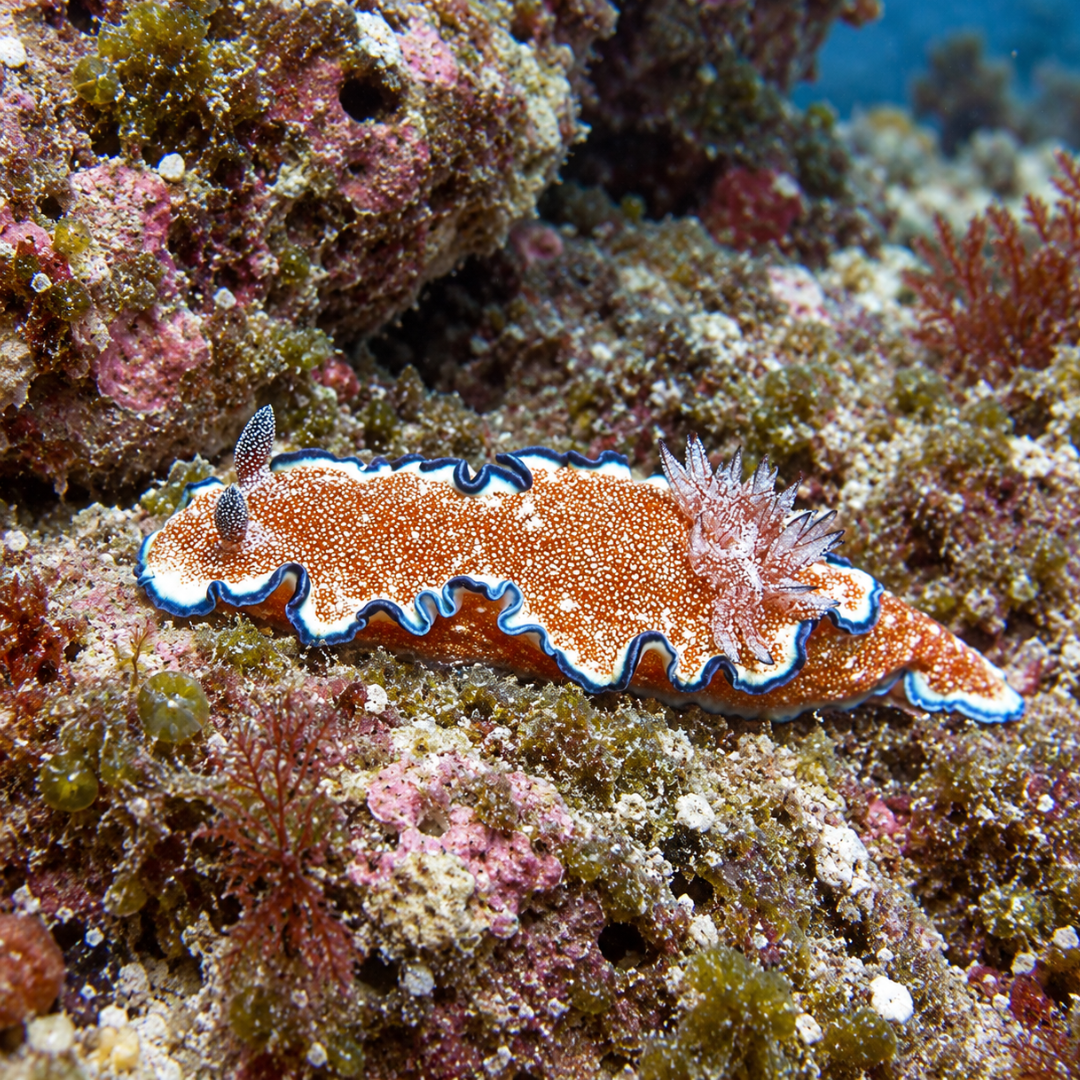
モンジャウミウシは、黄褐色から茶褐色の背面に青白い斑点が密に散り、外套膜の縁が大きく波打つイロウミウシ科の仲間です。日本でこの名で観察される個体は、真正の Glossodoris cincta と同一であることが確定しておらず、Glossodoris cf. cincta、または Glossodoris sp. cf. cincta と暫定的に扱われています。匍匐時の体長はおよそ6cmに達し、複雑な色彩と波打つ外套膜から水中観察でも目を引く存在です。一方、飼育ではカイメン食への強い依存が最大の難点です。一般的な人工飼料や冷凍餌を代替食として利用できる根拠は乏しく、長期維持を考えるなら、その個体が実際に摂食しているカイメンを継続して確保できることが重要です。 Monja-umiushi is a chromodorid nudibranch with a yellow-brown to brown dorsum densely scattered with bluish-white spots and a strongly undulating mantle edge. Japanese animals called by this name have not been conclusively shown to be identical to true Glossodoris cincta, and are therefore treated provisionally as Glossodoris cf. cincta or Glossodoris sp. cf. cincta. Crawling individuals can reach about 6 cm and are conspicuous underwater because of their intricate coloration and rippled mantle. In aquaria, the main difficulty is their strong dependence on sponge prey. There is little basis for expecting ordinary prepared or frozen foods to replace the natural diet, so long-term maintenance depends on securing the sponge that the individual is actually observed eating.
基本情報 / Basic Information
| 学名 / Scientific Name | Glossodoris cf. cincta |
|---|---|
| 通称 / Common Name | モンジャウミウシ。日本でこの和名が使われる個体は、現在も真正の Glossodoris cincta と同一と確定していないため、Glossodoris cf. cincta または Glossodoris sp. cf. cincta と記されることがあります。Monja-umiushi. Japanese animals under this common name are still not conclusively identified as true Glossodoris cincta, so the provisional forms Glossodoris cf. cincta or Glossodoris sp. cf. cincta are used. |
| 分類 / Family | 軟体動物門・腹足綱・異鰓類・裸鰓目・ドーリス類・イロウミウシ科・シロタエイロウミウシ属Phylum Mollusca, Class Gastropoda, Heterobranchia, Order Nudibranchia, dorid nudibranchs, Family Chromodorididae, Genus Glossodoris |
| 英名 / English Name | 日本で扱われる Glossodoris cf. cincta に確立した英語の一般名はなく、学名表記で呼ばれることが多いです。No widely established English common name is specific to the Japanese Glossodoris cf. cincta population; it is commonly referred to by its provisional scientific name. |
| 分布 / Distribution | 日本では沖縄本島、八重山、小笠原、八丈島などに観察記録があり、西太平洋にもよく似た個体群が知られています。一方、真正の Glossodoris cincta は現在、中央インド洋を中心とする個体群として扱われ、従来その名で報告された広域の記録には別種が含まれると考えられています。そのため、日本のモンジャウミウシを含む暫定個体群の正確な分布範囲は、まだ整理の途中です。In Japan, animals under this name have been recorded from Okinawa, the Yaeyama Islands, the Ogasawara Islands, Hachijojima, and other localities, with similar-looking populations elsewhere in the western Pacific. True Glossodoris cincta is currently treated as an Indian Ocean species, and many older wide-ranging records under that name are considered to represent related species. The precise distribution of the provisional populations that include Japanese Monja-umiushi therefore remains unresolved. |
| 最大体長 / Max Size | 約6cm。通常は5〜6cmほどの中型のウミウシとして観察されます。About 6 cm. Adults are typically observed at approximately 5–6 cm in crawling length. |
| 寿命 / Lifespan | 野外・飼育下ともに、本種の寿命を種レベルで示せる十分なデータはありません。飼育期間は個体の採集時の年齢や餌カイメンの維持状態に大きく左右されるため、特定の飼育日数だけから本来の寿命を推定するのは避けた方がよいでしょう。There are insufficient species-level data to define the natural or captive lifespan of this taxon. Captive duration is strongly affected by the animal’s age at collection and by the continued availability of suitable sponge prey, so a single husbandry record should not be treated as a reliable estimate of normal lifespan. |
飼育環境 / Aquarium Environment
| 水槽サイズ / Tank Size | 本種について科学的に確立された最小水槽サイズはありません。飼育する場合は、生体の大きさよりも水質の安定と餌カイメンを維持できる余裕を優先します。実務上は60cm規格水槽(約55〜65L)以上をひとつの目安にし、複数の餌カイメンを維持するなら90cm規格水槽(約150L前後)の方が管理しやすくなります。これらは種固有の最低条件ではなく、安定性を確保するための飼育上の目安です。No scientifically established minimum tank size is available for this taxon. In practice, water stability and the ability to maintain its living sponge food matter more than the animal’s body size. A standard 60 cm aquarium of roughly 55–65 L or larger is a practical starting point, while a standard 90 cm aquarium of around 150 L is easier to manage when keeping multiple food sponges. These figures are husbandry guidelines rather than species-specific biological minimums. |
|---|---|
| 水温 / Temperature | 20〜25℃を飼育上の目安にできますが、本種の最適水温が実験的に確立されているわけではありません。採集地や入荷時の水温から大きく外さず、急変を避けて安定させることを優先します。餌カイメンも環境変化に敏感なため、ウミウシ本体だけでなくカイメンの状態も同時に観察してください。 Approximately 20–25°C can be used as a practical husbandry range, but an experimentally established optimum for this taxon is not available. Priority should be given to avoiding abrupt changes and keeping the aquarium close to the temperature at which the animal was collected or received. The food sponge may also be sensitive to environmental change, so its condition should be monitored alongside the nudibranch. |
| 水質 / Water Quality | 種固有の許容範囲は確立されていないため、安定した一般的なリーフ水槽の海水条件を基準にします。比重1.023〜1.026程度、pH 8.0〜8.4程度を目安とし、アンモニアと亜硝酸は検出されない状態を保ち、硝酸塩の蓄積も抑えます。餌カイメンが崩れ始めると水質を急速に悪化させることがあるため、変色や組織の崩れが見られた場合は早めに隔離して状態を確認します。Species-specific tolerance limits have not been established, so stable reef-aquarium seawater conditions are the appropriate reference. A specific gravity of about 1.023–1.026 and pH around 8.0–8.4 are reasonable general targets, with ammonia and nitrite kept undetectable and nitrate accumulation minimized. Because deteriorating sponge tissue can rapidly degrade water quality, any sponge showing discoloration or tissue breakdown should be isolated and assessed promptly. |
| レイアウト / Layout | ライブロックを主体に、カイメンを固定できる岩の側面や陰になる場所を複数用意します。水流はカイメン表面に淀みが生じない程度の中〜やや強めを確保しつつ、ウミウシが直接吹き飛ばされるような一点集中の強流は避けます。ポンプやオーバーフローの吸い込み口はスポンジやガードで覆い、柔らかな体が吸い込まれないようにしてください。Use live rock as the main structure and provide several shaded or vertical surfaces where food sponges can be secured. Moderate to moderately strong circulation should prevent stagnant zones around the sponge, but avoid a concentrated jet strong enough to dislodge the nudibranch. Cover pump and overflow intakes with guards or sponge prefilters to prevent the soft-bodied animal from being drawn in. |
| 注意点 / Precautions | 最大の注意点は、購入前にその個体が実際に食べているカイメンを確認し、継続して用意できるかを見極めることです。外見が似たカイメンでも食べない可能性があり、代替餌を前提にした飼育は勧められません。また、カイメンは種類によって空気への曝露や切断に弱いものがあるため、移動や手入れはできる限り水中で行い、傷んだ個体を本水槽へ持ち込まないようにします。長期間絶食していたウミウシは、適切な餌を用意しても回復しない場合があります。The most important precaution is to confirm the sponge that the individual is actually eating before purchase and determine whether that food can be supplied continuously. Visually similar sponges may be rejected, so husbandry should not depend on an assumed substitute diet. Sponges also vary in their tolerance of air exposure and cutting; handling and maintenance should therefore be carried out underwater whenever possible, and deteriorating sponge tissue should not be introduced into the display. A nudibranch already weakened by prolonged starvation may fail to recover even after suitable food is provided. |
餌と給餌 / Feeding
| 餌の種類 / Diet | カイメンを食べる強い専食性を持つと考えられています。過去に Glossodoris cincta と同定されたグアムの個体では Hyrtios erecta を摂食した記録がありますが、その後この仲間に複数の隠蔽種が含まれることが分かり、この記録を日本の Glossodoris cf. cincta にそのまま当てはめることはできません。したがって、飼育では採集時や販売時に実際の摂食が確認されたカイメンを維持する方法が最も確実です。ペレット、フレーク、一般的な冷凍餌を代替食として利用できる確かな情報はありません。This nudibranch is regarded as a highly specialized sponge feeder. Animals historically identified as Glossodoris cincta on Guam were recorded feeding on Hyrtios erecta, but later taxonomic work showed that the former G. cincta concept contained multiple cryptic species. That feeding record therefore cannot automatically be applied to Japanese Glossodoris cf. cincta. For aquarium care, the most reliable approach is to maintain the exact sponge on which the individual was observed feeding at collection or sale. There is no reliable evidence that pellets, flakes, or ordinary frozen foods can serve as substitutes. |
|---|---|
| 給餌のポイント / Feeding Tips | まず、ウミウシがカイメン上にいるだけでなく、表面に新しい摂食痕が増えているかを観察します。摂食が進んで表面の柔らかな組織が減り、繊維質だけが目立つようになった場合には、状態を見ながら突出部を整える方法が用いられることがあります。ただし、カイメンの切断耐性は種類によって異なり、この方法は本種で標準化された飼育手法ではありません。処置する場合はカイメンを空気にさらさず、水中で最小限に行い、処置後に組織崩壊がないか確認します。最も重要なのは、ウミウシを人工餌へ慣らすことではなく、実際に食べるカイメンを健全な状態で維持し続けることです。Confirm feeding by looking for fresh grazing marks rather than assuming that a nudibranch resting on a sponge is eating. When grazing has removed soft surface tissue and tougher fibers become prominent, some husbandry approaches use limited trimming of protruding material. Sponge tolerance to cutting varies, however, and this is not a standardized technique for this taxon. If trimming is attempted, keep the sponge submerged, minimize tissue damage, and watch carefully for subsequent deterioration. The central feeding challenge is not to train the nudibranch onto artificial food, but to keep the sponge it actually eats in healthy condition. |
性格と混泳 / Temperament and Tank Mates
| 性格 / Temperament | 非常におとなしく、魚や他の無脊椎動物を追い回すような生体ではありません。行動は緩慢で、餌となるカイメンの周辺にとどまることが多いと考えられます。イロウミウシ科では、餌由来の化学物質を防御に利用する例が広く知られていますが、日本のモンジャウミウシ個体群で利用される化学物質の種類まで確定しているわけではありません。It is a very peaceful, slow-moving animal and does not chase fish or other invertebrates. It is expected to spend much of its time around suitable sponge prey. Dietary chemical defenses are well documented across Chromodorididae, but the exact defensive compounds used by Japanese Monja-umiushi populations have not been established. |
|---|---|
| 混泳の相性 / Compatibility | ウミウシをつつく、捕食する、あるいは強く接触する可能性のある魚類や大型甲殻類との混泳は避けるのが安全です。本種が一般的な小型魚を捕食することはありませんが、専用の餌カイメンを安定して維持する必要があるため、混泳相手の数を増やすことよりも、落ち着いたリーフ環境を保つことを優先します。ポンプやオーバーフローの吸い込み口にはガードを設け、柔らかな体が巻き込まれないようにします。It is safest to avoid fishes or large crustaceans that may nip, prey on, or repeatedly disturb nudibranchs. This animal is not a predator of ordinary small reef fishes, but because its specialized sponge food must be maintained, a calm reef environment is more important than keeping a large community of tank mates. Guard pump and overflow intakes so the soft-bodied nudibranch cannot be drawn in. |
病気と対策 / Diseases and Prevention
| かかりやすい病気 / Common Diseases | モンジャウミウシ固有の疾病について、観賞飼育で確立された病名や治療法はほとんどありません。実際に問題となりやすいのは、長期の絶食による衰弱、急激な水温・比重変化によるストレス、水質悪化に伴う活動低下、輸送やポンプ吸引による外傷です。特に餌カイメンの壊死や腐敗は、ウミウシ本体の不調より先に水槽全体を悪化させることがあります。There are few well-established disease names or treatment protocols specific to Glossodoris cf. cincta in ornamental culture. The most common practical problems are prolonged starvation, stress from rapid temperature or salinity shifts, lethargy associated with poor water quality, and physical injury during transport or from pumps. Necrosis or decay of the food sponge can become a system-wide water-quality emergency even before obvious signs appear in the nudibranch itself. |
|---|---|
| 対策と予防 / Prevention | 新規個体は、購入時に摂食確認が取れたカイメンと一緒に導入するのが理想です。水合わせは急がず、水温と比重を大きく変化させないようにします。餌カイメンは本水槽へ入れる前に別環境で状態を確認し、崩れ始めた部分は速やかに除去します。ウミウシが長時間動かない、体が薄く縮む、カイメン上にいても摂食痕が増えない場合は、まず餌の適合性と水質を確認してください。薬浴や魚病薬については本種への安全性が十分に確立されていないため、安易な使用は避けます。Ideally, introduce a new specimen together with the sponge on which feeding has already been confirmed. Acclimate slowly and avoid abrupt changes in temperature or salinity. Stabilize and inspect food sponges in a separate system before placing them in the display, and remove deteriorating tissue promptly. If the nudibranch remains inactive for long periods, becomes visibly thin, or leaves no new grazing marks despite sitting on the sponge, first reassess food suitability and water quality. The safety of many common fish medications has not been established for this species, so casual medication should be avoided. |
増やし方(繁殖) / Breeding
| 雌雄の判別 / Sexing | 外見からオス・メスを分けて判別することはできません。ウミウシ類の多くと同様に雌雄同体で、1個体が雄性・雌性の両方の生殖機能を備えます。繁殖には通常、成熟した別個体との交接が必要です。Males and females cannot be separated by external appearance. Like many nudibranchs, they are simultaneous hermaphrodites, with each individual possessing both male and female reproductive functions. Reproduction normally requires mating with another mature individual. |
|---|---|
| 繁殖形態 / Reproduction | 雌雄同体で、成熟した個体同士が交接して繁殖します。沖縄産の Glossodoris sp. cf. cincta では交接行動と生殖器形態が研究されています。一方、産卵後の発生や幼生飼育については、家庭飼育へそのまま応用できるほど詳しい情報は確立されていません。It is a simultaneous hermaphrodite, and reproduction involves mating between mature individuals. Mating behavior and reproductive anatomy have been studied in Okinawan Glossodoris sp. cf. cincta. In contrast, post-spawning development and larval husbandry are not documented well enough to provide an established home-aquarium breeding protocol. |
| 繁殖のポイント / Breeding Tips | 繁殖を考える場合も、まず親個体を長期間健康に維持できるだけの適切な餌カイメンを確保することが前提です。交接や産卵が見られても、その後の卵発生、ふ化、着底、変態に必要な条件は本種で実用的に確立されていません。現時点では一般家庭で再現性のある繁殖法はなく、親個体と餌カイメンを安定して維持すること自体が高度な飼育課題です。Any breeding attempt first requires enough suitable sponge prey to keep the adults healthy over the long term. Even if mating or spawning occurs, the conditions required for embryonic development, hatching, settlement, and metamorphosis have not been established as a practical protocol for this taxon. There is currently no reproducible home-aquarium breeding method, and stable maintenance of the adults and their food sponge is already an advanced husbandry challenge. |
雑学と豆知識 / Trivia and Fun Facts
| 1. 「G. cincta」ではなく「cf. cincta」と書かれる理由 / 1. Why the name is often written as “cf. cincta” | かつては、インド太平洋の広い地域で似た姿をした個体がまとめて Glossodoris cincta と呼ばれていました。しかし、DNA解析と詳細な形態比較によって、この中に複数の隠蔽種・類似種が含まれることが示されました。2018年の再検討では、模式産地であるモーリシャスの真正個体を遺伝的に比較できておらず、西太平洋で従来 G. cincta とされてきた個体の正確な帰属には不確実性が残りました。そこで日本のモンジャウミウシには、「G. cincta に似るが同一種と断定しない」という意味で Glossodoris cf. cincta、あるいは Glossodoris sp. cf. cincta という表記が使われます。見た目がよく似ていても、分類上は別種である可能性を残して扱うための慎重な表記です。Similar-looking animals across much of the Indo-Pacific were historically grouped under Glossodoris cincta. DNA analyses and detailed anatomical comparisons later showed that this broad concept contained multiple cryptic or closely related species. In the 2018 revision, genetically comparable material from the type locality in Mauritius was not available, leaving uncertainty over the exact identity of western Pacific animals formerly called G. cincta. Japanese Monja-umiushi are therefore often written as Glossodoris cf. cincta or Glossodoris sp. cf. cincta: a cautious way of saying that they resemble G. cincta but have not been proven to be the same species. |
|---|---|
| 2. 学名の歴史は、ウミウシ分類の変化そのもの / 2. Its naming history mirrors the changing science of nudibranch taxonomy | Glossodoris cincta は、Rudolph Bergh によって1888年に最初は Casella cincta として記載されました。ウミウシの分類は長い間、体色や外套膜、歯舌、生殖器などの形態に大きく依存していたため、似た姿の種が同じ属へまとめられたり、後になって別属へ移されたりすることが珍しくありませんでした。シロタエイロウミウシ属 Glossodoris もその影響を強く受けた属のひとつです。21世紀に入ってDNA解析が加わると、「同じ色模様なら同じ種」という従来の感覚では見抜けなかった系統差が次々に浮かび上がりました。モンジャウミウシは、見た目の美しさだけでなく、形態分類から分子分類へと進んだ現代分類学の変化を身近に感じさせてくれる生き物でもあります。Glossodoris cincta was originally described by Rudolph Bergh in 1888 under the name Casella cincta. For much of the history of nudibranch taxonomy, classification relied heavily on morphology such as coloration, mantle form, radula, and reproductive anatomy, so superficially similar species were often placed together and later reassigned. The genus Glossodoris is one group that experienced repeated revision. Once DNA sequencing became widely used in the twenty-first century, evolutionary differences invisible to color-pattern comparison alone began to emerge. Monja-umiushi therefore offers a vivid example of how modern taxonomy has shifted from appearance-based grouping toward an integrated view combining morphology and molecular data. |
| 3. 「餌を与える」のではなく「餌を維持する」飼育 / 3. Husbandry means maintaining the food, not merely offering it | 専食性のウミウシでは、一般的な魚のように「代わりの餌へ慣らす」という発想が通用しにくくなります。モンジャウミウシの場合も、まず実際に摂食するカイメンを見極め、そのカイメン自体を良い状態で維持することが飼育の中心です。摂食が進んでカイメン表面に繊維質が目立つ場合、突出部を整える管理法が用いられることもありますが、カイメンの種類によって切断への強さは異なり、標準化された方法ではありません。手入れを行う場合も空気への曝露を避け、組織の崩れが起きていないかを確認します。ウミウシだけでなく、その餌となる生物まで含めて状態を整える必要があることが、この仲間の飼育を難しくも興味深いものにしています。For a dietary specialist, the usual aquarium idea of converting an animal to an alternative food often does not work. With Monja-umiushi, husbandry begins by identifying the sponge it actually eats and keeping that sponge healthy. When grazing leaves conspicuous fibrous material at the surface, limited trimming is sometimes used as a management option, but tolerance of cutting differs among sponge species and this is not a standardized method. Any maintenance should minimize air exposure and be followed by close observation for tissue breakdown. The need to care for the prey organism as well as the nudibranch itself is what makes this kind of husbandry both difficult and biologically interesting. |
| 4. 貝殻を失ったイロウミウシと化学防衛 / 4. Chromodorid nudibranchs and chemical defense after shell loss | 成体の裸鰓類は外から見える貝殻を持たず、イロウミウシ科の多くは餌由来の二次代謝産物を体内へ取り込んで防御に利用します。外套膜の縁にある外套膜真皮層構造(MDFs)へ防御物質を高濃度に蓄える例も、この科の複数種で確認されています。旧来 Glossodoris cincta と同定された個体群でも、餌カイメン由来の化学物質と捕食抑制との関係が研究されてきました。ただし、その後この名前の下に複数種が含まれていたことが分かったため、過去の研究結果を日本の Glossodoris cf. cincta にそのまま当てはめることはできません。鮮やかな体色と化学防衛の関係はこの科を理解する重要な手掛かりですが、日本産個体群での詳細は今後も区別して考える必要があります。Adult nudibranchs lack an external shell, and many chromodorids use secondary metabolites obtained from their prey as chemical defenses. In several members of the family, defensive compounds are concentrated in mantle dermal formations, or MDFs, along exposed parts of the mantle. Populations historically identified as Glossodoris cincta have also been studied for sponge-derived chemistry and predator deterrence. Later taxonomy showed, however, that more than one species had been grouped under that name, so those older results cannot automatically be assigned to Japanese Glossodoris cf. cincta. The connection between conspicuous coloration and chemical defense remains an important feature of chromodorid biology, but the details for Japanese populations should be treated separately. |
| 5. 海綿由来の天然物は、創薬研究にもつながる / 5. Sponge-derived natural products also attract biomedical research | 旧来 Glossodoris cincta と同定された個体群や近縁の Glossodoris では、ヘテロネミンやスカララン型化合物など、餌となるカイメンに由来すると考えられる二次代謝産物が研究されてきました。これらの海洋天然物の一部には、培養細胞を用いた実験で細胞増殖抑制などの生物活性が報告され、薬理研究の候補物質として調べられています。ただし、分類再検討以前の「G. cincta」には複数種が混在していた可能性があるため、各化合物の記録を日本のモンジャウミウシ固有の性質として扱うことはできません。また、培養細胞で活性が見つかることと、人に安全で有効な医薬品になることは別の段階です。ウミウシとカイメンの関係は、生態学と天然物化学が交わる研究対象として興味深い位置にあります。Populations historically identified as Glossodoris cincta, together with related Glossodoris species, have been investigated for sponge-derived secondary metabolites such as heteronemin and scalarane-type compounds. Some of these marine natural products show biological activities, including growth inhibition in cultured cells, and are studied as leads in pharmacological research. Because the older name G. cincta may have included multiple species, however, individual chemical records should not be treated as traits proven specifically for Japanese Monja-umiushi. Activity in cultured cells also does not mean that a compound is already a safe or effective medicine. The nudibranch-sponge relationship remains notable because it connects marine ecology with natural-products chemistry. |
| 6. 名前の「モンジャ」は、日本らしい親しみから生まれた呼び名 / 6. The Japanese name reflects a distinctly local sense of familiarity | モンジャウミウシという和名は、茶褐色の地に細かな斑点が散る模様が、鉄板料理のもんじゃ焼きを思わせることに由来するとされています。分類学上は学名の扱いに慎重さが必要な一方、和名は一目見たときの印象を素直に伝えています。水中では外套膜の縁が大きく波打ち、青白い斑点と暗色の縁取りが体の動きに合わせて表情を変えます。分類上の課題を残しながらも、姿そのものは非常に覚えやすいという対照も、このウミウシの印象深さにつながっています。The Japanese name Monja-umiushi is said to refer to the mottled brown appearance of monjayaki, the Japanese griddled dish. The scientific name requires taxonomic caution, while the common name simply captures the animal’s immediate visual impression. Underwater, the broad mantle edge ripples as it crawls and the bluish spots and dark border continually change in appearance with the movement. Its taxonomy remains unresolved, yet its living form is remarkably easy to remember. |
まとめ / Conclusion
モンジャウミウシは、波打つ外套膜と複雑な色彩が目を引く一方、特定のカイメンに強く依存するため、長期飼育の難易度が高いウミウシです。安定した水質を保つだけでは足りず、その個体が実際に食べるカイメンを見極め、カイメン自体を良好な状態で維持できるかどうかが大きな鍵になります。 Monja-umiushi is visually striking because of its rippled mantle and intricate coloration, but its strong dependence on particular sponge prey makes long-term aquarium care difficult. Stable seawater alone is not enough: success depends heavily on identifying the sponge the individual actually eats and keeping that sponge healthy.
日本で見られる個体群は、真正の Glossodoris cincta と同一であることがまだ確定しておらず、過去に「G. cincta」として報告された食性や化学成分の知見も、すべてをそのまま日本産個体へ当てはめることはできません。だからこそ、名前だけで判断せず、目の前の個体の摂食や状態を丁寧に観察することが大切です。十分な餌環境を用意できたとき、このウミウシは美しい姿だけでなく、海の生き物同士がどれほど強く結び付いて暮らしているかを実感させてくれる存在になります。 Japanese populations have not yet been conclusively shown to be identical to true Glossodoris cincta, and older findings on diet or chemistry reported under the name “G. cincta” cannot all be transferred directly to Japanese animals. Care therefore depends on observing the individual in front of you rather than relying on the name alone. When its living food requirements can be met, this nudibranch reveals not only remarkable beauty but also the close ecological dependence that links animals to their prey on the reef.

気になる道具や飼い方を見つけてみませんか?
 アイのアクアグッズ案内コケを食べるコイの仲間に合わせる飼育用品|フライングフォックス・アルジイーター・ガラ道具の特徴や使い方、選ぶときのポイントをアイが紹介します。記事はコチラ →
 アイのアクアグッズ案内水草用ソイルの選び方|土・砂の違いとおすすめ商品道具の特徴や使い方、選ぶときのポイントをアイが紹介します。記事はコチラ →
 アイのアクアグッズ案内ラスボラ・ボララスの群泳を楽しむ飼育用品|水槽・ろ過・ヒーター・餌・水草道具の特徴や使い方、選ぶときのポイントをアイが紹介します。記事はコチラ →
 アイのアクアグッズ案内エンゼルフィッシュの飼育用品|高さのある水槽・ろ過・水草・餌の選び方道具の特徴や使い方、選ぶときのポイントをアイが紹介します。記事はコチラ →
さまざまな飼育テーマをご紹介。リンク先の記事には広告・商品紹介が含まれます。
案内・紹介記事一覧へ →分布マップ
日本では沖縄本島、八重山、小笠原、八丈島などに観察記録があります。西太平洋にもよく似た個体群が知られていますが、日本のモンジャウミウシを含む暫定的な個体群の正確な分布範囲は、分類学的な再検討が続いているため、まだ十分に整理されていません。
この地図は、日本で観察記録のある主な地域を把握するための概略表示です。マーカーは分布域を示すために沖縄本島周辺へ設定した代表地点であり、実際の採集地点や特定個体の確認地点を示すものではありません。また、分類学的な再検討が続いているため、表示範囲が本種の正確な分布境界を示すものではありません。
参考文献
-
MolluscaBase eds. (2026). Glossodoris cincta (Bergh, 1888). World Register of Marine Species.
WoRMS
分類、原記載名、真正の Glossodoris cincta の現在の扱い。
-
Matsuda, S. B. & Gosliner, T. M. (2018). Molecular phylogeny of Glossodoris (Ehrenberg, 1831) nudibranchs and related genera reveals cryptic and pseudocryptic species complexes. Cladistics, 34(1), 41–56.
https://doi.org/10.1111/cla.12194
Glossodoris cincta 複合体の分子系統、隠蔽種・類似種の存在、分類学的再検討の基礎。
-
Matsuda, S. B. & Gosliner, T. M. (2018). Glossing over cryptic species: Descriptions of four new species of Glossodoris and three new species of Doriprismatica (Nudibranchia: Chromodorididae). Zootaxa, 4444(5), 501–529.
https://doi.org/10.11646/zootaxa.4444.5.1
Glossodoris sp. cf. cincta の形態、分布、真正の G. cincta との同一性が未確定であることの根拠。
-
Rudman, W. B. & Bergquist, P. R. (2007). A review of feeding specificity in the sponge-feeding Chromodorididae (Nudibranchia: Mollusca). Molluscan Research, 27(2), 60–88.
https://doi.org/10.11646/mr.27.2.2
イロウミウシ科のカイメン食と高い餌選択性、Glossodoris 属の食性を理解するための基礎資料。
-
Rogers, S. D. & Paul, V. J. (1991). Chemical defenses of three Glossodoris nudibranchs and their dietary Hyrtios sponges. Marine Ecology Progress Series, 77, 221–232.
https://doi.org/10.3354/meps077221
旧来 Glossodoris cincta と同定されたグアム個体群のカイメン食と化学防衛に関する研究。現在の分類では日本の Glossodoris cf. cincta へ直接同一視しない。
-
Sekizawa, A., Tsurumi, Y., Ito, N. & Nakashima, Y. (2021). Another usage of autotomized penis. Journal of Ethology, 39, 319–328.
https://doi.org/10.1007/s10164-021-00706-1
沖縄で扱われた Glossodoris sp. cf. cincta の交接行動と生殖器形態。
-
Hayashi, M. & Nakano, H. (2024). Staging of post-settlement growth in the nudibranch Hypselodoris festiva. Scientific Reports, 14, 16157.
https://doi.org/10.1038/s41598-024-66322-4
近縁のイロウミウシ科における飼育、特定カイメンの維持、幼生から成体までの飼育上の難点を示す比較資料。
-
Lavrov, A. I. & Ereskovsky, A. V. (2022). Studying Porifera WBR Using the Calcerous Sponges Leucosolenia. In Whole-Body Regeneration: Methods and Protocols, Methods in Molecular Biology, 2450, 69–93.
https://doi.org/10.1007/978-1-0716-2172-1_4
生きたカイメンの採集・移送・切断時の慎重な取り扱いと、空気への曝露を避ける実験手順の参考資料。
-
O’Brien, M. F. & Pellett, S. (2022). Diseases of Gastropoda. Frontiers in Immunology, 12, 802920.
https://doi.org/10.3389/fimmu.2021.802920
腹足類で知られる感染症・寄生性疾患の総説。本種について確立された疾病名や標準治療が乏しいことを踏まえるための一般資料。




コメント