

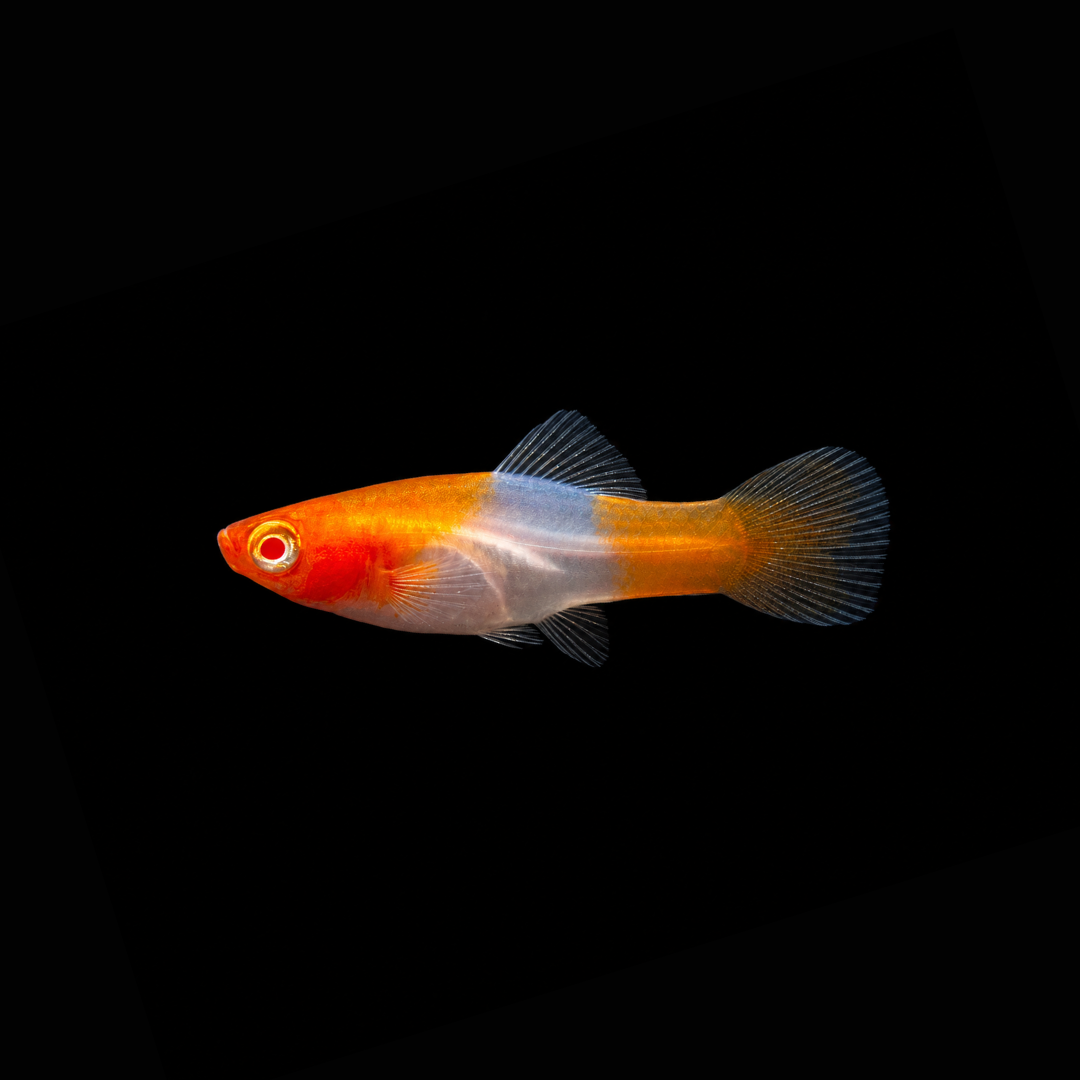


解説 / Description
コウハクソード(紅白ソードテール)は、中米原産のグリーンソードテール(Xiphophorus hellerii)をもとに、近縁のサザンプラティやヴァリアタスとの交雑と長年の選別交配によって作り出された改良品種です。雪のような白地に朱赤の模様が入る姿は、日本の錦鯉「紅白」を思わせます。2000年代初頭にシンガポールで新品種として登場したとされ、現在では国内でも定番の人気品種となっています。いま主に流通しているのは、アルビノの性質をもつ赤い目のタイプで、「ルビーアイ紅白ソード」や「アルビノ紅白ソード」の名でも販売されています。通常の赤いソードテールに比べるとやや穏やかな傾向があるとされ、水草水槽の主役としても、差し色としてもよく映えます。ただし、本来は中性から弱アルカリ性の硬めの水を好む魚のため、軟水の多い日本の水道水や、水を酸性に傾けやすいソイルを使う水槽では、水質への配慮が欠かせません。また、生まれたばかりの稚魚はほぼ全身が赤く、成長とともに白地が現れて模様ができあがるという独特の色の変化を見せます。さらに、ハイフィンやライヤーテールといった特殊なヒレの系統には、繁殖に関わる遺伝上の制約もあります。こうした背景を知るほど、この魚の奥深さが見えてくるでしょう。 The Kohaku Swordtail (red-and-white swordtail) is an ornamental strain developed from the Central American Green Swordtail (Xiphophorus hellerii) through hybridization with the closely related Southern Platy and Variatus, followed by many years of selective breeding. Its vermilion markings on a snow-white body recall the classic Kohaku Nishikigoi of Japan. It is said to have appeared as a new variety in Singapore in the early 2000s, and it is now a staple favorite in the Japanese hobby. The form most widely available today carries the albino trait and has red eyes, and it is also sold under names such as “Ruby-Eye Kohaku Swordtail” and “Albino Kohaku Swordtail.” It is said to be somewhat calmer than ordinary red swordtails, and it looks equally good as the centerpiece or as an accent color in a planted aquarium. However, because it originally prefers neutral to slightly alkaline, fairly hard water, care with water chemistry is essential when using Japan’s generally soft tap water or aqua soils that tend to acidify the water. Newborn fry are almost entirely red and develop their white ground and pattern only as they grow, a distinctive color change. In addition, special-finned lines such as Hi-Fin and Lyretail come with genetic constraints that affect breeding. The more one learns about this background, the more fascinating this fish becomes.
基本情報 / Basic Information
| 学名 / Scientific Name | Xiphophorus hellerii var.(改良品種/原種は Xiphophorus hellerii Heckel, 1848) |
|---|---|
| 通称 / Common Name | コウハクソード、紅白ソードテール、アルビノ紅白ソード、ルビーアイ紅白ソードテールKohaku Swordtail, Koi Swordtail, Red-and-White Swordtail, Santa Claus Swordtail |
| 分類 / Family | カダヤシ目カダヤシ科シフォフォルス属(ソードテールとプラティ類の交雑に由来する改良品種)Cyprinodontiformes, Poeciliidae, genus Xiphophorus (an ornamental strain derived from hybridization between swordtails and platies) |
| 英名 / English Name | Kohaku Swordtail / Koi Swordtail |
| 分布 / Distribution | 改良品種のため、自然の生息地はありません。原種のグリーンソードテールは、メキシコ南東部からグアテマラ、ベリーズ、ホンジュラス北西部にかけて、中米の大西洋側の河川や湧水域に分布しています。流通している個体の多くは、シンガポール、インドネシア、マレーシア、タイなど東南アジアの養殖場で生産されたものです。As an ornamental strain, it has no natural habitat. The wild Green Swordtail lives in rivers and spring-fed waters on the Atlantic side of Central America, from southeastern Mexico through Guatemala and Belize to northwestern Honduras. Most fish in the trade are produced on farms in Southeast Asia, including Singapore, Indonesia, Malaysia and Thailand. |
| 最大体長 / Max Size | 家庭の水槽では胴体が6〜8cm前後、オスはソード(剣のように伸びた尾ビレ)を含めて10〜12cm程度が目安です。原種では、全長でオス最大14cm、メス最大16cmほどの記録があります。In home aquariums, expect a body length of about 6–8 cm, with males reaching around 10–12 cm including the sword (the sword-like extension of the tail fin). Wild-type fish have been recorded at up to about 14 cm total length for males and 16 cm for females. |
| 寿命 / Lifespan | 2〜5年ほどです。一般的な家庭の水槽では、2〜3年程度がひとつの目安とされています。About 2–5 years; in typical home aquariums, around 2–3 years is a common guideline. |
飼育環境 / Aquarium Environment
| 水槽サイズ / Tank Size | 幼魚を一時的に飼うだけなら30cm水槽でも可能ですが、成魚のよく泳ぐ性質を考えると、最低でも60cm規格水槽(約57L)が必要です。オスを複数飼う場合や他の魚と混泳させる場合は、90cm規格水槽(約160L)以上が理想です。海外の飼育資料でも、横幅80〜120cm程度の水槽が推奨されています。A 30 cm tank can serve temporarily for juveniles, but given how actively adults swim, a standard 60 cm tank (about 57 L) is the minimum. When keeping multiple males or a community, a standard 90 cm tank (about 160 L) or larger is ideal. Overseas care references likewise recommend tanks roughly 80–120 cm long. |
|---|---|
| 水温 / Temperature | 22〜28℃です。体調と繁殖のバランスが良いのは22〜26℃前後とされています。冬場はサーモスタット付きのヒーターが欠かせず、夏場は冷却ファンやエアコンを使って28℃以下に保ちましょう。 22–28°C, with about 22–26°C considered the best balance for health and breeding. A thermostat-controlled heater is essential in winter, and in summer a cooling fan or air conditioning should keep the water at 28°C or below. |
| 水質 / Water Quality | pH7.0〜8.0の中性〜弱アルカリ性で、中硬水〜硬水が理想です。日本の水道水は多くの地域で軟水ですが、カルキを抜いた水道水でも飼育自体はできます。ただし、ソイルを敷いた水槽や換水が足りない水槽ではpHが下がりやすく、6.0を下回ると体調を崩しやすくなります。水草水槽でもpH6.0を下限と考え、定期的な換水で6.5〜7.0付近を保ち、必要に応じて淡水用のミネラル添加剤で補いましょう。Neutral to slightly alkaline water at pH 7.0–8.0 with moderate to high hardness is ideal. Tap water in most of Japan is soft, but the fish can still be kept in dechlorinated tap water. However, pH tends to drop in tanks with aqua soil or insufficient water changes, and below 6.0 the fish are prone to health problems. Even in planted tanks, treat pH 6.0 as the lower limit, keep it around 6.5–7.0 with regular water changes, and supplement with a freshwater mineral additive as needed. |
| レイアウト / Layout | 主に中層から表層を泳ぐため、前景から中景には広い遊泳スペースを確保しましょう。後景に水草を植えて隠れ家や視線を遮る場所を作っておくと、メスがオスの追尾から逃げやすくなります。水草を優先しない場合は、中性を保ちやすい大磯砂などの底床が扱いやすく、ネットに入れたサンゴ砂をフィルター内に少量入れておくとpHの低下を防ぎやすくなります。ただし、サンゴ砂は入れすぎると水草の育成に影響するため、水質を測りながら控えめに使ってください。ろ過には、緩やかな水流を作れる外部式や上部式のフィルターが適しています。Since the fish mainly swim in the middle and upper layers, leave plenty of open swimming space in the foreground and midground. Planting the background to create hiding places and visual barriers helps females escape males’ pursuit. If plants are not the priority, a substrate that stays near neutral, such as Oiso sand, is easy to manage, and a small amount of coral sand in a mesh bag inside the filter helps prevent pH from dropping. Coral sand can affect plant growth if overused, so add it sparingly while testing the water. Canister or top-mounted filters that produce a gentle current are well suited. |
| 注意点 / Precautions | もっとも注意したいのは飛び出し事故です。ソードテールには水面から高く跳ねる習性があり、オス同士の追いかけ合いや、照明の点灯に驚いた拍子に水槽の外へ飛び出してしまうことがあります。ガラス蓋の角の切り欠きや配管まわりの隙間も、できる限り塞いでおきましょう。また、春や秋の季節の変わり目は水温が急に変わりやすく、白点病などが出やすい時期です。早めにヒーターを点検しておくと安心です。ハイフィンやライヤーテールなどヒレの長い系統には、水流を弱めに調整してあげましょう。The greatest concern is jumping. Swordtails have a habit of leaping high out of the water and may jump out of the tank when chased by other males or startled when the lights come on. Close every gap you can, including the cut-out corners of glass lids and the spaces around filter pipes. Spring and autumn bring sudden temperature changes, a time when white spot disease and similar problems often appear, so checking heaters early provides peace of mind. For long-finned lines such as Hi-Fin and Lyretail, set the current on the gentle side. |
餌と給餌 / Feeding
| 餌の種類 / Diet | 雑食性で、野生では水生昆虫などの小さな無脊椎動物から藻類、植物片まで幅広く食べています。飼育下では熱帯魚用のフレークや顆粒の人工飼料をよく食べ、スピルリナ入りなど植物質を含む餌を組み合わせると体調が安定しやすくなります。冷凍アカムシやブラインシュリンプ、ミジンコなどを時々与えると、成長や繁殖にも良い効果が期待できます。An omnivore, it eats a broad range of foods in the wild, from aquatic insects and other small invertebrates to algae and plant matter. In captivity it readily accepts tropical fish flakes and granules, and combining these with plant-based foods such as spirulina-enriched flakes helps keep the fish in good condition. Occasional offerings of frozen bloodworms, brine shrimp or daphnia can also be expected to benefit growth and breeding. |
|---|---|
| 給餌のポイント / Feeding Tips | 成魚には1日2回、稚魚には1日3〜5回を目安に、1〜2分で食べきれる量を与えます。動物質ばかりに偏ると体調を崩しやすいため、植物質とのバランスを意識しましょう。紅白の美しさを保つうえでは、色揚げ用の飼料を与え続けると、赤は濃くなる一方で白地が黄ばみやすいと経験的に言われています。普段は栄養バランスの良い標準的な飼料を主食にし、色揚げ用の飼料は赤を補いたい時期に控えめに併用するのがおすすめです。白地の透明感を引き出すうえで何より大切なのは、きれいな水を保つことです。Feed adults twice a day and fry three to five times a day, offering only what can be eaten within one to two minutes. A diet heavily weighted toward animal foods can upset their health, so keep a balance with plant matter. To preserve the red-and-white beauty, it is commonly observed that continuous use of color-enhancing food deepens the red but tends to make the white ground yellowish. Use a well-balanced standard food as the staple, and add color-enhancing food sparingly only when you want to boost the red. Above all, keeping the water clean is what brings out the clarity of the white. |
性格と混泳 / Temperament and Tank Mates
| 性格 / Temperament | 活発な魚で、アルビノの紅白系統は通常のソードテールよりやや穏やかな傾向があるとされます。それでも成熟したオスははっきりとした順位をつくり、オス同士で激しく争ったり、メスをしつこく追いかけたりする習性は変わりません。狭い水槽にオスを2匹だけ入れると、強いオスが弱いオスを執拗に攻撃し続けることがあるため、この組み合わせは避けましょう。An active fish, the albino Kohaku lines are said to be somewhat calmer than ordinary swordtails. Even so, mature males form clear hierarchies, fight fiercely with one another and persistently chase females. Keeping only two males in a small tank can lead the dominant one to attack the other relentlessly, so avoid this combination. |
|---|---|
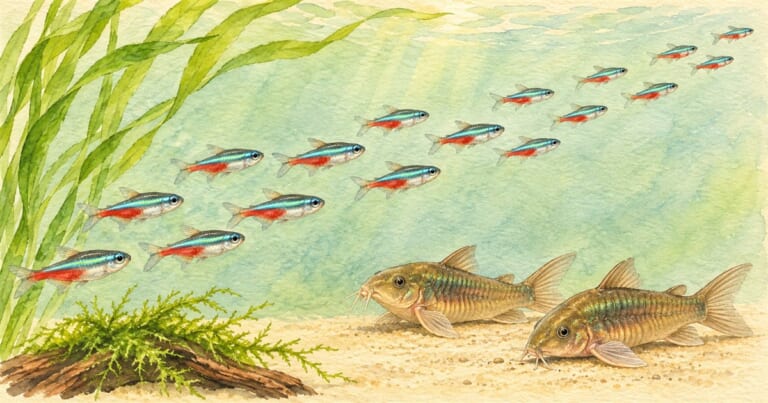
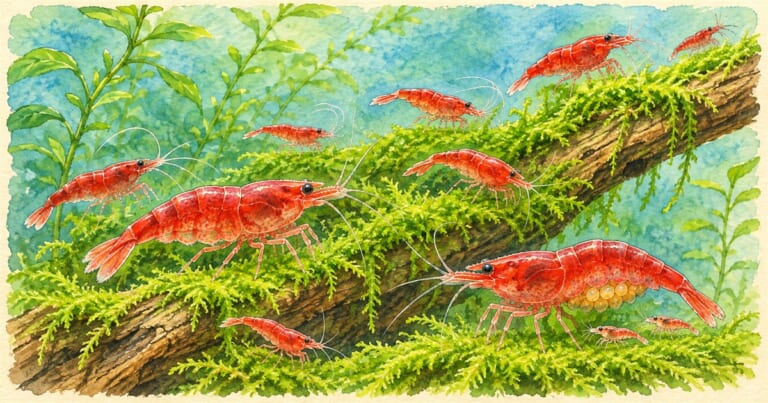
| 混泳の相性 / Compatibility | 体の大きさが極端に違わなければ、多くの熱帯魚と一緒に飼えます。中性付近の水質に馴染むモーリーやグッピー、コリドラス、温和な中小型のカラシン類やラスボラ類は良い同居相手です。一方、他品種のソードテールやプラティとは簡単に交雑して紅白の系統が崩れてしまうため、系統を守りたい場合は同居を避けてください。スマトラのようにヒレをかじる魚や、口に入る大きさの小型エビ・小型魚との混泳も向きません。同じ種類どうしでは「オス1匹にメス2〜3匹以上」を基本とします。オスを複数飼う場合は、90cm以上の水槽に水草をたっぷり植え、オスを3匹以上にしてメスも十分な数を入れ、攻撃が1匹に集中しないようにするのが定石です。As long as size differences are not extreme, it can live with many tropical fish. Mollies, guppies, Corydoras and peaceful small to medium tetras and rasboras, which adapt well to near-neutral water, make good tank mates. However, it readily hybridizes with other swordtail varieties and platies, which breaks down the Kohaku line, so avoid housing them together if you want to preserve the strain. Fin-nipping fish such as tiger barbs, and small shrimp or fish small enough to fit in its mouth, are also unsuitable companions. Within the species, the basic ratio is one male to two or three or more females. If keeping several males, the standard approach is a heavily planted tank of 90 cm or larger with at least three males and plenty of females, so that aggression is not concentrated on a single fish. |
病気と対策 / Diseases and Prevention
| かかりやすい病気 / Common Diseases | 卵胎生魚に多い「揺れ病(シミー)」は、ヒレを閉じたまま、その場で体を小刻みに揺らす症状です。硬度やpHが低すぎる水、低い水温、水質の悪化などが主なきっかけと考えられていますが、遺伝的な要因や細菌感染が関わるという見方もあります。このほか、季節の変わり目や導入直後に出やすい白点病、低pHで傷んだヒレや争いでできた傷から感染しやすい尾ぐされ病・口ぐされ病(カラムナリス症)、水質の悪化がきっかけとなる松かさ病・赤斑病(エロモナス症)にも注意が必要です。白地の多い紅白の個体は、体の充血などの異変に気づきやすいという面もあります。“Shimmies,” common in livebearers, is a condition in which the fish keeps its fins clamped and wobbles in place. Water with too little hardness or too low a pH, low temperatures and poor water quality are thought to be the main triggers, though some also point to genetic factors or bacterial infection. Other conditions to watch for include white spot disease, which tends to appear at seasonal transitions or soon after introduction; fin rot and mouth rot (columnaris), which easily infect fins weakened by low pH or wounds from fighting; and dropsy and red sore disease (Aeromonas infections), triggered by deteriorating water quality. On the positive side, the largely white body of Kohaku fish makes problems such as reddening easier to spot. |
|---|---|
| 対策と予防 / Prevention | 揺れ病では、薬よりも先に飼育環境の見直しを優先します。水温を25〜26℃で安定させ、サンゴ砂やミネラル添加剤でpHを7.0以上に、硬度もゆっくり回復させながら、0.3〜0.5%の塩水浴(水1Lあたり食塩3〜5g)で魚の負担を和らげましょう。白点病には、換水したうえで水温をやや上げ、メチレンブルー系などの白点病治療薬を規定量使用します。尾ぐされ病やエロモナス症は、病魚を隔離したうえで、観賞魚用の抗菌剤と0.3〜0.5%の塩水浴を併用するのが一般的です。新しく迎えた魚はすぐに本水槽へ入れず、スポンジフィルターとエアレーションを備えた隔離水槽で数週間ほど様子を見ると、病気の持ち込みを大きく減らせます。冬場に持ち帰るときや通販で迎えるときは、保温対策も大切です。For shimmies, review the tank environment before turning to medication. Stabilize the temperature at 25–26°C, gradually raise pH to 7.0 or higher and restore hardness with coral sand or mineral additives, and ease the fish’s burden with a 0.3–0.5% salt bath (3–5 g of salt per liter). For white spot, change some water, raise the temperature slightly and use a white spot treatment such as a methylene blue–based product at the labeled dose. Fin rot and Aeromonas infections are generally treated by isolating the sick fish and combining an aquarium antibacterial medication with a 0.3–0.5% salt bath. Rather than placing newly acquired fish straight into the main tank, observing them for a few weeks in a quarantine tank with a sponge filter and aeration greatly reduces the risk of bringing in disease. Keeping fish warm when carrying them home or receiving them by mail in winter is also important. |
増やし方(繁殖) / Breeding
| 雌雄の判別 / Sexing | オスもメスも同じような紅白模様になるため、体色では見分けられません。成熟したオスは、尻ビレが細長い棒状の交尾器(ゴノポディウム)に変化し、尾ビレの下側が剣のように伸びます。メスの尻ビレは扇形のままで、成熟や妊娠に伴ってお腹が丸く膨らみます。なお、通常の暗い体色のソードテールでは、お腹の黒い斑(妊娠斑)が妊娠の目安になりますが、アルビノや白地の多い個体ではこれが見えにくく、淡い影程度にしか確認できない点に注意しましょう。また、3〜4cmの幼魚の中には、まだ成熟していないためメスのように見えるオスが混じっていることがあります。ペアを狙う場合は、5cm以上で特徴がはっきりした個体を選ぶか、幼魚を5匹以上まとめて迎えるのがおすすめです。Males and females develop similar red-and-white patterns, so color cannot be used to tell them apart. In mature males, the anal fin transforms into a slender, rod-like copulatory organ (gonopodium), and the lower edge of the tail fin extends like a sword. Females keep a fan-shaped anal fin, and their bellies become rounded as they mature or become pregnant. In ordinary dark-colored swordtails, a dark spot on the belly (the gravid spot) signals pregnancy, but in albino or largely white fish it is hard to see and may appear only as a faint shadow. In addition, young fish of 3–4 cm may include males that look like females simply because they have not yet matured. When seeking a pair, choose fish of 5 cm or more with clear sexual characteristics, or acquire five or more juveniles together. |
|---|---|
| 繁殖形態 / Reproduction | 体内受精を行う卵胎生で、メスはお腹の中で卵を育て、稚魚の姿で産み出します。メスは精子を体内に長く蓄えておけるため、一度の交尾で何度も出産することがあります。出産の間隔は水温によって変わり、24〜26℃ではおおむね4週間前後です。1回に産む数は、若いメスで20匹前後、大きく成熟したメスでは数十匹から100匹を超えることもあります。生まれた稚魚は5〜10mmほどと比較的大きく、すぐに泳ぎ回り、生まれたてのブラインシュリンプや細かくすりつぶした人工飼料を食べます。It is a livebearer with internal fertilization: the female develops the eggs inside her body and gives birth to free-swimming fry. Because females can store sperm for a long time, a single mating can result in several broods. The interval between births depends on temperature and is roughly four weeks at 24–26°C. A young female typically gives birth to around 20 fry at a time, while a large, fully mature female may produce several dozen to more than 100. Newborn fry are relatively large at about 5–10 mm, swim freely right away, and eat newly hatched brine shrimp or finely crushed prepared foods. |
| 繁殖のポイント / Breeding Tips | 親魚は自分の稚魚も食べてしまいます。確実に稚魚を残したい場合は、お腹が大きく膨らんだメスを出産予定の1〜2週間前に、ウィローモスや浮草を茂らせた10L前後の産卵用水槽へ移し、出産を確認したら親だけを元の水槽へ戻しましょう。生まれたばかりの稚魚がほぼ赤一色でも、紅白系統ではそれが正常な姿です。数週間から数ヶ月かけて白地が現れ、柄が落ち着いてから選別してください。紅白の親どうしを掛け合わせても子の柄は大きくばらつくため、系統を磨くには、まず体型(背骨の曲がりやエラ蓋の欠けがないこと)、次に紅白のコントラスト、最後にソードやヒレの形という順で選ぶのが基本です。血縁の近い個体どうしの交配を続けると、背骨の曲がりや体質の低下が出やすくなります。2〜3の系統を並行して維持し、計画的に系統間で交配させて血を入れ替えることが大切です。なお、ハイフィンやライヤーテールの系統には特有の遺伝のルールがあり、詳しくは下の雑学で紹介しています。Adults will eat their own fry. To raise fry reliably, move a heavily swollen female one to two weeks before she is due into a breeding tank of about 10 L densely furnished with willow moss or floating plants, and return only the mother to the main tank once she has given birth. Even if newborn fry are almost entirely red, this is normal for Kohaku lines. Wait several weeks to a few months for the white ground to appear and the pattern to settle before selecting. Since offspring patterns vary widely even when two red-and-white parents are crossed, refining the line follows a basic order: body shape first (no curved spine or missing gill covers), then the red-and-white contrast, and finally the sword and fin shape. Continued breeding between close relatives tends to cause curved spines and weakened constitution. It is important to maintain two or three lines in parallel and cross between them in a planned way to refresh the bloodline. Hi-Fin and Lyretail lines follow their own genetic rules, which are introduced in the trivia below. |
雑学と豆知識 / Trivia and Fun Facts
| 1. 「剣を持つもの」と名付けられた魚の発見史 / 1. The Discovery of the “Sword Bearer” | ソードテールの学術的な歴史は、19世紀半ばのメキシコ調査から始まります。オーストリアの博物学者カール・バルトロメウス・ヘラーは、1845年から1848年にかけてメキシコを調査し、ベラクルス州オリサバ付近で採集した標本をウィーンへ持ち帰りました。この標本をもとに、魚類学者ヨハン・ヤコブ・ヘッケルが1848年に新しい属と種として Xiphophorus hellerii を記載し、種小名を採集者ヘラーにちなんで名付けました。属名は古代ギリシャ語の「剣(xiphos)」と「持つもの(phoros)」を組み合わせたものです。ところが意外なことに、この「剣」は尾ビレではなく、オスの交尾器(ゴノポディウム)を指していると考えられています。ちなみに、文献では i が1つの helleri という綴りもよく見かけますが、正しい綴りは i が2つの hellerii です。また、日本では「卵胎生メダカ」と呼ばれることもありますが、日本のメダカ(ダツ目メダカ科)とは分類上の近い仲間ではありません。The scientific history of the swordtail begins with a survey of Mexico in the mid-19th century. The Austrian naturalist Karl Bartholomaeus Heller explored Mexico from 1845 to 1848 and brought specimens collected near Orizaba in Veracruz back to Vienna. Based on these specimens, the ichthyologist Johann Jakob Heckel described Xiphophorus hellerii as a new genus and species in 1848, naming the species after its collector, Heller. The genus name combines the ancient Greek words for “sword” (xiphos) and “bearer” (phoros). Surprisingly, however, this “sword” is thought to refer not to the tail fin but to the male’s copulatory organ, the gonopodium. The spelling helleri with a single i is often seen in the literature, but the correct spelling is hellerii with two. And although the fish is sometimes called a “livebearing medaka” in Japan, it is not closely related to the Japanese medaka (order Beloniformes, family Adrianichthyidae). |
|---|---|
| 2. 日本で最初の熱帯魚 / 2. Japan’s First Tropical Fish | ソードテールは、日本のアクアリウムの歴史において特別な存在です。大正5年(1916年)に金魚の養殖家・秋山吉五郎氏がアメリカからソードテールを輸入したことが、日本における熱帯魚輸入の始まりとされています。グッピーの輸入はこれより少し後とされ、ソードテールはいわば日本の近代アクアリウム文化の幕開けを告げた魚でした。昭和の初め頃には一部の愛好家の間で飼育が広がり、戦後はプラティやグッピーと並ぶ卵胎生魚の定番として全国に普及していきます。一方ヨーロッパでは、20世紀初頭からドイツを中心に交雑による改良が進みました。1920年代には赤い体に黒い斑点を散らした「ベルリンソードテール」が生まれ、1960年代頃までには、背ビレが大きく伸びるハイフィンや、ヒレの先端が伸びるライヤーテールも登場しています。今日のコウハクソードに見られる華やかなヒレのバリエーションは、こうした100年以上にわたる改良の積み重ねの上に成り立っているのです。The swordtail holds a special place in the history of Japanese aquarium keeping. The import of swordtails from the United States in 1916 by goldfish breeder Kichigoro Akiyama is regarded as the beginning of tropical fish imports to Japan. Guppies are said to have arrived a little later, making the swordtail, in a sense, the fish that heralded the dawn of modern aquarium culture in Japan. In the early Showa era its keeping spread among some enthusiasts, and after the war it became a nationwide staple livebearer alongside platies and guppies. Meanwhile in Europe, improvement through crossbreeding advanced from the early 20th century, centered in Germany. The “Berlin Swordtail,” a red fish scattered with black spots, appeared in the 1920s, and by around the 1960s the Hi-Fin, with its greatly extended dorsal fin, and the Lyretail, with elongated fin tips, had also emerged. The showy fin variations seen in today’s Kohaku Swordtail rest on more than a century of accumulated refinement. |
| 3. 錦鯉の美意識を受け継いだ紅白 / 3. A Red and White Inheriting the Aesthetics of Koi | コウハクソードの直接のルーツは、20世紀後半から世界の観賞魚生産の中心となった東南アジアの養殖場にあります。赤い目と紅白の体色をもつアルビノ紅白系統は、2000年代初頭にシンガポールで新品種として発表されたとされています。縞模様のない系統を選び抜き、そこにアルビノの性質と赤い体色を組み合わせて、何世代にもわたる選別を重ねて作り上げられたと考えられていますが、最初に作出した養殖場や具体的な交配の手順は、商業上のノウハウとして公開されていないようです。品種名や理想とされる柄には、日本の錦鯉「紅白」「丹頂」「大正三色」の美意識がそのまま取り入れられており、頭にだけ丸い赤斑が乗る「丹頂紅白ソード」や、赤と白に黒が加わる「三色」系統なども流通しています。良い個体を見極めるときにも錦鯉の見方が役立ち、黄ばみのない白地、ムラのない濃い赤、そして赤と白の境目がくっきりしていることが美しさの条件とされます。欧米では、赤い頭と白い胴をサンタクロースの衣装に見立てた「サンタクロース・ソードテール」という愛称もあります。東洋の伝統美が海を越え、新しい名前で親しまれているのは面白いところです。The direct roots of the Kohaku Swordtail lie in the Southeast Asian farms that became the center of world ornamental fish production from the late 20th century. The red-eyed albino Kohaku line is said to have been introduced as a new variety in Singapore in the early 2000s. It is thought to have been created by selecting stripeless lines, combining them with the albino trait and red coloration, and repeating selection over many generations, but the farm that first produced it and the specific crossing methods appear not to have been made public, being treated as commercial know-how. Its variety names and ideal patterns directly adopt the aesthetics of Japanese Nishikigoi such as Kohaku, Tancho and Taisho Sanshoku, and strains such as the “Tancho Kohaku Swordtail,” with a single round red spot only on the head, and “Sanke” types with black added to red and white are also available. The koi-viewing eye is useful when judging fine specimens as well: a white ground free of yellowing, deep and even red, and a crisp boundary between red and white are considered marks of beauty. In the West, the red head and white body have also inspired the nickname “Santa Claus Swordtail.” It is charming that this traditional Eastern beauty has crossed the sea and is cherished under new names. |
| 4. 赤く生まれて紅白に育つ不思議 / 4. Born Red, Growing into Red and White | 初めてコウハクソードを殖やした人の多くが驚くのが、稚魚の色です。紅白系統のシフォフォルス属の稚魚は、生まれた直後はほぼ全身が透き通るような赤色をしています。成長するにつれて赤い色がところどころ途切れ、少しずつ白地が現れて、紅白の模様が浮かび上がってくるのです。ドイツの観賞魚卸業者は、紅白系統の出産を「毎回サプライズボックスのよう」と表現しています。理想的な紅白の親どうしを掛け合わせても、白が極端に多い子から赤一色に近い子まで幅広く生まれ、どんな柄に育つかは成長してみるまでわかりません。新しい色彩を市場に出せるほど安定させるには、4〜6世代以上の選別が必要だともいわれます。赤い稚魚が日ごとに姿を変え、それぞれが世界にひとつだけの柄に育っていく過程は、繁殖ならではの楽しみといえるでしょう。What surprises many people breeding Kohaku Swordtails for the first time is the color of the fry. Newborn fry of red-and-white Xiphophorus are almost entirely a translucent red. As they grow, the red breaks up here and there, the white ground gradually appears, and the red-and-white pattern emerges. A German ornamental fish wholesaler has described each Kohaku birth as being “like a surprise box.” Even when two ideal red-and-white parents are crossed, the offspring range widely from fish with extremely large white areas to ones that are nearly solid red, and there is no telling what pattern each will develop until it grows. It is said that stabilizing a new color well enough to bring it to market requires four to six or more generations of selection. Watching red fry change day by day and grow into patterns found nowhere else in the world is a joy unique to breeding. |
| 5. ハイフィンとライヤーテールに隠された遺伝のルール / 5. The Genetic Rules Behind Hi-Fin and Lyretail | 人気の高いハイフィンやライヤーテールの紅白ソードには、ふつうの交配とは違う遺伝上の決まりごとがあります。背ビレが大きく伸びるハイフィンは、遺伝子を1つ受け継ぐだけで現れる性質(優性)です。ところが、ハイフィンの遺伝子を両親から1つずつ、つまり2つ受け継いだ個体は、正常に育たず生まれてこないことが知られています。言い換えると、生まれてくるハイフィンの個体はすべて、ハイフィンの遺伝子を1つだけ持っていることになります。そのため、ハイフィンどうしを掛け合わせても生まれる数が減るうえに一部はノーマルヒレになり、ハイフィンだけを産む系統は作れません。実際の繁殖では、ハイフィンとノーマルヒレの個体を掛け合わせて、およそ半数のハイフィンを得る方法が広く使われています。一方、尾ビレの上下や各ヒレの先が優雅に伸びるライヤーテールでは、オスの交尾器まで長く伸びてしまいます。そのため、ライヤーテールのオスは多くの場合、自然に交配することができません。そこでブリーダーは、ライヤーテールのメスと、同じ系統から生まれたノーマルヒレの兄弟オスを掛け合わせ、およそ半数のライヤーテールを得る方法を主に用いています。海外では人工授精の技術や、ヒレは伸びても交尾器だけは正常な長さを保つ珍しいオスを選んで系統を作る試みも知られています。華やかなヒレの陰には、ブリーダーたちの知恵と工夫が積み重ねられているのです。The popular Hi-Fin and Lyretail Kohaku Swordtails follow genetic rules that differ from ordinary crosses. The Hi-Fin trait, with its greatly extended dorsal fin, appears when a fish inherits just one copy of the gene (it is dominant). However, fish that inherit one copy from each parent, that is, two copies, are known not to develop properly and are never born. In other words, every Hi-Fin fish that is born carries exactly one copy of the Hi-Fin gene. As a result, crossing two Hi-Fins reduces the number of fry and still produces some normal-finned fish, and a line that produces only Hi-Fins cannot be created. In practice, breeders widely cross a Hi-Fin with a normal-finned fish to obtain roughly half Hi-Fin offspring. In the Lyretail, where the upper and lower tips of the tail and the tips of the other fins extend gracefully, the male’s gonopodium also becomes elongated. For this reason, Lyretail males in most cases cannot mate naturally. Breeders therefore mainly pair a Lyretail female with a normal-finned brother from the same line to obtain roughly half Lyretail offspring. Overseas, artificial insemination techniques are also known, as are efforts to build lines from rare males whose fins are elongated but whose gonopodium remains of normal length. Behind those splendid fins lies an accumulation of breeders’ ingenuity and effort. |
| 6. 「性転換する魚」の本当の姿 / 6. The Truth About the “Sex-Changing Fish” | ソードテールは「性転換する魚」として紹介されることがよくあります。しかし、科学的に報告されているのはメスからオスへの変化だけで、成熟したオスがメスになるという確かな根拠は見つかっていません。メスからオスへの性転換は1920年代に初めて報告され、その後も長く議論されてきました。のちの研究で、一部の系統では例外的にこうした変化が起こり得ることが示されたものの、それが本当の性転換なのか、未熟な個体を見誤ったものなのかについては、今も慎重な議論が続いています。実は、飼育者が「メスがオスに変わった」と驚く例の多くは、「晩熟オス」が成熟しただけだと考えられています。シフォフォルス属のオスには、小さいうちに早く成熟するタイプと、長い間メスのような体型のまま大きく育ち、あとから交尾器や剣を発達させるタイプがいるのです。つまり、メスだと思っていた魚は、最初から成熟の遅いオスだったというわけです。近縁種の研究では、性染色体にある特定の遺伝子の違いが、成熟の時期を遅らせて大きなオスを生み出す仕組みに関わっていることが明らかにされています。Swordtails are often described as “fish that change sex.” However, only changes from female to male have been scientifically reported, and there is no solid evidence that mature males turn into females. Female-to-male sex change was first reported in the 1920s and has been debated for a long time since. Later research showed that such changes can occur as exceptions in some strains, but careful discussion continues as to whether these are true sex changes or misidentified immature fish. In fact, most cases in which keepers are surprised that “a female turned into a male” are thought to be simply the maturation of “late males.” Xiphophorus males include a type that matures early at a small size and a type that grows large while keeping a female-like body for a long time, developing the gonopodium and sword only later. In other words, the fish that seemed to be a female was a slow-maturing male all along. Research on related species has shown that differences in a particular gene on the sex chromosome are involved in the mechanism that delays maturation and produces larger males. |
| 7. メスの好みが先にあった?剣の進化の謎 / 7. Did Female Preference Come First? The Mystery of the Sword’s Evolution | オスの尾ビレに伸びる剣は、捕食者の目にも留まりやすく、生きていくうえでは負担にもなる飾りです。それなのに、なぜこのような剣が進化したのでしょうか。この問いに新しい視点をもたらしたのが、1990年に科学誌『Science』に発表されたアレクサンドラ・バソロの実験です。バソロは、オスに剣がない近縁種サザンプラティのオスに黄色いプラスチック製の剣を取り付け、メスの反応を調べました。すると、本来剣のあるオスを見たことがないはずのプラティのメスまでもが、剣を付けたオスを好んだのです。この結果は、メスの側にもともと剣のような形を好む感覚が備わっていて、その好みに合わせるように後からオスの剣が進化したのではないか、という「先在的選好」の考え方を代表する例として広く知られるようになりました。その後の遺伝子を用いた系統の研究では、剣が属の祖先で一度獲得され、のちに一部の系統で失われた可能性も示されており、剣の起源をめぐる研究は今も続いています。水槽の中でオスが剣をひらめかせる姿は、進化の大きな問いを今に伝えているのかもしれません。The sword extending from the male’s tail is an ornament that catches the eye of predators and can be a burden for survival. So why did such a sword evolve? A new perspective on this question came from Alexandra Basolo’s experiment published in the journal Science in 1990. Basolo attached yellow plastic swords to males of the Southern Platy, a close relative whose males have no sword, and examined how females responded. Remarkably, even platy females, which should never have seen sworded males of their own species, preferred the males with swords. This result became widely known as a leading example of the “pre-existing bias” idea: females may already have had a sensory preference for sword-like shapes, and the male sword may have evolved afterward to match that preference. Later genetic studies of the group’s lineages have suggested that the sword may have been acquired once in an ancestor of the genus and later lost in some lineages, and research into its origin continues today. A male flashing his sword in the aquarium may be carrying one of evolution’s great questions into the present. |
| 8. がん研究を切り拓いた雑種の魚たち / 8. Hybrid Fish That Opened a Path in Cancer Research | コウハクソードの祖先であるグリーンソードテールとサザンプラティの交雑は、観賞魚の品種改良だけでなく、人類のがん研究にも大きな足跡を残しました。1920年代、アメリカのマイロン・ゴードンとドイツのクルト・コスヴィヒらは、それぞれの研究の中で、背ビレに黒い斑点をもつプラティとソードテールを交雑させ、さらにその子をソードテールと掛け合わせると、どちらの親にも通常は見られない悪性黒色腫(メラノーマ)が、遺伝の法則に従って一部の子に現れることを発見しました。その後の研究で、仕組みが明らかになります。プラティはがんを引き起こす遺伝子を持っていますが、ふだんはプラティ自身が持つ別の遺伝子がその働きを抑えています。ところが、ソードテールとの掛け合わせを重ねるうちに、抑える側の遺伝子だけを失った雑種が生まれ、ブレーキの外れたがん遺伝子によってメラノーマが生じるのです。この「がんを起こす遺伝子と、それを抑える遺伝子のバランスが崩れると、がんが生じる」という考え方は、ヒトの腫瘍研究にも大きな影響を与えたとされています。ゴードンが研究用の魚を保存するために設立した施設は、現在もアメリカの大学で受け継がれています。水槽で優雅に泳ぐ紅白の魚の体には、20世紀の医学を動かした雑種研究の系譜が息づいているのです。The hybridization of the Green Swordtail and the Southern Platy, ancestors of the Kohaku Swordtail, left a major mark not only on ornamental fish breeding but also on human cancer research. In the 1920s, Myron Gordon in the United States and Curt Kosswig and colleagues in Germany, in their respective research, crossed platies bearing black spots on the dorsal fin with swordtails and then crossed the offspring back to swordtails. They discovered that malignant melanoma, normally absent in both parent species, appeared in some of the offspring in accordance with the laws of inheritance. Later research revealed the mechanism. The platy carries a gene that can cause cancer, but normally another gene of the platy’s own keeps it in check. Through repeated crosses with swordtails, however, hybrids were produced that had lost only the suppressing gene, and the cancer gene, now without its brake, caused melanoma. This idea that cancer arises when the balance between a cancer-causing gene and the gene that suppresses it breaks down is said to have had a significant influence on human tumor research. The facility Gordon founded to preserve research fish is still maintained at a university in the United States today. Within the bodies of these elegant red-and-white fish lives the legacy of hybrid research that helped move 20th-century medicine forward. |
| 9. 丈夫さゆえの外来種問題 / 9. An Invasive Problem Born of Hardiness | ソードテールの丈夫さと旺盛な繁殖力は、自然の水辺に放たれると深刻な問題を引き起こします。グリーンソードテールは、飼えなくなった観賞魚の放流や養殖場からの逸出によって、アメリカ本土やハワイ、オーストラリア、南アフリカ、ヨーロッパの一部など世界各地に定着しており、地域によっては在来の魚やイトトンボの仲間の減少との関連も指摘されています。日本国内でも、1960年代に沖縄県の久米島で野外に持ち込まれたのが始まりとされ、現在は沖縄島や久米島の河川、さらに温泉の排水が流れ込む山梨県の水域でも定着が確認されています。湧き水や温泉排水がある場所では日本の冬を越せる可能性があるため、増えすぎた場合でも、川や池、用水路へ放すことは決してしないでください。オスとメスの比率を調整したり、雌雄を分けて飼ったりして繁殖を抑えるか、引き取ってくれる人を探すことが大切です。The swordtail’s hardiness and prolific breeding cause serious problems when it is released into natural waters. Through the release of unwanted aquarium fish and escapes from farms, the Green Swordtail has established populations around the world, including the mainland United States, Hawaii, Australia, South Africa and parts of Europe, and in some regions it has been linked to declines in native fish and damselflies. In Japan, its introduction into the wild is said to have begun on Kumejima Island in Okinawa in the 1960s, and established populations are now confirmed in rivers on Okinawa Island and Kumejima as well as in waters fed by hot-spring runoff in Yamanashi Prefecture. Because the fish may be able to survive Japanese winters where spring water or hot-spring runoff is present, never release them into rivers, ponds or irrigation channels, even if they multiply too much. Instead, control breeding by adjusting the ratio of males to females or keeping the sexes separate, or look for someone who can take them in. |
まとめ / Conclusion
コウハクソードは、中米の川に暮らすソードテールと、日本の錦鯉が育んできた美意識とが、アジアの養殖場で出会って生まれた魚です。雪のような白地に映える朱赤は、水草の緑の中でひときわ鮮やかに輝き、水槽全体を明るく引き立ててくれます。丈夫でよく餌を食べるため、基本を押さえれば初めての方でも十分に楽しめます。そのうえで、日本の軟水に合わせた水質の工夫、飛び出し対策、そしてオスとメスのバランスへの気配りが、長く健やかに育てるための鍵となります。 The Kohaku Swordtail is a fish born when the swordtail of Central American rivers met the aesthetic sensibility nurtured by Japanese Nishikigoi on the fish farms of Asia. Its vermilion, set against a snow-white body, shines especially vividly among green aquatic plants and brightens the whole aquarium. Hardy and an eager eater, it can be fully enjoyed even by newcomers once the basics are in place. Beyond that, adjusting water chemistry for Japan’s soft water, guarding against jumping, and paying attention to the balance of males and females are the keys to raising it healthily for many years.
赤一色で生まれた稚魚が少しずつ白をまとい、世界にひとつだけの紅白模様へと育っていきます。その変化を見守る時間は、この魚と暮らすからこそ味わえる特別な喜びです。日本で最初の熱帯魚とされるソードテールの流れをくむこの紅白の魚は、これからも飼う人の毎日に、ささやかな彩りと発見をもたらしてくれることでしょう。 Fry born solid red gradually take on white and grow into red-and-white patterns found nowhere else in the world. The time spent watching that transformation is a special joy that comes only from living alongside this fish. Descended from the swordtail regarded as Japan’s first tropical fish, this red-and-white fish will continue to bring small touches of color and discovery to the daily lives of those who keep it.

困りごとの解決から、用品えらび、水槽づくり、生き物えらびまで。飼育に役立つ案内です。
分布マップ
コウハクソードは改良品種のため自然の生息地はありません。地図には、原種であるグリーンソードテール(Xiphophorus hellerii)の分布域を示しています。メキシコ南東部からグアテマラ、ベリーズ、ホンジュラス北西部にかけて、中米の大西洋側の河川や湧水域に分布しています。
※この地図は分布域のおおよその範囲を示す概略表示です。マーカーは分布域の中ほどに置いた代表地点であり、実際の採集地点や生息地点を示すものではありません。正確な分布境界や個々の生息地は表していません。
参考文献
分類・記載・分布
- Heckel, J. J. (1848). Eine neue Gattung von Poecilien mit rochenartigem Anklammerungs-Organe. Sitzungsberichte der Kaiserlichen Akademie der Wissenschaften in Wien, Mathematisch-Naturwissenschaftliche Classe, 1: 289–303.
- Fricke, R., Eschmeyer, W. N. & van der Laan, R. (eds.). Eschmeyer’s Catalog of Fishes: Genera, Species, References. California Academy of Sciences. https://researcharchive.calacademy.org/research/ichthyology/catalog/fishcatmain.asp
- Froese, R. & Pauly, D. (eds.). Xiphophorus hellerii Heckel, 1848. FishBase. https://www.fishbase.se/summary/Xiphophorus-hellerii.html
- Kang, J. H., Schartl, M., Walter, R. B. & Meyer, A. (2013). Comprehensive phylogenetic analysis of all species of swordtails and platies (Pisces: Genus Xiphophorus) uncovers a hybrid origin of a swordtail fish, Xiphophorus monticolus, and demonstrates that the sexually selected sword originated in the ancestral lineage of the genus, but was lost again secondarily. BMC Evolutionary Biology, 13: 25.
生息環境・飼育条件
- Seriously Fish. Xiphophorus hellerii – Green Swordtail. https://seriouslyfish.com/species/xiphophorus-hellerii
- U.S. Fish and Wildlife Service (2019). Green Swordtail (Xiphophorus hellerii) Ecological Risk Screening Summary. https://www.fws.gov/media/ecological-risk-screening-summary-green-swordtail-xiphophorus-hellerii-uncertain-risk
繁殖・遺伝・行動
- Tobler, M. (2019). Just Ask a Scientist! Livebearers (American Livebearer Association), 244/245: 17–18.
- Basolo, A. L. (1990). Female preference predates the evolution of the sword in swordtail fish. Science, 250: 808–810.
- Lampert, K. P., Schmidt, C., Fischer, P., Volff, J.-N., Hoffmann, C., Muck, J., Lohse, M. J., Ryan, M. J. & Schartl, M. (2010). Determination of onset of sexual maturation and mating behavior by melanocortin receptor 4 polymorphisms. Current Biology, 20: 1729–1734.
がん研究との関わり
- Meierjohann, S. & Schartl, M. (2006). From Mendelian to molecular genetics: the Xiphophorus melanoma model. Trends in Genetics, 22: 654–661.
- Xiphophorus Genetic Stock Center, Texas State University. https://www.xiphophorus.txstate.edu/
外来種としての定着
- Nico, L., Fuller, P. & Neilson, M. Green Swordtail (Xiphophorus hellerii) – Species Profile. USGS Nonindigenous Aquatic Species Database. https://nas.er.usgs.gov/queries/FactSheet.aspx?SpeciesID=869
- Pandakov, P., Barzov, Z., Moldovanski, R. & Huđek, H. (2021). First confirmed record of an established population of green swordtail (Xiphophorus hellerii Heckel, 1848) in Europe. Knowledge and Management of Aquatic Ecosystems, 422: 29.
- Global Invasive Species Database. Species profile: Xiphophorus hellerii. IUCN SSC Invasive Species Specialist Group. https://www.iucngisd.org/gisd/species.php?sc=1270





コメント