

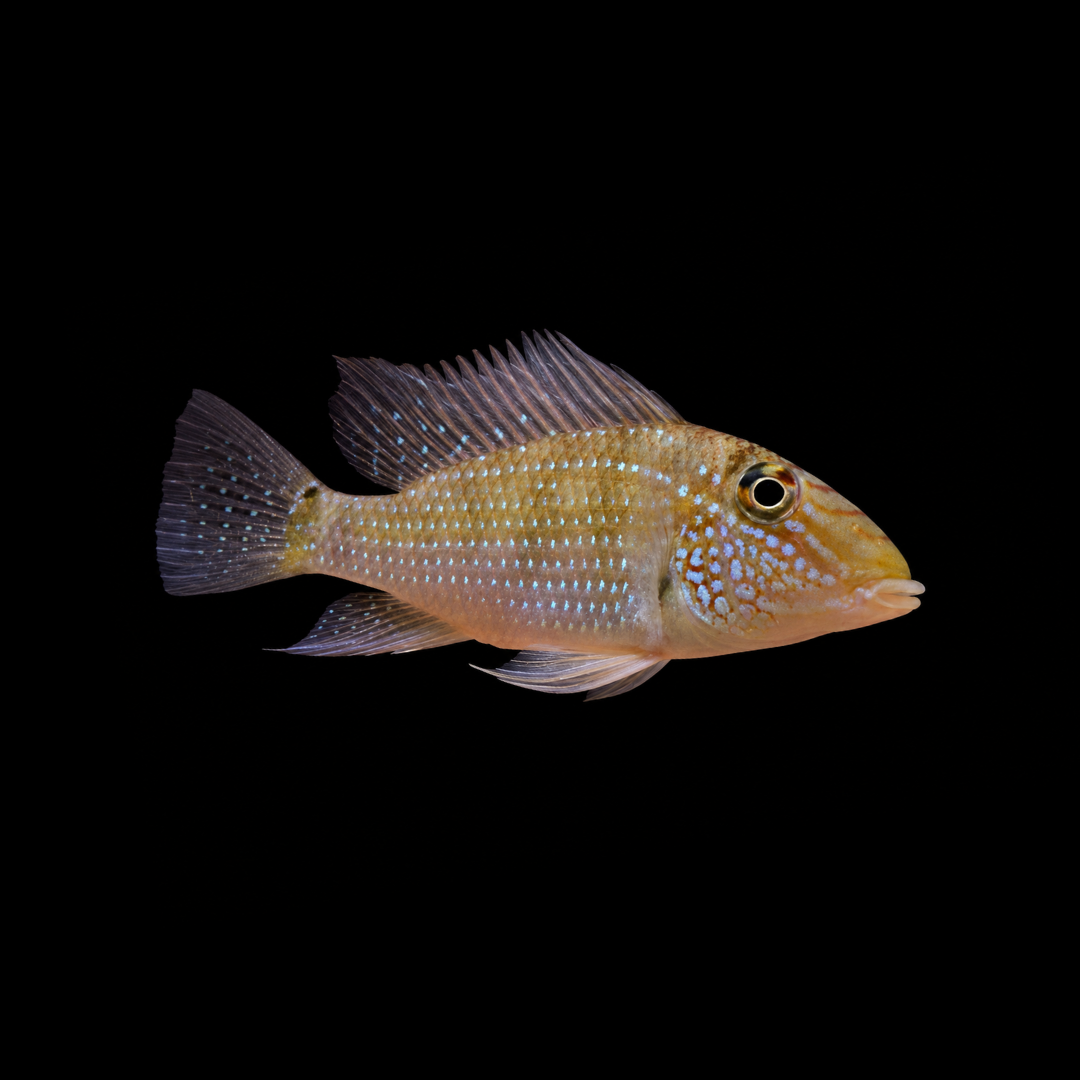
解説 / Description
サタノペルカ・ジュルパリは、南米アマゾン水系に分布するシクリッドの一種です。長く伸びた吻と小さな口、落ち着いた銀褐色の体に浮かぶ青緑色の光沢が美しく、何よりも底砂を口いっぱいに含み、食物を選り分けながら砂を排出する「アースイーター」らしい行動が大きな魅力です。見た目の迫力に反して性格は比較的温和ですが、成魚は20cm級になるため、広い底面と十分な遊泳空間が必要です。複数飼育する場合は、細かな砂を広く確保できる大型水槽を前提に計画します。国内では近縁種のサタノペルカ・レウコスティクタが「ジュルパリ」の名で流通してきた経緯があり、購入時には産地、入荷名、頭部の模様などを合わせて確認することが大切です。 Satanoperca jurupari is a South American cichlid native to the Amazon basin. Its long snout, small mouth, subdued silver-brown body and blue-green iridescence give it an elegant appearance, while its most characteristic behavior is that of an “eartheater”: it takes mouthfuls of substrate, sorts out edible material and expels the remaining sand. Despite its substantial adult size, it is generally peaceful. Adults can exceed 20 cm in total length, so they require a broad footprint and ample swimming space. If several fish are kept together, long-term care should be planned around a large aquarium with an extensive area of fine sand. In Japan, the closely related Satanoperca leucosticta has historically been sold under the name “jurupari,” so locality, import information and head markings should be considered together when purchasing fish.
基本情報 / Basic Information
| 学名 / Scientific Name | Satanoperca jurupari (Heckel, 1840) |
|---|---|
| 通称 / Common Name | ジュルパリ、サタノペルカ・ジュルパリ、アースイーターJurupari eartheater, demon eartheater |
| 分類 / Family | 条鰭綱・シクリッド目・シクリッド科・シクリッド亜科・ゲオファーガス族・サタノペルカ属Actinopterygii; Cichliformes; Cichlidae; Cichlinae; tribe Geophagini; genus Satanoperca |
| 英名 / English Name | Demon Eartheater / Jurupari Eartheater |
| 分布 / Distribution | 南米アマゾン川流域。ブラジル、ペルー、コロンビアなどから記録されています。ただし「S. jurupari」とされてきた地域個体群の一部には近縁種や未記載系統が含まれる可能性があり、サタノペルカ・ジュルパリ種群の分類は現在も整理が続いています。原記載のタイプ産地はブラジルのアマゾン川とネグロ川の合流域付近です。Amazon River basin in South America, with records from Brazil, Peru, Colombia and adjoining Amazonian regions. Some populations historically identified as S. jurupari may represent related or undescribed lineages, so the taxonomy of the S. jurupari species group remains an active area of study. The original type locality is near the mouth of the Rio Negro in the Amazon River, Brazil. |
| 最大体長 / Max Size | 標準体長で約18.5cm、全長では20〜25cmほどになる個体があります。飼育計画は25cm級を想定すると安全です。About 18.5 cm standard length, with some individuals reaching roughly 20–25 cm total length. Planning for a fish in the 25 cm class is prudent. |
| 寿命 / Lifespan | 本種について、信頼できる種別の寿命統計は十分に整っておらず、確定的な年数は示しにくいのが現状です。大型シクリッドとして長期飼育を前提に、将来の水槽サイズや設備まで見越して飼育計画を立ててください。Reliable species-specific longevity data are limited, so a definitive lifespan is difficult to state. As a relatively large cichlid, it should be treated as a long-term commitment, with future tank size and equipment planned accordingly. |
飼育環境 / Aquarium Environment
| 水槽サイズ / Tank Size | 成魚を5〜6匹程度のグループで長期飼育するなら、180cmクラス、できれば180×60×60cm前後の大型水槽を推奨します。公称水量は約650Lですが、実水量は底砂やレイアウトで少なくなります。若魚は120cmワイド水槽などで育成できますが、終生飼育用としては底面積が不足しやすいため、成長に合わせて大型化してください。水槽、架台、水、底砂を合わせると総重量が大きくなるため、床の耐荷重確認も欠かせません。For a long-term group of about five to six adults, a 180 cm-class aquarium is recommended, ideally around 180 × 60 × 60 cm. Nominal volume is about 650 L, although actual water volume will be lower after substrate and décor are added. Juveniles can be grown in a 120 cm wide tank, but this is usually inadequate as a permanent adult setup because floor area becomes limiting. The combined weight of the aquarium, stand, water and sand can be substantial, so floor load must also be considered. |
|---|---|
| 水温 / Temperature | 25〜29℃を中心に管理し、急変を避けます。輸入直後や治療中は、単に高温へ上げるのではなく、病状と溶存酸素量を見ながら安定を優先してください。 Maintain roughly 25–29°C and avoid sudden fluctuations. After import or during treatment, stability and oxygenation are more important than simply raising the temperature. |
| 水質 / Water Quality | 弱酸性〜中性を基本に、軟水〜中程度の硬度で安定させます。目安はpH5.5〜7.5前後ですが、数値を急激に動かすことは避けてください。流木、モモタマナの葉、ハンノキの実などによるタンニンの添加は自然感を高める方法の一つですが、ブラックウォーター化そのものは必須条件ではありません。アンモニアと亜硝酸は検出されない状態を維持し、硝酸塩も低く抑えます。週1回30〜50%程度の換水を基準に、給餌量や飼育密度に応じて調整すると管理しやすくなります。Slightly acidic to neutral water with soft to moderate hardness is suitable. A practical target is around pH 5.5–7.5, but rapid chemical adjustment should be avoided. Driftwood, Indian almond leaves and alder cones can add tannins and a natural appearance, but strongly blackwater conditions are not mandatory. Ammonia and nitrite should remain undetectable, and nitrate should be kept low. A weekly water change of roughly 30–50% is a useful baseline, adjusted according to feeding and stocking density. |
| レイアウト / Layout | 最重要なのは、口に含んで鰓から排出できる細かく角のない砂です。田砂、細目の珪砂などを広く敷き、砂をふるう行動を十分に行える面積を確保します。流木や丸みのある石で視線を遮りつつ、泳ぐ空間と砂地を残してください。石や流木は掘り返しで崩れないよう底面から安定させます。水草は掘り起こされやすいため、アヌビアス類やミクロソリウム類などを流木や石に活着させる方法が扱いやすく、浮草も利用できます。The most important feature is fine, smooth sand that can be taken into the mouth and expelled through the gills without injury. Fine silica sand or similarly rounded aquarium sand should cover a broad area so the fish can sift naturally. Use driftwood and smooth stones to break lines of sight while leaving open swimming and feeding space. Heavy décor must be supported securely because the fish will excavate around it. Rooted plants are often disturbed, so epiphytes such as Anubias and Microsorum attached to wood or rock, as well as floating plants, are easier to maintain. |
| 注意点 / Precautions | 粗い砂利や尖った底床は、口周りや鰓を傷つけるおそれがあるため避けます。複数飼育では成長に伴って順位争いが見られ、繁殖ペアができると産卵場所の周囲を強く守ることもあるため、逃げ場と広い底面積を確保してください。濾過だけに頼らず、底床にたまる有機物を定期的に取り除き、十分な水流とエアレーションで酸素不足を防ぎます。Avoid coarse or sharp gravel because it may injure the mouth and gills. In group settings, social disputes can become more noticeable as the fish mature, and breeding pairs may defend the area around a spawning site, so provide visual barriers and ample floor space. Do not rely on filtration alone: remove accumulated organic waste from the substrate and maintain adequate circulation and aeration to prevent oxygen depletion. |
餌と給餌 / Feeding
| 餌の種類 / Diet | 沈下性の小粒シクリッドフードや高品質な顆粒飼料を主食にし、冷凍赤虫、ブラインシュリンプ、ミジンコ、細かくしたオキアミなどを副食として組み合わせます。自然下では底床中の小型無脊椎動物、甲殻類、昆虫、植物質やデトリタスなどを取り込むため、動物性一辺倒ではなく植物質を含む総合飼料も有効です。Use small sinking cichlid pellets or high-quality granules as the staple diet, supplemented with frozen bloodworm, brine shrimp, daphnia and finely chopped krill. In nature the fish obtains small invertebrates, crustaceans, insects, plant material and detritus while sifting the substrate, so a balanced prepared food containing some plant-derived ingredients is preferable to an exclusively animal-based diet. |
|---|---|
| 給餌のポイント / Feeding Tips | 大きな餌を一度に与えるより、小さな餌を砂面に広く落とし、1日2〜3回に分けて食べさせると本来の採餌行動を引き出しやすくなります。口が見た目ほど大きくないため、成魚でも粒の小さな餌を好みます。砂に残った餌は水質悪化の原因になるので、給餌量は数分で食べ切れる範囲に調整してください。Rather than offering a few large items, distribute small foods over the sand and feed two to three modest meals per day. This encourages natural foraging behavior. The mouth is smaller than the adult body size suggests, so even mature fish often prefer relatively small food particles. Uneaten food trapped in the sand can degrade water quality, so portions should be adjusted to what is consumed promptly. |
性格と混泳 / Temperament and Tank Mates
| 性格 / Temperament | 大型になる南米シクリッドとしては温和な部類です。普段は底層から中層をゆったり移動し、群れの中で緩やかな順位関係をつくります。ただし同種間の小競り合いはあり、繁殖期にはペアが産卵場所の周囲を強く防衛することがあります。For a relatively large South American cichlid, this species is generally peaceful. It spends much of its time moving calmly through the lower and middle zones and forms a social hierarchy within the group. Minor conspecific disputes are normal, and breeding pairs can defend the spawning area much more vigorously. |
|---|---|
| 混泳の相性 / Compatibility | 同程度の水温と水質を好む温和な中型カラシン、メチニス類、穏やかなロリカリア科のナマズなどと合わせやすい魚です。上層〜中層を泳ぐ魚がいると警戒心が和らぐこともあります。一方、底層を強く縄張り化する攻撃的な大型シクリッド、執拗に追い回す魚、口に入るほど小さな魚との混泳は避けてください。コリドラス類とは性格上は合わせやすいものの、底床の餌を競合するため十分な面積と給餌管理が必要です。Compatible choices include peaceful medium-sized characins, silver dollars and mild loricariid catfishes that prefer similar water conditions. Active fish in the upper and middle layers can also help reduce shyness. Avoid highly territorial bottom-dwelling cichlids, persistent bullies and fish small enough to be swallowed. Corydoras are often behaviorally compatible, but they share the feeding zone, so adequate floor space and careful food distribution are needed. |
病気と対策 / Diseases and Prevention
| かかりやすい病気 / Common Diseases | 輸入や移動後には白点病などの寄生虫症、鰓や体表の細菌感染、擦れ傷に続いて生じる潰瘍性病変などに注意します。エロモナス属細菌による体表の「穴あき病」と、シクリッドで頭部の感覚孔周辺に侵食が生じる頭部穴あき症状(HITH)は、同じ「穴あき」という言葉で呼ばれることがありますが、同一の病態とは限りません。HITHの原因は一つに確定しておらず、寄生性鞭毛虫や栄養条件など複数の要因が研究されています。After import or relocation, watch for parasitic diseases such as ich, bacterial infections of the skin or gills, and ulcerative lesions that develop after abrasions. Aeromonas-associated ulcer disease and the erosive lesions around sensory pores known as hole-in-the-head disease (HITH) in cichlids may both be described with similar “hole” terminology, but they should not automatically be treated as the same condition. The cause of HITH has not been established as a single factor; parasitic flagellates, nutritional conditions and other possible contributors have been investigated. |
|---|---|
| 対策と予防 / Prevention | 予防の基本は、細かく滑らかな砂、清浄な底床、安定した水温、十分な酸素、定期的な換水、偏りのない食事です。新規導入魚は、可能であれば別水槽で状態を確認してから合流させます。明確な潰瘍や体表欠損があり、エロモナス属による穴あき病が疑われる場合、国内ではオキソリン酸製剤の観パラDが承認されています。使用時は必ず最新の添付文書を優先し、規定量は水10Lあたり1mL、早期治療では4時間、治療では5〜7日間の薬浴です。pH5.0以下では使用せず、活性炭やゼオライトを外し、他の薬剤を加えて使用しないでください。規定期間が終了したら、効果の有無にかかわらず使用を中止し、自己判断で繰り返し投薬しないことも重要です。原因が不明な場合や、病変が急速に広がる、呼吸障害を伴うといった場合は、薬を重ねるより魚病に詳しい獣医師や専門家への相談を優先してください。Prevention starts with smooth fine sand, a clean substrate, stable temperature, adequate oxygenation, regular water changes and a balanced diet. New fish should ideally be observed in quarantine before joining the main aquarium. In Japan, the oxolinic-acid product Kanpara D is approved for Aeromonas-associated ulcer disease in ornamental fish. Always follow the current label: the stated dose is 1 mL per 10 L, with a 4-hour bath for early treatment or 5–7 days for treatment. Do not use it below pH 5.0, remove activated carbon and zeolite, and do not add other medications to the treatment water. Once the stated treatment period has ended, use should be stopped regardless of apparent effect rather than repeated on the keeper’s own judgment. If the cause is uncertain, lesions progress rapidly or breathing problems develop, seek advice from a veterinarian or fish-health specialist rather than layering medications. |
増やし方(繁殖) / Breeding
| 雌雄の判別 / Sexing | 外見だけでの確実な判別は難しい魚です。成熟するとオスがやや大型化し、ヒレの伸長や体つきに差が出ることがありますが、個体差が大きいため決定打にはなりません。複数の若魚を育て、自然に形成されたペアを観察する方法が最も現実的です。Reliable visual sexing is difficult. Mature males may become somewhat larger and can show more fin extension or a heavier profile, but individual variation is substantial. Raising a group of juveniles and allowing pairs to form naturally is the most practical approach. |
|---|---|
| 繁殖形態 / Reproduction | 卵を口腔内で保護する卵好性のマウスブリーダーとして知られています。ペルー産個体群の飼育記録では、メスが受精した卵を産卵直後に口へ取り込む即時型の口腔保育が報告されています。ただし、この記録は特定の個体群に基づくため、すべての地域個体群で行動が同一とは断定できません。なお、1958年にGeophagus jurupariの名で報告された「卵を基質上で約1日守ってから口へ取り込む」繁殖観察は、後の分類学的検討によってSatanoperca leucostictaの記録とみなされています。仔魚は成長初期に親の口腔を避難場所として利用します。This species is known as an ovophilous mouthbrooder, protecting the eggs in the buccal cavity. In an aquarium record involving a Peruvian population, the female collected fertilized eggs into her mouth immediately during spawning. Because that observation concerned a particular population, it should not be assumed that every geographic population behaves identically. Importantly, the often-cited 1958 account published under the name Geophagus jurupari, in which eggs remained on the substrate for about a day before oral incubation, was later regarded on taxonomic grounds as a record of Satanoperca leucosticta. Developing fry use the parental mouth as a refuge during early life. |
| 繁殖のポイント / Breeding Tips | 十分に成熟した個体、細砂、平らな産卵面、落ち着いた環境、安定した水質を整えることが基本です。産卵期には縄張り意識が強まるため、混泳水槽では他魚が追い詰められない広さと逃げ場を確保してください。口腔保育中の親魚は、無理に移動・捕獲せず静かに観察する方が安全です。稚魚が自由遊泳を始めたら、孵化直後のブラインシュリンプ幼生や微細な人工飼料を少量ずつ与えます。強制的なストリッピングは親魚と仔魚の双方に負担がかかるため、繁殖経験と明確な目的がある場合に限って検討してください。Provide mature fish, fine sand, a flat spawning surface, a quiet environment and stable, high-quality water. Territoriality increases during spawning, so a community aquarium must offer enough space and refuge that other fish are not continually cornered. A mouthbrooding parent is best observed without unnecessary capture or transfer. Once the fry are free-swimming, offer newly hatched brine shrimp and very fine prepared foods in small portions. Forced stripping can stress both the parent and the brood and is best reserved for experienced breeders with a clear reason to intervene. |
雑学と豆知識 / Trivia and Fun Facts
| 1. 1840年の「ゲオファーガス」から始まった分類史 / 1. From Geophagus in 1840 to modern Satanoperca | ジュルパリは1840年、ヨハン・ヤーコプ・ヘッケルによってGeophagus jurupariとして記載されました。現在の属名Satanopercaはアルベルト・ギュンターが1862年に設けたもので、その後の形態学と分子系統学の研究によって、サタノペルカ属がゲオファーガス族の中でまとまりのある系統であることが支持されています。長い吻と小さな口だけでなく、背ビレと尻ビレの鰭条間膜に鱗を欠くこと、尾部の椎骨にも肋骨を持つこと、浮き袋が後方へ伸びることなど、外からは見えにくい形質も属の診断に使われます。近年もトカンチンス水系からSatanoperca setepeleが記載され、S. jurupariとして扱われてきた個体群の中にも未整理の系統が示されていることから、この仲間の分類は今なお検討が続いています。Jurupari was described by Johann Jakob Heckel in 1840 as Geophagus jurupari. The modern genus Satanoperca was established by Albert Günther in 1862, and later morphological and molecular studies have supported Satanoperca as a coherent lineage within Geophagini. The genus is recognized not only by its long snout and small mouth but also by less visible characters, including the absence of scales on the inter-radial membranes of the dorsal and anal fins, ribs on caudal vertebrae and posterior extensions of the swim bladder. Taxonomic work is still continuing: Satanoperca setepele has been described from the Tocantins basin, and some populations formerly treated broadly as S. jurupari remain taxonomically unresolved. |
|---|---|
| 2. 「悪魔の魚」という名前は、魚の性格を表していない / 2. A “demon fish” with a misleadingly fierce name | Satanopercaという属名は、ギリシャ語の「悪魔」を意味する語と「パーチ」を意味する語を組み合わせた名称で、「悪魔のパーチ」といった意味合いを持ちます。ただし、この名前は魚の性格を表したものではなく、ジュルパリ自体は大型シクリッドとしては比較的温和です。種小名jurupariはアマゾン地域の在来名に由来し、「悪魔」などと訳されてきましたが、Jurupari/Yuruparíが指す文化的概念を西洋的なサタンと一対一で置き換えることはできません。The genus name Satanoperca combines Greek terms associated with a “demon” and a “perch,” giving the name the sense of a “demon perch.” This is not a description of the fish’s temperament; jurupari is comparatively peaceful for a large cichlid. The species name jurupari derives from an Amazonian vernacular name and has often been translated using words such as “demon,” but the cultural ideas represented by Jurupari or Yuruparí cannot be equated one-for-one with the Western concept of Satan. |
| 3. ジュルパリ神話は「森の悪霊」だけでは語れない / 3. Yuruparí is more than a “forest demon” | 北西アマゾンでは、Yuruparí/Jurupariという呼称は、単一の神格だけでなく、神話的・祖先的な存在、神聖な笛やラッパ、男性の通過儀礼などと結びつく複合的な宗教文化として記録されています。その意味や物語は地域や民族によって異なるため、ひとまとめに「森の悪霊」と説明するのは適切ではありません。ヨーロッパ側の記録では「悪魔」に近い語で説明されてきた歴史もあり、魚の学名に残る強い印象の背後には、異なる文化の概念を別の言語へ置き換えてきた過程があります。In the northwestern Amazon, the names Yuruparí or Jurupari have been recorded in connection not with a single uniform deity but with a broader religious complex involving mythic or ancestral beings, sacred flutes and trumpets, and male initiation rites. Meanings and narratives vary among peoples and regions, so reducing the entire complex to a simple “forest demon” is misleading. European-language records have also described these Indigenous concepts using terms comparable to “devil,” and the striking scientific name therefore reflects a history of translation between very different cultural frameworks. |
| 4. 砂を「食べる」のではなく、砂の中の食物をふるい分けている / 4. It does not eat sand; it sorts food from sand | アースイーターの採餌は、底砂を口に吸い込み、口腔と鰓の構造を使って食物だけを選別し、不要な砂を口や鰓蓋側から排出する「ウィノウィング」と呼ばれる行動です。ゲオファーガス族では第一上鰓骨周辺に発達した上鰓葉が見られ、この構造は底質をふるう採餌への適応と考えられています。サタノペルカ属では鰓耙の配置にも独特の特徴があり、見た目には単純な「砂をもぐもぐする」動作の裏で、吸水、選別、排出という精密な処理が連続しています。だからこそ、細砂は飾りではなく、この魚の行動と健康を支える飼育設備の一部です。The eartheater feeding method is better understood as winnowing. The fish sucks up substrate, separates edible material within the oral and branchial cavities, and expels unwanted sand through the mouth or opercular openings. Geophagine cichlids possess an expanded region of the first epibranchial known as an epibranchial lobe, a structure associated with substrate-sifting feeding. Satanoperca also has distinctive gill-raker arrangements. What looks like simple “sand chewing” is therefore a sequence of suction, sorting and ejection, which is why fine sand is not merely decorative but an important part of the animal’s functional environment. |
| 5. 「ジュルパリ」と「レウコスティクタ」は国内流通で今も混同される / 5. Jurupari and leucosticta are still confused in the aquarium trade | 日本では長年、サタノペルカ・レウコスティクタが「ジュルパリ」の名で流通してきた経緯があり、現在も「ジュルパリ」として入荷した幼魚についてレウコスティクタの可能性を注記する販売例があります。分類学的には、S. leucostictaの頭部に見られる小さな淡色斑は重要な識別点の一つです。一方、S. jurupariでも頭部の暗色線が成長に伴って分断され、斑点状に見えることがあるため、「斑点があるかないか」だけで判断するのは危険です。幼魚や流通個体は写真一枚で断定せず、産地、入荷名、成長後の頭部模様を合わせて確認するのが現実的です。In Japan, Satanoperca leucosticta has long been associated with the commercial name “jurupari,” and current retail listings may still warn that juveniles imported under that name could prove to be leucosticta. Taxonomically, small pale spots on the head are one useful character of S. leucosticta. However, the dark head stripes of S. jurupari can fragment into spot-like markings as the fish grows, so identification should not be reduced to a simple “spots present or absent” rule. Juveniles and trade specimens are best assessed using locality, invoice information and the head pattern that develops with growth rather than a single photograph. |
| 6. 産地情報と入荷名は、後の再同定にも役立つ / 6. Locality and invoice data can support later re-identification | サタノペルカ・ジュルパリ種群では、地域個体群の一部に未整理の系統が含まれる可能性が指摘されています。そのため、流通名だけで種名を断定するより、ワイルドかブリードか、採集地や輸出地としてどのような情報が付いていたか、どの入荷名で扱われたかを残しておくことに意味があります。Satanoperca cf. jurupariやSatanoperca sp.として入荷した個体も、無理に「真正ジュルパリ」と言い切らず、元の情報を保持する方が、将来分類が整理された際の再確認に役立ちます。Within the Satanoperca jurupari species group, some geographic populations are still thought to include unresolved lineages. For that reason, it is often more useful to preserve information about wild or captive-bred origin, collection or export locality, and the original invoice name than to force every trade fish into a definitive species identification. Specimens imported as Satanoperca cf. jurupari or Satanoperca sp. are best documented with those original data intact, which may allow more accurate re-identification as the taxonomy is refined. |
| 7. 1958年の有名な繁殖記録には、分類学上の注意が必要 / 7. The famous 1958 breeding record needs a taxonomic caution | 1958年にはGeophagus jurupariの名で、産卵後しばらく卵を基質上で守ってから両親が口に取り込む詳細な繁殖観察が発表されました。この記録は長く「ジュルパリの繁殖」として引用されてきましたが、後の分類学的検討では、観察された魚は現在のSatanoperca leucostictaに当たるとされています。一方、ペルー産のS. jurupariでは産卵直後に卵を口へ取り込む観察例があります。古い文献を読むときは、当時使われていた学名が現在の種の範囲と同じとは限らないことが、この仲間では特に重要です。In 1958, a detailed breeding study was published under the name Geophagus jurupari, describing eggs guarded on the substrate for a period before being taken into the mouths of both parents. That account was long cited as the breeding behavior of “jurupari,” but later taxonomic work regarded the fish in the study as what is now Satanoperca leucosticta. By contrast, a Peruvian population identified as S. jurupari has been observed collecting eggs into the mouth immediately during spawning. This is a useful reminder that an older scientific name does not always refer to exactly the same species concept used today. |
| 8. 「穴あき病」という同じ日本語が、別の病態を指すことがある / 8. One Japanese disease name can refer to very different problems | シクリッド飼育では英語のHole-in-the-head diseaseを「穴あき病」と訳すことがありますが、日本の観賞魚用医薬品で適応症として示される「穴あき病」は、エロモナス属細菌による体表の潰瘍性疾病を指します。名称が似ていても、頭部の感覚孔周辺に生じる侵食と、体表にできる細菌性潰瘍を同じ病態と決めつけることはできません。治療を選ぶ際は病名だけで判断せず、病変がどこに現れ、どのような形で、どの程度の速さで広がっているかを確認することが重要です。Among cichlid keepers, the English term hole-in-the-head disease is sometimes translated into Japanese with the same words used for “anaaki-byo.” In approved Japanese ornamental-fish medicine, however, anaaki-byo refers to ulcerative disease associated with Aeromonas bacteria. Similar terminology does not make erosions around the sensory pores of the head and bacterial ulcers of the body the same condition. Treatment decisions should therefore begin with the location, appearance and rate of progression of the lesion rather than the disease name alone. |
まとめ / Conclusion
サタノペルカ・ジュルパリの魅力は、派手さだけではなく、細砂を何度も口に含みながら静かに底層を動く独特の生活感にあります。180cmクラスの広い底面、滑らかな細砂、清浄で十分に酸素を含む水を用意すると、長い吻を砂へ差し込み、食物を選り分ける本来の採餌行動を日常的に観察できます。大型になるシクリッドでありながら比較的穏やかで、広い南米水景の中で落ち着いた存在感を見せてくれる魚です。 The appeal of Satanoperca jurupari lies not in bright coloration alone, but in the quiet presence of a fish that repeatedly takes fine sand into its mouth while moving over the bottom. With the broad footprint of a 180 cm-class aquarium, smooth sand and clean, well-oxygenated water, its characteristic feeding behavior—placing the long snout into the substrate and sorting edible material—can become part of everyday observation. It grows into a substantial cichlid yet remains comparatively peaceful, giving a spacious South American aquarium a calm, distinctive presence.
飼育では、細砂を使える広い底面と安定した水質を優先し、流通名だけでなく産地や入荷情報にも目を向けることが大切です。近縁種との混同が起こりやすい仲間だからこそ、無理に同定を急がず、成長とともに変わる模様を観察しながら長く付き合うことで、ジュルパリらしい落ち着いた姿と砂をふるう行動を十分に楽しめます。 Successful long-term care depends on prioritizing a broad area of fine sand and stable water quality, while also paying attention to locality and import information rather than relying on a trade name alone. Because closely related Satanoperca can be confused in commerce, identification need not be forced prematurely. Watching the markings develop as the fish matures, while providing conditions suited to natural sand-sifting behavior, allows the calm character of jurupari to be appreciated over the long term.

気になる道具や飼い方を見つけてみませんか?
 アイのアクアグッズ案内プレコ飼育に必要なもの|餌・流木・ろ過・隠れ家・掃除用品道具の特徴や使い方、選ぶときのポイントをアイが紹介します。記事はコチラ →
 アイのアクアグッズ案内水槽のエアーポンプの選び方|水深・音・泡で選ぶおすすめ用品道具の特徴や使い方、選ぶときのポイントをアイが紹介します。記事はコチラ →
 アイのアクアグッズ案内ベタの一匹飼いを楽しむ|水槽・ヒーター・ふた・フィルターの選び方ベタの一匹飼いに向く水槽容量、ふたと空気層、ヒーターと水温計、弱い水流のフィルターを、コタロウとアイの会話で分かりやすく解説します。記事はコチラ →
 アイのアクアグッズ案内カルキ抜き・水質調整剤の選び方|水換えと水槽の種類に合わせて選ぶ道具の特徴や使い方、選ぶときのポイントをアイが紹介します。記事はコチラ →
さまざまな飼育テーマをご紹介。リンク先の記事には広告・商品紹介が含まれます。
案内・紹介記事一覧へ →分布マップ
サタノペルカ・ジュルパリ(Satanoperca jurupari)は、南米のアマゾン川流域に分布し、ブラジル、ペルー、コロンビアなどから記録されています。地図ではアマゾン川流域の主要な分布地域が見渡せる範囲を概略表示しています。
※この地図は分布欄の記載をもとに、アマゾン川流域全体が見えるよう設定した概略表示です。マーカーは分布域を把握しやすくするため、アマゾン川とネグロ川の合流域付近を代表地点として示したもので、実際の採集地点を示すものではありません。また、本種群には分類学的に未整理の地域個体群が含まれる可能性があります。
参考文献
-
分類・学名・タイプ産地・分布
Fricke, R., Eschmeyer, W. N. & Van der Laan, R. (eds.). Eschmeyer's Catalog of Fishes: Genera, Species, References — Satanoperca jurupari (Heckel, 1840). California Academy of Sciences.
https://researcharchive.calacademy.org/research/ichthyology/catalog/fishcatget.asp?spid=16500 -
分類・形態・ペルー産個体群
Kullander, S. O. (1986). Cichlid Fishes of the Amazon River Drainage of Peru. Swedish Museum of Natural History, Stockholm.
https://svenkullander.se/publications/Kullander_Peru_1986.pdf -
近縁種識別・繁殖記録の再同定
Kullander, S. O. & Nijssen, H. (1989). The Cichlids of Surinam: Teleostei, Labroidei. E. J. Brill, Leiden. Satanoperca leucostictaの診断と、Reid & Atz(1958)がGeophagus jurupariとして扱った繁殖個体の再評価を含む。
https://brill.com/downloadpdf/display/title/503.pdf -
種群分類・頭部模様・未整理系統
Ota, R. R., Deprá, G. C., Kullander, S. O., Graça, W. J. & Pavanelli, C. S. (2021). A new species of Satanoperca (Teleostei: Cichlidae) from the Rio Tocantins basin, Brazil. Neotropical Ichthyology, 19(4), e210116. DOI: 10.1590/1982-0224-2021-0116.
https://doi.org/10.1590/1982-0224-2021-0116 -
分布・生息環境・体長・水質・食性・繁殖
Froese, R. & Pauly, D. (eds.). FishBase: Satanoperca jurupari (Heckel, 1840). World Wide Web electronic publication.
https://www.fishbase.se/summary/Satanoperca-jurupari -
底砂採餌・上鰓葉・食性形態
López-Fernández, H., Winemiller, K. O., Montaña, C. & Honeycutt, R. L. (2012). Diet-morphology correlations in the radiation of South American geophagine cichlids (Perciformes: Cichlidae: Cichlinae). PLoS ONE, 7(4), e33997. DOI: 10.1371/journal.pone.0033997.
https://doi.org/10.1371/journal.pone.0033997 -
ウィノウィング・底床の重要性
Weller, H. I., McMahan, C. D. & Westneat, M. W. (2017). Dirt-sifting devilfish: winnowing in the geophagine cichlid Satanoperca daemon and evolutionary implications. Zoomorphology, 136, 45–59. DOI: 10.1007/s00435-016-0335-6.
https://doi.org/10.1007/s00435-016-0335-6 -
繁殖・即時型口腔保育・飼育下観察
Newman, L. (1996). Spawning the Peruvian Satanoperca jurupari — A Case of Immediate Mouthbrooding. The Cichlid Room Companion. ペルー産個体群の飼育下繁殖を直接記録した一次観察資料。
https://cichlidae.com/article.php?id=37 -
歴史的繁殖記録
Reid, M. J. & Atz, J. W. (1958). Oral incubation in the cichlid fish Geophagus jurupari Heckel. Zoologica, 43, 77–88. 後年の分類学的検討では観察個体は現在のSatanoperca leucostictaに相当するとされる。
https://www.biodiversitylibrary.org/part/203376 -
頭部穴あき症状(HITH)
Amesberger-Freitag, A., Tichy, A., El-Matbouli, M. & Lewisch, E. (2019). Hole-in-the-head disease in discus fish, Symphysodon (Heckel, 1840): Is it a consequence of a dietary Ca/P imbalance? Journal of Fish Diseases, 42(8), 1133–1142. DOI: 10.1111/jfd.13023.
https://doi.org/10.1111/jfd.13023 -
エロモナス属による穴あき病・観パラD
農林水産省 動物医薬品検査所「動物用医薬品等データベース:観パラD」。効能・効果、オキソリン酸濃度、薬浴量・薬浴期間、pH、併用、ろ材、反復使用に関する使用上の注意を掲載。
https://www.vm.nval.go.jp/public/detail/5710




コメント