

解説 / Description
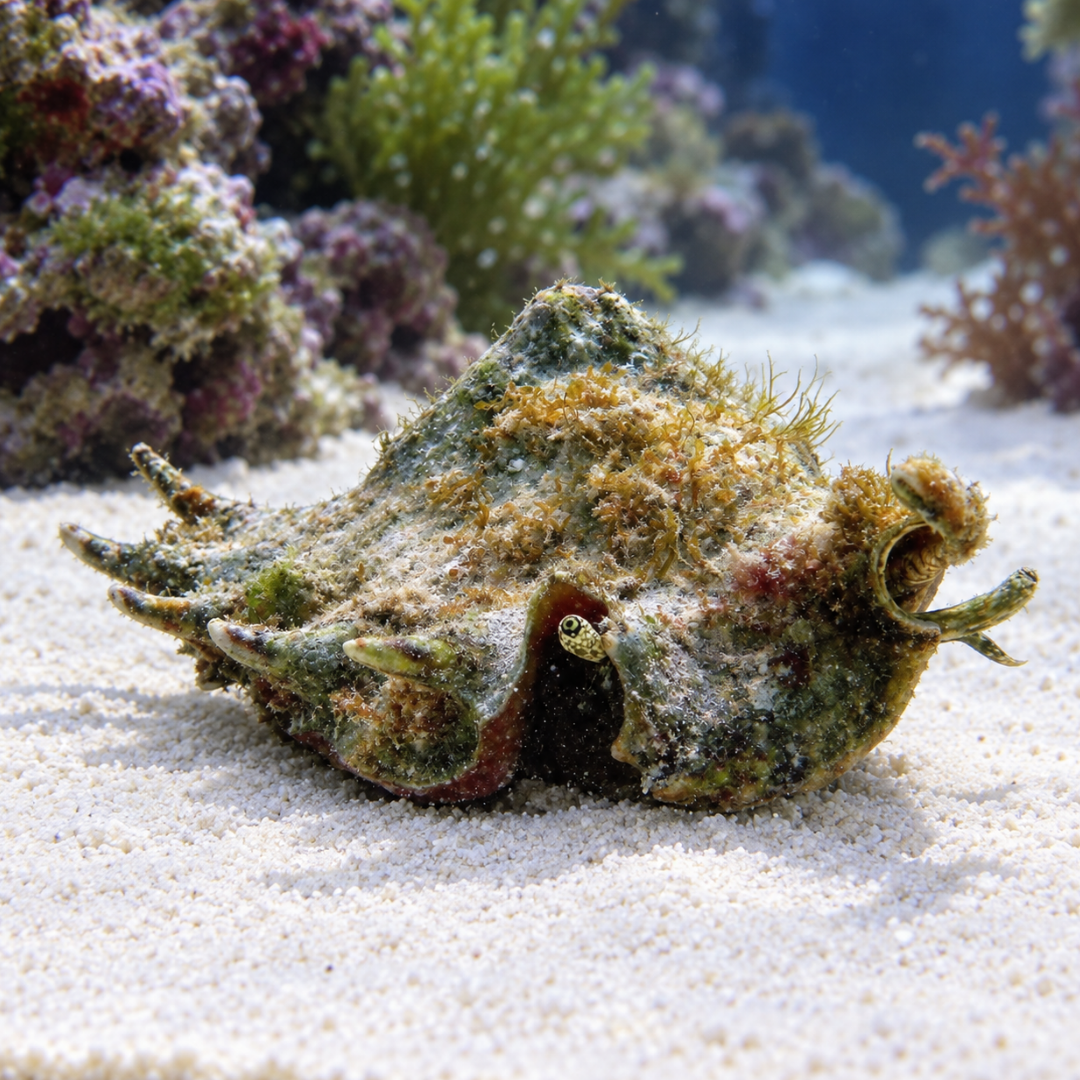
ムカデソデは、西太平洋の熱帯域に分布するソデボラ科クモガイ属の大型海産巻貝です。成貝では外唇から多数の短い指状突起が張り出し、殻口には褐色から紫褐色の地に白っぽい筋状の彫刻が並びます。一般的な巻貝のように足裏全体で滑るように進むのではなく、ソデボラ科に特徴的な細長い蓋を使い、殻を跳ね上げるように前進する独特の移動方法も大きな特徴です。水槽では十分な底面積と安定した海水環境を用意し、自然な採餌場所となる底砂や岩の表面を確保して飼育します。 Lambis millepeda is a large marine gastropod of the family Strombidae found in tropical parts of the western Pacific. Adults develop numerous short finger-like projections along the outer lip, while the aperture typically shows pale ridges over a brown to mauve-brown background. Rather than gliding smoothly on the entire foot like many familiar snails, strombids use their elongated operculum to propel the shell forward in a distinctive leaping motion. In an aquarium, this species should be provided with ample bottom area, stable marine water conditions, and suitable sand and hard surfaces on which it can forage naturally.
基本情報 / Basic Information
| 学名 / Scientific Name | Lambis millepeda (Linnaeus, 1758) |
|---|---|
| 通称 / Common Name | ムカデソデMilleped spider conch |
| 分類 / Family | 軟体動物門・腹足綱・新生腹足亜綱・吸腔目・ソデボラ上科・ソデボラ科・クモガイ属Phylum Mollusca, Class Gastropoda, Subclass Caenogastropoda, Order Littorinimorpha, Superfamily Stromboidea, Family Strombidae, Genus Lambis |
| 英名 / English Name | Milleped spider conch / Millipede spider conch |
| 分布 / Distribution | フィリピンからインドネシア南部、パプアニューギニア周辺にかけての西太平洋中部を中心に分布します。主な生息場所は潮間帯下部から数m程度までの浅い海域にある、さまざまな底質環境です。The species is centered in the central western Pacific, occurring from the Philippines through southern Indonesia to the Papua New Guinea region. It is mainly associated with shallow-water bottoms, from the lower intertidal zone to depths of a few metres. |
| 最大体長 / Max Size | 殻長は通常9~15cmほどです。最大値は資料によって差があり、15~16cm程度を上限とする資料がある一方、殻標本の記録ではそれを上回る大型個体も知られています。飼育では大型の巻貝として考えるのが安全です。Shell length is commonly around 9–15 cm. Reported maximum size varies among sources: some major references give approximately 15–16 cm, while shell-collection records include larger exceptional specimens. For aquarium purposes, it should be treated as a relatively large gastropod. |
| 寿命 / Lifespan | 本種について、飼育下を含めた明確な寿命年数を示せる情報は十分ではありません。特定の年数を目安として示すよりも、餌不足や急激な水質変化を避け、安定した環境を維持することが重要です。Reliable species-specific information establishing a precise lifespan, including under aquarium conditions, is limited. Rather than assigning an unsupported number of years, long-term care should focus on stable conditions and the prevention of chronic food shortages and abrupt water-quality changes. |
飼育環境 / Aquarium Environment
| 水槽サイズ / Tank Size | 本種だけを対象とした確立済みの最低水槽サイズは確認されていません。殻が10cmを超える大型種で、底面を使って移動することを考えると、飼育上は90cm規格水槽以上の底面積をひとつの目安とし、大型個体では120cmクラスなど、より広い底面を確保できる水槽を検討すると管理しやすくなります。水量だけでなく、実際に動ける砂地の広さを重視してください。No well-established species-specific minimum aquarium size has been documented. Because this is a large gastropod exceeding 10 cm in shell length and uses the aquarium floor actively, a 90 cm class aquarium or larger can serve as a practical starting point, while larger adults are easier to accommodate in tanks around the 120 cm class with greater floor area. Usable open substrate area is more important than water volume alone. |
|---|---|
| 水温 / Temperature | 熱帯の浅海域に生息する種です。ただし、本種について長期飼育に適した狭い温度範囲を断定できるだけの飼育資料は乏しいため、一般的な熱帯性海水水槽の範囲で安定させ、短時間で大きく変化させないことを優先します。 This is a tropical shallow-water species. However, species-specific long-term aquarium data are too limited to define a narrow ideal temperature range with confidence. Priority should therefore be given to stable tropical marine conditions and the avoidance of rapid temperature changes. |
| 水質 / Water Quality | 安定した海水環境を維持し、比重やpHを急変させないことが重要です。殻を形成・維持する生物であるため、一般的な海水水槽と同様にカルシウムやアルカリ度などが極端に不足しないよう管理します。ただし、特定のカルシウム値やマグネシウム値を本種固有の必須条件として扱える根拠は十分ではありません。Stable marine water conditions are important, particularly avoiding abrupt changes in salinity and pH. As a shell-forming organism, it should be maintained in seawater with adequate calcium and alkalinity, as would normally be expected in a well-managed marine aquarium. However, precise calcium or magnesium values should not be presented as proven species-specific requirements. |
| レイアウト / Layout | 細かな砂を使った広い底面を確保し、ライブロックなどを配置する場合も移動経路を狭くしすぎないようにします。自然界では浅い海底で生活するため、水槽内でも底砂や岩の表面を採餌場所として利用できる構成が適しています。粗い礫だけで底面を覆ったり、複雑な岩組みで移動場所をほとんど残さなかったりするレイアウトは避けたほうが管理しやすいでしょう。Provide a broad area of relatively fine sand, and if live rock is used, avoid restricting the animal’s movement with overly dense rockwork. Because the species naturally lives on shallow-water bottoms, a layout that provides both substrate and hard surfaces for foraging is appropriate. Aquariums covered entirely with coarse rubble or packed with complex rock structures leaving little usable floor space are less suitable. |
| 注意点 / Precautions | 導入時は輸送水と水槽水の温度や比重の差を確認し、急激な環境変化を避けます。また、外唇から張り出す突起と、殻全体を大きく動かす独特の移動方法を考慮し、岩やサンゴは簡単に倒れないよう安定させてください。大型個体を狭い隙間へ無理に入り込ませないレイアウトも重要です。When introducing the animal, check differences in temperature and salinity between shipping water and the aquarium and avoid abrupt environmental changes. The protruding shell digitations and forceful strombid locomotion also make stable rockwork important. The layout should not force a large individual to squeeze repeatedly through narrow gaps. |
餌と給餌 / Feeding
| 餌の種類 / Diet | ソデボラ科の巻貝は主に藻類などの植物質を利用し、デトリタスも摂食することで知られています。ムカデソデについても藻類を利用する食性が知られていますが、野生下でどの種類の藻類や有機物をどの割合で食べるかまで詳細に断定できる情報は多くありません。水槽では底砂や岩の表面に形成される藻類や付着物を利用させ、必要に応じて植物質を含む沈下性の餌を少量補助します。Strombid gastropods are primarily herbivorous grazers and may also consume detrital material. Lambis millepeda is associated with an algal diet, although detailed species-specific information on the exact proportions of individual algae and organic materials consumed in the wild is limited. In aquariums, naturally occurring growth on sand and rock can be utilized, with small amounts of sinking plant-based food offered when necessary. |
|---|---|
| 給餌のポイント / Feeding Tips | 大型になるため、底砂やライブロックが見た目にきれいだからといって、十分な餌があるとは限りません。特に立ち上げ直後の水槽や付着藻類がほとんどない水槽では、餌不足に注意します。一方で補助餌を大量に投入すると水質悪化につながるため、活動や摂餌の様子を観察しながら少量ずつ与えることが基本です。Because this species becomes relatively large, a visually clean sand bed or live rock does not necessarily contain enough food. Newly established aquariums and systems with very little natural algal growth require particular attention to food availability. Supplemental foods should still be offered sparingly, since excessive uneaten food can degrade water quality. |
性格と混泳 / Temperament and Tank Mates
| 性格 / Temperament | 基本的には底面や岩の表面で餌を探して生活する穏やかな巻貝で、魚を追い回して捕食するような生き物ではありません。ただし、細長い蓋を支点として殻を大きく動かすため、一般的な小型巻貝よりも移動時の力は強く、狭い場所では周囲の物に接触することがあります。It is generally a peaceful gastropod that spends its time foraging over the bottom and hard surfaces rather than pursuing fish as prey. However, because it moves its shell forcefully by using the elongated operculum as part of its locomotion, it can exert more physical force on surrounding objects than many small aquarium snails. |
|---|---|
| 混泳の相性 / Compatibility | 本種自身は攻撃的ではありませんが、貝類を捕食する魚や大型甲殻類、肉食性の巻貝との組み合わせには注意が必要です。また、殻が大きく外唇に突起があるため、小型で固定の弱いサンゴやフラグなどが密集した環境では、移動時の物理的な接触にも配慮します。混泳相手だけでなく、本種が無理なく移動できる空間を確保できるかどうかも重要です。The conch itself is not aggressive, but caution is appropriate with mollusc-eating fishes, large crustaceans, and predatory gastropods. Its large shell and projecting outer lip can also make physical contact with small or loosely secured coral fragments. Compatibility therefore depends not only on tank mates but also on whether sufficient open space is available for normal movement. |
病気と対策 / Diseases and Prevention
| かかりやすい病気 / Common Diseases | 本種について、観賞魚の白点病のように飼育下で頻発すると確認されている特定の病気はよく分かっていません。実際の飼育では、急激な水質変化、長期的な餌不足、水質悪化、殻の損傷など、病名を付けにくい飼育環境由来の不調に注意する必要があります。There is little species-specific information identifying a particular aquarium disease that commonly affects Lambis millepeda in the way that well-known diseases affect aquarium fishes. In practice, greater attention should be given to husbandry-related problems such as abrupt water-quality changes, chronic food shortage, deteriorating water conditions, and physical shell damage. |
|---|---|
| 対策と予防 / Prevention | 予防の基本は、比重や水温、pHを安定させ、十分な餌資源と移動スペースを確保することです。殻の縁や欠損部分、軟体部の状態、活動量などを定期的に観察し、普段と異なる状態が続く場合は水質と餌の量を確認します。海産無脊椎動物に有害となり得る薬剤を魚と同じ感覚で使用しないことも重要です。Prevention begins with stable salinity, temperature, and pH together with adequate food and space. Regularly observe the shell margin, damaged areas, exposed soft tissues, and overall activity. If abnormal behavior persists, check water quality and food availability. Medications that may harm marine invertebrates should not be used as casually as they might be in a fish-only system. |
増やし方(繁殖) / Breeding
| 雌雄の判別 / Sexing | ソデボラ科では雌雄が分かれている種が一般的ですが、ムカデソデについて、殻の大きさや突起の形だけから雌雄を確実に判定できる方法は十分に確認されていません。近縁のクモガイでは殻に明瞭な性的二形が知られていますが、その特徴をそのままムカデソデへ当てはめて判定するのは避けたほうが安全です。Separate sexes are common within Strombidae, but a reliable method for sexing Lambis millepeda solely from shell size or the shape of its digitations is not well established. Strong shell-based sexual dimorphism is documented in the related Lambis lambis, but those characters should not automatically be transferred to L. millepeda for identification of sex. |
|---|---|
| 繁殖形態 / Reproduction | ムカデソデそのものについて、産卵から幼生の成長までを詳しく追った繁殖情報は限られています。ソデボラ科では、雌がゼリー状の卵紐を産み、孵化後に浮遊性の幼生期を経る繁殖様式が知られています。本種についても、家庭水槽で成体同士を維持するだけでは完結しない幼生飼育が必要になると考えるのが適切です。Detailed species-specific information following Lambis millepeda from spawning through larval development is limited. In Strombidae, females are known to deposit gelatinous egg strings and the young pass through a planktonic larval stage after hatching. Breeding this species in captivity would therefore involve larval culture rather than simply maintaining a pair of adults. |
| 繁殖のポイント / Breeding Tips | 一般的な家庭用水槽で計画的に繁殖させるための確立した方法は確認されていません。仮に産卵まで進んでも、浮遊幼生を維持し、成長後に底生生活へ移行させる段階が必要になります。そのため、通常の観賞飼育とは別に幼生用の飼育環境を用意できなければ、繁殖までを目標とするのは難しい生体です。There is no well-established home-aquarium breeding method for this species. Even if spawning occurs, planktonic larvae would have to be maintained until they are ready to transition to benthic life. Breeding is therefore considerably more demanding than ordinary display maintenance and would require a dedicated larval-rearing system. |
雑学と豆知識 / Trivia and Fun Facts
| 1. リンネが1758年に記載した歴史ある種 / 1. A Species Described by Linnaeus in 1758 | ムカデソデは、カール・フォン・リンネが1758年の『自然の体系』第10版でStrombus millepedaとして記載した種です。リンネの記載には、さらに古い博物学書に掲載された図版も参照されています。その後、クモガイ類の分類が整理され、現在はLambis millepedaという学名が受け入れられています。18世紀に学名を与えられた貝が、分類体系を変えながら現在まで同じ生物として研究され続けていること自体が、本種の博物学上の長い歴史を物語っています。Lambis millepeda was formally described by Carl Linnaeus in the 10th edition of Systema Naturae in 1758 under the name Strombus millepeda. Linnaeus also referred to illustrations in earlier natural-history works. As spider-conch classification was subsequently reorganized, the accepted name became Lambis millepeda. Its history provides a clear example of how a species described in the 18th century can remain recognizable while the classification surrounding it changes. |
|---|---|
| 2. 名前の印象どおり、たくさんの「足」が並ぶ / 2. A Shell with Many “Legs” | 成貝の外唇には通常9本前後の短い指状突起が並び、これがムカデを思わせる独特の輪郭を作ります。特に下側の突起は殻頂方向へ曲がる傾向があり、殻口には白っぽい筋状の彫刻が多数見られます。学名のmillepedaや英名のMilleped spider conchも、多数の突起を持つ姿に由来する名前です。殻を観察するときは外側の突起だけでなく、褐色から紫褐色を帯びた殻口にも注目すると本種らしさがよく分かります。Adults usually carry about nine short finger-like digitations along the outer lip, creating the many-legged outline that gives the species its name. Several of the lower projections tend to curve toward the shell apex, while numerous pale ridges decorate the aperture. Both the species name millepeda and the common name “Milleped spider conch” refer to this many-legged appearance. The brown to mauve-brown aperture is also an important part of the species’ characteristic appearance. |
| 3. 巻貝らしくない「跳ねる」移動 / 3. The Characteristic Strombid “Leap” | ムカデソデが属するソデボラ科には、一般的な巻貝とは大きく異なる移動方法があります。足の先にある細長い蓋を底面へ引っ掛けるように使い、筋肉の力で殻を前方へ送り出します。そのため、一歩ずつ滑らかに進むというよりも、殻が断続的に跳ねるように見えます。この構造は重い殻を動かすだけでなく、捕食者から素早く距離を取る際にも役立つ、ソデボラ類を象徴する適応のひとつです。Strombids, including Lambis, use a form of locomotion very different from the smooth gliding familiar in many snails. The elongated operculum at the end of the foot is braced against the substrate, and muscular contractions propel the shell forward. The resulting movement appears as a series of intermittent leaps. This mechanism helps move a heavy shell and can also provide rapid bursts of movement during escape responses. |
| 4. 頑丈な殻は、成長し続ける生物材料 / 4. A Strong Shell That Is Still Living Architecture | ムカデソデの厚い殻は、主に炭酸カルシウムを主体とする無機成分と、有機成分が組み合わさって形成されています。これはムカデソデだけに特有の仕組みではなく、腹足類の殻に広く見られる生体鉱物形成の一例です。完成した標本だけを見ると硬い構造物に見えますが、生きている個体では外套膜の働きによって殻が形成・維持されています。そのため、飼育中の殻の状態は外見上の美しさだけでなく、長期的な飼育環境を見る手掛かりにもなります。The thick shell of Lambis millepeda is formed mainly from calcium-carbonate minerals together with organic components. This is not unique to the species but is part of the biomineralization process widely found in gastropod shells. An empty specimen may appear to be a finished inert structure, but in a living animal the shell continues to be produced and maintained by the mantle. Shell condition can therefore provide useful clues about long-term husbandry as well as appearance. |
| 5. 殻の奥から周囲を見る大きな眼 / 5. Prominent Eyes Watching from the Shell | ソデボラ類を生きた状態で見ると、貝殻だけでは分からない特徴が現れます。長い眼柄の先にはよく発達した眼があり、左右を別々に動かしながら周囲をうかがいます。ソデボラ類では視覚が逃避行動の方向を保つうえで役立つことも示されており、ゆっくり動く巻貝という一般的な印象とは異なる、活動的な一面を感じさせる器官です。A living stromb reveals features that are invisible in an empty shell. Well-developed eyes sit at the ends of long eyestalks and can survey the surroundings independently. Studies of strombids indicate that vision can contribute to maintaining the direction of escape behavior, revealing a much more active sensory life than the usual image of a slow-moving snail might suggest. |
| 6. 近縁種との交雑と考えられた標本もある / 6. Shells Interpreted as Hybrids Have Been Reported | クモガイ属では、二つの種の中間的な殻形を持ち、交雑個体と解釈された標本がいくつか報告されています。ムカデソデについても近縁種との交雑と考えられた例があります。ただし、こうした記録の中には主として殻の形態に基づいて判断されたものもあり、すべてを現在の遺伝学的な意味で確認済みの交雑例とみなすのは適切ではありません。個性的な殻を持つグループだからこそ、形態だけから分類する難しさを示す興味深い話題です。Several Lambis specimens with shell characters intermediate between two species have historically been interpreted as hybrids, and Lambis millepeda has been involved in some of these proposed combinations. However, some reports were based primarily on shell morphology, so they should not all be treated as genetically confirmed hybridization events. These examples are nevertheless useful reminders of how difficult classification can become in a group with highly variable and elaborate shells. |
| 7. フィリピンでは、他のクモガイ類ほど食用にされない / 7. Less Commonly Eaten Than Other Spider Conchs | ソデボラ科の大型巻貝には食用として利用される種類が多く、フィリピンの市場でもクモガイ類が扱われてきました。ただし、ムカデソデについては肉に苦味があるとされ、近縁のクモガイ類ほど頻繁には食べられないとする記録があります。一方で、美しい殻を目的として採集されることは多く、現地での利用を考える際には「食用の大型巻貝」と一括りにせず、本種と近縁種を区別することが大切です。Many large strombids are used as food, and spider conchs have long appeared in markets in the Philippines. Lambis millepeda, however, has been reported to have somewhat bitter flesh and to be eaten less often than other Lambis species. Its shell is an important reason for collection. It is therefore useful to distinguish this species from its relatives rather than treating all large spider conchs as having identical local uses. |
| 8. 「底砂掃除役」というより、底面を利用して暮らす生き物 / 8. A Bottom-Dwelling Grazer, Not a Cleaning Machine | 水槽では底砂や岩の表面を移動しながら餌を探すため、その活動が結果として底面の状態に影響することはあります。しかし、「底砂をきれいにしてくれる生物」とだけ考えると、本種に必要な餌や空間を見落としやすくなります。大型のムカデソデ自身も餌を食べ、排泄する水槽の一員です。濾過や水流、給餌量、底床管理の代わりにするのではなく、自然な採餌行動を観察できる大型巻貝として飼育するほうが、本来の姿を理解しやすいでしょう。In an aquarium, the animal searches for food while moving across sand and hard surfaces, so its activity can influence the condition of the substrate. However, treating it simply as a “sand cleaner” can obscure its own need for food and space. A large Lambis millepeda is itself a feeding and waste-producing member of the aquarium community. It is better regarded as a large grazing gastropod whose natural behavior can be observed, rather than as a replacement for filtration, circulation, feeding control, or substrate maintenance. |
まとめ / Conclusion
ムカデソデは、短い指状突起が並ぶ重厚な殻と、ソデボラ類ならではの跳ねるような移動をあわせ持つ大型の海産巻貝です。空の貝殻だけでも特徴的ですが、生きた個体では長い眼柄を動かしながら底面を探索し、独特の方法で殻を運ぶ姿を見ることができます。 Lambis millepeda is a large marine gastropod distinguished by its heavy shell with numerous short digitations and the characteristic leaping locomotion of strombids. Its empty shell is striking on its own, but a living animal reveals much more as it surveys the aquarium with elongated eyestalks, searches the bottom for food, and moves its shell in its unusual manner.
長期飼育では、大型になることを前提に十分な底面積を用意し、水質を安定させながら、底砂や岩の表面にある餌資源が不足していないかを見守ることが大切です。単なる掃除役としてではなく、浅い熱帯海域の底で独自の暮らし方を発達させた巻貝として観察すると、特徴的な殻だけでは分からないムカデソデの魅力が見えてきます。 For long-term care, adequate floor space should be provided with the animal’s adult size in mind, while water conditions are kept stable and food availability on sand and rock is monitored. Viewing the species not simply as a cleanup animal but as a specialized gastropod adapted to life on tropical shallow-water bottoms reveals much more of its character than the distinctive shell alone can show.

気になる道具や飼い方を見つけてみませんか?
 アイのアクアグッズ案内アフリカンシクリッドの飼育用品|水槽・ろ過・底砂・岩組み・餌の選び方道具の特徴や使い方、選ぶときのポイントをアイが紹介します。記事はコチラ →
 アイのアクアグッズ案内ローチの仲間に合わせる飼育用品|クーリー・流水性・ボーシャの水槽と底砂道具の特徴や使い方、選ぶときのポイントをアイが紹介します。記事はコチラ →
 アイのアクアグッズ案内エンゼルフィッシュの飼育用品|高さのある水槽・ろ過・水草・餌の選び方道具の特徴や使い方、選ぶときのポイントをアイが紹介します。記事はコチラ →
 アイのアクアグッズ案内グッピー・プラティ・モーリーを親子で楽しむ飼育用品|水槽・稚魚保護・ろ過・餌・水草道具の特徴や使い方、選ぶときのポイントをアイが紹介します。記事はコチラ →
さまざまな飼育テーマをご紹介。リンク先の記事には広告・商品紹介が含まれます。
案内・紹介記事一覧へ →分布マップ
ムカデソデ(Lambis millepeda)は、フィリピンからインドネシア南部、パプアニューギニア周辺にかけての西太平洋中部に分布します。
この地図は分布地域全体を把握するための概略表示です。表示範囲や代表地点は分布情報をもとに設定したもので、個々の生息地点を正確に示すものではありません。地図上のマーカーは表示上の代表地点であり、実際の採集地点を示すものではありません。
参考文献
-
MolluscaBase eds. (2026). Lambis millepeda (Linnaeus, 1758). World Register of Marine Species (WoRMS).
分類・学名・命名者・受容名の確認。
https://www.marinespecies.org/aphia.php?p=taxdetails&id=211099 -
Poutiers, J. M. (1998). Gastropods. In Carpenter, K. E. & Niem, V. H. (eds.), FAO Species Identification Guide for Fishery Purposes: The Living Marine Resources of the Western Central Pacific, Volume 1: Seaweeds, Corals, Bivalves and Gastropods, pp. 363–648. FAO, Rome. Lambis millepeda account: p. 478.
分布、浅海性の生息環境、殻長、形態、利用状況の確認。
https://www.fao.org/docrep/009/w7191e/w7191e00.htm -
Jagadis, I., Shanmugasundaram, K. & Padmanathan, J. (2012). Observations on broodstock maintenance, breeding and early larval development of the common spider conch Lambis lambis (Linnaeus, 1758) in captivity. Indian Journal of Fisheries, 59(2), 165–169.
近縁のクモガイ属における飼育環境、砂底、餌、交尾、卵紐、浮遊幼生期の参考資料。
https://eprints.cmfri.org.in/8995/ -
Cob, Z. C., Arshad, A., Ghaffar, M. A., Bujang, J. S. & Muda, W. L. W. (2009). Development and growth of larvae of the dog conch, Strombus canarium (Mollusca: Gastropoda), in the laboratory. Zoological Studies, 48(1), 1–11.
ソデボラ科におけるベリジャー幼生、浮遊幼生期、定着・変態と幼生飼育の参考資料。
https://zoolstud.sinica.edu.tw/issue.php?id=1241 -
Kohn, A. J. & Waters, V. (1966). Escape responses of three herbivorous gastropods to the predatory gastropod Conus textile. Animal Behaviour, 14(2–3), 340–345. DOI: 10.1016/S0003-3472(66)80094-5.
クモガイ属を含むソデボラ科の跳躍型移動と捕食者に対する逃避行動の確認。
https://doi.org/10.1016/S0003-3472(66)80094-5 -
Yanong, R. P. E. Use of Copper in Marine Aquaculture and Aquarium Systems. University of Florida IFAS Extension, FA165.
海水飼育環境での銅使用と、海産無脊椎動物に対する薬剤使用上の注意の参考資料。
https://ask.ifas.ufl.edu/publication/FA165




コメント