

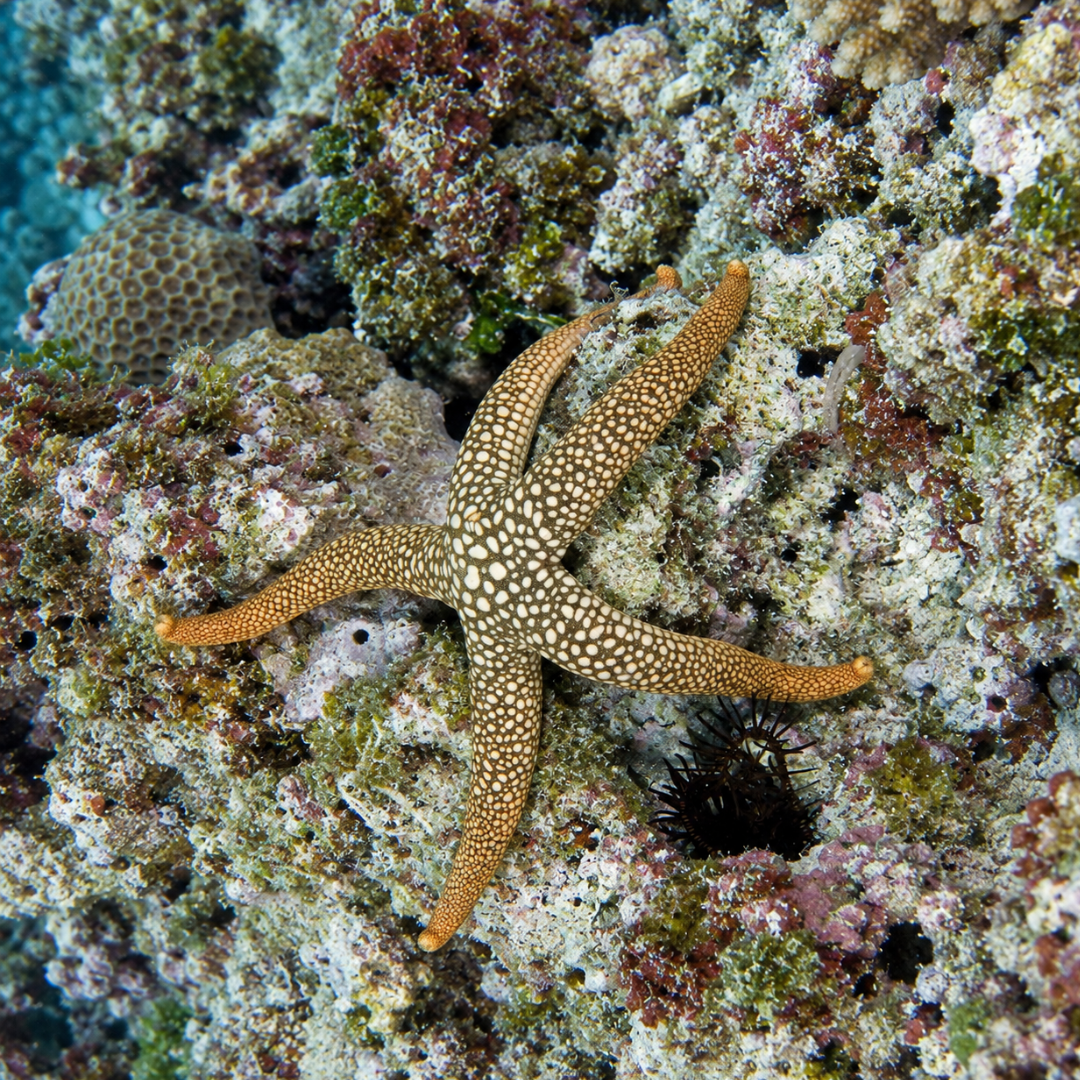
解説 / Description
イボヒトデは、インド西太平洋の熱帯・亜熱帯海域に分布するホウキボシ科のヒトデです。黄褐色から赤褐色を基調とする体に暗色の帯模様が入り、背面には和名の由来にもなった低い半球状のイボ状突起が不規則に並びます。岩礁やサンゴ礁の表面をゆっくり移動しながら、藻類や有機物の膜、デトリタスなどを利用し、小型の無脊椎動物を摂食することもあるとされています。飼育下では比較的温和ですが、長期飼育には安定した海水と十分な採餌面積を備えた成熟水槽が必要です。特に急な塩分変化と慢性的な餌不足を避けるため、導入時は慎重に水合わせを行い、ライブロック上に自然な餌資源が保たれる環境を整えることが重要です。 The warty sea star, Nardoa tuberculata, is a member of the family Ophidiasteridae distributed across tropical and subtropical waters of the Indo-West Pacific. Its yellowish-brown to reddish-brown body often bears darker bands, while low hemispherical tubercles are scattered irregularly across the upper surface, giving the species both its Japanese name and its scientific epithet. It moves slowly over rocky and coral-reef surfaces and is reported to use algal and organic films, detritus, and sometimes small invertebrates as food. In aquaria it is generally peaceful, but long-term care requires stable seawater and a mature system with ample grazing surface. Careful acclimation is important because abrupt salinity changes can be stressful, and the aquarium should provide a continuing supply of natural food on well-established live rock.
基本情報 / Basic Information
| 学名 / Scientific Name | Nardoa tuberculata Gray, 1840 |
|---|---|
| 通称 / Common Name | イボヒトデWarty sea star, Mottled sea star, Warty mesh sea star |
| 分類 / Family | 棘皮動物門・ヒトデ綱・アカヒトデ目・ホウキボシ科・Nardoa属Phylum Echinodermata, Class Asteroidea, Order Valvatida, Family Ophidiasteridae, Genus Nardoa |
| 英名 / English Name | Warty sea star / Mottled sea star / Warty mesh sea star |
| 分布 / Distribution | インド西太平洋の熱帯・亜熱帯域。フィリピン、インドネシア、オーストラリア、ミクロネシア、中国南部、アンダマン・ニコバル諸島などに分布し、日本では紀伊半島以南の温暖な海域、奄美群島、沖縄諸島を含む南西諸島などで見られます。潮間帯の礁池から水深約70mのサンゴ礁斜面・岩礁域まで記録されています。Tropical and subtropical Indo-West Pacific, including the Philippines, Indonesia, Australia, Micronesia, southern China, and the Andaman and Nicobar Islands. In Japan it occurs mainly in warm waters from the Kii Peninsula southward, including the Amami and Okinawa island groups of the Ryukyus. It has been recorded from shallow intertidal reef pools to coral and rocky slopes at depths of roughly 70 m. |
| 最大体長 / Max Size | 半径約10cmが目安で、腕の先端から反対側までの全幅は約20cm程度。About 10 cm in radius, or roughly 20 cm across from one arm tip to the opposite side. |
| 寿命 / Lifespan | 情報なし。野外・飼育下ともに、本種に限定した信頼できる寿命データは確認されていません。No reliable species-specific lifespan has been established for either wild or captive individuals. |
飼育環境 / Aquarium Environment
| 水槽サイズ / Tank Size | 約280L以上がひとつの目安です。日本の規格水槽では120cm水槽クラスが近い目安ですが、一般的な120×45×45cm水槽は約240Lのため、可能であれば120cmワイド水槽など、実水量に余裕のある構成が適します。容量だけでなく、成熟したライブロックを十分に配置し、採餌できる表面積を確保することが重要です。A practical reference is about 280 L or more. In common Japanese aquarium terms this is around the 120 cm tank class, although a typical 120 × 45 × 45 cm tank holds only about 240 L before displacement, so a roomier 120 cm wide setup is preferable when possible. More important than volume alone is providing abundant mature live rock and extensive grazing surface. |
|---|---|
| 水温 / Temperature | 22〜28℃。ヒーターと水槽用クーラーを使い、短時間での急な温度変化を避けます。 22-28°C. Use heating and cooling as needed to avoid rapid temperature fluctuations. |
| 水質 / Water Quality | 比重1.023〜1.025、pH 8.0〜8.4を目安とし、アンモニアと亜硝酸は0を維持します。硝酸塩・リン酸塩もリーフタンクに準じて低く管理します。蒸発による比重上昇を防ぐため、自動給水装置の利用が有効です。Target a specific gravity of 1.023-1.025 and pH 8.0-8.4, with ammonia and nitrite maintained at zero. Nitrate and phosphate should also be kept low, as in a well-managed reef aquarium. An automatic top-off system is useful for preventing salinity increases caused by evaporation. |
| レイアウト / Layout | 十分に熟成したライブロックを広く配置し、表面に藻類や有機物の膜、デトリタスなどが自然に保たれる環境を作ります。岩組みは安定させ、狭い隙間に挟まれにくく、底面から岩上まで連続して移動できるようにします。立ち上げ直後の過度にクリーンな水槽は、自然な餌資源が少ないため不向きです。Provide abundant, mature live rock with surfaces that naturally retain algal and organic films and some detritus. Rockwork should be stable and arranged so the sea star can move continuously across the bottom and rock surfaces without becoming trapped in narrow gaps. Newly established, overly sterile aquaria are unsuitable because natural food resources are limited. |
| 注意点 / Precautions | 急な塩分変化は大きな負担になるため、導入時は輸送水と水槽水の比重差を確認し、点滴法などでゆっくり水合わせします。時間だけを固定せず、両者の水質差を小さくしてから導入することが重要です。また、銅イオンを含む魚病薬は海産無脊椎動物に有害なため、同一システム内では使用しません。Abrupt salinity changes can place considerable stress on sea stars. Compare the transport water with the aquarium and acclimate slowly, using a drip method when appropriate; the goal is to reduce the difference between the two water conditions rather than follow a fixed time alone. Copper-based fish medications are harmful to marine invertebrates and should not be used in the same system. |
餌と給餌 / Feeding
| 餌の種類 / Diet | 岩やサンゴ礁の基質表面にある藻類・有機物の膜やデトリタスを利用し、小型の無脊椎動物を摂食することもあるとされています。飼育下では成熟したライブロック上の自然な餌資源を基本とし、補助的に沈下性の海藻系ペレットや、魚肉・貝肉の小片を与える方法があります。It is reported to use algal and organic films and detritus on reef substrates, and it may also consume small invertebrates. In captivity, natural food on mature live rock should form the basis of the diet, with supplemental sinking algae-based pellets or small pieces of fish or shellfish offered when accepted. |
|---|---|
| 給餌のポイント / Feeding Tips | 人工飼料を受け付けない個体もいるため、単発の餌やりだけに依存せず、水槽全体に継続的な採餌面を用意します。補助餌は体の下、口側が接触しやすい位置にそっと置き、反応を確認します。食べ残しは水質悪化を招くため回収し、長期間にわたり体が痩せる、腕が細くなる、活動性が落ちる場合は餌不足を疑います。Some individuals may refuse prepared foods, so do not rely on occasional target feeding alone. Maintain a large, continuously available grazing surface throughout the aquarium. Place supplemental food gently beneath the animal where the oral surface can contact it, and remove uneaten material before it degrades water quality. Progressive thinning of the body or arms and reduced activity over time can indicate inadequate food availability. |
性格と混泳 / Temperament and Tank Mates
| 性格 / Temperament | 非常に温和で、魚を追い回すような行動は見られません。ゆっくりと岩や底面を移動しながら採餌するタイプで、サンゴを積極的に食害する種としては扱われていません。Very peaceful. It does not chase fish and typically moves slowly across rockwork and the substrate while grazing. It is not generally treated as an active coral-eating species. |
|---|---|
| 混泳の相性 / Compatibility | 温和なリーフフィッシュやサンゴとは合わせやすいとされますが、小型の無脊椎動物を摂食する可能性があるため、すべての無脊椎動物に対して完全に無害とは言い切れません。ヒトデを捕食するフリソデエビ、フグ類、モンガラカワハギ類、大型のヤドカリやカニ類などとの混泳は避けます。ホラガイ類のようにヒトデを捕食する大型巻貝も同居には向きません。It is generally compatible with peaceful reef fishes and corals, but because it may consume small invertebrates it should not be described as harmless to every invertebrate tank mate. Avoid harlequin shrimp, puffers, triggerfishes, large hermit crabs, large crabs, and other animals known to attack or consume sea stars. Large predatory gastropods such as triton snails are also unsuitable tank mates. |
病気と対策 / Diseases and Prevention
| かかりやすい病気 / Common Diseases | 本種に特有の感染症として広く確立された病名は確認されていません。飼育下では、急な塩分変化、輸送ストレス、水質悪化、長期的な餌不足、物理的な損傷などが大きな問題になります。状態を崩すと、体表や腕の一部に白化や組織の崩れが見られることがあります。No widely established infectious disease is known to be specific to this species. In captivity, major concerns include abrupt salinity changes, transport stress, deteriorating water quality, chronic food shortage, and physical injury. When severely compromised, whitening or tissue breakdown may appear on the body surface or arms. |
|---|---|
| 対策と予防 / Prevention | 比重とpHを安定させ、導入時は点滴法でゆっくり馴化させます。アンモニア・亜硝酸を検出させず、成熟したライブロックと十分な採餌面積を維持します。銅イオン系薬剤は使用せず、魚の治療が必要な場合は別水槽で行います。体表の白化、組織の崩れ、腕先の異常などが見られた場合は、水質と塩分の変動履歴、餌不足、捕食・物理損傷の有無を優先して確認します。Keep salinity and pH stable and use slow drip acclimation during introduction. Maintain zero measurable ammonia and nitrite, together with mature live rock and sufficient grazing area. Do not use copper-based medications in the system; treat fishes separately when medication is necessary. If whitening, tissue breakdown, or abnormal arm tips appear, first review water quality, recent salinity changes, food availability, predation, and physical injury. |
増やし方(繁殖) / Breeding
| 雌雄の判別 / Sexing | 情報なし。外見だけで安定して雌雄を判別できる特徴は確認されていません。No reliable external method for distinguishing males from females has been established. |
|---|---|
| 繁殖形態 / Reproduction | 雌雄が分かれ、海中へ卵と精子を放出して受精する有性生殖が基本とされ、幼生期を水中で過ごします。ヒトデ類には高い再生能力があり、近縁のホウキボシ科では腕の自切を利用した無性生殖や「コメット型」が知られる種もいますが、イボヒトデについて同じ仕組みを一般化できるだけの確実な情報は限られています。腕の再生と、独立個体を生じる無性生殖は区別して考える必要があります。The species is generally treated as having separate sexes, releasing eggs and sperm into the water for external fertilization, followed by a planktonic larval stage. Sea stars have strong regenerative abilities, and some related ophidiasterids reproduce asexually through arm autotomy and can form a “comet” shape during regeneration. However, firm species-specific evidence for treating this as a routine reproductive mode in Nardoa tuberculata is limited, so arm regeneration should not be equated automatically with asexual reproduction. |
| 繁殖のポイント / Breeding Tips | 家庭水槽で計画的に繁殖させる確立手順は確認されていません。再生能力を繁殖方法とみなして意図的に腕を切断することは避けます。自然に腕を失った場合は、水質を安定させ、十分な餌資源を確保しながら回復を長期的に見守ります。No established protocol is available for planned breeding in a home aquarium. Regenerative ability should not be treated as a reason to deliberately remove an arm. If an arm is lost naturally, maintain stable water conditions and adequate food resources while monitoring recovery over the long term. |
雑学と豆知識 / Trivia and Fun Facts
| 1. 名前に刻まれた「イボ」の特徴 / 1. The tubercles behind the name | イボヒトデという和名は、背面に散在する低い半球状の突起をそのまま表したものです。学名の種小名 tuberculata も、ラテン語で小さな膨らみや結節を意味する tuberculum に由来します。つまり、日本語名と学名は異なる言語で同じ特徴に注目しており、海中で本種を見分けるうえでも、この凹凸のある体表が最も印象的な手がかりになります。体表はさらに微細な顆粒で密に覆われており、単なる「でこぼこ」ではなく、石灰質の骨片を内側に持つ棘皮動物らしい精巧な外装を作り上げています。The Japanese name literally refers to the low, wart-like tubercles scattered across the upper surface. The species epithet tuberculata points to the same feature and is derived from the Latin tuberculum, meaning a small swelling or nodule. The Japanese and scientific names therefore focus on the same unmistakable trait from two different linguistic traditions. Beneath that rough appearance, the surface is densely covered with fine granules over calcareous ossicles, creating a remarkably intricate external armor typical of echinoderms. |
|---|---|
| 2. 19世紀から続いた分類の迷路 / 2. A long taxonomic maze | Nardoa tuberculata は1840年にジョン・エドワード・グレイによって記載され、その後は Ophidiaster tuberculatus、Linckia pauciforis、Nardoa pauciforis、Scytaster obtusus、Nardoa finschi など、現在ではシノニムとして扱われる複数の名前が用いられてきました。円筒形の腕など、ホウキボシ科の近縁種どうしには外見上の共通点が多く、分類の整理には長い時間がかかりました。現在は Nardoa tuberculata が有効名として扱われています。ひとつの種に積み重なった名前の履歴からは、標本の比較と分類学的な再検討によって生物の位置づけが少しずつ整理されてきた歴史を読み取ることができます。Nardoa tuberculata was described by John Edward Gray in 1840, and a number of names later applied to the same species—including Ophidiaster tuberculatus, Linckia pauciforis, Nardoa pauciforis, Scytaster obtusus, and Nardoa finschi—are now treated as synonyms. Closely related ophidiasterid sea stars share many external features, including cylindrical arms, so their classification required repeated comparison and revision over time. Nardoa tuberculata is currently accepted as the valid name. Its history of names shows how taxonomy is refined through renewed study of specimens and characters. |
| 3. 一匹のヒトデが小さな生態系になる / 3. A sea star that becomes a miniature habitat | イボヒトデの体表は、ほかの生物との関係が生まれる場所にもなります。ハナゴウナ科の寄生性巻貝では、Thyca stellasteris がイボヒトデへの寄生宿主記録を持ちます。一方、ヒトデヤドリエビ Zenopontonia soror は多くのヒトデ類と共生し、宿主に似た色彩を示すことで知られていますが、イボヒトデとの組み合わせは地域や調査によって記録状況が異なります。さらにヒトデ類には、フリソデエビなど専門的に捕食する生物もいます。動きのゆっくりした一匹のヒトデの周囲にも、寄生・共生・捕食という複数の関係が重なっているのです。The surface of a sea star can also become a site of close biological interactions. Among parasitic eulimid snails, Thyca stellasteris has been recorded using Nardoa tuberculata as a host. The sea-star shrimp Zenopontonia soror is a widespread symbiont of many sea-star species and is well known for coloration that matches its host, although records specifically linking it with N. tuberculata are not consistent among regions and surveys. Sea stars also face specialized predators such as harlequin shrimp. Even around one slow-moving sea star, parasitism, symbiosis, and predation can overlap. |
| 4. 再生能力と「コメット型」をどう考えるか / 4. Regeneration and the meaning of the “comet form” | ヒトデ類が失った腕を再生できることは広く知られています。また、ホウキボシ科の一部では、一本の大きな腕に小さな腕が生えそろっていく「コメット型」が無性生殖と結び付いて見られます。ただし、こうした現象をそのままイボヒトデの通常の繁殖様式として扱うのは慎重であるべきです。本種でも腕の損傷後に再生が起こると考えられますが、失った腕を修復する再生と、切り離された腕から独立個体が成立する無性生殖は別の現象です。似た外見の再生途中個体を見ても、両者を同じ意味として判断しないことが大切です。Sea stars are well known for regenerating lost arms. In some ophidiasterids, a large original arm with several small newly formed arms creates the so-called “comet form,” and in certain species this is associated with asexual reproduction. It is more cautious, however, not to treat that process as a routine reproductive mode of Nardoa tuberculata without stronger species-specific evidence. Regrowth after an arm injury and asexual reproduction in which a detached arm becomes an independent individual are biologically different processes and should not be conflated. |
| 5. 海洋天然物化学から見たイボヒトデ / 5. A subject of marine natural-products research | イボヒトデからは、Halityloside 類を含むステロイド配糖体が単離・同定されています。沖縄産個体を用いた研究では、一部のステロイド成分について抗真菌活性やウニ受精卵の発生への作用が調べられ、近年には抽出物がヒスタミン産生菌の増殖を抑える可能性も検討されています。いずれも海洋天然物化学や薬理学の研究段階にある知見であり、イボヒトデそのものに治療効果があることを意味するものではありません。海洋生物が体内に持つ化学物質を調べることが、生理活性物質を探す研究の手がかりになっているという位置づけです。Steroidal glycosides, including halitylosides, have been isolated and identified from Nardoa tuberculata. Research on specimens collected in Okinawa examined antifungal activity and effects of some steroidal components on the development of fertilized sea-urchin eggs, while more recent work has investigated whether extracts can inhibit histamine-producing bacteria. These are research-stage findings in marine natural-products chemistry and pharmacology and do not mean that the sea star itself has a therapeutic effect. Their significance lies in showing how marine organisms can provide compounds worth investigating for biological activity. |
| 6. 日本の海にもいる南方系のヒトデ / 6. A tropical sea star that reaches Japan | イボヒトデは海外から輸入される観賞用個体だけの存在ではありません。日本では紀伊半島以南の温暖な海域に分布し、奄美群島や沖縄諸島などでも見られます。浅い礁池からサンゴ礁斜面まで暮らすため、南西諸島の沿岸生態系を紹介する展示生物としても扱われてきました。水槽の中ではゆっくりした動きの生き物ですが、その体の上には共生者が暮らし、外敵との攻防があり、体内では再生や化学防御の仕組みが働いています。静かな見た目とは対照的に、非常に多くの生物学的テーマを一身に抱えたヒトデです。Nardoa tuberculata is not only an imported aquarium animal. In Japan it occurs in warm waters south of the Kii Peninsula, including the Amami and Okinawa island groups. Because it inhabits environments from shallow reef pools to coral slopes, it has also been used in displays that introduce the coastal ecosystems of the southern Japanese islands. Its movements may look slow and quiet in an aquarium, yet its body can host symbionts, face specialized predators, regenerate lost structures, and produce defensive compounds. Few outwardly calm animals bring together so many different biological themes. |
まとめ / Conclusion
イボヒトデは、背面のイボ状突起と落ち着いた色彩が印象的な、インド西太平洋のサンゴ礁域に暮らすヒトデです。性質は比較的温和ですが、安定した環境を必要とするため、見た目の丈夫さだけで飼いやすさを判断することはできません。比重やpHを安定させ、導入時の急変を避け、十分に熟成したライブロック上に継続的な餌資源を確保することが長期飼育の基本になります。 Nardoa tuberculata is an Indo-West Pacific reef sea star recognizable by its wart-like dorsal tubercles and subdued mottled coloration. It is generally peaceful, but it still requires a stable environment and should not be judged as easy to keep simply because of its sturdy appearance. Long-term care depends on stable salinity and pH, gentle acclimation, and a mature aquarium with a continuing supply of natural food on well-established live rock.
ゆっくり岩肌をたどる姿の奥には、寄生生物との関係、ヒトデ類ならではの再生能力、そして海洋天然物として研究される化学成分など、さまざまな生物学的特徴があります。水槽では「掃除役」として期待しすぎず、一個の生き物として必要な餌と安定した環境を整えることが大切です。状態よく暮らす姿を長く観察できれば、サンゴ礁に生きる底生動物の多様さを身近に感じさせてくれる存在になります。 Behind its slow movement across rockwork lie many biological themes, including relationships with parasites, the regenerative abilities typical of sea stars, and compounds studied in marine natural-products chemistry. In an aquarium, it should not be treated simply as a clean-up animal; providing appropriate food and a stable environment is more important. When maintained in good condition, it offers a close view of the diversity of benthic life associated with coral reefs.

気になる道具や飼い方を見つけてみませんか?
 アイのアクアグッズ案内おとひめ物語|養殖生まれの餌を、わが家の魚に合う一粒へ道具の特徴や使い方、選ぶときのポイントをアイが紹介します。記事はコチラ →
 アイのアクアグッズ案内水草の肥料の選び方|底床用・液肥・メネデールの使い分け道具の特徴や使い方、選ぶときのポイントをアイが紹介します。記事はコチラ →
 アイのアクアグッズ案内水槽フィルターの選び方|外掛け・外部・上部から小型オーバーフローまで道具の特徴や使い方、選ぶときのポイントをアイが紹介します。記事はコチラ →
 アイのアクアグッズ案内水槽の流木の選び方|枝・マングローブ・アク抜きとおすすめ商品水槽に小さな森を作る流木。枝流木やマングローブという名前の違いから、魚の隠れ家、水草の取り付け、浮く・水が茶色くなるときの準備まで、アイとコタロウが商品とともに案内します。記事はコチラ →
さまざまな飼育テーマをご紹介。リンク先の記事には広告・商品紹介が含まれます。
案内・紹介記事一覧へ →分布マップ
イボヒトデ(Nardoa tuberculata)は、インド西太平洋の熱帯・亜熱帯域に分布し、フィリピン、インドネシア、オーストラリア、ミクロネシア、中国南部、アンダマン・ニコバル諸島などで知られています。日本では紀伊半島以南の温暖な海域や、奄美群島・沖縄諸島を含む南西諸島などで見られます。
この地図は記事中の分布情報をもとに、主な分布地域が把握できるよう概略的な表示範囲を設定したものです。マーカーは分布域を示すための代表地点であり、実際の採集地点や個体の確認地点を示すものではありません。
参考文献
- Integrated Taxonomic Information System (ITIS). Nardoa tuberculata Gray, 1840, TSN 990335. 分類、学名、シノニム、有効名の確認。
- 国立研究開発法人海洋研究開発機構(JAMSTEC)Biological Information System for Marine Life(BISMaL). Nardoa tuberculata Gray, 1840 イボヒトデ. 分類体系、国内外の出現記録、関連文献の確認。
- 沖縄美ら海水族館「美ら海生き物図鑑」. イボヒトデ(Nardoa tuberculata). 紀伊半島以南の西太平洋における分布、サンゴ礁の礁池・礁斜面での生息状況、形態の確認。
- Fortaleza, M. A., Lanutan, J. J., Consuegra, J. M. & Nañola, C. L. Jr. (2021). Diversity of Echinoderms in Intertidal and Shallow-water Areas of Samal Island, Philippines. Philippine Journal of Science, 150(S1), 281–297. DOI: 10.56899/150.S1.19. 浅海・潮間帯での出現、サンゴ礫や礁原を利用する生息環境、形態と分布の確認。
- SeaLifeBase. Nardoa tuberculata Gray, 1840. 熱帯性の底生種としての位置づけ、インド西太平洋域の分布、水深0–70mの記録範囲の確認。
- Ornamental Aquatic Trade Association (OATA). How to look after starfish, sea urchins and sea cucumbers. 海産棘皮動物の一般的な水質管理、成熟水槽、ライブロック、馴化、給餌、混泳、銅への感受性、繁殖管理の確認。
- Yanong, R. P. E. Use of Copper in Marine Aquaculture and Aquarium Systems. University of Florida IFAS Extension, FA165. 海産無脊椎動物に対する銅の高い毒性と、銅系治療薬を同居水槽で避ける根拠の確認。
- Chia, F.-S., Oguro, C. & Komatsu, M. (1993). Sea star (asteroid) development. Oceanography and Marine Biology: An Annual Review, 31, 223–257. ヒトデ類の有性生殖、受精、幼生発生、発生様式の多様性を確認するための総説。
- Oulhen, N., Byrne, M., Duffin, P., Gomez-Chiarri, M., Hewson, I., Hodin, J., Konar, B., et al. (2022). A Review of Asteroid Biology in the Context of Sea Star Wasting: Possible Causes and Consequences. The Biological Bulletin, 243(1), 50–75. DOI: 10.1086/719928. ヒトデ類の生理、繁殖、生息環境への依存性、体表病変や組織崩壊を伴う消耗症候群と環境ストレスの関係を確認。




コメント