

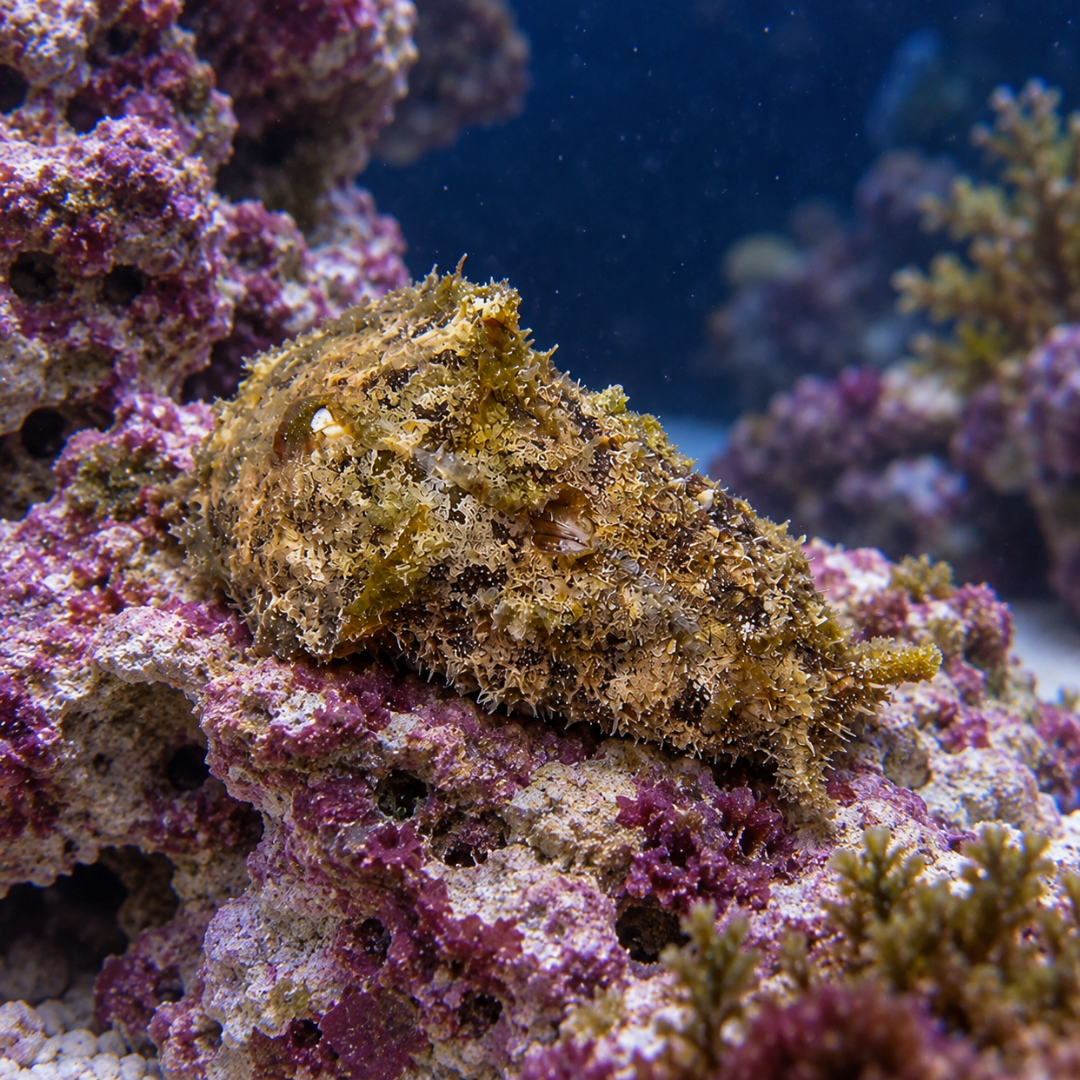
解説 / Description
タツナミガイは、インド太平洋の浅い海に広く分布するアメフラシ科の大型腹足類です。頭側がやや細く、後方へ向かって太くなる重厚な体つきと、斜めに切り落とされたような後端が大きな特徴です。体色は褐色から緑褐色を中心に変化し、表面には大小の突起が並ぶため、岩や海藻の間では驚くほど周囲に溶け込みます。海水水槽では幅広い藻類を食べることからコケ取り生体として扱われることがありますが、単なる掃除役として迎えるには大きく、餌切れや吸水口への巻き込み、急な水質変化にも注意が必要です。導入する場合は、水槽内の藻類が減った後も継続して餌を用意できる環境を整えることが大切です。 Dolabella auricularia is a large sea hare of the family Aplysiidae widely distributed in shallow Indo-Pacific waters. Its heavy, wedge-shaped body broadens toward the rear and ends in a distinctive sloping, blunt surface. Coloration varies from brown to olive green, and the uneven, papillose skin provides excellent camouflage among rocks and algae. In marine aquaria it is often kept as an algal grazer, but its large size, risk of starvation after algae are depleted, sensitivity to sudden water changes, and vulnerability to pump intakes mean it should not be treated simply as a clean-up animal. If kept, a continuing food supply should be planned for after naturally growing algae become scarce.
基本情報 / Basic Information
| 学名 / Scientific Name | Dolabella auricularia ([Lightfoot], 1786) |
|---|---|
| 通称 / Common Name | タツナミガイ、立浪貝Wedge sea hare, Blunt-end sea hare, Dolabella sea hare |
| 分類 / Family | 軟体動物門・腹足綱・アメフラシ科(Aplysiidae)・タツナミガイ属(Dolabella)Phylum Mollusca, Class Gastropoda, Family Aplysiidae, Genus Dolabella |
| 英名 / English Name | Wedge Sea Hare / Blunt-end Sea Hare |
| 分布 / Distribution | インド洋から太平洋にかけて広く分布します。日本では房総半島以南で記録され、潮間帯から浅海の岩礁や砂礫底、海藻・海草の多い場所に見られます。Widely distributed across the Indo-Pacific. In Japan it has been recorded from the Boso Peninsula southward, where it occurs in intertidal and shallow rocky or sandy habitats with abundant algae or seagrass. |
| 最大体長 / Max Size | 体長20cm以上になる大型種で、国内の水族館資料では25cm程度とする例もあります。資料によって示される大きさには差があるため、飼育では少なくとも20cmを超える体格を見込んで設備を整える必要があります。A large species that exceeds 20 cm in length; some Japanese aquarium references give about 25 cm. Reported sizes vary among references, so aquarium planning should at least allow for an animal over 20 cm long. |
| 寿命 / Lifespan | 野外ではおおむね1年前後の生活史が目安とされますが、環境条件によって変動します。飼育下では条件差が大きく、標準的な寿命は十分に確立されていません。In the wild, its life cycle is generally considered to be on the order of about one year, although this varies with environmental conditions. A standardized lifespan for captive animals has not been firmly established. |
飼育環境 / Aquarium Environment
| 水槽サイズ / Tank Size | 90cm規格水槽(約180Lクラス)以上を実用上の目安とし、長期飼育ではさらに余裕のある水量が管理しやすくなります。ただし、本種について科学的に確立された「最低水量」があるわけではありません。20cmを超える大型種で、十分な餌場も必要になるため、小型水槽には不向きです。A 90 cm standard aquarium of roughly 180 L or larger is a practical husbandry guideline, and additional water volume makes long-term management easier. This is not a scientifically established species-specific minimum. Because the animal can exceed 20 cm and requires substantial grazing and feeding space, small aquaria are unsuitable. |
|---|---|
| 水温 / Temperature | 23〜26℃を目安に、急変を避けて安定させます。夏季は高水温になりやすいため、水槽用クーラーなどを用いて上昇を抑えると安全です。 Maintain approximately 23–26°C with minimal fluctuation. In warm seasons, aquarium cooling may be required to prevent excessive temperatures. |
| 水質 / Water Quality | 比重1.023〜1.025程度の安定した海水環境が目安です。アンモニアと亜硝酸は検出されない状態を保ち、硝酸塩や溶存有機物の蓄積も抑えます。銅を含む薬剤は海産無脊椎動物に有害なため、本種を入れたまま使用しないでください。導入時は比重差による浸透圧ショックを避けるため、時間をかけて水合わせします。Stable marine conditions around specific gravity 1.023–1.025 are suitable. Ammonia and nitrite should remain undetectable, with nitrate and dissolved organics kept low. Copper-based medications are harmful to marine invertebrates and should not be used in a tank containing this species. Acclimate slowly to avoid osmotic shock from salinity differences. |
| レイアウト / Layout | 表面に藻類が育つライブロックと、体を休められる砂地や陰を組み合わせます。体が大きく力もあるため、岩組みは崩れないよう確実に固定してください。夜間に広く移動するので、ポンプやオーバーフローの吸水口にはスポンジやガードを設け、巻き込み事故を防ぎます。Provide mature live rock carrying natural algal growth together with open sand and shaded resting areas. Rockwork should be securely fixed because the animal is bulky and can dislodge unstable pieces. Protect pump and overflow intakes with guards or sponge covers to prevent entrapment during nocturnal roaming. |
| 注意点 / Precautions | 長期飼育で特に注意したいのは餌切れです。導入直後はよく食べても、水槽内の藻類を短期間で食べ尽くすことがあります。痩せ始める前から補助給餌を準備してください。また、強い刺激を受けると紫色のインクを放出することがあります。インクが出た場合は可能な範囲で吸い出し、活性炭と十分なろ過・換水で対応します。弱った個体を放置すると水質悪化につながるため、日々の状態確認が重要です。One of the main long-term husbandry risks is food depletion. An individual may graze down the available algae surprisingly quickly, so supplemental feeding should be prepared before visible weight loss occurs. When severely disturbed it may release purple ink. If inking occurs, siphon out concentrated material where possible and use activated carbon, filtration, and water changes. A weakened or dead animal should be removed promptly to protect water quality. |
餌と給餌 / Feeding
| 餌の種類 / Diet | 海藻や海草などの植物質を食べます。野生では緑藻、紅藻、褐藻、海草などを幅広く利用するジェネラリストとして知られます。水槽では自然発生した糸状藻類や柔らかな藻類を食べ、藻類が不足する場合は無添加の海苔、海藻シート、育成した海藻類などを補助餌として試す方法があります。ただし、特定のシアノバクテリアを必ず食べるとは限らないため、赤ゴケ対策だけを目的に導入するのは避けた方が安全です。It feeds on plant material including marine algae and seagrasses. In nature it is a generalist herbivore that uses a broad range of green, red, and brown algae as well as seagrasses. In aquaria it may graze filamentous and soft algae; when natural algae are insufficient, plain nori, algae sheets, or cultured macroalgae can be tried as supplemental foods. It should not be purchased solely on the assumption that it will reliably consume a particular cyanobacterial mat. |
|---|---|
| 給餌のポイント / Feeding Tips | 一種類だけに偏らず、複数の海藻を組み合わせて与える方が適しています。海苔などはクリップや小石で底近くに固定し、夜間の活動時間に食べやすくします。リフジウムや別水槽でジュズモ類などの海藻を増やしておくと、藻類が枯渇したときの安定した餌源になります。体が目に見えて細くなる前に給餌量を見直してください。A varied mixture of algae is preferable to relying on a single food source. Secure nori or algae sheets near the bottom with a clip or clean rock so the animal can feed naturally, especially after lights-out. Growing macroalgae in a refugium or separate tank provides a dependable reserve when display-tank algae are depleted. Increase feeding before noticeable body shrinkage develops. |
性格と混泳 / Temperament and Tank Mates
| 性格 / Temperament | 植食性で、他の魚や無脊椎動物を捕食するタイプではありません。日中は岩陰や底床付近で休み、薄暗くなるとゆっくり移動しながら藻類を削り取ることが多く、行動そのものは穏やかです。It is herbivorous and does not normally prey on fish or other invertebrates. It often rests under rocks or near the substrate by day and becomes more active in dim conditions, moving slowly while grazing algae. Its movements are generally gentle despite its large body. |
|---|---|
| 混泳の相性 / Compatibility | 本種を攻撃しない海水魚やサンゴ類とは同居させやすい一方、フグ類、大型ベラ類、強くつつく魚、大型のカニやヤドカリなど、柔らかな体表を傷つける可能性がある生体は避けます。サンゴを餌として狙う生体ではありませんが、大型個体が通過する際に未固定のサンゴや小さなフラグを倒すことがあります。It can usually be kept with marine fish and corals that do not attack it, but tank mates that may bite or tear its soft body, such as some puffers, large wrasses, large crabs, or aggressive hermit crabs, should be avoided. It does not target corals as food, though a large individual may knock over unsecured coral frags while moving through the aquascape. |
病気と対策 / Diseases and Prevention
| かかりやすい病気 / Common Diseases | タツナミガイに特有の感染症として、家庭水槽で広く確立された病名はほとんどありません。実際の飼育では、病気そのものよりも餓死、急な比重・水温変化、アンモニアや亜硝酸の上昇、ポンプへの巻き込み、他生体による外傷などの環境性トラブルが大きな問題になります。There are few well-established, species-specific diseases commonly diagnosed in home aquaria. In practice, starvation, abrupt changes in salinity or temperature, ammonia or nitrite exposure, pump injuries, and bites from tank mates are more important risks than named infectious diseases. |
|---|---|
| 対策と予防 / Prevention | 成熟した安定水槽に導入し、点滴法などでゆっくり水合わせを行います。吸水口を保護し、餌となる海藻量と体の張りを日常的に確認してください。海産無脊椎動物に有害な銅系薬剤は使用せず、異常がある場合も魚と同じ薬浴を安易に行わないことが大切です。食欲低下や著しい縮みが続くときは、水質、比重、水温、餌量を優先して確認します。Introduce the animal only to a mature, stable aquarium and acclimate it slowly, preferably by drip acclimation. Protect all intakes and routinely monitor both available algae and body condition. Do not use copper-based treatments, and avoid applying fish medications to this invertebrate without specialist guidance. Persistent loss of appetite or severe shrinkage should prompt checks of water quality, salinity, temperature, and food availability first. |
増やし方(繁殖) / Breeding
| 雌雄の判別 / Sexing | 雌雄同体で、1個体が雄性・雌性の両方の生殖機能を持つため、外見からオスとメスに分けることはできません。交尾では個体同士が連なり、前方の個体に対して雄として、後方の個体に対して雌として機能する連鎖交尾が見られることがあります。This species is a simultaneous hermaphrodite, so individuals cannot be separated into external male and female forms. During mating, sea hares may form chains in which an individual can function as a male toward the animal in front and as a female toward the animal behind. |
|---|---|
| 繁殖形態 / Reproduction | 卵生です。日本近海では主に5〜6月に産卵が見られ、青緑色の細い紐状の卵塊を岩や海藻などに産み付けます。孵化後はベリジャー幼生として浮遊生活を送り、実験飼育ではおよそ30日のプランクトン栄養型幼生期を経たのち、適した底生藻類を手掛かりに変態します。It is oviparous. In Japanese waters, spawning is reported mainly in May and June, with thin blue-green string-like egg masses attached to rocks or algae. After hatching, planktotrophic veliger larvae live in the plankton; laboratory studies indicate a larval period of about 30 days before metamorphosis in response to suitable benthic algae. |
| 繁殖のポイント / Breeding Tips | 水槽内で産卵自体が起こることはありますが、幼生は微細な浮遊餌を必要とし、変態条件も成体飼育とは大きく異なるため、家庭水槽での累代繁殖は非常に難しい部類です。繁殖を狙う場合は、親水槽とは別に幼生専用容器を用意し、適切な植物プランクトンを与えながら、定着・変態の手掛かりとなる藻類も管理する必要があります。一般的なリーフ水槽では、卵塊が見られても自然に成体まで育つ可能性は低いと考えた方がよいでしょう。Spawning can occur in aquaria, but rearing the larvae is far more difficult than maintaining adults. The planktonic larvae require appropriately sized suspended food and suitable settlement cues, so successful captive propagation requires a separate larval system, controlled phytoplankton feeding, and suitable algae that provide settlement and metamorphosis cues. In a typical reef display, egg masses are unlikely to develop naturally into juveniles. |
雑学と豆知識 / Trivia and Fun Facts
| 1. 名前の由来は体内に隠れた「立つ波」 / 1. A Hidden Shell Shaped Like a Rising Wave | タツナミガイは一見すると殻を持たない生き物に見えますが、外套膜の内側には扁平な石灰質の内在殻を残しています。その殻を横から見ると、波頭が立ち上がるような独特の輪郭を示します。和名の「立浪貝」はこの形に由来するとされ、柔らかな海のナメクジのような姿の内側に、巻貝としての進化の痕跡がひっそり残されていることを教えてくれます。Although it appears shell-less at first glance, D. auricularia retains a flattened calcareous internal shell beneath the mantle. Seen from the side, that shell has a distinctive outline reminiscent of a rising wave. The Japanese name Tatsunami-gai, meaning “standing-wave shell,” refers to this form and offers a visible reminder of the animal’s gastropod ancestry. |
|---|---|
| 2. 多様な藻類を利用するジェネラリスト / 2. A Generalist Grazer with a Preference for Variety | タツナミガイは特定の一種だけを専門に食べるのではなく、緑藻、紅藻、褐藻、海草など多様な植物質を利用します。研究では、単一の餌だけを与えた場合より、複数の藻類を組み合わせた方が良好な成長につながることが示されています。水槽でも、食べる量だけでなく餌の種類に幅を持たせることが、長期飼育を考えるうえで重要です。D. auricularia is not a strict specialist on a single alga. It consumes a broad range of green, red, and brown algae as well as seagrasses. Studies indicate that mixed algal diets can support better growth than single-food diets, so long-term captive feeding should consider dietary variety as well as quantity. |
| 3. 紫色のインクには食物由来の色素が関わる / 3. Dietary Pigments Contribute to the Purple Ink | 強い刺激を受けたタツナミガイは紫色のインクを放出することがあります。アメフラシ類の紫色成分として知られるアプリシオビオリンは、餌となる紅藻の色素に由来する化合物です。タツナミガイのインクについても捕食者に対する作用が研究されていますが、その効果は捕食者の種類や条件によって一様ではありません。食べた海藻が、栄養だけでなく体内の化学成分にもつながる点は、本種の生態を理解するうえで興味深い特徴です。When strongly disturbed, D. auricularia may release purple ink. Aplysioviolin, a well-known purple pigment in sea hares, is derived from pigments obtained from red algae in the diet. The effects of D. auricularia ink on predators have also been studied, but they are not uniform across predator species or experimental conditions. The link between diet and body chemistry is therefore one of the more interesting aspects of this sea hare’s ecology. |
| 4. ドラスタチン10は海洋天然物研究の象徴 / 4. Dolastatin 10 Became an Icon of Marine Natural-Product Research | 1980年代、タツナミガイの抽出物から極めて強い細胞増殖阻害作用を示すドラスタチン10が単離されました。その後の研究により、ドラスタチン10はタツナミガイ自身が作るのではなく、海洋シアノバクテリアが生合成する化合物であることが裏付けられています。海の草食動物を調べたことが、微生物由来の化学物質へと研究をつなげた代表的な例です。In the 1980s, the extraordinarily potent cytostatic compound dolastatin 10 was isolated from extracts of D. auricularia. Subsequent biosynthetic research has confirmed that the compound is produced by marine cyanobacteria rather than by the sea hare itself. It is a classic example of how studying a grazing marine animal led researchers to bioactive chemistry originating in microorganisms. |
| 5. 海の天然物が抗体薬物複合体へつながった / 5. From a Marine Natural Product to Antibody-Drug Conjugates | ドラスタチン10そのものは、臨床試験で毒性が課題となり、単独の抗がん剤として実用化されるには至りませんでした。しかし、その構造研究から生まれたオーリスタチン類は、がん細胞を狙う抗体に細胞傷害性薬物を結び付ける抗体薬物複合体のペイロードとして重要な位置を占めています。水槽ではのんびりと藻を食べる生き物が、現代の創薬史ではまったく別の顔を持っているのです。Dolastatin 10 itself did not become a stand-alone anticancer drug; dose-limiting toxicity was a major problem in clinical trials. However, structural studies inspired the auristatins, which became important cytotoxic payloads in antibody-drug conjugates that deliver potent compounds to targeted cancer cells. The same animal that appears to be a slow-moving algal grazer in an aquarium therefore occupies a remarkable place in modern drug-development history. |
| 6. 幼生時代には小さな殻を持つ / 6. The Larva Carries a Shell Before Metamorphosis | 成体は外から殻が見えませんが、孵化したベリジャー幼生は巻貝らしい小さな殻を備えて海中を漂います。その後、適した藻類の存在を手掛かりに海底へ定着し、2〜4日ほどかけて変態しながら底生生活へ移行します。大きな成体の姿だけを見ていると想像しにくいものの、その生活史には「浮遊する小さな巻貝」から「海底を歩く大型のアメフラシ」への劇的な変化が組み込まれています。The adult has no externally visible shell, yet its newly hatched veliger larva carries a small gastropod shell while drifting in the plankton. After becoming competent to settle, the larva responds to suitable benthic algae and completes metamorphosis over roughly two to four days, becoming a bottom-dwelling juvenile. Its life history therefore includes a dramatic transition from a tiny swimming shelled larva to a large benthic sea hare. |
まとめ / Conclusion
タツナミガイは、重厚な体とゆったりした動き、そして幅広い藻食性をあわせ持つ、海水水槽でも存在感のある無脊椎動物です。藻類を食べる性質は飼育上の魅力になりますが、水槽内の藻類が減った後まで見越して、十分な空間と継続的な給餌を用意することが長期飼育の要点です。 Dolabella auricularia combines a heavy, distinctive body, slow movement, and a broad herbivorous diet, giving it a strong presence in a marine aquarium. Its grazing behavior can be useful, but long-term care depends on providing adequate space and a continuing food supply after naturally growing algae become scarce.
体内に残る立浪形の内在殻、紫色のインク、浮遊幼生を経る生活史、そして海洋天然物との関係まで知ると、タツナミガイは単なる「コケ取り役」では捉えきれない存在です。ゆっくりと岩や底床を移動する姿の背景には、巻貝としての進化の痕跡と、海藻や微生物がつくる化学物質との深い関わりがあります。 Its hidden wave-shaped internal shell, purple ink, planktonic larval stage, and connection to marine natural-product chemistry reveal far more than a simple “clean-up” animal. Behind its slow movement across rock and substrate are traces of gastropod evolution and close ecological links with algae and microbially produced compounds.

気になる道具や飼い方を見つけてみませんか?
 アイのアクアグッズ案内水槽フィルターの選び方|外掛け・外部・上部から小型オーバーフローまで道具の特徴や使い方、選ぶときのポイントをアイが紹介します。記事はコチラ →
 アイのアクアグッズ案内水草水槽のCO₂添加|3つの方式の選び方とおすすめ用品道具の特徴や使い方、選ぶときのポイントをアイが紹介します。記事はコチラ →
 アイのアクアグッズ案内水草の肥料の選び方|底床用・液肥・メネデールの使い分け道具の特徴や使い方、選ぶときのポイントをアイが紹介します。記事はコチラ →
 アイのアクアグッズ案内おとひめ物語|養殖生まれの餌を、わが家の魚に合う一粒へ道具の特徴や使い方、選ぶときのポイントをアイが紹介します。記事はコチラ →
さまざまな飼育テーマをご紹介。リンク先の記事には広告・商品紹介が含まれます。
案内・紹介記事一覧へ →分布マップ
タツナミガイ(Dolabella auricularia)は、インド洋から太平洋にかけて広く分布する海産の腹足類です。日本では房総半島以南で記録され、潮間帯から浅海の岩礁や砂礫底、海藻や海草の多い場所に見られます。
この地図は、記録されている分布情報をもとにインド洋から太平洋までの範囲を概略表示したものです。マーカーは分布域を把握しやすくするために設定した代表地点であり、特定個体の採集地点や観察地点を示すものではありません。また、表示範囲内のすべての海域に連続して生息していることを示すものではありません。
参考文献
-
MolluscaBase eds. (2026). Dolabella auricularia ([Lightfoot], 1786). World Register of Marine Species (WoRMS).
https://www.marinespecies.org/aphia.php?p=taxdetails&id=208629 -
海洋研究開発機構(JAMSTEC)Biological Information System for Marine Life(BISMaL). Dolabella auricularia タツナミガイ.
https://www.godac.jamstec.go.jp/bismal/j/view/9020304 -
Poutiers, J. M. (1998). Gastropods. In Carpenter, K. E. & Niem, V. H. (eds.), FAO Species Identification Guide for Fishery Purposes: The Living Marine Resources of the Western Central Pacific, Volume 1: Seaweeds, Corals, Bivalves and Gastropods, pp. 363–648. FAO, Rome. Dolabella auricularia account: p. 640.
https://www.fao.org/3/w7191e/w7191e.pdf -
Ornamental Aquatic Trade Association (OATA). How to look after marine molluscs.
https://ornamentalfish.org/what-we-do/advice-information/care-sheets/caresheets-marine-invertebrates/how-to-look-after-marine-molluscs/ -
Pauly, D. & Calumpong, H. (1984). Growth, reproduction and mortality of the sea hare Dolabella auricularia (Gastropoda: Aplysiidae) in the Central Visayas, Philippines. Marine Biology, 79, 289–293. DOI: 10.1007/BF00393260.
https://doi.org/10.1007/BF00393260 -
Switzer-Dunlap, M. & Hadfield, M. G. (1977). Observations on development, larval growth and metamorphosis of four species of Aplysiidae (Gastropoda: Opisthobranchia) in laboratory culture. Journal of Experimental Marine Biology and Ecology, 29(3), 245–261. DOI: 10.1016/0022-0981(77)90069-7.
https://doi.org/10.1016/0022-0981(77)90069-7 -
Yanong, R. P. E. (2024 rev.). Use of Copper in Marine Aquaculture and Aquarium Systems. UF/IFAS Extension, FA165.
https://edis.ifas.ufl.edu/publication/FA165




コメント