

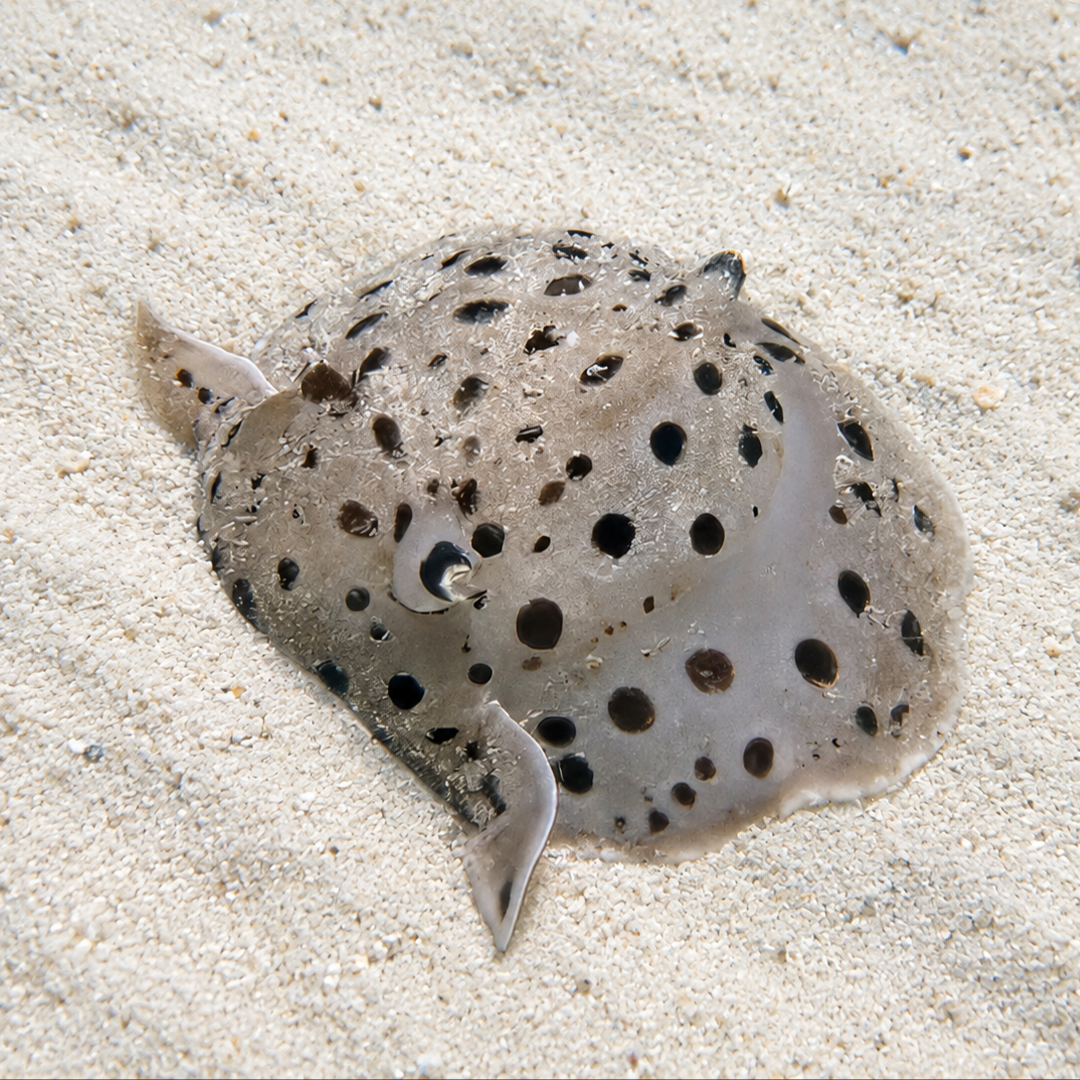
解説 / Description
マダラウミフクロウは、砂泥底に暮らす海産腹足類で、カメノコフシエラガイ目ウミフクロウ科に属します。淡い灰白色から肉色の扁平な体に暗褐色から黒紫色の斑紋が散り、頭部の前には三日月のように大きく広がる口幕があります。広い足部で砂上を移動し、日中は砂中に潜み、夜になると餌を探して活動します。口幕の縁や下面には感覚乳頭が並び、砂面を探りながら小型の底生無脊椎動物を見つけます。刺激を受けると体を波打たせて泳ぐこともある、独特の運動性をもつ種類です。国内のマリンアクアリウムではカーリー対策用として販売される例もありますが、野外で確認されている食性は小型の底生無脊椎動物を中心とする肉食性であり、飼育では実際に何を食べているかを継続して確認することが重要です。 Euselenops luniceps is a marine gastropod of the side-gilled slug family Pleurobranchaeidae that inhabits sandy and muddy bottoms. Its flattened, pale grayish-white to flesh-colored body is scattered with dark brown to purplish-black markings, and a broad crescent-shaped oral veil spreads across the front of the head. It moves over the substrate on a broad foot, usually buries itself by day, and emerges at night to forage. Sensory papillae around and beneath the oral veil probe the sediment and help locate small benthic invertebrates. When disturbed, it can also undulate the body and swim. In the Japanese marine aquarium trade it is sometimes sold for Aiptasia control, but its confirmed natural diet is carnivorous and centered on small benthic invertebrates, so captive care requires continued confirmation that the animal is actually feeding.
基本情報 / Basic Information
| 学名 / Scientific Name | Euselenops luniceps (Cuvier, 1816) |
|---|---|
| 通称 / Common Name | マダラウミフクロウMoon-headed sidegill slug |
| 分類 / Family | 軟体動物門・腹足綱・異鰓亜綱・カメノコフシエラガイ目(Pleurobranchida)・ウミフクロウ科(Pleurobranchaeidae)・マダラウミフクロウ属(Euselenops)Phylum Mollusca, Class Gastropoda, Subclass Heterobranchia, Order Pleurobranchida, Family Pleurobranchaeidae, Genus Euselenops |
| 英名 / English Name | Moon-headed sidegill slug |
| 分布 / Distribution | 熱帯から暖温帯のインド太平洋に広く分布します。東アフリカ、東南アジア、フィリピン、インドネシア、パプアニューギニア、オーストラリア、日本、ハワイなどで記録があり、主に砂泥底や砂礫底で見られます。浅場から数十mの水深まで生息記録があります。Widely distributed across tropical to warm-temperate parts of the Indo-Pacific, with records from East Africa, Southeast Asia, the Philippines, Indonesia, Papua New Guinea, Australia, Japan, Hawaii, and surrounding regions. It is found mainly on sandy, muddy, or shell-grit bottoms, from shallow water to depths of several tens of meters. |
| 最大体長 / Max Size | 資料によって差があります。70~80mm前後の記録が多い一方、10cmを超える観察記録もあり、最大サイズは一つの数値に定めにくい種類です。Reported size varies among sources. Many records are around 70–80 mm, while field observations exceeding 10 cm also exist, so a single definitive maximum is difficult to state. |
| 寿命 / Lifespan | 本種に限定した信頼できる寿命データは乏しく、野外・飼育下とも明確な年数は確立されていません。Reliable species-specific lifespan data are scarce, and a clear lifespan has not been established for either wild or captive individuals. |
飼育環境 / Aquarium Environment
| 水槽サイズ / Tank Size | 本種専用の推奨水槽サイズは確立されていません。特定の規格水槽を一律に推奨できる根拠は確認されていないため、水槽の長さだけで判断せず、全身を潜らせられる砂地の面積と、水質を安定させられる水量を確保することを優先します。No species-specific recommended tank size has been established, and there is not enough evidence to prescribe one standard aquarium size. Rather than choosing a tank by length alone, prioritize enough open sand for complete burial and sufficient water volume to maintain stable conditions. |
|---|---|
| 水温 / Temperature | 本種に固有の最適水温は十分に確立されていません。国内流通では24℃前後、海外の飼育情報では22~27℃程度が示される例があります。特定の狭い温度帯を絶対条件とせず、急激な温度変化を避けて安定させることを優先します。 A species-specific optimum temperature has not been firmly established. Japanese trade records include maintenance around 24°C, while overseas husbandry information may give ranges of roughly 22–27°C. Do not treat a narrow temperature range as an absolute requirement; stable conditions and avoidance of sudden temperature changes are more important. |
| 水質 / Water Quality | 安定した海水環境を維持し、急な比重変化やアンモニア・亜硝酸の蓄積を避けます。本種専用のpHや比重の最適値は確立されていないため、一般的な海水水槽の安定域から外さないことを重視します。導入時は輸送水との温度や比重の差を確認し、急変を避けて水合わせします。Maintain stable marine water conditions and avoid abrupt salinity changes or the accumulation of ammonia and nitrite. Species-specific optimum values for pH and salinity have not been established, so the priority is to remain within a stable range appropriate for a marine aquarium. During introduction, compare the shipping water with the aquarium and acclimate without sudden changes. |
| レイアウト / Layout | 全身を潜らせられるよう、粒の細かい砂を十分な厚みに敷き、広い砂地を作ります。硬く尖った底材は柔らかな体表を傷つけるおそれがあるため避けるのが無難です。夜間に砂上を移動し、ときに泳ぐため、ポンプ吸水口やオーバーフローへの巻き込みも防ぎます。Provide a broad area of fine sand deep enough for the animal to bury itself completely. Hard or sharp substrate may damage the soft body and is best avoided. Because the animal moves over the sand at night and may occasionally swim, protect pump intakes and overflow openings. |
| 注意点 / Precautions | 導入時の急な環境変化、長期的な餌不足、ポンプなどへの巻き込みに注意します。体を無理につまんだり、頻繁に触れたりせず、移動時は柔らかな体を傷つけない方法を選びます。カーリー対策用として販売されることがありますが、狙った生物だけを選択的に食べるとは限らないため、サンゴや小型無脊椎動物がいる水槽では行動をよく観察します。Pay particular attention to abrupt environmental changes during introduction, long-term food shortage, and accidental intake by pumps or overflows. Avoid pinching or repeatedly handling the soft body, and move the animal in a way that minimizes physical damage. It is sometimes sold for Aiptasia control, but selective feeding on only the intended pest cannot be assumed, so its behavior should be watched closely in tanks containing corals or small invertebrates. |
餌と給餌 / Feeding
| 餌の種類 / Diet | 肉食性で、野外では小型の底生無脊椎動物を捕食します。消化管から多毛類(ゴカイの仲間)が確認された記録があり、クモヒトデを捕食する行動も観察されています。国内ではカーリー対策用として販売される例がありますが、これを本種の主要な自然食とみなす根拠は十分ではありません。飼育下で刻んだアサリや冷凍イサザアミなどを補助的に試す場合も、実際に摂食するかを個体ごとに確認します。It is carnivorous and preys on small benthic invertebrates. Polychaete worms have been recorded from the digestive tract, and predation on brittle stars has been directly observed. In Japan it is sometimes sold for Aiptasia control, but there is not enough evidence to regard Aiptasia as its principal natural food. If supplemental foods such as finely chopped clam or frozen mysids are offered in captivity, acceptance should be confirmed for the individual animal. |
|---|---|
| 給餌のポイント / Feeding Tips | 夜行性なので、消灯後に活動を始めたタイミングで給餌すると反応を確認しやすくなります。補助給餌を行う場合は、口幕の近くへ少量を提示し、実際に取り込んだことを目視で確認します。害生物や残り餌だけで十分な栄養を得られるとは限らないため、体が痩せる前から摂餌状況を定期的に確認します。Because the species is nocturnal, offering food after lights-out makes feeding responses easier to observe. If supplemental feeding is attempted, present a small amount near the oral veil and confirm that it is actually ingested. Pest organisms or leftover food should not be assumed to provide a complete diet, so monitor feeding before visible weight loss develops. |
性格と混泳 / Temperament and Tank Mates
| 性格 / Temperament | 魚を主な捕食対象とすることは知られていませんが、小型無脊椎動物を捕食する夜行性の肉食動物です。日中は砂中に潜み、夜間に口幕の感覚乳頭で砂面を探りながら移動します。刺激を受けると体を波打たせて泳ぐことがあります。Fish are not known to be its principal prey, but it is a nocturnal carnivore that feeds on small invertebrates. By day it usually remains buried in sand, while at night it moves across the substrate and probes it with sensory papillae on the oral veil. When disturbed, it may undulate the body and swim. |
|---|---|
| 混泳の相性 / Compatibility | 混泳に関する体系的な情報は多くありません。小型の底生無脊椎動物は捕食対象になり得るため、これらを保護したい水槽には向きません。また、本種をつつく魚や大型の捕食性甲殻類との同居も避けるのが無難です。カーリー対策としてリーフ水槽に導入される例はありますが、完全なサンゴ安全種と断定できる根拠はないため、導入後の行動を観察します。Systematic compatibility information is limited. Small benthic invertebrates may be prey and should not be housed with this species if they must be protected. It is also prudent to avoid fish that peck at soft-bodied invertebrates and large predatory crustaceans. Although the species is sometimes introduced into reef aquariums for Aiptasia control, there is not enough evidence to call it completely reef-safe, so its behavior should be observed after introduction. |
病気と対策 / Diseases and Prevention
| かかりやすい病気 / Common Diseases | 本種に特有の感染症や寄生虫症について、アクアリウム向けに確立された情報はほとんどありません。飼育上は、病名のつく疾患よりも、導入時の急な水質変化、慢性的な餌不足、底材や機器による外傷、水質悪化に伴う衰弱に注意が必要です。There is very little established aquarium information on species-specific infections or parasites. In practice, greater attention should be paid to abrupt water-condition changes during introduction, chronic food shortage, mechanical injury from substrate or equipment, and general decline associated with poor water quality. |
|---|---|
| 対策と予防 / Prevention | 水温と比重を安定させ、導入時の急変を避け、十分な細砂と機器へ巻き込まれにくい環境を用意します。夜間の摂餌を定期的に確認し、痩せや活動低下を早めに見つけます。海産無脊椎動物は魚用治療薬の影響を受けやすいため、とくに銅を含む薬剤を本水槽へ安易に使用しないようにします。Keep temperature and salinity stable, avoid abrupt changes during acclimation, and provide fine sand while protecting the animal from equipment intakes. Check feeding activity regularly at night so that weight loss or reduced activity is recognized early. Marine invertebrates can be sensitive to fish medications, particularly copper-based treatments, so such products should not be used casually in the display system. |
増やし方(繁殖) / Breeding
| 雌雄の判別 / Sexing | 雌雄同体で、1個体が雄性・雌性の両方の生殖機能を持ちます。そのため、外見からオス・メスに分ける一般的な雌雄判別は行いません。The species is a simultaneous hermaphrodite, with both male and female reproductive functions in the same individual. Conventional external sexing into separate males and females therefore does not apply. |
|---|---|
| 繁殖形態 / Reproduction | 雌雄同体の個体同士が交尾し、体内受精を行います。野外では交尾する個体が観察されていますが、マダラウミフクロウの卵塊の形状や幼生発生については、種として確実に扱える情報が限られています。Hermaphroditic individuals mate and internal fertilization takes place. Mating pairs have been observed in the wild, but species-specific information on the egg mass and larval development of Euselenops luniceps remains limited. |
| 繁殖のポイント / Breeding Tips | 家庭水槽で再現性のある繁殖手順は確立されていません。成熟個体を良好な状態で維持し、交尾や産卵が見られた場合に経過を観察する段階から始めることになります。卵や幼生の管理条件、初期餌に関する情報が不足しているため、計画的な繁殖は難易度の高い分野です。A repeatable home-aquarium breeding protocol has not been established. The practical starting point is to maintain mature individuals in good condition and document any mating or spawning that occurs. Because information on egg and larval conditions and first foods is limited, planned captive propagation remains difficult. |
雑学と豆知識 / Trivia and Fun Facts
| 1. 「月の頭」を思わせる学名 / 1. A scientific name that evokes a moon-shaped head | 種小名のlunicepsは、一般にラテン語のluna「月」と、「~の頭をもつ」を表す-cepsに由来すると解釈されています。正面に大きく広がる口幕は半月のような輪郭を描き、英名Moon-headed sidegill slugにも同じ印象が表れています。この口幕は見た目の特徴であるだけでなく、縁や下面の感覚乳頭で砂面を探り、餌を見つけるための重要な感覚器官でもあります。The specific name luniceps is generally interpreted from Latin luna, “moon,” and the suffix -ceps, meaning “headed.” The broad oral veil forms a half-moon-like outline when seen from the front, an image reflected in the English name Moon-headed sidegill slug. The veil is not merely distinctive in appearance: sensory papillae around and beneath it probe the substrate and help the animal locate food. |
|---|---|
| 2. 砂の中でも呼吸を続ける後方の水管 / 2. A posterior siphon for life beneath the sand | 日中のマダラウミフクロウは、ほぼ全身を砂中へ隠し、嗅角と後方の水管だけを砂上へ出すことがあります。砂に潜ったままでも周囲の海水を取り込み、右側にある鰓で呼吸できるためです。広い足部とこの水管は、身を隠せる構造物の少ない砂泥底で生活するうえで重要な形態的特徴と考えられます。By day, Euselenops luniceps may bury almost the entire body while leaving only the rhinophores and posterior siphon exposed above the sand. This allows it to remain concealed while still drawing seawater toward the gill on the right side of the body. The broad foot and posterior siphon are important features for life on open, soft sediment. |
| 3. 「ウミウシは這うだけ」という印象を覆す泳ぎ / 3. A sea slug that can truly swim | 本種は底生生活が基本ですが、刺激を受けると扁平な体と広い足部を波打たせ、水中を泳ぐことがあります。伊豆半島での観察では20分以上泳ぎ続けた個体が記録され、オーストラリアでも遊泳が観察されています。普段は砂底を移動する動物が、必要に応じて水中へ移動できることは、本種の行動を特徴づける興味深い一面です。Although fundamentally benthic, this species can swim by undulating its flattened body and broad foot when disturbed. A Japanese observation recorded an individual swimming for more than 20 minutes, and swimming has also been observed in Australia. The ability of an animal normally associated with sandy bottoms to move through open water is one of the species’ most distinctive behaviors. |
| 4. 捕食の証拠は「砂と一緒に丸のみ」から見えてきた / 4. Its predatory life has been revealed one meal at a time | 古い解剖記録では消化管から小型の多毛類が見つかり、2015年にはクモヒトデを捕食する一連の行動が映像記録されています。口幕の下面にある感覚乳頭で砂面を探り、餌を感知すると口を前方へ伸ばして取り込む姿も観察されています。柔らかな外見とは対照的に、マダラウミフクロウは砂底を探索して小動物を捕らえる肉食性の捕食者です。Older anatomical records found small polychaete worms in the digestive tract, and a 2015 observation documented a complete feeding sequence on a brittle star. Sensory papillae beneath the oral veil probe the substrate, and the mouth can project forward when food is detected. Despite its soft, slug-like appearance, Euselenops luniceps is an active carnivorous predator that searches sandy bottoms for small animals. |
| 5. 「一属一種」とされてきた分類は現在では変化している / 5. The once “single-species genus” is no longer treated that way | 古い図鑑やWeb資料では、Euselenops属はマダラウミフクロウ1種だけからなる単型属と説明されることがあります。しかし、現在のWorld Register of Marine SpeciesではEuselenops winckworthiも有効種として扱われているため、Euselenops属を「現生1種だけ」とする説明は現在の整理と一致しません。また、2024年刊行の全属規模の分子系統解析では、Euselenopsはウミフクロウ科Pleurobranchaeidaeに含まれ、PleurobranchaeaとPleurobranchellaからなる系統群の姉妹群として位置づけられました。つまり、形態から同じ科とされてきた仲間関係が、分子データからも支持されたことになります。Older field guides and websites often describe Euselenops as a monotypic genus containing only E. luniceps. The current World Register of Marine Species also accepts Euselenops winckworthi as a valid species, so the genus should no longer be described simply as containing one living species. An all-genus molecular phylogeny published in the 2024 volume also placed Euselenops within Pleurobranchaeidae as sister to the clade containing Pleurobranchaea and Pleurobranchella. In practical terms, molecular evidence now supports the family relationship that had long been proposed from morphology. |
| 6. 強い酸を使う仲間だが、腺の説明には注意が必要 / 6. Acid defense is real, but the gland anatomy needs careful wording | カメノコフシエラガイ目では、酸性物質を防御に利用する仕組みが知られています。ただし、その事実をそのままマダラウミフクロウの具体的な腺構造へ当てはめることはできません。2017年の比較組織学研究では、表皮下酸腺(SAG)が確認されたのは調査対象のうちBerthellina属に限られ、マダラウミフクロウ自体はこの比較組織学調査の対象に含まれていません。したがって、本種がSAGに硫酸を蓄えて放出するといった具体的な説明は、種レベルで確認された事実としては扱わない方が適切です。Acidic defensive secretions are known among side-gilled slugs, but that general fact should not be converted into a specific gland description for E. luniceps without evidence. In a 2017 comparative histological study, subepidermal acid glands, or SAGs, were confirmed only in Berthellina among the taxa examined, and E. luniceps itself was not included in that histological survey. It is therefore more accurate not to state as established fact that this species stores sulfuric acid in SAGs and releases it through that particular gland type. |
| 7. 抗菌活性研究は「新薬候補」ではなく、まず試験管内の出発点 / 7. Antimicrobial activity is a laboratory starting point, not a finished drug | 2018年には、マダラウミフクロウの粗抽出物を用いた試験管内の抗菌・抗真菌試験が報告されています。ブタノール抽出物は緑膿菌に対して20±1.76mmの発育阻止帯を示しました。ただし、これは粗抽出物を寒天培地上で評価した初期的な実験結果です。どの成分が作用したのか、動物体内で安全か、医薬品として有効かはこの研究だけでは分かりません。つまり、抗菌活性が観察されたことと、新薬としての有用性が証明されたことは別に考える必要があります。A 2018 study tested crude extracts of E. luniceps for antibacterial and antifungal activity in vitro. The butanol extract produced a 20 ± 1.76 mm inhibition zone against Pseudomonas aeruginosa. This was an early laboratory assay using crude extracts on culture media. It did not identify the active compound, establish safety in animals, or demonstrate medical efficacy. Observed antimicrobial activity and proof of usefulness as a drug are therefore two different conclusions. |
| 8. 仰向け姿勢は「疑似餌行動」と断定しない方がよい / 8. Upside-down posture should not yet be labeled a proven lure behavior | 飼育下では腹面を上にした姿勢が見られるという記述があり、疑似餌のように獲物を誘う行動だと解釈されることもあります。しかし、確認できる野外観察で明確に記録されているのは、口幕の感覚乳頭で砂面を探り、口を伸ばして餌を取り込む行動です。現時点では、仰向け姿勢そのものを捕食のためのルアー行動と断定できる十分な根拠は確認できません。飼育中にこの姿勢が見られても、姿勢だけで行動の意味や健康状態を決めつけず、反応や体表の状態、摂餌、水質を合わせて観察するのが適切です。Captive accounts sometimes describe individuals lying with the ventral surface upward, and this posture has been interpreted as a possible prey-luring behavior. Confirmed field observations, however, more clearly document the animal probing the sand with sensory papillae on the oral veil and extending the mouth to take food. At present, there is not enough evidence to identify the upside-down posture itself as a proven lure behavior. In captivity, the posture alone should not be used to decide either the meaning of the behavior or the animal’s health; responsiveness, body condition, feeding, and water quality should be considered together. |
まとめ / Conclusion
マダラウミフクロウは、三日月形の大きな口幕、砂へ潜る扁平な体、餌を探る感覚乳頭、そして必要に応じて泳ぐ能力まで、砂泥底での生活に結びついた特徴を備えています。夜の砂底を探索して小型無脊椎動物を捕らえる姿は、柔らかな外見から受ける印象とは異なる、本種ならではの生態をよく表しています。 Euselenops luniceps has a distinctive set of features associated with life on soft sediment: a broad crescent-shaped oral veil, a flattened body that buries in sand, sensory papillae used to search for food, and the ability to swim when needed. Its habit of searching the night-time seabed for small invertebrate prey reveals a predatory ecology that contrasts with its soft, delicate appearance.
飼育では、安定した海水環境、全身を潜らせられる細かな底砂、急変を避けた導入、そして継続して餌を取れているかの確認が重要です。カーリー対策という役割だけに頼らず、夜行性の肉食性底生動物として食性と行動を観察することが、状態を保つうえで大切です。砂から現れ、大きな口幕で周囲を探りながら進む姿は、この生き物の生活様式をそのまま感じさせてくれます。 Captive care depends on stable marine water, fine sand deep enough for complete burial, introduction without abrupt environmental changes, and continued confirmation that the animal is feeding. Rather than relying on its role as an Aiptasia-control animal, it is better understood as a nocturnal carnivorous benthic species whose diet and behavior must be observed. Emerging from the sand and moving forward with its broad oral veil spread open is one of the clearest expressions of its natural way of life.
気になる道具や飼い方を見つけてみませんか?
 アイのアクアグッズ案内水草用ライトの選び方|緑の絨毯と赤い水草を楽しむ照明・植栽用品道具の特徴や使い方、選ぶときのポイントをアイが紹介します。記事はコチラ →
 アイのアクアグッズ案内水草の肥料の選び方|底床用・液肥・メネデールの使い分け道具の特徴や使い方、選ぶときのポイントをアイが紹介します。記事はコチラ →
 アイのアクアグッズ案内コリドラスのもふもふ時間を楽しむ|餌・底砂・お掃除用品の選び方コリドラスのもふもふする食事風景を楽しむために。沈む餌2種類の違い、口元に配慮した底砂、食べ残しを回収する道具を、アクアグッズナビゲーターのアイが紹介します。記事はコチラ →
 アイのアクアグッズ案内ラスボラ・ボララスの群泳を楽しむ飼育用品|水槽・ろ過・ヒーター・餌・水草道具の特徴や使い方、選ぶときのポイントをアイが紹介します。記事はコチラ →
さまざまな飼育テーマをご紹介。リンク先の記事には広告・商品紹介が含まれます。
案内・紹介記事一覧へ →分布マップ
マダラウミフクロウ(Euselenops luniceps)は、熱帯から暖温帯のインド太平洋に広く分布し、東アフリカ、東南アジア、フィリピン、インドネシア、パプアニューギニア、オーストラリア、日本、ハワイなどで記録されています。
この地図は記事に記載された分布地域を把握するための概略表示です。個々の生息記録地点や正確な分布限界を示すものではありません。マーカーは分布域を見やすくするために設定した代表地点であり、実際の採集地点を示すものではありません。
参考文献
- MolluscaBase / World Register of Marine Species (WoRMS). Euselenops luniceps (Cuvier, 1816). Taxonomic record and accepted classification. https://www.marinespecies.org/aphia.php?p=taxdetails&id=535693
- Moles J, Brenzinger B, Berning MI, Martynov A, Korshunova T, Schrödl M. 2024. Systematic rearrangements in an all-genus phylogeny of side-gilled slugs (Heterobranchia: Pleurobranchida). Zoological Journal of the Linnean Society, 202(2), zlad162. https://doi.org/10.1093/zoolinnean/zlad162
- Chow LH, Yu VPF, Kho ZY, See GCL, Wang A, Baker DM, Tsang LM. 2022. An Updated Checklist of Sea Slugs (Gastropoda, Heterobranchia) from Hong Kong Supported by Citizen Science. Zoological Studies, 61:52. https://doi.org/10.6620/ZS.2022.61-52
- Rajendra S, Nigam NK, Sivaperuman C. 2022. A new record of Opisthobranch, Tayuva lilacina (Gould, 1852) and notes on Euselenops luniceps (Cuvier, 1816) from the Andaman Sea, India. Indian Journal of Geo-Marine Sciences, 51(10):850-853. https://doi.org/10.56042/ijms.v51i10.2934
- Kamalakannan R, Chen CWK. 2022. Biodiversity Record: Moon-headed sidegill slug at Sentosa. Nature in Singapore, 15:e2022017. https://doi.org/10.26107/NIS-2022-0017
- Nimbs MJ, Smith SDA. 2017. Observation of feeding in the pleurobranchomorph sea slug Euselenops luniceps (Cuvier, 1816). Newsletter of the Malacological Society of Australasia, 161. https://www.malsocaus.org/wp-content/uploads/2025/09/MSA161.pdf
- Martynov AV, Schrödl M. 2009. The new Arctic side-gilled sea slug genus Boreoberthella (Gastropoda, Opisthobranchia): Pleurobranchoidean systematics and evolution revisited. Polar Biology, 32:53-70. https://doi.org/10.1007/s00300-008-0503-3
- Spotte S. 1992. Captive Seawater Fishes: Science and Technology. John Wiley & Sons. FAO AGRIS bibliographic record
- Yanong RPE. 2009. Use of Copper in Marine Aquaculture and Aquarium Systems. EDIS, FA165. University of Florida IFAS Extension. https://doi.org/10.32473/edis-fa165-2009




コメント