

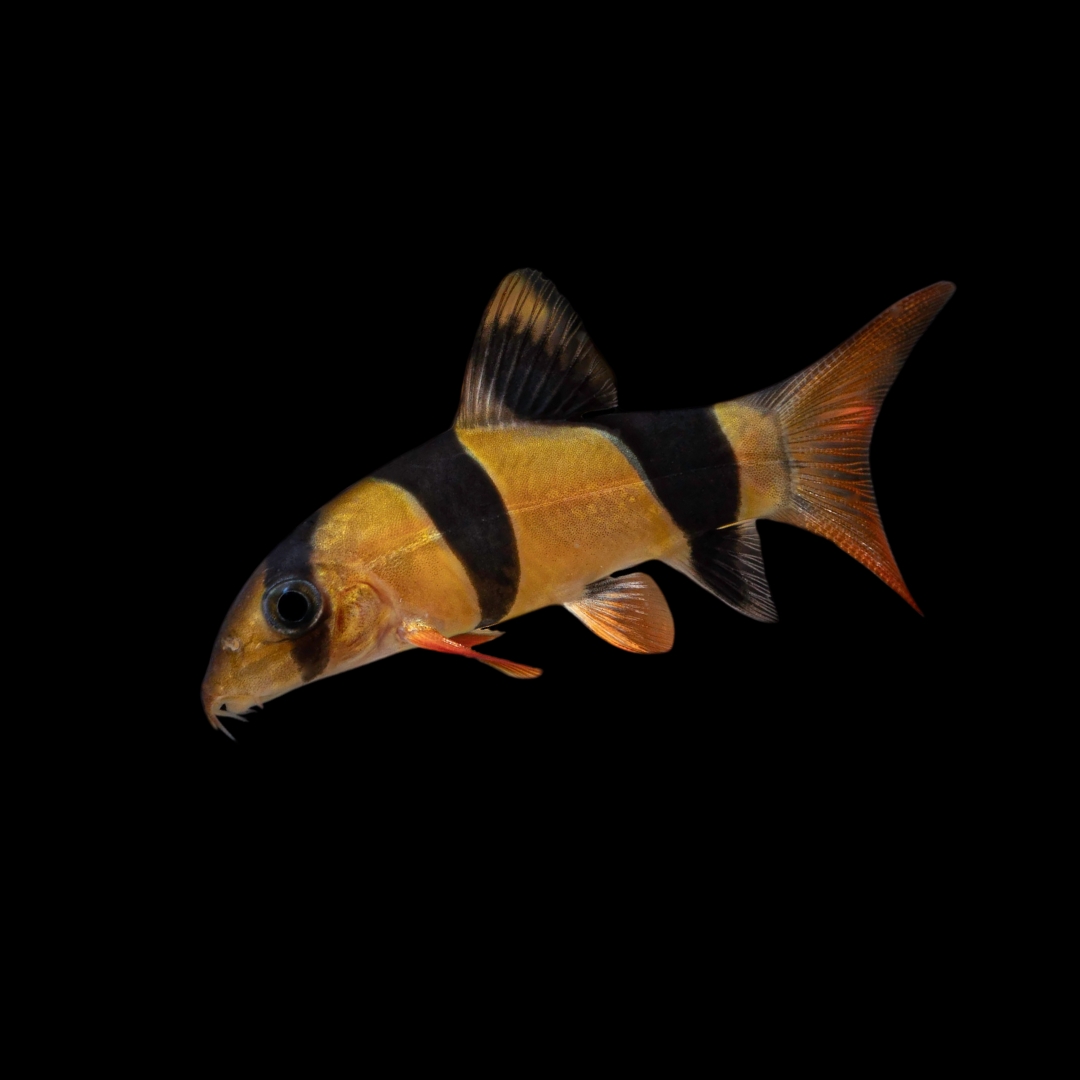
解説 / Description
クラウンローチは、オレンジ色の体に太い黒い帯が入る、観賞魚として非常に人気の高い熱帯性の底生魚です。インドネシアのスマトラ島とボルネオ島の河川に分布し、自然下では本流の底や流木、岩、泥のくぼみなどを利用して暮らします。水槽では、横になって休む姿、仲間と並んで泳ぐ姿、餌の時間に活発になる姿など、ローチらしい個性をたっぷり見せてくれます。 The clown loach is a highly popular tropical bottom-dwelling fish, instantly recognized by its orange body and bold black bands. Native to river systems of Sumatra and Borneo in Indonesia, it naturally lives near the bottom of main river channels, using wood, rocks, and mud cavities as shelter. In aquariums it shows many characteristic loach behaviors, including resting on its side, moving with companions, and becoming lively at feeding time.
一方で、本種は「小さくてかわいい幼魚」の印象だけで迎える魚ではありません。成長すると大きくなり、群れでの生活を好み、長期飼育では大きな水槽と安定した水質が必要になります。スネール対策として語られることもありますが、本来は長く付き合う主役級の魚として計画的に飼育したい種類です。 However, this is not a species to choose only because juveniles are small and cute. It grows large, prefers life in a group, and requires a spacious aquarium with stable water quality for long-term care. Although it is sometimes mentioned as a snail-eating helper, it is better viewed as a long-term centerpiece species that deserves careful planning.
基本情報 / Basic Information
| 学名 / Scientific Name | Chromobotia macracanthus |
|---|---|
| 通称 / Common Name | クラウンローチ、ボティア・マクラカンサ、タイガーボティアClown loach, tiger botia |
| 分類 / Family | コイ目 アユモドキ科 Chromobotia属Order Cypriniformes, family Botiidae, genus Chromobotia |
| 英名 / English Name | Clown Loach |
| 分布 / Distribution | インドネシアのスマトラ島およびボルネオ島の淡水域。ムシ川、インドラギリ川、カプアス川、マハカム川などの水系が知られています。Freshwater habitats of Sumatra and Borneo, Indonesia. Known river systems include the Musi, Indragiri, Kapuas, and Mahakam. |
| 最大体長 / Max Size | 最大で約30cm前後。水槽内では15〜20cm前後で成長がゆるやかになることもありますが、終生飼育では30cm級になる可能性を前提に考えます。Up to around 30 cm. In aquariums growth may slow around 15–20 cm, but long-term planning should assume the possibility of a fish approaching 30 cm. |
| 寿命 / Lifespan | 適切な環境では20年以上生きることがある長寿魚です。30年を超えるとされる話も見られますが、図鑑情報としては「20年以上を見込んで飼う魚」と考えるのが現実的です。A long-lived fish that may live for more than 20 years under good care. Reports of individuals exceeding 30 years exist, but as practical care guidance it is safest to plan for a fish that may live 20 years or more. |
飼育環境 / Aquarium Environment
| 水槽サイズ / Tank Size | 幼魚期だけなら60cm規格水槽から始められますが、これはあくまで一時的な育成用です。群れでの長期飼育を考えるなら、早めに90cm規格水槽以上へ移行し、成魚群では150cm水槽以上、余裕を持つなら180cm級の大型水槽を目標にします。水量だけでなく、底面積と遊泳距離を重視してください。Juveniles can be started in a standard 60 cm tank, but this should be considered temporary. For long-term group care, move to at least a standard 90 cm tank as they grow, and aim for a tank of 150 cm or longer for an adult group; a 180 cm-class aquarium is preferable when possible. Footprint and swimming length matter as much as water volume. |
|---|---|
| 水温 / Temperature | 25〜30℃。飼育では26〜28℃前後を安定させると管理しやすく、導入直後や白点病が心配な時期は急な水温低下を避けることが大切です。 25–30°C. Around 26–28°C is generally easy to manage in aquariums. Avoid sudden temperature drops, especially after introduction or when ich is a concern. |
| 水質 / Water Quality | pH5.0〜8.0、硬度5〜12dH程度の範囲に適応します。通常飼育ではpH6.0〜7.5前後の弱酸性〜中性を目安に、急変を避けて清潔な水を保つことが大切です。大型でよく食べるため、ろ過能力には余裕を持たせます。It tolerates roughly pH 5.0–8.0 and hardness around 5–12 dH. For routine aquarium care, aim for stable slightly acidic to neutral water around pH 6.0–7.5, avoiding sudden changes. Because it grows large and feeds well, filtration should be generous. |
| レイアウト / Layout | 底床はヒゲを傷めにくい細かな砂、または角のない小粒の砂利が向きます。流木、滑らかな石、土管、シェルター、アヌビアス類などの丈夫な水草を使い、個体数分以上の隠れ家を作ると落ち着きます。暗がりに逃げ込める場所と、群れで泳げる開けた空間の両方を用意します。Fine sand or smooth small gravel is suitable because it helps protect the barbels. Use driftwood, rounded stones, caves, shelters, and hardy plants such as Anubias to provide more hiding places than the number of fish. Provide both shaded retreats and open space where the group can move together. |
| 注意点 / Precautions | 単独飼育や少数飼育では隠れがちになり、本来の行動が出にくくなります。5〜6匹以上、可能ならさらに多めの群れで飼うと安定しやすくなります。また、目の下に鋭い眼下棘を持つため、網で無理に追い回すと魚体が傷ついたり、網に絡んだりすることがあります。移動時はプラスチックケースで水ごとすくう方法が安全です。Single specimens or very small groups often hide and fail to show natural behavior. Keep at least 5–6 individuals, and a larger group if space allows. They possess sharp suborbital spines below the eyes, so chasing them with a net can injure the fish or tangle the spine. Scooping them with water in a plastic container is safer. |
餌と給餌 / Feeding
| 餌の種類 / Diet | 雑食性で、沈下性タブレット、底物用ペレット、冷凍アカムシ、ブラインシュリンプ、イトミミズ系の餌、スピルリナ配合フードなどをよく食べます。植物質の補給として、軽くゆでたズッキーニ、キュウリ、ほうれん草、プレコ用ウェハーなども使えます。小型の巻貝を食べることもありますが、スネール駆除だけを目的に導入する魚ではありません。This omnivore accepts sinking tablets, bottom-feeder pellets, frozen bloodworms, brine shrimp, worm-based foods, and spirulina foods. Blanched zucchini, cucumber, spinach, and algae wafers can be used to provide plant matter. It may eat small snails, but it should not be purchased only as a snail-control tool. |
|---|---|
| 給餌のポイント / Feeding Tips | 底に落ちた餌を探すのが得意ですが、混泳魚が多い水槽では中層魚に餌を取られやすいことがあります。消灯前や薄暗い時間に沈下性の餌を与えると、クラウンローチまで行き渡りやすくなります。動物性の餌ばかりに偏らせず、人工飼料と植物質を組み合わせ、太りすぎや水質悪化にも注意します。It is good at finding food on the bottom, but faster midwater fish may consume food first. Offering sinking foods just before lights out or during dim periods helps ensure the loaches receive enough. Avoid relying only on rich animal foods; combine prepared diets with plant matter and watch for obesity and water pollution. |
性格と混泳 / Temperament and Tank Mates
| 性格 / Temperament | 基本的には混泳向きですが、体格が大きく、群れの中では順位争いや小競り合いが起こります。体を並べて押し合うような動き、体色が一時的に薄くなる行動、ガラス面に沿って上下するような動きは、飼育下でよく語られるクラウンローチらしい行動です。餌を見つけた時などにカチカチという音を出すこともあります。It is generally suitable for community aquariums, but it becomes large and may show hierarchy-related chasing or sparring within the group. Side-by-side pushing, temporary fading of body color, and repeated up-and-down swimming along the glass are often described by keepers as typical clown loach behaviors. They may also make clicking sounds, especially around feeding time. |
|---|---|
| 混泳の相性 / Compatibility | 中層〜上層を泳ぐ活発で温和な魚と相性がよく、レインボーフィッシュ、コンゴテトラ、スマトラ、ある程度サイズのあるシクリッドなどが候補になります。口に入るほど小さな魚や稚エビは誤食の可能性があります。ベタやグッピーのようにヒレが長く動きがゆっくりな魚は、好奇心からヒレをかじられることがあるため注意が必要です。It usually matches well with active, peaceful midwater to upper-level fish such as rainbowfish, Congo tetras, tiger barbs, and suitably sized cichlids. Very small fish and young shrimp may be eaten accidentally. Slow-moving long-finned fish such as fancy bettas or guppies require caution because curious loaches may nip their fins. |
病気と対策 / Diseases and Prevention
| かかりやすい病気 / Common Diseases | 最も注意したいのは白点病です。クラウンローチはウロコが非常に細かく目立ちにくいタイプの魚で、導入直後の輸送ストレス、水温低下、水質悪化をきっかけに発症しやすいとされています。痩せが進むスキニー病と呼ばれる状態、外傷からの二次感染、尾ぐされなどにも注意します。Ich is the disease to watch most carefully. Clown loaches have very small, inconspicuous scales and are often considered prone to outbreaks after shipping stress, temperature drops, or poor water quality. Also watch for wasting conditions often called skinny disease, secondary infections from injuries, and fin rot. |
|---|---|
| 対策と予防 / Prevention | 導入時は温度合わせと水合わせを丁寧に行い、可能であれば隔離水槽で様子を見ます。普段は安定した水温、清潔な水、十分な酸素を保ち、急な水質変化を避けます。白点病の治療では換水で水中の遊走子を減らし、薬剤を使う場合はローチ類が薬に敏感なことを考慮して慎重に投薬します。塩水浴や薬浴を行う場合も、製品説明、飼育環境、他の生体への影響を確認し、無理な高濃度処置は避けてください。Acclimate new fish carefully and observe them in a quarantine tank when possible. In normal care, maintain stable temperature, clean water, and good oxygenation while avoiding sudden water-quality changes. When treating ich, water changes can help reduce free-swimming stages, and medication should be used carefully because loaches can be sensitive. If salt or medication baths are used, check the product directions, aquarium conditions, and effects on other livestock, and avoid overly strong treatments. |
増やし方(繁殖) / Breeding
| 雌雄の判別 / Sexing | 外見での判別はかなり難しい魚です。成熟個体ではメスがふっくらしやすい、オスの尾ビレ先端が内側へ軽く曲がることがある、などの見分け方が語られますが、個体差が大きく参考程度です。確実な判別は、成熟状態の確認を伴う専門的な方法でなければ困難です。Sexing is quite difficult by appearance alone. Mature females may become fuller-bodied, and males are sometimes said to have slightly inward-curving caudal fin tips, but these points vary and should be treated only as hints. Reliable sexing is difficult without specialist assessment of reproductive condition. |
|---|---|
| 繁殖形態 / Reproduction | 卵生です。自然下では雨季の始まりや増水と関係した繁殖を行うとされ、成魚は本流だけでなく流れのある環境や氾濫原と関係する季節的な環境変化を利用します。家庭水槽で自然繁殖を安定して狙うのは非常に困難です。An egg-laying species. In the wild, reproduction is associated with the beginning of the rainy season and seasonal flooding, with adults using changes in flowing river and floodplain-related habitats. Reliable natural breeding in home aquariums is extremely difficult. |
| 繁殖のポイント / Breeding Tips | 家庭水槽では、モンスーンに伴う水位、水温、流れ、溶存酸素、餌環境の変化を再現する必要があり、一般飼育の延長で繁殖させる魚ではありません。研究・商業レベルでは、親魚の長期育成、温度管理、ホルモン誘起、採卵と人工授精を組み合わせた繁殖方法が報告されています。飼育者としては、まず健康な群れを長く維持することを目標にするとよいでしょう。In home aquariums, breeding would require reproducing monsoon-related changes in water level, temperature, flow, oxygen, and food availability, so it is not a species normally bred as an extension of routine care. At research and commercial levels, methods using long-term broodstock conditioning, temperature management, hormone induction, egg stripping, and artificial fertilization have been reported. For hobbyists, the best goal is to maintain a healthy group for many years. |
雑学と豆知識 / Trivia and Fun Facts
| 1. 名前に刻まれた「色」と「大きな棘」 / 1. A name shaped by color and a large spine | 現在の学名であるChromobotia macracanthusには、この魚の特徴がよく表れています。Chromoは色を連想させる語で、macracanthusは大きな棘に由来する名前です。派手な体色に目が行きがちですが、目の下には眼下棘という鋭い棘があり、驚いた時や身を守る時に立てることがあります。クラウンローチの美しさは、野生の川で生き抜くための機能と隣り合わせなのです。The current scientific name, Chromobotia macracanthus, reflects the fish’s appearance and anatomy. “Chromo” evokes color, while “macracanthus” refers to a large spine. Although its vivid pattern draws the eye first, a sharp suborbital spine is hidden below each eye and can be erected when the fish is startled or defending itself. Its beauty is closely tied to practical adaptations for life in wild rivers. |
|---|---|
| 2. かつてはボティア、今は1属1種の特別な存在 / 2. Once a Botia, now a one-species genus | クラウンローチは長い間Botia macracanthusとして知られていました。その後、分類研究が進み、他のローチ類とは異なる特徴が整理されたことで、現在は本種だけを含むChromobotia属に置かれています。店頭や古い飼育書で「ボティア」と呼ばれる名残があっても、現在の図鑑情報ではChromobotia macracanthusとして扱うのが基本です。For many years the clown loach was widely known as Botia macracanthus. Later taxonomic work clarified that it differs enough from other loaches to be placed in its own genus, Chromobotia, which contains this species alone. Even if older books or shops still use the “Botia” name, modern reference information generally treats it as Chromobotia macracanthus. |
| 3. 横になって寝る姿は、弱っているとは限らない / 3. Lying on its side does not always mean trouble | 初めて飼う人が驚きやすいのが、底や流木の下で横になって休む姿です。時には逆さまに近い角度で止まるため、死んでしまったのではと慌てることがあります。呼吸が整っていて、近づいた時に反応し、体表に異常がなければ、これはクラウンローチらしい休息姿勢の一つです。もちろん、白点、呼吸の荒さ、食欲不振を伴う場合は病気の可能性もあるため、行動だけで判断しないことが大切です。New keepers are often startled when a clown loach rests on the substrate or under driftwood while lying on its side. Sometimes the posture is almost upside down, making it look dead. If breathing is normal, the fish reacts when approached, and the body shows no signs of disease, this is one of the species’ normal resting behaviors. However, if it is accompanied by white spots, heavy breathing, or poor appetite, disease should be considered, so behavior alone should not be the only judgment. |
| 4. スマトラ産とボルネオ産には地域差がある / 4. Sumatra and Borneo fish show regional differences | 同じクラウンローチでも、スマトラ島産とボルネオ島産では腹ビレの色、黒い帯の広がり、全体の色味に違いが見られることがあります。さらに、遺伝的にも島ごとに異なる集団構造が示唆されています。観賞魚としては一つの名前で流通しますが、その背景には、島や川ごとの長い時間が育てた多様性があります。Even within the same species, fish from Sumatra and Borneo can differ in pelvic fin color, the extent of black bands, and overall tone. Genetic work also suggests population structure between the islands. In the aquarium trade they are usually sold under one name, but behind that name lies diversity shaped over long periods by islands and river systems. |
| 5. 小さな幼魚の背景にある長い流通経路 / 5. The long supply chain behind a small juvenile | 日本で見かけるクラウンローチは、数cmほどの幼魚であることが多い魚です。ワイルド個体、養殖個体、現地で一定期間育成された個体など流通背景は一様ではありませんが、いずれにしても採集・養殖、現地管理、輸送、国内での販売まで、複数の段階を通って水槽にやって来ます。導入直後に白点病が出やすいといわれるのは、こうした移動のストレスとも関係します。迎え入れる時は、安価な小魚としてではなく、長期飼育を前提にした生体として丁寧に扱いたい存在です。In Japan, clown loaches are often seen for sale as juveniles only a few centimeters long. Their background may include wild-caught fish, cultured fish, or fish grown for a period in local holding facilities, but in all cases they pass through several stages before reaching an aquarium: collection or culture, local management, transport, and retail. Their tendency to develop ich soon after arrival is related to this stress. They should be welcomed not as cheap small fish, but as animals intended for long-term care. |
| 6. 「お掃除役」では終わらない魚 / 6. More than a cleanup fish | クラウンローチは小型の巻貝を食べることがあるため、スネール対策として名前が挙がることがあります。しかし、成魚は大きく、群れを必要とし、寿命も長い魚です。水槽の問題を解決するためだけに迎えると、やがて水槽サイズや飼育数の問題が大きくなります。むしろ、広い水槽の底層で仲間と暮らす姿を楽しむ魚として考えると、本種の魅力がきちんと見えてきます。Because clown loaches may eat small snails, they are sometimes mentioned as snail-control fish. However, adults become large, need a group, and can live for many years. If they are introduced only to solve a tank problem, tank size and group-size issues may soon become the bigger problem. Their true appeal is best appreciated when they are kept as social bottom dwellers in a spacious aquarium. |
まとめ / Conclusion
クラウンローチは、鮮やかな体色、独特の休息姿勢、仲間同士で見せる豊かな行動によって、多くのアクアリストを惹きつけてきたローチです。幼魚は小さく見えても、成長後は大型水槽を必要とし、群れでこそ本来の魅力が出る魚です。導入前には、水槽サイズ、飼育匹数、水温、水質、将来の維持計画まで含めて準備しておくことが大切です。 The clown loach has attracted many aquarists with its vivid color, unusual resting postures, and rich social behavior. Although juveniles look small, adults require a large aquarium, and the species shows its best qualities in a proper group. Before bringing it home, prepare not only for the current tank but also for future size, group number, temperature, water quality, and long-term maintenance.
この魚を健康に育てる鍵は、安定した暖かい水、十分なろ過、ヒゲを傷めにくい底床、複数の隠れ家、そして5〜6匹以上の仲間です。白点病に注意しながら丁寧に導入し、成長に合わせて広い環境へ移していくことで、クラウンローチは水槽の底で落ち着いた存在感を放ち、群れの動きや個体ごとのしぐさをじっくり観察できるようになります。小さな幼魚の姿だけで判断せず、長い寿命と将来のサイズまで見据えて迎えたい、終生飼育向きの一種です。 The keys to keeping this fish healthy are stable warm water, strong filtration, a barbel-safe substrate, multiple shelters, and at least 5–6 companions. Introduce it carefully while watching for ich, and move it to a more spacious environment as it grows. With proper care, the clown loach becomes a calm but distinctive presence on the aquarium bottom, allowing its group movements and individual behavior to be observed over many years. It should not be chosen only by its small juvenile appearance; this is a species best kept with its long lifespan and adult size clearly in mind.

気になる道具や飼い方を見つけてみませんか?
 アイのアクアグッズ案内ショップで見かけるカラフルなバケツ。いったい何が入ってる?道具の特徴や使い方、選ぶときのポイントをアイが紹介します。記事はコチラ →
 アイのアクアグッズ案内水槽ライトの選び方|魚の見え方・水草・海水で選ぶおすすめ照明道具の特徴や使い方、選ぶときのポイントをアイが紹介します。記事はコチラ →
さまざまな飼育テーマをご紹介。リンク先の記事には広告・商品紹介が含まれます。
案内・紹介記事一覧へ →参考文献・参照資料
本記事の分類、分布、生息環境、飼育条件、繁殖、病気や投薬時の注意点を支える資料として、学術論文、公的・学術系データベース、大学拡張資料、公式ラベル情報を中心に選定しました。店舗、通販ページ、個人ブログ、まとめサイトは参考文献から除外しています。
分類・分布・基本的な生態
-
Fricke, R., Eschmeyer, W. N. & Van der Laan, R. (eds.). Eschmeyer’s Catalog of Fishes: Chromobotia macracanthus.
現行学名、原記載、シノニム、分類上の位置づけ、スマトラ島・ボルネオ島の淡水域という分布確認に使用。
California Academy of Sciences, Eschmeyer’s Catalog of Fishes -
Froese, R. & Pauly, D. (eds.). FishBase: Chromobotia macracanthus, Clown loach.
最大体長、pH、硬度、水温、底生性、生息場所、成魚と幼魚の利用環境、群れでの飼育条件などの確認に使用。
FishBase species summary -
IUCN. (2019). Chromobotia macracanthus. The IUCN Red List of Threatened Species.
保全状況、レッドリスト上の評価、野生個体群を扱う際の背景確認に使用。
IUCN Red List species page -
Sudarto, S., Hidonis, K. & Paradis, E. (2008). Genetic differentiation among populations of Chromobotia macracanthus Bleeker from Sumatra and Kalimantan based on sequencing gene of mtDNA Cytochrome B and nucleus DNA RAG2. Indonesian Aquaculture Journal, 3(2), 107–117.
スマトラ島系統とカリマンタン系統の遺伝的差異、地域個体群を混同しない保全上の注意に関する補助資料として使用。
Indonesian Aquaculture Journal article page
繁殖・初期発生・養殖研究
-
Legendre, M., Satyani, D., Subandiyah, S., Sudarto, Pouyaud, L., Baras, E. & Slembrouck, J. (2012). Biology and culture of the clown loach Chromobotia macracanthus: 1. Hormonal induced breeding, unusual latency response and egg production in two populations from Sumatra and Borneo Islands. Aquatic Living Resources, 25, 95–108.
家庭水槽での繁殖が難しいこと、商業・研究レベルでホルモン誘起繁殖が用いられること、親魚管理と採卵の記述を支える資料として使用。
Open-access PDF via IRD Horizon -
Baras, E., Slembrouck, J., Priyadi, A., Satyani, D., Pouyaud, L. & Legendre, M. (2012). Biology and culture of the clown loach Chromobotia macracanthus: 3. Ontogeny, ecological and aquacultural implications. Aquatic Living Resources, 25, 119–130.
孵化仔魚の大きさ、浮遊生活から底生生活への移行、ヒレや体色パターンの発達など、初期発生に関する記述の確認に使用。
Open-access PDF via IRD Horizon -
Baras, E., Ginanjar, R., Ahmad, M., Permana, A., Priyadi, A., Legendre, M., Pouyaud, L. & Slembrouck, J. (2012). Biology and culture of the clown loach Chromobotia macracanthus: 4. Thermal biology of embryos and larvae. Aquatic Living Resources, 25, 131–142.
卵・仔魚期の温度感受性、雨季や増水と初期生存条件が関係する可能性、養殖時の温度管理に関する補助資料として使用。
Open-access PDF via IRD Horizon
病気・導入時の注意・薬剤への配慮
-
Francis-Floyd, R., Yanong, R. P. E. & Pouder, D. B. Ichthyophthirius multifiliis (White Spot) Infections in Fish. UF/IFAS Extension.
白点病の生活環、温度による進行速度の変化、治療を中断しないこと、二次感染への注意、導入魚の隔離管理に関する記述を支える資料として使用。
University of Florida IFAS Extension publication -
Sudova, E., Machova, J., Svobodova, Z. & Vesely, T. (2007). Negative effects of malachite green and possibilities of its replacement in the treatment of fish eggs and fish: a review. Veterinární Medicína, 52(12), 527–539.
マラカイトグリーン系薬剤の有効性だけでなく、毒性や残留性にも注意すべきことを説明するための補助資料として使用。
Open-access review PDF -
DailyMed. (2024). ODIMOR drug label: copper sulfate pentahydrate and malachite green oxalate solution.
ローチ類のような敏感な観賞魚では薬剤量を抑える必要がある場合があること、エビ・貝類など無脊椎動物への影響確認が必要であることを示す公式ラベル情報として使用。
DailyMed official label
参照日:2026年6月17日。各資料の内容は更新される可能性があるため、分類や保全状況などの最新確認時にはリンク先の最新版も確認してください。




コメント