

解説 / Description
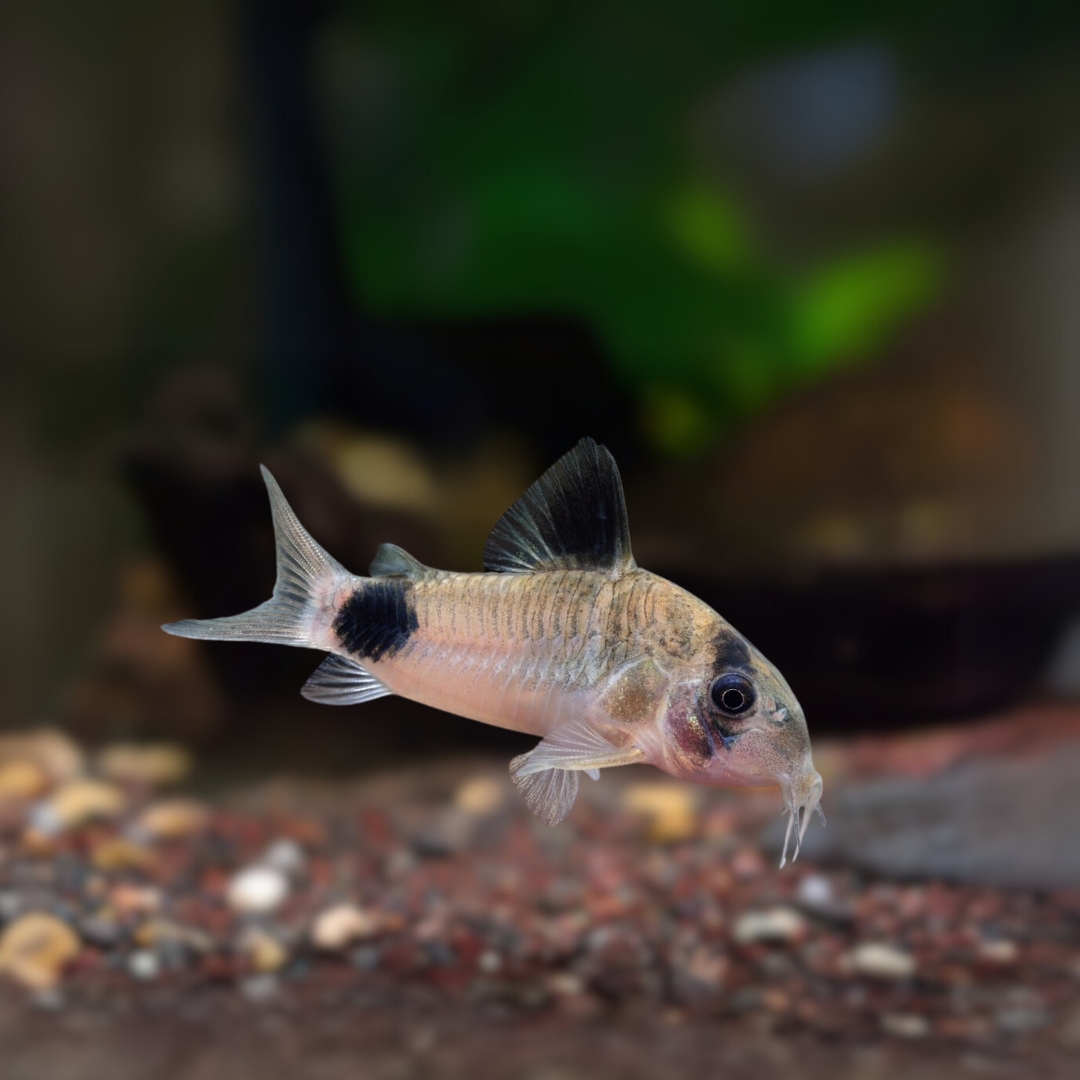
コリドラス・パンダは、目元を横切る黒いアイバンド、背びれの黒斑、尾柄部の黒いスポットが印象的な小型の底生ナマズです。長く Corydoras panda として親しまれてきましたが、2024年のコリドラス亜科の大きな分類再編では Hoplisoma panda として扱われるようになりました。一方で、流通名や古いデータベースでは今も「コリドラス・パンダ」「Corydoras panda」の表記が広く残っています。かわいらしい見た目と温和な性格から日本の水槽でも定番ですが、原産地はアマゾン川上流域の比較的涼しく酸素量の多い環境とされ、暑さ、底床の汚れ、急な水質変化には注意が必要です。見た目は親しみやすくても、長く美しく飼うためには、低めの水温、角のない細かい砂、十分な群れ、安定したろ過をそろえることが大切です。 Panda cory is a small bottom-dwelling catfish recognized by its black eye band, dark dorsal-fin marking, and black spot on the caudal peduncle. It was long known as Corydoras panda, but the 2024 revision of the Corydoradinae places it in Hoplisoma as Hoplisoma panda. In the aquarium trade and in older databases, however, the familiar names “panda cory” and “Corydoras panda” remain widely used. Its cute appearance and peaceful nature make it a classic aquarium fish in Japan, but it comes from the upper Amazon basin, where conditions are generally cool and oxygen-rich. Heat, dirty substrate, and sudden water-quality changes can be serious risks. Long-term success depends on relatively cool water, smooth fine sand, a proper group, and stable filtration.
基本情報 / Basic Information
| 学名 / Scientific Name | Hoplisoma panda (Nijssen & Isbrücker, 1971) 旧来の表記として Corydoras panda も広く使われます。The older name Corydoras panda is still widely used in the hobby. |
|---|---|
| 通称 / Common Name | コリドラス・パンダ、パンダコリPanda cory, Panda corydoras |
| 分類 / Family | ナマズ目 カリクティス科 コリドラス亜科 Hoplisoma属Order Siluriformes, family Callichthyidae, subfamily Corydoradinae, genus Hoplisoma |
| 英名 / English Name | Panda Cory, Panda Corydoras |
| 分布 / Distribution | 南米のアマゾン川上流域。観賞魚資料では、主にペルー方面の上流域に由来する種として紹介されます。Upper Amazon basin in South America. In aquarium references, it is generally treated as a species from the upper basin, especially around Peru. |
| 最大体長 / Max Size | 標準体長で約3.8cm、飼育上は全長4〜5cm前後を目安にします。成熟したメスはオスよりやや大きく、丸みを帯びやすいです。About 3.8 cm standard length, or roughly 4–5 cm total length in aquarium terms. Mature females tend to be slightly larger and rounder than males. |
| 寿命 / Lifespan | 一般に3〜5年程度。水温、水質、底床の清潔さが安定した環境では、さらに長く飼育できることもあります。Generally around 3–5 years, though individuals may live longer when temperature, water quality, and substrate cleanliness remain stable. |
飼育環境 / Aquarium Environment
| 水槽サイズ / Tank Size | 単独ではなく群れで飼う魚なので、最低でも30cmキューブ水槽、できれば45cm規格水槽以上を推奨します。5匹以上、余裕があれば8〜10匹以上で飼育すると落ち着きやすく、底を探る自然な行動も観察しやすくなります。Because this species should be kept in a group, a 30 cm cube tank is the practical minimum, while a standard 45 cm tank or larger is recommended. A group of at least five, and ideally eight to ten or more, helps them settle and display natural foraging behavior. |
|---|---|
| 水温 / Temperature | 20〜25℃が目安です。28℃前後までは一時的に耐えることがありますが、30℃を超える高水温は体力低下や病気のリスクを高めます。日本の夏は水槽用冷却ファンや水槽用クーラーを検討すると安心です。 A range of 20–25°C is a good target. They may tolerate around 28°C temporarily, but temperatures above 30°C increase the risk of stress, weakness, and disease. In Japanese summers, an aquarium cooling fan or chiller is worth considering. |
| 水質 / Water Quality | pH 6.0〜8.0、硬度は低〜中硬度まで対応しますが、飼育では弱酸性〜中性、軟水寄りを安定させると管理しやすいです。アンモニアと亜硝酸は必ず0を維持し、硝酸塩もため込まないようにします。底層で暮らすため、底砂付近に汚れがたまる環境ではダメージを受けやすい魚です。They can be kept around pH 6.0–8.0 and from soft to moderately hard water, but in practice slightly acidic to neutral, softer water is easy to manage. Ammonia and nitrite must stay at zero, and nitrate should not be allowed to accumulate. As bottom dwellers, they are especially vulnerable when waste builds up around the substrate. |
| レイアウト / Layout | 底床は田砂やボトムサンドのような、角のない細かい砂が適しています。吻とヒゲで砂を探るため、尖った砂利、溶岩砂、砕石は避けます。流木、落ち葉、水草の陰を用意すると落ち着きやすく、適度な水流と十分な酸素供給も有効です。Fine, smooth sand such as Japanese river sand or fine bottom sand is suitable. Because they probe the substrate with the snout and barbels, sharp gravel, lava sand, and crushed stone should be avoided. Driftwood, leaf litter, and plant cover help them feel secure, while moderate flow and good oxygenation are beneficial. |
| 注意点 / Precautions | 高水温、底床の汚れ、亜硝酸の発生、ヒゲを傷つける底砂に注意します。また、コリドラス類は強いストレス下で胸びれ付近の腺から分泌物を出すことがあり、輸送袋のような閉鎖環境では魚自身に悪影響を与える場合があります。購入後の輸送水は水槽へ入れず、魚だけを移してください。Watch for excessive heat, dirty substrate, nitrite spikes, and abrasive substrate that can damage the barbels. Cory-type catfishes can release secretions from glands near the pectoral fins under severe stress, and in a closed transport bag these secretions may harm the fish itself. Do not add transport water to the aquarium; transfer only the fish. |
餌と給餌 / Feeding
| 餌の種類 / Diet | 沈下性のコリドラス用タブレットや小粒の沈下性人工飼料を主食にし、冷凍赤虫、イトメ、ブラインシュリンプなどを副食として与えます。自然下では砂底を探りながら小さな底生生物、有機物、植物質などを食べる雑食性の魚です。Use sinking cory tablets or small sinking prepared foods as the staple, with frozen bloodworms, tubifex-type foods, or brine shrimp as supplements. In nature, they are omnivorous foragers that search sandy bottoms for small benthic organisms, organic matter, and some plant material. |
|---|---|
| 給餌のポイント / Feeding Tips | 上層魚との混泳では、餌が底まで届く前に食べられてしまうことがあります。消灯前や照明を落とした時間帯に、沈みやすい餌を少量ずつ与えると安心です。底砂に餌が残ると水質悪化の原因になるため、食べ切れる量を観察しながら調整します。In community tanks with mid- or upper-level fish, food may be eaten before it reaches the bottom. Feeding small amounts of easily sinking food near lights-out can help. Uneaten food in the substrate quickly worsens water quality, so adjust the amount by observing what they finish. |
性格と混泳 / Temperament and Tank Mates
| 性格 / Temperament | 非常に温和で、同種や他魚へ攻撃的に振る舞うことはほとんどありません。群れを作る性質が強く、単独や少数では臆病になったり、物陰から出にくくなったりします。Very peaceful, with little aggression toward its own kind or other fish. It is strongly social, and solitary or very small groups can make individuals shy or reluctant to leave cover. |
|---|---|
| 混泳の相性 / Compatibility | ネオンテトラ、カージナルテトラ、小型ラスボラ、小型グラミー、アピストグラマ、他の温和なコリドラス類などと相性が良いです。大型魚、底を強く掘り返す魚、気性の荒い魚、餌を独占する魚との混泳は避けます。Good tank mates include neon tetras, cardinal tetras, small rasboras, small gouramis, Apistogramma, and other peaceful cory-type catfishes. Avoid large predatory fish, powerful substrate diggers, aggressive species, and fish that monopolize food. |
病気と対策 / Diseases and Prevention
| かかりやすい病気 / Common Diseases | 底床の汚れや水質悪化により、尾腐れ病、体表のただれ、ヒゲの欠損、細菌感染症、白点病などが起こりやすくなります。ヒレの先が白く溶ける、体表に赤みが出る、ヒゲが短くなる、呼吸が荒くなるといった変化は早期対応が必要です。Dirty substrate and poor water quality can lead to fin rot, skin lesions, barbel erosion, bacterial infections, and white spot disease. Early action is needed if fin edges turn white and melt, the body shows redness, barbels shorten, or breathing becomes labored. |
|---|---|
| 対策と予防 / Prevention | 予防の基本は、清潔な細かい底砂、強い生物ろ過、定期的な換水、過密飼育の回避です。ナマズの仲間は塩分や薬に敏感なため、塩水浴は原則として避け、薬浴を行う場合も規定量より低い濃度から慎重に始めます。症状が出た個体は早めに隔離し、水温と酸素量を安定させて治療します。Prevention starts with clean fine sand, strong biological filtration, regular water changes, and avoiding overcrowding. Catfishes are sensitive to salt and medication, so salt baths should generally be avoided, and medication should be introduced cautiously at a reduced concentration. Affected fish should be isolated early and treated with stable temperature and good aeration. |
増やし方(繁殖) / Breeding
| 雌雄の判別 / Sexing | 成熟したメスはオスより大きく、上から見ると腹部が丸く幅広く見えます。オスはやや小柄でスリムな体型になりやすく、背びれや腹びれが比較的シャープに見えることがあります。Mature females are larger and appear broader and rounder from above. Males are usually smaller and slimmer, sometimes with relatively sharper dorsal and pelvic fins. |
|---|---|
| 繁殖形態 / Reproduction | 卵生です。コリドラス類に特徴的なTポジションをとり、メスは腹びれで卵を受けるポケットを作って、水草の葉、ウィローモス、ガラス面などに粘着性の卵を1粒ずつ産み付けます。Egg-laying. During the characteristic cory-style T-position, the female forms a small egg pocket with her pelvic fins and deposits adhesive eggs one by one on plant leaves, moss, glass, or other surfaces. |
| 繁殖のポイント / Breeding Tips | 雨季の到来を模倣するように、普段より2〜3℃ほど低い新しい水でやや多めに換水すると産卵のきっかけになることがあります。産卵後は親魚が卵を食べる場合があるため、卵を隔離ケースなどへ移し、24〜25℃前後で弱めのエアレーションをかけて管理します。卵はおおむね2〜4日ほどで孵化します。Spawning may be triggered by a larger water change using fresh water 2–3°C cooler than usual, imitating the onset of the rainy season. After spawning, remove the eggs to a separate container if adults may eat them, and keep them around 24–25°C with gentle aeration. Eggs usually hatch in about 2–4 days. |
雑学と豆知識 / Trivia and Fun Facts
| 1. 「パンダ」の名を持つ理由 / 1. Why it is called “panda” | 種小名の panda は、目の周囲の黒い帯と尾柄部の黒斑がジャイアントパンダの配色を思わせることに由来します。専門的な学名でありながら、一度聞いただけで姿を想像しやすい名前でもあり、このわかりやすさが観賞魚としての人気を後押ししてきました。小さなナマズの仲間でありながら、名前、模様、行動の三つがそろって記憶に残るところが、この魚の大きな魅力です。The species name panda refers to the dark eye band and caudal-peduncle spot that resemble the color pattern of the giant panda. Although it is a scientific name, it instantly evokes the fish’s appearance, and that clarity has helped its popularity in the aquarium trade. For a small catfish, its name, pattern, and behavior all make it unusually memorable. |
|---|---|
| 2. Corydoras から Hoplisoma へ / 2. From Corydoras to Hoplisoma | コリドラス・パンダは長年 Corydoras panda として知られてきました。しかし、2024年に公表されたコリドラス亜科の再編では、従来の巨大な Corydoras 属を整理する形で複数の属が復活し、本種は Hoplisoma panda として扱われるようになりました。学術名は変わっても、アクアリウムでは「コリドラス・パンダ」という親しみある呼び名が残り続けるはずです。図鑑では、現在の分類と流通名の両方を知っておくと、文献やショップ表示を読み解きやすくなります。Panda cory was long known as Corydoras panda. In the 2024 revision of the Corydoradinae, several genera were resurrected to reorganize the formerly very broad Corydoras concept, and this species is now treated as Hoplisoma panda. Even with the scientific update, the familiar aquarium name “panda cory” will surely remain. Knowing both the current classification and the trade name makes it easier to understand references and shop labels. |
| 3. データベースによって名前が違う理由 / 3. Why databases may show different names | 新しい分類はすぐに全てのデータベースへ反映されるわけではありません。FishBaseのように Hoplisoma panda を採用している資料がある一方で、GBIFなどでは Corydoras panda の表記が残っている場合があります。これはどちらかが単純に「間違い」というより、分類改訂の反映速度が資料ごとに違うためです。調べ物をするときは、Hoplisoma panda と旧称の Corydoras panda の両方で探すと、情報を見つけやすくなります。New taxonomy is not reflected in every database at the same speed. Some references, such as FishBase, use Hoplisoma panda, while others, including GBIF, may still display Corydoras panda. This does not simply mean one side is “wrong”; taxonomic updates propagate at different speeds. Searching both Hoplisoma panda and the older name Corydoras panda can help you find relevant information. |
| 4. 輸送時に注意したい分泌物 / 4. Secretions to watch for during transport | コリドラス類には、胸びれの付け根付近に腋窩腺と呼ばれる構造を持つものがあり、強いストレスで水中に分泌物が出ることがあります。自然の川では水量と流れですぐ薄まりますが、輸送袋のような狭い環境では濃くなり、魚自身にも負担となることがあります。購入直後の袋の水を水槽へ入れないという基本は、病原体を持ち込まないためだけでなく、このような分泌物への配慮としても理にかなっています。Some cory-type catfishes have axillary glands near the bases of the pectoral fins and may release secretions under severe stress. In a natural river, these are quickly diluted by water volume and flow, but in a transport bag they can become concentrated and stress the fish further. Avoiding the addition of transport water to the aquarium is sensible not only for preventing pathogens, but also for minimizing the effect of such secretions. |
| 5. Tポジションと研究が続く繁殖の不思議 / 5. The T-position and an unusual reproductive story | コリドラス類の繁殖で有名なのが、オスとメスがアルファベットのT字のような姿勢をとるTポジションです。ブロンズコリドラスを対象にした研究では、メスがオスの精子を口から取り込み、消化管を通して腹びれのポケットへ運ぶという非常に珍しい受精様式が報告されています。さらに近年の研究では、精嚢液中のタンパク質が精子の運動を一時的に抑える可能性も示されています。ただし、これらの詳細研究は主に近縁種で行われたものであり、コリドラス・パンダそのものについて同じ分子機構まで確認された、という書き方は避けるのが正確です。One of the most famous cory-type breeding behaviors is the T-position, where the male and female form a shape like the letter T. Research on the bronze cory has reported a remarkable insemination mode in which the female takes sperm into her mouth and transports it through the digestive tract to the pelvic-fin pocket. More recent work also suggests that proteins in seminal vesicle fluid may temporarily suppress sperm motility. However, these detailed studies were mainly performed on a related species, so it is more accurate not to claim that the same molecular mechanism has been confirmed specifically in panda cory. |
| 6. 「熱帯魚」でも暑さは苦手 / 6. A tropical fish that dislikes heat | コリドラス・パンダは熱帯魚として販売されますが、好む水温は多くの一般的な熱帯魚より低めです。日本の夏は水槽水温が30℃を超えやすく、小型水槽ほど変化も急になります。病気が出てから対処するより、夏前から冷却ファン、室温管理、水槽用クーラーを準備しておく方が安心です。かわいらしい魚を長く楽しむための最大のコツは、実は「暑くしすぎないこと」かもしれません。Although sold as a tropical fish, panda cory prefers cooler water than many common tropical species. In Japanese summers, aquarium temperatures can easily exceed 30°C, and smaller tanks change especially quickly. Rather than reacting after disease appears, it is safer to prepare a cooling fan, room-temperature control, or an aquarium chiller before summer. The biggest secret to enjoying this charming fish long-term may simply be not letting it get too hot. |
| 7. 保全状況とブリード個体の意味 / 7. Conservation status and the value of captive-bred fish | IUCNレッドリストでは、本種は準絶滅危惧として扱われています。現在の日本市場ではブリード個体も広く流通しており、人工飼料に慣れやすく、日本の水槽環境にも順応しやすい利点があります。ワイルド個体の美しさを否定する必要はありませんが、はじめて飼う場合は状態の良いブリード個体を選ぶことが、飼育者にとっても魚にとっても穏やかなスタートになります。The IUCN Red List treats this species as Near Threatened. Captive-bred individuals are now widely available in the Japanese market and are often easier to feed and acclimate to aquarium conditions. Wild-caught fish can be beautiful, but for a first attempt, choosing healthy captive-bred fish usually gives both the aquarist and the fish a gentler start. |
まとめ / Conclusion
コリドラス・パンダは、黒いパンダ模様と砂を探るしぐさで、多くのアクアリストを惹きつけてきた小型ナマズです。飼育の要点は難しく見えませんが、実際には「涼しめに保つ」「底砂を清潔にする」「角のない細かい砂を使う」「群れで飼う」という基本をどれだけ丁寧に続けられるかで、状態に大きな差が出ます。 Panda cory is a small catfish that has charmed many aquarists with its black panda-like markings and sand-sifting behavior. The care points may not look difficult, but long-term condition depends greatly on how consistently the basics are maintained: keeping the water cool, keeping the substrate clean, using smooth fine sand, and keeping them in a group.
分類の再編、ストレス時の分泌物、Tポジションに代表される繁殖行動を知ると、この魚は単なる「かわいい底もの」ではなく、南米の上流域で独自の進化を重ねてきた奥深い生き物だと分かります。水槽の底を小さな群れで歩き回る姿を長く楽しむために、涼しく、きれいで、安心して砂を掘れる環境を用意してあげましょう。それがコリドラス・パンダという魚を迎えるうえで、いちばん大切な締めくくりです。 When its taxonomic revision, stress-related secretions, and T-position breeding behavior are considered, this fish becomes much more than just a “cute bottom dweller.” It is a fascinating animal shaped by the upper Amazon basin. To enjoy a small group exploring the aquarium floor for years, provide a cool, clean, safe environment where they can sift the sand with confidence. That is the most important final lesson in keeping panda cory well.

気になる道具や飼い方を見つけてみませんか?
 アイのアクアグッズ案内水草用ソイルの選び方|土・砂の違いとおすすめ商品道具の特徴や使い方、選ぶときのポイントをアイが紹介します。記事はコチラ →
 アイのアクアグッズ案内バルブの仲間に合わせる飼育用品|チェリーバルブ・スマトラ・中型種の水槽とろ過道具の特徴や使い方、選ぶときのポイントをアイが紹介します。記事はコチラ →
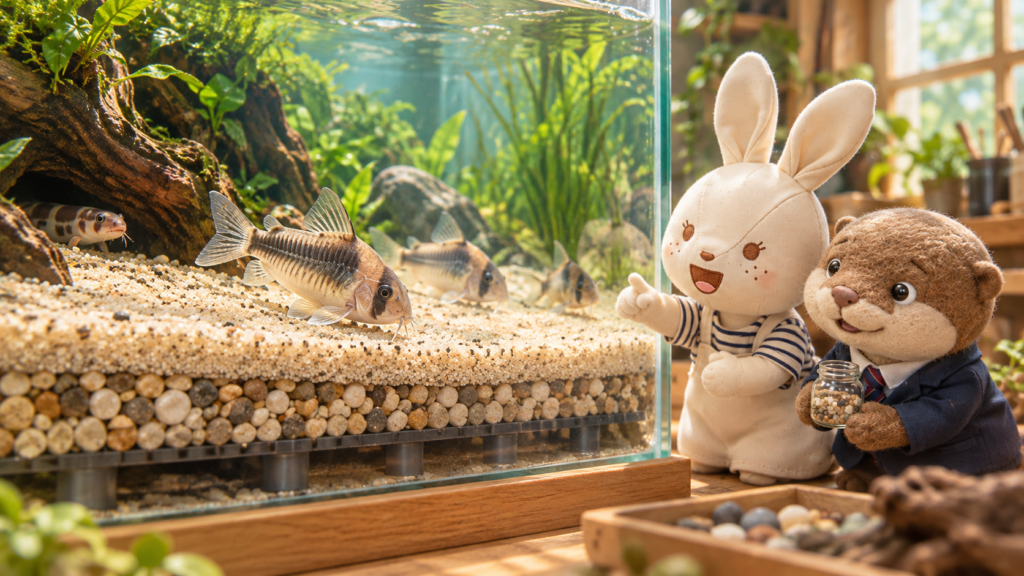 アイのアクアグッズ案内水槽の底砂の選び方|砂・砂利の違いとおすすめ商品道具の特徴や使い方、選ぶときのポイントをアイが紹介します。記事はコチラ →
 アイのアクアグッズ案内ダニオの仲間に合わせる飼育用品|ゼブラダニオから超小型種まで水槽・ろ過・餌を選ぶ道具の特徴や使い方、選ぶときのポイントをアイが紹介します。記事はコチラ →
さまざまな飼育テーマをご紹介。リンク先の記事には広告・商品紹介が含まれます。
案内・紹介記事一覧へ →参考文献
本記事の分類、分布、生息環境、飼育条件、繁殖、病気・注意点を確認するため、原記載、学術データベース、査読論文、公的・獣医学系資料を中心に選定しました。店舗、通販ページ、個人ブログ、まとめサイトは参考文献から除外しています。
-
原記載・命名
Nijssen, H. & Isbrücker, I. J. H. (1971). Two new species of the catfish genus Corydoras from Brazil and Peru (Pisces, Siluriformes, Callichthyidae). Beaufortia, 18(239), 183–189.
https://repository.naturalis.nl/pub/504807
記事で支える内容:Corydoras panda としての原記載、ペルー産標本、種名と形態的特徴の基礎。 -
現行分類・分布
Fricke, R., Eschmeyer, W. N. & van der Laan, R. (eds.). Eschmeyer’s Catalog of Fishes. California Academy of Sciences. Species record for Corydoras panda / Hoplisoma panda.
https://researcharchive.calacademy.org/research/ichthyology/catalog/fishcatget.asp?genus=Corydoras&species=panda&tbl=species
記事で支える内容:Hoplisoma panda を現行有効名とする扱い、Corydoras panda との関係、上部アマゾン水系、ペルー・エクアドル、淡水性。 -
Corydoradinae の分類再編
Dias, A. C., Tencatt, L. F. C., Roxo, F. F., da Costa Silva, G. S., Santos, S. A., Britto, M. R., Taylor, M. I. & Oliveira, C. (2025). Phylogenomic analyses in the complex Neotropical subfamily Corydoradinae (Siluriformes: Callichthyidae) with a new classification based on morphological and molecular data. Zoological Journal of the Linnean Society, 203(3), zlae053.
https://doi.org/10.1093/zoolinnean/zlae053
記事で支える内容:UCEsを用いたコリドラス亜科の再検討、Hoplisoma などの属の復活、分類表記を更新する根拠。 -
基礎情報・飼育水質の目安
Froese, R. & Pauly, D. (eds.). FishBase. Hoplisoma panda, Panda corydoras summary page.
https://fishbase.se/summary/Hoplisoma_panda.html
記事で支える内容:淡水・底生、上部アマゾン水系、最大標準体長3.8cm、pH 6.0–8.0、硬度2–25 dH、水温20–25℃、IUCN準絶滅危惧、観賞魚利用。 -
保全状況
Hidalgo del Aguila, M., Velasquez, M. & Chocano, L. (2016). Corydoras panda. The IUCN Red List of Threatened Species 2016: e.T49830400A53818288.
https://doi.org/10.2305/IUCN.UK.2016-1.RLTS.T49830400A53818288.en
記事で支える内容:準絶滅危惧としての扱い、野生個体群と観賞魚取引に関する注意。 -
ペルーにおける分布確認
Ortega, H., Hidalgo, M., Trevejo, G., Correa, E., Cortijo, A. M., Meza, V. & Espino, J. (2012). Lista anotada de los peces de aguas continentales del Perú: Estado actual del conocimiento, distribución, usos y aspectos de conservación. Ministerio del Ambiente / Museo de Historia Natural, UNMSM.
https://museohn.unmsm.edu.pe/docs/pub_ictio/Ortega_et_al.2012Lista_Peces_Aguas_Cont.Peru.pdf
記事で支える内容:ペルー内陸水域の魚類リストにおける本種の掲載、ペルー産淡水魚としての位置づけ。 -
腸管呼吸・低酸素への適応
Kramer, D. L. & McClure, M. (1980). Aerial respiration in the catfish, Corydoras aeneus (Callichthyidae). Canadian Journal of Zoology, 58(11), 1984–1991.
https://doi.org/10.1139/z80-273
記事で支える内容:コリドラス類に見られる水面での空気摂取と後腸を用いた補助呼吸の説明。ただし種は C. aeneus であり、H. panda への適用は近縁群の一般的特徴として扱う。 -
胸びれ棘・腋窩腺・ストレス時分泌
Kiehl, E., Rieger, C. & Greven, H. (2006). Axillary gland secretions contribute to the stress-induced discharge of a bactericidal substance in Corydoras sterbai (Callichthyidae, Siluriformes). Verhandlungen der Gesellschaft für Ichthyologie, 5, 111–115.
https://www.biologie.hhu.de/fileadmin/redaktion/Fakultaeten/Mathematisch-Naturwissenschaftliche_Fakultaet/Biologie/Institute/weitere_und_ehemalige_Dozenten/weitere_Dozenten/Prof._Dr._Hartmut_Greven_i._R/2006_07_Kiehl-Rieger-Greven-GfI-Bd_5_111-115.pdf
記事で支える内容:輸送・捕獲などのストレス下でコリドラス類が水中へ分泌物を出すこと、腋窩腺分泌物がその一部と考えられること。対象種は C. sterbai のため、H. panda 固有の確定事実としては扱わない。 -
防衛器官の形態学
Carvalho, T. I., Sazima, I. & Zuanon, J. (2021). Pectoral-fin glands and delivery apparatus in the catfish Corydoras aeneus (Siluriformes: Callichthyidae). Papéis Avulsos de Zoologia, 61, e20216145.
https://doi.org/10.11606/1807-0205/2021.61.45
記事で支える内容:コリドラス類の胸びれ棘と関連腺構造、防衛機構を説明するための形態学的根拠。 -
繁殖行動・Tポジション・精子飲み
Kohda, M., Tanimura, M., Kikue-Nakamura, M. & Yamagishi, S. (1995). Sperm drinking by female catfishes: a novel mode of insemination. Environmental Biology of Fishes, 42, 1–6.
https://doi.org/10.1007/BF00002344
記事で支える内容:Tポジション、精子を口から取り込む繁殖様式、腹びれポケットでの受精機構。研究対象は主に C. aeneus であり、H. panda では近縁群の繁殖様式として慎重に扱う。 -
精嚢タンパク質と精子運動制御
Yoshida, J., Yamamoto, M., Kamiya, J., Kondo, A., Sakaguchi, Y., Morino, N., Saito, T., Kohda, M., Awata, S., Sato, B., Miyado, K. & Kawano, N. (2025). Seminal vesicle protein caCA12 in Corydoras aeneus inhibits sperm motility for sperm drinking. Journal of Experimental Biology, 228(9), jeb250293.
https://doi.org/10.1242/jeb.250293
研究内容:caCA12による精子運動の抑制。C. aeneusを対象とする研究であり、コリドラス・パンダ固有の結果ではありません。 -
亜硝酸・メトヘモグロビン血症
Durborow, R. M., Crosby, D. M. & Brunson, M. W. (1997). Nitrite in Fish Ponds. Southern Regional Aquaculture Center Publication No. 462.
https://agrilife.org/fisheries/files/2013/09/SRAC-Publication-No.-0462-%E2%80%93-Nitrite-in-Fish-Ponds.pdf
記事で支える内容:亜硝酸がエラから血中に入り、ヘモグロビンをメトヘモグロビン化して酸素運搬を阻害する仕組み、閉鎖系での濾過不全・水質管理の重要性。 -
細菌性疾患・カラムナリス
MSD Veterinary Manual. Bacterial Diseases of Fish. MSD Manual, Veterinary Manual.
https://www.msdvetmanual.com/exotic-and-laboratory-animals/aquarium-fish/bacterial-diseases-of-fish
記事で支える内容:Flavobacterium columnare によるカラムナリス病、皮膚・エラ組織での診断、魚病では水質やストレス管理が重要であること。




コメント