

解説 / Description
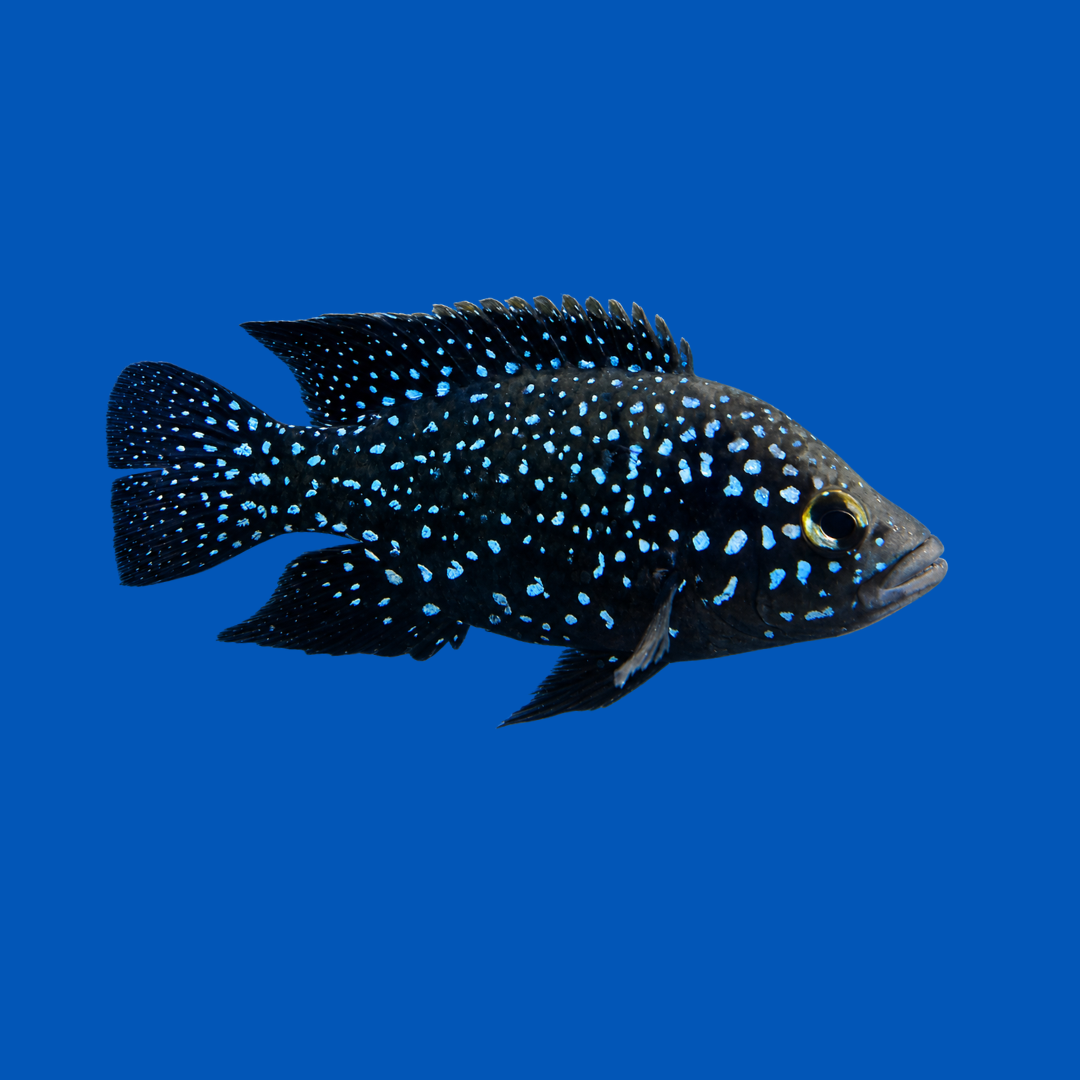
パラティラピア・ポレニィは、マダガスカル固有の大型シクリッドです。黒い体に細かな輝点が広がる姿から、英語圏のアクアリウムでは「Starry-night cichlid」と呼ばれています。マダガスカル産シクリッドの中では比較的広い分布を持ち、魚類や両生類など動きのある獲物も利用する捕食性が知られています。飼育では十分な水槽容量とろ過能力を確保し、水温や水質を急変させないことが重要です。また、同種間では強い争いが起こることがあるため、成長後のサイズと隔離手段まで見越して飼育計画を立てる必要があります。Paratilapia polleni is a large cichlid endemic to Madagascar. Its dark body is scattered with fine reflective spots, giving rise to the aquarium name “Starry-night cichlid.” Compared with many Malagasy cichlids, it has a relatively broad distribution and is known to take active prey including fishes and amphibians. In captivity, it needs ample tank space, adequate filtration, and stable temperature and water chemistry. Strong aggression can also occur between conspecifics, so long-term planning should include adult size and a reliable means of separating fish when necessary.
基本情報 / Basic Information
| 学名 / Scientific Name | Paratilapia polleni |
|---|---|
| 通称 / Common Name | パラティラピア・ポレニィ、マラケリー(Marakely)Paratilapia polleni, Marakely |
| 分類 / Family | シクリッド目(Cichliformes)・シクリッド科(Cichlidae)・Ptychochrominae亜科・Paratilapia属Order Cichliformes; family Cichlidae; subfamily Ptychochrominae; genus Paratilapia |
| 英名 / English Name | Starry-night cichlid |
| 分布 / Distribution | マダガスカルの淡水域。マダガスカル産シクリッドの多くが限られた水系に分布するのに対し、本種は比較的広い分布を持つことで知られています。Fresh waters of Madagascar. Unlike many Malagasy cichlids that are restricted to individual drainages or lakes, this species is known to have a comparatively broad distribution. |
| 最大体長 / Max Size | 全長約28cmが目安です。About 28 cm in total length. |
| 寿命 / Lifespan | 飼育下での寿命について、信頼できる標準値は十分に整理されていません。大型シクリッドとして長期飼育を前提に設備を整えます。A well-established standard lifespan in captivity is not sufficiently documented. As a large cichlid, it should be kept with long-term care and equipment planning in mind. |
飼育環境 / Aquarium Environment
| 水槽サイズ / Tank Size | 幼魚は60cm規格水槽で一時的に管理できますが、成魚の単独飼育またはペア飼育では、120×45×45cmクラス(総水量約240L)以上を目安にします。成長後の遊泳空間や縄張り行動を考えると、150cmクラスの水槽を用意できると管理しやすくなります。Juveniles can be managed temporarily in a standard 60 cm aquarium. For adults kept singly or as a pair, a tank around 120 × 45 × 45 cm (about 240 L gross volume) or larger is a practical starting point. A 150 cm-class aquarium provides more room for adult swimming and territorial behavior. |
|---|---|
| 水温 / Temperature | 24〜28℃を目安に、急変させず安定して維持します。Paratilapia属の飼育・養殖研究では22〜28℃が適温域として扱われており、野外で報告される低温・高温への耐性は、日常的な飼育水温の目安とは分けて考えます。Maintain a stable temperature around 24–28°C. Culture studies of Paratilapia have treated roughly 22–28°C as a suitable range. Reports of tolerance to much colder or hotter conditions should be distinguished from recommended routine aquarium temperatures. |
| 水質 / Water Quality | pHはおおむね中性付近から弱アルカリ性までを目安にし、特定の硬度へ無理に合わせるよりも安定性を優先します。日本の軟水でKHが低く、換水間にpHが下がりやすい場合は、サンゴ砂や石灰質のろ材を少量利用して緩衝力を補う方法があります。使用量は水質を測定しながら調整します。Aim for stable water from around neutral to mildly alkaline rather than forcing the aquarium to a particular hardness. In very soft water with low KH, where pH tends to fall between water changes, a small amount of coral sand or other calcareous filter material can be used to support buffering capacity. Adjust the amount while monitoring water parameters. |
| レイアウト / Layout | 細かい砂や角の丸い砂利を敷き、流木、石灰岩、素焼き鉢などで複数の隠れ家と視線を遮る場所を作ります。繁殖期には底床を強く掘るため、岩は底面に直接置くか確実に固定し、崩落を防ぎます。水草を使う場合は、アヌビアスやミクロソリウムなど流木に活着させやすい丈夫な種類が向きます。Use fine sand or rounded gravel and provide several shelters and visual barriers with driftwood, limestone, or clay pots. Because the fish digs vigorously when preparing to breed, heavy rocks should rest directly on the tank base or be securely fixed to prevent collapse. If plants are used, hardy epiphytes such as Anubias and Microsorum are suitable. |
| 注意点 / Precautions | 成魚は大きく、給餌量に応じてろ過への負荷も高くなるため、水槽容量に見合った十分な物理・生物ろ過を確保します。換水は定期的な部分換水を基本とし、新しい水との水温やpHの差を小さくして、一度に大きな環境変化を起こさないようにします。Adults are large and can place a substantial load on filtration, so provide mechanical and biological filtration appropriate to the tank volume and feeding level. Use regular partial water changes, keeping differences in temperature and pH between old and new water small so that maintenance does not create abrupt environmental shifts. |
餌と給餌 / Feeding
| 餌の種類 / Diet | 主食には大型シクリッド向けの総合人工飼料を使い、副食として冷凍赤虫、クリル、イサザアミ、小魚などを組み合わせます。本種は野生で魚類や両生類なども捕食しますが、飼育下で金魚やメダカなどの活餌を常用する必要はありません。病原体を持ち込む可能性があるため、由来の不明な活餌は避けます。Use a complete prepared food for large cichlids as the staple diet, supplemented with items such as frozen bloodworms, krill, mysis, and small fish. Although the species takes fishes and amphibians in the wild, routine use of live feeder goldfish or medaka is unnecessary in captivity. Avoid live foods of uncertain origin because they can introduce pathogens. |
|---|---|
| 給餌のポイント / Feeding Tips | 動物質をよく利用する魚ですが、飼育下では栄養の偏りを避けるため、総合人工飼料を中心にします。食べ残しが出ない量を与え、体格や活動量に合わせて調整することが、水質の安定にもつながります。It readily consumes animal-based foods, but a complete prepared diet should remain the foundation in captivity to avoid nutritional imbalance. Feed amounts that are eaten cleanly and adjust them to the fish’s size and activity level, which also helps maintain stable water quality. |
性格と混泳 / Temperament and Tank Mates
| 性格 / Temperament | 大型で縄張り性があり、捕食性も示すシクリッドです。とくに同種間では、ペア形成前や繁殖期を含めて強い攻撃行動が見られることがあります。優劣が固定すると劣位個体が追われ続ける場合があるため、逃げ場だけでなく隔離できる設備を用意しておきます。This is a large, territorial cichlid with predatory behavior. Strong aggression can occur between conspecifics, including before pair formation and during breeding. If a dominance relationship becomes fixed, a subordinate fish may be repeatedly chased, so provide not only visual refuges but also a practical means of separation. |
|---|---|
| 混泳の相性 / Compatibility | 口に入る小型魚や小型エビは捕食される可能性があります。混泳を試す場合は十分に広い水槽で、体格差が大きすぎない魚を選び、個体ごとの反応を確認します。同種の成魚を複数維持する場合、とくにオス同士では争いが激しくなりやすいため、無理な同居は避けます。Small fish and shrimp that fit in its mouth may be eaten. If tank mates are attempted, use a spacious aquarium, avoid extreme size differences, and judge compatibility by the behavior of the individual fish. Keeping multiple adult Paratilapia—especially males—can lead to severe aggression, so forced cohabitation should be avoided. |
病気と対策 / Diseases and Prevention
| かかりやすい病気 / Common Diseases | 本種だけに特有の「かかりやすい病気」を示す信頼できる資料は十分ではありません。一般的な淡水魚と同様に、白点病などの外部寄生虫症や、争いによる傷からの二次感染には注意します。Reliable evidence for diseases uniquely common in this species is limited. As with other freshwater fishes, watch for external parasitic diseases such as white spot and for secondary infection following injuries caused by aggression. |
|---|---|
| 対策と予防 / Prevention | 予防の基本は、水温と水質を安定させ、過密や継続的な追い回しを避けることです。新しい魚や活餌から病原体を持ち込まないよう管理し、異常が出た場合は症状だけで一律に塩分や水温を上げるのではなく、原因を確認して病気に合った対処を行います。Prevention centers on stable temperature and water quality and on avoiding overcrowding or persistent harassment. Reduce the chance of introducing pathogens with new fish or live foods. If symptoms appear, do not automatically raise salinity or temperature; first identify the likely cause and use treatment appropriate to the condition. |
増やし方(繁殖) / Breeding
| 雌雄の判別 / Sexing | 成熟したオスはメスより大きくなる傾向があり、背鰭・臀鰭が長く伸び、頭部に隆起が見られる個体もいます。メスはオスより小柄で、鰭も短めになる傾向があります。ただし、若魚では外見だけでの判別が難しい場合があります。Mature males tend to grow larger than females, with more extended dorsal and anal fins, and some develop a forehead hump. Females are generally smaller with shorter fins. Sexing juveniles by external appearance alone can be difficult. |
|---|---|
| 繁殖形態 / Reproduction | 基質産卵型です。パラティラピア・ポレニィでは、卵が基質へ一粒ずつ強く固着するのではなく、卵に付随するフィラメントによって互いにつながり、まとまった可動性の卵塊を作ることが研究で報告されています。産卵数は個体や条件による幅が大きく、単一の上限値で示すのは適切ではありません。孵化までの間は雌が中心となって卵を保護します。It is a substrate-spawning cichlid. In Paratilapia polleni, research has described eggs that attach to one another through associated filaments rather than each egg being firmly fixed to the substrate, forming a cohesive and mobile egg mass. Fecundity varies substantially with individual fish and conditions, so it is not appropriate to present a single fixed maximum. During the egg stage, the female is the primary caregiver. |
| 繁殖のポイント / Breeding Tips | 繁殖ではペアの相性が重要です。幼魚を複数育てて自然にペアを形成させる方法は実践的ですが、成立後に残りの個体を分けられる水槽やセパレーターをあらかじめ用意します。繁殖期は縄張り性が強まるため、同居魚への攻撃にも注意します。水温が25℃前後であれば孵化はおおむね数日以内に進み、その後に稚魚が遊泳を始めます。発育速度は水温などの条件で変わるため、日数は固定値として考えません。Pair compatibility is important for breeding. Raising several juveniles and allowing a pair to form naturally is a practical method, but another tank or divider should be ready so the remaining fish can be separated once a pair forms. Territorial aggression increases during breeding, so other tank mates must also be watched closely. Around the mid-20s °C, hatching generally proceeds within a few days, followed by the onset of free swimming. Developmental timing varies with temperature and other conditions and should not be treated as a fixed number of days. |
雑学と豆知識 / Trivia and Fun Facts
| 1. 名前に残る19世紀の探検史 / 1. A name rooted in 19th-century exploration | パラティラピア・ポレニィは1868年、オランダの魚類学者ピーター・ブリーカーによって記載されました。種小名polleniは、19世紀にマダガスカルの自然史調査に関わったフランソワ・ポレンへの献名です。現在の学名にも、当時のマダガスカル生物相研究の歴史が残されています。Paratilapia polleni was described in 1868 by the Dutch ichthyologist Pieter Bleeker. The specific name polleni honors François Pollen, who was involved in 19th-century natural-history exploration of Madagascar. The scientific name therefore preserves part of the history of early biological study on the island. |
|---|---|
| 2. 古い系統と、まだ残る分類上の課題 / 2. An early-diverging lineage with unresolved taxonomy | Ptychochrominae亜科は、アフリカ大陸と新熱帯区の主要なシクリッド群の姉妹群とされる、比較的早い段階で分岐した系統です。一方、Paratilapia属では地域個体群の整理に未解決の部分が残っています。現在のEschmeyer’s Catalog of FishesではParatilapia bleekeriはP. polleniのシノニムとされていますが、流通上の「スモールスポット」「ラージスポット」といった呼び分けを、そのまま正式な種名と考えることはできません。The subfamily Ptychochrominae is an early-diverging lineage regarded as sister to the major African and Neotropical cichlid groups. At the same time, the taxonomy of regional Paratilapia populations is not completely resolved. Eschmeyer’s Catalog of Fishes currently treats Paratilapia bleekeri as a synonym of P. polleni, so aquarium labels such as “small spot” and “large spot” should not be assumed to represent formally recognized species. |
| 3. 光の当たり方で表情を変える、星空のような斑点 / 3. Starry spots that change with the light | 魚類では、黒い色素に関わるメラノフォアや、グアニン結晶を含むイリドフォアが体色や光沢に関与することが知られています。ただし、パラティラピア・ポレニィの斑点について、その微細構造や神経による色調制御まで直接検証した研究は十分ではありません。本種について確実に言えるのは、黒い体色に細かな輝点が並び、光の当たり方によって見え方が変化するという観賞上の特徴です。In fishes generally, melanophores contribute dark pigment and iridophores containing guanine crystals contribute reflective coloration. However, the fine structure and neural control of the spots in Paratilapia polleni have not been sufficiently studied directly. What can be stated with confidence for this species is the visible aquarium trait: fine reflective spots stand out against the dark body and change in appearance with the angle of light. |
| 4. 極端な水温の記録は「適温」とは別 / 4. Extreme temperature records are not care targets | Paratilapia属では、高地で約12℃まで下がる環境での生存や、短時間ながら約40℃の高温に耐えた観察例が報告されています。しかし、これは耐えられる範囲を示す記録であり、水槽で再現すべき飼育条件ではありません。日常の飼育では安定した中間域を保つことが重要です。また、パラティラピア・ポレニィはマダガスカル産シクリッドの中では珍しく、魚類や両生類のような比較的大きく動く獲物を継続的に利用することが報告されています。Reports for Paratilapia include survival in highland waters dropping to about 12°C and short-term observations of tolerance near 40°C. These records describe tolerance limits, not aquarium targets. Routine care should use a stable intermediate temperature. Paratilapia polleni is also unusual among Malagasy cichlids in regularly taking relatively large, mobile prey such as fishes and amphibians. |
| 5. 保全と飼育下繁殖 / 5. Conservation and captive breeding | パラティラピア・ポレニィはIUCNレッドリストの2016年評価で危急種(VU)とされています。マダガスカルの淡水魚では、生息地の改変や外来種など複数の要因が保全上の課題となっています。飼育下繁殖は、由来や系統を記録し、個体群を計画的に維持する仕組みと結びついたときに域外保全としての意味を持ちます。家庭水槽で繁殖しただけで自動的に保全活動になるわけではありませんが、正確な由来を残して維持する姿勢は重要です。Paratilapia polleni was assessed as Vulnerable (VU) on the IUCN Red List in 2016. Malagasy freshwater fishes face several conservation pressures, including habitat alteration and introduced species. Captive breeding has ex-situ conservation value when provenance and lineages are documented and populations are managed in a coordinated way. Reproduction in a home aquarium is not automatically a conservation program, but maintaining accurate origin and lineage information is still important. |
| 6. 動かせる独特の卵塊 / 6. An unusual mobile egg mass | 本種の繁殖で特に特徴的なのが、卵同士がフィラメントでつながって一つの卵塊を作ることです。1992年の飼育下研究では、この独特な卵形態と可動性の卵塊が記載され、受精後は雌が中心となって保護することも報告されました。一般的な「岩に一粒ずつ貼り付ける卵」とは異なるため、本種の繁殖を理解するうえで重要な特徴です。A particularly distinctive reproductive trait is that the eggs are linked by filaments into a cohesive mass. A 1992 captive study described this unusual egg morphology and mobile egg mass and found that the female became the primary caregiver after fertilization. This differs from the more familiar pattern of individual eggs being attached one by one to a rock or other fixed surface. |
| 7. 日本で迎えるなら、由来と将来のスペースを確認 / 7. In Japan, check origin and long-term space | 日本では一般的な小型熱帯魚のように常時どこでも見られる種類ではありませんが、専門店や通販でブリード個体が流通することがあります。購入時はサイズだけでなく、分かる範囲で由来やロカリティ情報も確認しておくと、分類が整理途上にあるParatilapia属を扱ううえで役立ちます。さらに、成魚用の大型水槽と、ペア形成や争いに備えた隔離スペースまで用意できるかを導入前に考えておくことが大切です。In Japan, this species is not as routinely available as common small tropical fishes, although captive-bred specimens do appear through specialist shops and online retailers. When possible, confirm not only the size but also origin and locality information, which is useful when working with a genus whose regional taxonomy remains incompletely resolved. Before purchase, also plan for an adult-sized aquarium and separate space in case pairing or aggression makes isolation necessary. |
まとめ / Conclusion
パラティラピア・ポレニィは、マダガスカル固有の大型シクリッドで、黒い体に細かな輝点が広がる外見と、卵同士がつながって可動性の卵塊を作る繁殖様式が大きな特徴です。Paratilapia属では地域個体群の分類に未解決の部分が残るため、流通名だけで系統を決めつけず、分かる範囲で由来情報を確認して扱うことが大切です。Paratilapia polleni is a large cichlid endemic to Madagascar, distinguished by a dark body scattered with fine reflective spots and by an unusual reproductive system in which the eggs form a cohesive, mobile mass. Because the taxonomy of regional Paratilapia populations is not fully resolved, aquarium trade labels alone should not be used to assume lineage; origin information should be retained whenever available.
飼育では十分な水槽容量とろ過を確保し、水温や水質を急変させないこと、同種間の争いに備えて隔離手段を用意することが重要です。小型魚との混泳を避け、相性のよいペアが形成された場合には、雌を中心とした卵の保護など本種ならではの繁殖行動も観察できます。成長後のサイズまで見越して余裕のある環境を整えることで、特徴的な体色と行動を長期的に楽しめるシクリッドです。Successful care depends on adequate tank volume and filtration, avoiding abrupt changes in temperature or water chemistry, and having a reliable means of separating fish if conspecific aggression develops. Small tank mates should be avoided, and a compatible pair may provide the opportunity to observe the species’ distinctive breeding behavior, including female-centered egg care. Planning for adult size from the start allows its characteristic coloration and behavior to be maintained over the long term.

気になる道具や飼い方を見つけてみませんか?
 アイのアクアグッズ案内海水魚の底砂の選び方|サンゴ砂・ライブサンドとおすすめ商品道具の特徴や使い方、選ぶときのポイントをアイが紹介します。記事はコチラ →
 アイのアクアグッズ案内旅行中、お魚のごはんはどうする? 自動給餌器・使える餌・スマート水槽の選び方旅行中の魚の餌やりを助ける自動給餌器を、アイとコタロウが紹介。時間指定、おかわり給餌、対応するフレークや顆粒、設置台、スマホ管理、一体型水槽、留守番フードまで、使いどころと選び方を案内します。記事はコチラ →
 アイのアクアグッズ案内水草用ライトの選び方|緑の絨毯と赤い水草を楽しむ照明・植栽用品道具の特徴や使い方、選ぶときのポイントをアイが紹介します。記事はコチラ →
 アイのアクアグッズ案内ダニオの仲間に合わせる飼育用品|ゼブラダニオから超小型種まで水槽・ろ過・餌を選ぶ道具の特徴や使い方、選ぶときのポイントをアイが紹介します。記事はコチラ →
さまざまな飼育テーマをご紹介。リンク先の記事には広告・商品紹介が含まれます。
案内・紹介記事一覧へ →分布マップ
Paratilapia polleni は、マダガスカルの淡水域に分布する固有種です。マダガスカル産シクリッドの中では比較的広い分布を持つため、下の地図では島全体を含む範囲を概略表示しています。
※この地図は記事に記載された「マダガスカルの淡水域」という分布情報をもとにした概略表示です。マーカーは分布地域を把握しやすくするための代表地点であり、実際の採集地点・観察地点を示すものではありません。
参考文献
-
分類・シノニム
Fricke, R., Eschmeyer, W. N. & Van der Laan, R. (eds.). Eschmeyer’s Catalog of Fishes. California Academy of Sciences. “Paratilapia bleekeri” entry; current status: synonym of Paratilapia polleni Bleeker, 1868. California Academy of Sciences -
分類・系統
Sparks, J. S. & Smith, W. L. (2004). Phylogeny and biogeography of cichlid fishes (Teleostei: Perciformes: Cichlidae). Cladistics, 20(6), 501–517. DOI: 10.1111/j.1096-0031.2004.00038.x DOI -
分布・生息環境・体長
Royal Museum for Central Africa. Faunafri / CLOFFA: Paratilapia polleni Bleeker, 1868. マダガスカルにおける広域分布、淡水性、最大体長28 cm、および生態・分布に関する基礎文献を収録。 Royal Museum for Central Africa -
分布・保全状況
Ravelomanana, T. (2016). Paratilapia polleni. The IUCN Red List of Threatened Species 2016: e.T16199A58297263. DOI: 10.2305/IUCN.UK.2016-3.RLTS.T16199A58297263.en IUCN Red List -
飼育条件・生息環境・繁殖
Caballero-Huertas, M., Canonne, M., Rakotomanana, D., Tianandriatsiferana, R. J. C., Andrianjafisoa, T., Rasoloariniaina, J. R. & Mortillaro, J.-M. (2025). New insights into the reproductive physiology and culture approaches of Paratilapia sp., a Malagasy cichlid with potential interest for sustainable aquaculture. Journal of the World Aquaculture Society, 56(1), e13103. DOI: 10.1111/jwas.13103 DOI -
繁殖・親魚行動
Stiassny, M. L. J. & Gerstner, C. L. (1992). The parental care behaviour of Paratilapia polleni (Perciformes, Labroidei), a phylogenetically primitive cichlid from Madagascar, with a discussion of the evolution of maternal care in the family Cichlidae. Environmental Biology of Fishes, 34, 219–233. DOI: 10.1007/BF00004768 DOI -
繁殖・卵の付着構造
Stiassny, M. L. J. & Mezey, J. G. (1993). Egg attachment systems in the family Cichlidae (Perciformes, Labroidei): with some comments on their significance for phylogenetic studies. American Museum Novitates, No. 3058. Biodiversity Heritage Library -
飼育管理・水質・検疫
Petty, B. D., Francis-Floyd, R. & Yanong, R. P. E. Management of Aquarium Fish. Merck Veterinary Manual. 水質管理、生物ろ過、換水、隔離・検疫、家庭水槽のバイオセキュリティに関する獣医学的資料。 Merck Veterinary Manual -
病気・外部寄生虫
Petty, B. D., Francis-Floyd, R. & Yanong, R. P. E. Parasitic Diseases of Fish. Merck Veterinary Manual. 淡水魚の白点病(Ichthyophthirius multifiliis)、淡水性ベルベット病の原因となる Piscinoodinium、診断と治療の基本を収録。 Merck Veterinary Manual




コメント