
解説 / Description
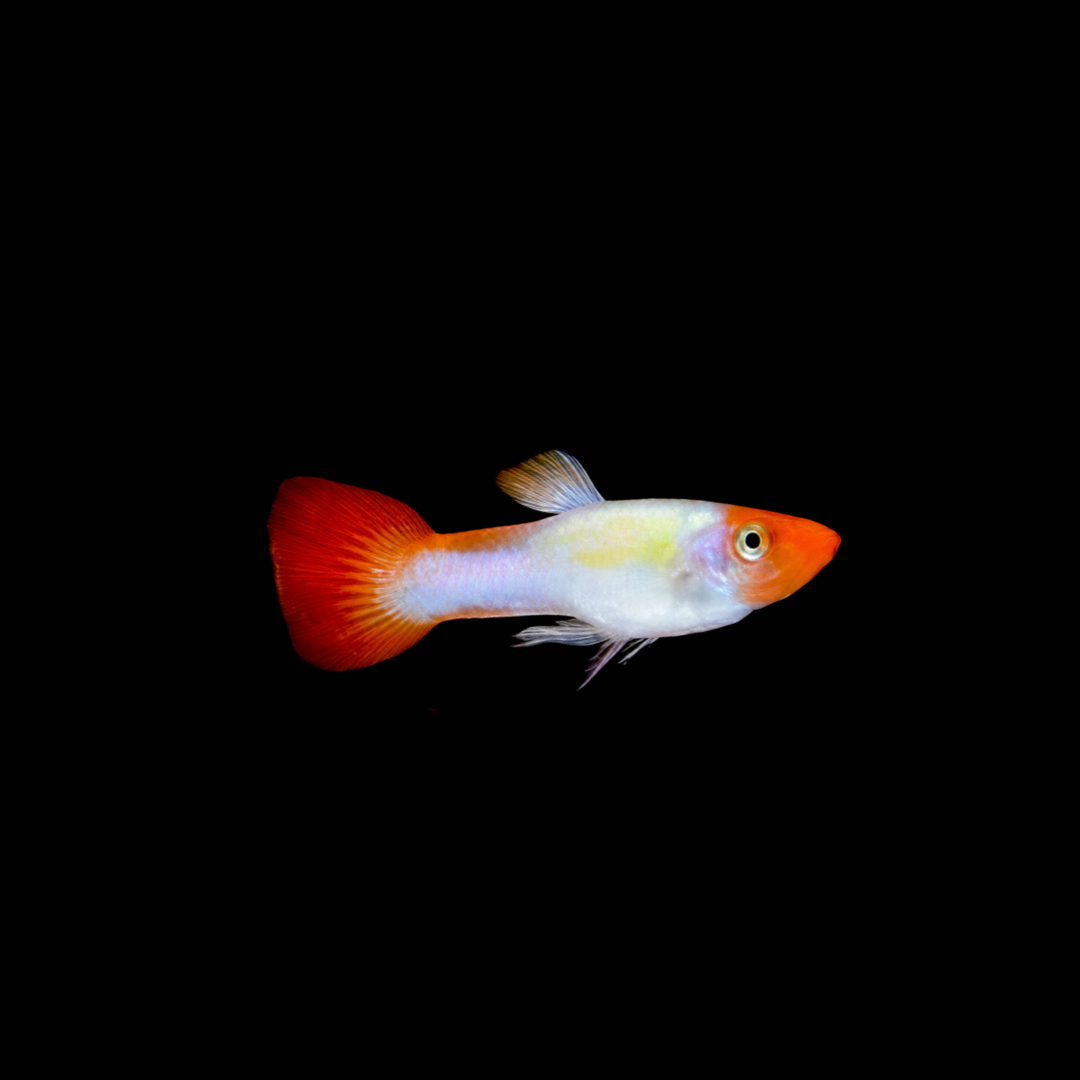
丹頂グッピーは、白〜クリーム色の体に、口先から頭部にかけて鮮やかな赤が乗る紅白模様が特徴のグッピーです。独立した種ではなく、熱帯魚として古くから親しまれてきたグッピー(Poecilia reticulata)を選抜交配して生み出された改良品種で、海外では錦鯉に見立てて「コイグッピー」や「紅白グッピー(Kohaku Guppy)」とも呼ばれています。日本国内では2017〜2018年頃から「丹頂グッピー」の名で本格的に流通し始めたとされる比較的新しい品種で、金魚や錦鯉の丹頂を思わせる紅白のコントラストが多くのアクアリストを惹きつけています。基本の紅白表現のほか、体の後半が黒く染まる丹頂タキシード、黒い色素を持たず目が赤いRREA(リアルレッドアイアルビノ)丹頂、胸ビレまで赤く染まるレッドイヤー丹頂、胸ビレが大きく広がる丹頂ダンボ、ヒレが長く伸びるリボンやスワロー、お腹が透けて見えるグラスベリー、体の短いショートボディなど、バリエーションは急速に増えています。ただし「丹頂」は世界共通の基準で固定された品種名ではなく、紅白の見た目に対して付けられた流通上の呼び名です。そのため、作出された国やブリーダーによって血統や品質に大きな差があります。頭部の赤を次の世代へ受け継がせる難しさ、日本の軟水への慣らし方、外国産個体との混泳のリスクなど、定番のグッピーとは少し違った視点での管理が求められる、奥深い魚です。 The Tancho Guppy is a guppy distinguished by a red-and-white pattern, with vivid red covering the snout and head against a white to cream-colored body. It is not a separate species but an ornamental strain created by selectively breeding the guppy (Poecilia reticulata), a tropical fish long loved by hobbyists. Overseas it is likened to Nishikigoi and is also called the “Koi Guppy” or “Kohaku Guppy.” In Japan it is said to have begun circulating widely under the name “Tancho Guppy” around 2017 to 2018, making it a relatively new strain, and its red-and-white contrast, reminiscent of Tancho goldfish and koi, has captivated many aquarists. Besides the basic red-and-white form, variations are multiplying rapidly: the Tancho Tuxedo with a darkened rear body, the RREA (Real Red Eye Albino) Tancho lacking black pigment and having red eyes, the Red Ear Tancho with red pectoral fins, the Tancho Dumbo with enlarged pectoral fins, long-finned Ribbon and Swallow types, the Glass Belly with a see-through abdomen, and the compact Short Body. However, “Tancho” is not a strain name fixed to a common international standard but a trade name given to fish with a red-and-white look. As a result, bloodlines and quality differ greatly depending on the country of origin and the breeder. The difficulty of passing head coloration on to the next generation, acclimating fish to Japan’s soft water, and the risks of mixing them with imported fish all call for a slightly different approach than standard guppy varieties, making this a fish of real depth.
基本情報 / Basic Information
| 学名 / Scientific Name | Poecilia reticulata(改良品種) (ornamental strain) |
|---|---|
| 通称 / Common Name | 丹頂グッピー、紅白グッピー、コイグッピーTancho Guppy, Koi Guppy, Kohaku Guppy, Red Cap Guppy |
| 分類 / Family | カダヤシ目カダヤシ科ポエキリア属Cyprinodontiformes, Poeciliidae, genus Poecilia |
| 英名 / English Name | Koi Guppy / Kohaku Guppy / Tancho Guppy |
| 分布 / Distribution | 原種のグッピーは南米北部(トリニダード・トバゴ、ベネズエラ、ギアナ地方、ブラジル北部)に分布しています。丹頂グッピーは改良品種のため野生には存在せず、タイ、スリランカ、シンガポール、台湾、ベトナム、中国などの養殖場や、日本国内のブリーダーによって生産されています。The wild guppy is native to northern South America (Trinidad and Tobago, Venezuela, the Guianas, and northern Brazil). Being an ornamental strain, the Tancho Guppy does not occur in the wild; it is produced by fish farms in Thailand, Sri Lanka, Singapore, Taiwan, Vietnam, China and elsewhere, as well as by breeders in Japan. |
| 最大体長 / Max Size | オス約3〜4cm、メス約4〜6cmMales approx. 3–4 cm, females approx. 4–6 cm |
| 寿命 / Lifespan | 2〜3年程度(適切な環境下)Around 2–3 years under proper conditions |
飼育環境 / Aquarium Environment
| 水槽サイズ / Tank Size | 1ペアでの繁殖や系統の維持が目的であれば、30cm規格水槽(約12L)や30cmキューブ水槽(約25L)から飼育できます。群泳を楽しみたい場合や、水質をより安定させたい場合は、60cm規格水槽(約57L)以上がおすすめです。大きな尾ビレやダンボ胸ビレ、リボン系統など、強い水流が苦手な個体が多いため、上部フィルターや外部フィルターの吐出口から強い流れが当たる環境は避けましょう。スポンジフィルターなど、穏やかな水流をつくれる濾過設備が適しています。For breeding a single pair or maintaining a line, a 30 cm standard tank (about 12 L) or a 30 cm cube tank (about 25 L) is sufficient. For a schooling display or more stable water, a 60 cm standard tank (about 57 L) or larger is recommended. Because many individuals, such as those with large tails, Dumbo pectoral fins, or ribbon fins, struggle in strong currents, avoid setups where outflow from a hang-on-top or canister filter hits them directly. Filtration that produces a gentle flow, such as a sponge filter, is well suited. |
|---|---|
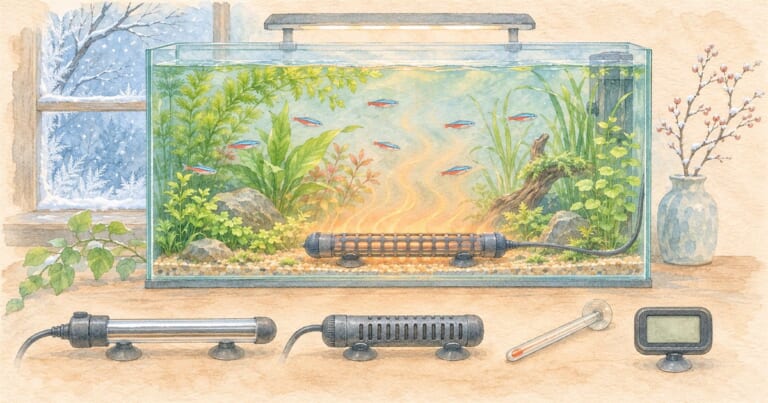
| 水温 / Temperature | 24〜26℃が最適です。日本の冬場はサーモスタット付きのヒーターが欠かせません。夏場に30℃を超える高水温や急激な温度上昇が続くと、妊娠中のメスから背骨の曲がった稚魚が生まれやすくなる一因になるとされているため、冷却ファンや室温管理で水温を安定させましょう。 24–26°C is ideal. A heater with a thermostat is essential during Japanese winters. Prolonged water temperatures above 30°C or sudden rises in summer are considered one factor that makes pregnant females more likely to give birth to fry with curved spines, so keep the temperature stable with a cooling fan or room climate control. |
| 水質 / Water Quality | 中性〜弱アルカリ性(pH7.0前後)で、ある程度ミネラルを含む水を好みます。日本の水道水は多くの地域で中性付近ですが、ミネラル分の少ない軟水であることがほとんどです。水が軟らかすぎてミネラルが不足したり、濾過が進むにつれてpHが酸性側(pH6.0未満)へ下がったりすると、元気がない、尾ビレが開かない、繁殖しにくくなるといった不調につながることがあります。最も大切なのは、理想の数値に無理に合わせることではなく、急な変化を起こさずに安定させることです。カルキを抜いた水道水がpH7.0前後であれば、国産の個体に対して特別な調整は必要ありません。ミネラルがきわめて少ない地域や、pHが下がりやすい水槽、外国産の個体を迎える場合には、カキガラやサンゴ砂を少量ネットに入れてフィルター内や水槽の隅に置く方法が有効です。底砂に直接混ぜるとpHが上がりすぎても調整しにくいため、出し入れできるネットに入れておくと安心です。Prefers neutral to slightly alkaline water (around pH 7.0) with some mineral content. Japanese tap water is near neutral in most regions but is almost always soft, low in minerals. When water is too soft and minerals run short, or when pH drifts acidic (below 6.0) as filtration progresses, problems such as listlessness, clamped tails, and poor breeding can result. Most important is not forcing the water to ideal values but keeping it stable without sudden changes. If dechlorinated tap water is around pH 7.0, domestically bred fish need no special adjustment. In areas with very mineral-poor water, in tanks where pH tends to drop, or when introducing imported fish, placing a small amount of oyster shell or coral sand in a mesh bag inside the filter or in a corner of the tank is effective. Mixing it directly into the substrate makes it hard to correct if the pH rises too far, so a removable mesh bag is the safer choice. |
| レイアウト / Layout | 水草をほとんど食べないため、水草レイアウト水槽との相性は良好です。浮き草や有茎草の茂みを用意しておくと、オスのしつこい追尾からメスが逃げ込む隠れ家になり、出産時には稚魚の避難場所としても役立ちます。RREA系統は強い光にストレスを感じやすいため、照明をやや控えめにするか、浮き草で陰をつくると落ち着きやすくなります。紅白の色をより引き立てたい場合は、暗めの底砂や背景を選ぶと、白地と赤がくっきりと映えます。Since it rarely eats plants, it pairs well with planted aquascapes. Thickets of floating and stem plants give females a refuge from persistent chasing by males and also serve as shelter for fry at birth. RREA lines are prone to stress under strong light, so dimming the lighting slightly or providing shade with floating plants helps them settle. To make the red and white stand out more, choose a darker substrate or background so the white body and red head appear sharply defined. |
| 注意点 / Precautions | 最も大切なのは、国産のグッピーと外国産のグッピーを同じ水槽に入れないことです。産地によって、体に持っている細菌や寄生虫、免疫を持っている病原体が異なるため、見た目は健康でも一緒にした途端に病気が一気に広がることがあり、特に国産の個体が大きな被害を受けやすいといわれています。同じ国産でも、別のブリーダーから迎えた系統をいきなり合流させるのは避けましょう。新しく迎えた個体は、産地にかかわらず最低1〜2週間は別の水槽で様子を見てから合流させることが大切です。また、スリランカなどから輸入される外国産の丹頂グッピーはオスだけで流通することが多く、到着直後は輸送の疲れや水質の違いからヒレが傷んだり体調を崩したりしやすいため、水合わせは時間をかけて丁寧に行ってください。なお、グッピーは環境省の「生態系被害防止外来種リスト」に掲載されており、温泉地の排水路や沖縄などで野生化しています。飼っている個体を川や池に放すことは絶対にせず、最後まで責任を持って飼育しましょう。The most important rule is never to keep domestically bred guppies and imported guppies in the same tank. Fish from different origins carry different bacteria and parasites and have immunity to different pathogens, so even when all look healthy, disease can spread rapidly as soon as they are combined, and domestic fish are said to be especially likely to suffer heavy losses. Even among domestic fish, avoid suddenly combining lines obtained from different breeders. Regardless of origin, keep newly acquired fish in a separate tank for at least 1–2 weeks before introducing them. Imported Tancho Guppies from places such as Sri Lanka are often sold as males only, and right after arrival they are prone to fin damage and poor condition from shipping fatigue and differences in water quality, so acclimate them slowly and carefully. Note also that the guppy is included on the Ministry of the Environment’s list of alien species that threaten ecosystems and has become established in hot-spring drainage channels and in Okinawa. Never release your fish into rivers or ponds, and care for them responsibly for their whole lives. |
餌と給餌 / Feeding
| 餌の種類 / Diet | 口が小さく、水面近くで餌をとる習性に合わせて、水に浮く細かい粒状やフレーク状の人工飼料を主食にします。成長や繁殖を促したい場合は、孵化させたブラインシュリンプ、ミジンコ、冷凍アカムシ、スピルリナ入りの飼料などをバランスよく組み合わせると効果的です。赤の発色を強めたい場合には、アスタキサンチンやヘマトコッカス、スピルリナなどを含む色揚げ用の飼料が役立ちます。Matching its small mouth and habit of feeding near the surface, use fine floating granules or flakes as the staple. To promote growth and breeding, combine these in balance with newly hatched brine shrimp, daphnia, frozen bloodworms, and spirulina-based foods. To intensify red coloration, color-enhancing foods containing astaxanthin, Haematococcus, or spirulina are helpful. |
|---|---|
| 給餌のポイント / Feeding Tips | 丹頂グッピーならではの課題は、赤を濃く仕上げることと、白地を白く保つことの両立です。赤い色のもとになる色素の一部は魚が自分で作れず、餌から取り込むしかありません。そのため、どれほど優れた血統でも、色素の少ない餌ばかりでは頭部の赤を十分に引き出せません。一方で、紅白の錦鯉や金魚の飼育でも知られているように、色揚げ飼料や黄色系の色素を含む餌を与えすぎると、白い部分まで黄ばんで紅白のメリハリが失われることがあり、消化への負担も心配されます。色揚げ飼料は毎回与えるのではなく、通常の人工飼料やブラインシュリンプと交互に適量を与えるのがコツです。あわせて週1〜2回、水量の1/3程度を目安に水換えを行い、水の汚れや黄ばみを防ぐことで、澄んだ白地と鮮やかな赤い頭を保ちやすくなります。1回に与える量は数分で食べきれる程度とし、1日1〜2回に分けて与えましょう。食べ残しは水を汚す原因になるため、取り除いてください。A challenge unique to the Tancho Guppy is achieving deep red while keeping the white areas truly white. Some of the pigments behind red coloration cannot be made by the fish and must come from food. So no matter how good the bloodline, a diet poor in these pigments will not fully bring out the red on the head. On the other hand, as is known from keeping red-and-white koi and goldfish, overfeeding color-enhancing foods or foods with yellow pigments can turn the white areas yellowish and blur the red-and-white contrast, and may also burden digestion. The trick is not to feed color-enhancing food every time but to alternate moderate amounts with regular dry food and brine shrimp. Together with water changes of about one-third of the volume once or twice a week to prevent dirty or yellowed water, this makes it easier to keep a clear white body and a vivid red head. Give an amount that can be eaten within a few minutes, divided into one or two feedings a day, and remove leftovers, which foul the water. |
性格と混泳 / Temperament and Tank Mates
| 性格 / Temperament | 温和な性格で、他の魚を攻撃することはほとんどありません。ただし、オスにはメスをしつこく追いかける習性があり、オスが多すぎるとメスが疲れて弱ってしまいます。群れで泳ぐ姿が美しく、水槽の中層から上層を活発に泳ぎ回ります。Peaceful and rarely aggressive toward other fish. However, males tend to chase females persistently, and too many males can tire and weaken the females. They look beautiful swimming in groups and move actively through the middle and upper levels of the tank. |
|---|---|
| 混泳の相性 / Compatibility | コリドラス、オトシンクルス、小型のラスボラ、おとなしいテトラ類などとは問題なく混泳できます。ベタやヒレをかじる気の荒い魚、グッピーを食べてしまう大型魚は避けてください。名前の由来となった錦鯉とは、適した水温も体の大きさもまったく異なるため、一緒に飼うことはできません。エンドラーズ・ライブベアラーはグッピーと簡単に交雑するため、丹頂の血統を守りたい場合は同じ水槽に入れないでください。ミナミヌマエビなどの小型エビは、成体であれば問題ありませんが、稚エビは食べられてしまうことがあるため、エビも増やしたい場合は隠れ家を十分に用意しましょう。また、前述のとおり国産の個体と外国産の個体を一緒にすることは厳禁です。They coexist well with Corydoras, Otocinclus, small rasboras, and peaceful tetras. Avoid bettas, aggressive fin-nipping fish, and large fish that may eat guppies. Nishikigoi, from which the name is borrowed, require entirely different temperatures and grow far larger, so the two cannot be kept together. Endler’s livebearers hybridize easily with guppies, so keep them in separate tanks if you wish to protect a Tancho bloodline. Adult small shrimp such as Neocaridina are fine, but baby shrimp may be eaten, so provide plenty of hiding places if you also want the shrimp to breed. As mentioned above, combining domestic and imported guppies is strictly prohibited. |
病気と対策 / Diseases and Prevention
| かかりやすい病気 / Common Diseases | カラムナリス症(尾ぐされ病・口ぐされ病)は、水質の悪化や輸送の疲れ、ヒレの傷などをきっかけに発症します。ヒレをたたむ、尾ビレの縁が白く濁って溶ける、口の周りが綿のようにただれるといった症状が見られます。テトラヒメナという微生物の寄生による病気や、愛好家の間で「グッピーエイズ」と呼ばれている症状は、ヒレを閉じてふらふらと泳いだあと急死してしまうのが特徴です。人の病気とは関係のない通称で、原因がはっきりしないものも含まれます。致死率がきわめて高く、確実な治療法が確立されていない厄介な病気で、国産と外国産の個体を一緒にすることが最大のきっかけになると考えられています。ハリ病(グッピー病)は主に稚魚に多く、尾ビレが溶けて閉じ、残ったヒレの骨が針のようにとがって見えます。水質の悪化や栄養不足、近親交配による体力の低下などが関係するとされていますが、はっきりした原因はわかっていません。このほか、急な水温の変化で起こりやすい白点病、傷口から起こる水カビ病、エラに寄生する小さな寄生虫による呼吸の乱れにも注意が必要です。Columnaris disease (fin rot and mouth rot) is triggered by poor water quality, shipping fatigue, or fin injuries. Symptoms include clamped fins, cloudy white edges on the tail that begin to disintegrate, and cotton-like lesions around the mouth. Infection by the microorganism Tetrahymena, along with the condition hobbyists call “guppy AIDS,” is characterized by clamped fins and unsteady swimming followed by sudden death. The latter is a nickname unrelated to the human disease and includes cases with no clear cause. It is a troublesome illness with extremely high mortality and no established reliable treatment, and mixing domestic and imported fish is thought to be the biggest trigger. “Needle disease” (guppy disease) occurs mainly in fry: the tail disintegrates and folds, leaving the remaining fin rays looking sharp like needles. Poor water quality, malnutrition, and weakened health from inbreeding are thought to be involved, but the exact cause is unknown. Also watch for white spot disease, which tends to follow sudden temperature changes, fungal infections that start from wounds, and breathing problems caused by tiny parasites on the gills. |
|---|---|
| 対策と予防 / Prevention | 何よりも大切なのは、病気を水槽に持ち込まないことです。新しい個体は産地を問わず最低1〜2週間は別の水槽で様子を見て、必要に応じて塩水浴や薬浴を行ってから本水槽へ移しましょう。カラムナリス症は、病気の個体を隔離したうえで元の水槽の水を換え、軽い場合は0.5%の塩水浴(水10Lに塩50g)、進行している場合はグリーンFゴールド顆粒やエルバージュエースなどで薬浴します。ハリ病は清潔な新しい水へ移し、初期であれば0.5%の塩水浴で体への負担を和らげますが、進行すると回復は難しくなります。白点病は早めに水温を28℃程度まで上げたうえで薬浴を行い、水カビ病は0.3%程度の塩水浴(水10Lに塩30g)や専用の薬で対処します。日頃から定期的な水換えで水質を安定させ、水温の急変を避け、近親交配を重ねすぎないことが、病気に強い個体を育てる基本です。Above all, avoid bringing disease into the tank. Regardless of origin, observe new fish in a separate tank for at least 1–2 weeks, giving salt baths or medication as needed before moving them to the main tank. For columnaris, isolate the affected fish and change water in the original tank; treat mild cases with a 0.5% salt bath (50 g of salt per 10 L of water) and advanced cases with medications such as Green F Gold Granules or Elbagen Ace. For needle disease, move fish to clean fresh water and use a 0.5% salt bath in the early stages to ease the strain on the body, though recovery becomes difficult once it progresses. For white spot, raise the temperature to about 28°C early and then medicate; for fungal infections, use a salt bath of about 0.3% (30 g of salt per 10 L of water) or a dedicated medication. Keeping water stable through regular changes, avoiding sudden temperature shifts, and not overdoing inbreeding are the basics of raising disease-resistant fish. |
増やし方(繁殖) / Breeding
| 雌雄の判別 / Sexing | オスは体が小さく、尾ビレや背ビレが大きく色鮮やかで、尻ビレが「ゴノポディウム」と呼ばれる細長い棒状の交接器に変化しています。メスは体が大きくお腹に丸みがあり、尻ビレは扇形のままです。一般的なグッピーのメスは地味な体色であることが多いのに対し、丹頂系統ではメスにも鼻先や唇に赤い斑紋が出やすく、錦鯉の用語を借りて「口紅」と呼ばれ珍重されています。ただし、メスの背ビレは半透明か白いままの個体が多く、オスも全身が赤いフルレッド系統とは違って、ゴノポディウムには赤が乗らないのが一般的です。稚魚は早ければ生後1か月ほどで雌雄の違いが見え始めます。Males are smaller, with large, colorful caudal and dorsal fins, and their anal fin is modified into a long, rod-like copulatory organ called the gonopodium. Females are larger with a rounded belly, and their anal fin remains fan-shaped. Whereas females of ordinary guppy strains are usually plain-colored, females of Tancho lines often show red markings on the snout and lips, prized as “kuchibeni” (lipstick), a term borrowed from Nishikigoi. However, many females keep translucent or white dorsal fins, and unlike all-red full-red strains, males typically have no red on the gonopodium. Differences between the sexes can begin to appear in fry as early as about one month of age. |
|---|---|
| 繁殖形態 / Reproduction | メスのお腹の中で卵をかえし、稚魚の姿で産む卵胎生です。生後3〜4か月ほどで繁殖できるようになり、一度出産すると、その後は25〜30日ほどの間隔で出産を繰り返します。メスは体内に精子を蓄えておくことができ、一度の交尾で数か月にわたって何度も出産することがあります。出産が近づくと、水槽の側面に鼻先をつけて激しく上下に泳ぐ、物陰や水面・水底でじっとして他の魚を気にするようになる、呼吸が荒くなり肛門のあたりが膨らむ、といった行動の変化が見られます。Livebearing: the eggs hatch inside the female’s body and the young are born as free-swimming fry. They become able to breed at about 3–4 months of age, and once a female gives birth, she repeats the process roughly every 25–30 days. Females can store sperm in their bodies, so a single mating can result in several births over a period of months. As birth approaches, females may press their snout against the tank wall and swim vigorously up and down, stay still in cover or at the surface or bottom while becoming wary of other fish, breathe heavily, and show swelling around the vent. |
| 繁殖のポイント / Breeding Tips | 数を増やすだけなら難しくありませんが、頭部に赤が乗った美しい丹頂を安定して得るには、計画的に親を選んで交配することが欠かせません。紅白の模様はひとつの遺伝子で決まるのではなく、複数の遺伝子が関わっていると考えられており、親を選ばずに増やした系統では、頭に赤が乗る子が半分に満たないことも珍しくありません。選別を徹底した系統であれば、親と同じ表現の子が9割前後生まれるところまで近づけられるとされますが、そのためには通常5〜7世代にわたる選別の積み重ねが必要です。また、メスは精子を体内に蓄えられるため、系統づくりには交尾したことのないメス(処女メス)が欠かせません。雌雄の違いが見え始めたら、交尾できるようになる前にオスとメスを別の水槽に分けておきましょう。生後2〜3か月で色やヒレの形が見え始めたら、頭の赤の濃さや境目の美しさだけでなく、背骨がまっすぐか、体格がしっかりしているか、元気に泳ぐかも基準にして種親を選びます。交配は「オス1〜2匹に対してメス3〜5匹」が目安です。水槽ごとに親の組み合わせ、出産日、生まれた数、丹頂の表現が出た割合を記録しておくと、系統の衰えに早く気づけます。遺伝面では、次の三つの落とし穴に注意しましょう。一つ目は、同じアルビノでもRREA(赤目)とルチノー(ブドウ目)は別の遺伝子によるもので、この二つを掛け合わせると子はすべて普通の黒い目に戻ってしまうことです。二つ目は、リボンやスワローのオスはゴノポディウムも長く伸びて交尾ができなくなるため、繁殖には普通のヒレのオスと、リボンやスワローのメスを組み合わせる必要があることです。三つ目は、タキシードの黒は外見では分かりにくい形でメスに受け継がれていることがあり、素性の分からないメスを使うと思いがけず黒の出る子が生まれる場合があることです。さらに、兄弟同士や親子での交配を繰り返すと、背骨の曲がり、生まれる数の減少、病気への弱さが目立つようになります。背骨の曲がった個体は種親から外し、3〜6世代に一度は同じ品種の別の血統を加えて、系統の活力を取り戻しましょう。出産の近いメスは産卵箱や水草の多い別の水槽へ移すと、生まれた稚魚が親に食べられるのを防げます。Simply increasing numbers is easy, but consistently producing beautiful Tancho with red on the head requires deliberately choosing the parents. The red-and-white pattern is thought to be governed not by a single gene but by several, and in lines bred without selection, it is not unusual for fewer than half of the offspring to show red on the head. Thoroughly selected lines are said to approach the point where around 90% of offspring match the parents, but getting there usually takes 5–7 generations of continued selection. Because females can store sperm, females that have never mated (virgin females) are essential for line breeding. Once the sexes become distinguishable, separate males and females into different tanks before they are able to mate. When color and fin shape begin to show at 2–3 months, choose breeders not only by the depth of head color and the neatness of its edge, but also by whether the spine is straight, the build is sturdy, and the fish swims energetically. A ratio of 1–2 males to 3–5 females is a good guideline. Recording parent pairings, birth dates, brood sizes, and the proportion showing Tancho coloration for each tank helps you notice a line’s decline early. On the genetic side, watch out for three pitfalls. First, RREA (red eye) and Lutino (grape eye) albinism come from different genes, so crossing the two produces offspring that all revert to normal black eyes. Second, Ribbon and Swallow males also have an elongated gonopodium and cannot mate, so breeding requires pairing a normal-finned male with a Ribbon or Swallow female. Third, the black of the tuxedo can be passed on through females in ways that are hard to see, so using females of unknown background may unexpectedly produce offspring with black. In addition, repeated sibling or parent-offspring matings make curved spines, smaller broods, and weaker disease resistance increasingly noticeable. Remove fish with curved spines from breeding, and every 3–6 generations add a different bloodline of the same strain to restore vigor. Moving a female close to giving birth into a breeding box or a separate heavily planted tank keeps the newborn fry from being eaten by the adults. |
雑学と豆知識 / Trivia and Fun Facts
| 1. 本家タンチョウの赤い頭は「羽」ではなかった / 1. The Red-Crowned Crane’s Red Head Isn’t Feathers | 「丹頂」という言葉は、赤色を表す「丹」と、頭のてっぺんを表す「頂」を組み合わせたもので、日本を代表する大型の鳥・タンチョウに由来します。タンチョウの頭の赤い部分は、実は赤い羽毛ではありません。その部分にはほとんど羽毛がなく、むき出しになった皮膚の下を流れる血液の色が透けて見えているのです。この赤い部分はオスにもメスにもあり、興奮したり相手を威嚇したりすると赤い範囲が広がるといわれています。つまりタンチョウの赤い頭は、気持ちの高ぶりを映し出すサインでもあるのです。気品のあるこの紅白の姿にあやかって、日本では金魚、錦鯉、そしてグッピーにまで「丹頂」の名が受け継がれてきました。The word “Tancho” combines “tan,” meaning red, and “cho,” meaning the top of the head, and comes from the red-crowned crane, one of Japan’s iconic large birds. The red patch on the crane’s head is not actually made of red feathers. That area has almost no feathers, and the color of the blood flowing beneath the bare skin shows through. Both males and females have this red patch, and it is said to expand when the bird is excited or threatening a rival. In other words, the crane’s red crown is also a signal reflecting its emotional arousal. Inspired by this elegant red-and-white figure, the name “Tancho” has been handed down in Japan to goldfish, koi, and now even guppies. |
|---|---|
| 2. 金魚・錦鯉・グッピー、三つの「丹頂」はここが違う / 2. How the Three “Tancho” Fish Differ | 同じ「丹頂」の名を持つ観賞魚でも、美しさの基準や赤の正体は大きく異なります。金魚の丹頂は中国で作られたオランダ獅子頭の仲間で、海外では「レッドキャップ・オランダ」と呼ばれています。その赤は、成長とともに頭に発達する「肉瘤(にくりゅう)」というこぶによるもので、真っ白な体に、目や口にかからない赤い肉瘤が頭の上にまとまって乗る姿が理想とされます。錦鯉の丹頂はさらに条件が厳しく、両目の間に円に近い赤い斑紋がひとつだけあることが絶対条件です。体のほかの場所に赤があれば丹頂とは認められず、鼻先まで赤く覆われた「面かぶり」は欠点とされる一方、唇だけが赤い「口紅」は魅力として評価されることもあります。これに対して丹頂グッピーには肉瘤がなく、赤は皮膚の色素細胞によるものです。さらに尾ビレや背ビレ、レッドイヤー系統では胸ビレにも赤が入るのが一般的です。錦鯉の見方に当てはめるなら、「口紅のある紅白」に近い姿といえるかもしれません。黒が加わる丹頂タキシードであれば、赤・白・黒の三色を持つ「大正三色」を思わせます。同じ名前でも、それぞれに異なる美意識が込められているのです。Even among ornamental fish that share the name “Tancho,” the standards of beauty and the source of the red differ greatly. The Tancho goldfish is a relative of the Oranda developed in China and is called the “Red Cap Oranda” overseas. Its red comes from a fleshy head growth called a wen that develops with age, and the ideal is a pure white body with a compact red wen sitting on top of the head without covering the eyes or mouth. The Tancho koi is even more demanding: a single, nearly circular red spot between the eyes is an absolute requirement. Red anywhere else on the body disqualifies it as Tancho, and red that extends over the snout (“menkaburi”) is considered a fault, while red only on the lips (“kuchibeni”) can be appreciated as an attractive feature. The Tancho Guppy, by contrast, has no wen; its red comes from pigment cells in the skin. Red also commonly appears on the caudal and dorsal fins, and in Red Ear lines on the pectoral fins as well. Viewed through koi standards, it might resemble a “Kohaku with kuchibeni,” and the Tancho Tuxedo, with its added black, recalls the red, white, and black “Taisho Sanshoku.” The same name carries a different sense of beauty in each fish. |
| 3. 赤を生み出す「二つの色素」の協力関係 / 3. Two Pigments Working Together to Create Red | グッピーの鮮やかな赤やオレンジは、皮膚にある「黄色素胞」という色素細胞によって生み出されています。研究によって、この赤は一種類の色素だけでできているのではなく、性質の異なる二つの色素が組み合わさってできていることが分かっています。ひとつは、魚が自分では作ることができず、餌から取り込むしかない「カロテノイド」という色素です。もうひとつは、魚が自分の体の中で作り出す「プテリジン」という赤い色素です。さらに、光を反射してきらめきを生む別の色素細胞との組み合わせが、色の鮮やかさに影響していると考えられています。野生のグッピーのメスには赤い斑紋がほとんどありませんが、改良された丹頂系統ではメスの頭部や尾ビレにも赤が現れます。そして、二つの色素のうち片方は餌からしか得られないという事実は、どれほど優れた血統でも、与える餌によって赤の濃さが変わってしまう理由を教えてくれます。つまり丹頂の赤は、受け継いだ遺伝子と毎日の食事の両方によって描かれる色なのです。The vivid reds and oranges of guppies are produced by pigment cells in the skin called xanthophores. Research has shown that this red is not made of a single pigment but of two pigments with different properties working together. One is a carotenoid, a pigment the fish cannot make itself and can only obtain from food. The other is a red pteridine pigment that the fish produces within its own body. In addition, the combination with other pigment cells that reflect light and create shimmer is thought to affect how vivid the color appears. Wild female guppies have almost no red markings, but in improved Tancho lines, red appears on the females’ heads and tails as well. The fact that one of the two pigments can only come from food explains why, however fine the bloodline, the depth of red changes with what the fish are fed. In other words, Tancho red is painted by both inherited genes and daily meals. |
| 4. 頭に赤を乗せることが難しい理由 / 4. Why Getting Red onto the Head Is So Difficult | 丹頂グッピーを繁殖させた人の多くが、「頭に赤が乗らない子がたくさん生まれる」という壁に突き当たります。その背景には、グッピーの色の現れ方の仕組みが関わっていると考えられています。ある育種家が示した考え方では、グッピーの体は「頭から体の前半」「尾の付け根」「尾ビレ」という三つの区域ごとに、色の出方が別々に決まりやすいとされます。もともとグッピーの赤は、オスの尾ビレのように体の後ろ側に出やすい傾向があります。つまり丹頂を作ることは、本来は体の後ろに出やすい赤を、正反対の頭や鼻先に出させるということであり、遺伝的にとても難しい挑戦なのです。紅白メダカの品種改良でも知られている考え方ですが、頭にわずかな赤い点しかない個体同士ばかりを掛け合わせ続けると、次の世代では白い部分が増えたり、赤が薄くなったりしやすいとされます。そのため、赤い部分が広く色の濃い種親を別の水槽に残しておくと、系統が崩れかけたときに立て直す助けになります。Many people who breed Tancho Guppies hit the same wall: many offspring are born without red on the head. This is thought to be related to how coloration appears in guppies. According to an idea put forward by one breeder, the guppy body tends to have its coloring determined separately in three zones: the head and front of the body, the base of the tail, and the tail fin. Guppy red naturally tends to appear toward the rear of the body, as on males’ tail fins. Creating a Tancho therefore means making red, which normally favors the back of the body, appear at the opposite end on the head and snout, a genetically very demanding challenge. As is also known in breeding red-and-white medaka, repeatedly pairing only fish with tiny red spots on the head tends to produce offspring with more white or paler red. Keeping breeders with large areas of deep red in a separate tank can therefore help restore a line when it starts to falter. |
| 5. 一度の交尾で何か月も出産できる「貯精」の不思議 / 5. The Wonder of Sperm Storage: Months of Births from One Mating | グッピーのメスには、驚くべき能力が備わっています。体の中にある小さなくぼみに精子を蓄え、長い期間生かしておくことができるのです。そのため、一度交尾をすると、数か月にわたって何度も出産できるといわれ、半年を超える例も報告されています。オスと出会えるかどうか分からない自然の中で、確実に子孫を残すためのたくましい仕組みだと考えられています。ただ、この能力はブリーダーにとって悩みの種にもなります。すでに別のオスと交尾したメスを迎えた場合、手元のお気に入りのオスと組ませても、以前のオスの子が生まれてしまう可能性があるからです。丹頂の系統づくりで処女メスが重視されるのは、まさにこの小さな体に秘められた仕組みのためなのです。Female guppies possess a remarkable ability: they can store sperm in tiny pockets inside their bodies and keep it alive for a long time. As a result, a single mating is said to allow several births over a period of months, with cases exceeding half a year also reported. This is thought to be a resilient mechanism for reliably leaving offspring in the wild, where there is no guarantee of meeting a male. For breeders, however, this ability can be a headache. If you acquire a female that has already mated with another male, she may still give birth to that earlier male’s offspring even after you pair her with your chosen male. The emphasis on virgin females in Tancho line breeding comes precisely from this mechanism hidden in such a small body. |
| 6. グッピーの名前の由来と日本への長い旅 / 6. The Origin of the Name and the Long Journey to Japan | 「グッピー」という名前は、19世紀後半にトリニダード島からこの魚をイギリスへ送った博物学者、ロバート・ジョン・レクメア・グッピーにちなんだものです。日本へは1920年頃に初めて輸入されたといわれ、その約10年後には日本橋の三越や銀座の千疋屋に並ぶほど、一般の人には手の届かない高級な観賞魚だったと伝えられています。やがて誰もが楽しめる身近な熱帯魚となり、長い改良の歴史の中で数えきれないほどの品種が生まれました。紅白や丹頂の系統がいつ、どこで誕生したのかをはっきり示す記録は見つかっていません。ただ、明るい金色の地に赤を持つアルビノの紅白は日本で作られ、黒や青みを帯びたタキシード系のコイグッピーはタイで発展したという見方があります。2010年代には複数の地域のブリーダーがそれぞれ改良を進めていたと考えられ、現在ではタイが世界有数の生産国として、色の対比が際立つ系統を各国へ送り出しています。The name “guppy” honors Robert John Lechmere Guppy, a naturalist who sent the fish from Trinidad to Britain in the latter half of the 19th century. It is said to have first been imported to Japan around 1920, and about ten years later it was reportedly displayed at Mitsukoshi in Nihonbashi and Sembikiya in Ginza as a luxury ornamental fish beyond the reach of ordinary people. In time it became a familiar tropical fish anyone could enjoy, and countless varieties emerged over a long history of improvement. No record clearly shows when or where the red-and-white or Tancho lines first appeared. There is, however, a view that the albino red-and-white type with red on a light golden base was created in Japan, while the tuxedo-type Koi Guppy with black and bluish tones developed in Thailand. Breeders in several regions appear to have been refining these lines independently during the 2010s, and today Thailand, one of the world’s leading producers, ships lines with striking color contrast to many countries. |
| 7. 品評会ではまだ「発展途上」の挑戦者 / 7. Still a Developing Challenger at Guppy Shows | 世界各地のグッピーの品評会では、尾ビレの形の整い方、背骨のまっすぐさ、背ビレの立ち上がり、体の色や柄のそろい具合などが厳しく審査されます。尾ビレの形では、三角形に近い大きな尾ビレを持つ「デルタテール」などが代表的です。丹頂グッピーについては、一部の大会で「コイ」の部門が設けられた例があるものの、多くの大会ではまだ独立した部門がなく、新しい系統などをまとめて扱う「その他部門」で審査されているのが現状です。国内でも、丹頂系は尾ビレが大きくなりにくい傾向があり、まだ発展途上の品種と評されています。つまり、紅白の色の美しさと、品評会で競える大きく整った尾ビレの両方を備えた系統は、まだ完成していないということです。それだけに、日本のブリーダーにとっては挑戦の余地が大きく残された、夢のある品種といえるでしょう。At guppy shows around the world, judges strictly evaluate how well-formed the tail is, how straight the spine is, how the dorsal fin rises, and how uniform the body color and pattern are. A representative tail shape is the “delta tail,” a large tail close to a triangle. For the Tancho Guppy, although some contests have created a “Koi” category, most still have no dedicated class, and it is currently judged in an “Any Other Class” that groups new strains together. In Japan, too, Tancho lines are noted for tending not to develop large tails and are regarded as a strain still in development. In other words, a line that combines beautiful red-and-white coloring with a large, well-shaped tail able to compete at shows has not yet been completed. That is exactly why it can be called a strain full of promise, with much room left for Japanese breeders to take on the challenge. |
| 8. 沖縄で「世界の侵略的外来種ワースト100」を追いやったグッピー / 8. The Guppy That Displaced One of the “World’s 100 Worst” Invasive Species in Okinawa | グッピーは熱帯魚のため、日本の一般的な川では冬を越せません。しかし汚れた水や塩分にも強く、冬でも水温が下がりにくい温泉地の排水路や、一年中暖かい沖縄・小笠原などでは野生化しています。興味深いことに、野外で世代を重ねたグッピーは、天敵に狙われにくい個体が生き残っていくうちに派手な改良品種の姿を失い、原種に近い地味な姿へ戻っていくことが知られています。この沖縄の野生化グッピーについて、2019年に琉球大学の研究チームが発表した研究は大きな注目を集めました。沖縄島では、蚊の駆除のために放された北米原産のカダヤシが大きく数を増やしていましたが、その後、ペットとして飼われていたグッピーが野外に広がると、今度はグッピーがカダヤシに取って代わっていったのです。調査と水槽での実験から、その原因は、グッピーのオスがカダヤシのメスにも交尾を試みることで、カダヤシが産む子の数を大きく減らしてしまう「繁殖干渉」であることが示されました。一方、グッピーのメスはカダヤシのオスと一緒にいても子の数が減らないという、一方通行の関係があることも分かりました。研究チームはこの性質を利用して、単独では増えることのない「グッピーのオスだけ」を放し、カダヤシを根絶する方法の研究を進めているといいます。もっともこの発見は、グッピーがほかの魚や日本の自然に強い影響を与えうる生き物であることも示しています。美しい丹頂を楽しむからこそ、決して野外へ放さない心がけが大切です。As a tropical fish, the guppy cannot survive the winter in ordinary Japanese rivers. However, it tolerates polluted and brackish water and has become established in hot-spring drainage channels where water stays warm through winter, as well as in year-round warm places like Okinawa and the Ogasawara Islands. Interestingly, guppies that breed in the wild over generations are known to lose their flashy ornamental appearance and return to a plain look close to the wild type, as individuals less noticeable to predators survive. A study on these feral guppies in Okinawa, published in 2019 by a University of the Ryukyus research team, attracted wide attention. On Okinawa Island, mosquitofish from North America, released to control mosquitoes, had greatly increased in number. Later, as guppies kept as pets spread into the wild, the guppies in turn replaced the mosquitofish. Field surveys and tank experiments showed that the cause was “reproductive interference”: male guppies also attempt to mate with female mosquitofish, greatly reducing the number of young the mosquitofish produce. It was also found that the relationship runs only one way, as female guppies do not have fewer young when kept with male mosquitofish. Using this trait, the research team is reportedly studying a method of eradicating mosquitofish by releasing only male guppies, which cannot multiply on their own. At the same time, this discovery shows that guppies are creatures capable of strongly affecting other fish and Japan’s natural environment. Precisely because we enjoy the beauty of the Tancho, it is important never to release them into the wild. |
まとめ / Conclusion
丹頂グッピーは、白い体に赤い頭という、日本人の心に響く紅白の美しさを小さな体にまとったグッピーです。グッピー本来の丈夫さを受け継いでいるため飼育そのものは難しくありませんが、急な変化を避けた安定した水、国産と外国産を混ぜない慎重な迎え入れ、赤と白のバランスを意識した餌選びといった少しの心配りで、その紅白はいっそう鮮やかに輝きます。水草の緑の中を、赤い頭をきらめかせながら群れで泳ぐ姿は、水槽にやさしい華やかさを添えてくれるでしょう。 The Tancho Guppy is a guppy that carries, in its small body, a red-and-white beauty that resonates deeply with Japanese sensibilities: a red head on a white body. Having inherited the guppy’s natural hardiness, it is not difficult to keep, but a little care makes its red and white shine all the more vividly: stable water free of sudden changes, cautious introductions that never mix domestic and imported fish, and food chosen with the balance of red and white in mind. A school swimming among green plants, their red heads glinting, adds a gentle splendor to the aquarium.
丹頂グッピーのもうひとつの魅力は、世代を重ねるごとに広がっていきます。頭に赤が乗る子もいれば、乗らない子もいて、ときには思いがけない美しさを見せる子も生まれます。そうした一匹一匹との出会いが、飼い主を次の一歩へと誘ってくれます。品評会での評価を目指すのも、自分だけの理想の紅白を追い求めるのも、それぞれの楽しみ方です。まだ完成されていない品種だからこそ、飼う人の数だけ物語が生まれる余地があります。手のひらに収まるほどの小さな紅白の魚は、長く付き合うほどに、その魅力を少しずつ見せてくれるはずです。 Another charm of the Tancho Guppy unfolds with each passing generation. Some offspring have red on the head and some do not, and now and then one appears with unexpected beauty. Each of these encounters draws the keeper toward the next step. Aiming for recognition at a show and pursuing your own ideal red and white are both ways to enjoy it. Precisely because the strain is not yet complete, there is room for as many stories as there are keepers. This small red-and-white fish, small enough to fit in the palm of your hand, will reveal its charm little by little the longer you spend with it.

困りごとの解決から、用品えらび、水槽づくり、生き物えらびまで。飼育に役立つ案内です。
分布マップ / Distribution Map
丹頂グッピーは改良品種のため野生には存在しません。地図は原種のグッピー(Poecilia reticulata)が自然分布する南米北部、トリニダード・トバゴ、ベネズエラ、ギアナ地方、ブラジル北部のおおよその範囲を示しています。 As an ornamental strain, the Tancho Guppy does not occur in the wild. The map shows the approximate natural range of the wild guppy (Poecilia reticulata) in northern South America: Trinidad and Tobago, Venezuela, the Guianas, and northern Brazil.
Google Earthで開くOpen in Google Earth
※地図は分布地域を大まかに示した概略表示であり、正確な生息範囲を示すものではありません。マーカーの位置(トリニダード島)は分布域を示すための代表地点で、実際の採集地点ではありません。 Note: This map is a rough overview of the distribution area and does not show the exact range. The marker (Trinidad) is a representative point for the range, not an actual collection site.
参考文献References
分類・分布Taxonomy and Distribution
- Peters, W. (1859). Eine neue vom Herrn Jagor im atlantischen Meere gefangene Art der Gattung Leptocephalus, und über einige andere neue Fische des Zoologischen Museums. Monatsberichte der Königlichen Preussischen Akademie der Wissenschaften zu Berlin, 1859: 411–413.
- Froese, R. & Pauly, D. (eds.). FishBase: Poecilia reticulata Peters, 1859, Guppy. https://www.fishbase.se/summary/3228
- GBIF Secretariat. GBIF Backbone Taxonomy: Poecilia reticulata Peters, 1859. https://www.gbif.org/species/2350050
日本における野生化・外来種としての扱いFeral Populations and Invasive Species Status in Japan
- 国立環境研究所. 侵入生物データベース:グッピー(Poecilia reticulata). https://www.nies.go.jp/biodiversity/invasive/DB/detail/50240e.html
- 環境省・農林水産省. 我が国の生態系等に被害を及ぼすおそれのある外来種リスト(生態系被害防止外来種リスト). https://www.env.go.jp/nature/intro/2outline/iaslist.html
- 鹿児島県 (2017). 鹿児島県侵略的外来種カルテ:グッピー. https://www.pref.kagoshima.jp/ad04/documents/58074_20170401121723-1.pdf
- Tsurui-Sato, K., Fujimoto, S., Deki, O., Suzuki, T., Tatsuta, H. & Tsuji, K. (2019). Reproductive interference in live-bearing fish: the male guppy is a potential biological agent for eradicating invasive mosquitofish. Scientific Reports, 9: 5439. https://doi.org/10.1038/s41598-019-41858-y
体色・発色のしくみColoration and Pigmentation
- Grether, G. F., Hudon, J. & Endler, J. A. (2001). Carotenoid scarcity, synthetic pteridine pigments and the evolution of sexual coloration in guppies (Poecilia reticulata). Proceedings of the Royal Society of London B, 268(1473): 1245–1253.
- Grether, G. F., Cummings, M. E. & Hudon, J. (2005). Countergradient variation in the sexual coloration of guppies (Poecilia reticulata): drosopterin synthesis balances carotenoid availability. Evolution, 59(1). https://doi.org/10.1554/04-351
繁殖・貯精Reproduction and Sperm Storage
- Kobayashi, H. & Iwamatsu, T. (2002). Fine structure of the storage micropocket of spermatozoa in the ovary of the guppy Poecilia reticulata. Zoological Science, 19(5): 545–555. https://doi.org/10.2108/zsj.19.545
- Gasparini, C. & Evans, J. P. (2013). Ovarian fluid mediates the temporal decline in sperm viability in a fish with sperm storage. PLoS ONE, 8(5): e64431. https://doi.org/10.1371/journal.pone.0064431
- López-Sepulcre, A., Gordon, S. P., Paterson, I. G., Bentzen, P. & Reznick, D. N. (2013). Beyond lifetime reproductive success: the posthumous reproductive dynamics of male Trinidadian guppies. Proceedings of the Royal Society B, 280: 20131116.
病気Diseases
- Imai, S., Tsurimaki, S., Goto, E., Wakita, K. & Hatai, K. (2000). Tetrahymena infection in guppy, Poecilia reticulata. Fish Pathology, 35(2): 67–72. https://www.jstage.jst.go.jp/article/jsfp1966/35/2/35_2_67/_article
コメント