

解説 / Description
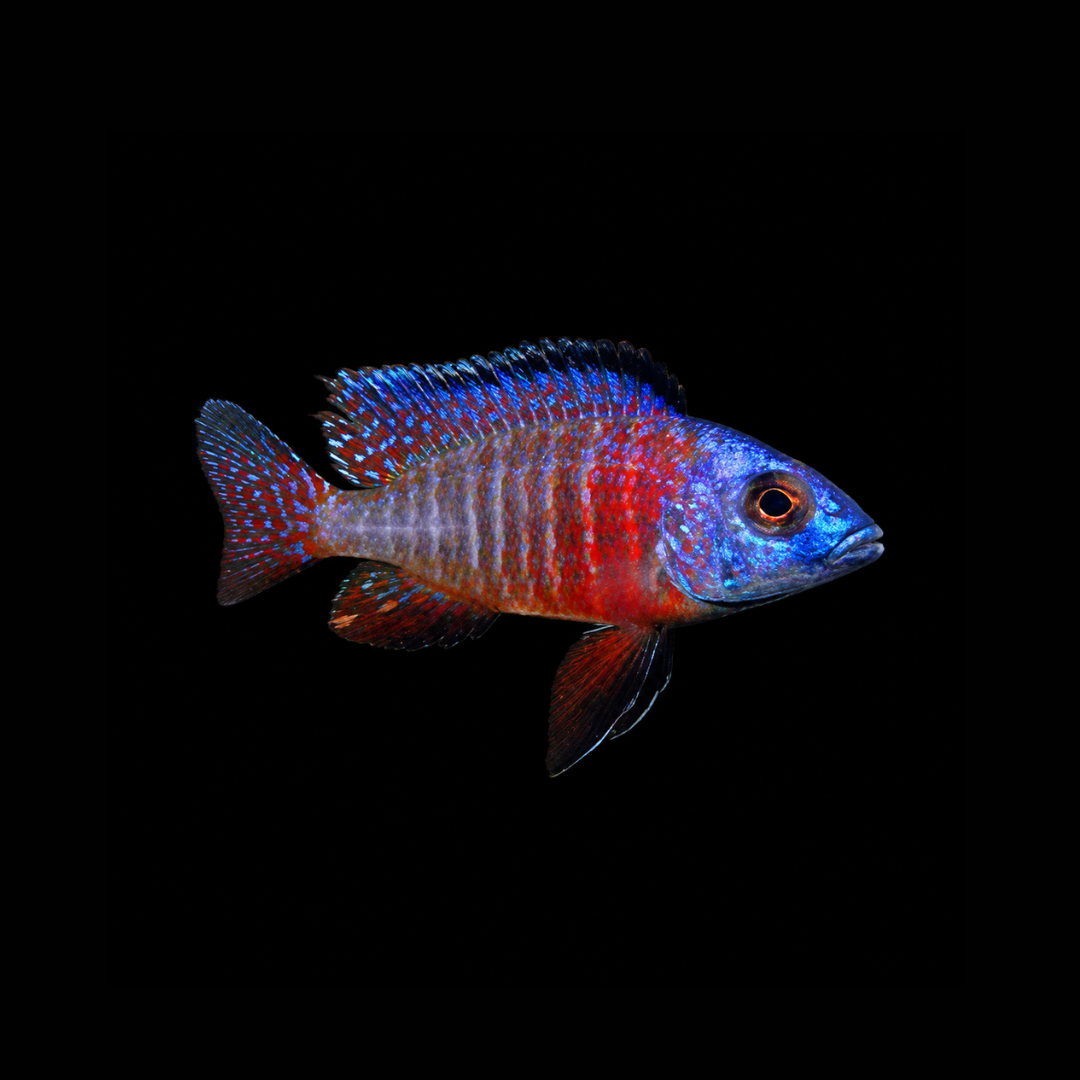
レッドピーコックは、マラウイ湖に固有のアウロノカラ属を基礎として、赤色やオレンジ色の発色を強調する方向に選抜されてきた観賞用シクリッドの流通名です。野生下に「レッドピーコック」という単一種が存在するわけではなく、ジャーマンレッド、ルビーレッド、エウレカレッドなど、由来の異なる改良系統が含まれます。成熟したオスは赤やオレンジにメタリックブルーが重なり、鮮やかな体色を見せます。これに対して、メスや未成熟魚は銀灰色から灰褐色を基調とすることが多く、成熟に伴って雌雄の色彩差が明瞭になります。飼育では、マラウイ湖産シクリッドに適した弱アルカリ性からアルカリ性の水質を安定させ、十分な遊泳空間と細かな底砂を確保することが重要です。状態よく育てることで、華やかな発色だけでなく、底床付近を探るアウロノカラらしい採餌行動も観察できます。 Red Peacock is an ornamental African cichlid strain developed from Lake Malawi peacock cichlids of the genus Aulonocara through selective breeding for stronger red and orange coloration. It is not a single wild species, and several aquarium strains such as German Red, Ruby Red, and Eureka Red are sold under this general name. Adult males may display striking combinations of metallic blue with vivid red or orange, while females and juveniles are usually much more subdued in silver-gray to brownish tones. Their pronounced sexual dimorphism, specialized bottom-feeding behavior, and brilliant male coloration make them especially attractive aquarium fish. Stable alkaline water, ample swimming space, and a fine substrate help bring out their natural behavior and appearance.
基本情報 / Basic Information
| 学名 / Scientific Name | Aulonocara spp.(selectively bred aquarium strains) |
|---|---|
| 通称 / Common Name | レッドピーコック、ジャーマンレッド、ルビーレッド、エウレカレッドなど。販売名と実際の血統が必ずしも一致するとは限らないため、繁殖目的では系統情報の確認が重要です。Red Peacock, German Red Peacock, Ruby Red Peacock, Eureka Red Peacock. Trade names do not always identify a precisely documented lineage, so provenance is important when breeding for strain purity. |
| 分類 / Family | カワスズメ科(シクリッド科)・ハプロクロミス族・アウロノカラ属Family Cichlidae, tribe Haplochromini, genus Aulonocara |
| 英名 / English Name | Red Peacock Cichlid |
| 分布 / Distribution | 改良品種のため自然分布はありません。基礎となるアウロノカラ属の原種はアフリカ・マラウイ湖に固有で、岩礁と砂地が接する推移帯などに生息します。As a selectively bred aquarium strain, Red Peacock has no natural distribution. Its Aulonocara ancestors are endemic to Lake Malawi in Africa, where many inhabit transition zones between rocky and sandy habitats. |
| 最大体長 / Max Size | 多くの流通系統では約12〜15cmが目安ですが、系統によってはこれを上回ります。基礎となる原種ごとにも成魚サイズが異なるため、購入時は系統名と親魚サイズを確認してください。Many aquarium strains are around 12–15 cm, but some lines can grow larger. Adult size also varies among the ancestral Aulonocara species, so strain identity and parental size should be checked when possible. |
| 寿命 / Lifespan | 系統や飼育条件による差が大きく、信頼できる統一的な寿命データは限られています。長期飼育を前提に、水質と栄養を安定させて管理します。Reliable, standardized lifespan data for the various Red Peacock strains are limited. Because longevity varies with lineage and husbandry, they should be maintained as a long-term commitment with stable water quality and nutrition. |
飼育環境 / Aquarium Environment
| 水槽サイズ / Tank Size | 成魚の長期飼育では、90cm規格水槽程度をひとつの基準とします。複数匹を維持する場合や、オス同士の競合が予想される場合は、120cm規格水槽または120cmワイド水槽など、底面積に余裕のある水槽が適しています。必要な広さは個体数や系統の成魚サイズ、性格によって変わります。For long-term adult care, a standard 90 cm aquarium is a practical baseline. Groups or setups with competing males are better housed in a 120 cm standard or wide aquarium with greater floor area. Required space varies with stocking level, adult strain size, and temperament. |
|---|---|
| 水温 / Temperature | 24〜26℃前後を飼育の中心域とし、急激な変化を避けます。原種では22〜26℃の記録もありますが、改良系統の飼育では上限・下限ぎりぎりを常用せず、安定した水温を優先します。日本では冬季のヒーター管理が基本です。 Around 24–26°C is a practical target for routine aquarium care. Records for wild forms include 22–26°C, but captive strains are best kept away from temperature extremes, with stability prioritized. In Japan, heater use is generally necessary in winter. |
| 水質 / Water Quality | pH7.5〜8.5程度の弱アルカリ性からアルカリ性を基本とし、中硬水から硬水を好みます。日本の水道水は地域によって軟水傾向が強いため、サンゴ砂などを利用してpHと硬度を安定させる方法が有効です。アンモニアと亜硝酸は常に検出されない状態を維持します。Slightly alkaline to alkaline water around pH 7.5–8.5 is suitable, with moderate to hard mineral content preferred. In soft-water regions, coral sand or similar buffering media can help stabilize pH and hardness. Ammonia and nitrite should remain undetectable. |
| レイアウト / Layout | 底床には、口や鰓を傷つけにくい細かな砂を用いると、アウロノカラ本来の探索行動を観察しやすくなります。岩組みは隠れ家と視線を遮る仕切りとして配置し、その一方で前面から中央部には十分な遊泳空間を残します。底床全体を岩で覆うより、砂地と岩場の両方を設けたレイアウトが適しています。Fine, smooth sand makes it easier to observe the substrate-searching behavior typical of Aulonocara while reducing the risk of abrasion around the mouth and gills. Rockwork should provide shelters and visual barriers, while the front and center remain open for swimming. A layout combining sandy areas with rock structures is generally more suitable than covering the entire bottom with rock. |
| 注意点 / Precautions | 成熟したオス同士では縄張り争いが起こるため、弱い個体が継続的に追われていないか観察します。十分な底面積、隠れ家、視線を遮る岩組みを用意し、逃げ場を確保してください。アフリカンシクリッドでは収容密度を高めて攻撃を分散させる管理法も用いられますが、水質管理の難度が上がるため、初心者が単純に「過密にすれば安全」と考えるのは適切ではありません。Territorial disputes can develop between mature males, so subordinate fish should be monitored for persistent harassment. Provide adequate floor area, shelters, and rockwork that breaks lines of sight. Higher stocking density is sometimes used in African cichlid husbandry to spread aggression, but it also increases the demands on filtration and water quality and should not be treated as an automatic solution. |
餌と給餌 / Feeding
| 餌の種類 / Diet | 良質なシクリッド用人工飼料を主食にし、オキアミやブラインシュリンプなどの小型甲殻類を補助的に利用します。野生のアウロノカラには砂中の無脊椎動物を捕食する習性があるため、動物質を含む消化しやすい餌が適しています。赤色の発色を補助する目的では、アスタキサンチンなどのカロテノイドを含む色揚げ飼料も利用できます。A high-quality cichlid pellet is suitable as the staple diet, with small crustaceans such as krill or brine shrimp used as supplements. Wild Aulonocara feed on invertebrates associated with sandy substrates, so digestible feeds containing appropriate animal protein suit their feeding ecology. Color-enhancing foods containing carotenoids such as astaxanthin may support red coloration. |
|---|---|
| 給餌のポイント / Feeding Tips | 1日1〜2回を目安に、短時間で食べ切れる量を与えます。色揚げ飼料は発色を支える手段のひとつですが、過剰に与えても遺伝的な発色の上限を超えるわけではありません。発色は餌だけでなく、成熟度、健康状態、社会的順位、照明などにも影響されます。高脂肪で消化しにくい餌に偏らず、主食の品質と水質の安定を優先してください。Feed once or twice daily in amounts consumed quickly. Color-enhancing foods can support pigmentation, but they cannot override the genetic limits of a strain. Color is also influenced by maturity, health, social status, and lighting. Avoid relying on fatty or poorly digestible foods and prioritize a balanced staple diet and stable water quality. |
性格と混泳 / Temperament and Tank Mates
| 性格 / Temperament | 多くのアウロノカラは、攻撃性の強いムブナ類と比べると比較的穏やかですが、性格は系統や個体によって異なります。成熟したオスは縄張りを主張し、繁殖状態に入るとメスや競争相手を追う行動が強くなることがあります。とくにエウレカレッドの基礎となる系統など、比較的大型で気の強いタイプでは余裕のある飼育空間が必要です。Many Aulonocara are relatively moderate compared with highly aggressive mbuna, but temperament varies among strains and individuals. Mature males defend territories and may chase females or rivals more strongly when breeding. Some larger, more assertive lines, including those associated with Eureka-type A. jacobfreibergi, benefit from additional space. |
|---|---|
| 混泳の相性 / Compatibility | 混泳相手は、体格と水質要求が近く、極端に攻撃的ではないマラウイ湖産シクリッドを中心に選びます。気の強いムブナ類と組み合わせると、レッドピーコックが落ち着いて採餌できない場合があります。繁殖を目的とする場合は、オス1匹に対して複数のメスを組み合わせると、特定のメスに追跡が集中しにくくなります。また、異なるアウロノカラ系統を同居させると交雑する可能性があるため、系統維持を重視する場合は繁殖群を分けて管理します。Choose tank mates with similar size and water requirements, favoring Lake Malawi cichlids that are not excessively aggressive. Highly assertive mbuna can prevent peacocks from feeding and behaving normally. For breeding, one male with several females helps distribute courtship pressure. Different Aulonocara strains can hybridize, so breeding groups should be separated when lineage maintenance is important. |
病気と対策 / Diseases and Prevention
| かかりやすい病気 / Common Diseases | レッドピーコックだけに特有の代表的な病気があるというより、水質悪化や輸送、混泳ストレスをきっかけとして、白点病、細菌性感染症、消化器症状など一般的な観賞魚の疾病が現れます。食欲低下、呼吸の速さ、体表の異常、腹部の不自然な膨らみ、長時間の隔離行動などは、早めに環境を確認するサインです。Red Peacocks are not defined by one unique disease; instead, common aquarium illnesses such as ich, bacterial infections, and digestive disorders often emerge after poor water quality, transport stress, or aggression. Loss of appetite, rapid breathing, skin abnormalities, unusual abdominal swelling, or prolonged isolation are signs that warrant prompt evaluation. |
|---|---|
| 対策と予防 / Prevention | 予防の基本は、水温とpHを急変させず、十分なろ過と定期的な換水によって水質を安定させることです。過剰給餌を避け、新しく迎えた魚は可能であれば別水槽で観察してから合流させます。異常が見られた場合は、病名を決めつけて薬を使う前に、水温、アンモニア・亜硝酸、pH、混泳魚からの攻撃などを確認し、必要に応じて病魚を隔離します。Prevention begins with stable temperature and pH, effective filtration, and regular water changes. Avoid overfeeding and, when possible, observe new fish in quarantine before introduction. If abnormalities appear, check temperature, ammonia, nitrite, pH, and aggression before assuming a diagnosis or beginning medication, and isolate affected fish when appropriate. |
増やし方(繁殖) / Breeding
| 雌雄の判別 / Sexing | 成熟したオスは、赤やオレンジ、メタリックブルーの発色が強くなり、雌雄差が目立つようになります。メスは銀灰色から灰褐色を基調とすることが多く、系統によっては暗色の横帯が見られます。ただし、ヒレの形やエッグスポットだけで雌雄を断定するのは難しく、幼魚や発色前の若魚では判別を誤ることがあります。確実性を高めるには、成熟後の体色や生殖孔など複数の特徴を確認します。Mature males develop stronger red, orange, and metallic blue coloration, making sexual differences more obvious. Females are often silver-gray to brownish, sometimes with darker bars depending on lineage. Fin shape or egg spots alone are not fully reliable for sexing, especially in juveniles and subadults. Greater confidence comes from evaluating several traits, including mature coloration and the genital papilla. |
|---|---|
| 繁殖形態 / Reproduction | アウロノカラ属は母系口内保育型のマウスブリーダーです。産卵後、メスは卵を口に取り込み、発生中の卵や仔魚を口腔内で保護します。抱卵期間は水温や個体の状態によって変わりますが、飼育下ではおおむね3週間前後がひとつの目安です。メスは抱卵中に摂餌量が大きく減るため、過度な追跡を受けない環境を整える必要があります。Aulonocara are maternal mouthbrooders. After spawning, the female collects the eggs and protects developing embryos and fry in her mouth. Brooding duration varies with temperature and condition, but roughly three weeks is a common aquarium guideline. Because feeding is greatly reduced during brooding, females should be protected from excessive harassment. |
| 繁殖のポイント / Breeding Tips | 繁殖群はオス1匹に対して複数のメスを組み合わせ、岩陰や逃げ場を十分に確保します。抱卵中のメスが繰り返し追われる場合は、ストレスを抑えるために隔離を検討します。ただし、移動そのものが抱卵放棄の原因になることもあるため、捕獲は必要性を見極めて行います。系統維持を目的とする場合は、別系統のアウロノカラとの交雑を避け、親魚の由来を記録しておくことが重要です。For breeding, keep one male with several females and provide ample shelters. If a brooding female is repeatedly harassed, separation may reduce stress, although capture itself can sometimes cause premature release or abandonment. When maintaining a lineage, avoid crossing with other Aulonocara strains and keep records of broodstock provenance. |
雑学と豆知識 / Trivia and Fun Facts
| 1. 砂の中の獲物を探す「感覚のスペシャリスト」 / 1. A Specialist at Detecting Prey in Sand | アウロノカラ属には、幅広く発達した頭部側線管と大型の感覚器が備わっています。研究では、Aulonocara stuartgranti が暗所でも生きた無脊椎動物の生む水流を検出し、側線系の働きを一時的に弱めると獲物の検出能力が低下することが確認されています。水槽内で底床のすぐ上をゆっくり移動し、砂地を探る姿は、この感覚能力と野生下の採餌生態をうかがわせる行動です。「水中レーダー」という比喩で説明されることもありますが、実際には水の動きを感知する機械受容器として働いています。Aulonocara possess widened cranial lateral-line canals and large sensory neuromasts. Experiments on Aulonocara stuartgranti have shown that the fish can detect hydrodynamic signals from live invertebrate prey in darkness, and that temporarily reducing lateral-line function decreases prey-detection performance. Their slow searching behavior just above sandy substrate reflects this specialized sensory ecology. Although sometimes compared metaphorically with underwater radar, the system is a mechanosensory organ that detects water movement. |
|---|---|
| 2. エッグスポットと口内保育 / 2. Egg Spots and Mouthbrooding | オスの尻ビレに見られる黄色やオレンジ色の斑点は、一般にエッグスポットと呼ばれます。ハプロクロミス系シクリッドでは、この模様と口内保育型の繁殖行動との関係が古くから研究されてきました。「メスが卵と見間違えるために存在する」と単純に説明されることがありますが、エッグスポットの進化や機能には複数の要因が関与すると考えられており、ひとつの仮説だけで断定するのは適切ではありません。レッドピーコックを観察するときは、斑点そのものだけでなく、オスの求愛、メスの採卵、口内保育までを一連の繁殖行動として見ると理解しやすくなります。The yellow or orange markings on the male anal fin are commonly called egg spots. Their relationship with mouthbrooding courtship in haplochromine cichlids has long attracted scientific interest. They are sometimes described simply as marks that females mistake for eggs, but the evolution and function of egg spots are more complex and should not be reduced to a single explanation. In the aquarium, they are best understood as part of the broader sequence of male courtship, female egg collection, fertilization, and maternal mouthbrooding. |
| 3. 「レッドピーコック」は単一の野生種ではない / 3. Red Peacock Is Not a Single Wild Species | レッドピーコックは分類学上の種名ではなく、赤系のアウロノカラを示す流通上の呼び名です。ジャーマンレッドやルビーレッドは赤みを強調して選抜された系統として流通し、エウレカレッドは Aulonocara jacobfreibergi 系のラインブリードとして扱われています。ただし、観賞魚市場では同じ販売名でも由来が異なる場合があります。純系維持や繁殖を目的とするなら、体色だけで系統を判断せず、販売元が示す親魚情報やブリード履歴を確認することが大切です。Red Peacock is a trade name rather than a taxonomic species name. German Red and Ruby Red are sold as red-enhanced line-bred peacocks, while Eureka Red is generally associated with line-bred Aulonocara jacobfreibergi. Aquarium trade names, however, may be applied to fish of differing provenance. Anyone breeding for lineage purity should rely on documented parentage and breeder records rather than appearance alone. |
| 4. 赤色は遺伝だけで完成しない / 4. Red Color Is Not Determined by Genetics Alone | 赤く発色する素質は選択交配によって強められてきましたが、見える色彩は遺伝だけでは決まりません。成熟度、健康状態、社会的順位、照明、餌などが重なって体色が変化します。魚類はカロテノイドを食物から取り込むため、アスタキサンチンなどを含む餌は赤色の維持を助けます。ただし、色揚げだけを目的に給餌内容を偏らせると健康を損なうおそれがあります。安定した水質と良質な主食を土台にしたうえで、補助的に色揚げ成分を利用する考え方が適切です。Selective breeding strengthens the genetic potential for red coloration, but visible color is not determined by genetics alone. Maturity, health, social status, lighting, and diet all contribute. Fish obtain carotenoids through food, so ingredients such as astaxanthin can support red pigmentation. Color enhancement should remain secondary to balanced nutrition and stable water quality. |
| 5. 園芸の世界にも「レッドピーコック」がある / 5. There Is Also a Plant Called Red Peacock | 日本の流通名で「レッドピーコック」と呼ばれるものには、魚だけでなく、ヒッペアストルム属の八重咲きアマリリスもあります。こちらは巨大な深紅の花を咲かせる園芸品種で、アフリカンシクリッドとは生物学的にまったく別の存在です。同じ名前が異なる観賞生物に使われているため、通販や検索では「レッドピーコック シクリッド」「レッドピーコック アマリリス」のように分野を添えると混同を避けられます。In horticulture, the name Red Peacock is also used for a double-flowered Hippeastrum cultivar with large deep-red blooms. It is biologically unrelated to the cichlid. Because the same common name is used for two very different ornamental organisms, adding terms such as cichlid or amaryllis when searching helps avoid confusion. |
まとめ / Conclusion
レッドピーコックの魅力は、鮮やかな赤色だけではありません。砂地を探りながら獲物の気配を捉えるアウロノカラ特有の感覚生態、成熟とともに変化するオスの体色、そしてメスが卵や仔魚を口の中で守る繁殖行動がひとつの魚に重なっています。華やかな見た目の奥に、マラウイ湖の環境へ適応してきたシクリッドならではの暮らし方を感じられる点が、この魚を長く観察する面白さにつながります。 Red Peacock combines the elegant form and specialized ecology of Lake Malawi Aulonocara with the intense red coloration produced through selective breeding. Watching a mature male display vivid red and blue while methodically searching across fine sand gives the aquarium a distinctive character unlike that of many other tropical fish.
美しく育てるために最も大切なのは、色揚げだけを追い求めることではなく、十分な水槽空間、安定した弱アルカリ性からアルカリ性の水質、適切な給餌、そして過度な争いを起こさせない混泳環境を整えることです。落ち着いて生活できる条件がそろえば、レッドピーコックは成長とともに色彩と行動の両面で存在感を増していきます。系統ごとの個性を理解しながら丁寧に向き合うことで、鮮烈な色彩の背景にあるアウロノカラ本来の魅力を長く楽しめるでしょう。 Successful care depends on stable alkaline water, adequate aquarium space, reliable filtration, and careful management of tank-mate aggression. Rather than focusing on coloration alone, prioritizing health and natural behavior allows the fish’s full beauty to emerge with maturity and makes it increasingly rewarding to keep over time.

気になる道具や飼い方を見つけてみませんか?
 アイのアクアグッズ案内カルキ抜き・水質調整剤の選び方|水換えと水槽の種類に合わせて選ぶ道具の特徴や使い方、選ぶときのポイントをアイが紹介します。記事はコチラ →
 アイのアクアグッズ案内水草の肥料の選び方|底床用・液肥・メネデールの使い分け道具の特徴や使い方、選ぶときのポイントをアイが紹介します。記事はコチラ →
 アイのアクアグッズ案内プレコ飼育に必要なもの|餌・流木・ろ過・隠れ家・掃除用品道具の特徴や使い方、選ぶときのポイントをアイが紹介します。記事はコチラ →
 アイのアクアグッズ案内水槽用ヒーターの選び方|固定式・温度調節式と、水量に合うW数の考え方水槽の魚は冬に寒くない? アイとコタロウが水温計から固定式・温度調節式・分離式ヒーターまで比較。水量と室温に合うW数、設置場所、水換えや交換の注意点を、国内メーカーの商品とともに紹介します。記事はコチラ →
さまざまな飼育テーマをご紹介。リンク先の記事には広告・商品紹介が含まれます。
案内・紹介記事一覧へ →分布マップ
レッドピーコックは改良品種のため自然分布を持ちません。基礎となるアウロノカラ属の原種は、東アフリカのマラウイ湖に固有で、岩礁と砂地が接する推移帯などに生息します。
※この地図は、基礎となるアウロノカラ属の分布地域であるマラウイ湖全体を把握するための概略表示です。マーカーは分布地域を示すために設定した代表地点であり、実際の採集地点・観察地点を示すものではありません。
参考文献
-
Fricke, R., Eschmeyer, W. N. & Van der Laan, R. (eds.). Eschmeyer’s Catalog of Fishes: Aulonocara stuartgranti Meyer & Riehl, 1985. California Academy of Sciences.
分類上の有効性、カワスズメ科における位置づけ、マラウイ湖産であることの確認。
https://researcharchive.calacademy.org/research/ichthyology/catalog/fishcatget.asp?spid=8048 -
Froese, R. & Pauly, D. (eds.). FishBase: Aulonocara stuartgranti Meyer & Riehl, 1985.
マラウイ湖固有という分布、淡水・底生遊泳性の生態、水温、生息環境、砂中の無脊椎動物を捕食する食性、原種の最大体長に関する基礎資料。
https://www.fishbase.se/summary/Aulonocara-stuartgranti -
Froese, R. & Pauly, D. (eds.). FishBase: Aulonocara jacobfreibergi (Johnson, 1974).
A. jacobfreibergi系統に関する分類、マラウイ湖内の分布、岩場から推移帯にかけての生息環境、pH・硬度・水温、最大体長の参考資料。
https://www.fishbase.se/summary/Aulonocara-jacobfreibergi -
Schwalbe, M. A. B., Bassett, D. K. & Webb, J. F. (2012). Feeding in the dark: lateral-line-mediated prey detection in the peacock cichlid Aulonocara stuartgranti. Journal of Experimental Biology, 215, 2060–2071.
頭部側線系、感覚孔、暗所における水流刺激の検出、砂地での採餌行動を支える実験研究。
https://doi.org/10.1242/jeb.065920 -
Duponchelle, F., Paradis, E., Ribbink, A. J. & Turner, G. F. (2008). Parallel life history evolution in mouthbrooding cichlids from the African Great Lakes. Proceedings of the National Academy of Sciences, 105(40), 15475–15480.
アフリカ大湖群の口内保育型シクリッドにおける繁殖戦略と生活史を理解するための基礎資料。
https://doi.org/10.1073/pnas.0802343105 -
Santos, M. E. et al. (2014). The evolution of cichlid fish egg-spots is linked with a cis-regulatory change. Nature Communications, 5, 5149.
ハプロクロミス系シクリッドのエッグスポットの進化的背景を支える研究資料。
https://doi.org/10.1038/ncomms6149 -
Sefc, K. M., Brown, A. C. & Clotfelter, E. D. (2014). Carotenoid-based coloration in cichlid fishes. Comparative Biochemistry and Physiology Part A: Molecular & Integrative Physiology, 173, 42–51.
シクリッドのカロテノイド由来体色、食餌・健康状態・社会的順位と発色の関係を整理したレビュー。
https://pmc.ncbi.nlm.nih.gov/articles/PMC4003536/ -
Petty, B. D., Francis-Floyd, R. & Yanong, R. P. E. Management of Aquarium Fish. Merck Veterinary Manual.
観賞魚の水質管理、隔離、バイオセキュリティ、アンモニア・亜硝酸などの水質異常、疾病予防と健康管理に関する獣医学的資料。
https://www.merckvetmanual.com/exotic-and-laboratory-animals/aquarium-fish/management-of-aquarium-fish




コメント