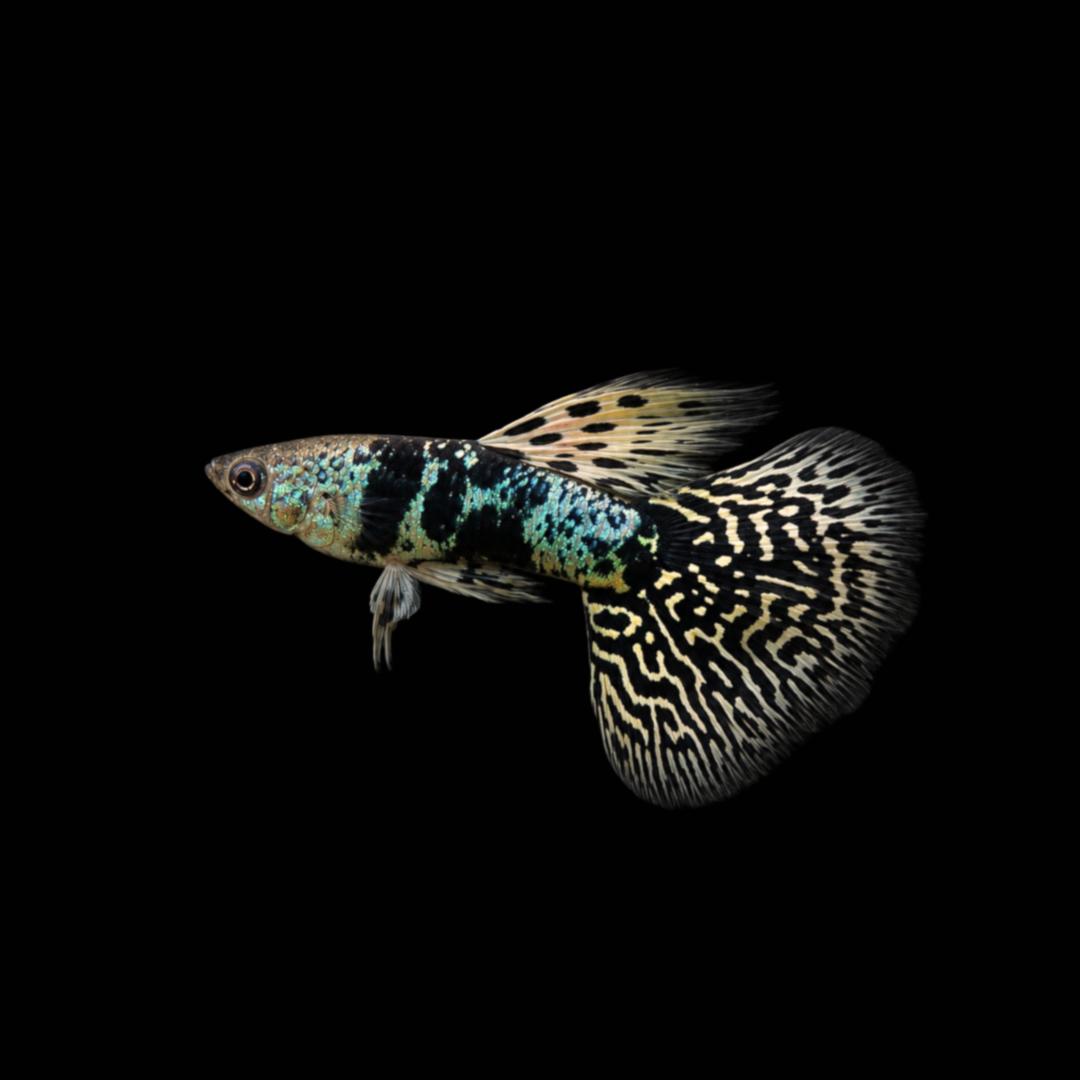
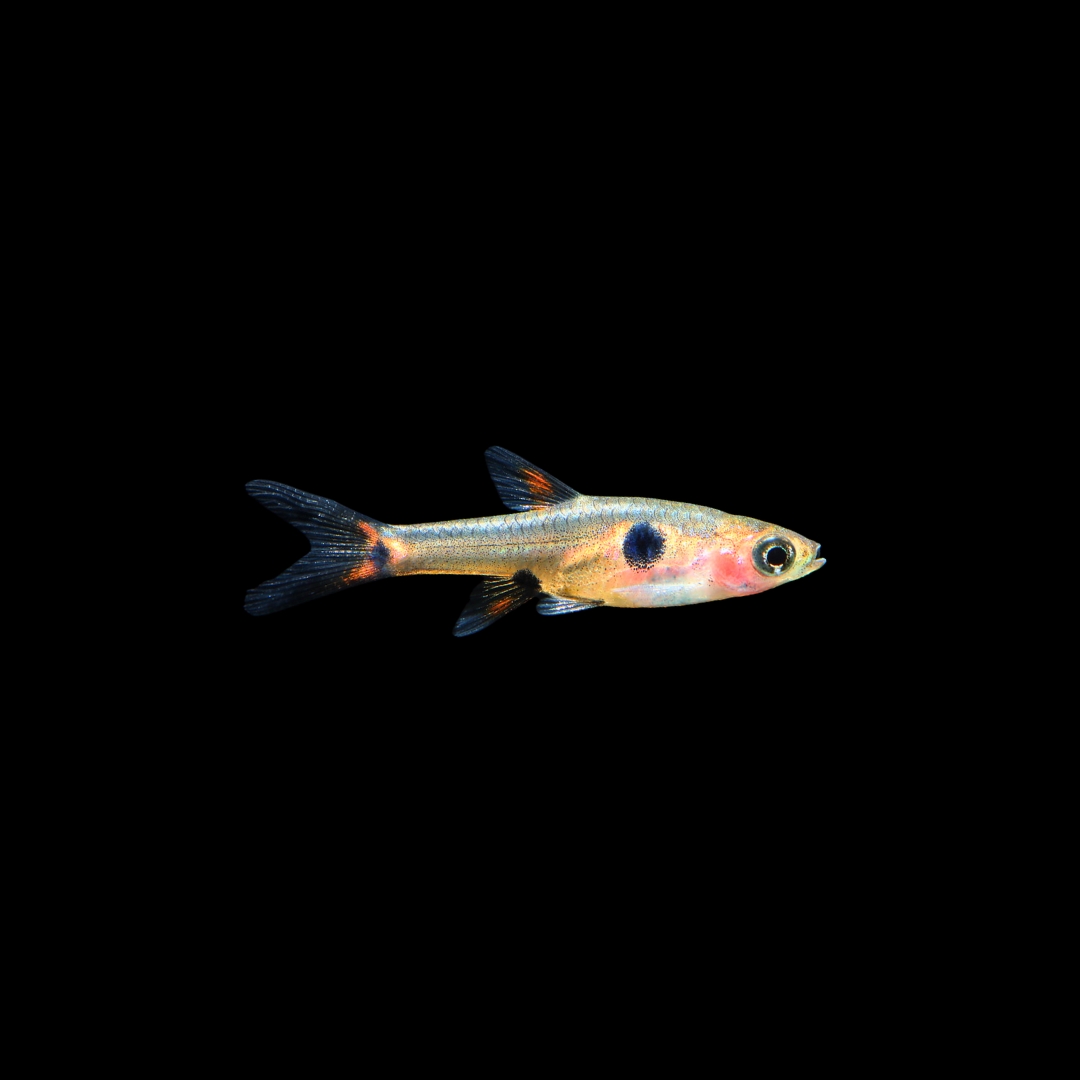
イエロータイガーキングコブラグッピーは、体の側面を覆う金属光沢の網目模様「コブラ模様」と、黄色から橙色の地色に不規則な黒斑が散る「タイガー(マーブル)模様」を併せ持つ、グッピーの改良品種です。キングコブラ系統らしいコントラストの強い網目に東南アジア由来のブチ模様が重なり、同じ両親から生まれた兄弟でも模様が一匹ずつ異なります。この個性の豊かさが、本品種の大きな魅力です。グッピーのメスは地味な色合いのことが多いのですが、本品種ではメスの尾びれにも黄色みや斑模様がある程度現れる傾向があり、雌雄そろって観賞価値が高いと評価されています。日本国内では、国内のブリーダーが東南アジア由来の斑模様を日本の水で代を重ねて繁殖させ、大きな扇形の尾びれ(デルタテール)とともに定着させた国産個体のペア販売が流通の中心です。丈夫で繁殖も容易なため入門魚として親しまれる一方、性染色体と結びついた独特の遺伝の仕組みを持つことから、模様の美しさを世代を超えて追い求める愛好家にとっても奥深い品種です。The Yellow Tiger King Cobra Guppy is a fancy guppy strain that combines a metallic, net-like “cobra” pattern along the sides of the body with a “tiger” (marble) pattern of irregular black blotches on a yellow-to-orange base color. Bold, high-contrast reticulation typical of king cobra lines is overlaid with mottling of Southeast Asian origin, so even siblings from the same parents each look different. This individuality is one of the strain’s greatest charms. Female guppies are usually plainly colored, but females of this strain tend to show some yellow tint and mottling on the tail as well, and both sexes are valued for their beauty. In Japan, the main form on the market is the domestically bred pair: Japanese breeders have bred the Southeast Asian mottled pattern over many generations in local water and established it together with a large, fan-shaped delta tail. Hardy and easy to breed, it is popular with beginners, yet its distinctive sex-linked inheritance also makes it a deeply rewarding strain for hobbyists who pursue pattern quality across generations.
基本情報 / Basic Information
学名 / Scientific Name
Poecilia reticulata ‘Yellow Tiger King Cobra’
通称 / Common Name
イエロータイガーキングコブラグッピー、イエロータイガーキングコブラ、イエローマーブルタイガーコブラ(国内の通信販売で見られる別称)Yellow Tiger King Cobra Guppy, Yellow Tiger King Cobra, Yellow Marble Tiger Cobra (an alternative name seen in Japanese online shops)
分類 / Family
カダヤシ目 カダヤシ科 ポエキリア属(グッピーの改良品種)Order Cyprinodontiformes, Family Poeciliidae, Genus Poecilia (a domesticated strain of the guppy)
英名 / English Name
Yellow Tiger King Cobra Guppy
分布 / Distribution
人の手で作られた改良品種のため、野生には存在しません。原種のグッピーは、ベネズエラ、トリニダード・トバゴ、ガイアナなど南米北部に分布します。国内で流通する個体は、主に日本国内のブリーダーや養殖場で繁殖された国産個体で、シンガポールやスリランカなど東南アジアの養殖場から輸入された個体も見られます。As a man-made strain, it does not occur in the wild. The wild guppy is native to northern South America, including Venezuela, Trinidad and Tobago, and Guyana. Fish sold in Japan are mainly bred by domestic breeders and farms, though fish imported from Southeast Asian farms in countries such as Singapore and Sri Lanka are also seen.
最大体長 / Max Size
オス約3〜4cm(ヒレを含めると3〜5cm前後)、メス約4〜6cmMales about 3–4 cm (around 3–5 cm including fins); females about 4–6 cm
寿命 / Lifespan
約2〜3年(高水温が続くと老化が早まり、寿命が短くなる傾向があります)About 2–3 years (prolonged high water temperatures tend to speed up aging and shorten lifespan)
飼育環境 / Aquarium Environment
水槽サイズ / Tank Size
1匹あたり1〜2Lの水量が目安です。ペアでの飼育や繁殖には30cm規格水槽(約12L)以上、複数匹の群泳や水草レイアウトを楽しむなら60cm規格水槽(約57L)以上がおすすめです。60cm規格水槽の場合も、過密によるストレスを避けるため20〜30匹以内に抑えると安定します。稚魚の育成や系統維持を行うなら、掃除のしやすい底砂なしの小型水槽を複数用意すると管理が楽になります。Allow roughly 1–2 liters of water per fish. A standard 30 cm tank (about 12 L) or larger suits a pair or breeding, while a standard 60 cm tank (about 57 L) or larger is recommended for a group or a planted layout. Even in a 60 cm tank, keeping numbers to 20–30 fish helps avoid stress from overcrowding. For raising fry or maintaining lines, several small bare-bottom tanks that are easy to clean make management much easier.
水温 / Temperature
飼育できる水温はおおむね20〜28℃で、発色・成長・繁殖のバランスが最も良いのは23〜26℃です。30℃を超えると繁殖力の低下や老化の加速が起こり、水に溶け込む酸素の量も大きく減るため、酸欠の危険が高まります。日本の夏は閉め切った室内が35℃を超えることもあるため、エアコンによる室温管理か水槽用クーラーの使用が最も確実です。冷却ファンは水の蒸発を利用して冷やす仕組みのため、下げられる温度は2〜4℃程度にとどまり、湿度の高い時期には効果が落ちます。万一30℃を超えた場合は給餌を止めてエアレーションを強めます。氷や保冷剤を直接入れると急な水温変化で魚に負担がかかるため、避けてください。The workable temperature range is roughly 20–28°C, and 23–26°C gives the best balance of coloration, growth and breeding. Above 30°C, fertility declines, aging accelerates and the amount of oxygen dissolved in the water drops sharply, raising the risk of suffocation. Closed rooms in a Japanese summer can exceed 35°C, so controlling room temperature with an air conditioner or using an aquarium chiller is the most reliable approach. Cooling fans work by evaporation and lower the temperature by only about 2–4°C, and they are less effective in humid weather. If the water does exceed 30°C, stop feeding and increase aeration. Avoid adding ice or ice packs directly, as the sudden temperature change stresses the fish.
水質 / Water Quality
中性〜弱アルカリ性(pH 7.0〜7.5前後)が適しており、強い酸性の水は苦手です。水草水槽でもpH 6.0を下限の目安とし、これを下回るとヒレを畳むなど調子を崩しやすくなります。日本の水道水は多くの地域で軟水(GH 3〜8程度)のため、水換えの間隔が空いたりソイルを使ったりすると、水が酸性側に傾きやすい点に注意が必要です。酸処理をしていない大磯砂は水を弱アルカリ性に緩やかに保つため相性が良く、pHが下がりやすい地域では大磯砂にサンゴ砂を全体の10〜20%ほど混ぜる方法も有効です。サンゴ砂は多すぎるとpHが上がりすぎるため、少量から試してください。水換えは週1回、全水量の1/3〜1/2を、カルキ抜きと水温合わせを済ませた新しい水と交換するのが基本です。Neutral to slightly alkaline water (around pH 7.0–7.5) is ideal, and strongly acidic water should be avoided. Even in planted tanks, treat pH 6.0 as the lower limit; below that, fish tend to clamp their fins and decline. Tap water in most of Japan is soft (about GH 3–8), so the water easily drifts acidic when water changes are infrequent or aqua soil is used. Non-acid-treated Oiso gravel gently keeps the water slightly alkaline and suits this fish well, and in areas where pH tends to fall, mixing coral sand into the gravel at about 10–20% of the total is also effective. Too much coral sand raises pH excessively, so start with a small amount. As a rule, replace one-third to one-half of the water once a week with dechlorinated water matched to the tank temperature.
レイアウト / Layout
底砂は大磯砂が最も失敗が少なく、厚さ3〜5cmを目安に敷きます。底を泳ぐ魚と一緒に飼うなら、水質への影響が穏やかな田砂も向いています。ソイルは水草の育成には有利ですが水を弱酸性に傾けるため、定期的なpH測定とこまめな水換えが欠かせません。繁殖や系統維持には、掃除のしやすい底砂なしの水槽が一般的です。オスは大きなデルタテールを持つため、強い水流はヒレを傷めたり体力を奪ったりする原因になります。スポンジフィルターや、水の吐出量を絞った外掛け式・外部式フィルターで穏やかな流れを作りましょう。本品種は水草をほとんど食べないため、明るい緑の有茎草を植えた水草水槽では、黄色と黒の模様がいっそう引き立ちます。Oiso gravel is the most foolproof substrate; lay it about 3–5 cm deep. If keeping bottom-dwelling fish as well, fine river sand, which has little effect on water chemistry, also works well. Aqua soil benefits plant growth but makes the water slightly acidic, so regular pH checks and frequent water changes are essential. For breeding and line maintenance, bare-bottom tanks are common because they are easy to clean. Males carry large delta tails, so strong currents can damage their fins and wear them out; create gentle flow with a sponge filter or a hang-on or canister filter with reduced output. Because this strain rarely eats plants, a planted tank with bright green stem plants makes its yellow and black pattern stand out even more.
注意点 / Precautions
最も重要なのは、国産個体と外国産個体を同じ水槽に入れないことです。外国産個体の中には、外見は健康でも病原体を保有している個体(無症状キャリア)がいる場合があり、同居させた国産個体が短期間で一斉に発症した例が知られています。国産同士であっても、ブリーダーや入荷時期の異なる個体を安易に混ぜるのは避け、網やバケツ、ホースなどの器具も水槽ごとに分けると安心です。新しい個体を迎える際は30〜60分かけて水温と水質をゆっくり合わせ、袋の水は水槽に入れず、魚だけを網ですくって移します。既存の水槽に合流させる前には、別の水槽で最低1〜2週間、慎重を期すなら1ヶ月ほど様子を見ましょう。また、グッピーは環境省の生態系被害防止外来種リストに掲載されており、温かい排水が流れ込む水域や沖縄の河川などで野生化が確認されています。どのような理由があっても、野外に放流してはいけません。The most important rule is never to keep domestically bred and imported fish in the same tank. Some imported fish may carry pathogens while appearing healthy (asymptomatic carriers), and there are known cases in which domestic fish kept with them fell ill all at once within a short time. Even among domestic fish, avoid casually mixing fish from different breeders or shipments, and use separate nets, buckets and hoses for each tank. When introducing new fish, adjust them slowly to the tank’s temperature and water chemistry over 30–60 minutes, then transfer only the fish with a net, leaving the bag water behind. Before adding them to an established tank, observe them in a separate tank for at least one to two weeks, or about a month to be safe. Guppies are also on the Japanese Ministry of the Environment’s list of alien species that threaten ecosystems, and feral populations have been confirmed in waters receiving warm discharge and in rivers in Okinawa. Never release them into the wild for any reason.
餌と給餌 / Feeding
餌の種類 / Diet
雑食性で水面近くを泳ぐため、口に入る大きさの細かい浮上性の顆粒飼料やフレークフードが主食に向いています。黄色の発色を引き出すにはスピルリナを配合した栄養バランスの良い人工飼料がおすすめで、冷凍赤虫やブラインシュリンプを組み合わせると体格も整いやすくなります。アスタキサンチンを多く含む赤色強化用の飼料は主に赤〜赤橙色を強めるものなので、黄色の地色が主役の本品種には、スピルリナ配合の飼料を中心にする方が向いていると考えられています。An omnivore that swims near the surface, it does well on fine floating granules or flakes small enough for its mouth. To bring out the yellow coloration, a nutritionally balanced prepared food containing spirulina is recommended, and adding frozen bloodworms or brine shrimp helps build good body condition. Red-enhancing foods rich in astaxanthin mainly intensify red to red-orange tones, so for this strain, whose highlight is its yellow base color, a diet centered on spirulina-containing food is considered more suitable.
給餌のポイント / Feeding Tips
1日1〜2回、数分で食べきれる量を与えるのが基本です。急に食いつきが悪くなったときは水質が悪化しているサインであることが多いため、全水量の2/3ほどを換水し、2日ほど餌を止めて様子を見ます。飼料に含まれる色素は熱や光で劣化しやすく、照明の近くに置いた飼料は数ヶ月で色揚げ効果が大きく落ちるといわれます。開封後は冷暗所で保管し、早めに使い切りましょう。水温が30℃を超えるような猛暑日は、消化に使われる酸素を減らすため給餌を控えることも大切です。As a rule, feed once or twice a day, giving only what the fish can finish in a few minutes. A sudden loss of appetite often signals worsening water quality; change about two-thirds of the water and withhold food for around two days while observing the fish. The pigments in fish food degrade easily with heat and light, and food kept near aquarium lights is said to lose much of its color-enhancing effect within a few months. After opening, store food in a cool, dark place and use it up promptly. On very hot days when the water exceeds 30°C, it is also important to skip feeding to reduce the oxygen used for digestion.
性格と混泳 / Temperament and Tank Mates
性格 / Temperament
温和で活発な性格で、他の魚を攻撃することはほとんどありません。水槽の上層をひらひらと泳ぎ回り、オスはメスの前で体をS字にくねらせ、大きな尾びれと模様を見せつける求愛行動をよく見せます。ただし、オスがメスをしつこく追い回すこともあるため、メスの数をオスと同じかそれ以上にしたり、水草などの隠れ場所を用意したりすると、メスの負担を和らげられます。Peaceful and active, it rarely attacks other fish. It flutters around the upper part of the tank, and males often court females by bending their bodies into an S-shape to show off their large tails and patterns. Males can, however, chase females persistently, so keeping at least as many females as males and providing hiding places such as plants helps ease the burden on the females.
混泳の相性 / Compatibility
中性付近の水質を好み、ヒレをかじらない温和なコリドラスやオトシンクルス、成体の小型エビ類とは混泳させやすい組み合わせです(ただし、生まれたばかりの稚エビは食べられることがあります)。ブルーテトラやフグ類のようにヒレをかじる魚、エンゼルフィッシュのように口が大きい魚や気の荒い魚との混泳は避けてください。また、エンドラーズ(Poecilia wingei)とは簡単に交雑し、その子孫も繁殖できるため、系統を維持したい場合は同じ水槽に入れないようにします。繁殖を目的とする場合は、稚魚を守るため本品種だけで飼育するのが基本です。It mixes well with peaceful fish that prefer near-neutral water and do not nip fins, such as Corydoras and Otocinclus, as well as adult dwarf shrimp (though newborn shrimp may be eaten). Avoid fin-nippers such as blue tetras and pufferfish, as well as large-mouthed or aggressive fish such as angelfish. It also hybridizes easily with Endler’s livebearer (Poecilia wingei), and the offspring are fertile, so keep the two apart if you wish to maintain the line. When breeding is the goal, keeping this strain on its own to protect the fry is the standard approach.
病気と対策 / Diseases and Prevention
かかりやすい病気 / Common Diseases
最も多いのは、カラムナリス菌(Flavobacterium columnare)による尾ぐされ病や口ぐされ病です。この菌は多くの水槽にふだんから存在しており、輸送のストレスや過密、水質悪化、ヒレの傷などをきっかけに発症します。ヒレの先が白く縁取られて欠ける、輪郭のぼやけた白い濁りが出る、口元に綿のようなものが付くといった症状が特徴で、進行の速いものでは数日で死に至ることもあります。塩の粒のような白い点が一つひとつ現れる白点病とは、見た目も治療法も異なるため、正しく見分けることが大切です。もう一つの大きな脅威が、通称「グッピーエイズ」と呼ばれる致死性の病気です。これは正式な病名ではなく、原因となる病原体も一つには特定されていません。繊毛虫テトラヒメナによる感染症など、よく似た経過をたどる複数の病気がまとめてこう呼ばれている可能性が指摘されています。胸びれが白く曇って透明感を失う初期症状に始まり、尾びれの白濁、体をくねらせる不安定な泳ぎへと進行します。The most common problems are fin rot and mouth rot caused by the bacterium Flavobacterium columnare (columnaris). This bacterium is normally present in many aquariums and causes disease when triggered by shipping stress, overcrowding, poor water quality or fin injuries. Typical signs are white, fraying fin edges, blurry whitish patches and cotton-like growths around the mouth, and fast-progressing cases can be fatal within a few days. White spot disease, which produces separate salt-grain-like dots, differs in both appearance and treatment, so telling them apart correctly is important. Another major threat is a deadly illness popularly called “guppy AIDS.” This is not an official disease name, and no single causative pathogen has been identified. It has been suggested that several diseases with similar courses, including infection by the ciliate Tetrahymena, may be grouped under this name. It begins with the pectoral fins turning cloudy white and losing their transparency, then progresses to clouding of the tail fin and unsteady, wriggling swimming.
対策と予防 / Prevention
カラムナリス菌は水温がおおむね25〜28℃を超えると活発になるため、白点病のように水温を上げる治療は逆効果です。隔離水槽の水温を24〜25℃程度とやや低めで安定させ、グリーンFゴールド顆粒、観パラD、エルバージュエースなどの抗菌剤で5〜7日間薬浴しながら、毎日水換えを行うのが確実です。0.5%程度の塩水浴は魚の体力を温存する補助としてよく紹介されますが、この濃度では菌の増殖を十分に抑えられない場合があることが研究で示されています。塩水浴だけに頼らないようにしましょう。グッピーエイズには市販薬による確立した治療法がないため、予防が何より重要です。国産と外国産、また入手先や入荷時期の異なる個体を混ぜない、器具を共用しない、新しい個体は必ず隔離して様子を見る、という原則を守りましょう。初期の胸びれの曇りは上からの照明では見落としやすいため、気になる個体は透明なカップにすくい、ライトを横や斜め下から当てて健康な個体と見比べると早期発見に役立ちます。購入時は模様の派手さよりも、ヒレを広げて元気に泳いでいるか、背中が痩せていないか、ヒレに白い濁りや欠けがないかを優先して選ぶことが、予防の第一歩です。Columnaris bacteria become active once the water rises above roughly 25–28°C, so raising the temperature, as is done for white spot, is counterproductive. Keep the hospital tank stable at a slightly cool 24–25°C and treat with an antibacterial medication available in Japan, such as Green F Gold granules, Kanpara D or Elbage Ace, for 5–7 days while changing the water daily. Salt baths of around 0.5% are often recommended to help fish conserve strength, but studies have shown that this concentration may not sufficiently suppress the bacteria, so do not rely on salt alone. There is no established commercial treatment for guppy AIDS, so prevention is paramount. Follow the basic rules: do not mix domestic and imported fish, or fish from different sources or shipments; do not share equipment; and always quarantine new arrivals. Early clouding of the pectoral fins is easy to miss under overhead lighting, so scoop a suspect fish into a clear cup and shine a light from the side or at an angle from below, comparing it with a healthy fish. When buying, the first step in prevention is to prioritize health over flashy patterns: choose fish that swim actively with spread fins and show no thinness along the back and no cloudiness or fraying on the fins.
増やし方(繁殖) / Breeding
雌雄の判別 / Sexing
オスは体が小さく、大きなデルタテールと鮮明なコブラ模様を持ち、尻びれが棒状の交接器(ゴノポディウム)に変化しています。メスはオスより一回り大きく、ふっくらとした体つきで、尻びれは扇形のまま、尻びれ付近の腹部に黒い妊娠点が見られます。雌雄は生後約1ヶ月で見分けられるようになります。メスには生後3週間頃から妊娠点が現れ、オスは生後1ヶ月前後から尻びれが交接器へと変化し始めます。Males are smaller, with a large delta tail, a vivid cobra pattern and an anal fin modified into a rod-like mating organ (gonopodium). Females are noticeably larger and plumper, keep a fan-shaped anal fin, and show a dark gravid spot on the belly near the anal fin. The sexes can be told apart at about one month old: the gravid spot appears in females from around three weeks, and the male’s anal fin begins changing into a gonopodium at around one month.
繁殖形態 / Reproduction
メスのお腹の中で卵をかえし、稚魚を直接産む卵胎生です。成熟した雌雄を同じ水槽に入れておけば、特別な産卵床がなくても一年中繁殖します。妊娠期間は約30日で、1回に30〜100匹の稚魚を産みます(若いメスの初産では十数匹程度のこともあります)。一度交尾したメスは体内に精子を蓄えられるため、オスがいなくても2〜3回続けて出産します。生まれた稚魚は、約3ヶ月で次の世代を残せるまでに成長します。It is a livebearer: eggs hatch inside the female’s body and she gives birth to free-swimming fry. Mature males and females kept together will breed year-round without any special spawning site. Gestation lasts about 30 days, and each brood numbers 30–100 fry (a young female’s first brood may be only a dozen or so). A mated female can store sperm, so she can give birth two or three times in a row even without a male. The fry grow old enough to breed in about three months.
繁殖のポイント / Breeding Tips
メスのお腹が膨らんで妊娠点が目立ち、落ち着きなく泳ぐようになったら出産が近いサインです。親魚が稚魚を食べてしまうのを防ぐため、隔離ケースや産卵箱を使うか、水草を茂らせて稚魚の隠れ場所を作ります。稚魚は生まれた直後から細かい人工飼料を食べますが、孵化したてのブラインシュリンプを少量ずつ回数を多く与えると、体とヒレがよく育ちます。美しい模様を次の世代に残すうえで最も重要なのが、まだ交尾していない「処女メス」を確保することです。意図しないオスと一度でも交尾すると、その精子による出産が2〜3回続いてしまうため、交接器が完成する前の生後3〜4週間で確実に雌雄を分けます。コブラ模様は主に父から息子へ受け継がれるため、種オスには、体側の網目が濃く途切れがなく、背びれと尾びれの黄色と黒の柄が調和した健康な個体を選びます。一方、体格や産む稚魚の数はメスの影響が大きいため、体格の良いメスを選ぶことも大切です。兄弟同士の交配を3世代ほど続けて特徴を固めたら、別のラインの同じ品種や、信頼できる別のブリーダーの国産個体と計画的に掛け合わせましょう。近い血縁同士の交配だけを続けると、体が小さくなったり奇形が増えたりするためです。When a female’s belly swells, her gravid spot darkens and she begins swimming restlessly, birth is near. To keep the parents from eating the fry, use a hang-on isolation case or breeding box, or provide dense plants as hiding places. Fry can eat fine prepared food right after birth, but feeding newly hatched brine shrimp in small, frequent portions helps their bodies and fins develop well. The most important step for passing beautiful patterns to the next generation is securing “virgin females” that have not yet mated. A single unintended mating can affect two or three broods, so reliably separate the sexes at three to four weeks old, before the gonopodium is fully formed. Because the cobra pattern is passed mainly from father to son, choose as sires healthy males whose body mesh is dense and unbroken and whose dorsal and tail fins show harmonious yellow and black patterns. Body size and brood size, on the other hand, depend heavily on the female, so selecting well-built females also matters. After fixing traits through about three generations of sibling mating, plan crosses with another line of the same strain or with domestically bred fish from another trusted breeder. Continuing to mate only close relatives tends to cause smaller bodies and more deformities.
雑学と豆知識 / Trivia and Fun Facts
1. 国や地域で変わる「コブラ」の呼び名 / 1. Names for the “Cobra” Pattern Around the World
体側を覆う網目模様は、国や地域によって呼び名も受け止め方も少しずつ異なります。ドイツを中心とする欧州では、「線条細工・レース細工」を意味するフィリグラン(Filigran)と呼ばれ、繊細な網目模様全般を指す言葉として親しまれてきました。北米ではヘビの皮に見立ててスネークスキン(Snakeskin)と呼ばれ、国際的な品評会の基準では、鎖状やロゼット状の網目が体側の60%以上を覆っていることが条件とされています。そしてアジアや日本では「コブラ」の名が定着し、網目が細かく繊細なものを「レースコブラ」、コントラストが強い粗い網目に、尾の付け根の縦縞や体側の黒斑を伴う派手な系統を「キングコブラ」と呼び分ける傾向があります。同じ模様を見て、ある地域では精巧な工芸品を、別の地域では毒ヘビのうろこを思い浮かべたという違いは、グッピーが世界中で愛されてきたことを物語っています。The net-like pattern covering the body is named and perceived a little differently from region to region. In Europe, especially Germany, it is called Filigran, meaning filigree or lacework, a word used for delicate mesh patterns in general. In North America it is likened to the skin of a snake and called Snakeskin, and international show standards require chain-like or rosette patterns to cover at least 60% of the body. In Asia and Japan the name “cobra” took hold, with fine, delicate mesh often called “lace cobra,” and bold lines with coarse, high-contrast mesh, vertical bars near the tail base and dark body spots called “king cobra.” That the same pattern reminded one region of fine craftwork and another of a venomous snake’s scales shows how widely guppies have been loved around the world.
2. コブラ模様は父から息子へ受け継がれる / 2. The Cobra Pattern Passes from Father to Son
グッピーはヒトと同じく、オスがXY、メスがXXという性染色体の組み合わせで性別が決まります。シンガポール国立大学の研究者らによる一連の交配実験から、スネークスキン(コブラ)模様は一つの遺伝子だけで決まるのではなく、体側の網目を生むSsbと、ヒレの網目を生むSstという2つの顕性遺伝子によって現れることが明らかになりました。この2つは性染色体上のごく近い位置にあるため、ふつうはセットでY染色体に乗り、父から息子へそのまま受け継がれます。つまり、コブラ模様は基本的にオスの血筋で伝わる特徴なのです。ただし、XとYの染色体の間でまれに遺伝子の入れ替わり(乗換え)が起こり、これらの遺伝子がX染色体に移る例も確認されています。「コブラ模様はオスから伝わるのが原則なのに、メス側に因子が残ることもある」というブリーダーの経験則には、こうした科学的な裏付けがあります。さらに、キングコブラ系統の尾の付け根に見られる光沢のある縦縞についても研究が進んでいます。常染色体にあるbarという潜性遺伝子を両親から受け継いだオスが、Y染色体上のSsbも持っている場合に限って、4〜5本の縦縞が現れることが報告されています。Like humans, guppies have their sex determined by sex chromosomes: males are XY and females are XX. A series of breeding experiments by researchers at the National University of Singapore revealed that the snakeskin (cobra) pattern is not controlled by a single gene but appears through two dominant genes: Ssb, which produces the body mesh, and Sst, which produces the fin mesh. Because the two lie very close together on the sex chromosome, they normally travel together on the Y chromosome and pass directly from father to son. In other words, the cobra pattern is basically a trait handed down through the male line. Occasionally, however, genes are exchanged between the X and Y chromosomes (crossing over), and cases where these genes move onto the X chromosome have been confirmed. This gives scientific backing to the breeders’ rule of thumb that “the cobra pattern is passed through males, yet the factor can sometimes remain on the female side.” Research has also examined the glossy vertical bars near the tail base in king cobra lines: they are reported to appear as four or five stripes only in males that inherit a recessive autosomal gene called bar from both parents and also carry Ssb on the Y chromosome.
3. 「タイガー」の正体をめぐる謎 / 3. The Mystery Behind the “Tiger” Name
グッピーの遺伝学で本来「タイガー」と呼ばれる体色は、常染色体上の潜性遺伝子(記号gg)による変異で、ゴールデンに似た色合いの体に、うろこの縁取りが現れるものを指します。海外ではヨーロピアンゴールドやブロンズとも呼ばれますが、尾びれの柄を乱しやすいことから、日本ではあまり流通していません。一方、イエロータイガーキングコブラの黄色と黒のブチ模様は、このggとは別のもので、外国産の系統から持ち込まれた「マーブル因子」によるものだと、国内の大手専門店では説明されています。つまり、同じ「タイガー」という名前でも、中身は別物である可能性が高いということです。このマーブル因子がどの遺伝子にあたるのかを本品種で突き止めた学術論文は、まだ見当たりません。ただし、シンガポール産の系統を調べた研究では、尾びれに不規則な黒斑と明るい斑紋を生むVar(斑入り)という遺伝子が性染色体上に見つかっており、同じ両親から生まれた兄弟でも同じ斑紋が二つとないほどの個体差を生むことが示されています。本品種の模様が一匹ごとに異なるのも、こうした仕組みと関係している可能性が考えられています。また、DNAを用いて品種どうしの近さを調べた研究では、イエローコブラ系統はアルビノ系の品種とははっきり別のグループに分かれ、同じスネークスキン模様を持つ系統と遺伝的に近いことが報告されています。In guppy genetics, the color properly called “tiger” is a mutation caused by a recessive autosomal gene (symbol gg), producing a golden-like body with dark-edged scales. Known abroad as European Gold or Bronze, it tends to disrupt tail patterns and is rarely seen in Japan. Major Japanese retailers explain that the yellow-and-black mottling of the Yellow Tiger King Cobra is different from gg and comes from a “marble factor” introduced from foreign lines. In other words, the two “tigers” likely share only a name. No scientific paper has yet identified which gene this marble factor corresponds to in this strain. However, research on Singaporean lines found a gene called Var (variegated) on the sex chromosome that produces irregular dark blotches and light patches on the tail, creating so much individual variation that no two siblings from the same parents share identical markings. It is thought that the individuality of each Yellow Tiger King Cobra’s pattern may be related to a similar mechanism. A DNA-based study comparing how closely strains are related also reported that yellow cobra lines form a group clearly separate from albino strains and are genetically close to other lines with the snakeskin pattern.
4. 欧州から米国、そして日本へ続く系譜 / 4. A Lineage from Europe to America to Japan
スネークスキン模様のルーツは、南米北部の野生グッピーにもともと断片的な斑紋として見られた特徴を、人が選び抜いて固定したものと考えられています。学術的に初めて記載されたのは1959年で、ドイツの研究者ミヒャエル・ツヴィロによる、飼育下のグッピーの遺伝に関する論文でした。それ以前から英国では「イングリッシュ・レーステール」として知られており、現代のグッピー審査基準の基礎を築いた英国の系統につながる可能性も指摘されています。大きな尾びれと力強い網目を持つキングコブラは、ドイツにあった原型をもとに1965年に米国で発表されたと伝えられ、日本には1960年代後半に導入されました(導入年は1967年とも1968年ともいわれます)。その後、シンガポールやスリランカ、タイなどが世界有数の観賞魚養殖地へと成長し、多彩な変異を持つ商業系統が次々と生まれました。その中から黄色の地に大胆な黒斑を乗せたコブラ系統が日本に渡り、国内のブリーダーが日本の水で代を重ねながら尾びれの大きさと系統の安定性を高めたものが、現在の国産イエロータイガーキングコブラです。欧州の繊細な美意識、米国の大型化への情熱、アジアの多彩な変異、そして日本の緻密なブリード技術という半世紀以上にわたる流れが、この一匹の中に重なっています。The snakeskin pattern is thought to have originated from fragmentary markings already found in wild guppies of northern South America, which people selected and fixed. Its first scientific description came in 1959, in a paper on the genetics of captive guppies by the German researcher Michael Dzwillo. Even before that it was known in Britain as the “English lacetail,” and it has been suggested that it may be linked to British lines that laid the foundation of modern guppy show standards. The king cobra, with its large tail and bold mesh, is said to have been introduced in the United States in 1965 based on a prototype from Germany, and it reached Japan in the late 1960s (accounts differ between 1967 and 1968). Singapore, Sri Lanka and Thailand later grew into some of the world’s leading ornamental fish farming regions, producing one commercial line after another with rich variation. From among them, a cobra line with bold black blotches on a yellow base came to Japan, where domestic breeders bred it over generations in Japanese water, enlarging the tail and stabilizing the line into today’s Japanese-bred Yellow Tiger King Cobra. More than half a century of history is layered into this single fish: European refinement, American passion for size, Asian variety and meticulous Japanese breeding.
5. 黄色を輝かせる色素と背景色の科学 / 5. The Science of Yellow Pigment and Background Color
黄色や橙色のもとになるカロテノイド色素を、魚は自分の体で作り出すことができません。そのため、カロテノイドは餌から取り込むしかなく、何を食べるかが発色に直接影響します。グッピーを使った栄養試験では、藍藻の一種であるスピルリナを飼料に15%混ぜて数ヶ月育てたところ、体表のカロテノイドの量や黄色の鮮やかさが増し、成長率や生き残る割合も向上したと報告されています。スピルリナに含まれるβ-カロテンなどの色素やルテインは、黄色いうろこやヒレの縁の色を深める働きがあるとされ、黄色の地色が主役の本品種とは特に相性が良いと考えられています。さらに興味深いのは、水槽の背景の色も体の色に影響するという研究結果です。グッピーを異なる色の背景の水槽で5ヶ月間育てたところ、透明や緑色の背景で育った個体は、青や赤の背景で育った個体よりも体表のカロテノイドが多かったと報告されています。明るい緑の水草を茂らせた水槽は、見た目のコントラストを引き立てるだけでなく、発色を保つうえでも理にかなっているのかもしれません。Fish cannot produce carotenoids, the pigments behind yellow and orange coloration, in their own bodies. Carotenoids must therefore come from food, so what a fish eats directly affects its color. In nutrition trials with guppies, fish raised for several months on food containing 15% spirulina, a type of blue-green alga, were reported to have more skin carotenoids and brighter yellow coloration, along with improved growth and survival rates. Pigments in spirulina such as beta-carotene, as well as lutein, are said to deepen the color of yellow scales and fin edges, so they are considered an especially good match for this yellow-based strain. More intriguing still, research shows that the color of the tank background also affects body color. When guppies were raised for five months against backgrounds of different colors, those raised against clear or green backgrounds had more skin carotenoids than those raised against blue or red ones. A tank lush with bright green plants may therefore make sense not only for visual contrast but also for maintaining coloration.
6. 心の動きを映す体色と、二つの恋の戦術 / 6. Colors That Mirror Mood, and Two Courtship Tactics
グッピーのオスの鮮やかで複雑な色彩を生み出す色素細胞は、発生の過程で神経のもとにもなる神経堤細胞から生まれることが分かっています。うろこの中の色素細胞は、神経やホルモンの指令を受けて色素の粒を広げたり集めたりできるため、過密や水質悪化でストレスがかかると体色がくすみ、求愛や興奮の場面では模様がくっきりと浮かび上がります。また、オスが状況に応じて瞳の虹彩を黒く変化させることも知られています。体色は、いわばそのときの気分や体調を映し出す鏡なのです。繁殖行動にも巧みな戦略があります。グッピーのメスは複数のオスと交尾する習性を持ち、オスは状況に応じて二つの戦術を使い分けます。一つはメスの正面で体をS字にくねらせ、コブラ模様と大きな尾びれを震わせて見せる優雅な求愛ディスプレイ、もう一つはメスの死角から忍び寄り、素早く交尾を済ませる方法です。水槽の中で、オスが模様を輝かせながら体をくねらせる姿を見かけたら、それは長い進化の中で磨かれてきた求愛の舞台なのです。The pigment cells that create the vivid, complex colors of male guppies are known to arise from neural crest cells, which also give rise to nerves during development. These pigment cells in the scales can spread out or gather their pigment granules on signals from nerves and hormones, so body color turns dull under stress from overcrowding or poor water, while patterns stand out sharply during courtship or excitement. Males are also known to darken the iris of their eyes depending on the situation. Body color is, in a sense, a mirror of the fish’s mood and condition at that moment. Their breeding behavior is equally strategic. Female guppies mate with multiple males, and males switch between two tactics depending on the situation. One is an elegant courtship display in which the male bends into an S-shape in front of the female, quivering his cobra pattern and large tail; the other is sneaking up from the female’s blind spot and mating quickly. When you see a male in your tank twisting his body while his pattern glows, you are watching a courtship stage refined over a long evolutionary history.
7. 沖縄で起きた外来魚どうしの逆転劇 / 7. A Reversal Between Invasive Fish in Okinawa
熱帯生まれのグッピーは、日本の一般的な冬の水温では冬を越せません。それでも1950年代半ば頃から温泉の排水が流れ込む水域で野生化が見られるようになったとされ、現在では各地の温泉地や工場の温かい排水が流れる水域、そして一年中水温の高い沖縄県の川や水路に、観賞魚由来の個体が定着しています。沖縄島では1960年代に北米原産の外来魚カダヤシが在来のメダカを追いやって広がりましたが、1970年代以降は、逃げ出したグッピーが今度はカダヤシに取って代わっていきました。2019年に琉球大学の研究チームが発表した研究では、島内各地での野外調査と水槽での実験から、グッピーのオスがカダヤシのメスに交尾を仕掛けることで、カダヤシが産む子の数を大きく減らしていることが示されました。このように別の種の繁殖を邪魔する現象は「繁殖干渉」と呼ばれ、卵胎生の魚で実証された初めての例として注目を集めました。この発見は、野外に放たれたグッピーが他の魚に影響を与え得ることを示すと同時に、オスだけなら子孫を残せず定着の心配がないグッピーを使って、特定外来生物のカダヤシを減らすという応用研究にもつながっています。水槽の中の小さな魚が、生態系の大きな課題に新しい視点をもたらしているのです。Being tropical, guppies cannot survive ordinary Japanese winter water temperatures. Even so, feral populations are said to have begun appearing in the mid-1950s in waters fed by hot-spring runoff, and today fish of aquarium origin are established in hot-spring areas, waters receiving warm factory discharge, and the rivers and canals of Okinawa, where the water stays warm year-round. On Okinawa Island, the North American mosquitofish spread in the 1960s, driving out native medaka, but from the 1970s escaped guppies in turn replaced the mosquitofish. A study published in 2019 by a University of the Ryukyus research team, based on field surveys across the island and tank experiments, showed that male guppies attempt to mate with female mosquitofish, sharply reducing the number of young the mosquitofish produce. This kind of interference with another species’ reproduction is called reproductive interference, and the study drew attention as the first demonstration of it in livebearing fish. The finding shows that guppies released into the wild can affect other fish, and it has also led to applied research on reducing the mosquitofish, a legally designated invasive species in Japan, by using only male guppies, which cannot produce offspring on their own and so pose no risk of establishing a population. A small aquarium fish is offering a fresh perspective on a major ecological challenge.
8. 「ミリオンフィッシュ」と愛好家の格言 / 8. The “Million Fish” and a Hobbyist’s Proverb
グッピーは、その驚くほどの繁殖力から、英語で「100万匹の魚」を意味する「ミリオンフィッシュ」という別名で呼ばれてきました。約30日ごとに数十匹の稚魚を産み、その稚魚も3ヶ月ほどで親になるのですから、この名前にも納得がいきます。日本の観賞魚界には「熱帯魚はグッピーに始まり、グッピーに終わる」という格言があります。初めての一匹として気軽に迎えられる一方で、遺伝や系統を突き詰めていくと終わりのない奥深さが待っている、という意味です。網目の細かさ、斑模様の配置、尾びれと背びれの柄の調和など、追い求める要素の多いイエロータイガーキングコブラは、まさにこの格言を体現する品種の一つといえるでしょう。国内外の品評会では、尾びれの大きさだけでなく、体側の網目の密度や柄の統一感、無理なく泳げる体のバランスが重視されます。日本グッピー協会の大会では、オス3匹とメス1匹を1組として出品し、模様や体形の揃い具合を競う部門も設けられているとされ、一匹だけの偶然ではなく、系統としての完成度が問われる世界でもあります。Thanks to its astonishing fertility, the guppy has long been nicknamed the “million fish.” It produces dozens of fry roughly every 30 days, and those fry become parents themselves in about three months, so the name is well earned. Japanese aquarists have a saying: “Tropical fish begin with the guppy and end with the guppy.” It means that while the guppy is an easy first fish, endless depth awaits those who delve into its genetics and bloodlines. With so many qualities to pursue, from the fineness of its mesh and the placement of its blotches to the harmony between tail and dorsal fin patterns, the Yellow Tiger King Cobra is a fine embodiment of this saying. At shows in Japan and abroad, judges value not only tail size but also the density of the body mesh, the unity of fin patterns and a well-balanced body that swims with ease. Contests of the Japan Guppy Association are also said to include a class in which three males and one female are entered as a set and judged on how uniform their patterns and body shapes are, a world where the quality of the whole line, not a single lucky fish, is put to the test.
まとめ / Conclusion
イエロータイガーキングコブラグッピーは、黄色の地色に躍る黒斑と、光を受けて輝く網目模様を併せ持つグッピーです。水槽の上層を泳ぐたびに模様の表情が変わり、一匹ごとに異なる柄を見比べる楽しさがあります。丈夫で繁殖も容易なため、初めてグッピーを飼う方にとっても心強い存在です。The Yellow Tiger King Cobra Guppy combines black blotches dancing on a yellow base with mesh patterns that shimmer in the light. Its pattern changes expression each time it swims through the upper water, and comparing the unique markings of each fish is a pleasure in itself. Hardy and easy to breed, it is a reliable companion even for those keeping guppies for the first time.
長くその美しさを楽しむには、軟水によるpHの低下や夏の高水温に気を配り、入手先の異なる個体を混ぜないという基本を守ることが大切です。処女メスを確保し、親魚を選びながら世代をつないでいけば、自分の水槽から理想に近い網目と斑模様を持つ一匹が生まれる楽しみも広がります。小さな体に長い品種の歴史と遺伝の不思議を宿したこの魚は、向き合うほどに新しい発見を見せてくれるでしょう。To enjoy its beauty for years, it is important to watch for falling pH in soft water and high summer temperatures, and to follow the basic rule of never mixing fish from different sources. By securing virgin females and selecting parents as you carry the line forward, you can look forward to a fish with mesh and mottling close to your ideal being born in your own tank. Holding a long breeding history and the wonders of genetics in its small body, this fish reveals something new the more closely you engage with it.
イエロータイガーキングコブラグッピーは人の手で作られた改良品種のため、野生には存在しません。地図では、原種のグッピー(Poecilia reticulata)が自然分布するベネズエラ、トリニダード・トバゴ、ガイアナなど南米北部の範囲を示しています。As a man-made strain, the Yellow Tiger King Cobra Guppy does not occur in the wild. The map shows the natural range of the wild guppy (Poecilia reticulata) in northern South America, including Venezuela, Trinidad and Tobago, and Guyana.
※地図は分布域のおおよその範囲を示す概略表示です。マーカーはトリニダード島付近に置いた代表地点であり、実際の採集地点を示すものではありません。国内で流通する個体は、主に日本国内で繁殖された国産個体です。Note: This map gives only an approximate view of the distribution range. The marker is a representative point placed near Trinidad and does not indicate an actual collection site. Fish sold in Japan are mainly bred domestically.
Poeser, F. N., Kempkes, M. & Isbrücker, I. J. H. (2005). Description of Poecilia (Acanthophacelus) wingei n. sp. from the Paría Peninsula, Venezuela, including notes on Acanthophacelus Eigenmann, 1907 and other subgenera of Poecilia Bloch and Schneider, 1801 (Teleostei, Cyprinodontiformes, Poeciliidae). Contributions to Zoology, 74(1/2), 97–115. https://repository.naturalis.nl/pub/214343/
Magurran, A. E. (2005). Evolutionary Ecology: The Trinidadian Guppy. Oxford University Press. ISBN 978-0-19-852786-2.
遺伝・品種の成り立ち
Winge, Ö. & Ditlevsen, E. (1947). Colour inheritance and sex determination in Lebistes. Heredity, 1, 65–83. https://doi.org/10.1038/hdy.1947.4
Dzwillo, M. (1959). Genetische Untersuchungen an domestizierten Stämmen von Lebistes reticulatus (Peters). Mitteilungen aus dem Hamburgischen Zoologischen Museum und Institut, 57, 143–186.
Phang, V. P. E., Fernando, A. A. & Chia, E. W. K. (1990). Inheritance of the color patterns of the Blue Snakeskin and Red Snakeskin varieties of the guppy, Poecilia reticulata. Zoological Science, 7, 419–425. https://www.biodiversitylibrary.org/part/71678
Phang, V. P. E., Khoo, G. & Ang, S. P. (1999). Interaction between the autosomal recessive bar gene and the Y-linked snakeskin body (Ssb) pattern gene in the guppy, Poecilia reticulata. Zoological Science, 16(6), 905–908. https://doi.org/10.2108/zsj.16.905
Khoo, G., Lim, T. M., Chan, W.-K. & Phang, V. P. E. (1999). Genetic basis of the variegated tail pattern in the guppy, Poecilia reticulata. Zoological Science, 16(3), 431. https://doi.org/10.2108/zsj.16.431
Khoo, G., Lim, T. M., Chan, W.-K. & Phang, V. P. E. (1999). Linkage analysis and mapping of three sex-linked color pattern genes in the guppy, Poecilia reticulata. Zoological Science, 16(6), 893–903. https://doi.org/10.2108/zsj.16.893
体色・栄養
Grether, G. F., Hudon, J. & Endler, J. A. (2001). Carotenoid scarcity, synthetic pteridine pigments and the evolution of sexual coloration in guppies (Poecilia reticulata). Proceedings of the Royal Society B, 268, 1245–1253. https://escholarship.org/uc/item/85j3q7pg
Kodric-Brown, A. (1989). Dietary carotenoids and male mating success in the guppy: an environmental component to female choice. Behavioral Ecology and Sociobiology, 25, 393–401. https://doi.org/10.1007/BF00300185
Perera, G. S. C., Bhujel, R. C., Krishna, S. & Sermwatanakul, A. (2024). Comparative effects of Chlorella and Spirulina on growth, pigmentation, breeding, and stress tolerance in guppy (Poecilia reticulata Peters, 1859). Journal of Fisheries and Environment. https://li01.tci-thaijo.org/index.php/JFE/article/view/261930
病気と防疫
Cai, W., De La Fuente, L. & Arias, C. R. (2013). Biofilm formation by the fish pathogen Flavobacterium columnare: development and parameters affecting surface attachment. Applied and Environmental Microbiology, 79(18), 5633–5642. https://pmc.ncbi.nlm.nih.gov/articles/PMC3754160/
Decostere, A., Haesebrouck, F., Turnbull, J. F. & Charlier, G. (1999). Influence of water quality and temperature on adhesion of high and low virulence Flavobacterium columnare strains to isolated gill arches. Journal of Fish Diseases, 22(1), 1–11. https://doi.org/10.1046/j.1365-2761.1999.00132.x
Hoffman, G. L. et al. (1975). A disease of freshwater fishes caused by Tetrahymena corlissi Thompson, 1955, and a key for identification of holotrich ciliates of freshwater fishes. Journal of Parasitology, 61(2), 217–223. https://doi.org/10.2307/3278995
Chettri, J. K., Leibowitz, M. P., Ofir, R. & Zilberg, D. (2009). Protective immunization against Tetrahymena sp. infection in guppies (Poecilia reticulata). Fish & Shellfish Immunology, 27(2), 302–308. https://doi.org/10.1016/j.fsi.2009.05.013
Tsurui-Sato, K., Fujimoto, S., Deki, O., Suzuki, T., Tatsuta, H. & Tsuji, K. (2019). Reproductive interference in live-bearing fish: the male guppy is a potential biological agent for eradicating invasive mosquitofish. Scientific Reports, 9, 5439. https://doi.org/10.1038/s41598-019-41858-y
Fujimoto, S., Tsurui-Sato, K., Katsube, N., Tatsuta, H. & Tsuji, K. (2021). Alternative reproductive tactics in male freshwater fish influence the accuracy of species recognition. Ecology and Evolution, 11. https://doi.org/10.1002/ece3.7267


コメント