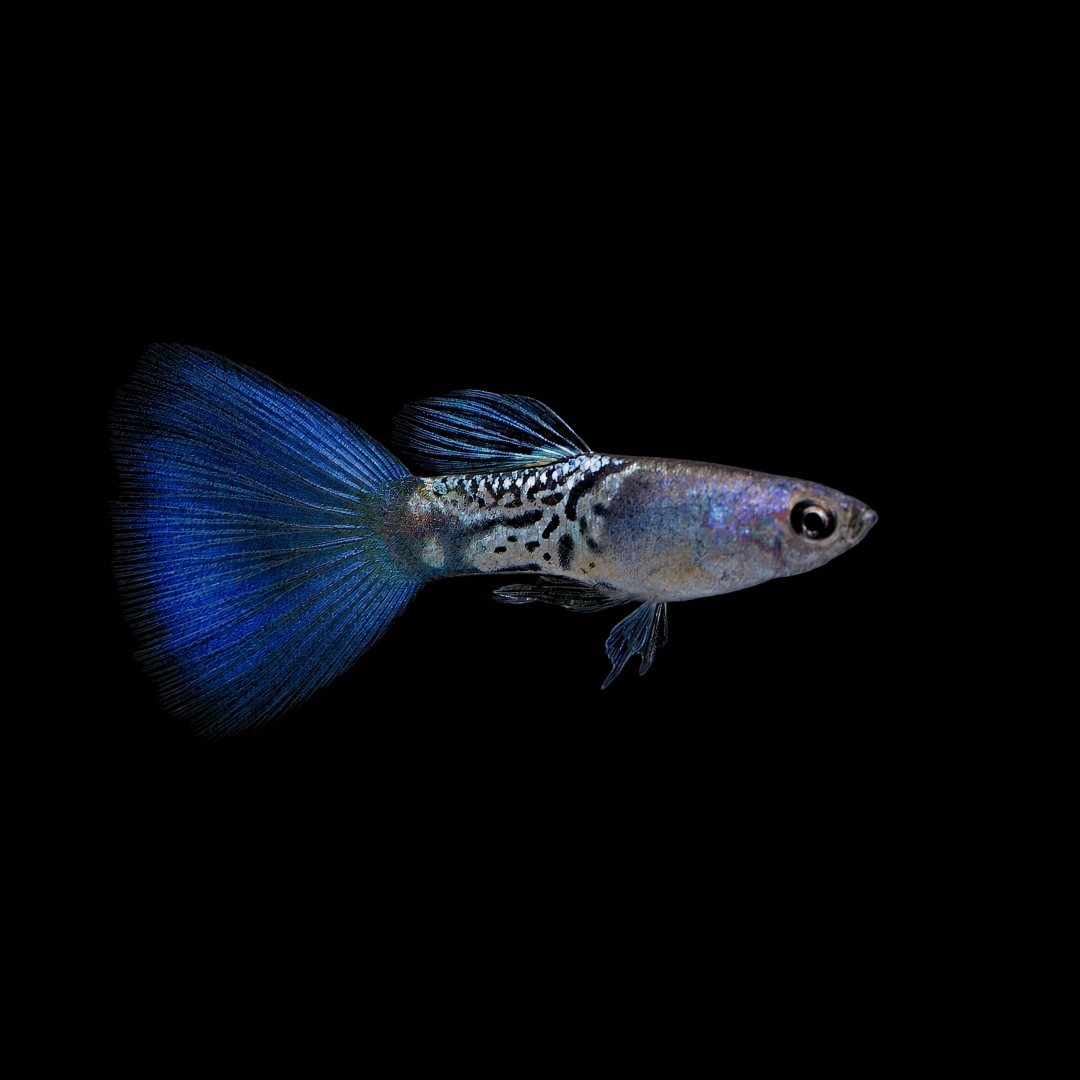
メタルスネークスキンブルーテールグッピーは、ひとつの体に三つの表情を持つグッピーの改良品種です。頭部から前半身は金属のような光沢を帯びた濃紺の「メタル(モスコー)」、後半身は細かな網目が刻まれた「スネークスキン(コブラ)」模様、そして尾びれは柄のないビロードのような濃紺一色の「ブルーテール」。この三つの区画がくっきりと切り替わるコントラストが最大の魅力で、海外では英名の頭文字をとって「MSSBT」とも呼ばれています。メタリックな青は青い色素によるものではなく、皮膚の細胞に並ぶ微細な結晶が光を反射して生まれる構造色のため、照明の下で泳ぐたびに角度によって輝きが移ろいます。日本国内では国内のブリーダーが代々繁殖させた「国産グッピー」として流通しており、日本の軟水に慣れた個体は導入しやすく、飼育そのものは難しくありません。ただし、濃密な網目と単色の尾のバランスを次の世代へ受け継ぐには、早めの雌雄分離と丁寧な選別、そして外国産の個体を持ち込まない防疫管理が欠かせず、続けるほどに奥深さを感じられる品種です。The Metal Snakeskin Blue Tail guppy is a selectively bred guppy that carries three distinct looks on a single body. The head and front half of the body show a deep navy “metal” (Moscow) sheen like polished metal, the rear half bears a fine mesh-like “snakeskin” (cobra) pattern, and the caudal fin is a solid, velvety navy blue with no pattern. The sharp transition between these three zones is the breed’s greatest charm, and overseas it is often called “MSSBT” after the initials of its English name. The metallic blue is not produced by a blue pigment but is a structural color created when microscopic crystals in skin cells reflect light, so the shine shifts with the viewing angle every time the fish swims under the light. In Japan, it is distributed as a “domestic guppy” bred over many generations by Japanese breeders, and fish already accustomed to Japan’s soft water are easy to introduce and not difficult to keep. However, passing the balance of dense mesh and solid tail on to the next generation requires early separation of the sexes, careful selection, and biosecurity that keeps imported fish out, making this a breed whose depth grows the longer you keep it.
基本情報 / Basic Information
学名 / Scientific Name
Poecilia reticulata
通称 / Common Name
メタルスネークスキンブルーテールグッピー、メタルスネークスキンブルーテール、MSSBT(近縁の流通名にメタルコブラ、メタルヘッドスネークスキンなど)Metal Snakeskin Blue Tail Guppy, MSSBT (related trade names include Metal Cobra and Metal Head Snakeskin)
分類 / Family
カダヤシ目 カダヤシ科 ポエキリア属(改良品種)Cyprinodontiformes, Poeciliidae, genus Poecilia (cultivated variety)
英名 / English Name
Metal Snakeskin Blue Tail Guppy
分布 / Distribution
改良品種のため、野生の個体群は存在しない。原種のグッピーは、ベネズエラ、ガイアナ、トリニダード・トバゴなど南米大陸北東部とその周辺の島々に分布する。本品種は日本国内のブリーダーのほか、インドネシア、ベトナム、タイ、シンガポール、台湾などアジア各地の養魚場でも生産されている。As a cultivated variety, it has no wild populations. The original wild guppy is native to northeastern South America and nearby islands, including Venezuela, Guyana, and Trinidad and Tobago. This variety is produced by breeders in Japan as well as by fish farms across Asia, including Indonesia, Vietnam, Thailand, Singapore, and Taiwan.
最大体長 / Max Size
オス約3〜4cm、メス約4〜6cm(メスの方が大きくなる)Males about 3 to 4 cm, females about 4 to 6 cm (females grow larger)
寿命 / Lifespan
約1〜2年。安定した環境では3年前後生きることもある。About 1 to 2 years. In a stable environment, some live around 3 years.
飼育環境 / Aquarium Environment
水槽サイズ / Tank Size
1〜2ペアであれば30cm規格水槽(約12L)でも飼育できるが、大きなデルタテールを伸ばし、水質を安定させるには45cm規格水槽(約35L)〜60cm規格水槽(約57L)がおすすめ。繁殖や選別を行う場合は、親魚用の水槽に加えて、稚魚用、オス用、メス用の小型水槽を複数用意すると管理しやすい。One or two pairs can be kept in a standard 30 cm tank (about 12 L), but a standard 45 cm tank (about 35 L) to a standard 60 cm tank (about 57 L) is recommended for developing a large delta tail and keeping water quality stable. For breeding and selection, it is easier to manage with several small tanks for fry, males, and females in addition to the parent tank.
水温 / Temperature
24〜27℃前後。繁殖させる場合は25〜27℃で安定させるとよい。冬場はヒーターを使い、急な水温低下を防ぐ。Around 24 to 27°C. For breeding, keep it stable at 25 to 27°C. Use a heater in winter to prevent sudden drops in temperature.
水質 / Water Quality
弱酸性〜弱アルカリ性(pH6.5〜7.5前後)、軟水〜中硬水。海外の飼育ガイドではpH7.0〜8.0の中硬水〜硬水が勧められることが多いが、日本の水に慣れた国産個体であれば、カルキを抜いた水道水で十分に健康を保てる。大切なのは理想の数値に合わせることよりも、水質を急に変えないこと。サンゴ砂の入れすぎによる急なアルカリ化や、硝酸塩がたまることによるpHの低下に注意し、週に1回、20〜30%程度の換水を習慣にするとよい。Slightly acidic to slightly alkaline (around pH 6.5 to 7.5), soft to moderately hard water. Overseas care guides often recommend moderately hard to hard water at pH 7.0 to 8.0, but domestic Japanese fish accustomed to local water stay healthy in dechlorinated tap water. What matters more than matching ideal numbers is avoiding sudden changes. Watch for rapid alkalization from too much coral sand and for pH drops caused by nitrate buildup, and make a habit of changing about 20 to 30% of the water once a week.
レイアウト / Layout
ろ過には、スポンジフィルターや、水流を弱めに調整した外掛け式・外部式フィルターが向いている。マツモやウィローモスなどの水草は、稚魚の隠れ家としても役立つ。背面にツヤを抑えた黒や濃紺のバックスクリーンを貼り、暗い色の底床を使うと、照明の映り込みが抑えられ、メタル光沢と網目のコントラストが引き立つ。照明は色温度6,500〜8,000K前後の白色〜やや青みのあるLEDを使うと青系の発色が自然に見えやすく、点灯時間は1日8〜10時間程度が目安となる。For filtration, a sponge filter or a hang-on or canister filter adjusted to a gentle flow is suitable. Aquatic plants such as hornwort and willow moss also serve as hiding places for fry. A matte black or navy background screen and a dark substrate reduce light reflections and bring out the contrast between the metallic sheen and the mesh. White to slightly bluish LED lighting at around 6,500 to 8,000 K tends to show blue tones naturally, with a photoperiod of about 8 to 10 hours a day as a guideline.
注意点 / Precautions
面積の広いデルタテールは強い水流の中では体力を消耗しやすく、ヒレ裂けや尾曲がりの原因にもなる。国産グッピーと外国産グッピーを一緒に飼うと感染症を持ち込むおそれがあるため避け、網やバケツなどの器具も分けて使う。新しく迎えた個体は、購入時の袋の水を水槽に入れず、別の水槽でしばらく様子を見てから合流させる。輸送直後やストレスを受けているときは体色が淡く見えることがあるが、落ち着けば濃紺に戻ることが多い。また、グッピーは環境省などが定める生態系被害防止外来種リストに「その他の総合対策外来種」として掲載されているため、どのような理由があっても河川や用水路に放してはいけない。A broad delta tail tires easily in strong currents and can lead to torn fins or a bent tail. Avoid keeping domestic and imported guppies together, as this may introduce infectious diseases, and use separate nets, buckets, and other equipment. When bringing in new fish, do not add the water from the shop bag to the tank; observe them in a separate tank for a while before introducing them. Right after transport or under stress, the body color may look pale, but it usually returns to deep navy once the fish settles. In addition, guppies are listed as an “other invasive species requiring comprehensive countermeasures” on Japan’s list of invasive alien species that threaten ecosystems, so they must never be released into rivers or irrigation channels for any reason.
餌と給餌 / Feeding
餌の種類 / Diet
雑食性。良質なフレークフードや細かい粒の人工飼料を主食とし、孵化させたブラインシュリンプ、冷凍アカムシ、ミジンコなどの生き餌や冷凍餌、植物質を含む餌を組み合わせるとよい。Omnivorous. Use quality flake food or fine-grained prepared food as the staple, combined with live and frozen foods such as hatched brine shrimp, frozen bloodworms, and daphnia, as well as foods containing plant matter.
給餌のポイント / Feeding Tips
1日に数回、数分で食べきれる量を少しずつ与えると、水質の悪化を防ぎながら成長を促せる。稚魚の育成や、出産を終えたメスの体力回復には、孵化させたブラインシュリンプが特に役立つ。食べ残しは硝酸塩の蓄積やpH低下の原因になるため、水質の変化を和らげる力が弱い軟水の水槽では、特に与えすぎに注意する。Feeding small amounts several times a day, only what can be eaten in a few minutes, supports growth while preventing water deterioration. Hatched brine shrimp is especially useful for raising fry and helping females recover after giving birth. Leftover food leads to nitrate buildup and lower pH, so be especially careful not to overfeed in soft-water tanks, which have little capacity to buffer such changes.
性格と混泳 / Temperament and Tank Mates
性格 / Temperament
温和で、ほかの魚を攻撃することはほとんどない。オスはメスを追いかけて盛んに求愛し、ヒレを大きく広げてアピールする。ただし、親魚は生まれたばかりの稚魚を食べてしまうことがある。Peaceful and rarely attacks other fish. Males actively chase females to court them, spreading their fins wide in display. However, adults may eat newborn fry.
混泳の相性 / Compatibility
本来の発色や求愛の姿を楽しむなら、同じ系統だけを飼う単独飼育がおすすめ。観賞が目的であれば、コリドラスやオトシンクルスなど温和な底層の魚と一緒に飼うこともできるが、ヒレをかじる魚や稚魚を食べる魚とは組み合わせない。系統を維持するための繁殖が目的なら、他種やほかの系統のグッピーを混ぜない完全な単独飼育が基本となる。エンドラーズ(Poecilia wingei)とは交雑してしまうため、同じ水槽では飼わないようにする。To enjoy the true coloration and courtship behavior, keeping only fish of the same line is recommended. For display purposes, it can be kept with peaceful bottom dwellers such as Corydoras and Otocinclus, but avoid fin-nipping fish and species that eat fry. When breeding to maintain a line, the basic rule is a strictly single-line tank with no other species or guppy lines. Since it hybridizes with Endler’s livebearer (Poecilia wingei), do not keep the two in the same tank.
病気と対策 / Diseases and Prevention
かかりやすい病気 / Common Diseases
尾ぐされ病(カラムナリス病)にかかると、濃紺の尾びれの縁が白く濁り、ギザギザに溶けていく。白点病は白点虫が寄生する病気で、ヒレや体表に砂粒のような白い点が現れる。ギロダクチルス症は寄生虫がエラや体表に付く病気で、エラ病に似た症状を示す。日本のグッピー飼育で特に警戒されているのが、通称「グッピーエイズ」と呼ばれる病気である。ヒトのエイズとは関係がなく、正式な病名でもなければ原因も解明されていないが、胸びれの曇りから始まって尾びれがすぼまり、頭を上げた立ち泳ぎのような不自然な泳ぎを見せたのち、短期間で水槽全体に広がった例が報告されている。原虫によるテトラヒメナ症にも注意が必要で、国産の個体では白点病と見分けにくい小さな白点程度しか現れないことがある、との指摘もある。With tail rot (columnaris disease), the edge of the navy caudal fin turns cloudy white and dissolves into a ragged edge. White spot disease is caused by the parasite Ichthyophthirius and produces sand-like white dots on the fins and body. Gyrodactylosis is caused by parasites attaching to the gills and skin and shows symptoms similar to gill disease. A condition especially feared in Japanese guppy keeping is nicknamed “guppy AIDS”. It has nothing to do with human AIDS, is not an official disease name, and its cause is unknown, but cases have been reported in which it begins with clouding of the pectoral fins, the tail closes up, the fish swims unnaturally with its head raised, and the condition spreads through the whole tank in a short time. Tetrahymena infection, caused by a protozoan, also requires caution; it has been noted that in domestic fish it may show only small white dots that are hard to distinguish from white spot disease.
対策と予防 / Prevention
異常のある個体は、すぐに別の水槽へ隔離する。尾ぐされ病には、細菌による病気に効能を持つ魚病薬(グリーンFゴールド顆粒など)での薬浴に、0.3〜0.5%程度の塩水浴を組み合わせるのが一般的。白点病は、水温を26〜27℃程度まで緩やかに上げ、メチレンブルー系やマラカイトグリーン系の魚病薬で治療する。メチレンブルーは光で分解されやすいため水槽を遮光し、エアレーションを十分に行う。抗菌剤で改善しないエラの症状は、寄生虫を疑う。魚病薬は製品ごとに効能や用量が異なるため、必ず添付文書の指示に従う。通称グッピーエイズには確立された治療法がないとされ、国産と外国産を一緒に飼わないこと、器具を分けること、新しい個体を別の水槽で様子見してから合流させることが、現実的にもっとも確かな予防策と考えられている。Move any fish showing abnormalities to a separate tank immediately. For tail rot, a common approach combines a medicated bath with a fish medicine effective against bacterial diseases (such as Green F Gold granules) and a salt bath of about 0.3 to 0.5%. For white spot disease, gradually raise the temperature to about 26 to 27°C and treat with methylene blue or malachite green based medicines. Methylene blue breaks down in light, so shade the tank and provide ample aeration. If gill symptoms do not improve with antibacterial treatment, suspect parasites. Because effects and dosages differ by product, always follow the package instructions. There is said to be no established treatment for so-called guppy AIDS; not keeping domestic and imported fish together, keeping equipment separate, and observing new fish in a separate tank before introduction are considered the most reliable means of prevention in practice.
増やし方(繁殖) / Breeding
雌雄の判別 / Sexing
オスは体が小さめで、尻びれが細長い棒状の交接器(ゴノポディウム)に変化しており、頭部のメタル光沢、後半身の網目模様、大きく開く濃紺のデルタテールを持つ。メスはオスより大きく丸みのある体形で、尻びれは扇形のまま。金属光沢や網目模様はほとんど現れず、尾びれに濃紺〜暗色の色味が乗る程度の落ち着いた姿をしている。生後1ヶ月前後になると、尻びれの形で見分けられるようになる。Males are smaller, with the anal fin modified into a long, rod-shaped copulatory organ (gonopodium), and they display the metallic head, the mesh pattern on the rear body, and a wide navy delta tail. Females are larger and rounder than males, and their anal fin remains fan-shaped. They show almost no metallic sheen or mesh pattern and have a subdued appearance with only a navy to dark tint on the caudal fin. From around one month of age, the sexes can be distinguished by the shape of the anal fin.
繁殖形態 / Reproduction
卵胎生。卵はメスの体内でかえり、交尾からおよそ24〜30日(水温25〜27℃前後)で、20〜60匹程度の稚魚が直接産み出される。メスのお腹が膨らみ、尻びれの付け根付近にある黒い妊娠斑が目立ってきたら、出産が近いサイン。メスは一度の交尾で精子を体内に長く蓄えることができ、オスがいなくても数ヶ月にわたって何度か出産することがある。Livebearer. Eggs hatch inside the female, and about 24 to 30 days after mating (at around 25 to 27°C) she gives birth to roughly 20 to 60 live fry. A swollen belly and a prominent dark gravid spot near the base of the anal fin indicate that birth is near. Females can store sperm in their bodies for a long time after a single mating and may give birth several times over several months even without a male present.
繁殖のポイント / Breeding Tips
出産が近づいたメスは、水草を多めに浮かべた水槽か隔離用の水槽へ移し、出産後は元の水槽に戻して栄養価の高い餌で体力を回復させる。メスは精子を長く蓄えられるため、狙ったオスの子を得るには、生後1ヶ月〜1ヶ月半(体長約1.5cm)のうちにオスとメスを別々の水槽に分け、まだ交尾していないメスを確保しておくことが欠かせない。選別は二段階で行うと効率がよく、生後2〜3ヶ月で背曲がりや柄の大きな崩れがある個体を種親候補から外し、尾びれの形が完成に近づく生後5〜6ヶ月以降に最終的な種親を選ぶ。オス親は、途切れのない濃密なメタル光沢、後半身の細かく均一な網目、濁りのない濃紺一色の尾びれと背びれ、そして大きく鋭く開く尾びれを基準に選ぶ。メス親は、体格が大きく背筋が真っ直ぐな健康な個体のうち、尾びれに濃紺〜暗色がしっかり乗ったものを選ぶと、デルタテールを維持しやすいと考えられている。グッピーは近親交配を続けると体が小さくなったり産む稚魚の数が減ったりしやすいため、複数の血統を並行して維持し、計画的に血統どうしを掛け合わせるのが理想。なお、リボンやスワローなどヒレが長く伸びるタイプのオスは交接器も伸びて交尾が難しくなるため、繁殖ではノーマルのオスとリボンやスワローのメスを組み合わせる。Move a female close to giving birth to a tank with plenty of floating plants or to a separate birthing tank, then return her to the original tank afterward and help her recover with nutritious food. Because females store sperm for a long time, obtaining offspring from a chosen male requires separating males and females into different tanks at one to one and a half months of age (about 1.5 cm long) to secure females that have not yet mated. Selection works best in two stages: at two to three months, remove fish with bent spines or major pattern defects from the breeder candidates, and from five to six months onward, when the tail shape nears completion, choose the final breeders. Choose males for an unbroken, dense metallic sheen, a fine and even mesh on the rear body, clear solid navy caudal and dorsal fins, and a large, sharply spread tail. Among large, healthy females with straight backs, choosing those with a strong navy to dark tint on the caudal fin is thought to help maintain the delta tail. Continued inbreeding in guppies tends to reduce body size and the number of fry, so ideally several bloodlines are maintained in parallel and crossed with one another in a planned way. Note that males of long-finned types such as ribbon and swallow also develop an elongated gonopodium that makes mating difficult, so breeding pairs combine a normal-finned male with a ribbon or swallow female.
雑学と豆知識 / Trivia and Fun Facts
1. 青い色素を持たない「青い魚」 / 1. A “Blue Fish” Without Blue Pigment
頭部を覆う深い青は、実は絵の具のような青い色素から生まれたものではありません。グッピーの体色を電子顕微鏡で調べた研究によると、オスの模様は黒色素胞、虹色素胞、黄色素胞といった複数の種類の色素細胞が組み合わさってつくられています。メタリックな青を生み出しているのは虹色素胞です。その内部には薄いグアニンの結晶板が並んでおり、シャボン玉の膜が虹色に見えるのと同じように光が干渉し合うことで、青い光だけが強く跳ね返ってきます。結晶板がきれいに平行に揃っている部分は鮮やかな青に、並びが乱れている部分は白っぽく見えるため、魚が泳ぐ角度によって見え方が刻々と変わるのです。さらに、その下にある黒色素胞が余分な光を吸収していると考えられており、黒い下地があるからこそ、上の青が濁らずに鮮やかに浮かび上がります。照明の下で泳ぐたびにきらりと輝くのは、皮膚の中にあるこうした小さな光の仕組みのおかげなのです。The deep blue covering the head does not actually come from a blue pigment like paint. Studies of guppy coloration using electron microscopy show that male patterns are built from combinations of several types of pigment cells, including melanophores, iridophores, and xanthophores. The metallic blue is produced by iridophores. Inside them lie thin guanine crystal plates, and just as a soap bubble film looks iridescent, light waves interfere with one another so that blue light is reflected most strongly. Where the plates are neatly aligned in parallel the color is a vivid blue, and where they are disordered it looks whitish, so the appearance changes moment by moment with the angle at which the fish swims. In addition, the melanophores beneath are thought to absorb excess light, and it is precisely because of this dark underlayer that the blue above stands out vividly without turning murky. The sparkle each time the fish swims under the light comes from these tiny optical structures in its skin.
2. 気分で色が変わる「カメレオン効果」 / 2. The “Chameleon Effect” That Shifts With Mood
お店の水槽では灰色がかった薄い青に見えたのに、家の水槽に慣れたら見違えるほど濃い紺色になった。そんな経験をする飼育者は少なくありません。海外のグッピーの遺伝に関する専門書では、メタル(モスコー)系統の特徴として、黒色素胞の中にあるメラニンの粒が、細胞の中心に集まったり周囲に広がったりする動きが大きいことが挙げられています。粒が中心に集まると色は淡くなり、広がると漆黒に近い濃紺になります。そのため、輸送直後や緊張しているときには色が抜けたように見え、落ち着いたときやメスに求愛するときには一気に濃くなるのです。一時的に色が薄く見えても、それだけで系統の質が低いとは限らない。これは、この品種と付き合ううえで知っておきたい大切なポイントです。Many keepers have seen a fish that looked a grayish pale blue in the shop tank turn a strikingly deep navy once it settled into their home aquarium. Specialist books on guppy genetics published overseas point out that a characteristic of metal (Moscow) lines is the large movement of melanin granules within melanophores, which gather at the center of the cell or spread outward. When the granules gather at the center, the color fades; when they spread out, it deepens to a navy close to jet black. As a result, the fish can look washed out right after transport or when nervous, and darken quickly when relaxed or courting a female. A temporarily pale color does not by itself mean a low-quality line, and this is an important point to know when living with this breed.
3. 父から息子へ受け継がれるメタルと、二つに分かれた網目の遺伝子 / 3. A Metal Trait Passed From Father to Son, and Mesh Genes Split in Two
グッピーの性別はヒトと同じXY型で決まり、オスがXY、メスがXXです。メタルの形質はY染色体の上にある優性の遺伝子(文献によりMwやMoと表記されます)によるものとされています。Y染色体は父から息子にしか受け継がれないため、頭部のメタル光沢はオスにだけ現れるのです。面白いのは、このメタルの遺伝子とスネークスキンの形質が組み合わさると、頭部から前半身ではメタルが網目を覆い隠し、後半身にだけ網目が残るという点です。また、スネークスキン模様はひとつの遺伝子で決まるのではなく、体の網目を担う遺伝子(Ssb)と、ヒレの網目を担う遺伝子(Sst)が別々に働いていることが知られています。体と尾の両方に網目が出るメタルコブラ系に対して、この品種は体にだけ網目を出し、尾びれは柄のない濃紺に染めた組み合わせだと考えられています。尾びれの青に関わる遺伝子を報告した研究もありますが、流通している一つひとつの血統について遺伝子の構成が確かめられているわけではありません。さらに、体の網目の遺伝子はX染色体とY染色体の間で入れ替わることがある可能性も指摘されています。つまり、同じ血統を守っているつもりでも、まれに柄の出方が変わることがあるため、毎世代の観察が欠かせないのです。Sex in guppies is determined by an XY system like that of humans: males are XY and females XX. The metal trait is attributed to a dominant gene on the Y chromosome (written as Mw or Mo depending on the source). Because the Y chromosome passes only from father to son, the metallic head appears only in males. What is interesting is that when this metal gene is combined with the snakeskin trait, the metal covers and hides the mesh from the head to the front body, leaving the mesh only on the rear body. The snakeskin pattern is also known not to be controlled by a single gene: one gene governs the body mesh (Ssb) and a separate gene governs the fin mesh (Sst). Whereas metal cobra types show mesh on both body and tail, this breed is thought to combine mesh on the body only with a tail dyed in plain, patternless navy. Some research has reported a gene involved in the blue of the caudal fin, but the genetic makeup of each line in circulation has not been individually confirmed. It has also been suggested that the body mesh gene may move between the X and Y chromosomes. In other words, even in a line kept as consistently as possible, the pattern can occasionally change, which is why observation in every generation is essential.
4. モスクワから東ドイツ、そして日本へ / 4. From Moscow to East Germany, and Then to Japan
前半身を彩る「モスコー」という名前は、ロシアの首都モスクワに由来します。ドイツの観賞魚業界の記録によると、この名前が文献に現れる起点のひとつは1976年のドイツの観賞魚雑誌で、たくさんの展示水槽を並べるモスクワのグッピー愛好家たちの活動が紹介されていたとされます。興味深いことに、海外の専門書やブリーダーの調査記録には、モスクワから旧東ドイツへ渡った初期のモスコーは、今よく知られる全身一色のブルーモスコーではなく、頭から前半身が金属的な青で、後半身とヒレにスネークスキンやモザイクの柄を持つ「メタルヘッド」型だったという記述が見られます。それが確かなら、メタルスネークスキンは新しい品種のように見えて、実はモスコーの初期の姿に近い特徴を受け継いでいるともいえそうです。この系統は日本のブリーダーの手でも磨かれ、1990年代の終わりに米国で開かれた国際的なグッピーコンテストに日本から出品されたモスコー系統が北米の愛好家の目に留まり、現地のスネークスキン系統と掛け合わされたことが、世界に広まるきっかけのひとつになったと伝えられています。The name “Moscow” for the coloration of the front body comes from the Russian capital. According to records from the German ornamental fish industry, one of the earliest appearances of the name in print is a 1976 German aquarium magazine article that introduced Moscow guppy enthusiasts who displayed many exhibition tanks. Interestingly, specialist books and breeder research records overseas describe the early Moscow guppies that went from Moscow to former East Germany not as the now-familiar solid blue Moscow, but as a “metal head” type with metallic blue from the head to the front body and snakeskin or mosaic patterns on the rear body and fins. If that is accurate, the metal snakeskin, though it looks like a new breed, may actually carry features close to the early form of the Moscow. This line was also refined by Japanese breeders, and it is said that Moscow guppies entered from Japan in an international guppy contest held in the United States in the late 1990s caught the eye of North American enthusiasts, and that their crossing with local snakeskin lines became one of the triggers for the breed’s worldwide spread.
5. コブラ、スネークスキン、フィリグラン / 5. Cobra, Snakeskin, and Filigran
後半身を彩る網目模様は、地域によって呼び名が異なります。北米では「スネークスキン」、日本やアジアでは「コブラ」や「キングコブラ」、ヨーロッパでは金銀の繊細な細工を思わせる「フィリグラン」と呼ばれてきました。この模様は特定の一人の作出者が生み出したものではなく、各国のブリーダーがそれぞれに固定を進めたと記録されています。世界に広く普及する転機となったのは1960年代後半のシンガポールで、米国の養殖場が閉鎖されたあと、シンガポールの養魚場が「コブラ」の名で商業生産を広げたと伝えられています。日本で、従来の「メタルコブラ」に加えて英語由来の「メタルスネークスキンブルーテール」という名前が使われるようになってきたのも、東南アジアや欧米のブリーダーとの交流が盛んになり、海外での呼び名がそのまま流通名として取り入れられるようになった流れの表れといえるでしょう。なお、網目が特に細かいものは「レース」とも呼ばれますが、これは特定の遺伝子の名前ではなく、網目の繊細さを表す呼び方と捉えるのがよいとされています。The mesh pattern decorating the rear body goes by different names depending on the region. In North America it is called “snakeskin”, in Japan and Asia “cobra” or “king cobra”, and in Europe “Filigran”, evoking delicate gold and silver metalwork. Records indicate that this pattern was not created by one particular breeder but was fixed independently by breeders in various countries. The turning point for its worldwide spread came in Singapore in the late 1960s, where, after an American hatchery closed, local fish farms are said to have expanded commercial production under the name “Cobra”. The growing use in Japan of the English-derived name “Metal Snakeskin Blue Tail” alongside the traditional “Metal Cobra” likewise reflects increasingly active exchange with breeders in Southeast Asia, Europe, and North America, with overseas names being adopted directly as trade names. Fish with especially fine mesh are also called “lace”, but this is best understood not as the name of a specific gene but as a description of how delicate the mesh is.
6. よく似た仲間との見分け方 / 6. Telling It Apart From Similar Varieties
メタル系、コブラ系、ブルー系のグッピーには似た品種が多く、見分けるには体の三つの区画を順に見ていくのが近道です。全身が均一な濃紺の金属光沢で、網目を持たないのがモスコーブルー(フルメタルブルー)。頭部のメタルと体の網目は同じでも、尾びれにまで細かな網目が入るのがメタルレースコブラやメタルコブラです。淡い青を基調に尾びれが黒い細かな点の模様になり、頭部の濃紺のメタルを持たないのがブルーグラス。頭まで太めの網目や縦縞が入り、尾びれも網目模様になるのがキングコブラです。後半身にくっきりとした網目を残しながら、尾びれは柄のない濃紺一色できりりと締まる。この組み合わせこそが、メタルスネークスキンブルーテールを見分ける最大の手がかりです。There are many similar varieties among metal, cobra, and blue guppies, and the quickest way to tell them apart is to look at the three zones of the body in turn. The Moscow Blue (Full Metal Blue) has a uniform navy metallic sheen over the whole body with no mesh. The Metal Lace Cobra and Metal Cobra share the metallic head and body mesh but also have fine mesh on the caudal fin. The Blue Grass has a pale blue base with fine black spots on the caudal fin and lacks the navy metallic head. The King Cobra has thicker mesh and vertical stripes extending to the head, with a mesh-patterned tail. Clear mesh on the rear body combined with a tail crisply finished in plain, patternless navy is the key clue that identifies the Metal Snakeskin Blue Tail.
7. 「グッピー」という名前と、世界に広がったミリオンフィッシュ / 7. The Name “Guppy” and the Millionfish That Spread Worldwide
グッピーの原種は、1859年にドイツの動物学者ヴィルヘルム・ペータースによって記載されました。その後、トリニダード島に住んでいた英国人ロバート・ジョン・レッチメア・グッピーが採集した標本をロンドンの大英博物館の魚類学者ギュンターへ送ったことから、彼の名にちなんだ「グッピー」という呼び名が広まったといわれています。また、旺盛な繁殖力から英語圏やドイツ語圏では「ミリオンフィッシュ」とも呼ばれ、20世紀には蚊の幼虫であるボウフラを食べる魚として、世界各地の熱帯や亜熱帯に持ち込まれました。日本でも南西諸島などの温暖な地域で野外への定着が確認されており、生態系被害防止外来種リストにも掲載されています。小さな水槽の中で愛されるこの魚が、野外では在来の生き物を脅かす存在にもなりうることは、飼育者として心に留めておきたい事実です。The wild guppy was described in 1859 by the German zoologist Wilhelm Peters. Later, Robert John Lechmere Guppy, an Englishman living in Trinidad, sent specimens he had collected to the ichthyologist Günther at the British Museum in London, and the name “guppy” in his honor is said to have spread from this. Because of its prolific breeding, it has also been called the “millionfish” in English- and German-speaking regions, and in the 20th century it was introduced to tropical and subtropical regions around the world as a fish that eats mosquito larvae. In Japan as well, it has become established in the wild in warm areas such as the Nansei Islands, and it appears on Japan’s list of invasive alien species that threaten ecosystems. That this fish, so loved in small aquariums, can threaten native wildlife in the wild is a fact every keeper should keep in mind.
8. 国によって違う「美しいグッピー」の物差し / 8. Different Yardsticks for a “Beautiful Guppy” Around the World
グッピーのコンテストは、米国のIFGA(国際ファンシーグッピー協会)、ヨーロッパのIKGH(国際グッピー改良評議会)、そして日本の愛好会など、地域ごとに異なる審査の考え方を育んできました。北米では大きな体格と力強く広がるデルタテールが重視される傾向があります。一方、ヨーロッパのIKGHはオス3匹を一組にして出品する方式をとっており、偶然生まれた1匹の傑作だけでは高い評価を得られません。日本でも、複数の個体がどれだけ揃っているかが高く評価されてきました。網目の細かさ、メタルの濃さ、尾の濃紺が、どの個体を見ても同じように揃っていること。それは、何世代にもわたって丁寧に選別を重ねてきた系統の完成度を示す、何よりの証といえるでしょう。Guppy contests have developed different judging philosophies by region, from the IFGA (International Fancy Guppy Association) in the United States to the IKGH (International Curatorium for Guppy Breeding) in Europe and clubs in Japan. In North America, large body size and a powerfully spread delta tail tend to be emphasized. In contrast, the European IKGH requires entries as sets of three males, so a single lucky masterpiece cannot earn a high rating on its own. In Japan as well, how uniform several fish are has long been highly valued. Mesh fineness, depth of metallic sheen, and the navy of the tail matching across every fish is perhaps the best evidence of a line refined through careful selection over many generations.
9. 「全部メスだった?」という早とちり / 9. “They Were All Females?” A Common Misunderstanding
初めて繁殖に成功した飼育者の多くが、一度は口にする言葉があります。「何十匹も生まれたのに、全部メスだった」。実はグッピーの稚魚は、将来オスになる個体も含めて、生まれてから数週間はみなメスと同じ地味な色と扇形の尻びれをしています。生後1ヶ月を過ぎて雄性ホルモンが働き始めると、オスの尻びれは少しずつ細長く変わり、やがて頭部に濃紺のメタルが差し、後半身に網目が浮かび上がってきます。尾びれが大きく広がって形が整うのは生後半年前後で、モスコー系統が完全に成熟するには10ヶ月前後かかるという報告もあります。地味な稚魚が日を追うごとに濃紺のビロードをまとった成魚へと変わっていく様子を見守れることこそ、この品種を代々育てるいちばんの楽しみといえるでしょう。There is something many keepers say after their first successful breeding: “Dozens were born, but they were all females.” In fact, all guppy fry, including future males, have the same plain coloring and fan-shaped anal fin as females for the first few weeks after birth. After about a month, when male hormones begin to act, the males’ anal fins gradually become long and narrow, and before long navy metal appears on the head and the mesh emerges on the rear body. The tail spreads and takes its full shape at around six months, and some reports say full maturity in Moscow lines takes around ten months. Watching plain fry change day by day into adults clothed in navy velvet is perhaps the greatest joy of raising this breed over generations.
まとめ / Conclusion
金属のように輝く濃紺の頭、繊細な網目を刻んだ後半身、そして柄のないビロードの尾。メタルスネークスキンブルーテールグッピーは、皮膚の中の小さな結晶と色素細胞がつくり出す光の美しさと、各国のブリーダーが積み重ねてきた改良の歴史が、ひとつの体に宿った魚です。日本の水に慣れた国産の個体は飼いやすく、水質を急に変えないこと、水流を穏やかにすること、外国産の個体と一緒にしないことを心がければ、初めての方でも元気な姿を長く楽しめます。A navy head that gleams like metal, a rear body etched with delicate mesh, and a velvety tail without pattern. The Metal Snakeskin Blue Tail guppy is a fish in which the beauty of light created by tiny crystals and pigment cells in the skin, and a history of selective breeding built up by breeders in many countries, come together in a single body. Domestic fish accustomed to Japanese water are easy to keep, and even beginners can enjoy them in good health for a long time by avoiding sudden changes in water quality, keeping the current gentle, and not keeping them with imported fish.
そして、この魚の本当の奥深さは、命を次の世代へつないでいくところにあります。オスとメスを早めに分け、網目の細かさや尾の濃紺を見比べながら種親を選び、地味な稚魚が半年ほどかけて輝く成魚へ変わっていくのを見守る。その積み重ねの先に、よく揃った濃紺の群れが水槽を泳ぐ姿は、手間を惜しまなかった飼育者だけが目にできる特別な景色となるはずです。And the true depth of this fish lies in carrying life on to the next generation. Separating males and females early, choosing breeders by comparing the fineness of the mesh and the navy of the tail, and watching plain fry turn into shining adults over about half a year: at the end of that steady effort, a well-matched school of navy fish swimming through the tank becomes a special sight that only a keeper who spared no effort gets to see.
Kottler, V. A., Koch, I., Flötenmeyer, M., Hashimoto, H., Weigel, D. & Dreyer, C. (2014). Multiple Pigment Cell Types Contribute to the Black, Blue, and Orange Ornaments of Male Guppies (Poecilia reticulata). PLoS ONE, 9(1), e85647. https://doi.org/10.1371/journal.pone.0085647
スネークスキン模様と青い尾の遺伝
Phang, V. P. E., Ng, L. N. & Fernando, A. A. (1989). Inheritance of the Snakeskin Color Pattern in the Guppy, Poecilia reticulata. Journal of Heredity, 80(5), 393–399. https://doi.org/10.1093/oxfordjournals.jhered.a110881
Phang, V. P. E., Fernando, A. A. & Chia, E. W. K. (1990). Inheritance of the Color Patterns of the Blue Snakeskin and Red Snakeskin Varieties of the Guppy, Poecilia reticulata. Zoological Science, 7, 419–425. https://biostor.org/reference/106816
Petrescu-Mag, I. V., Păsărin, B., Hoha, G., Gîlcă, V. & Petrescu-Mag, R. M. (2011). The snakeskin body trait in guppy: from X to Y. Ion Ionescu de la Brad University of Agricultural Sciences and Veterinary Medicine, Iași, Scientific Papers, Vol. 56. https://www.uaiasi.ro/firaa/en/journal/vol-56/I_Petrescu_Mag.html
Francis-Floyd, R., Yanong, R. & Pouder, D. Ichthyophthirius multifiliis (White Spot) Infections in Fish. UF/IFAS Extension, EDIS (CIR920). https://doi.org/10.32473/edis-fa006-1991
Tepox-Vivar, N., Stephenson, J. F. & Guevara-Fiore, P. (2022). Transmission dynamics of ectoparasitic gyrodactylids (Platyhelminthes, Monogenea): An integrative review. Parasitology, 149, 865–877. https://doi.org/10.1017/S0031182022000361




コメント