| 水槽サイズ / Tank Size |
観賞だけが目的なら30cm規格水槽(約20L)から飼育できます。水質が安定しやすく、群泳や繁殖も楽しめる45cm規格水槽(約35L)から60cm規格水槽(約57L、20〜30匹程度まで)がおすすめです。For display only, a 30 cm standard tank (about 20 L) is sufficient. A 45 cm standard tank (about 35 L) to a 60 cm standard tank (about 57 L, up to roughly 20 to 30 fish) is recommended, as water quality stays more stable and you can enjoy group swimming and breeding. |
| 水温 / Temperature |
22〜28℃程度で飼育でき、普段は25〜26℃前後に保つのが目安です。冬場はヒーターを使って20℃を下回らないようにします。夏場は30℃を超えると酸欠やエロモナス症のリスクが高まるため、冷却ファンや水槽用クーラーで水温の上昇を抑えましょう。
Can be kept at about 22 to 28°C, ideally around 25 to 26°C. In winter, use a heater so the water never falls below 20°C. In summer, temperatures above 30°C raise the risk of oxygen shortage and Aeromonas infections, so use a cooling fan or aquarium chiller to keep the temperature down.
|
| 水質 / Water Quality |
中性〜弱アルカリ性(pH 7.0〜7.8前後)を好みます。カルキを抜いた日本の水道水でも飼育できますが、東南アジアの養殖場では総硬度(GH)10〜20程度の硬水で育てられていることが多いため、外国産個体を迎えたら時間をかけて水合わせを行います。ろ過が進むと飼育水は少しずつ酸性に傾くので、定期的な換水で酸性化を防ぎ、必要に応じて少量のサンゴ砂を入れてミネラルを補うのも有効です。薬剤で数値を無理に合わせ込むよりも、pHが短時間で0.5〜1.0も動くような急変を避けて水質を安定させるほうが、魚への負担は格段に少なくなります。Prefers neutral to slightly alkaline water (around pH 7.0 to 7.8). Dechlorinated Japanese tap water can be used, but fish on Southeast Asian farms are often raised in hard water with a general hardness (GH) of about 10 to 20, so take time to acclimate imported fish. As biological filtration progresses, the water gradually becomes more acidic; prevent this with regular water changes, and adding a small amount of coral sand to supply minerals can also help. Rather than forcing exact values with chemicals, keeping conditions stable and avoiding sudden swings, such as a pH change of 0.5 to 1.0 in a short time, places far less strain on the fish. |
| レイアウト / Layout |
底砂は、水質を酸性に傾けるソイルよりも、水質への影響が少なく中性〜弱アルカリ性を保ちやすい大磯砂が向いています。オスは大きな尾ビレを持つため、強い水流の中では体力を消耗しがちです。エアリフト式のスポンジフィルターや、吐出口の流れを弱めたフィルターで穏やかな水流を作るのが基本になります。水草を適度に植えておくと、オスに追われたメスの休み場所や、稚魚の隠れ家として役立ちます。飛び出し事故を防ぐため、フタは隙間なく設置しましょう。For substrate, Oiso gravel is better suited than soil, which tends to acidify the water, because it has little effect on water chemistry and helps maintain neutral to slightly alkaline conditions. Because males carry large tail fins, they tire easily in strong currents. The basic approach is to create gentle flow with an air-driven sponge filter or a filter with a softened outlet. A moderate amount of aquatic plants gives females a place to rest from pursuing males and provides cover for fry. Fit a lid with no gaps to prevent fish from jumping out. |
| 注意点 / Precautions |
輸入されたばかりの外国産個体を、いきなり古く酸性化した軟水の水槽に放すと、ヒレ先が傷んだり体調を崩したりしやすくなります。新しく迎えた個体は必ず別の水槽で2週間ほど単独で観察してください。また、国産個体や別ルートで入手した個体、プラティやモーリーなど他の卵胎生メダカとは、水槽だけでなく網・ホース・バケツも共用しないことが、感染症による大量死を防ぐ最も確実な方法です。オスはメスを活発に追い回すため、ペアで飼う場合はオス1匹に対してメス2匹以上の割合にすると、メスの消耗を抑えられます。Releasing newly imported fish directly into an old, acidified, soft-water tank can easily damage their fin tips or harm their health. Always observe new arrivals alone in a separate tank for about two weeks. Never sharing tanks, nets, hoses or buckets with domestic fish, fish obtained through other routes, or other livebearers such as platies and mollies is the most reliable way to prevent mass deaths from infectious disease. Males chase females vigorously, so when keeping pairs, a ratio of at least two females per male helps prevent the females from becoming exhausted. |
| 1. 「レオパード」と「レース」「モザイク」の境目 / 1. Where “Leopard” Ends and “Lace” and “Mosaic” Begin |
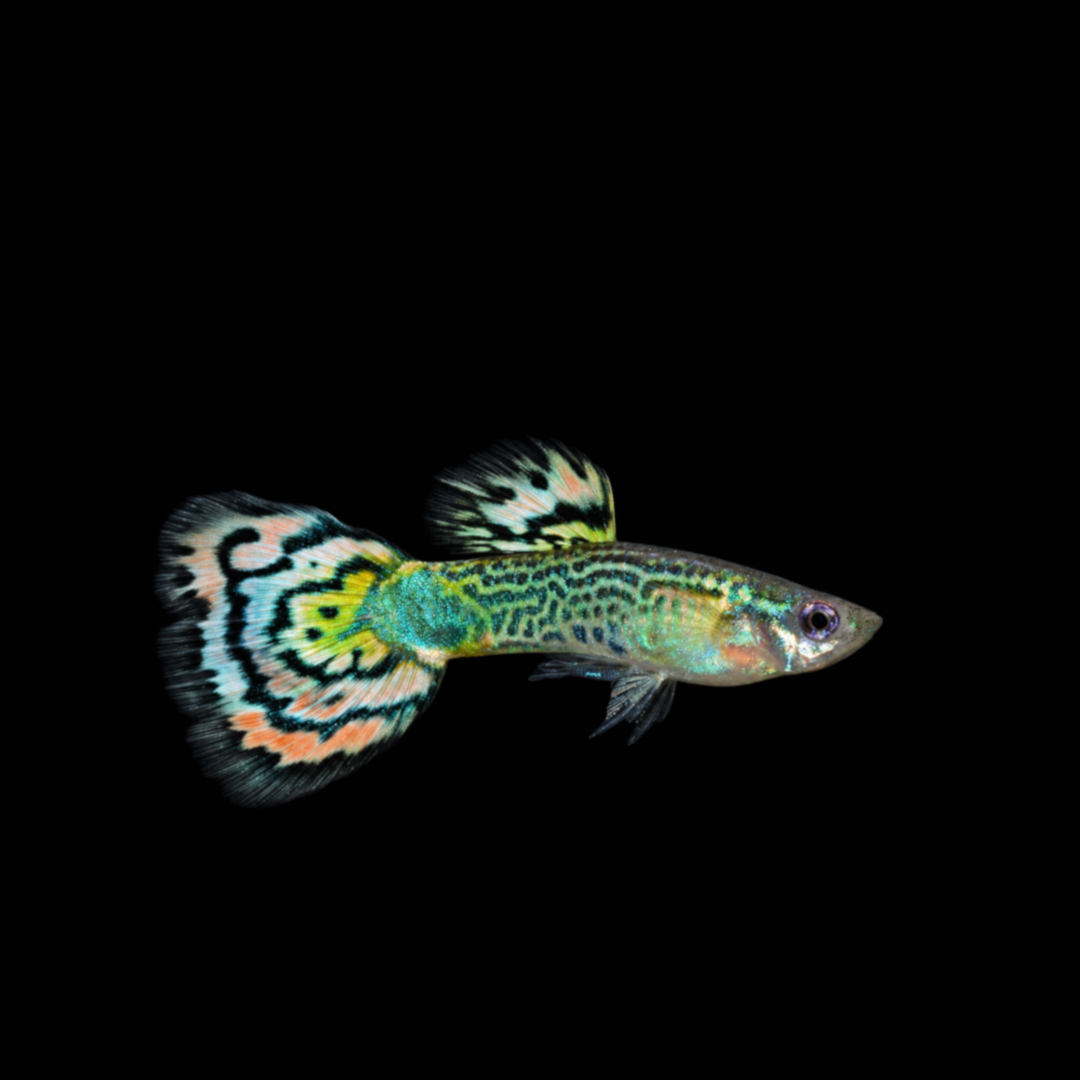
改良グッピーの品種名は、体色、体の模様、ヒレの色・模様、ヒレの形という4つの要素の組み合わせで整理するのが基本です。ところが体の模様については、スネークスキン、コブラ、キングコブラ、レースコブラ、レオパードコブラの間に、生物学的な厳密な境界があるわけではありません。欧米の観賞魚業界では、波線と点からなるヘビ皮状の体側模様をまとめてスネークスキン、欧州ではフィリグランと呼び、キングコブラとほぼ同じ意味で扱うことも少なくありません。それでも売り場では、ある程度の呼び分けが定着しています。細かな鎖状の網目全体を指すのがスネークスキン、やや太くコントラストの強い網目がコブラやキングコブラ、さらに細かく密な網目がレースコブラ、そして体はコブラ柄なのに尾ビレが網目ではなく大柄な斑点やモザイク調になったものがレオパードコブラ、という具合です。ただし海外の一部のブリーダーは、体の斑点模様や、ハーフブラック系統の斑点の入った尾にも「レオパード」の名を付けることがあります。名前だけで判断せず、体と尾ビレの実際の模様をそれぞれ確かめてみると、選ぶ楽しさがぐっと広がります。Fancy guppy variety names are basically organized by combining four elements: body color, body pattern, fin color and pattern, and fin shape. When it comes to body patterns, however, there is no strict biological boundary between Snakeskin, Cobra, King Cobra, Lace Cobra and Leopard Cobra. In the Western aquarium trade, the snakeskin-like body pattern of wavy lines and dots is often grouped under the name Snakeskin, or Filigran in Europe, and treated as nearly synonymous with King Cobra. Even so, certain naming conventions have taken hold in shops: Snakeskin refers to an overall fine, chain-like mesh; Cobra or King Cobra to a somewhat bolder, high-contrast mesh; Lace Cobra to an even finer, denser mesh; and Leopard Cobra to fish with a cobra body whose tail shows large spots or a mosaic look instead of mesh. Some overseas breeders, however, also use the name “Leopard” for spotted body patterns or for spotted tails in half-black lines. Rather than judging by name alone, checking the actual patterns on the body and the tail separately makes choosing a fish all the more enjoyable. |
| 2. コブラ模様を運ぶ遺伝子と、父から息子への受け渡し / 2. The Genes Behind the Cobra Pattern and Father-to-Son Inheritance |
グッピーの性別はヒトと同じく、オスがXY、メスがXXの性染色体の組み合わせで決まります。色彩や模様に関わる遺伝子の多くがこの性染色体の上に乗っているため、オスとメスで見た目が大きく異なるのです。シンガポール国立大学のViolet P. E. Phangらは、1989年から1999年にかけての一連の研究で、体側の蛇皮状の網目を生み出す優性遺伝子Ssbと、尾ビレの網目を生み出す遺伝子Sstという、強く連鎖した(ほぼセットで受け継がれる)2つの遺伝子がスネークスキン/コブラ模様のもとになっていることを明らかにしました。古典的な系統ではこれらが主にY染色体上にあるため、模様は父から息子へと直接受け継がれ、Y染色体を持たないメスには現れません。ところが話はそれほど単純ではありません。Phangらは1989年の時点で、ごく一部の個体がX染色体上にSsbやSstを持つ場合があることを報告していました。さらにルーマニアのPetrescu-Magらは2011年、それまで起こらないと考えられていた「X染色体からY染色体への移行」も起こり得ることを、レッドスネークスキン系統の交配実験で示しています。国内の問屋の品種解説でも、ヒレのコブラ柄がX染色体上で受け継がれる系統が紹介されています。つまり、手元の系統がY染色体型かX染色体型かによって、模様を次の世代へ伝えるうえでメス親がどれほど重要になるかが大きく変わってくるのです。As in humans, guppy sex is determined by sex chromosomes: XY in males and XX in females. Because many genes for color and pattern sit on these sex chromosomes, males and females look very different. In a series of studies from 1989 to 1999, Violet P. E. Phang and colleagues at the National University of Singapore showed that the snakeskin/cobra pattern is based on two tightly linked genes, inherited almost as a set: the dominant Ssb gene, which produces the snakeskin mesh on the body, and Sst, which produces the mesh on the tail. In classic lines these lie mainly on the Y chromosome, so the pattern passes directly from father to son and does not appear in females, which lack a Y chromosome. The story is not quite that simple, though. As early as 1989, Phang and colleagues reported that a small number of individuals can carry Ssb or Sst on the X chromosome. In 2011, Petrescu-Mag and colleagues in Romania showed through crosses of a red snakeskin line that movement from the X chromosome to the Y chromosome, previously thought not to occur, can also happen. Japanese wholesaler variety guides likewise describe lines in which the cobra pattern on the fins is inherited on the X chromosome. In other words, whether your line is the Y type or the X type greatly changes how important the mother is in passing the pattern on to the next generation. |
| 3. 豹柄の尾は「スイッチひとつ」では決まらない / 3. A Leopard Tail Is Not Decided by a Single Switch |
コブラ系統を何世代も殖やしていると、思いがけない模様が顔を出すことがあります。Phangらは1999年、シンガポールで養殖されているイエロースネークスキンの約1割に見られる「尾の付け根の4〜5本の虹色の縦縞」を調べました。その結果、この縦縞は、常染色体上の劣性遺伝子barを両親から受け継ぎ、なおかつY染色体上のSsbを持つオスにだけ現れることが分かりました。メスは縦縞を見せないまま遺伝子を隠し持っていることがあり、ある世代で突然タイガー調の縦縞が出てくるのはこのためです。また同じ研究グループのKhooらは、尾ビレに多彩な黒い斑点やパッチを生むVar遺伝子を解析し、この遺伝子がX・Y両方の性染色体上に存在し得ることを報告しています。とはいえ、市販のレオパードコブラすべてに共通する単一の「レオパード遺伝子」を特定した学術研究は、まだ確認されていません。愛好家の間でも、Y染色体上にあるという説、常染色体の劣性遺伝子だという説、複数の遺伝子が関わるという説が並び立っています。欧州の愛好家による長期観察では、体の網目の線を太く粗くする方向へ選別を重ねると、体に斑点が増え、それに連動して尾ビレもレース状からモザイクや大柄なスポットへと変わっていったことが記録されています。豹柄の尾は、網目の太さ、斑入りに関わる遺伝子、そして毎世代の選別のバランスによって保たれている姿だと考えるのが自然でしょう。When cobra lines are bred over many generations, unexpected patterns sometimes appear. In 1999, Phang and colleagues studied the “four to five iridescent vertical bars at the base of the tail” seen in about 10% of yellow snakeskins farmed in Singapore. They found that these bars appear only in males that inherit the autosomal recessive gene bar from both parents and also carry Ssb on the Y chromosome. Females can carry the gene hidden without showing bars, which is why tiger-like bars can suddenly appear in a given generation. Khoo and colleagues from the same research group analyzed the Var gene, which produces a variety of black spots and patches on the tail, and reported that it can exist on both the X and Y sex chromosomes. Even so, no scientific study has yet identified a single “leopard gene” shared by all commercially available Leopard Cobras. Among hobbyists, too, the theories that it is on the Y chromosome, that it is an autosomal recessive gene, and that several genes are involved all coexist. Long-term observations by a European hobbyist recorded that repeatedly selecting for thicker, coarser body mesh lines increased spotting on the body, and the tail changed along with it from lace-like to mosaic or large spots. It seems most reasonable to view the leopard tail as an appearance maintained by the balance of mesh thickness, genes involved in variegation and selection in every generation. |
| 4. 明るく輝く体色を生むブロンド遺伝子 / 4. The Blonde Gene Behind the Bright Body Color |
ゴールデンレオパードコブラのように体全体が明るく輝く個体は、黒い色素細胞の働きを弱めるブロンド遺伝子(劣性のb)によって生まれます。日本の売り場ではこうした明るい体色を「ゴールデン」と呼ぶことが多いものの、遺伝学ではブロンドとゴールデンは別の遺伝子として区別されています。ブロンド遺伝子は常染色体上の劣性遺伝子なので、両親の双方から受け継いだbb型のときにだけ、オスにもメスにも現れます。そのため、ブロンド遺伝子を持たないノーマル体色の個体と交配すると、生まれる子どもはすべてノーマル体色に戻ります。ブロンド系統は初期の成長がやや遅い傾向があるという報告もあり、明るい体色の個体を育てるときは、少し気長に成長を見守るのがよさそうです。Fish whose whole body glows brightly, like the Golden Leopard Cobra, are produced by the blonde gene (recessive b), which weakens the activity of black pigment cells. Although Japanese shops often call this bright coloration “golden,” genetics distinguishes blonde and golden as separate genes. Because the blonde gene is an autosomal recessive gene, it appears in both males and females only when inherited from both parents as bb. As a result, crossing with a normal-colored fish that does not carry the blonde gene produces offspring that are all normal-colored. There are also reports that blonde lines tend to grow somewhat more slowly in early life, so when raising bright-bodied fish, it seems wise to watch their growth with a little extra patience. |
| 5. 野生のレーステールからキングコブラへ / 5. From Wild Lace-Tails to the King Cobra |
コブラ模様の原型となるヘビ皮状の網目は、もともと野生のグッピーにも時折現れる形質でした。1950年代後半には、尾ビレにレース状の網目を持つ野生採集個体が「レーステール」として注目を集め、1959年には研究者のM. Dzwilloがその遺伝的な特徴を調べています。ただし、現代のスネークスキン/コブラ系統すべてについて、ひとりの作出者や誕生年が記録されているわけではありません。ドイツ、イギリス、アメリカの複数のブリーダーが、ほぼ同じ時期に模様を体側へ広げて固定する試みに取り組んでいたのです。欧州の愛好家の回顧によれば、野生個体の雑然とした斑点やジグザグの線を、体側の整った網目へと洗練させるまでに約16年を要し、1966年にイギリス・マンチェスターの展示会で体側にスネークスキン模様を持つ系統が披露されたといわれます。日本では、ドイツに原型のあった系統が1965年にアメリカから「キングコブラ」として発表され、1968年に初めて輸入されたと伝えられています。この草創期には、レース、スネークスキン、コブラ、キングコブラといった名前がはっきり区別されないまま使われていました。現在の呼び名の曖昧さは、その名残ともいえそうです。The snakeskin-like mesh that became the basis of the cobra pattern was originally a trait that occasionally appeared in wild guppies. In the late 1950s, wild-caught fish with lace-like mesh on the tail attracted attention as “lace-tails,” and in 1959 the researcher M. Dzwillo examined their genetic characteristics. However, not every modern snakeskin/cobra line has a recorded single creator or year of origin. Several breeders in Germany, Britain and the United States were working at around the same time to extend the pattern onto the body and fix it. According to the recollections of a European hobbyist, it took about 16 years to refine the chaotic spots and zigzag lines of wild fish into an orderly mesh on the body, and a line with a snakeskin body pattern was shown at an exhibition in Manchester, England, in 1966. In Japan, it is said that a line originating in Germany was released from the United States as the “King Cobra” in 1965 and first imported into Japan in 1968. In those early days, names such as Lace, Snakeskin, Cobra and King Cobra were used without clear distinction. The ambiguity of today’s names may well be a remnant of that era. |
| 6. 国産と外国産、二つの道に分かれたグッピー文化 / 6. Domestic and Imported: Two Paths of Guppy Culture |
グッピーが日本に初めて入ってきたのは大正時代で、大正7年(1918年)に秋山吉五郎が輸入したという記録や、1920年頃に渡来したとする説が知られています。昭和初期には百貨店や高級果物店に飾られるほどの高級魚でしたが、1960年代後半の熱帯魚ブームで一気に身近な存在になりました。1970年代以降は、温暖な気候と広い養殖池を持つシンガポールなど東南アジアの養殖場が、コブラ系統を大量生産して輸出する拠点となります。1976年にシンガポール産の赤い斑入りスネークスキンを親に使った交配の記録も残っており、コブラ柄の体に斑入りや斑点の尾を組み合わせた商業的なバリエーションは、この頃から世界へ広まっていったと考えられています。一方、1980年代後半から1990年代にかけて日本でグッピーブームが起こると、日本グッピー協会(JGA)の設立や、プラチナとコブラの遺伝子をY染色体上で固定した「ギャラクシー」などを生み出した筒井良樹氏らの活躍によって、日本独自の国産グッピー文化が花開きました。西ドイツから導入されたドイツイエロータキシードの黄色い尾を、長年の選別によって濁りのない純白へと作り変えたという逸話に象徴されるように、日本の愛好家は繊細な色彩と整った大きなデルタテールを好み、国内の改良はブルーグラスやレースコブラ、整然としたキングコブラなどへと絞り込まれていきます。こうして、大柄でランダムな斑点の尾を持つレオパードコブラは、東南アジアの養殖場から届く個性的な外国産コブラとして、日本の水槽に独自の居場所を見つけたのです。外国産のオスは手頃な価格で手に入りやすい一方、ペアで出回る機会は限られているため、系統を殖やしたい場合は入荷のタイミングを逃さないことが大切です。Guppies first arrived in Japan in the Taisho era; there is a record that Kichigoro Akiyama imported them in 1918, and arrival around 1920 is also widely cited. In the early Showa period they were luxury fish displayed in department stores and high-end fruit shops, but they quickly became familiar during the tropical fish boom of the late 1960s. From the 1970s, farms in Southeast Asia, such as in Singapore with its warm climate and extensive ponds, became bases for mass-producing and exporting cobra lines. A breeding record from 1976 shows a Singapore red variegated snakeskin used as a parent, and commercial variations combining a cobra body with variegated or spotted tails are thought to have spread worldwide from around this time. Meanwhile, when a guppy boom swept Japan from the late 1980s through the 1990s, a uniquely Japanese domestic guppy culture blossomed, driven by the founding of the Japan Guppy Association (JGA) and figures such as Yoshiki Tsutsui, who created lines like “Galaxy” by fixing platinum and cobra genes on the Y chromosome. As symbolized by the story of the German Yellow Tuxedo, introduced from West Germany, whose yellow tail was transformed over years of selection into a spotless pure white, Japanese hobbyists favored delicate coloration and large, well-formed delta tails, and domestic breeding narrowed toward lines such as Blue Grass, Lace Cobra and orderly King Cobras. In this way, the Leopard Cobra, with its large, random tail spots, found its own place in Japanese aquariums as a distinctive imported cobra from Southeast Asian farms. Imported males are affordable and easy to find, but pairs are rarely offered, so anyone hoping to breed the line should not miss the chance when they arrive. |
| 7. 「キングコブラ」の本来の意味は毒蛇の眼鏡模様 / 7. “King Cobra” Originally Meant the Cobra’s Spectacle Mark |
今ではコブラ柄全般を指す言葉のように使われる「キングコブラ」ですが、欧州の愛好家による記録では、本来の定義はもっと具体的なものだったとされています。インドコブラ(Naja属)が威嚇するときに広げるフードの眼鏡模様になぞらえ、体側の渦巻き模様がつくる同心円状の黒い斑紋が2つ横に並んで現れたスネークスキン個体だけが、厳密な意味での「キングコブラ」と呼ばれていたのです。ところが、この2つの眼鏡模様を系統として安定して受け継がせるのは非常に難しく、模様を太く粗く広げたときや作出の初期、あるいは先祖返りが起きたときなどに、散発的に現れるだけだったといわれています。名前に込められた本来のイメージを知ると、網目の中に偶然あらわれる円い斑紋にも、思わず目が留まるようになるかもしれません。“King Cobra” is now used almost as a catch-all name for cobra patterns, but according to records kept by a European hobbyist, its original definition was much more specific. Likening it to the spectacle mark on the hood that the Indian cobra (genus Naja) spreads when threatened, only snakeskin fish in which two concentric black spots formed by the spiral body pattern appeared side by side were called “King Cobras” in the strict sense. Passing these two spectacle marks on reliably as a line trait proved extremely difficult, and they are said to have appeared only sporadically, such as when the pattern was made thicker and coarser, in the early stages of breeding, or when reversion to ancestral traits occurred. Knowing the image originally behind the name, you may find your eyes drawn to any round spots that happen to appear within the mesh. |
| 8. 「ブロンズコブラ」は「ブロンド」から変化した名前? / 8. Did “Bronze Cobra” Come from “Blonde”? |
レオパードコブラの近縁として日本のショップでおなじみの「ブロンズコブラグッピー」は、海外では「Blonde Cobra guppy」、つまりブロンド体色のコブラという名前で呼ばれています。レッドキングコブラにブロンド遺伝子を組み合わせた品種とされ、金属光沢を帯びた体色のイメージも手伝って、日本に定着する過程で金髪を意味する「ブロンド」が、青銅を意味する「ブロンズ」へと変わって広まったと考えられています。カタカナの品種名の裏には、こうした言葉の旅が隠れていることがあるのです。The “Bronze Cobra Guppy,” a familiar relative of the Leopard Cobra in Japanese shops, is called the “Blonde Cobra guppy” overseas, meaning a cobra with a blonde body. It is said to be a Red King Cobra combined with the blonde gene, and helped along by the image of its metallic body color, “blonde” is thought to have changed into “bronze” as the name took hold in Japan. Behind a katakana variety name there is sometimes a little journey of words like this one. |
| 9. 珍しいオスほどモテる「希少オス効果」 / 9. The “Rare-Male Effect”: Unusual Males Get More Mates |
コブラの網目やレオパードの豹柄を生み出せるほどの色彩の多様性には、進化の上での深い理由があります。原産地トリニダード島の野生グッピーを研究した進化生物学者ジョン・エンドラーらは、オスの斑点模様が、メスを惹きつける派手な求愛のサインと、川底の小石に紛れて天敵から身を守る目立たない色という、相反する力のせめぎ合いの中で進化してきたことを示しました。さらに、米国フロリダ州立大学のKimberly A. Hughesらは2013年、トリニダード島の川の淵で、さまざまな模様のオスの割合を人為的に変える野外実験を行い、生まれた子どもの父親を遺伝子で調べました。その結果、どの模様であっても、集団の中で珍しい側に回ったオスほど多くの子どもを残すことが分かり、「希少オス効果」が自然の中でも働いていることが示されたのです。この効果がどれほど長く続くのかなど、まだ解明されていない点も残されていますが、メスの「珍しさを好む眼」が、オスの模様の多様さを支える一因になっていると考えられています。ブリーダーが次々と新しい模様を生み出せる背景には、野生で育まれたこの豊かな遺伝的多様性が横たわっているのかもしれません。There is a deep evolutionary reason behind the color diversity that makes cobra mesh and leopard spots possible. Evolutionary biologist John Endler and colleagues, studying wild guppies on their native island of Trinidad, showed that male spot patterns evolved through a tug-of-war between flashy courtship signals that attract females and inconspicuous coloration that blends with streambed pebbles to protect against predators. In 2013, Kimberly A. Hughes and colleagues at Florida State University conducted a field experiment in stream pools on Trinidad, artificially changing the proportions of males with different patterns and identifying the fathers of the offspring through genetic analysis. They found that, whichever pattern was involved, males that became the rarer type in the group fathered more offspring, showing that the “rare-male effect” operates in nature as well. Some questions remain, such as how long the effect lasts, but the female “eye for novelty” is thought to be one of the factors sustaining the diversity of male patterns. Behind breeders’ ability to produce one new pattern after another may lie this rich genetic diversity nurtured in the wild. |
| 10. ボウフラ退治の歴史と、沖縄の川で起きた「繁殖干渉」 / 10. A History of Mosquito Control and “Reproductive Interference” in Okinawa’s Rivers |
グッピーは蚊の幼虫であるボウフラを好んで食べるため、かつてはマラリアやデング熱の対策として、アジアやアフリカの各地へ大量に放流された歴史を持っています。日本国内でも、飼育されていた個体の遺棄などによって、沖縄県中南部の河川や北海道の温泉排水が流れ込む水域などで野生化が確認されてきました。沖縄の川では、もともと蚊の駆除のために放された北米原産のカダヤシが在来のメダカを追いやっていましたが、後から定着したグッピーが、今度はそのカダヤシに取って代わる現象が起きています。琉球大学の研究チームによる野外調査と水槽実験では、グッピーのオスが別種であるカダヤシのメスにも交尾を仕掛け、カダヤシが産む子どもの数を大きく減らしてしまう「繁殖干渉」が、その引き金になっていたことが明らかにされました。水槽の中では愛らしく丈夫なグッピーも、野外の生態系に放たれれば、その強い繁殖力が深刻な影響を及ぼすことがあるのです。Because guppies readily eat mosquito larvae, they were once released in large numbers across Asia and Africa as a measure against malaria and dengue fever. In Japan, too, feral populations, thought to originate from discarded pets, have been confirmed in rivers of central and southern Okinawa Prefecture and in waters fed by hot spring discharge in Hokkaido. In Okinawa’s rivers, the North American mosquitofish, originally released for mosquito control, had been displacing native medaka, but guppies that established themselves later went on to replace the mosquitofish in turn. Field surveys and tank experiments by a research team at the University of the Ryukyus revealed that the trigger was “reproductive interference”: male guppies also attempt to mate with female mosquitofish, a different species, greatly reducing the number of offspring the mosquitofish produce. The guppy, so charming and hardy in the aquarium, can have serious impacts through its strong reproductive power when released into wild ecosystems. |


コメント