

解説 / Description
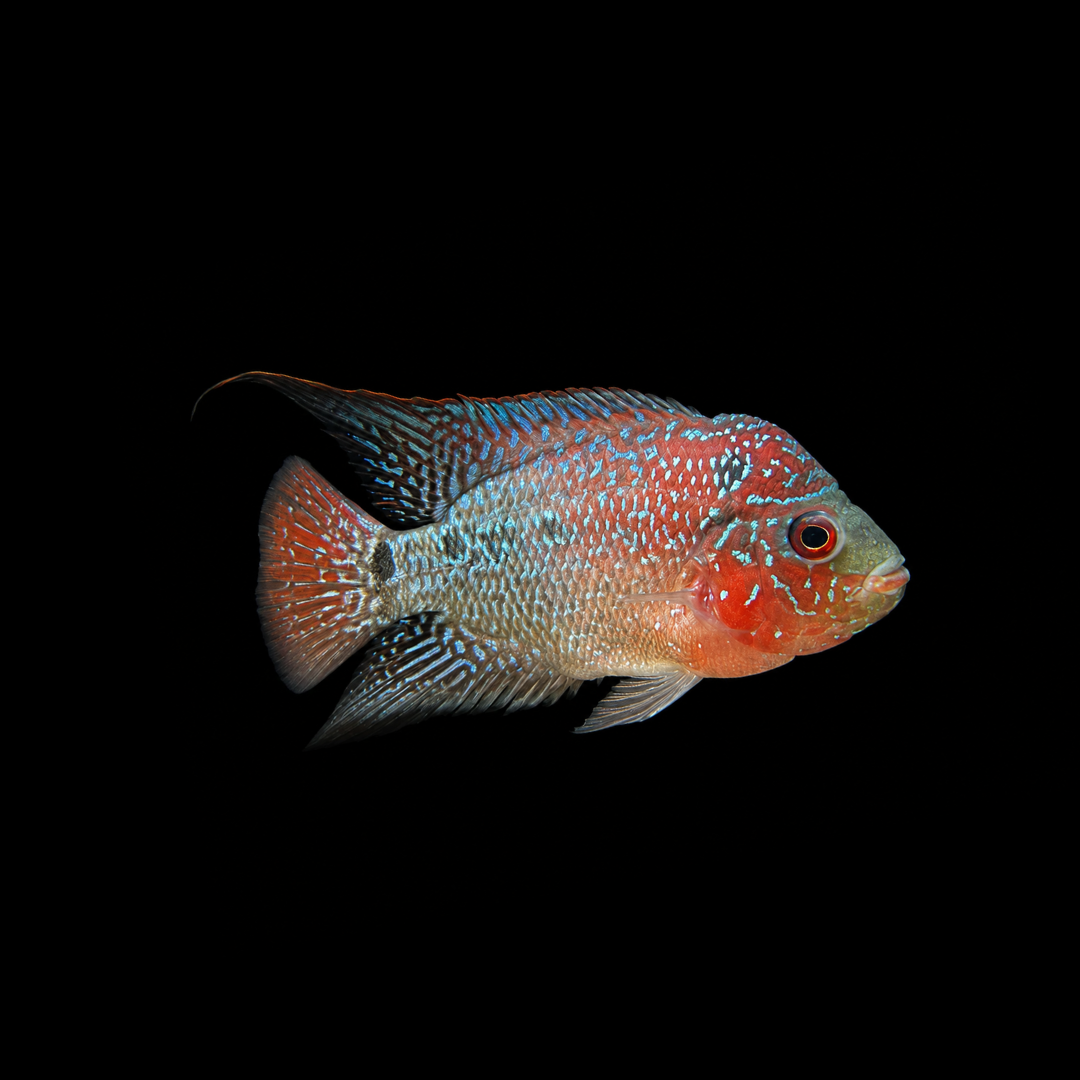
フラワーホーン紅麒麟(ベニキリン)は、東南アジアで発展したフラワーホーンの中でも、鮮烈な赤い体色と丸みのある力強い体型、発達した頭部隆起を大きな魅力とする観賞用の交雑系統です。自然界に存在する単一の魚種ではなく、中南米原産の複数の大型シクリッドを祖先に持つフラワーホーン系統と、赤色や短い体型の選抜に用いられてきたパロットシクリッド系統などを背景に成立したとされます。個体差が非常に大きく、赤の濃さ、頭部隆起の大きさ、体側に現れる黒斑や光沢模様の入り方によって一匹ごとに印象が異なります。飼育者をよく認識するような反応を見せる一方、魚同士では非常に強い縄張り性を示すため、基本は一匹でじっくり向き合う大型ペットフィッシュです。 The Red Kirin Flowerhorn, known in Japan as Benikirin, is an ornamental hybrid lineage of Flowerhorn prized for its intense red coloration, powerful rounded body, and prominent nuchal hump. It is not a naturally occurring species, but a selectively bred hybrid with ancestry involving several large Central American cichlids, together with Flowerhorn and parrot-cichlid lineages selected for red coloration and compact body shape. Individual variation is considerable, and each fish can differ in the depth of red color, hump development, dark lateral markings, and pearly iridescence. Although these fish often respond strongly to their keeper, they are highly territorial toward other fish and are best regarded as solitary large companion fish.
基本情報 / Basic Information
| 学名 / Scientific Name | 正式な学名なし(観賞用交雑系統) |
|---|---|
| 通称 / Common Name | フラワーホーン紅麒麟、ベニキリン、紅麒麟Red Kirin Flowerhorn, Qilin Flowerhorn |
| 分類 / Family | シクリッド科(Cichlidae)を基礎とする人為交雑系統An artificial hybrid lineage based on cichlids of the family Cichlidae |
| 英名 / English Name | Red Kirin Flowerhorn / Qilin Flowerhorn |
| 分布 / Distribution | 自然分布はありません。東南アジアを中心とするブリーダーによって作出・維持され、日本を含む各国へ観賞魚として流通しています。There is no natural distribution. The lineage is bred and maintained mainly by breeders in Southeast Asia and is distributed internationally as an ornamental fish, including in Japan. |
| 最大体長 / Max Size | 約30cm前後。個体や系統、飼育環境によっては30cmを超えることがあります。Around 30 cm, with some individuals exceeding 30 cm depending on lineage and husbandry conditions. |
| 寿命 / Lifespan | 飼育下で10年前後がひとつの目安です。水質、栄養、遺伝的背景などによって大きく左右されます。Around 10 years in captivity is a useful general guideline, although longevity varies with water quality, nutrition, genetics, and overall husbandry. |
飼育環境 / Aquarium Environment
| 水槽サイズ / Tank Size | 成魚は最低でも90cm規格水槽(約180L)を目安とし、体格のよい個体を余裕をもって飼うなら120cm規格水槽(約240L)以上が理想的です。幼魚は60cm規格水槽から始めることもできますが、成長が早いため早めのサイズアップを前提にします。For adults, a 90 cm standard aquarium of roughly 180 L should be considered a practical minimum. A 120 cm standard aquarium of roughly 240 L or larger is preferable for a large individual. Juveniles may begin in a 60 cm tank, but they grow quickly and should be moved to a larger aquarium before space becomes restrictive. |
|---|---|
| 水温 / Temperature | 25〜30℃の範囲で飼育でき、26〜28℃前後を安定して維持すると管理しやすくなります。急激な温度変化を避け、冬季は水量に合ったヒーターとサーモスタットを使用します。 They can be maintained at about 25–30°C, with a stable range around 26–28°C being practical for long-term care. Avoid sudden temperature changes and use a heater and thermostat appropriately sized for the aquarium during colder seasons. |
| 水質 / Water Quality | 中性から弱アルカリ性、目安としてpH7.0〜8.0程度を安定させます。アンモニアと亜硝酸は検出されない状態を維持し、硝酸塩は定期的な換水で低く保ちます。日本の水道水では地域差があるため、硬度の数値を無理に追うより、急変させないことを優先します。Stable neutral to slightly alkaline water, roughly pH 7.0–8.0, is suitable. Ammonia and nitrite should remain undetectable, while nitrate should be kept low through regular water changes. Because tap-water mineral content varies by region, stability is more important than aggressively chasing a specific hardness value. |
| レイアウト / Layout | 掃除しやすいベアタンクが扱いやすく、底面の反射が気になる場合は細かい砂を薄く敷く方法もあります。尖った石や複雑な流木は、突進時に体や頭部隆起を傷つけるおそれがあるため避けます。強力なろ過と十分な水面の撹拌を確保し、ヒーターには保護カバーを付けると安心です。A bare-bottom setup is easy to clean, while a very thin layer of fine sand can be used if reflections from the bottom appear to disturb the fish. Avoid sharp rocks and complicated driftwood that could injure the body or nuchal hump during sudden charges. Strong filtration, good surface agitation, and a protective heater guard are recommended. |
| 注意点 / Precautions | 非常に大食で排泄量も多いため、水質悪化が早い魚です。ろ過能力を十分に確保し、飼育密度や給餌量に応じて週1回を基本に30〜50%程度の換水を行います。縄張り性が極めて強いため原則は単独飼育とし、鏡を長時間見せ続けるなど過度に闘争行動を刺激する管理はストレスや衝突事故につながるため避けます。These fish eat heavily and produce a large amount of waste, so water quality can deteriorate quickly. Provide ample filtration and, as a general routine, replace about 30–50% of the water weekly according to feeding level and bioload. Because territorial aggression is extreme, solitary housing is the default. Avoid prolonged use of mirrors or other practices that continuously provoke fighting behavior, as they may increase stress and collision injuries. |
餌と給餌 / Feeding
| 餌の種類 / Diet | 主食はフラワーホーン用または大型シクリッド用の高品質な人工飼料が適します。副食として冷凍赤虫、ブラインシュリンプ、オキアミ、殻や鋭い部分を取り除いたエビなどを利用できます。赤色の維持にはアスタキサンチンやカロテノイドを含む飼料が役立ちますが、色揚げ成分だけに偏らず、タンパク質、脂質、ビタミン、植物性原料を含む総合的な栄養バランスを優先します。A high-quality formulated Flowerhorn or large-cichlid pellet should form the staple diet. Frozen bloodworms, brine shrimp, krill, and trimmed shrimp can be offered as supplements. Diets containing astaxanthin and other carotenoids can help maintain red coloration, but overall balance of protein, fat, vitamins, and plant-derived ingredients is more important than relying on color-enhancing ingredients alone. |
|---|---|
| 給餌のポイント / Feeding Tips | 幼魚は少量を1日2〜3回、成魚は体型と活動量を見ながら1日1〜2回を目安にし、短時間で食べ切れる量に抑えます。食欲が強くても与え過ぎないことが重要です。腹部の張り、便の状態、泳ぎ方を観察し、消化不良の兆候があれば給餌量を減らします。脂肪分の多い動物性餌を常用するより、人工飼料を軸に複数の餌を組み合わせるほうが長期管理に向きます。Feed juveniles small meals two to three times per day, while adults generally do well with one or two controlled meals depending on body condition and activity. Offer only what can be eaten quickly, even when the fish appears eager for more. Watch abdominal fullness, feces, and swimming posture, and reduce feeding if signs of digestive trouble appear. For long-term health, a balanced pellet-based diet with varied supplements is preferable to routinely feeding fatty animal foods. |
性格と混泳 / Temperament and Tank Mates
| 性格 / Temperament | 縄張り意識が非常に強く、同種にも他種にも激しく攻撃することがあります。その一方で、人の接近を素早く察知し、飼育者の動きに合わせて泳いだり、餌をねだったりするなど、人に対して強い関心を示す個体が多く見られます。気性の強さと人への反応性が同居していることが、ペットフィッシュとしての大きな個性です。Red Kirin Flowerhorns are intensely territorial and may attack both their own kind and other species. At the same time, many individuals show strong interest in people, quickly reacting to their keeper, following hand movements, and actively begging for food. This combination of fish-to-fish aggression and keeper-directed responsiveness gives them a distinctive companion-fish character. |
|---|---|
| 混泳の相性 / Compatibility | 基本的には単独飼育を推奨します。大型で丈夫な魚との混泳例はありますが、長期間うまくいっていても突然激しい争いに発展する可能性があります。繁殖目的で雌雄を合わせる場合も、最初から同じ空間に放すのではなく、頑丈な透明セパレーターで隔てて反応を観察し、危険があればすぐ分離できる状態を維持します。Solitary housing is strongly recommended. Although there are occasional reports of coexistence with other large, robust fish, severe aggression can begin suddenly even after a period of apparent tolerance. When introducing a potential breeding pair, begin with a strong transparent divider and maintain the ability to separate the fish immediately if aggression escalates. |
病気と対策 / Diseases and Prevention
| かかりやすい病気 / Common Diseases | 注意したいのは、過食や消化不良に伴う浮力異常、頭部や側線周辺が侵食される頭部穴あき病、白点病、外傷をきっかけとする細菌感染症などです。丸みの強い体型の個体では、消化器の不調が泳ぎ方に影響しやすいことがあります。頭部穴あき病は単一原因で説明できないことが多く、慢性的な水質悪化、栄養の偏り、消化管性の鞭毛虫など複数の要因が関与すると考えられています。Important problems include buoyancy disorders associated with overeating or digestive trouble, hole-in-the-head lesions around the head and lateral-line area, white spot disease, and bacterial infections following injury. Individuals with especially compact or rounded bodies may show swimming problems more readily when digestion is impaired. Hole-in-the-head disease is often multifactorial, with chronic poor water quality, nutritional imbalance, and intestinal flagellates among the factors considered to be involved. |
|---|---|
| 対策と予防 / Prevention | 最も重要なのは、過密にせず、安定した水温、十分なろ過、定期的な換水、適量給餌を守ることです。食欲低下、白い粘液便、体表の白点、眼の突出、鱗の逆立ち、頭部の陥没などが見られたら早めに原因を切り分けます。治療薬は症状だけで選ばず、水質検査と観察を行ったうえで対象疾患に合った観賞魚用薬を用い、用法・用量を厳守します。重症例や原因が判断できない場合は、魚類診療に対応できる獣医師への相談が安全です。Prevention centers on avoiding overcrowding, maintaining stable temperature and strong filtration, performing regular water changes, and controlling food intake. Loss of appetite, pale or stringy feces, white spots, protruding eyes, raised scales, or pitting around the head should be investigated early. Do not select medication from appearance alone; check water quality, observe the fish carefully, and use an aquarium medication appropriate to the suspected condition exactly as directed. Severe or unclear cases are best discussed with a veterinarian experienced in fish medicine. |
増やし方(繁殖) / Breeding
| 雌雄の判別 / Sexing | 成熟したオスは一般に大型化しやすく、頭部隆起が発達し、背鰭・尻鰭の先端が伸びる傾向があります。メスは比較的小柄で、産卵期には腹部がふっくらし、生殖突起の形状でも判断できます。ただし、紅麒麟は交雑系統で個体差が大きいため、外見だけでの判別は確実ではありません。Mature males are generally more likely to grow large, develop a prominent nuchal hump, and show more extended dorsal and anal fin tips. Females are often smaller and may become visibly fuller in the abdomen before spawning; the genital papilla can also help with identification. Because Red Kirin Flowerhorns are hybrid fish with substantial individual variation, appearance alone is not completely reliable. |
|---|---|
| 繁殖形態 / Reproduction | シクリッドらしい基質産卵型で、ペアが成立すると平らな石や水槽底などを掃除して卵を産み付けます。多くの卵を一度に産むことがありますが、交雑系統のため繁殖能力には個体差があり、特にオスで不妊が見られる場合があります。孵化後の稚魚は非常に小さいため、初期餌にはブラインシュリンプ幼生などが適します。They reproduce as substrate-spawning cichlids. A compatible pair may clean a flat stone or section of the tank bottom and deposit a large clutch of eggs. Fertility can vary considerably in hybrid lineages, and some males may be infertile. Newly free-swimming fry are very small and are commonly started on newly hatched brine shrimp nauplii. |
| 繁殖のポイント / Breeding Tips | 最大の難関は雌雄間の攻撃です。十分に広い水槽を用意し、透明セパレーター越しに長めのお見合い期間を設け、互いに過剰な攻撃を続けないことを確認してから慎重に同居させます。産卵後も親魚同士の争い、食卵、食仔が起こり得るため、いつでも分離できる準備が必要です。親の色や頭部隆起が優れていても、交雑系統では子に同じ特徴がそのまま再現されるとは限らず、選別育種には多数の個体と長期的な観察が必要になります。The greatest challenge is aggression between the pair. Use a sufficiently large aquarium and allow an extended introduction period through a transparent divider, only permitting direct contact after their reactions appear manageable. Even after spawning, aggression between the parents, egg eating, or fry predation can occur, so immediate separation must remain possible. Because this is a complex hybrid lineage, attractive parental traits such as deep red color or a large hump are not reproduced uniformly in the offspring, and selective breeding requires many juveniles and long-term evaluation. |
雑学と豆知識 / Trivia and Fun Facts
| 1. 「学名がない魚」という面白さ / 1. A Fish Without a Formal Scientific Name | 紅麒麟は自然界から記載された単一種ではなく、人の手で複数のシクリッド系統を交配し、さらに何世代にもわたって色や体型を選抜することで維持されてきた観賞魚です。そのため、一般的な図鑑魚のように「この学名が紅麒麟を指す」と一対一で対応させることはできません。祖先候補にはレッドデビル、ミダスシクリッド、トリマキュラータムなどが挙げられますが、現在流通する個体はブリーダーごとの血統や選抜過程が複雑に重なっています。紅麒麟を理解するうえでは、野生種の分類というより、家畜や園芸品種に近い「育種の歴史」を見る視点が重要です。Red Kirin is not a single naturally described species. It is an ornamental fish maintained through crosses among cichlid lineages followed by generations of selection for color and body shape. For that reason, there is no one-to-one scientific name that uniquely identifies every Red Kirin. Species such as the Red Devil, Midas cichlid, and Three Spot cichlid are often discussed among the ancestral contributors to Flowerhorn lineages, but modern stocks may combine complicated breeder-specific pedigrees. Understanding Red Kirin therefore requires looking at the history of selective breeding as much as conventional wild-species taxonomy. |
|---|---|
| 2. 「花羅漢」から広がったフラワーホーン文化 / 2. From Hua Luo Han to the Flowerhorn Craze | フラワーホーンの育種が大きく発展したのは1990年代後半から2000年代初頭の東南アジアです。中国語圏では「花羅漢」と呼ばれ、体側の黒い模様が文字を思わせることや、大きく盛り上がる頭部が縁起のよい姿として受け止められました。そこへ風水や幸運の象徴という文化的な意味が重なり、単に色鮮やかな大型魚という枠を超えて、個体ごとの模様や頭部隆起を鑑賞し、その価値を競う独特の愛好文化が形成されました。現在の紅麒麟も、その流れの中で「赤の強さ」と「迫力ある体型」をさらに磨き上げた系統のひとつとして見ることができます。Flowerhorn breeding expanded rapidly in Southeast Asia from the late 1990s into the early 2000s. In Chinese-speaking communities the fish became known as Hua Luo Han, with the dark markings along the flank sometimes interpreted as writing-like symbols and the enlarged forehead regarded as an auspicious feature. Combined with ideas of feng shui, prosperity, and good fortune, this created a culture in which individual markings and hump development were admired and compared almost as much as coloration itself. Red Kirin can be understood as one branch of that tradition, emphasizing intense red color and a powerful compact form. |
| 3. 「麒麟」という名が似合う理由 / 3. Why the Name “Qilin” Fits | 麒麟は中国神話に登場する瑞獣で、複数の動物を思わせる特徴を併せ持つ特別な存在として語られてきました。紅麒麟もまた、ひとつの野生種をそのまま改良した魚ではなく、異なるシクリッド系統の特徴を重ね合わせながら成立した観賞魚です。赤い体色、短く厚みのある体型、真珠を散らしたような光沢、頭部隆起といった複数の形質が一匹の中にまとまっている姿は、まさに複合的な美しさを持つ「麒麟」の名を連想させます。名称そのものが、紅麒麟の複雑な育種背景を象徴しているともいえるでしょう。The qilin is an auspicious creature in Chinese mythology, traditionally described as combining qualities reminiscent of several animals. Red Kirin likewise did not arise by simply improving one wild species, but through the combination and selection of traits from different cichlid lineages. Deep red coloration, a short heavy body, pearly iridescence, and an enlarged nuchal hump can all appear in the same fish. In that sense, the name “Qilin” is a fitting cultural metaphor for an ornamental lineage built from multiple inherited characteristics. |
| 4. 頭のコブは「骨の角」ではない / 4. The Hump Is Not a Bony Horn | フラワーホーン最大の象徴である頭部隆起は、英語圏の愛好家の間で「Kok」と呼ばれることがあります。見た目は硬い角のようですが、単純に頭蓋骨が飛び出した構造ではなく、軟組織や脂質を多く含む組織が関与する隆起です。野生の大型シクリッドにも繁殖状態や成熟に伴って頭部が盛り上がる種類がいますが、フラワーホーンでは人為選抜によってその特徴が非常に強く表現されるようになりました。大きさには遺伝の影響が強く、餌を増やしたり鏡で闘争心を刺激したりすれば必ず巨大化するわけではありません。無理に成長を促すより、健康な体格と安定した飼育を優先するほうが長く楽しめます。The enlarged forehead that defines the Flowerhorn is often called a “kok” among hobbyists. Despite its horn-like appearance, it is not simply a bony projection of the skull; soft tissues, including lipid-rich tissue, contribute to the swelling. Some wild large cichlids also develop enlarged foreheads with maturity or reproductive condition, but selective breeding has exaggerated this feature dramatically in Flowerhorns. Genetics strongly influence hump size, and neither heavy feeding nor mirror-based aggression stimulation guarantees extreme growth. Prioritizing healthy body condition and stable husbandry is more sustainable than forcing development. |
| 5. 赤色は「餌だけ」で作られるわけではない / 5. Red Color Is Not Created by Food Alone | 紅麒麟の赤色には遺伝的な素質がまずあり、その上で餌、体調、照明、背景色、ストレスなどが見え方を左右します。魚はカロテノイドを完全にゼロから作り出すことができないため、アスタキサンチンなどを含む餌は赤い発色を支える材料になります。しかし、色揚げ飼料を大量に与えれば遺伝的な限界を超えて赤くなるというものではありません。むしろ、水質が悪化したり消化器に負担がかかったりすれば、発色以前に健康を損ねます。よい発色は、色素成分だけでなく、安定した水と適正な栄養状態がそろって初めて引き出されるものです。Red coloration begins with genetic potential, while diet, health, lighting, background, and stress all influence how strongly that color is expressed. Fish cannot synthesize carotenoids entirely from basic metabolic building blocks, so foods containing pigments such as astaxanthin provide raw material that supports red coloration. However, heavy use of color-enhancing food cannot push every fish beyond its genetic limits. If excess feeding damages water quality or digestion, health declines before color can improve. The best coloration appears when pigment-rich nutrition is combined with stable water and good overall condition. |
| 6. 魚には厳しく、人にはよく反応する / 6. Aggressive to Fish, Responsive to People | 紅麒麟の魅力を語るとき、単独飼育という制約は弱点であると同時に、この魚ならではの関係性を生み出す要素でもあります。ほかの魚には激しく縄張りを主張する一方、水槽の外にいる人の動きには敏感で、飼育者が近づくと前面へ寄ってきたり、視線や指の動きに合わせて泳いだりする個体が少なくありません。毎日の給餌や換水を通して行動の変化が分かりやすいため、一匹を長く観察するほど性格の違いが見えてきます。群泳の美しさとは正反対の、ひとつの生命と向き合う楽しさを強く感じさせる魚です。The need for solitary housing may seem like a limitation, yet it also shapes the distinctive relationship keepers often develop with this fish. While intensely territorial toward other fish, many Red Kirin Flowerhorns are highly attentive to movement outside the aquarium, approaching the front when their keeper arrives and tracking hands or faces. Because behavioral changes are easy to notice during feeding and maintenance, individual personality becomes more apparent over years of observation. Their appeal is almost the opposite of a schooling display: the experience centers on living closely with one highly interactive fish. |
まとめ / Conclusion
フラワーホーン紅麒麟は、真紅の発色、堂々とした頭部隆起、そして一匹ごとに異なる模様を楽しめる、存在感の非常に強い大型シクリッドです。丈夫な面を持つ一方、大食による水質悪化と強烈な縄張り性を軽視すると飼育は安定しません。90cm規格以上の水槽、余裕あるろ過、安定した26〜28℃前後の水温、定期的な換水、適量の給餌、そして単独飼育を基本にすることが、健康と美しさを長く保つための土台になります。 The Red Kirin Flowerhorn is a commanding large cichlid, combining deep red coloration, a prominent nuchal hump, and markings that make every individual look different. Although generally robust, its heavy feeding and intense territoriality cannot be ignored. A tank of at least 90 cm, generous filtration, stable temperatures around 26–28°C, regular water changes, controlled feeding, and solitary housing form the foundation for maintaining both health and appearance over the long term.
十分な設備を整えて一匹と向き合えば、紅麒麟は単なる鑑賞対象にとどまらず、飼育者の存在に反応しながら年月とともに個性を深めていきます。赤色の変化や頭部の成長、日々の仕草までじっくり観察できるため、大型魚を長期飼育する喜びを濃密に感じさせてくれる魚です。 With adequate equipment and attentive solitary care, a Red Kirin becomes more than a colorful display fish. Its responses to the keeper, changing coloration, developing hump, and daily behavior reveal more personality with time. For aquarists prepared for a long-term commitment to a large cichlid, it can become a remarkably engaging companion.

気になる道具や飼い方を見つけてみませんか?
 アイのアクアグッズ案内水合わせの道具とやり方|魚を迎える前にそろえたい容器・点滴キット・ネット買ってきた魚はすぐ水槽に入れていい? 水温合わせと水合わせの違いから、透明ケース・点滴キット・ネットの選び方、時間をかけすぎない注意点まで、アイとコタロウが紹介します。記事はコチラ →
 アイのアクアグッズ案内おとひめ物語|養殖生まれの餌を、わが家の魚に合う一粒へ道具の特徴や使い方、選ぶときのポイントをアイが紹介します。記事はコチラ →
 アイのアクアグッズ案内エーハイム、安いのと高いのは何が違う? コタロウと見比べる外部フィルター道具の特徴や使い方、選ぶときのポイントをアイが紹介します。記事はコチラ →
 アイのアクアグッズ案内水草用ソイルの選び方|土・砂の違いとおすすめ商品道具の特徴や使い方、選ぶときのポイントをアイが紹介します。記事はコチラ →
さまざまな飼育テーマをご紹介。リンク先の記事には広告・商品紹介が含まれます。
案内・紹介記事一覧へ →分布マップ
フラワーホーン紅麒麟(ベニキリン)は自然分布を持たない観賞用の交雑系統です。東南アジアを中心とするブリーダーによって作出・維持され、日本を含む世界各地へ観賞魚として流通しています。
※この地図は、記事の分布欄に基づき東南アジアを中心とする作出・流通地域を概略的に示したものです。マーカーは地域を把握しやすくするための代表地点であり、実際の採集地点・原産地点を示すものではありません。
参考文献
分類・起源・分布・生息環境
- Sari, D. W. K., Achmad, H., Rahman, H., & Bimasuci, H. (2023). Molecular Identification of Several Morphologically Distinct Flowerhorn Fish (Family) Using Mitochondrial COI Gene Marker. Journal of Tropical Biodiversity and Biotechnology, 8(2), 78459. https://doi.org/10.22146/jtbb.78459
- Herder, F., Schliewen, U. K., Geiger, M. F., Hadiaty, R. K., Gray, S. M., McKinnon, J. S., Walter, R. P., & Pfaender, J. (2012). Alien invasion in Wallace’s Dreamponds: records of the hybridogenic “flowerhorn” cichlid in Lake Matano, with an annotated checklist of fish species introduced to the Malili Lakes system in Sulawesi. Aquatic Invasions, 7(4), 521–535. https://doi.org/10.3391/ai.2012.7.4.009
飼育条件・給餌・繁殖
- Weber, P., Wigraiboon, S., Sutthi, N., Kasamesiri, P., & Thaimuangphol, W. (2025). The Physiological Benefits and Economic Value of Using Fairy Shrimp as Fish Meal for Flowerhorn Cichlids; Amphilophus citrinellus (Günther, 1864) × Cichlasoma trimaculatum (Günther, 1867). Fishes, 10(3), 132. https://doi.org/10.3390/fishes10030132
- Hedianto, D. A., Sentosa, A. A., & Satria, H. (2018). Aspek reproduksi ikan louhan hibrid sebagai ikan asing invasif di Danau Matano, Sulawesi Selatan. BAWAL Widya Riset Perikanan Tangkap, 10(2), 69–82. https://doi.org/10.15578/bawal.10.2.2018.69-82
- Sri Lanka Export Development Board. (2017). Spawning Methods and Technology for Spawning. https://www.srilankabusiness.com/pdf/2-spawning-methods.pdf
病気・健康管理・注意点
- Paull, G. C., & Matthews, R. A. (2001). Spironucleus vortens, a possible cause of hole-in-the-head disease in cichlids. Diseases of Aquatic Organisms, 45(3), 197–202. https://doi.org/10.3354/dao045197
- Amesberger-Freitag, A., Tichy, A., El-Matbouli, M., & Lewisch, E. (2019). Hole-in-the-head disease in discus fish, Symphysodon (Heckel, 1840): Is it a consequence of a dietary Ca/P imbalance? Journal of Fish Diseases, 42(8), 1133–1142. https://doi.org/10.1111/jfd.13023
- MSD Veterinary Manual. Disorders and Diseases of Fish. https://www.msdvetmanual.com/all-other-pets/fish/disorders-and-diseases-of-fish





コメント