

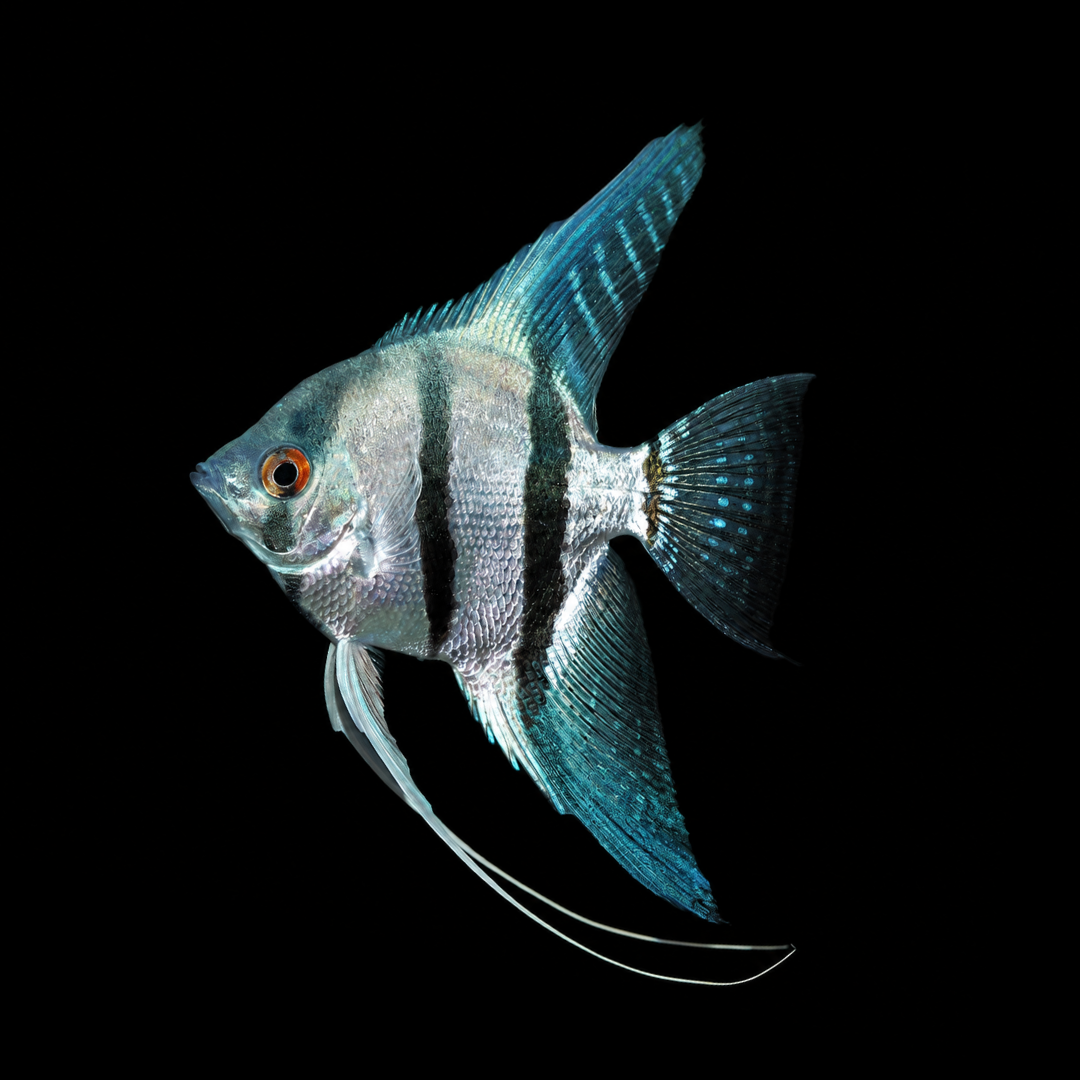
解説 / Description
スカラレエンゼルは、南米のアマゾン川水系を中心に分布するシクリッド科の淡水魚です。現在流通するエンゼルフィッシュの多くの改良品種は、本種を中心に作出されてきたとされています。左右に薄く、上下に高い体と、帆のように伸びる背ビレ・尻ビレ、糸状の腹ビレがつくる輪郭は独特で、水草や水没した枝が入り組む比較的流れの穏やかな環境に適した体型と考えられています。野生型は銀白色の体に太い暗色の縦帯を持ち、その濃さは状態や環境によって変化します。長年の選択交配によってブラック、マーブル、ゴールデン、コイ、プラチナ、パールスケール、ベールテールなど多彩な品種が作られており、飼育魚としての親しみやすさと繁殖・品種改良の奥深さをあわせ持つ、淡水アクアリウムを代表する魚の一つです。 Pterophyllum scalare is a South American cichlid distributed mainly through the Amazon basin. Many of the domestic freshwater angelfish strains in the aquarium trade are regarded as having been developed primarily from this species. Its laterally compressed, deep-bodied shape, tall dorsal and anal fins, and threadlike pelvic fins create a distinctive silhouette suited to relatively calm, structured habitats with aquatic vegetation and submerged branches. Wild-type fish are silvery with dark vertical bars whose intensity can change with condition and surroundings. Selective breeding has produced black, marble, gold, koi, platinum, pearlscale, veiltail, and many other forms, giving the species broad appeal as both an aquarium fish and a subject for breeding.
基本情報 / Basic Information
| 学名 / Scientific Name | Pterophyllum scalare (Schultze, 1823) |
|---|---|
| 通称 / Common Name | スカラレエンゼル、エンゼルフィッシュ、並エンゼル、テンニンイシダイ(天人石鯛)Freshwater angelfish, common angelfish, scalare angelfish |
| 分類 / Family | シクリッド科(Cichlidae)エンゼルフィッシュ属(Pterophyllum)Family Cichlidae, genus Pterophyllum |
| 英名 / English Name | Freshwater Angelfish |
| 分布 / Distribution | 南米。ペルー、コロンビア、ブラジルのアマゾン川水系を中心に、ウカヤリ川、ソリモインス川、アマゾン本流、ブラジル・アマパ州の河川、フランス領ギアナのオヤポク川、ガイアナのエセキボ川などに分布します。South America, mainly in the Amazon basin of Peru, Colombia, and Brazil, including the Ucayali, Solimões, and Amazon rivers, as well as rivers in Amapá, the Oyapock River in French Guiana, and the Essequibo River in Guyana. |
| 最大体長 / Max Size | 全長はおおむね10〜15cm程度。成熟した個体は背ビレ・尻ビレを含む体高が20cm前後に達することがあります。ベールテール系などヒレの長い品種では、見かけの体高がさらに大きくなります。Usually about 10–15 cm in total length. Mature fish can reach roughly 20 cm in overall height including the dorsal and anal fins, while long-finned strains such as veiltails may appear taller still. |
| 寿命 / Lifespan | 飼育下でおおむね8〜10年程度。安定した水質、適切な給餌、十分な水槽空間を維持できれば10年前後生きる個体も珍しくありません。Commonly around 8–10 years in captivity. With stable water quality, appropriate feeding, and adequate space, many individuals can live for roughly a decade. |
飼育環境 / Aquarium Environment
| 水槽サイズ / Tank Size | 成魚は体高があり、成熟すると縄張りも持つため、長期飼育では高さ45cm以上を確保できる90cm規格水槽(幅90×奥行45×高さ45cm)以上を基本の目安とすると安心です。繁殖用にペアだけを管理する場合は60cmハイタイプ水槽(例:幅60×奥行30×高さ45cm)が使われることもありますが、長期飼育としては余裕が大きくありません。複数飼育では個体同士が距離を取れる、さらに広い水槽が適します。Because adults are deep-bodied and become territorial, a standard 90 cm aquarium of about 90 × 45 × 45 cm or larger is a safer baseline for long-term care. A 60 cm high-type tank of roughly 60 × 30 × 45 cm is sometimes used to manage a breeding pair, but it offers limited room for permanent housing. Groups benefit from still larger aquariums that allow individuals to keep distance from one another. |
|---|---|
| 水温 / Temperature | 25〜28℃を基本とします。野生域では24〜30℃程度の環境にも見られますが、飼育では急変を避け、年間を通して安定させる方が安全です。 Maintain 25–28°C for routine aquarium care. Wild populations occur across roughly 24–30°C, but in captivity stable temperatures are more important than using the full natural range. |
| 水質 / Water Quality | 弱酸性〜中性寄りの水を基本とし、pH6.0〜7.5程度、軟水〜中程度の硬度を目安にすると管理しやすい魚です。国内・東南アジアで累代された改良品種は幅広い水質に適応しますが、ワイルド個体や繁殖狙いでは急激なpH・硬度変化を避け、比較的軟らかい水を安定させる方が適しています。アンモニアと亜硝酸は検出されない状態を維持します。Slightly acidic to near-neutral water is ideal, with approximately pH 6.0–7.5 and soft to moderately hard conditions. Long-established domestic strains tolerate a broad range, but wild fish and breeding pairs benefit from softer, more stable water. Ammonia and nitrite should remain undetectable. |
| レイアウト / Layout | 強い水流よりも穏やかな流れを好みます。アマゾンソードなどの背丈のある広葉水草、流木、垂直に立つ枝状の素材を組み合わせ、視線を遮る場所と開けた遊泳空間の両方を作ると落ち着きます。産卵を狙う場合は、広い葉、産卵筒、スレート板など平滑でやや垂直な面を用意すると利用されやすくなります。Gentle flow is preferable to strong current. Combine tall broad-leaved plants such as Amazon swords with driftwood or vertical branches, while keeping open swimming space. For breeding, provide smooth, slightly vertical surfaces such as broad leaves, spawning cones, or slate. |
| 注意点 / Precautions | 幼魚時はおとなしく見えても、成長するとシクリッドらしい縄張り行動が強くなります。特にペア形成後や産卵期は他魚を追い払うため、逃げ場を確保し、必要なら隔離できるようにします。体高が高いので浅い水槽は不向きです。また、輸入直後のワイルド個体は水質差と輸送ストレスの影響を受けやすいため、急な水合わせや過度な給餌を避けて慎重に立ち上げます。Juveniles may appear peaceful, but adults can become strongly territorial, especially after pair formation or during spawning. Provide visual barriers and be prepared to separate fish when necessary. Shallow tanks are unsuitable because of the species’ body depth. Newly imported wild fish are particularly sensitive to transport stress and sudden changes in water chemistry. |
餌と給餌 / Feeding
| 餌の種類 / Diet | 肉食傾向の強い雑食性です。主食にはシクリッド用または熱帯魚用の高品質な顆粒・フレークフードを用い、冷凍アカムシ、冷凍ブラインシュリンプ、イトミミズ類、ミジンコ類などを補助的に組み合わせると栄養バランスを取りやすくなります。ワイルド個体の導入初期は冷凍・生餌の方が反応しやすい場合があります。They are omnivores with a strong carnivorous tendency. Use high-quality cichlid or tropical-fish pellets and flakes as staples, supplemented with foods such as frozen bloodworms, brine shrimp, tubificid worms, or small cladocerans. Newly imported wild fish may initially respond better to frozen or live foods. |
|---|---|
| 給餌のポイント / Feeding Tips | 成魚は1日1〜2回、数分で食べ切れる量を基本にし、肥満や水質悪化につながる過剰給餌を避けます。幼魚は成長が速いため少量を1日2〜4回に分けると育てやすくなります。繁殖前の親魚には良質な動物性タンパク質を含む餌を複数種類与えます。孵化仔魚は卵黄吸収後に初めて摂餌を始めるため、口径に合う微小な生餌から開始し、成長に応じてブラインシュリンプ幼生などへ切り替えます。Feed adults once or twice daily in portions they can finish within a few minutes, avoiding excess food that promotes obesity and poor water quality. Fast-growing juveniles do well with smaller meals two to four times daily. Condition breeding adults with a varied, protein-rich diet. Fry should receive very small live foods after yolk absorption, followed by larger prey such as Artemia nauplii as mouth size increases. |
性格と混泳 / Temperament and Tank Mates
| 性格 / Temperament | 普段はゆったり泳ぎますが、性質は完全な温和魚ではありません。順位関係を作り、同種間で小競り合いをするほか、成熟個体はペア形成後に明確な縄張りを持ちます。小さく細身の魚や小型のエビは捕食対象になることがあります。個体差も大きく、同じ組み合わせでも相性が変わる点に注意が必要です。Although they usually swim calmly, angelfish are not completely peaceful community fish. They establish social ranks, may spar with one another, and breeding pairs defend territories aggressively. Very small fish and small shrimp can be treated as prey. Individual temperament varies considerably. |
|---|---|
| 混泳の相性 / Compatibility | 口に入りにくいサイズで、極端に攻撃的ではなく、ヒレをかじる習性のない中型魚との混泳が比較的安定します。体格のあるテトラ類、穏やかなコリドラス類などが候補になりますが、繁殖期は底層魚にも攻撃することがあります。ネオンテトラなど小型カラシンは、幼魚期から同居していても成長後に捕食される可能性があります。スマトラなどヒレをつつきやすい魚、非常に活発な魚、大型で攻撃的なシクリッドとの混泳は避けた方が安全です。Tank mates should be too large to swallow, not excessively aggressive, and not prone to fin-nipping. Robust medium-sized tetras and peaceful Corydoras can work, although breeding pairs may still attack bottom dwellers. Small characins such as neon tetras can eventually become prey even when raised alongside juvenile angelfish. Avoid fin-nippers such as tiger barbs, hyperactive species, and large aggressive cichlids. |
病気と対策 / Diseases and Prevention
| かかりやすい病気 / Common Diseases | 特定の病気にだけ特別かかりやすいというより、水質悪化や輸送ストレスをきっかけに、白点病、ヒレの細菌性感染、外部寄生虫など一般的な熱帯魚のトラブルが見られます。長いヒレは他魚につつかれたり傷んだりしやすく、そこから二次感染につながることがあります。食欲低下や白っぽい糞は消化器の不調を示すことがありますが、その症状だけで寄生性原虫と断定することはできません。Rather than being uniquely prone to one particular disease, angelfish can develop common tropical-fish problems such as ich, bacterial fin infections, and external parasites when water quality declines or transport stress is severe. Their long fins are vulnerable to damage and secondary infection. Loss of appetite or pale, stringy feces can indicate digestive trouble, but these signs alone do not prove an intestinal protozoan infection. |
|---|---|
| 対策と予防 / Prevention | 最も重要なのは、水温と水質を安定させ、過密と過剰給餌を避けることです。定期的な換水、十分に成熟したろ過、傷を作りにくい混泳相手の選択を基本とします。新しい魚は可能なら別水槽で一定期間観察し、食欲、呼吸、糞、体表、ヒレの状態を確認してから合流させます。治療時は症状から原因を絞り、対象魚と薬剤の適合性を確認したうえで用法・用量を守ります。Prevention depends primarily on stable temperature and water quality, moderate stocking density, and controlled feeding. Use regular water changes, mature filtration, and compatible tank mates that will not damage fins. Whenever possible, quarantine new fish and observe appetite, respiration, feces, skin, and fins before introduction. When treatment is required, identify the likely cause and use an appropriate medication according to its directions. |
増やし方(繁殖) / Breeding
| 雌雄の判別 / Sexing | 外見だけでの判別は難しく、若魚では特に確実な方法がありません。成熟するとオスは頭部がやや張り出す傾向、メスは腹部が丸みを帯びる傾向が見られますが個体差があります。最も確実なのは産卵期の生殖突起で、メスの産卵管は比較的太く丸みがあり、オスの生殖突起は細く尖り気味に見えます。複数の若魚を育て、自然に形成されたペアを繁殖に用いる方法が一般的です。Sexing by appearance alone is difficult, especially in juveniles. Mature males may develop a somewhat fuller forehead and females may appear rounder in the abdomen, but these are unreliable tendencies. The most dependable clue is the breeding tube: the female ovipositor is broader and more blunt, while the male papilla is generally narrower and more pointed. Breeders often raise a group of juveniles and allow pairs to form naturally. |
|---|---|
| 繁殖形態 / Reproduction | 基質産卵型で、ペアが広い葉、流木、産卵筒、ガラス面などを掃除した後、メスが列状に粘着卵を産み、オスが続いて受精させます。1回に数百個を産むことが多く、良好な大型ペアではさらに多くなる場合があります。シクリッドらしく両親が卵へ送水し、未受精卵を取り除き、孵化後の仔魚を保護する行動を示します。Angelfish are substrate spawners. A pair cleans a broad leaf, driftwood surface, spawning cone, or even aquarium glass; the female lays adhesive eggs in rows and the male follows to fertilize them. Spawns commonly contain several hundred eggs and can be larger in well-conditioned adults. Both parents fan the eggs, remove nonviable eggs, and normally guard the larvae after hatching. |
| 繁殖のポイント / Breeding Tips | 繁殖には落ち着いた専用水槽を用意し、水温26〜28℃前後、弱酸性〜中性寄りで急変のない水質を維持すると管理しやすくなります。初期発生を調べた研究では、28℃・pH6.8の条件で良好な発生が見られた一方、水をややアルカリ側へ高めた実験条件では胚や仔魚の生残率が大きく低下しました。これは「必ずpH6.8にすればよい」という意味ではなく、繁殖時に親魚が慣れた水質から急に条件を変えないことの重要性を示す結果として捉えるのが適切です。親が繰り返し食卵する場合は、産卵床ごと別容器へ移し、弱いエアレーションで卵に水流を当てる人工孵化も行われます。仔魚は卵黄を吸収した後に摂餌を始めるため、まず口に入る大きさの餌を選び、成長に合わせてワムシ類などの微小な生餌からブラインシュリンプ幼生へ移行します。Use a quiet breeding tank and keep the water stable at about 26–28°C, generally on the slightly acidic to near-neutral side. In a study of early development, embryos developed well at 28°C and pH 6.8, whereas survival of embryos and larvae fell sharply in an experimentally elevated, mildly alkaline condition. This does not mean that every spawn must be kept at exactly pH 6.8; the more practical lesson is to avoid abrupt changes away from the water conditions to which the breeders are accustomed. If parents repeatedly eat the eggs, the spawning surface can be moved to a separate container and supplied with gentle aeration. Fry begin feeding after yolk absorption, so food should first be matched to mouth size and then increased gradually from very small live prey such as rotifers to Artemia nauplii. |
雑学と豆知識 / Trivia and Fun Facts
| 1. 1823年に別の属名で記載された魚 / 1. A species first described under another genus | スカラレエンゼルは1823年にZeus scalarisとして記載され、その後の分類整理を経て現在のPterophyllum scalareとなりました。Platax scalarisやPlataxoides dumeriliiなどは、現在では本種のシノニムとして扱われています。属名Pterophyllumは、ギリシャ語のpteron(ヒレ・帆)とphyllon(葉)に由来します。現在の種小名scalareは、原記載名scalarisと同じく「はしご状の、階段状の」という意味につながる語で、背ビレの棘条が後方へ向かって段階的に高くなる形に由来すると説明されています。The freshwater angelfish was described in 1823 as Zeus scalaris and later transferred through taxonomic revision to its current name, Pterophyllum scalare. Names such as Platax scalaris and Plataxoides dumerilii are now treated as synonyms of this species. Pterophyllum combines the Greek pteron, meaning fin or sail, with phyllon, meaning leaf. The specific epithet scalare, corresponding to scalaris in the original combination, is associated with a ladder- or stair-like form and has been explained as referring to the progressively increasing height of the dorsal-fin spines. |
|---|---|
| 2. 縦縞は単なる模様ではない / 2. The vertical bars are more than decoration | 野生型の成魚では、銀色の体を横切る太い暗色帯が大きな特徴です。水草の茎や沈木の影が縦に並ぶ環境では、こうした帯が体の輪郭を分断し、背景へ溶け込みやすくする働きを持つと考えられています。さらにエンゼルフィッシュの帯は固定された「塗装」のようなものではなく、ストレス、社会的な緊張、環境光などに応じて濃淡が変わります。同じ個体でも、落ち着いている時と警戒している時とで印象が大きく変わるのは、この色素調節のためです。Wild-type adults are characterized by strong dark vertical bars across a silver body. In habitats filled with vertical plant stems and submerged branches, these bars are thought to break up the body outline and improve camouflage. The markings are also dynamic rather than fixed: stress, social interactions, and lighting can change their intensity, so the same fish may look dramatically different from one moment to the next. |
| 3. 「天人石鯛」と呼ばれた日本の古典的熱帯魚 / 3. The classic Japanese name “Tennin-ishidai” | 日本ではエンゼルフィッシュに「テンニンイシダイ(天人石鯛)」という和名があり、国語辞典にもエンゼルフィッシュの名称として収録されています。日本への導入は1930年頃とされ、その後、繁殖技術や飼育設備の普及とともに家庭でも広く親しまれる古典的な熱帯魚となりました。現在は「エンゼルフィッシュ」の呼称が一般的ですが、天人石鯛という名前には、長く伸びるヒレと縞模様を日本語で表そうとした時代の名残が感じられます。In Japan, angelfish also have the traditional name “Tennin-ishidai,” a term recorded in Japanese dictionaries as a name for the fish. Their introduction to Japan is generally placed around 1930, after which advances in breeding and aquarium equipment helped establish them as a classic household tropical fish. “Angelfish” is now the usual name, while the older Japanese term preserves an early attempt to describe the fish’s long fins and barred appearance in Japanese. |
| 4. 改良品種は「遺伝子の足し算」だけではない / 4. Domestic strains are not created by simple genetic addition | エンゼルフィッシュの品種改良では、長年の交配記録から整理されたブリーダー用の遺伝表記が広く使われています。古典的な表記では、色の基本に関わる同一の座に野生型の+、DarkのD、MarbleのM、Gold MarbleのGm、Goldのgなどを置き、別の座にStripelessのS、Pearlscaleのp、Philippine Blueのpbなどを置いて交配結果を予測します。Stripelessは不完全優性として扱われ、1コピーのS/+でゴースト、2コピーのS/Sでブラッシングとなり、pやpbは劣性として扱われます。ここで使うD、M、Gm、S、pbなどは交配上の形質を整理する記号であり、すべての形質について原因となる分子遺伝子が同定済みという意味ではありません。この区別を押さえると、品種名と遺伝子型の関係を誤解しにくくなります。Angelfish breeders commonly use a genetic notation developed from many generations of breeding records. In traditional breeder notation, wild type (+), Dark (D), Marble (M), Gold Marble (Gm), and Gold (g) are treated as alternatives at a major color locus, while traits such as Stripeless (S), Pearlscale (p), and Philippine Blue (pb) are tracked at other loci. Stripeless is treated as incompletely dominant: one copy, S/+, produces the Ghost phenotype, while S/S produces Blushing; p and pb are treated as recessive. Importantly, symbols such as D, M, Gm, S, and pb are breeding notation for inherited traits and do not mean that the molecular gene responsible for every phenotype has already been identified. |
| 5. プラチナ、コイ、パライバの遺伝的な違い / 5. Why Platinum, Koi, and Paraiba are genetically different | 明るい体色の品種同士でも、ブリーダー表記上の組み合わせは異なります。一般的な表記では、プラチナはGoldのg/gとPhilippine Blueのpb/pb、パライバはStripelessのS/Sとpb/pbの組み合わせです。コイはGold MarbleのGm/GmまたはGm/gにS/Sを組み合わせた「Gold Marble Blushing」として整理されます。つまり、外見が似ていても同じ遺伝的背景とは限りません。また、親魚が外見だけでは分からない劣性形質を保有している場合、表現型だけから次世代の出現率を完全に予測することはできません。Even bright-colored strains that look similar can have different combinations in breeder notation. Platinum is generally written as Gold g/g with Philippine Blue pb/pb, while Paraiba combines Stripeless S/S with pb/pb. Koi is classified as Gold Marble Blushing, usually Gm/Gm or Gm/g together with S/S. Similar appearance therefore does not guarantee the same genetic background, and hidden recessive traits in the parents can make offspring ratios impossible to predict from phenotype alone. |
| 6. 卵から「エンゼルの形」になるまでを追った研究 / 6. Research following the transformation from egg to angelfish | 初期発生を詳しく観察した研究では、卵は琥珀色の楕円形で、長径約1.436mm、短径約1.171mmと測定されています。28℃・pH6.8の条件で孵化した仔魚は平均約2.60mmで、大きな卵黄嚢を抱え、頭部の腺から出る粘着性の分泌物で基質へ付着します。この腺は5日目頃には消失し、4〜5日齢頃から生き餌を取り始めます。23日齢では鰓蓋や顎、脊椎などがよく発達し、25日齢には成魚を小さくしたような体型になります。長いヒレを持って泳ぐ成魚からは想像しにくいものの、発生の最初期には基質へ付着して過ごす時期があるのです。A detailed study of early development measured the amber, oval eggs at about 1.436 mm by 1.171 mm. Under conditions of 28°C and pH 6.8, newly hatched larvae averaged about 2.60 mm and carried a large yolk sac. They temporarily attach to the substrate using sticky secretions from glands on the head; these glands disappear around day five, and feeding begins around days four to five. By day 23 the opercula, jaws, vertebral column, and other structures are well developed, and by about day 25 the fry resemble miniature adults. The elegant free-swimming adult therefore begins life in a surprisingly stationary, substrate-attached phase. |
| 7. 「最初からブラインシュリンプ」が常に最良とは限らない / 7. Artemia is not always the best very first food | エンゼルフィッシュの稚魚育成ではブラインシュリンプ幼生が定番ですが、初期発生を扱った研究では、ごく初期の仔魚にブラインシュリンプ幼生を与えた群で、原生生物やワムシ類を与えた群より死亡率が高かったと報告されています。一方、別の飼育試験では生後数日の仔魚にArtemiaを利用し、人工飼料より高い成長を示した例もあります。これらは矛盾というより、仔魚の大きさ、給餌開始日、餌生物のサイズや系統によって最適条件が変わることを示しています。繁殖では「有名な餌を与える」より、「その日の仔魚が実際に飲み込める大きさか」を観察することが重要です。Artemia nauplii are a standard food for angelfish fry, but a study of the earliest larval stages reported higher mortality in very young larvae fed brine shrimp than in groups offered protozoans or rotifers. Other rearing trials have successfully used Artemia from only a few days after hatching and found better growth than with dry diets. Rather than being contradictory, these results show that the best food depends on larval size, first-feeding age, and prey size. The key is not simply choosing a famous live food, but matching prey size to what the fry can actually capture and swallow. |
| 8. 2022年に公開された初の全ゲノム・アセンブリ / 8. The first whole-genome assembly published in 2022 | 2022年には、スカラレエンゼルで初めて全ゲノムのシーケンスとde novoアセンブリを行った研究が公開されました。報告された核ゲノムのアセンブリは約734.79Mbで、24,247のタンパク質コード配列が注釈されています。ただし、ゲノム配列が得られたことと、ブラックやマーブル、Stripelessなど観賞魚で使われる各形質の原因遺伝子がすべて分子レベルで特定されたことは別です。従来のブリーダー表記とゲノム研究は、現時点では区別して理解する必要があります。In 2022, the first whole-genome sequencing and de novo assembly of Pterophyllum scalare was published. The reported nuclear assembly was approximately 734.79 Mb and included 24,247 annotated protein-coding sequences. However, having a genome assembly is not the same as having identified the molecular gene responsible for every aquarium trait such as Black, Marble, or Stripeless. Traditional breeder notation and molecular genomic findings therefore need to be understood as distinct levels of information. |
| 9. ワイルド個体は「別種」ではなく産地情報が価値になる / 9. Locality data adds value to wild fish without making them separate species | ワイルド系のエンゼルフィッシュでは、採集地や地域名を冠した流通名が使われます。代表例の「ペルーアルタム」は、ペルー由来の体高のあるスカラレ系個体に用いられる流通名で、分類学上の別種Pterophyllum altumそのものを指す名称ではありません。こうした流通名は、必ずしも学術的な種名や亜種名と一致するわけではないため、購入時は「商品名」と「学名・産地情報」を分けて確認することが大切です。改良品種とワイルド個体では由来だけでなく導入時の水質への慣れ方も異なるため、同じエンゼルフィッシュとして一括りにせず管理します。Wild angelfish are often sold under trade names based on locality or regional form. A well-known example is “Peru Altum,” a trade name used for tall-bodied scalare-type fish from Peru; it does not mean the separate species Pterophyllum altum. Such trade names do not necessarily correspond to formal species or subspecies names, so it is useful to distinguish the sales name from the scientific name and locality information. Captive-bred domestic strains and newly imported wild fish may also differ in how readily they adjust to aquarium water, so their origins should be considered in husbandry. |
まとめ / Conclusion
スカラレエンゼルは、優雅な体型だけでなく、ペア形成と子育て、状態によって変化する縦帯、多彩な改良品種など、飼育を続けるほど観察する要素が増えていく魚です。十分な高さと広さのある水槽、穏やかな水流、安定した水質を用意すれば、累代飼育された改良品種は比較的飼育しやすく、成長とともに幼魚とは印象の異なる堂々とした姿へ変化していきます。 Pterophyllum scalare offers more than a graceful silhouette. Pair formation, parental care, changing vertical bars, and the diversity of domestic strains provide many features to observe over time. With adequate height and floor space, gentle flow, and stable water quality, established captive-bred strains are relatively manageable and develop from delicate juveniles into striking, deep-bodied adults.
一方で、小型魚を捕食することがあり、繁殖期には縄張り意識も強くなるため、混泳相手と成魚時の大きさを考えて迎える必要があります。幼魚のサイズだけで水槽を決めず、成長後の体高と行動範囲まで見越して環境を整えることが、長く健やかに飼うための基本です。改良品種の色彩を楽しむ場合でも、ワイルド個体の地域的な特徴を楽しむ場合でも、ゆったりと泳ぐ成魚は水槽の中で大きな存在感を見せてくれます。 At the same time, angelfish may prey on small tank mates and can become strongly territorial during breeding, so adult size and compatibility need to be considered before purchase. The aquarium should be planned for the height and behavior of the mature fish rather than only for the juvenile being brought home. Whether kept for domestic color strains or for the regional character of wild fish, a mature P. scalare can become a striking focal presence in the aquarium.

気になる道具や飼い方を見つけてみませんか?
 アイのアクアグッズ案内水槽のコケ掃除|道具の選び方とお掃除生体の得意・不得意道具の特徴や使い方、選ぶときのポイントをアイが紹介します。記事はコチラ →
 アイのアクアグッズ案内海水魚初心者の必需品|水槽・人工海水・比重計・水質検査道具の特徴や使い方、選ぶときのポイントをアイが紹介します。記事はコチラ →
 アイのアクアグッズ案内水草水槽のCO₂添加|3つの方式の選び方とおすすめ用品道具の特徴や使い方、選ぶときのポイントをアイが紹介します。記事はコチラ →
 アイのアクアグッズ案内テトラミンって、こんなにあるの? アイとコタロウのごはん探究旅道具の特徴や使い方、選ぶときのポイントをアイが紹介します。記事はコチラ →
さまざまな飼育テーマをご紹介。リンク先の記事には広告・商品紹介が含まれます。
案内・紹介記事一覧へ →分布マップ
Pterophyllum scalare は南米に分布し、ペルー、コロンビア、ブラジルのアマゾン川水系を中心に、ウカヤリ川、ソリモインス川、アマゾン本流、ブラジル・アマパ州の河川、フランス領ギアナのオヤポク川、ガイアナのエセキボ川などに分布します。
※この地図は記事に記載された分布地域をもとにした概略表示です。表示範囲は実際の分布境界を示すものではありません。マーカーは分布域を把握しやすくするために設定した代表地点であり、実際の採集地点・標本採集地点を示すものではありません。
参考文献
-
California Academy of Sciences. Eschmeyer's Catalog of Fishes: Pterophyllum scalare.
資料ページ
分類、有効学名、原記載、シノニム、分布の確認。
-
Froese, R. & Pauly, D. (eds.). FishBase: Pterophyllum scalare (Schultze, 1823).
資料ページ
分布、生息環境、水温・pH・硬度、形態、飼育時の水槽規模、繁殖行動の確認。
-
Cacho, M. S. R. F., Chellappa, S. & Yamamoto, M. E. (2006). Reproductive success and female preference in the amazonian cichlid angel fish, Pterophyllum scalare. Neotropical Ichthyology, 4(1).
DOI
自然下の生息場所に関する記述、縄張り、配偶行動、親による保護行動の確認。
-
Korzelecka-Orkisz, A., Szalast, Z., Pawlos, D., Smaruj, I., Tański, A., Szulc, J. & Formicki, K. (2012). Early ontogenesis of the angelfish, Pterophyllum scalare Schultze, 1823 (Cichlidae). Neotropical Ichthyology, 10(3), 567–576.
DOI
卵・仔魚の初期発生、28℃・pH6.8での実験条件、アルカリ側条件での生残低下、初期飼料サイズの確認。
-
Ortega-Salas, A. A., Cortés G., I. & Reyes-Bustamante, H. (2009). Fecundity, growth, and survival of the angelfish Pterophyllum scalare (Perciformes: Cichlidae) under laboratory conditions. Revista de Biología Tropical, 57(3), 741–747.
SciELO
産卵数、ペア形成、人工孵化、仔魚の給餌、成長・生残に関する飼育試験の確認。
-
Petty, B. D., Francis-Floyd, R. & Yanong, R. P. E. Management of Aquarium Fish. Merck Veterinary Manual.
資料ページ
水質管理、輸送・導入時のストレス、検疫、バイオセキュリティ、治療時の基本原則の確認。
-
Petty, B. D., Francis-Floyd, R. & Yanong, R. P. E. Parasitic Diseases of Fish / Bacterial Diseases of Fish. Merck Veterinary Manual.
寄生虫性疾患
/
細菌性疾患
白点病を含む外部寄生虫、細菌感染、水質悪化・過密・輸送・外傷などの発症リスクの確認。




コメント