

解説 / Description
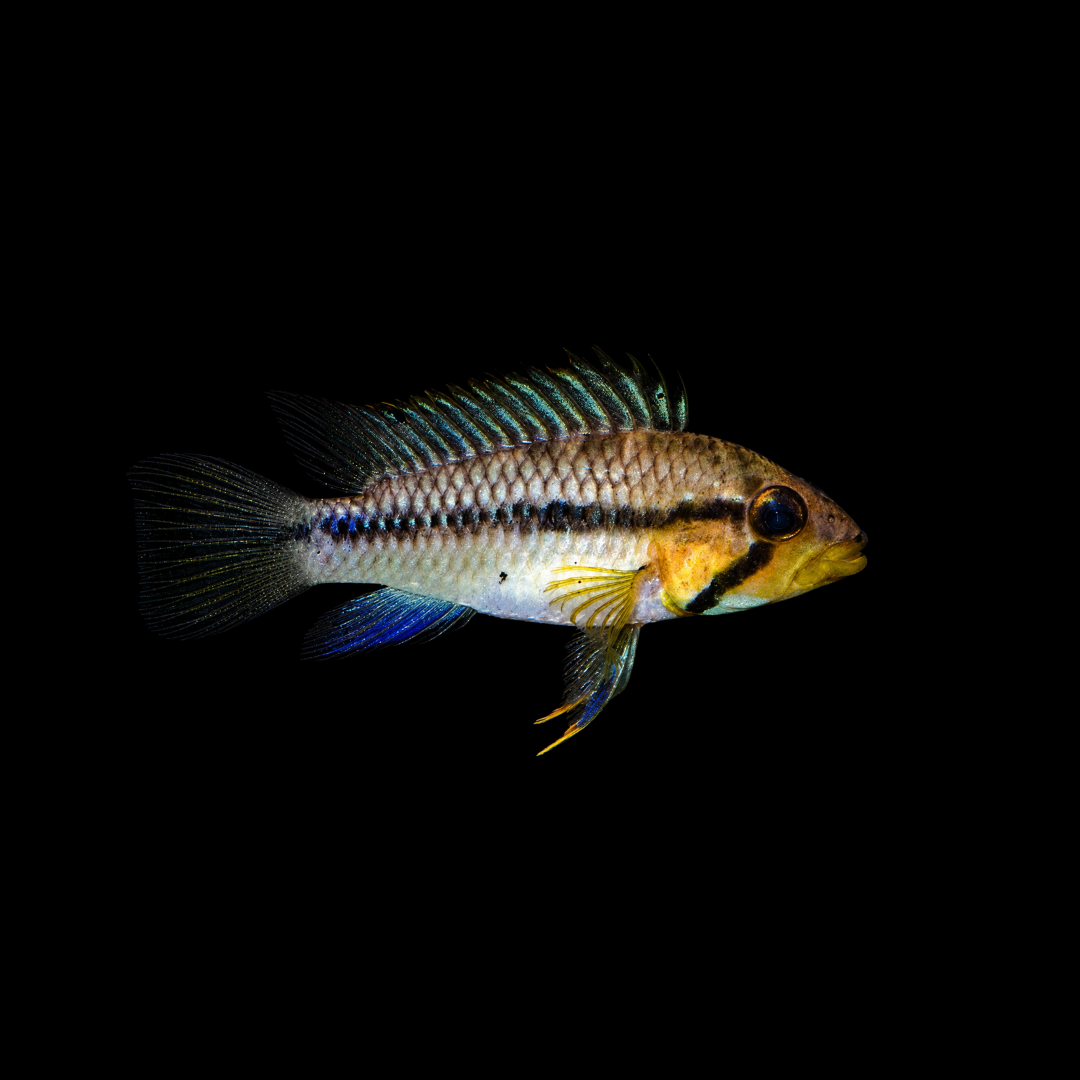
アピストグラマ・バルロウィは、ペルー北東部のアンピヤク川水系周辺に分布する小型シクリッドです。成熟したオスは大きな頭部と分厚い唇、伸長した背ビレ、上下で色調の異なるライヤーテールが目を引き、繁殖期のメスは鮮やかな黄色に黒い胸帯を浮かび上がらせます。最大の特徴は、一般的なアピストグラマと同じように洞窟状の場所へ産卵した後、孵化した仔魚を状況に応じてメス、オス、あるいは両親が口に含んで守ることです。この条件的な仔魚の口内保育は、親魚による保育行動の柔軟さを観察できる本種ならではの特徴です。飼育では細かな砂、清浄で軟らかい水、十分な隠れ家、そして水質を急変させない安定した管理が重要になります。 Apistogramma barlowi is a dwarf cichlid from the Río Ampiyacu drainage and surrounding area in northeastern Peru. Mature males are notable for their large heads, thick lips, extended dorsal-fin membranes, and a lyrate caudal fin with contrasting upper and lower lobes, while breeding females become bright yellow and show a distinctive dark breast band. Its most remarkable feature is a flexible breeding strategy: after spawning in a cave-like site in typical Apistogramma fashion, the hatched larvae may be carried in the mouth by the female, the male, or both parents depending on circumstances. This facultative larvophilous mouthbrooding provides an unusual opportunity to observe flexibility in parental care. In captivity, fine sand, clean soft water, ample shelter, and stable conditions without abrupt changes in water chemistry are the main priorities.
基本情報 / Basic Information
| 学名 / Scientific Name | Apistogramma barlowi Römer & Hahn, 2008 |
|---|---|
| 通称 / Common Name | アピストグラマ・バルロウィ、バルロウィ、A174。記載前には「マウルブリューター(Maulbrüter)」「ブレストバンド(Brustband)」などの名称でも流通しました。Barlow’s Apistogramma, A174, and historically the trade names “Maulbrüter” or “Brustband” before formal description. |
| 分類 / Family | シクリッド科(Cichlidae)・アピストグラマ属(Apistogramma)。上位分類の扱いは分類体系によって異なります。Family Cichlidae, genus Apistogramma. Higher-level classification varies among taxonomic systems. |
| 英名 / English Name | Larvophile dwarf cichlid / Barlow’s Dwarf Cichlid |
| 分布 / Distribution | 南米ペルー北東部、ロレト県ペバス周辺のアンピヤク川(Río Ampiyacu)水系。現在知られている分布は比較的狭く、森林内の小規模な支流やイガラペに強く結び付いています。Northeastern Peru, principally the Río Ampiyacu drainage near Pebas in the Loreto region. The known range is relatively restricted and closely associated with small forest streams and igarapés. |
| 最大体長 / Max Size | 記載論文では、最大標準体長はオス約6.3cm、メス約4.6cmです。標準体長は尾ビレを含まない測定値です。In the original description, maximum standard length was about 6.3 cm for males and 4.6 cm for females. Standard length excludes the caudal fin. |
| 寿命 / Lifespan | 本種について、野外・飼育下ともに寿命を明確に示す資料は乏しく、正確な年数は不明です。具体的な寿命を一律に示すより、安定した水質と適切な水温を維持して長期飼育を目指します。Reliable species-specific lifespan data are scarce for both wild and captive fish, so an exact lifespan is not established. Rather than assigning a fixed number of years, long-term care should focus on stable water quality and appropriate temperature. |
飼育環境 / Aquarium Environment
| 水槽サイズ / Tank Size | ペア飼育は60cm規格水槽(約57L)を基本にすると管理しやすく、縄張り形成と逃げ場を両立できます。繁殖専用で十分に管理できる場合は45cm規格水槽(約30〜40L)でも可能ですが、雌雄の相性が悪い個体ではより広い底面積が有利です。A standard 60 cm aquarium of about 57 L is a practical baseline for a pair because it provides both territory and escape space. A carefully managed 45 cm breeding tank of roughly 30–40 L can work, but pairs with strong aggression benefit from greater floor area. |
|---|---|
| 水温 / Temperature | 23〜27℃程度を基本の目安とし、繁殖や稚魚育成でも急な温度変化を避けて安定させます。野外では約29℃の記録がありますが、記載論文では本種が比較的冷涼で流れのある森林小川を好むとされており、29℃を常用水温と考える必要はありません。 A practical target is around 23–27°C, with stability also important during breeding and fry rearing. A field temperature close to 29°C has been recorded, but the original description characterizes the species as preferring relatively cool, flowing forest streams, so 29°C should not be treated as a routine aquarium target. |
| 水質 / Water Quality | 弱酸性の軟水を基本とし、pH 5.0〜6.5程度を飼育上の目安にすると管理しやすいでしょう。代表的な採集地点ではpH 4.8、導電率26µS/cmという非常に軟らかい水が記録されていますが、これは一地点の野外値であり、その数値を水槽で厳密に再現する必要はありません。水道水の硬度が高い地域ではRO水を混合するなどして調整し、数値そのものより急変を避けることを優先します。Soft, acidic water is the basic approach, with around pH 5.0–6.5 serving as a practical aquarium target. One documented collection site measured pH 4.8 and 26 µS/cm, but this is a field value from a single locality and does not need to be reproduced exactly in an aquarium. Where tap water is hard, RO water can be blended as needed; avoiding abrupt changes is more important than forcing a specific number. |
| レイアウト / Layout | 粒の細かい不活性な砂を薄く敷き、ココナッツシェル、素焼きシェルター、流木などで入口の狭い産卵場所と複数の視線遮断を作ります。細砂は砂を口に含む採餌や掘削だけでなく、オスが威嚇時に見せる砂山形成を観察するうえでも適しています。落ち葉を補助的な隠れ場所として使うことはできますが、記載された代表的な生息地は強く着色したブラックウォーターではなく、透明度の高いクリアウォーターの小川です。強い照明は避け、落ち着いた環境を作ります。Use a thin layer of fine inert sand and provide narrow-entrance spawning shelters with coconut shells, ceramic caves, or driftwood, together with multiple visual barriers. Fine sand suits the species’ sand-sifting and digging behavior and also makes it possible to observe the small sand piles males may build during threat displays. Leaf litter can be used as additional cover, but the best-documented habitat was a clear forest stream rather than strongly stained blackwater. Keep lighting subdued. |
| 注意点 / Precautions | アンモニアと亜硝酸は常に0を維持し、硝酸塩の蓄積も抑えます。導入時は水温だけでなくpHと導電率の差も確認し、とくにワイルド個体は慎重に水合わせします。繁殖刺激を狙ってpHや硬度を急激に上げる方法は、本種の標準的な繁殖法として確立していません。水質を大きく動かすより、親魚の状態を整え、清浄な水を保ち、通常の換水を無理のない範囲で行うことを優先します。Keep ammonia and nitrite at zero and prevent nitrate accumulation. During acclimation, compare not only temperature but also pH and conductivity, and acclimate wild fish particularly carefully. Abruptly raising pH or hardness is not an established standard spawning method for this species. Rather than making large changes in water chemistry, prioritize well-conditioned adults, clean water, and routine water changes made within a safe range. |
餌と給餌 / Feeding
| 餌の種類 / Diet | 孵化したてのブラインシュリンプ、ミジンコ、衛生的に管理したイトメ、冷凍アカムシ、冷凍ブラインシュリンプなどを利用できます。人工飼料では小粒の沈下性ペレットや高品質な顆粒飼料に慣らせます。野外での詳細な食性資料は限られますが、底層で砂を口に含んで選り分ける採餌行動が知られているため、底まで届く小型の餌が適しています。Suitable aquarium foods include newly hatched brine shrimp, daphnia, hygienically cultured worms, frozen bloodworms, and frozen brine shrimp. They can also be trained to accept high-quality small sinking pellets or granules. Detailed species-specific field diet data are limited, but the fish is known to take substrate into the mouth and sift it while feeding, so small foods that reach the bottom are appropriate. |
|---|---|
| 給餌のポイント / Feeding Tips | 少量を1日1〜2回、底まで届くように与えます。繁殖前はブラインシュリンプやミジンコなどを組み合わせて親魚の状態を整えます。冷凍アカムシだけに偏らせず、複数の餌をローテーションします。食べ残しは小容量の軟水水槽では水質悪化につながりやすいため、給餌量は控えめにし、残餌はこまめに除去します。Feed small portions once or twice daily, making sure some food reaches the bottom. Before breeding, condition the pair with a varied mix including brine shrimp and daphnia. Do not rely on frozen bloodworms alone; rotate several foods. Uneaten food can degrade water quality quickly in a small soft-water aquarium, so keep portions modest and remove leftovers. |
性格と混泳 / Temperament and Tank Mates
| 性格 / Temperament | 通常時は底層を中心に行動する観察しやすい小型シクリッドですが、縄張り意識は強く、特に繁殖期は攻撃性が高まります。オス同士は正面から長時間にわたって威嚇することがあり、ペアでも相性や発情のずれによって一方が追い込まれることがあります。隠れ家を1か所だけにせず、複数の退避場所と視線を切る構造を用意します。Outside breeding periods this is an engaging lower-level dwarf cichlid, but it is territorial and becomes substantially more aggressive during reproduction. Males can perform prolonged frontal displays, and even a pair may show one-sided chasing when their breeding condition is mismatched. Provide several refuges and sight breaks rather than relying on a single cave. |
|---|---|
| 混泳の相性 / Compatibility | 観賞目的ならナノストムス類や小型テトラなど、主に中上層を泳ぐ温和な魚が候補になります。こうした混泳魚がペア間の緊張を分散させる場合もありますが、卵や稚魚を食べる可能性があり、親魚の保育行動にも影響します。混泳魚の存在が口内保育を必ず促す、あるいは必ず抑えるという単純な関係ではないため、口内保育を詳しく観察したい場合や確実に稚魚を残したい場合はペア単独飼育が基本です。同じ底層を強く利用する他のアピストグラマ、コリドラス類、大型・攻撃的なシクリッドとの狭い水槽での混泳は避けます。For display aquariums, peaceful mid- to upper-water fish such as pencilfish and small tetras can be suitable. Such tank mates may sometimes reduce tension within the pair, but they can also prey on eggs or fry and influence parental behavior. Their presence does not have a simple one-way effect that always promotes or suppresses mouthbrooding. For close observation of brood care or maximum fry survival, keeping the pair alone is the safest choice. Avoid crowded combinations with other bottom-oriented Apistogramma, Corydoras, or large aggressive cichlids. |
病気と対策 / Diseases and Prevention
| かかりやすい病気 / Common Diseases | バルロウィだけに特有の代表的疾病は知られていませんが、導入ストレスや水質悪化に伴う細菌性の皮膚・ヒレ障害、白点病などの外部寄生虫症、消化不良や腹部膨満に注意します。体表に現れる黒い斑点や色むらを愛好家が「シミ」と呼ぶことがありますが、これは正式な病名ではなく、ストレス、体色変化、皮膚状態など複数の要因を含み得ます。No major disease is known to be unique to A. barlowi, but stressed or poorly maintained fish can develop bacterial skin and fin problems, external parasites such as ich, and digestive disorders or abdominal swelling. Dark blotches sometimes referred to by aquarists as “stains” are not a formal diagnosis and may reflect stress, normal pigment changes, or skin problems from several different causes. |
|---|---|
| 対策と予防 / Prevention | 新規導入魚は可能なら隔離観察し、安定した濾過、低い有機物負荷、少量で定期的な換水を維持します。極軟水ではKHが低く緩衝力も小さくなりやすいため、換水前後のpHと導電率を確認する習慣が有効です。落ち葉やタンニンを含む素材は落ち着いた環境作りの補助にはなりますが、治療薬の代わりにはなりません。異常が出た場合は病名を決めつけず、まず水質、呼吸、糞、食欲、体表を確認し、必要に応じて隔離して治療します。Quarantine new arrivals where possible and maintain mature filtration, low organic loading, and small regular water changes. In very soft water, KH and buffering capacity are often low, so checking pH and conductivity before and after water changes is useful. Leaf litter and tannin-rich botanicals can help create a calm environment but are not substitutes for medication. If symptoms appear, first check water quality, respiration, feces, appetite, and skin condition, then isolate and treat as appropriate rather than guessing the diagnosis. |
増やし方(繁殖) / Breeding
| 雌雄の判別 / Sexing | 成熟オスはメスより大型で、頭部と口が著しく発達し、唇も厚くなります。背ビレの膜が伸長し、尾ビレはライヤーテール状になり、上葉には青みを帯びた地色に斑点列、下葉にはレモンイエローの色域が現れます。メスは小型で尾ビレが比較的截形に近く、繁殖期には鮮やかな黄色となり、胸ビレ基部の後方に黒い「ブレストバンド」が目立ちます。Mature males are larger and develop a disproportionately large head and mouth with thick lips. The dorsal-fin membranes extend, and the caudal fin becomes lyrate with spotted bluish coloration in the upper lobe and a lemon-yellow lower lobe. Females remain smaller with a more truncate caudal fin and, when breeding, turn bright yellow with a distinctive dark breast band immediately behind the pectoral-fin base. |
|---|---|
| 繁殖形態 / Reproduction | 洞窟産卵型を基本とする、条件的・仔魚偏重型の口内保育種です。卵はシェルターの天井や内壁などに産み付けられ、孵化までは主にメスが基質上で守ります。その後の仔魚をメスだけ、オスだけ、あるいは両親が口に収容して保護することがあり、条件によっては口内保育をほとんど行わず浅いくぼみで仔魚を守ることもあります。つまり「必ず口に入れる」魚ではなく、周囲の条件に応じて複数の保育戦略を使い分ける点が重要です。This is fundamentally a cave-spawning species with facultative larvophilous mouthbrooding. Eggs are laid on the ceiling or inner surface of a shelter and are primarily guarded on the substrate by the female until hatching. After hatching, the larvae may be carried by the female, by the male, or by both parents; under some conditions the parents may largely bypass mouthbrooding and guard the brood in a shallow depression instead. The defining feature is not obligatory mouthbrooding, but flexible switching among parental-care strategies. |
| 繁殖のポイント / Breeding Tips | 健康な成熟ペアを細砂の繁殖水槽に入れ、入口の狭い産卵床を複数用意します。水は弱酸性の軟水で安定させ、良質な生餌や冷凍餌を組み合わせて親魚の状態を整えます。特定のpH変化を産卵の必須条件と考えず、通常の換水も水質を急変させない範囲で行います。孵化後に親が仔魚を口へ入れたり出したりしても、すぐに異常と判断せず観察します。自由遊泳後は孵化したてのブラインシュリンプを少量ずつ与えます。アピストグラマ属では水温などの環境条件が性比に影響する研究例がありますが、バルロウィについて同じ条件をそのまま適用できると確認されているわけではありません。Use a healthy mature pair in a fine-sand breeding aquarium with several narrow-entrance shelters. Keep the water stably soft and acidic, and condition the adults with a varied combination of high-quality live and frozen foods. Do not treat a particular pH shift as a required spawning trigger, and make routine water changes without abrupt changes in chemistry. After hatching, do not assume something is wrong if parents repeatedly pick up and release larvae; this can be part of normal brood care. Once the fry are free-swimming, offer newly hatched brine shrimp in small portions. Environmental effects on sex ratio have been demonstrated in other Apistogramma species, but the same conditions should not be assumed to apply specifically to A. barlowi without species-specific evidence. |
雑学と豆知識 / Trivia and Fun Facts
| 1. 2008年に正式記載された「口で仔魚を守るアピスト」 / 1. Formally described in 2008 as a remarkable mouthbrooding Apistogramma | アピストグラマ・バルロウィはUwe RömerとIngo Hahnによって2008年に記載されました。アピストグラマ属は長く洞窟や落ち葉の下で卵と仔魚を守る基質保護型のイメージが強かったため、仔魚を口に含んで保育する本種は大きな注目を集めました。現在ではアピストグラマ属にもほかの口内保育種が知られていますが、バルロウィの「環境に応じてオスまで保育へ参加し得る」という柔軟性は、依然として際立った特徴です。Apistogramma barlowi was formally described by Uwe Römer and Ingo Hahn in 2008. The genus had long been associated primarily with substrate-based brood care in caves, crevices, and leaf litter, so a species that carried larvae in the mouth drew considerable attention. Other mouthbrooding Apistogramma are now known, but A. barlowi remains exceptional because the male may also participate directly in larval mouthbrooding depending on circumstances. |
|---|---|
| 2. 学名に刻まれたシクリッド行動学の歴史 / 2. A name honoring the history of cichlid behavioral research | 種小名barlowiは、シクリッドの行動と進化の研究で大きな功績を残したGeorge Webber Barlowに献名されたものです。目立つ色彩だけでなく、縄張り、求愛、親による保育といった社会行動の複雑さこそがシクリッド研究を発展させてきました。本種の名前には、その研究史への敬意が込められています。The specific name barlowi honors George Webber Barlow, whose work made major contributions to the study of cichlid behavior and evolution. Cichlid biology has been shaped not only by spectacular coloration but also by the complexity of territoriality, courtship, and parental care, and this species name reflects that scientific legacy. |
| 3. 記載前の名前「Maulbrüter」とA174 / 3. The pre-description names “Maulbrüter” and A174 | 正式な学名が付く前、本種はドイツ語で「口内保育魚」を意味するMaulbrüterや、メスの胸部斑紋に由来するBrustbandなどの名前で知られていました。DATZ系の識別コードではA174と呼ばれたため、古い輸入記録や愛好家の記録では現在の学名よりコード名の方が見つかりやすい場合があります。観賞魚の流通名が分類学的記載より先に広まるという、アピストグラマらしい歴史を持つ魚です。Before receiving its formal scientific name, the fish circulated under names such as Maulbrüter, German for “mouthbrooder,” and Brustband, referring to the female’s breast marking. It was also assigned the aquarium identification code A174. As a result, older import and hobby records may be easier to find under these trade names than under the current scientific name, a familiar pattern in the history of Apistogramma discovery. |
| 4. pH4.8、導電率26µS/cmが記録された白砂の小川 / 4. A white-sand stream recorded at pH 4.8 and 26 µS/cm | 記載時に報告された代表的な採集地点の一つは、幅約1m、水深約30cm、細かな白砂が広がる透明度の高い森林小川でした。pHは4.8、導電率は26µS/cmと非常に低く、水草、岩、大きな小石は見られなかったとされています。この値は本種の全生息地が常に同じ水質であることを意味しませんが、極めて低い導電率の水域にも生息することを示す重要な記録です。One of the best-documented collection sites was a clear forest stream about one meter wide and roughly 30 cm deep, with fine white sand. The water measured pH 4.8 and 26 µS/cm, and submerged vegetation, rocks, and coarse pebbles were not reported. These values do not mean every locality has identical water chemistry, but they are important evidence that the species occurs in exceptionally low-conductivity water. |
| 5. 砂を選り分ける摂食と口内保育をつなぐ進化的ヒント / 5. An evolutionary link between sand-sifting feeding and mouthbrooding | 新熱帯区シクリッドを比較した研究では、底砂などを口に取り込み、餌と不要物を選り分ける「ウィノウィング」を行う系統では、そうでない系統より口内保育への進化的移行率が約15倍高かったと報告されています。つまり、摂食のために使われていた口腔の形態や動きが、仔魚を収容する保育にも利用されやすかった可能性があります。ただし、これは新熱帯区シクリッド全体を比較した研究結果であり、バルロウィだけを対象に実証したものではありません。本種の特異な口内保育を理解するための進化的な背景として位置づけるのが適切です。A comparative study of Neotropical cichlids found that evolutionary transitions to mouthbrooding were about fifteen times more frequent in lineages that already practiced winnowing, in which material is taken into the mouth and food is separated from unwanted substrate. In simple terms, mouth structures and movements already used for feeding may also have been suitable for carrying offspring. This was a broad comparative result across Neotropical cichlids, not a species-specific experiment on A. barlowi, so it is best treated as evolutionary context for understanding the species rather than direct proof about its own evolutionary pathway. |
| 6. オスが作る「砂山」は口の大きさを見せるディスプレイか / 6. Male sand piles may advertise mouth size | 本種のオスは正面からの威嚇時に砂を掘り、小さな砂山を作ることがあります。記載者は、この行動がライバルへ口の大きさを見せるだけでなく、メスに対して仔魚を保持できる口腔容量を示す信号になっている可能性にも触れています。ただし、砂山が実際に配偶者選択でどの程度評価されるのかは、今後さらに検証が必要な仮説です。水槽に細砂を使うと、こうした行動を観察できる可能性が高まります。Males may dig and build small sand piles during frontal threat displays. The original description proposed that this behavior could advertise mouth size to rivals and perhaps signal to females how much larval-carrying capacity a male possesses. The role of these piles in mate choice remains a hypothesis rather than a fully tested conclusion, but a fine-sand aquarium gives keepers the best chance of seeing the behavior. |
| 7. レッドフォームとホワイトフォーム / 7. Red and white geographic color forms | バルロウィには、頭部に赤〜橙色の色彩が出やすい濃色の個体群と、赤味が少なく淡い個体群が知られ、一般にレッドフォーム、ホワイトフォームとして区別されます。これらは地理的に分かれた採集地と結び付けられており、単なる同一個体群内の発色差として扱わない方が安全です。入手時には販売名だけでなく、可能であれば産地情報や親魚の系統も確認すると系統維持に役立ちます。A. barlowi is known in darker populations with red to orange coloration around the head and in paler populations lacking much of that red, commonly called the red and white forms. These forms are associated with geographically separated collection areas and should not automatically be treated as mere color variation within a single local population. When acquiring fish, locality and lineage information are valuable for maintaining distinct captive stocks. |
| 8. よく似たアピストグラマ・メガストマとの見分け方 / 8. How to distinguish the similar Apistogramma megastoma | かつて「Kelleri」などの名で知られた近縁のアピストグラマ・メガストマは2017年に正式記載されました。両種は外見がよく似ますが、バルロウィの頬の鱗列は3〜3.5列で、繁殖期のメスには通常、明瞭な黒いブレストバンドが現れます。これに対してメガストマは頬の鱗列がより多く、メスにこのブレストバンドが見られません。眼下感覚孔はバルロウィでは3個ですが、メガストマでは3〜4個と変異するため、孔の数だけを決定的な識別点にすることはできません。行動面では、メガストマはメスによる口内保育が報告されているのに対し、バルロウィではオスも仔魚の口内保育に参加する場合があります。The closely related fish once known in the hobby as “Kelleri” was formally described as Apistogramma megastoma in 2017. The two are very similar, but A. barlowi has about 3–3.5 rows of cheek scales and breeding females normally show a conspicuous black breast band. A. megastoma has more cheek-scale rows and lacks this female breast band. A. barlowi has three infraorbital pores, but A. megastoma varies from three to four, so pore count alone is not a decisive way to separate the two. Behavior also differs: mouthbrooding in A. megastoma has been reported as maternal, whereas males of A. barlowi may also participate in carrying larvae. |
| 9. 日本では「いつでも買える魚」ではない / 9. In Japan it remains an irregular specialty import | 日本では一般的な量販店の定番種というより、南米小型シクリッドに強い専門店や輸入店で不定期に見られる魚です。ペルー産個体のほか、欧州養殖個体の国内販売例もあります。販売価格や在庫は産地、サイズ、ペアの状態、入荷状況によって変動するため、固定的な相場よりも入荷のタイミングに左右される専門性の高い魚として捉える方が実態に合っています。In Japan, A. barlowi is not a routine mass-market species but an irregular specialty fish most often encountered through stores that focus on South American dwarf cichlids and imports. Both Peruvian-origin fish and European-bred stock have appeared in Japanese retail listings. Price and availability vary with locality, size, pairing, and import timing, so it is better regarded as a specialist fish with irregular availability than as a species with a fixed market price. |
| 10. 水質の急変を繁殖の定石にしない / 10. Abrupt water-chemistry shifts are not a standard breeding rule | 飼育下では換水や水質変化の後に産卵することがありますが、それだけで特定のpH変化が繁殖の必須条件だとは判断できません。代表的な野外記録では酸性で非常に低い導電率の水が確認されており、pHを中性〜弱アルカリ性へ急に上げる方法を本種の定石とする根拠は確認されていません。繁殖では数値を大きく動かすことより、成熟した親魚の状態、清浄で安定した軟水、細砂、適切な産卵床を整えることを優先します。Spawning may sometimes follow a water change or a shift in aquarium conditions, but this does not establish any particular pH change as a required trigger. The best-documented field record is from acidic water with very low conductivity, and there is no established basis for treating an abrupt shift toward neutral or alkaline water as a standard breeding method. Breeding efforts should prioritize mature, well-conditioned adults, clean and stable soft water, fine sand, and suitable spawning shelters rather than dramatic changes in water chemistry. |
まとめ / Conclusion
アピストグラマ・バルロウィは、成熟したオスの大きな頭部や独特の尾ビレに加え、仔魚の保育方法が状況によって変わる点に大きな特徴があります。洞窟で産卵した後、メスだけでなくオスが仔魚を口に含むこともあり、細砂の上では採餌や掘削、威嚇時の砂山形成など、本種らしい行動を観察できます。 Apistogramma barlowi is notable not only for the large head and distinctive caudal fin of mature males, but also for the way brood care can change with circumstances. After cave spawning, the female may carry larvae in the mouth and the male may also participate. On fine sand, the species can also be observed sifting, digging, and building small piles during threat displays.
飼育では、数値を極端に操作するよりも、清浄で安定した軟水、細かな砂、十分な逃げ場、偏りのない給餌を整えることが大切です。水質の急変を避けながら親魚の状態と行動をよく観察することで、バルロウィ本来の特徴を引き出しやすくなり、繁殖を目指す場合にも無理のない管理につながります。 Successful care depends less on extreme parameter manipulation than on clean, stable soft water, fine sand, adequate retreats, and a varied diet. By avoiding abrupt changes and closely observing the condition and behavior of the adults, keepers are more likely to see the species’ characteristic behavior and to manage breeding attempts without unnecessary stress.

気になる道具や飼い方を見つけてみませんか?
 アイのアクアグッズ案内ラスボラ・ボララスの群泳を楽しむ飼育用品|水槽・ろ過・ヒーター・餌・水草道具の特徴や使い方、選ぶときのポイントをアイが紹介します。記事はコチラ →
 アイのアクアグッズ案内水草用ライトの選び方|緑の絨毯と赤い水草を楽しむ照明・植栽用品道具の特徴や使い方、選ぶときのポイントをアイが紹介します。記事はコチラ →
 アイのアクアグッズ案内小型カラシンの群れを楽しむ|餌と水換えから考える飼育用品ガイド小型カラシンの群れを眺める時間を、もっと楽しく。泳ぐ余白、餌の食べ方、続けやすい水換えを軸に、日本で揃えやすい用品の選び方を紹介します。記事はコチラ →
 アイのアクアグッズ案内水草の肥料の選び方|底床用・液肥・メネデールの使い分け道具の特徴や使い方、選ぶときのポイントをアイが紹介します。記事はコチラ →
さまざまな飼育テーマをご紹介。リンク先の記事には広告・商品紹介が含まれます。
案内・紹介記事一覧へ →分布マップ
アピストグラマ・バルロウィ(Apistogramma barlowi)は、南米ペルー北東部のロレト県ペバス周辺にあるアンピヤク川(Río Ampiyacu)水系に分布し、森林内の小規模な支流やイガラペに生息します。
※この地図は記事の分布情報をもとにアンピヤク川水系周辺を概略表示したものです。マーカーは分布域を把握するための代表地点であり、実際の採集地点を示すものではありません。
参考文献
-
1. Römer, U. & Hahn, I. (2008)Apistogramma barlowi sp. n. — description of a new facultative mouth-breeding cichlid species (Teleostei: Perciformes: Geophaginae) from Northern Peru. Vertebrate Zoology, 58(1), 49–66.主な対応範囲:記載・形態・分布・生息環境・水質記録・雌雄差・条件的な仔魚口内保育・砂を用いた行動https://doi.org/10.3897/vz.58.e30908
-
2. López-Fernández, H., Honeycutt, R. L., Stiassny, M. L. J. & Winemiller, K. O. (2005)Morphology, molecules, and character congruence in the phylogeny of South American geophagine cichlids (Perciformes, Labroidei). Zoologica Scripta, 34(6), 627–651.主な対応範囲:アピストグラマ属を含む南米産シクリッド類の系統的位置づけhttps://doi.org/10.1111/j.1463-6409.2005.00209.x
-
3. Römer, U., Römer, C. I., Estivals, G., Vela Díaz, A., Duponchelle, F., García Dávila, C. R., Hahn, I. & Renno, J.-F. (2017)Description of a new maternal larvophilic mouth-brooding cichlid species, Apistogramma megastoma sp. n. (Teleostei: Perciformes: Geophaginae), from Loreto, Peru. Vertebrate Zoology, 67(2), 151–171.主な対応範囲:近縁のA. megastomaとの形態識別・頬部鱗列・眼下感覚孔・メスの胸帯・口内保育様式の比較https://doi.org/10.3897/vz.67.e31580
-
4. Weller, H. I., López-Fernández, H., McMahan, C. D. & Brainerd, E. L. (2022)Relaxed Feeding Constraints Facilitate the Evolution of Mouthbrooding in Neotropical Cichlids. The American Naturalist, 199(6), E197–E210.主な対応範囲:ウィノウィングと口内保育の進化的関連、口内保育への移行率に関する比較研究https://doi.org/10.1086/719235
-
5. Ospina-Álvarez, N. & Piferrer, F. (2008)Temperature-Dependent Sex Determination in Fish Revisited: Prevalence, a Single Sex Ratio Response Pattern, and Possible Effects of Climate Change. PLoS ONE, 3(7), e2837.主な対応範囲:魚類およびアピストグラマ属で報告された水温と性比の関係を解釈する際の学術的背景https://doi.org/10.1371/journal.pone.0002837
-
6. Petty, D. B. et al. — MSD Veterinary ManualManagement of Aquarium Fish.主な対応範囲:水質管理、アンモニア・亜硝酸、濾過、換水、水質急変への注意、新規導入魚の隔離管理MSD Veterinary Manual: Management of Aquarium Fish
-
7. Petty, D. B., Francis-Floyd, R. & Yanong, R. P. E. — MSD Veterinary ManualParasitic Diseases of Fish.主な対応範囲:白点病を含む観賞魚の外部寄生虫症、症状の確認、診断、衛生管理と感染予防MSD Veterinary Manual: Parasitic Diseases of Fish




コメント