

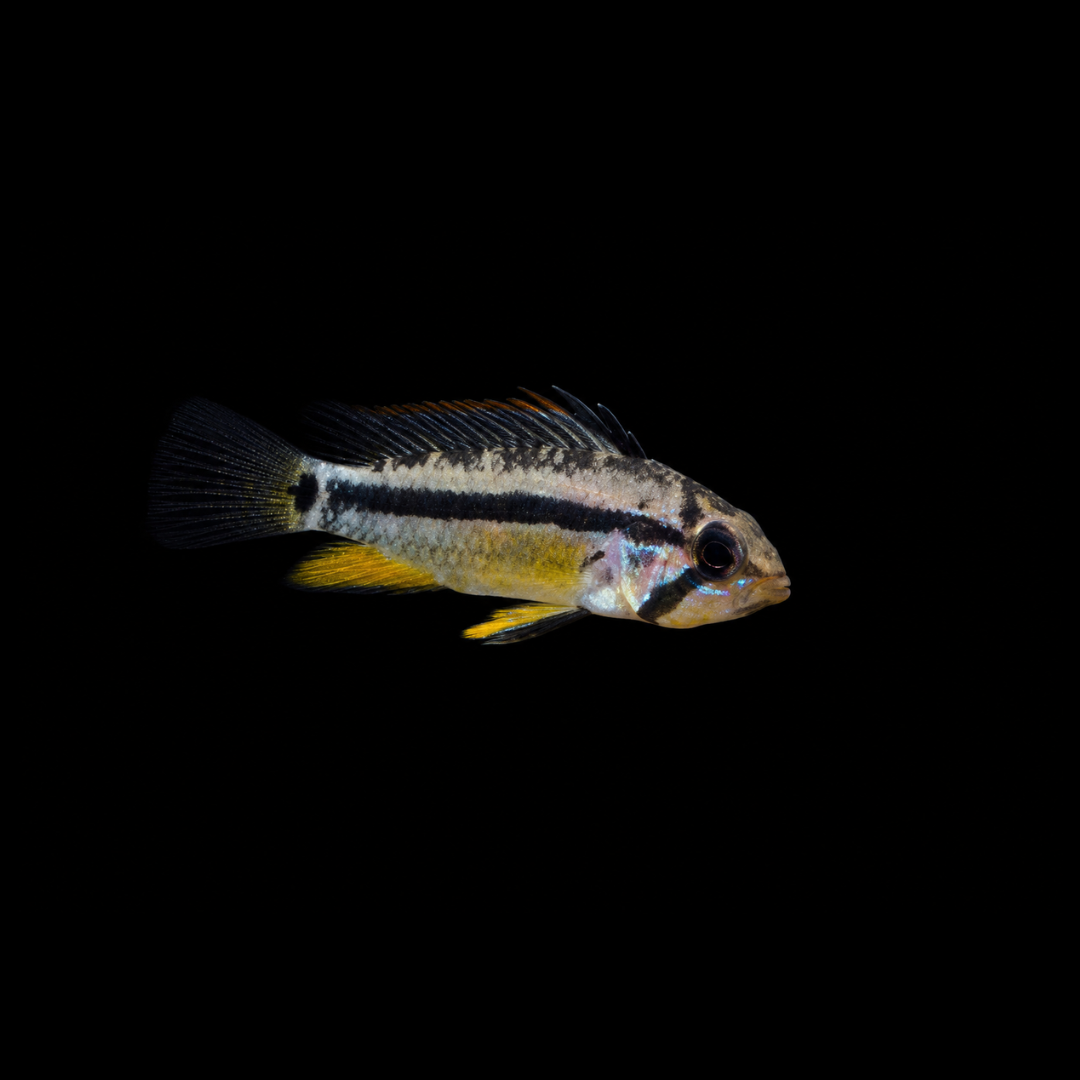
解説 / Description
アピストグラマ・アルパフアヨは、ペルー北東部ロレト県のナナイ川水系、特にアルパフアヨ・ミシャナ国立保護区周辺の小さな森林河川から記載されたドワーフシクリッドです。成熟したオスでは、発達した顎と厚みのある黄橙色の唇、下顎に現れる黒いW字状の「ブラックチン」、前方の鰭膜が伸長して鋸歯状に見える背ビレ、上下端が伸びるライヤーテールが大きな特徴です。日本では長く「ペルー産ユルエンシス」と呼ばれてきたため、現在もアルパフアヨとユルエンシスの名が併記されることがあります。青みの強い個体、黄から橙色が強く出る個体など色彩差も大きく、姿だけでなく行動、繁殖、分類史まで楽しめる奥深いアピストグラマです。 Apistogramma allpahuayo is a dwarf cichlid described from small forest streams in the Río Nanay drainage of Loreto, northeastern Peru, especially in and around the Allpahuayo-Mishana National Reserve. Mature males are notable for their developed jaws, thick yellow-orange lips, a distinctive black W-shaped marking on the lower jaw, conspicuously extended anterior dorsal-fin membranes, and a lyrate caudal fin. In the aquarium trade it was long sold as “Peruvian juruensis,” so both names may still appear together in Japan. Considerable colour variation also occurs, ranging from bluish forms to strongly yellow or orange individuals, making the species interesting not only for appearance but also for behaviour, breeding biology, and taxonomic history.
基本情報 / Basic Information
| 学名 / Scientific Name | Apistogramma allpahuayo Römer, Beninde, Duponchelle, Vela Díaz, Ortega, Hahn, Soares, Díaz Cachay, García Dávila, Sirvas Cornejo & Renno, 2012 |
|---|---|
| 通称 / Common Name | アルパフアヨ、ペルー産ユルエンシス、ブラックチン・アピスト。国内では色彩傾向によって「青ユル」「トラユル」などの愛称が使われることもありますが、これらは正式な分類名ではありません。Allpahuayo dwarf cichlid, Black-chin Apistogramma, and the historical trade name “Peruvian juruensis.” Japanese hobby names such as “Ao-yuru” and “Tora-yuru” may be used for colour tendencies, but they are not formal taxonomic names. |
| 分類 / Family | シクリッド目(Cichliformes)・シクリッド科(Cichlidae)・Geophaginae亜科・アピストグラマ属(Apistogramma)。原記載ではカカトイデス系統(A. cacatuoides lineage)のA. cacatuoides complexに位置づけられています。Order Cichliformes, family Cichlidae, subfamily Geophaginae, genus Apistogramma. The original description placed it in the A. cacatuoides complex within the A. cacatuoides lineage. |
| 英名 / English Name | Featherfin dwarf cichlid |
| 分布 / Distribution | ペルー共和国ロレト県。イキトスの南西約30kmに位置するアルパフアヨ・ミシャナ国立保護区とその周辺、ナナイ川水系の小規模な森林河川から正式記載されています。原記載ではロレト県外からの確実な記録は示されていません。Loreto, Peru. The species was formally described from small forest streams in and around the Allpahuayo-Mishana National Reserve, roughly 30 km southwest of Iquitos, within the Río Nanay drainage. The original description did not establish confirmed records outside Loreto. |
| 最大体長 / Max Size | 文献上の最大標準体長はオス4.0cm、メス3.1cmです。標準体長は尾ビレを含まない測定値のため、水槽内で見た全長はこれより長く見えます。The documented maximum standard length is 4.0 cm for males and 3.1 cm for females. Standard length excludes the caudal fin, so the fish appears longer when measured as total length in an aquarium. |
| 寿命 / Lifespan | 本種だけを対象にした信頼できる寿命データは確認されていません。飼育下では数年単位で維持される魚ですが、実際の寿命は水温、給餌、水質の安定性などに左右されます。Reliable species-specific lifespan data are not available. In aquaria the species can be maintained for several years, but actual longevity varies with temperature, feeding, and water stability. |
飼育環境 / Aquarium Environment
| 水槽サイズ / Tank Size | 1ペアなら30cmキューブ水槽(約25〜27L)から管理できますが、繁殖期の追い込みを避けるためには45cm規格水槽(約35L)以上を推奨します。複数のメスを同居させる場合や他魚と混泳する場合は、60cm規格水槽(約55〜60L)以上で十分な底面積と逃げ場を確保すると安全です。A pair can be maintained from a 30 cm cube aquarium of roughly 25–27 L, but a standard 45 cm tank of about 35 L or larger is recommended to reduce the risk of severe aggression during breeding. For multiple females or community maintenance, a standard 60 cm aquarium of roughly 55–60 L or larger provides safer floor space and retreat areas. |
|---|---|
| 水温 / Temperature | 24〜28℃。日常管理は25〜27℃前後が扱いやすく、長期間の高温維持は代謝を上げすぎないよう注意します。現地調査では24.5〜28.6℃が記録されています。 24–28°C. Around 25–27°C is a practical range for routine care, while prolonged high temperatures should be avoided to prevent unnecessarily elevated metabolism. Field measurements in the type-area study ranged from 24.5 to 28.6°C. |
| 水質 / Water Quality | 弱酸性の軟水を基本とし、飼育ではpH5.0〜6.5程度を中心に、低硬度・低導電率の状態を安定して保つと管理しやすいでしょう。原記載の採集地点ではpH4.6〜7.4、導電率23〜142 µS/cmが記録されていますが、多くの地点はpH5前後の酸性水でした。現地値の幅をそのまま飼育目標にするのではなく、急変を避けることを優先します。日本の水道水は地域差が大きいため、ミネラル分が多い場合はRO水を混ぜる方法も選択肢になります。Soft, acidic water is preferred, with pH around 5.0–6.5 serving as a practical aquarium range when mineral content is kept low and stable. The original field study recorded pH 4.6–7.4 and conductivity of 23–142 µS/cm, although many collection sites were around pH 5. These field extremes should not be treated as aquarium targets; avoiding abrupt change is more important. Because Japanese tap water varies by region, mixing reverse-osmosis water can be useful where mineral content is high. |
| レイアウト / Layout | 細目の砂を基本に、流木、落ち葉、ココナッツシェルや小型の素焼きシェルターなどを組み合わせます。本種は底砂を口に含んで選別する行動を見せるため、角の鋭い底床より細かな砂が適しています。ケーブは入口が狭く内部が暗いものを複数用意し、流木や陰性水草で視線を遮って、オスとメスが互いに見えない退避場所を作ることが重要です。Use fine sand with driftwood, leaf litter, coconut-shell caves, or small ceramic shelters. Because this species frequently takes substrate into the mouth and sorts through it, fine smooth sand is preferable to sharp gravel. Provide several dark caves with narrow entrances and use wood or shade-tolerant plants to break lines of sight so that males and females can retreat from one another. |
| 注意点 / Precautions | 現地では低酸素の場所からも採集されていますが、水槽内で低酸素を再現する必要はありません。ろ過は穏やかなスポンジフィルターなどが使いやすく、夜間も十分な酸素交換を確保します。成熟個体、とくに繁殖中のメスは非常に縄張り意識が強くなるため、追われる個体が水面や隅から動かなくなった場合は直ちに隔離します。ワイルド個体は導入直後の急激な水質変更を避け、落ち着いてから徐々に目的の水質へ合わせます。Although the species has been collected from very low-oxygen habitats, there is no need to reproduce hypoxia in an aquarium. Gentle filtration such as a sponge filter is suitable, while adequate gas exchange should be maintained, including at night. Mature fish, especially brooding females, can become intensely territorial; if a chased fish remains pinned near the surface or in a corner, separate it immediately. Wild fish should not be subjected to abrupt water-chemistry changes on arrival and should be adjusted gradually. |
餌と給餌 / Feeding
| 餌の種類 / Diet | 孵化したてのブラインシュリンプ、ミジンコ、冷凍コペポーダ、冷凍アカムシなどの小型動物質を中心に、高品質な小粒の沈下性人工飼料も組み合わせます。本種を含むアピストグラマでは、底砂やデトリタスを口に含み、小さな餌生物を探すシフティング行動が見られます。Offer newly hatched brine shrimp, daphnia, frozen copepods, frozen bloodworms, and other small animal foods, supplemented with high-quality sinking micro-pellets. Apistogramma, including this species, show substrate-sifting behaviour in which sand or detritus is taken into the mouth while small food organisms are searched out. |
|---|---|
| 給餌のポイント / Feeding Tips | 少量を1日1〜2回、底に届く量を与えます。アカムシなど嗜好性の高い餌だけに偏らせず、餌の種類を回すことが大切です。底砂と一緒に植物片を取り込むことはありますが、「繊維質が本種に不可欠」とする強い種別データは乏しいため、植物性原料入りの人工飼料は補助として利用し、基本は多様な小型動物質を中心に考えるのが安全です。腹部が不自然に膨れるほどの過給餌は避けます。Feed small portions once or twice daily, ensuring that food reaches the lower part of the aquarium. Do not rely exclusively on highly palatable foods such as bloodworms; rotate several food types. Although plant debris may be ingested while sifting substrate, strong species-specific evidence that dietary fibre is essential is limited. Pellets containing plant ingredients can be used as a supplement, while a varied selection of small animal foods should remain the foundation. Avoid overfeeding to the point of persistent abdominal swelling. |
性格と混泳 / Temperament and Tank Mates
| 性格 / Temperament | 通常時は小型シクリッドらしい警戒心と縄張り性を示し、成熟したオスは同種のオスに強く反応します。原記載では典型的な多妻型のアピストグラマとされ、繁殖期にはオスが広い縄張りを持ち、メスが産卵洞周辺を激しく防衛します。体格差や相性によっては1ペアでも追い込みが起こるため、常に退避場所を用意します。The species shows the alert, territorial behaviour typical of dwarf cichlids, and mature males react strongly to rival males. The original description regarded it as a typical polygamous Apistogramma, with males defending broader territories while females aggressively guard the immediate cave and brood area. Even a single pair can become dangerously aggressive if size or compatibility is poor, so retreat areas are essential. |
|---|---|
| 混泳の相性 / Compatibility | 繁殖を優先しない場合は、上層を泳ぐ小型カラシンやペンシルフィッシュなど、温和で口に入らないサイズの魚と合わせやすい種類です。一方、コリドラスなど底面を常時巡回する魚は産卵洞へ近づいて争いを招きやすく、繁殖水槽では避けた方が無難です。オトシンクルスなどを「共通の外敵」として入れてペア形成を促す方法は必須の手法ではなく、繁殖時にはむしろストレスや稚魚捕食の要因になり得ます。小型エビや稚エビは高確率で捕食対象になります。When breeding is not the main goal, peaceful upper-water fishes such as small characins or pencilfish can work well if they are too large to be swallowed. Bottom-roaming fishes such as Corydoras may repeatedly approach caves and provoke conflicts, so they are better avoided in a breeding tank. Using Otocinclus or other fish as a supposed “common enemy” to strengthen pair formation is not necessary and may instead add stress or risk to fry. Small shrimp and shrimplets are likely to be eaten. |
病気と対策 / Diseases and Prevention
| かかりやすい病気 / Common Diseases | 本種だけに特有の疾病が知られているわけではありませんが、導入直後のワイルド個体では外部寄生虫、白点病、細菌性のヒレ傷み、食欲不振や腹部の異常などに注意します。強い追尾で受けた傷が二次感染の入口になることもあります。No disease is known to be unique to this species, but newly imported wild fish should be watched for external parasites, ich, bacterial fin damage, loss of appetite, and abnormal abdominal condition. Injuries caused by persistent aggression can also become sites of secondary infection. |
|---|---|
| 対策と予防 / Prevention | 新規個体は可能であれば隔離水槽で観察し、アンモニアと亜硝酸が蓄積しない安定した環境を維持します。魚病薬は成分によってpHやアルカリ度などの水質条件で有効性や毒性が変わるため、症状を見極めずに本水槽へ一律に投薬するのは避けます。日常の予防では、過密と過給餌を避け、定期的な換水、十分な酸素交換、追い込みを防げるレイアウトを優先します。Where possible, observe new fish in a quarantine aquarium and maintain stable conditions without accumulating ammonia or nitrite. The efficacy and toxicity of some fish medications vary with water chemistry such as pH and alkalinity, so avoid indiscriminate treatment in the display aquarium before the problem has been assessed. Routine prevention depends on avoiding crowding and overfeeding, performing regular water changes, maintaining good gas exchange, and providing a layout that prevents persistent harassment. |
増やし方(繁殖) / Breeding
| 雌雄の判別 / Sexing | 成熟したオスはメスより大きく、顎が発達し、唇の黄橙色が強くなります。背ビレの前方から中央部にかけて膜や条が著しく伸び、尾ビレはライヤーテール状になります。メスは小型でヒレが短く、繁殖期には全身が鮮明な黄色になり、黒い腹ビレや体側斑が強調されます。若魚では雌雄差が弱く、販売サイズでは判定が難しい場合があります。Mature males grow larger, develop heavier jaws, and usually show stronger yellow-orange lips. The dorsal fin becomes conspicuously extended and the caudal fin develops a lyrate shape. Females remain smaller with shorter fins and turn bright yellow during breeding, with dark ventral fins and body markings becoming more pronounced. Sexing juveniles can be difficult, especially at typical retail sizes. |
|---|---|
| 繁殖形態 / Reproduction | ケーブスポウナーです。メスが流木の裏、ココナッツシェル、素焼きシェルターなどの天井面に卵を産み付け、主にメスが卵と仔魚を守ります。自由遊泳が始まると黄色い婚姻色のメスが稚魚群を誘導し、オスはより外側の縄張りを防衛します。水槽が狭い場合は、メスの防衛行動によってオスが追い詰められることがあります。This is a cave-spawning species. The female attaches eggs to the roof of a cavity beneath wood, inside a coconut shell, or in a ceramic shelter, and she performs most direct egg and fry care. Once the fry become free-swimming, the bright yellow female leads the brood while the male generally defends a wider territory. In a small aquarium, the female may drive the male into a corner during brood defence. |
| 繁殖のポイント / Breeding Tips | 十分にコンディションを整えた親魚に複数の産卵洞を用意し、pH5.0〜6.5程度の安定した軟水で管理します。メスが洞窟周辺を掃除し、黄色い婚姻色を強めたら産卵が近いサインです。稚魚が自由遊泳を始めたら孵化したてのブラインシュリンプを少量ずつ複数回与え、吸い込みの弱いスポンジフィルターを使用します。アピストグラマ属では、初期発育期の水温が性比に影響し、種によってはpHの影響も確認されています。ただし、アルパフアヨについて雌雄比を狙って調整できる固有の数値条件は確立されていないため、繁殖では極端な高温や酸性条件を避け、安定した環境を優先します。メスがオスを強く攻撃する場合は、稚魚の自由遊泳を待たず安全を優先して隔離します。Condition the adults well, provide several spawning caves, and maintain stable soft water around pH 5.0–6.5. A female cleaning a cave and intensifying her yellow breeding colour is a useful sign that spawning may be near. Once fry become free-swimming, offer newly hatched brine shrimp in several small feedings and use a gentle sponge filter. In Apistogramma, water temperature during early development can affect sex ratio, and pH has an effect in some species. However, no species-specific numerical recipe has been established for producing a particular sex ratio in A. allpahuayo, so breeding should prioritise stable conditions and avoid environmental extremes. If the female attacks the male severely, prioritise safety and separate him even before the fry are fully free-swimming. |
雑学と豆知識 / Trivia and Fun Facts
| 1. 約17年間「ペルー産ユルエンシス」と呼ばれた魚 / 1. A Fish Long Sold as “Peruvian juruensis” | アルパフアヨの物語は、観賞魚として先に知られ、学名が後から追いついた典型例です。原記載によると、この魚は少なくとも1995年にはペルーから観賞魚として輸入されていましたが、当初はブラジルのジュルア川水系を模式産地とするA. juruensisと誤同定されました。その後、黒い下顎斑を手がかりに「Black-chin Apistogramma」「Schwarzkinn」、あるいは「Pucallpa」などの仮称で区別され、2012年に51標本を基にA. allpahuayoとして正式記載されました。日本で今も「ユルエンシス」の名が残るのは、単なる誤表記というより、学名確定以前から続く流通史の名残でもあります。(Römer et al., 2012)The history of A. allpahuayo is a classic case of an aquarium fish becoming familiar before its scientific name caught up. According to the original description, it had been imported from Peru for the aquarium trade since at least 1995, but was initially misidentified as A. juruensis, whose type locality lies in the Brazilian Rio Juruá system. Its black lower-jaw marking later inspired provisional names such as “Black-chin Apistogramma,” “Schwarzkinn,” and “Pucallpa.” In 2012, a series of 51 specimens formed the basis of the formal description of A. allpahuayo. The continued use of “juruensis” in Japan therefore reflects a long trade history rather than simply a modern spelling error. (Römer et al., 2012) |
|---|---|
| 2. 学名「allpahuayo」は保護区と土地に結びついた名前 / 2. The Name “allpahuayo” Is Tied to Its Local Landscape | 種小名allpahuayoは、タイプ産地を含むReserva Nacional Allpahuayo Mishanaに由来します。模式標本はイキトスからナウタへ向かう道路周辺、ナナイ川水系の小さな森林河川で採集されました。大河本流の雄大な景観より、落ち葉と枝が沈む細いケブラーダの方が、この魚の暮らしを理解するうえでは重要です。アピストグラマの魅力は、小さな魚体の中にアマゾンの巨大な河川環境ではなく、森の中の微細な水域分化が映し出されている点にもあります。The specific name allpahuayo refers to the Reserva Nacional Allpahuayo Mishana, which includes the type locality. Type material was collected from small forest streams in the Río Nanay drainage near the road between Iquitos and Nauta. To understand this fish, the narrow leaf-littered quebradas are more important than the dramatic main channel of the Amazon. Much of the fascination of Apistogramma lies in how their small bodies reflect ecological differentiation among tiny, isolated forest waters. |
| 3. ブラックチンはユルエンシスとの有力な識別点 / 3. The Black Chin Is a Strong Clue Against True A. juruensis | 成熟個体の下顎に現れる幅広い黒いW字状パターンは、アルパフアヨを特徴づける重要な形質です。原記載の比較表では、この幅広いW字状のブラックチンはA. allpahuayoに示され、A. juruensisでは別形の細い上唇付近のストライプが比較対象として扱われています。さらにアルパフアヨは腹部のストライプが相対的に細く、オスの唇が黄から橙色に強く発色する傾向があります。ただし、魚の模様は気分や成熟度で変化するため、ブラックチンだけを一瞬見て断定するのではなく、尾ビレ、背ビレ、体側斑、産地情報を合わせて判断するのが安全です。The broad black W-shaped pattern on the lower jaw of mature fish is one of the most useful diagnostic characters of A. allpahuayo. In the comparative table of the original description, this broad W-shaped chin mark is characteristic of A. allpahuayo, whereas A. juruensis is compared using a different narrow stripe near the lip. A. allpahuayo also tends to show relatively narrow abdominal stripes and males may develop strongly yellow to orange lips. Because colour patterns vary with mood and maturity, however, identification should combine chin pattern, fins, body markings, and locality information rather than relying on a single momentary colour feature. |
| 4. 「青」と「黄」は原記載にも登場する色彩多型 / 4. Blue and Yellow Morphs Appear in the Original Description | 日本の愛好家が「青ユル」「トラユル」と呼び分ける背景には、実際に本種が大きな色彩変異を持つことがあります。2012年の原記載でも、生体色の記載でblue morphとyellow morphが区別され、その中間的な個体が存在する可能性にも触れられています。つまり「青」と「黄」は単なる照明の違いではありませんが、日本の流通名がそのまま固定された遺伝系統を意味するわけでもありません。成熟、気分、背景色、照明、個体差が重なって見え方が変わるため、一匹ずつの発色を育てる楽しさが大きい魚です。Japanese hobbyists sometimes separate strongly blue fish from more yellow or orange fish with informal names, and this reflects genuine colour variability in the species. The 2012 description itself distinguished blue and yellow male morphs in its account of live colouration and noted the possibility of intermediate forms. Thus, the contrast is not merely an effect of lighting, but Japanese trade names should not be treated as proof of fixed genetic strains. Maturity, mood, background, lighting, and individual variation all affect appearance, making colour development part of the enjoyment of keeping this species. |
| 5. アピストグラマ属で機能的性転換が明確に記録された特異例 / 5. An Exceptional Record of Functional Sex Change in Apistogramma | 2012年の原記載で最も注目される記述の一つが、繁殖経験のある成体メスが相手のオスを失った後に成長し、オス特有の色彩と形態を示すようになり、その後、機能的なオスとして繁殖した観察例です。原記載では、この時点で本種を「アピストグラマ属で機能的性転換が明確に記録された唯一の種」と位置づけています。性転換個体は保存され、性腺も追加調査のため固定されました。ただし重要なのは、同じ原記載の中で、その性腺の形態学的検査結果は「別途公表予定」とされている点です。原記載に記録されているのは、性転換後にオスとして繁殖した観察例であり、性腺の組織学的な検査結果までは含まれていません。(Römer et al., 2012)One of the most notable passages in the 2012 description concerns an adult female that had already reproduced and, after losing its male partner, grew, developed male-typical colour and morphology, and later reproduced as a functional male. At the time of publication, the authors described A. allpahuayo as the only species in the genus for which functional sex change had been unequivocally recorded. The sex-changed specimen was preserved and its gonads fixed for further study. Importantly, however, the same paper states that the results of the gonadal morphological examination were to be published elsewhere. The original description documents functional sex change followed by successful male reproduction, but does not include the results of the gonadal histological examination. (Römer et al., 2012) |
| 6. 性比は「pHだけ」で決まるわけではない / 6. Sex Ratio Is Not Controlled by pH Alone | アピストグラマ属では、RömerとBeisenherzの実験により33種で水温が性比に有意な影響を与え、種によってはpHも影響することが示されました。後のレビューでも、おおむね高温側や低pH側でオス比率が高くなる傾向が紹介されています。しかし、この結果を「pH5未満ならアルパフアヨはほぼ全部オスになる」という固定的な法則に置き換えるのは危険です。温度の影響は広く確認されていますが、pHの作用は種差があり、性決定と性分化をどこまで環境が直接制御するかについても慎重な解釈が必要です。繁殖では極端な条件を避けるという実践的な指針に留め、性比を保証する数値として扱わないのが適切です。(Römer & Beisenherz, 1996; Renn & Hurd, 2021)Experiments by Römer and Beisenherz demonstrated significant temperature effects on sex ratio in 33 Apistogramma species, with pH also influencing sex ratio in some species. Later reviews summarise a general tendency toward more males at higher temperatures and lower pH. It is risky, however, to convert those results into a fixed rule such as “A. allpahuayo below pH 5 will produce almost all males.” Temperature effects are broadly documented, but pH responses differ among species, and the distinction between environmental sex determination and environmentally influenced sex differentiation requires caution. For breeding, these findings are best used as a reason to avoid extreme rearing conditions rather than as a guaranteed numerical recipe. (Römer & Beisenherz, 1996; Renn & Hurd, 2021) |
| 7. 現地水質は「超低導電率だけ」ではない / 7. The Type Area Is Not Defined by Ultra-Low Conductivity Alone | 原記載の現地8地点では、水温24.5〜28.6℃、pH4.6〜7.4、溶存酸素0.37〜2.26mg/L、導電率23〜142 µS/cmが測定されました。多くの採集地点はpH約5のブラックウォーターまたはクリアウォーターでしたが、白水の影響を受けたpH7.4の地点もあり、そこで得られた個体は1匹だけで状態も良くなかったと記されています。つまり本種は「pH5、超低導電率」という一つの数字に閉じ込めるより、酸性の森林小河川を中心にしつつ、降雨や周囲の水系の影響を受ける変動環境の魚と捉える方が自然です。なお、自然界の極端な低酸素は適応対象であって、水槽で再現すべき飼育目標ではありません。(Römer et al., 2012)Across eight field sites in the original description, measured values ranged from 24.5–28.6°C, pH 4.6–7.4, dissolved oxygen 0.37–2.26 mg/L, and conductivity 23–142 µS/cm. Most collection sites were acidic blackwater or clearwater locations around pH 5, but one whitewater-influenced site reached pH 7.4; only one specimen was collected there and it was reported in relatively poor condition. The species is therefore better understood as a fish centred on acidic forest streams that still experience hydrological variation, rather than being defined by one ultra-low conductivity number. The extremely low oxygen measured in nature represents an environmental challenge to which the fish is adapted, not an aquarium target to reproduce. (Römer et al., 2012) |
| 8. 「ペルースイッチ」は飼育技法の俗称として考える / 8. The “Peru Switch” Is Better Treated as Hobby Practice | 日本のアピスト愛好家の間では、換水時に少し低い温度の水を入れたり、雨季の変化を意識して水質を動かしたりする繁殖誘発法を「ペルースイッチ」と呼ぶことがあります。現地で大雨の後に水位が短期間で約20cm上昇した観察は原記載にもありますが、特定の「ヒーターを切る」「pHを一段階急落させる」という操作が本種の産卵を科学的に保証するわけではありません。実践するなら、健康な親魚に対して小規模な換水とわずかな温度変化に留め、急激なpH低下や長時間の低温化を避ける方が安全です。繁殖の基本は、スイッチを探すことより、十分な栄養、安定した軟水、安心できるケーブ、そして相性の良い親魚を整えることにあります。Among Japanese Apistogramma hobbyists, the term “Peru switch” may refer to using slightly cooler replacement water or modest water-chemistry changes to imitate seasonal rainfall and encourage spawning. The original description did record a rapid water-level rise of about 20 cm after heavy rain, but this does not scientifically validate a fixed procedure such as switching off the heater or forcing a sudden pH drop. If the technique is tried, it is safer to use a small water change and only a mild temperature shift with healthy adults. The fundamentals of breeding remain good conditioning, stable soft water, secure caves, and compatible adults rather than a dramatic trigger. |
| 9. 「ペルー産ユルエンシス」という名が残る理由 / 9. Why the Name “Peruvian juruensis” Persists | 本種は正式記載より前から長く「ペルー産ユルエンシス」として観賞魚市場に流通していたため、学名がA. allpahuayoに整理された後も、旧流通名が併記されることがあります。これは真正のA. juruensisと同種であることを意味するものではなく、分類が確定する以前の流通史を反映した呼び名です。購入時には流通名だけで判断せず、学名、産地情報、下顎のブラックチンなどの特徴を合わせて確認すると混同を避けやすくなります。This species circulated in the aquarium trade as “Peruvian juruensis” for many years before it was formally described, so the historical trade name may still appear alongside A. allpahuayo. This does not mean that it is the same species as true A. juruensis; the name reflects its pre-description trade history. When identifying fish, it is safer to consider the scientific name, locality information, and diagnostic features such as the black chin rather than relying on the trade name alone. |
まとめ / Conclusion
アピストグラマ・アルパフアヨは、黒いW字状のブラックチン、伸長する背ビレとライヤーテール、青から黄橙色まで揺れ動く色彩によって、小型水槽でも強い存在感を見せるドワーフシクリッドです。細かな砂、落ち葉、流木、暗いケーブを組み合わせ、弱酸性の軟水を急変させず維持すると、底を探る仕草からペアの駆け引き、鮮やかな婚姻色まで、本来の行動をじっくり観察できます。 Apistogramma allpahuayo is a dwarf cichlid with remarkable presence despite its small size, combining a black W-shaped chin mark, extended dorsal and lyrate caudal fins, and colour that can shift from cool blue tones to rich yellow-orange. With fine sand, leaf litter, driftwood, dark caves, and stable mildly acidic soft water, the aquarist can observe a full range of natural behaviours, from substrate sifting and territorial negotiation to vivid breeding colours.
かつて「ペルー産ユルエンシス」として流通した分類史に加え、機能的性転換の観察記録や、アピストグラマ属で知られる環境条件と性比の関係など、本種には外見だけでは分からない興味深い背景があります。極端な数値を追い求めるのではなく、弱酸性の軟水を安定させ、個体同士の関係をよく観察しながら育てることで、色彩や行動、繁殖時の変化までじっくり楽しめます。 Beyond its appearance, the species has an unusual background: a long history under the trade name “Peruvian juruensis,” a documented observation of functional sex change, and genus-level research showing that environmental conditions can influence sex ratio in Apistogramma. Rather than pursuing extreme water values, maintain stable acidic soft water and observe social interactions carefully; changes in colour, behaviour, and breeding activity provide much of the species’ appeal.
気になる道具や飼い方を見つけてみませんか?
 アイのアクアグッズ案内ラスボラ・ボララスの群泳を楽しむ飼育用品|水槽・ろ過・ヒーター・餌・水草道具の特徴や使い方、選ぶときのポイントをアイが紹介します。記事はコチラ →
 アイのアクアグッズ案内グッピー・プラティ・モーリーを親子で楽しむ飼育用品|水槽・稚魚保護・ろ過・餌・水草道具の特徴や使い方、選ぶときのポイントをアイが紹介します。記事はコチラ →
 アイのアクアグッズ案内水槽フィルターの選び方|外掛け・外部・上部から小型オーバーフローまで道具の特徴や使い方、選ぶときのポイントをアイが紹介します。記事はコチラ →
 アイのアクアグッズ案内カルキ抜き・水質調整剤の選び方|水換えと水槽の種類に合わせて選ぶ道具の特徴や使い方、選ぶときのポイントをアイが紹介します。記事はコチラ →
さまざまな飼育テーマをご紹介。リンク先の記事には広告・商品紹介が含まれます。
案内・紹介記事一覧へ →分布マップ
アピストグラマ・アルパフアヨ(Apistogramma allpahuayo)は、ペルー共和国ロレト県のアルパフアヨ・ミシャナ国立保護区とその周辺にある、ナナイ川水系の小規模な森林河川から知られています。
※この地図は記事中の分布情報をもとにした概略表示です。マーカーは分布地域を把握するための代表地点であり、実際の採集地点を示すものではありません。
参考文献
-
Römer, U., Beninde, J., Duponchelle, F., Vela Díaz, A., Ortega, H., Hahn, I., Soares, D. P., Díaz Cachay, C., García Dávila, C. R., Sirvas Cornejo, S. & Renno, J.-F. (2012).Description of Apistogramma allpahuayo sp. n., a new dwarf cichlid species (Teleostei: Perciformes: Geophaginae) from in and around the Reserva Nacional Allpahuayo Mishana, Loreto, Peru. Vertebrate Zoology, 62(2), 189–212.主な裏づけ:新種記載、識別形質、模式産地、ナナイ川水系の分布、生息地の水温・pH・導電率・溶存酸素、繁殖生態、機能的性転換の観察記録。
-
Kullander, S. O. (1986).Cichlid Fishes of the Amazon River Drainage of Peru. Swedish Museum of Natural History, Stockholm, 431 pp. ISBN 91-86510-04-5.主な裏づけ:Apistogramma juruensisの原記載と診断、ペルー・アマゾン産シクリッドの分類学的基盤、アルパフアヨとの比較に必要な歴史的分類情報。
-
Froese, R. & Pauly, D. (eds.). FishBase.Apistogramma allpahuayo species summary.主な裏づけ:現在受容されている学名・分類、ロレト県アルパフアヨ・ミシャナ国立保護区周辺の分布、標準体長などの基礎データ。主要文献としてRömer et al. (2012)を収録。
-
Römer, U. & Beisenherz, W. (1996).Environmental determination of sex in Apistogramma (Cichlidae) and two other freshwater fishes (Teleostei). Journal of Fish Biology, 48(4), 714–725.主な裏づけ:アピストグラマ属33種で確認された水温による性比への影響、一部種におけるpHの影響、初期発育期に環境条件を極端にしないという繁殖上の注意。
-
Renn, S. C. P. & Hurd, P. L. (2021).Epigenetic Regulation and Environmental Sex Determination in Cichlid Fishes. Sexual Development, 15(1–3), 93–107.主な裏づけ:シクリッドにおける環境依存的な性決定・性分化の総説、水温・pH・酸素などの影響と種差、遺伝要因と環境要因が並行して働く可能性。アルパフアヨの性比を単一のpH値だけで断定しない根拠。
-
Petty, B. D., Francis-Floyd, R. & Yanong, R. P. E. Merck Veterinary Manual.Management of Aquarium Fish. Full review May 2022; updated September 2024.主な裏づけ:新規導入魚の隔離、水質安定、アンモニア・亜硝酸管理、外傷と二次的な健康リスク、薬剤の安全性がpHや水質条件で変化し得ること、本水槽で安易に投薬しないための一般的な魚病管理原則。
-
Petty, B. D., Francis-Floyd, R. & Yanong, R. P. E. Merck Veterinary Manual.Parasitic Diseases of Fish. Full review May 2022; updated September 2024.主な裏づけ:淡水魚の白点病(Ichthyophthirius multifiliis)、外部寄生虫、シクリッド類で問題となり得るSpironucleusやCryptobiaなどの内部寄生性原虫、衛生・過密回避・隔離の重要性。




コメント