

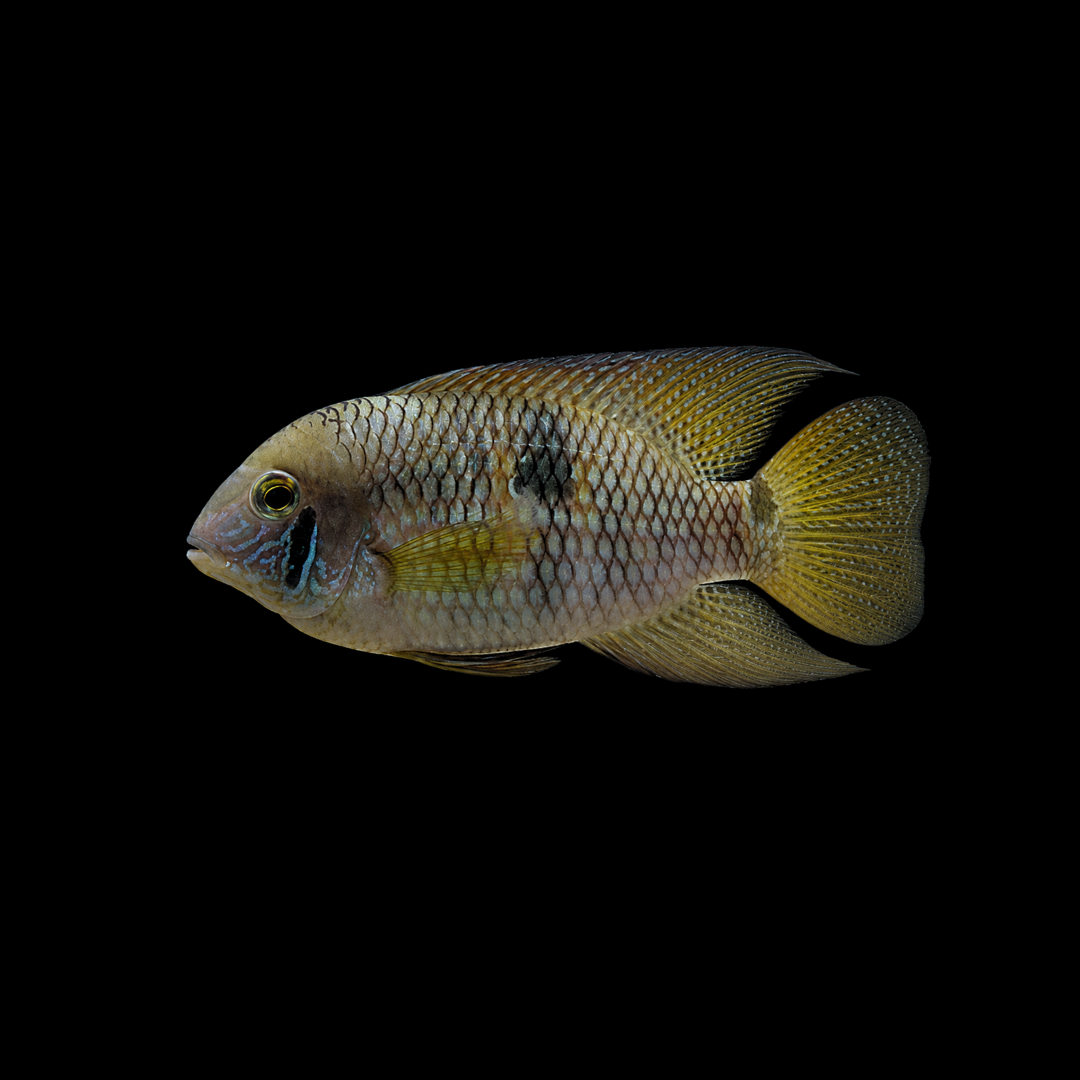
解説 / Description
エキデンス・メタエは、コロンビアのオリノコ川水系、主にメタ川流域に分布する中型の南米シクリッドです。黄褐色から黄金色を基調とした体に青緑色の光沢が入り、体側中央と尾柄付近の黒い斑点が印象的です。英語圏では「Yellow Acara」と呼ばれ、一部では「Twin Spot Flag Cichlid」の名も使われます。周囲の様子によく反応するシクリッドらしい行動を見せる一方、同程度の大きさの南米産シクリッドの中では比較的穏やかです。ただし、ペア形成後や繁殖期には縄張り性が強まるため、普段の性格だけを基準に混泳を考えないことが大切です。飼育では十分な遊泳空間と成熟した濾過を用意し、水質の急変を避けながら弱酸性の軟水を安定して維持することが基本となります。 Aequidens metae is a medium-sized South American cichlid distributed in the Colombian Orinoco basin, principally the Meta River drainage. Its yellow-brown to golden base color is accented by blue-green iridescence, with conspicuous dark markings near the middle of the flank and the caudal peduncle. In the English-speaking aquarium hobby it is best known as the Yellow Acara, while the name Twin Spot Flag Cichlid is also used in some sources. It shows the alert, responsive behavior typical of cichlids yet is relatively restrained compared with many similarly sized South American species. Established pairs can become territorial during breeding, so community planning should not be based on its usual calm temperament alone. A spacious aquarium, mature biological filtration, stable water chemistry, and consistently soft, acidic water provide a sound foundation for long-term care.
基本情報 / Basic Information
| 学名 / Scientific Name | Aequidens metae Eigenmann, 1922 |
|---|---|
| 通称 / Common Name | エキデンス・メタエ、アエクイデンス・メタエ、イエローアカラYellow Acara, Twin Spot Flag Cichlid |
| 分類 / Family | シクリッド目(Cichliformes)・シクリッド科(Cichlidae)・Cichlinae亜科・Aequidens属Order Cichliformes, family Cichlidae, subfamily Cichlinae, genus Aequidens |
| 英名 / English Name | Yellow Acara |
| 分布 / Distribution | 南アメリカ北部のコロンビア。オリノコ川水系に固有とされ、主にメタ川水系に分布します。小川や小支流から記録されています。Northern South America, in Colombia. The species is regarded as endemic to the Colombian Orinoco basin and is principally distributed in the Meta River system, where it is recorded from creeks and small streams. |
| 最大体長 / Max Size | 標準体長で最大約12.5cm。尾ビレを含む全長はこれより大きくなるため、水槽設計では中型シクリッドとして余裕を持たせます。Up to about 12.5 cm standard length. Total length including the caudal fin is greater, so the species should be planned for as a medium-sized cichlid. |
| 寿命 / Lifespan | 本種に固有の寿命の目安は明確になっていません。飼育下での寿命は、水質、食事、個体の状態などの影響を受けます。No reliable species-specific lifespan figure is available. Longevity in captivity varies with water quality, diet, individual condition, and husbandry. |
飼育環境 / Aquarium Environment
| 水槽サイズ / Tank Size | 成魚1ペアを長期飼育するなら90cm規格水槽(約180L)以上を推奨します。複数個体からペアを選ばせる場合や、他の中型魚と混泳させる場合は120cmクラスの水槽がより安全です。幼魚は小型水槽でも管理できますが、成長後の縄張り形成を見越して早めに広い環境へ移します。For long-term maintenance of an adult pair, a standard 90 cm aquarium of roughly 180 L or larger is recommended. A 120 cm class aquarium is preferable when raising a group for natural pair formation or when keeping the species with other medium-sized fish. Juveniles can be grown in smaller tanks, but they should be moved before adult territorial behavior develops. |
|---|---|
| 水温 / Temperature | 通常飼育は24〜28℃を目安にします。自然分布情報では24〜30℃の範囲が示されていますが、長期飼育では高温側に固定するより、十分な溶存酸素を確保しながら中間域で安定させる方が管理しやすいでしょう。 Aim for 24–28°C in routine aquarium care. Natural-range references give a broader range of about 24–30°C, but keeping the fish steadily in the middle of that range with good oxygenation is generally easier for long-term maintenance than holding it continuously at the warmest end. |
| 水質 / Water Quality | 弱酸性の軟水を基本とします。自然分布情報ではpH4.8〜6.0が示されていますが、水槽内でその数値へ急に合わせる必要はありません。重要なのはpHを無理に動かすことではなく、急変を避け、アンモニアと亜硝酸を検出させない安定した環境を維持することです。硝酸塩や有機物の蓄積にも注意し、定期的な換水を行います。Soft, acidic water is the basic target. Natural-range references report pH 4.8–6.0, but aquarium water should not be forced rapidly toward those values. Stability is more important than chasing a number: avoid abrupt changes, keep ammonia and nitrite undetectable, and prevent chronic accumulation of nitrate and organic waste through regular maintenance. |
| レイアウト / Layout | 細かな砂を底床にし、流木、丸みのある石、落ち葉などで視線を区切りながら、中央には十分な遊泳空間を残します。繁殖を考える場合は平たい石や素焼き鉢など、掃除しやすい産卵基質を用意すると観察しやすくなります。水草を使うなら、アヌビアス類やミクロソリウム類を流木や石に活着させる方法が扱いやすく、底床に植える場合は掘り返しに強い大型株をしっかり固定します。照明は極端に明るくせず、浮き草や流木の陰を作ると落ち着きやすくなります。Use fine sand as the substrate and divide sight lines with driftwood, rounded stones, and leaf litter while preserving an open swimming area. If breeding is a goal, provide an easily cleaned flat stone or terracotta surface that can serve as a spawning site. Epiphytic plants such as Anubias and Microsorum are convenient because they can be attached to wood or rocks; rooted plants should be well anchored and robust enough to tolerate occasional digging. Avoid excessively bright lighting and provide shaded areas with wood or floating plants. |
| 注意点 / Precautions | 比較的温和でも、ペア形成後や産卵期には縄張り性が急に強まります。逃げ場のない小型水槽では弱い個体が追い詰められるため、隠れ家と退避スペースを必ず確保してください。また、本種はオコア川などの環境毒性学研究で汚染影響を検出する対象魚として用いられてきましたが、その結果だけから「他のシクリッドよりアンモニアに特別弱い」とまでは断定できません。飼育上は一般的なシクリッドと同様、成熟した濾過、定期換水、薬剤の過量投与を避けることを徹底するのが安全です。Although comparatively mild-mannered, established pairs can become abruptly territorial during courtship and spawning. In a cramped aquarium, subordinate fish may have no escape route, so visual barriers and refuge space are essential. A. metae has been used in ecotoxicological studies of polluted Colombian rivers, but those findings do not by themselves prove that the species is uniquely sensitive to aquarium ammonia. The safest husbandry approach is therefore the same disciplined practice expected for quality cichlid care: mature biological filtration, regular water changes, and avoidance of medication overdoses. |
餌と給餌 / Feeding
| 餌の種類 / Diet | 自然下では底生でデトリタスを利用する習性が報告されています。飼育下では人工飼料への餌付きがよく、主食には品質の良いシクリッド用ペレットや顆粒飼料を使えます。副食として冷凍アカムシ、ブラインシュリンプ、ミジンコ類などを組み合わせ、単一の餌だけに偏らないようにします。残餌は水質悪化の原因になるため、長時間水槽内に残さないようにしてください。Benthic, detritus-feeding habits have been reported in the wild. In captivity the species readily accepts prepared foods, and a high-quality cichlid pellet or granule can form the staple diet. Frozen bloodworms, brine shrimp, and daphnia can be used as supplementary foods. Avoid relying on a single food and remove uneaten material promptly to protect water quality. |
|---|---|
| 給餌のポイント / Feeding Tips | 成魚は1日1〜2回を基本に、短時間で食べ切れる量を与えます。幼魚や繁殖前の親魚は少量を複数回に分ける方法が有効です。高タンパクな冷凍餌や生餌だけに偏らせると肥満や水質悪化を招きやすいため、主食を配合飼料に置き、補助食を変化させる構成が安定します。繁殖コンディションを上げる時も、給餌量を増やすだけでなく換水頻度と濾過能力を同時に上げることが重要です。Feed adults once or twice daily in portions they finish quickly. Juveniles and conditioned breeding fish can benefit from smaller meals given more frequently. Diets dominated by rich frozen or live foods can encourage obesity and deteriorating water quality, so a prepared staple with varied supplementary foods is more stable. When increasing food to condition a breeding pair, increase water-change discipline and filtration capacity at the same time rather than simply adding more food. |
性格と混泳 / Temperament and Tank Mates
| 性格 / Temperament | 中型シクリッドとしては比較的温和で、常時激しく他魚を攻撃するタイプではありません。一方で、成熟した個体には個体差があり、ペア形成や産卵をきっかけに縄張り防衛が強くなります。単独個体よりもペアの方が他魚への圧力が強くなる場合があるため、繁殖兆候が出たら混泳魚の退避を想定しておくと安心です。For a medium-sized cichlid it is comparatively peaceful and is not normally a relentless aggressor. Adult temperament still varies between individuals, and territorial defense can intensify sharply once a pair forms or spawning begins. A bonded pair may exert more pressure on tank mates than a single specimen, so be prepared to separate other fish if breeding behavior develops. |
|---|---|
| 混泳の相性 / Compatibility | 同程度の水質を好み、極端に攻撃的ではない中型魚が候補になります。大型の南米産テトラ類、温和なゲオファーガス類やサタノペルカ類などは広い水槽で検討できますが、底面の縄張りが重なる魚とは十分な面積が必要です。口に入るほど小さなテトラや、ヒレをかじる魚、極端に攻撃的な中大型シクリッドとの組み合わせは避けます。種名だけで相性を決めず、体格、個体の性格、レイアウト、繁殖状態を見ながら調整してください。Suitable companions are medium-sized fish that share similar water requirements without being excessively aggressive. Larger South American tetras and relatively calm Geophagus or Satanoperca species can be considered in spacious aquaria, although bottom-oriented cichlids require generous floor area because their territories overlap. Avoid very small tetras that may be swallowed, persistent fin nippers, and highly aggressive medium-to-large cichlids. Compatibility should be judged by body size, individual temperament, layout, and breeding condition rather than species name alone. |
病気と対策 / Diseases and Prevention
| かかりやすい病気 / Common Diseases | 本種だけに特有とされる代表的な疾病は知られていません。一般的な熱帯魚と同様に、白点病、細菌性の皮膚炎や鰭の損傷、内部寄生虫、消化不良などには注意が必要です。長期的な水質悪化や栄養の偏りが続く環境では、シクリッドで問題になることのある頭部・側線のびらん性症状が生じる可能性もあります。No major disease is known to be uniquely characteristic of this species. As with other tropical freshwater fish, watch for ich, bacterial skin or fin infections, internal parasites, and digestive problems. Under chronically poor water conditions or an imbalanced diet, cichlids may also develop erosive lesions around the head and lateral-line region. |
|---|---|
| 対策と予防 / Prevention | 最も有効な予防は、安定した水質と導入時の観察です。新規個体は可能なら隔離水槽で状態を確認し、食欲、呼吸、排泄物、体表の異常を見てから本水槽へ移します。換水は一度に水質を大きく変えない範囲で定期的に行い、フィルターの生物濾過を維持してください。薬浴が必要な場合は症状を見極め、製品の規定量を守り、複数薬剤を自己判断で重ねないことが大切です。The most effective prevention is stable water quality combined with careful observation of newly acquired fish. When possible, quarantine newcomers and check appetite, respiration, feces, and the skin before introducing them to the main aquarium. Perform regular water changes without causing abrupt shifts in chemistry and maintain the biological function of the filter. If medication becomes necessary, treat the likely condition with the labeled dose and avoid combining drugs casually. |
増やし方(繁殖) / Breeding
| 雌雄の判別 / Sexing | 幼魚では外見だけでの判別が難しい種です。成熟すると、オスはやや大型になり、背ビレと尻ビレ後端が長く伸びる傾向があり、頭部から背中にかけての輪郭がより厚く見えることがあります。メスは比較的小柄で、産卵前には腹部がふくらみます。ただし個体差があるため、外見だけで断定せず、生殖突起や実際のペア行動も合わせて判断します。Juveniles are difficult to sex reliably by appearance alone. As the fish mature, males tend to become somewhat larger, often with longer extensions on the dorsal and anal fins and a heavier profile from the head into the back. Females are usually smaller and become noticeably fuller in the abdomen before spawning. Individual variation is considerable, so body shape should be combined with examination of the breeding papilla and actual pair behavior rather than used as the sole criterion. |
|---|---|
| 繁殖形態 / Reproduction | 基質産卵型のシクリッドで、相性の良いペアが平たい石、流木、鉢などの表面を清掃して産卵します。産卵数はコンディションや親魚サイズによって変わりますが、まとまった数の卵を産み、雌雄で卵と仔魚を守る両親保護を行います。水温によって差はあるものの、卵は数日で孵化し、その後は卵黄嚢を吸収して自由遊泳へ移行します。This is a substrate-spawning cichlid. A compatible pair cleans a flat stone, piece of wood, terracotta surface, or similar site before spawning. Egg number varies with parental size and condition, but clutches can be substantial and both parents participate in guarding eggs and young. Depending on temperature, the eggs hatch after several days, followed by a yolk-sac stage before the fry become free swimming. |
| 繁殖のポイント / Breeding Tips | 確実性を高めるなら幼魚を6匹前後から育て、自然に形成されたペアを残す方法が有効です。繁殖前は栄養価の高い餌を与えつつ水質を清浄に保ち、適度な換水で環境を安定させます。飼育者の繁殖例では、雨季を意識して新鮮な軟水やわずかに低い温度の換水を刺激として利用する方法もありますが、本種に特化した実験的な根拠は限られます。急激な水温・pH変化は避けてください。自由遊泳を始めた稚魚には孵化直後のブラインシュリンプ幼生を少量ずつ頻回に与えると育成しやすくなります。親魚の保護行動を観察する場合でも、狭い水槽や強いストレス下では仔魚が失われることがあるため、必要に応じて親魚または稚魚を分けられる準備をしておきます。For a higher chance of obtaining a compatible pair, raise a group of around six juveniles and retain a naturally formed pair. Condition the adults with varied nutritious food while keeping the water very clean and stable. Some aquarists use fresh, soft water or slightly cooler replacement water as a seasonal cue intended to imitate rainfall, but species-specific experimental evidence for this method is limited. Abrupt changes in temperature or pH should be avoided. Once the fry become free swimming, newly hatched brine shrimp nauplii offered in small frequent meals are an excellent first food. Even when parental care is allowed to continue, be prepared to separate either the parents or fry if stress, crowding, or renewed spawning activity threatens the brood. |
雑学と豆知識 / Trivia and Fun Facts
| 1. 「メタエ」という名前はメタ川から生まれた / 1. The name “metae” comes from the Meta River | 本種はカール・H・アイゲンマンによって1922年に記載されました。模式産地はコロンビアのメタ川水系にあるバリゴン(Barrigón)で、種小名metaeはメタ川に由来する地名由来の名称です。属名Aequidensはラテン語のaequusに由来する「等しい」という意味と、densに由来する「歯」という意味を組み合わせた名で、歯の形態に着目して成立した属名です。日本語表記では「エキデンス」と読まれることが多い一方、ラテン語綴りに近い表記として「アエクイデンス」が使われることもあります。名前をたどるだけでも、魚そのものと南米の地理、そして魚類分類学の歴史が一本につながって見えてきます。Carl H. Eigenmann described the species in 1922. The type locality is Barrigón in the Río Meta system of Colombia, and the species epithet metae is a toponym referring to the Río Meta. The genus name Aequidens combines Latin roots meaning “equal” and “teeth,” reflecting a dental character historically used in defining the group. Even the scientific name therefore links the fish to both South American geography and the history of cichlid classification. |
|---|---|
| 2. 昔のAequidens属は「大きな箱」だった / 2. Aequidens was once a very broad taxonomic “box” | かつてAequidens属には、外見や生活様式がある程度似た南米産シクリッドが広く収められていました。その後、詳細な形態比較と分子系統解析が進み、ブルーアカラやグリーンテラーを含む系統はAndinoacaraへ、ほかにもBujurquina、Krobia、Laetacara、Cleithracaraなど複数の属へ整理されていきました。エキデンス・メタエはその再編を経てもAequidensに残っている種の一つです。したがって、昔の熱帯魚書籍で「エキデンス」と呼ばれている魚が、現在は別属名になっていることは珍しくありません。古い文献を読む時には、この分類史を知っているだけで混乱が大きく減ります。Aequidens historically served as a broad genus containing many South American cichlids that shared a general appearance or ecological style. With more detailed morphological work and later molecular phylogenetics, many of those fishes were reassigned to genera such as Andinoacara, Bujurquina, Krobia, Laetacara, and Cleithracara. A. metae is one of the species that remained within Aequidens after this reorganization. This is why older aquarium literature may call a fish “Aequidens” even though its accepted genus is different today. |
| 3. ミトコンドリアゲノムも系統研究の手掛かりになっている / 3. Its mitochondrial genome contributes to phylogenetic research | 公開されているAequidens metaeのミトコンドリアゲノム配列は16,541塩基対で、GenBankではKR150865として参照されています。ミトコンドリアDNAは、種同定だけでなく、新世界シクリッドの系統関係を比較するための材料として利用されます。ただし、ミトコンドリアゲノム一つだけで属や種の進化史を完全に説明できるわけではありません。形態情報、核DNA、地理分布などを重ねて初めて、複雑な南米シクリッドの進化像が精密になっていきます。A mitochondrial genome sequence of Aequidens metae is publicly available at 16,541 base pairs under GenBank accession KR150865. Mitochondrial DNA provides useful characters for species identification and comparative work on the relationships of New World cichlids. It is not, however, a complete account of evolutionary history by itself. Morphology, nuclear DNA, geography, and additional evidence must be considered together to resolve the complex diversification of South American cichlids. |
| 4. 観賞魚でありながら、水質汚染研究にも登場する / 4. An aquarium fish that also appears in pollution research | コロンビアのオコア川では、Aequidens metaeが都市排水などによる環境影響を調べる研究に用いられています。血液や赤血球の異常を調べた研究では、汚染の影響を受けた地点の個体に変化が確認され、別の研究では肝臓の生化学的・組織学的反応も調べられています。石油産業に関連する多環芳香族炭化水素の影響評価にも利用されており、本種は野外の環境ストレスを捉える指標魚の候補として研究されてきました。つまり、水槽で特別に弱い魚だと証明されたわけではなく、野外の汚染影響を魚の体の変化から追跡する研究に役立っている、という意味です。In Colombia’s Ocoa River, Aequidens metae has been used in studies of environmental effects associated with urban wastewater. Research on blood and erythrocyte abnormalities detected changes in fish from impacted sites, while other work has examined biochemical and histological responses in the liver. The species has also been used to assess effects of polycyclic aromatic hydrocarbons associated with the oil industry, making it a candidate bioindicator of environmental stress. In practical terms, this does not prove that A. metae is unusually fragile in aquaria; it means that researchers have found the species useful for tracking pollution-related biological responses in the wild. |
| 5. 繁殖期の色彩は「別の魚」のように変わることがある / 5. Breeding coloration can make the fish look dramatically different | 普段は黄褐色から黄金色が印象的な本種ですが、求愛や仔魚保護の時期には体側の暗色部が強まり、黒い斑紋や顔周りのコントラストがはっきりすることがあります。これは単なる「色揚がり」ではなく、ペア間のコミュニケーションや縄張り防衛と結びついたシクリッドらしい色彩変化です。飼育者が日々観察していると、色の変化が産卵の前触れや警戒状態を読み取る手掛かりになるため、本種の面白さは静止画よりもむしろ行動とともに見た時に際立ちます。Outside the breeding season, warm yellow-brown and golden tones dominate the fish’s appearance. During courtship and brood care, darker areas can intensify and the contrast of the black markings and facial pattern may become much stronger. This is not simply improved ornamental coloration; it is part of the visual signaling associated with pairing and territorial defense in cichlids. For an attentive aquarist, changing color can therefore become an early clue to reproductive condition or heightened vigilance. |
まとめ / Conclusion
エキデンス・メタエは、黄金色を帯びた体色、青緑色の光沢、体側と尾柄の黒斑をじっくり楽しめる南米シクリッドです。成熟した濾過と安定した弱酸性の軟水、十分な底面積を用意すれば、普段は比較的落ち着いた姿を見せながら、ペア形成や繁殖ではシクリッドらしい縄張り行動や子育てを観察できます。 Aequidens metae rewards close observation with its warm golden coloration, blue-green iridescence, and dark markings on the flank and caudal peduncle. With mature filtration, stable acidic soft water, and generous floor space, it can remain comparatively composed in everyday life while displaying the territorial and parental behavior characteristic of breeding cichlids.
成長とともに深まる体色や、ペアになった時の行動まで含めて観察できることも本種の魅力です。水を清潔に保ち、過密を避け、個体ごとの性格を見ながら環境を整えることで、落ち着いた中にもシクリッドらしい存在感を持つ一尾として長く向き合えるでしょう。 Its developing coloration and pair behavior provide lasting interest as the fish matures. Clean water, low stocking pressure, and a layout adjusted to the temperament of the individual fish allow this cichlid to become a calm but distinctive presence in a well-maintained aquarium.
気になる道具や飼い方を見つけてみませんか?
 アイのアクアグッズ案内小型カラシンの群れを楽しむ|餌と水換えから考える飼育用品ガイド小型カラシンの群れを眺める時間を、もっと楽しく。泳ぐ余白、餌の食べ方、続けやすい水換えを軸に、日本で揃えやすい用品の選び方を紹介します。記事はコチラ →
 アイのアクアグッズ案内水槽用浄水器の選び方|水換えを楽にするタイプとROの違い道具の特徴や使い方、選ぶときのポイントをアイが紹介します。記事はコチラ →
 アイのアクアグッズ案内旅行中、お魚のごはんはどうする? 自動給餌器・使える餌・スマート水槽の選び方旅行中の魚の餌やりを助ける自動給餌器を、アイとコタロウが紹介。時間指定、おかわり給餌、対応するフレークや顆粒、設置台、スマホ管理、一体型水槽、留守番フードまで、使いどころと選び方を案内します。記事はコチラ →
 アイのアクアグッズ案内水草水槽のCO₂添加|3つの方式の選び方とおすすめ用品道具の特徴や使い方、選ぶときのポイントをアイが紹介します。記事はコチラ →
さまざまな飼育テーマをご紹介。リンク先の記事には広告・商品紹介が含まれます。
案内・紹介記事一覧へ →分布マップ
Aequidens metae は南アメリカ北部のコロンビアに分布し、オリノコ川水系に固有とされます。特にメタ川水系を中心に、小川や小支流から記録されています。
※この地図は、記事に記載された「コロンビアのオリノコ川水系、主にメタ川水系」という分布情報をもとにした概略表示です。分布欄に緯度・経度の記載がないため、表示範囲とマーカー位置は分布地域を把握しやすくするための代表値を設定しています。マーカーは実際の採集地点や生息地点を示すものではありません。
参考文献
-
Eigenmann, C. H. (1922). The fishes of western South America. Part I. The fresh-water fishes of northwestern South America, including Colombia, Panama, and the Pacific slopes of Ecuador and Peru, together with an appendix upon the fishes of the Rio Meta in Colombia. Memoirs of the Carnegie Museum, 9(1), 1–350.
主な対応項目:原記載、学名、模式産地、メタ川水系。https://doi.org/10.5962/p.234839
-
Fricke, R., Eschmeyer, W. N. & Van der Laan, R. (eds.). Eschmeyer’s Catalog of Fishes: Aequidens metae Eigenmann, 1922. California Academy of Sciences.
主な対応項目:現在の有効学名、分類、コロンビアのオリノコ川水系における分布。https://researcharchive.calacademy.org/research/ichthyology/catalog/fishcatget.asp?spid=39083
-
Musilová, Z., Říčan, O. & Novák, J. (2009). Phylogeny of the Neotropical cichlid fish tribe Cichlasomatini (Teleostei: Cichlidae) based on morphological and molecular data, with the description of a new genus. Journal of Zoological Systematics and Evolutionary Research, 47(3), 234–247.
主な対応項目:Aequidensを含むCichlasomatiniの系統関係、Andinoacara設立を含む分類学的再編。https://doi.org/10.1111/j.1439-0469.2009.00528.x
-
DoNascimiento, C., Herrera-Collazos, E. E., Herrera-R., G. A., Ortega-Lara, A., Villa-Navarro, F. A., Usma-Oviedo, J. S. & Maldonado-Ocampo, J. A. (2017). Checklist of the freshwater fishes of Colombia: a Darwin Core alternative to the updating problem. ZooKeys, 708, 25–138.
主な対応項目:コロンビア淡水魚相における本種の記録と分布確認。https://doi.org/10.3897/zookeys.708.13897
-
Kullander, S. O. (2003). Cichlidae (Cichlids). In R. E. Reis, S. O. Kullander & C. J. Ferraris Jr. (eds.), Checklist of the Freshwater Fishes of South and Central America (pp. 605–654). EDIPUCRS.
主な対応項目:シクリッド科の分類、本種の標準体長などの基礎的な魚類学情報。https://www.fishbase.se/references/FBRefSummary.php?ID=36377
-
Stawikowski, R. & Werner, U. (1998). Die Buntbarsche Amerikas, Band 1. Verlag Eugen Ulmer, Stuttgart. ISBN 3-8001-7270-4.
主な対応項目:小川・小支流という生息環境、水温・pHなどの環境値、南米産シクリッドの飼育・繁殖に関する専門的基礎資料。https://www.fishbase.se/references/FBRefSummary.php?ID=40602
-
Corredor-Santamaría, W., Serrano Gómez, M. & Velasco-Santamaría, Y. M. (2016). Using genotoxic and haematological biomarkers as an evidence of environmental contamination in the Ocoa River native fish, Villavicencio—Meta, Colombia. SpringerPlus, 5, 351.
主な対応項目:オコア川のAequidens metaeで確認された血液学的・遺伝毒性学的変化と、水質汚染に関する注意点。https://doi.org/10.1186/s40064-016-1753-0
-
Corredor-Santamaría, W., Torres-Tabares, A. & Velasco-Santamaría, Y. M. (2019). Biochemical and histological alterations in Aequidens metae (Pisces, Cichlidae) and Astyanax gr. bimaculatus (Pisces, Characidae) as indicators of river pollution. Science of the Total Environment, 692, 1234–1241.
主な対応項目:河川汚染下における肝臓の生化学的・組織学的反応と、本種を環境影響評価に用いる根拠。https://doi.org/10.1016/j.scitotenv.2019.07.187
-
Corredor-Santamaría, W., Mora-Solarte, D. A., Arbeli, Z., Navas, J. M. & Velasco-Santamaría, Y. M. (2021). Liver biomarkers response of the neotropical fish Aequidens metae to environmental stressors associated with the oil industry. Heliyon, 7(7), e07458.
主な対応項目:環境ストレスに対する肝臓バイオマーカーの反応と、汚染影響に関する補足的根拠。https://doi.org/10.1016/j.heliyon.2021.e07458
-
Noga, E. J. (2010). Fish Disease: Diagnosis and Treatment, 2nd Edition. Wiley-Blackwell.
主な対応項目:白点病、細菌性疾患、寄生虫症、隔離・観察、投薬を含む観賞魚の疾病管理と予防の一般原則。https://doi.org/10.1002/9781118786758




コメント