

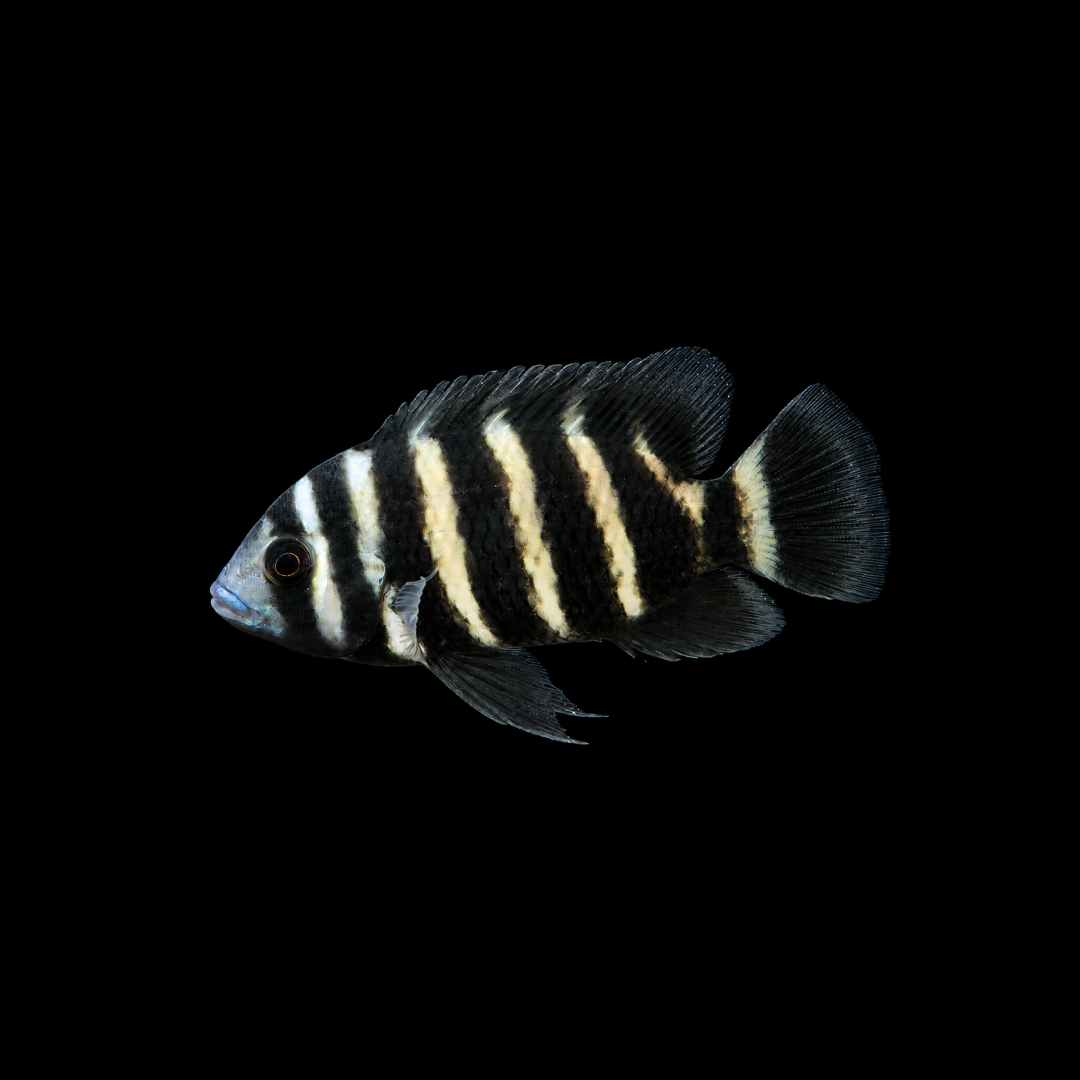
解説 / Description
ヘテロティラピア・ブティコフェリーは、西アフリカの大きな河川下流域に生息する大型のシクリッドです。明るい黄白色の地色に幅広い黒色の縦縞が入る姿は非常に印象的で、幼魚から成魚まで強い存在感を放ちます。一方で、成長すると標準体長30cm前後に達し、縄張り意識も非常に強くなるため、見た目の美しさだけで気軽に迎えられる魚ではありません。強い遊泳力、底砂やレイアウトを動かす力、豊富な排泄量まで含めて受け止められる大型設備が必要です。十分な空間と管理体制を整えれば、飼育者の動きに反応し、力強い行動や繁殖時の親魚による子育てまで観察できる、個性豊かな大型魚です。 Heterotilapia buettikoferi is a large West African cichlid native to the lower reaches of major rivers. Its pale yellow to whitish body crossed by broad black vertical bars gives it a striking appearance from juvenile to adult stages. However, this is not a fish to purchase for looks alone. Adults can approach 30 cm in standard length, become intensely territorial, produce a heavy biological load, and are powerful enough to move substrate and aquarium furnishings. With a suitably large aquarium, robust filtration, and careful long-term planning, it becomes an exceptionally charismatic fish whose strong behavior, recognition of routine, and biparental breeding care can be fascinating to observe.
基本情報 / Basic Information
| 学名 / Scientific Name | Heterotilapia buettikoferi (Hubrecht, 1881) |
|---|---|
| 通称 / Common Name | ティラピア・ブティコフェリー、ティラピア・ブチコヘリー、ゼブラ・ティラピア、バチコフェリーZebra tilapia |
| 分類 / Family | シクリッド科(Cichlidae)/Pseudocrenilabrinae亜科/Heterotilapiini族Cichlidae / Pseudocrenilabrinae / Heterotilapiini |
| 英名 / English Name | Zebra tilapia |
| 分布 / Distribution | 西アフリカ。ギニアビサウのゲバ川・コルバル川周辺から、ギニア、シエラレオネを経てリベリア西部のセントジョン川にかけての沿岸河川下流域が自然分布域です。原産地外では一部地域で導入・定着例があります。West Africa. Its native range extends through the lower reaches of coastal rivers from the Geba and Corubal river systems in Guinea-Bissau, through Guinea and Sierra Leone, to the St. John River area of western Liberia. Introduced populations have also been recorded outside its native range. |
| 最大体長 / Max Size | 標準体長で最大約30.8cm。飼育下でも30cm級に成長する大型種として扱い、体高や体厚を含めた十分な遊泳空間を確保します。Up to about 30.8 cm standard length. In aquaria it should be planned for as a fish capable of reaching the 30 cm class, with ample room for its deep, robust body. |
| 寿命 / Lifespan | 飼育下では10年前後から10年以上生きることが見込まれる長寿の大型魚です。ただし、本種だけを対象とした厳密な寿命統計は乏しく、飼育環境や栄養状態によって大きく変わります。A long-lived large cichlid that can be expected to live around a decade or longer under good captive conditions. Precise species-specific lifespan statistics are limited, and longevity varies with husbandry and nutrition. |
飼育環境 / Aquarium Environment
| 水槽サイズ / Tank Size | 終生飼育では単独でも最低120cmワイド水槽(120×60×60cm、約430L)を目安とします。混泳を検討する場合は180cmクラス(180×60×60cmで約650L)以上を基本とし、相手が逃げられる距離と視線を切る構造を確保します。大型水槽は総重量が非常に大きくなるため、床荷重や設置面の強度も事前に確認してください。For lifelong single-specimen care, use at least a 120 cm wide-format aquarium, about 120 × 60 × 60 cm or roughly 430 L. If tank mates are attempted, an aquarium in the 180 cm class, such as 180 × 60 × 60 cm or about 650 L, should be considered a starting point, with enough distance and visual barriers for other fish to retreat. The total installed weight of such systems is substantial, so floor loading and structural support must be checked in advance. |
|---|---|
| 水温 / Temperature | 24~28℃を中心に安定させるのが管理しやすい範囲です。短期的にはより広い温度域に耐える丈夫さがありますが、急変や低温での長期飼育は避けます。 A stable range of about 24–28°C is practical for aquarium care. The species is physiologically hardy and may tolerate a broader range for short periods, but prolonged chilling and sudden temperature changes should be avoided. |
| 水質 / Water Quality | 弱酸性から弱アルカリ性まで比較的幅広く適応し、pH6.5~8.0程度を目安にできます。数値そのものより急変を避けることが重要です。大型化すると排泄量が多いため、強力な物理濾過と生物濾過を組み合わせ、定期的な換水で硝酸塩や溶存有機物の蓄積を抑えます。It adapts to a fairly broad range from mildly acidic to mildly alkaline water, with roughly pH 6.5–8.0 being a practical target. Stability is more important than chasing an exact number. Large adults produce considerable waste, so strong mechanical and biological filtration should be combined with regular water changes to limit nitrate and dissolved organic accumulation. |
| レイアウト / Layout | ベアタンク、または大粒の砂利を薄く敷いた管理重視のレイアウトが向きます。底砂を掘り返し、水草を抜き、石や流木を動かすことがあるため、岩組みや流木は崩れないよう確実に固定します。大型の土管や洞窟状のシェルターを用い、視線を遮る配置にすると縄張り争いを緩和しやすくなります。A bare-bottom setup or a thin layer of coarse gravel is often the most practical. This fish digs, uproots plants, and may move stones or wood, so all heavy structures must be securely stabilized. Large caves, pipes, and solid shelters can be used to break lines of sight and reduce territorial pressure. |
| 注意点 / Precautions | 非常に強い縄張り性と物理的な力を持ち、特に繁殖期は攻撃性が高まります。小型魚は捕食対象となり、同程度の大型魚にも執拗に攻撃する個体がいます。ヒーターや吸水管などの機材は体当たりで破損しないよう保護し、可能ならヒーターを濾過槽側へ隔離します。大型水槽を用意しても混泳が成立しない個体がいるため、隔離用の仕切りや予備水槽を準備しておくと安全です。野外への放流は絶対に行わず、終生飼養を前提に迎えてください。This species is extremely territorial and physically powerful, with aggression often intensifying during breeding. Small fish may be eaten, while even similarly sized fish can be relentlessly attacked by some individuals. Protect heaters, intakes, and other equipment from impact; where possible, place the heater in a sump or protected filtration chamber. Even very large aquaria cannot guarantee compatibility, so dividers or a backup aquarium should be available. Never release this fish outdoors, and acquire it only with a lifelong care plan. |
餌と給餌 / Feeding
| 餌の種類 / Diet | 雑食性です。大型シクリッド用の高品質なペレットを主食とし、スピルリナなど植物質を含む配合飼料、加熱または衛生的に処理した葉野菜やズッキーニ、冷凍アカムシ、ブラインシュリンプ、ミミズなどを補助的に組み合わせます。野生では植物質、藻類、デトリタス、水生無脊椎動物など幅広い餌資源を利用します。Omnivorous. Use a high-quality large-cichlid pellet as the staple and supplement it with foods containing plant material such as spirulina, hygienically prepared leafy vegetables or zucchini, frozen bloodworms, brine shrimp, and earthworms. In the wild it uses a broad range of resources including plant matter, algae, detritus, and aquatic invertebrates. |
|---|---|
| 給餌のポイント / Feeding Tips | 食欲が強いため、欲しがるだけ与えないことが重要です。成魚は1日1~2回、短時間で食べ切る量を基本にし、植物質を含む餌も組み合わせて栄養の偏りを防ぎます。残餌は大型魚水槽の水質を急速に悪化させるため速やかに除去します。生きた小魚を常用する必要はなく、病原体の持ち込みや栄養の偏りを避ける意味でも配合飼料中心が安全です。Its appetite is strong, so avoid feeding simply because the fish continues to beg. For adults, one or two controlled meals per day that are consumed quickly are generally sufficient, with plant-containing foods included for balance. Remove leftovers promptly because waste can rapidly degrade water quality in a large-fish aquarium. Routine use of live feeder fish is unnecessary and may introduce pathogens or nutritional imbalance, making formulated diets a safer foundation. |
性格と混泳 / Temperament and Tank Mates
| 性格 / Temperament | 非常に強気で縄張り性が高いシクリッドです。底砂を掘り、物を移動させ、自分の行動圏を作り替える傾向があります。個体差はあるものの、成熟個体や繁殖ペアでは攻撃性が極端に高まることがあり、飼育者が水槽内へ手を入れる際にも注意が必要です。一方で、給餌時間や人の接近に反応しやすく、長期飼育では個体ごとの行動パターンがはっきり見えてきます。A very assertive and highly territorial cichlid. It digs, relocates objects, and actively remodels its living space. Individual temperament varies, but mature adults and breeding pairs can become exceptionally aggressive, requiring caution even during aquarium maintenance. At the same time, it readily responds to feeding routines and human approach, and long-term keepers often observe clear individual behavioral patterns. |
|---|---|
| 混泳の相性 / Compatibility | 基本は単独飼育が最も安全です。小型魚や細身の魚は捕食・攻撃される危険が高く、同種同士も激しく争うことがあります。混泳を試す場合は180cmクラス以上の大型水槽を用意し、同等以上の体格と耐久力を持つ大型魚だけを候補とし、十分な隠れ場所と視線遮断を作ります。それでも相性は個体依存で、突然関係が崩れることがあるため、即座に隔離できる体制が必要です。Single-specimen keeping is the safest default. Small or slender fish are at high risk of predation or attack, and conspecifics may also fight severely. If tank mates are attempted, use an aquarium in the 180 cm class or larger, consider only comparably robust large fish, and provide substantial refuge and visual separation. Compatibility remains highly individual and can deteriorate suddenly, so immediate separation must always be possible. |
病気と対策 / Diseases and Prevention
| かかりやすい病気 / Common Diseases | 本種だけに特異的に多い病気について確立した情報は多くありません。一般的な淡水魚と同様に、白点病などの外部寄生虫症、闘争やレイアウトへの接触で生じた外傷からの二次的な細菌感染、過食や偏食に伴う消化器トラブルに注意します。大型魚では病気そのものより、水質悪化や外傷が発症のきっかけになることも少なくありません。There is limited evidence for any disease uniquely common to this species. As with other freshwater fish, watch for external parasitic diseases such as ich, secondary bacterial infection following fighting or impact injuries, and digestive problems associated with overfeeding or an unbalanced diet. In large cichlids, declining water quality and physical injury are often important triggers for illness. |
|---|---|
| 対策と予防 / Prevention | 新規導入魚は可能な限り隔離観察し、水温と水質の急変を避けます。強力な濾過と定期換水を維持し、硝酸塩の蓄積を抑えることが基本です。傷が増えた場合は混泳相手との関係やレイアウトを見直し、必要なら直ちに隔離します。治療薬は症状を特定してから選び、大型魚では薬量計算の基準となる実水量を把握しておくことも重要です。Quarantine and observe new fish whenever possible, and avoid sudden changes in temperature or water chemistry. Maintain powerful filtration and regular water changes to control nitrate and organic waste. If injuries become frequent, reassess tank mates and layout and separate fish immediately when necessary. Select medications only after identifying the likely condition, and know the aquarium’s actual water volume so dosing can be calculated accurately. |
増やし方(繁殖) / Breeding
| 雌雄の判別 / Sexing | 成熟個体では、オスの方が大型化しやすく、背鰭・臀鰭の後端が尖って伸びる傾向がありますが、外見だけでの判別は確実ではありません。繁殖可能なサイズでは腹部の生殖突起を観察する方法がより確実で、オスは細く尖り、メスはより太く丸みを帯びる傾向があります。幼魚期の判別は難しいため、外形だけで断定しない方が安全です。Mature males often grow larger and may develop more pointed, extended tips to the dorsal and anal fins, but external appearance alone is not fully reliable. In breeding-size fish, examination of the genital papilla is more dependable: males tend to have a narrower, more pointed papilla, while females have a broader, rounder one. Juveniles are difficult to sex accurately, so visual traits should not be treated as definitive. |
|---|---|
| 繁殖形態 / Reproduction | 基質産卵型で、強いペア関係を形成し、岩や平らな面などを清掃して粘着性の卵を産み付けます。雌雄の親魚がともに卵と稚魚を守る双親保護を行い、産卵後は縄張り防衛が非常に激しくなります。条件が整えば周年繁殖する可能性があります。A substrate-spawning cichlid that forms a strong pair bond. The pair cleans rock or another firm surface and lays adhesive eggs on it. Both parents defend the eggs and fry, and territorial aggression becomes especially intense after spawning. Under favorable conditions, breeding may occur throughout the year. |
| 繁殖のポイント / Breeding Tips | 相性の良い成熟ペアを確保し、少なくとも120cmクラスの繁殖専用水槽を用意するのが安全です。平らな石や大型の素焼き鉢など産卵面を準備し、水温は28℃前後を目安に安定させます。産卵後は他魚を入れず、フィルター吸水口には稚魚吸い込み防止のメッシュを取り付けます。自由遊泳を始めた稚魚には沸かしたてのブラインシュリンプ幼生や細かく砕いた稚魚用飼料を与えます。親魚は熱心に保護しますが、親子の関係が崩れた場合に備えて稚魚を移せる育成水槽も準備しておきます。Use a compatible mature pair and, for safety, provide a dedicated breeding aquarium of at least the 120 cm class. Offer a flat stone, large terracotta pot, or other suitable spawning surface and keep the temperature stable at around 28°C. Do not keep other fish with a spawning pair, and cover filter intakes with fine mesh to protect fry. Once free-swimming, the young can be fed newly hatched brine shrimp and finely crushed fry food. The parents are attentive, but a separate rearing aquarium should be ready in case parental behavior changes. |
雑学と豆知識 / Trivia and Fun Facts
| 1. 学名の綴りに残る、ひとりの博物学者の名前 / 1. A naturalist’s name preserved in the scientific spelling | 本種は1881年、オランダの動物学者HubrechtによってChromis buttikoferiとして記載されました。種小名は、西アフリカで標本採集に関わったスイスの動物学者Johann Büttikoferに献名されたものです。現在の主要な魚類分類データベースでは、ドイツ語の姓に含まれる「ü」を国際的な綴りへ置き換えたbuettikoferiが有効な綴りとして扱われています。そのため、観賞魚の世界で長く親しまれてきたbuttikoferiという表記と、現在の有効名Heterotilapia buettikoferiが並んで見つかることがあります。名前のわずかな違いの背後には、100年以上にわたる命名規約と分類研究の積み重ねがあります。The species was described by Hubrecht in 1881 as Chromis buttikoferi, with the species name honoring the Swiss zoologist Johann Büttikofer, who worked in West Africa. Major modern fish-taxonomy databases now treat buettikoferi as the valid spelling, reflecting the standardized rendering of the German letter “ü.” This is why aquarists may encounter both the long-familiar buttikoferi spelling and the currently accepted name Heterotilapia buettikoferi. A tiny difference in spelling carries more than a century of nomenclatural history. |
|---|---|
| 2. 「ティラピア」から独立した、小さな属の一員 / 2. From “Tilapia” to a small, distinct genus | 長い間、本種はTilapia buttikoferiとして知られていました。しかし、アフリカ産シクリッドの分子系統研究が進むと、かつて「ティラピア」と呼ばれていた魚たちがひとつの自然な系統群ではないことが明らかになりました。DunzとSchliewenが2013年に発表した包括的な研究では、複数のミトコンドリア遺伝子と核遺伝子を用いて旧ティラピア類の系統関係が再検討され、本種を含むHeterotilapiaが独立した属として整理されました。現在この属に認められるのは本種とHeterotilapia cessianaの2種で、かつて巨大だった「ティラピア」という名前の中から切り出された、比較的小さな系統です。For many years this fish was known as Tilapia buttikoferi. As molecular studies of African cichlids progressed, however, the fishes once grouped together under “Tilapia” were shown not to form a single natural lineage. A major 2013 study by Dunz and Schliewen re-examined these relationships using multiple mitochondrial and nuclear genes and recognized Heterotilapia as a distinct genus. Today the genus contains only two recognized species, H. buettikoferi and H. cessiana, making it a relatively small lineage carved from the formerly broad concept of “Tilapia.” |
| 3. 喉の奥にある「第二の顎」 / 3. A second set of jaws deep in the throat | シクリッドの繁栄を語るとき、しばしば登場するのが咽頭顎です。私たちが普通に「口」と呼ぶ顎とは別に、喉の奥には餌を砕くための歯を備えた構造があります。本種では下咽頭骨が幅広く、中央部の歯が側方の歯より大きく発達することが形態的特徴のひとつです。口の顎で餌を捕らえ、喉の奥でさらに処理するという役割分担は、植物質から硬い無脊椎動物まで多様な餌を利用するシクリッドの柔軟な食生活を支えてきました。水槽で人工飼料を力強く砕く姿にも、その進化の一端を見ることができます。One of the structures often discussed when explaining cichlid success is the pharyngeal jaw. Separate from the oral jaws we normally think of as the mouth, cichlids possess a tooth-bearing apparatus deeper in the throat that helps process food. In this species, the lower pharyngeal bone is broad and the central teeth are enlarged relative to those at the sides. Capturing food with the oral jaws and processing it farther back in the throat helps cichlids exploit a remarkably diverse diet, from plant matter to hard-bodied invertebrates. Even the forceful way an aquarium specimen crushes pellets hints at this evolutionary specialization. |
| 4. 水槽の景色を自分で作り替える「ブルドーザー」 / 4. The “bulldozer” that redesigns its own aquarium | 飼育者がきれいに整えた底砂が翌朝には山になり、軽い石が別の場所へ移動していることがあります。これは単なる気まぐれではなく、縄張りを整え、産卵場所や通路を確保するシクリッドらしい行動の延長です。その力強さから、本種は英語圏のアクアリストの間でしばしばブルドーザーに例えられます。水草レイアウトとの相性が悪いのは欠点とも言えますが、魚自身が環境へ働きかける様子を観察できるという意味では、本種らしさが最もよく表れる行動のひとつです。A carefully leveled substrate may become a mound overnight, while light stones appear somewhere entirely different. This is not random mischief so much as an extension of typical cichlid behavior: shaping territory, clearing routes, and preparing potential spawning areas. Because of this physical determination, aquarists often compare the species to a bulldozer. It is certainly a poor match for delicate planted layouts, yet the same behavior makes it fascinating to watch as the fish actively modifies its environment rather than simply inhabiting it. |
| 5. 卵を産んだ後こそ始まる、両親の共同作業 / 5. The real teamwork begins after the eggs are laid | ティラピアの仲間というと、口の中で卵を育てるマウスブルーダーを思い浮かべる人も多いかもしれません。しかし本種は、岩などの表面に卵を産み付ける基質産卵型です。興味深いのは、その後に雌雄がそろって卵と稚魚を守ることです。片方が産卵床の近くで卵を世話し、もう片方が周囲を警戒するような役割分担が見られ、稚魚が泳ぎ始めると家族単位の防衛はさらに目立つようになります。普段の攻撃性が、繁殖期には子を守るための徹底した防衛行動として現れるのです。Many aquarists associate tilapia-like cichlids with mouthbrooding, but this species is a substrate spawner that lays eggs on solid surfaces such as rock. What becomes especially interesting is what happens afterward: both parents participate in guarding the eggs and fry. One parent may remain closer to the clutch while the other patrols the surrounding territory, and family defense becomes even more conspicuous once the fry begin swimming. The same aggression that complicates community keeping is transformed during breeding into remarkably determined parental defense. |
| 6. 強さを楽しむには、閉じた水槽の中で / 6. Its toughness belongs inside a controlled aquarium | 本種の丈夫さ、雑食性、強い縄張り性、両親による繁殖保護は、原産地では生き抜くための優れた能力です。しかし、その性質は原産地外へ持ち込まれたときには在来生物との競争につながる可能性があります。日本では国立環境研究所の侵入生物データベース個別ページで国内未定着とされていますが、温暖な水域や温排水環境へ放流された場合のリスクを軽視することはできません。30cm級まで育った魚を最後まで飼い続ける設備と覚悟を持つことが、本種の魅力を責任ある形で楽しむための大前提です。Its hardiness, omnivorous diet, strong territoriality, and intensive parental care are excellent survival traits in its native habitat. Outside that habitat, however, the same traits can create competition with native species. Japan’s National Institute for Environmental Studies currently lists the species as not established domestically on its individual invasive-species database page, but the risk of release into warm waters or thermally influenced habitats should not be dismissed. Responsible enjoyment of this powerful fish begins with having the equipment and commitment to care for a 30 cm-class cichlid for its entire life. |
まとめ / Conclusion
ヘテロティラピア・ブティコフェリーは、白黒の大胆な縞模様だけでなく、環境を自ら作り替えるほどの力強さ、縄張りを守る強い意志、そして繁殖期に見せる熱心な子育てまで、シクリッドらしい行動を濃密に感じられる大型魚です。小さな幼魚の姿からは想像しにくいほど大きく、強く成長するため、120cmワイド水槽以上の設備、強力な濾過、機材の保護、そして混泳を無理に成立させない判断力が求められます。 Heterotilapia buettikoferi offers far more than bold black-and-white bars. Its strength, habit of reshaping its surroundings, intense territorial behavior, and dedicated parental care all display the classic behavioral richness of large cichlids. The small juvenile seen in a shop can grow into a powerful 30 cm-class fish, so a 120 cm wide-format aquarium or larger, heavy-duty filtration, protected equipment, and the willingness to abandon unsafe community combinations are essential.
十分な空間を与え、単なる「丈夫な魚」としてではなく、一匹の大型シクリッドとして長期的に向き合うと、その魅力は年齢とともに深まっていきます。飼育者の気配に反応し、自分の縄張りを築き、時には水槽の景色まで変えてしまう姿は、観賞するだけの魚とは違う濃い付き合いを感じさせます。その力強さを水槽という安全な環境の中で最後まで受け止めることができれば、長い年月をともに過ごせる印象深いパートナーになります。 Given enough space and treated not merely as a “hardy fish” but as a large cichlid requiring long-term commitment, its appeal often deepens with age. It responds to its keeper, establishes and defends its territory, and may even redesign the aquarium around itself, creating a relationship that feels more interactive than simple display keeping. When its strength can be responsibly contained and supported for life, it can become a memorable companion for many years.

気になる道具や飼い方を見つけてみませんか?
 アイのアクアグッズ案内水槽用ヒーターの選び方|固定式・温度調節式と、水量に合うW数の考え方水槽の魚は冬に寒くない? アイとコタロウが水温計から固定式・温度調節式・分離式ヒーターまで比較。水量と室温に合うW数、設置場所、水換えや交換の注意点を、国内メーカーの商品とともに紹介します。記事はコチラ →
 アイのアクアグッズ案内海水魚初心者の必需品|水槽・人工海水・比重計・水質検査道具の特徴や使い方、選ぶときのポイントをアイが紹介します。記事はコチラ →
 アイのアクアグッズ案内金魚を長く楽しむ飼育用品|水槽・フィルター・エアレーション・水換え道具の特徴や使い方、選ぶときのポイントをアイが紹介します。記事はコチラ →
 アイのアクアグッズ案内海水魚の底砂の選び方|サンゴ砂・ライブサンドとおすすめ商品道具の特徴や使い方、選ぶときのポイントをアイが紹介します。記事はコチラ →
さまざまな飼育テーマをご紹介。リンク先の記事には広告・商品紹介が含まれます。
案内・紹介記事一覧へ →分布マップ
西アフリカのギニアビサウにあるゲバ川・コルバル川周辺から、ギニア、シエラレオネを経て、リベリア西部のセントジョン川周辺までの沿岸河川下流域に自然分布します。
※この地図は記事に記載された自然分布域をもとにした概略表示です。分布欄に緯度・経度の記載がないため、表示範囲とマーカー位置は分布地域全体を把握しやすいよう設定しています。マーカーは代表地点を示すためのもので、実際の採集地点や正確な生息地点を示すものではありません。
参考文献
- California Academy of Sciences. Eschmeyer’s Catalog of Fishes: Genera, Species, References. “Heterotilapia buettikoferi (Hubrecht, 1881).” Online version, updated 7 July 2026. California Academy of Sciences
- Dunz, A. R. & Schliewen, U. K. (2013). Molecular phylogeny and revised classification of the haplotilapiine cichlid fishes formerly referred to as “Tilapia”. Molecular Phylogenetics and Evolution, 68(1), 64–80. doi:10.1016/j.ympev.2013.03.015
- Teugels, G. G. & Thys van den Audenaerde, D. F. E. (2003). Cichlidae. In D. Paugy, C. Lévêque & G. G. Teugels (eds.), The Fresh and Brackish Water Fishes of West Africa, Vol. 2, pp. 521–600. IRD, Muséum national d’Histoire naturelle & Musée royal de l’Afrique centrale. FishBase reference record
- Froese, R. & Pauly, D. (eds.) (2026). FishBase. “Heterotilapia buettikoferi (Hubrecht, 1881).” World Wide Web electronic publication, version 02/2026. FishBase species summary
- Lamboj, A. (2004). The Cichlid Fishes of Western Africa. Birgit Schmettkamp Verlag, Bornheim, Germany, 255 pp. FishBase bibliographic record
- Werner, U. (2023). The Zebra Tilapia: Heterotilapia buettikoferi. AMAZONAS Magazine, 12(2), 38–47. AMAZONAS Magazine
- Pariselle, A. & Euzet, L. (1998). Five new species of Cichlidogyrus (Monogenea: Ancyrocephalidae) from Tilapia brevimanus, T. buttikoferi and T. cessiana from Guinea, Ivory Coast and Sierra Leone (West Africa). Folia Parasitologica, 45(4), 275–282. Folia Parasitologica
- Merck Veterinary Manual. Aquarium fish health and husbandry: Management of Aquarium Fish / Parasitic Diseases of Fish / Bacterial Diseases of Fish.
- U.S. Geological Survey. Nonindigenous Aquatic Species Database. “Zebra tilapia (Tilapia buttikoferi) — Species Profile.” USGS Nonindigenous Aquatic Species Database




コメント