

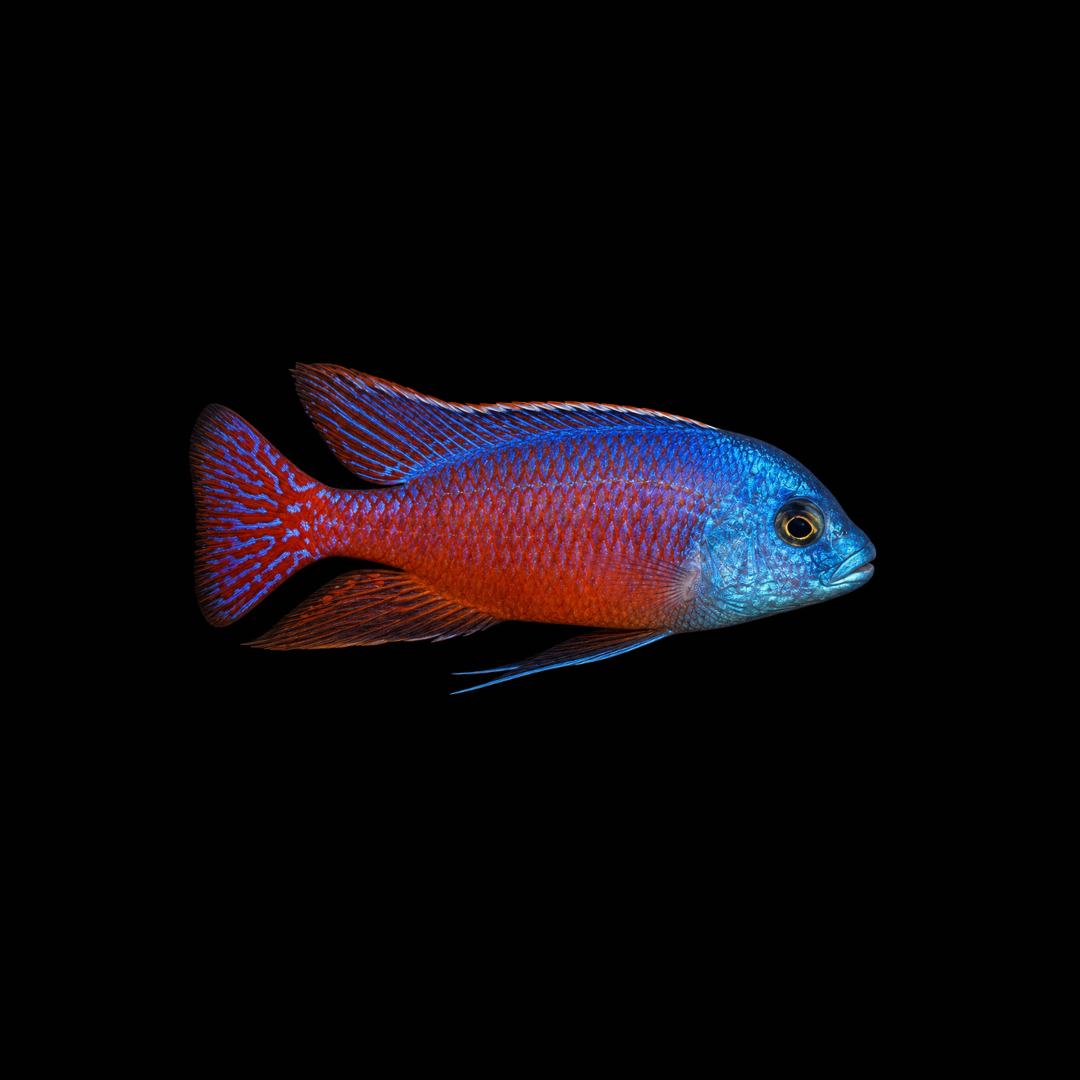
解説 / Description
プロトメラス・タエニオラータスは、マラウイ湖の岩礁域に生息する非ムブナ系のアフリカンシクリッドです。成熟した優位なオスは、頭部から背部にかけて金属光沢のある青緑色をまとい、体側から腹部には鮮やかな赤色やオレンジ色が広がります。この華やかな姿から、英語圏では「レッド・エンプレス」の名で親しまれています。一方、幼魚やメスは銀灰色から灰褐色を基調とし、体側に黒い水平線と不完全な縦帯を備えます。成長と社会的順位によって外見が大きく変わることも、本種ならではの魅力です。 Protomelas taeniolatus is a non-mbuna African cichlid that inhabits rocky areas of Lake Malawi. A mature dominant male develops a metallic blue-green head and back, while vivid red to orange coloration spreads across the flanks and belly. This striking appearance has earned it the popular name “Red Empress.” Juveniles and females, by contrast, are silver-gray to gray-brown, with a dark horizontal stripe crossed by incomplete vertical bars. Its dramatic change in appearance with growth and social status is one of the species’ most fascinating qualities.
基本情報 / Basic Information
| 学名 / Scientific Name | Protomelas taeniolatus |
|---|---|
| 通称 / Common Name | レッド・エンプレス、HAPL.タエニオラータス、ハプロ・タエニオラータスRed Empress, Haplo taeniolatus |
| 分類 / Family | シクリッド科・アフリカンシクリッド亜科・ハプロクロミス族・プロトメラス属Family Cichlidae, subfamily Pseudocrenilabrinae, tribe Haplochromini, genus Protomelas |
| 英名 / English Name | Red Empress |
| 分布 / Distribution | アフリカ東部のマラウイ湖。主に水深約5〜15mの、堆積物が少ない岩礁沿岸に分布します。Lake Malawi in East Africa, mainly along relatively clean rocky shores at depths of approximately 5–15 m. |
| 最大体長 / Max Size | オスは約15〜20cm、メスは約13〜15cm。Males approximately 15–20 cm; females approximately 13–15 cm. |
| 寿命 / Lifespan | 飼育下の寿命について確立した数値情報は乏しいものの、安定した水質と適切な食事を維持すれば長期飼育が期待できます。A firmly established numerical lifespan is not well documented, but long-term care can be expected when stable water conditions and an appropriate diet are maintained. |
飼育環境 / Aquarium Environment
| 水槽サイズ / Tank Size | 成魚をゆとりを持って飼育するなら90cm規格水槽以上を目安とし、オス1匹とメス複数匹のハレム飼育や中型シクリッドとの混泳では、120cmワイド水槽など約300Lを確保できる環境が適しています。A standard 90 cm aquarium or larger is a practical minimum for an adult. For a harem of one male with several females or a community of medium-sized cichlids, a wide 120 cm aquarium providing around 300 L is preferable. |
|---|---|
| 水温 / Temperature | 24〜28℃。夏季は高水温による酸欠を避けるため、水面の撹拌、冷却ファン、水槽用クーラーなどを用いて管理します。 24–28°C. During hot weather, use strong surface agitation, a cooling fan, or an aquarium chiller to reduce the risk of oxygen depletion. |
| 水質 / Water Quality | 弱アルカリ性の硬水を好み、目安はpH 7.5〜8.5、GH 10〜25 dGH、KH 8〜12です。日本の軟水ではpHが下がりやすいため、サンゴ砂などを利用して緩衝力を補い、急変を避けます。Prefers alkaline, mineral-rich water. Suggested parameters are pH 7.5–8.5, GH 10–25 dGH, and KH 8–12. In soft water, crushed coral or coral sand can help maintain buffering capacity and prevent sudden pH decline. |
| レイアウト / Layout | サンゴ砂を底床に用い、背面や側面へ安定した岩組みを設けます。縄張りの目印と逃げ場を作りながら、中央から前面には広い遊泳空間を残すことが大切です。岩は掘り返しによって崩れないよう、底面へ確実に固定します。Use coral sand as the substrate and build secure rockwork along the back and sides. Provide visual boundaries and retreats while leaving a broad open swimming area through the center and front. Rocks must be firmly stabilized so digging cannot cause a collapse. |
| 注意点 / Precautions | 水質を酸性側へ傾けるソイルは適しません。強いろ過と十分な酸素供給を行い、過密飼育や硝酸塩の蓄積を避けます。オス同士や繁殖期の個体は縄張り争いを起こすため、隠れ家と視線を遮る岩組みを用意してください。Acidifying soil substrates are unsuitable. Provide strong filtration and ample oxygen, and avoid overcrowding or nitrate accumulation. Males and breeding fish may become territorial, so include retreats and rock structures that interrupt lines of sight. |
餌と給餌 / Feeding
| 餌の種類 / Diet | スピルリナなどを配合した植物質主体のシクリッド用ペレットを主食にします。補助的にミジンコ、冷凍イサザアミ、茹でたズッキーニなどを少量与えられます。赤色やオレンジ色の発色を支えるため、アスタキサンチン配合飼料を週1〜2回取り入れる方法もあります。Use a plant-rich cichlid pellet containing ingredients such as spirulina as the staple food. Small amounts of daphnia, frozen mysis shrimp, or blanched zucchini may be offered as supplements. A food containing astaxanthin can be used once or twice weekly to support red and orange coloration. |
|---|---|
| 給餌のポイント / Feeding Tips | 一度に大量に与えず、短時間で食べ切れる量を分けて与えます。高脂肪の餌や赤虫など動物質に偏った食事は消化不良や腹部膨満につながるおそれがあるため、常用を避けます。体色だけを目的に色揚げ飼料へ偏らず、消化しやすい植物質とのバランスを優先してください。Feed modest portions that are consumed quickly rather than one large meal. Avoid a diet dominated by high-fat foods or bloodworms, as excessive animal protein may contribute to digestive trouble and abdominal swelling. Color-enhancing foods should remain supplementary to a balanced, easily digested plant-based diet. |
性格と混泳 / Temperament and Tank Mates
| 性格 / Temperament | アフリカンシクリッドの中では比較的温和ですが、成熟したオスは縄張りを持ち、繁殖期には同種や似た体色の魚を追うことがあります。十分な空間がない環境では、弱い個体が継続的に圧迫されることがあります。Relatively peaceful for an African cichlid, but mature males establish territories and may chase conspecifics or similarly colored fish during breeding. In cramped conditions, subordinate fish may be subjected to persistent pressure. |
|---|---|
| 混泳の相性 / Compatibility | コパディクロミス属、プラキドクロミス属、アウロノカラ属など、同程度の大きさで比較的温和な非ムブナ系との混泳に向きます。攻撃性の強いムブナ、小型魚、稚魚との同居は避けます。近縁のプロトメラス属とは交雑する可能性があるため、血統を維持する場合は別飼育が安全です。Suitable companions include similarly sized and relatively calm non-mbuna cichlids such as Copadichromis, Placidochromis, and Aulonocara species. Avoid highly aggressive mbuna, very small fish, and fry. Closely related Protomelas species may hybridize, so separate housing is safest when maintaining a pure line. |
病気と対策 / Diseases and Prevention
| かかりやすい病気 / Common Diseases | 特に注意したいのは、食欲低下、白い糸状の糞、腹部の異常な膨らみなどを伴う「マラウイ・ブロート」と呼ばれる腹部膨満症状です。水質悪化、強いストレス、消化しにくい動物質中心の食事が重なると発症リスクが高まります。栄養の偏りや長期的な水質悪化に関連して、頭部穴あき症状が見られることもあります。The main concern is the abdominal swelling syndrome commonly called “Malawi bloat,” which may involve loss of appetite, white stringy feces, lethargy, and a distended abdomen. Risk increases when poor water quality, severe stress, and an overly rich animal-protein diet occur together. Pitting around the head may also appear in association with nutritional imbalance or prolonged water-quality problems. |
|---|---|
| 対策と予防 / Prevention | 植物質中心の給餌を守り、週1回を目安に水量の3分の1〜2分の1を換水して、硝酸塩を20mg/L以下に維持します。新しい魚は隔離観察を行い、食欲、糞、腹部の形、呼吸の変化を早期に確認します。症状が進行した場合は自己判断で薬を重ねず、魚病に対応できる専門家へ相談してください。Maintain a plant-centered diet and change roughly one-third to one-half of the water each week, keeping nitrate below 20 mg/L. Quarantine new fish and watch for early changes in appetite, feces, abdominal shape, and breathing. If symptoms progress, avoid combining medications without guidance and consult a professional experienced with fish disease. |
増やし方(繁殖) / Breeding
| 雌雄の判別 / Sexing | 成熟した優位なオスは青緑色の頭部と赤〜オレンジ色の体側を示し、背鰭や臀鰭の縁にも暖色が現れます。メスは銀灰色から灰褐色で、黒い水平線と不完全な縦帯が目立ちます。約4cmで流通する幼魚は雌雄差がほとんど現れず、外見だけでの判別は困難です。A mature dominant male develops a blue-green head, red to orange flanks, and warm-colored edging on the dorsal and anal fins. Females remain silver-gray to gray-brown with a dark horizontal stripe and incomplete vertical bars. Juveniles sold at around 4 cm show little sexual differentiation and are difficult to sex by appearance alone. |
|---|---|
| 繁殖形態 / Reproduction | 母系口内保育型です。オスが砂地のくぼみや平らな岩面へメスを誘い、メスは産み落とした卵を口に回収します。オスの臀鰭にある卵状斑をついばもうとする動きの中で受精が成立し、その後はメスが口内で卵と稚魚を保護します。A maternal mouthbrooder. The male guides a female to a shallow nest in the sand or a cleaned flat rock. The female collects the eggs in her mouth, and fertilization occurs as she responds to the egg-like spots on the male’s anal fin. She then protects the eggs and developing fry inside her buccal cavity. |
| 繁殖のポイント / Breeding Tips | オス1匹に対してメスを複数匹用意すると、求愛による負担が分散しやすくなります。1回に約20〜60個の卵を抱え、水温26℃前後では約21〜28日間の口内保育が目安です。保育中のメスは摂食を止めて体力を消耗するため、追い回される場合は静かな別水槽へ移します。産地系統を維持する場合は、異なる地域型や近縁種との交雑を避けてください。Keeping several females with one male can distribute courtship pressure. A female may hold approximately 20–60 eggs, with mouthbrooding lasting about 21–28 days at around 26°C. Because she stops feeding and loses condition while holding, move her to a quiet separate aquarium if she is being harassed. To preserve a locality line, prevent crosses with other geographic variants or related species. |
雑学と豆知識 / Trivia and Fun Facts
| 1. 旧名が今も残る「HAPL.」表記 / 1. Why the Old “HAPL.” Label Survives | 本種は1935年、エセルウィン・トレワヴァスによってHaplochromis taeniolatusとして記載されました。1989年の分類再編でProtomelas属へ移されましたが、日本の流通現場では旧属名を略した「HAPL.」が商品分類として定着しています。店頭で「HAPL.タエニオラータス」と書かれていても、現在の学名ではプロトメラス属に置かれる魚です。学術名が変わっても、長く使われた商業名が生き続けるという、観賞魚流通ならではの歴史が感じられます。The species was described by Ethelwynn Trewavas in 1935 as Haplochromis taeniolatus. It was transferred to the genus Protomelas during a major taxonomic revision in 1989, yet the abbreviation “HAPL.” remains deeply established in the Japanese aquarium trade. A fish labeled “HAPL. taeniolatus” in a shop is therefore a Protomelas species under current classification. It is a vivid example of how commercial names can preserve an older scientific history. |
|---|---|
| 2. 属名に刻まれた黒い模様 / 2. The Dark Pattern Hidden in the Genus Name | Protomelasという属名は、ギリシャ語で「最初の、原始の」を意味するprotosと、「黒い」を意味するmelasまたはmelanosに由来します。成熟したオスの華やかな赤や青だけを見ていると意外ですが、幼魚やメスに現れる黒い水平線と縦帯こそ、この仲間を理解する重要な手がかりです。鮮烈な婚姻色の奥には、岩場と砂地へ溶け込むために受け継がれた、控えめで実用的な色彩設計が隠されています。The genus name Protomelas derives from the Greek protos, meaning “first” or “primitive,” and melas or melanos, meaning “black.” This may seem surprising when looking only at a brilliantly colored adult male, but the dark horizontal stripe and vertical bars of juveniles and females are important clues to the group’s identity. Beneath the spectacular breeding colors lies a restrained, functional pattern inherited for concealment among rocks and sand. |
| 3. 岩面を削る食べ方と交換され続ける歯 / 3. Scraping the Rocks with Continuously Replaced Teeth | 野生下では、岩の表面に育つ付着藻類と微小な無脊椎動物の群集を、素早く体を動かしながら削り取るように食べます。そのため顎の歯は鋭く、やや後方へ湾曲し、岩面から餌をはがす道具として働きます。摩耗した歯を生涯にわたって交換する仕組みと、喉の奥にある咽頭歯による二段階の処理能力は、シクリッドが限られた湖の中で多様な食べ物へ適応できた大きな理由の一つと考えられています。In the wild, the fish uses quick, jerking movements to scrape communities of attached algae and tiny invertebrates from rock surfaces. Its oral teeth are sharp and slightly recurved, functioning as tools that lift food from the substrate. The lifelong replacement of worn teeth, combined with a second processing system formed by the pharyngeal jaws, is considered one of the key innovations that allowed cichlids to adapt to many food resources within a single lake. |
| 4. 島ごとに異なる「レッド・エンプレス」 / 4. A Different “Red Empress” at Each Island | 南北に長いマラウイ湖では、岩礁地帯が砂地によって区切られ、地域個体群の交流が制限されてきました。その結果、ナマレンジェ島では青い頭部と赤橙色の体側が強く対比し、ボアヅル島では黄〜オレンジ色が目立ち、チニヤンクワジ島では青い面積の広い個体群が知られています。同じ種でありながら、島を一つ隔てるだけで色彩の印象が変わることは、マラウイ湖そのものが巨大な進化の舞台であることを実感させます。Because Lake Malawi is long from north to south, rocky habitats are separated by stretches of sand that restrict movement between local populations. Fish from Namalenje Island are known for a strong contrast between a blue head and red-orange flanks, those from Boadzulu tend to show more yellow to orange, and populations associated with Chinyankwazi display a broader blue area. The fact that a single species can change in appearance from one island to another makes the lake’s role as a vast arena of evolution easy to appreciate. |
| 5. 口の中が安全な育児室になる / 5. A Nursery Carried Inside the Mouth | メスは受精卵を口内へ集め、孵化した稚魚が自由に泳げるまで保護します。保育中はほとんど餌を取らず、自身の体力を使って次世代を守ります。稚魚を放した後も、危険が近づくと再び口内へ避難させる行動が観察されることがあります。外敵の多い岩礁域で、小さな卵と稚魚を安全に運べるこの方法は、産卵数をむやみに増やすのではなく、一つ一つの命を丁寧に守る繁殖戦略です。The female gathers fertilized eggs into her mouth and protects them until the fry are capable of free swimming. During this period she takes little or no food, spending her own reserves to safeguard the next generation. Even after release, fry may retreat into the mother’s mouth again when danger approaches. In a rocky habitat filled with predators, this method favors careful protection of each offspring rather than producing an enormous number of unguarded eggs. |
| 6. 地味な幼魚が極彩色へ変わるまで / 6. From Plain Juvenile to Brilliant Adult | 日本へ入荷する個体の多くは、東南アジアで繁殖された全長約4cmの幼魚です。この段階では銀灰色で雌雄判別も難しく、成魚の華やかさはまだ見えません。やがて成長し、オスが安定した縄張りと社会的な優位を得ると、青緑色と赤橙色が一気に強まります。購入時の控えめな姿から将来の色彩を想像し、環境を整えながら変化を見守る時間も、本種を育てる大きな楽しみです。Many individuals reaching Japan are captive-bred juveniles from Southeast Asia, measuring about 4 cm. At that stage they are silver-gray, difficult to sex, and show little of the adult’s splendor. As a male matures and secures a stable territory and social position, blue-green and red-orange colors intensify dramatically. Imagining that future appearance and watching the transformation unfold under good care is one of the great rewards of keeping this species. |
| 7. 若い性決定システムが示す進化の柔軟性 / 7. A Young Sex-Determination System and Evolutionary Flexibility | マラウイ湖のハプロクロミス族では、哺乳類のように長い時間をかけて大きく分化した性染色体ではなく、進化的に若く、主導する遺伝領域が変化しやすい性決定システムが示唆されています。こうした柔軟性は、環境や集団ごとの差に応じて生殖の仕組みが変わる余地を生み、短い地質学的時間の中で多くの種が分かれていった背景の一つと考えられています。目の前の一匹の美しい色彩は、湖全体で続いてきた壮大な進化の物語につながっています。Among Lake Malawi haplochromines, research suggests a relatively young and flexible sex-determination system rather than the deeply differentiated sex chromosomes familiar in mammals. Such flexibility may allow the genetic control of sex to shift between regions of the genome, creating room for reproductive systems to respond to differences among environments and populations. This has been considered one possible contributor to the rapid formation of many species over a geologically short period. The colors of a single aquarium fish are therefore connected to a far larger evolutionary story unfolding across the lake. |
まとめ / Conclusion
プロトメラス・タエニオラータスは、成熟したオスが見せる赤と青緑の鮮烈な対比だけでなく、岩礁域へ適応した食べ方、地域ごとの色彩変異、母系口内保育という高度な繁殖行動まで、マラウイ湖のシクリッドが持つ多様性を凝縮したような存在です。弱アルカリ性の硬水、広い遊泳空間、安定した岩組み、植物質中心の食事を整えることで、本来の力強さと色彩を引き出しやすくなります。 Protomelas taeniolatus embodies much of the diversity of Lake Malawi cichlids: not only the intense red and blue-green contrast of a mature male, but also specialized rock-scraping feeding, geographic color variation, and advanced maternal mouthbrooding. Alkaline mineral-rich water, generous swimming space, secure rockwork, and a plant-centered diet help reveal its natural strength and coloration.
幼魚の静かな銀灰色から、成魚の堂々とした婚姻色へ変わっていく過程には、飼育者が環境を整えてきた時間がそのまま映し出されます。穏やかな相手を選び、急な水質変化や過剰な動物質の給餌を避けながら育てれば、水槽の中で悠然と泳ぐ姿は、長く向き合うほど深い魅力を感じさせてくれるでしょう。 The transformation from a quiet silver-gray juvenile into a commanding, brilliantly colored adult reflects the time and care invested by the aquarist. When raised with peaceful companions, protected from sudden water changes, and spared an excessively rich animal-protein diet, its calm and powerful presence can become more rewarding with every year of attentive care.

気になる道具や飼い方を見つけてみませんか?
 アイのアクアグッズ案内テトラミンって、こんなにあるの? アイとコタロウのごはん探究旅道具の特徴や使い方、選ぶときのポイントをアイが紹介します。記事はコチラ →
 アイのアクアグッズ案内エンゼルフィッシュの飼育用品|高さのある水槽・ろ過・水草・餌の選び方道具の特徴や使い方、選ぶときのポイントをアイが紹介します。記事はコチラ →
 アイのアクアグッズ案内ダニオの仲間に合わせる飼育用品|ゼブラダニオから超小型種まで水槽・ろ過・餌を選ぶ道具の特徴や使い方、選ぶときのポイントをアイが紹介します。記事はコチラ →
 アイのアクアグッズ案内水槽ライトの選び方|魚の見え方・水草・海水で選ぶおすすめ照明道具の特徴や使い方、選ぶときのポイントをアイが紹介します。記事はコチラ →
さまざまな飼育テーマをご紹介。リンク先の記事には広告・商品紹介が含まれます。
案内・紹介記事一覧へ →分布マップ
プロトメラス・タエニオラータスは、アフリカ東部のマラウイ湖に分布し、主に水深約5〜15mの堆積物が少ない岩礁沿岸で見られます。地図上の印は湖内での分布を示すための概略代表地点であり、実際の採集地点や厳密な生息範囲を示すものではありません。
この地図は記事の分布情報をもとにした概略表示です。マーカーは自然な代表地点としてマラウイ湖中央部付近に置いたもので、実際の採集地点、個体群の位置、厳密な生息範囲を保証するものではありません。
参考文献
分類、分布、生息環境、飼育条件、繁殖、疾病と予防に関する主要資料
-
分類 原記載論文Trewavas, E. (1935). “A Synopsis of the Cichlid Fishes of Lake Nyasa.” Annals and Magazine of Natural History, Series 10, 16(91), 65–118.対応項目:原記載名、記載者、記載年、形態的特徴
-
分類 分類学モノグラフEccles, D. H. & Trewavas, E. (1989). Malawian Cichlid Fishes: The Classification of Some Haplochromine Genera. Lake Fish Movies, 333 pp.対応項目:プロトメラス属の設立、属の再編、現在の属名に至る分類史
-
分類 学術分類データベースFricke, R., Eschmeyer, W. N. & Van der Laan, R. (eds.). Eschmeyer’s Catalog of Fishes: Genera, Species, References. California Academy of Sciences.対応項目:有効学名、著者表記、シノニム、原記載情報
-
分布・生態 学術魚類データベースFroese, R. & Pauly, D. (eds.). FishBase. Protomelas taeniolatus (Trewavas, 1935).対応項目:分類、マラウイ湖内の分布、最大体長、水温、岩礁性の生息環境、付着生物と小型無脊椎動物を利用する食性
-
生息環境 査読論文Ribbink, A. J., Marsh, B. A., Marsh, A. C., Ribbink, A. C. & Sharp, B. J. (1983). “A Preliminary Survey of the Cichlid Fishes of Rocky Habitats in Lake Malawi.” South African Journal of Zoology, 18(3), 149–310.対応項目:マラウイ湖の岩礁域、深度分布、地域隔離、食物資源の利用、生息場所に応じた種分化
-
飼育・繁殖 査読総説Santos, M. E., Lopes, J. F. & Kratochwil, C. F. (2023). “East African Cichlid Fishes.” EvoDevo, 14, Article 1.対応項目:東アフリカ大地溝帯湖群の環境、マラウイ湖産シクリッドの生活史、口内保育、飼育水温、アルカリ性の水質、ろ過と飼育管理
-
飼育条件 査読論文Ondrašovičová, S., Zigo, F., Gogoľa, J., Lacková, Z., Farkašová, Z., Arvaiová, J., Almášiová, V. & Rehan, I. F. (2023). “The Effects of Humic Acids on the Early Developmental Stages of African Cichlids during Artificial Breeding.” Life, 13(5), 1071.対応項目:アフリカンシクリッドの人工繁殖、水温とpH、水質の安定、アンモニア・亜硝酸・硝酸塩の管理、初期育成
-
繁殖 査読論文Santos, M. E., Braasch, I., Boileau, N. et al. (2014). “The Evolution of Cichlid Fish Egg-Spots Is Linked with a Cis-Regulatory Change.” Nature Communications, 5, 5149.対応項目:ハプロクロミス族の母系口内保育、産卵から口内受精までの行動、オスの臀鰭に現れる卵状斑の機能と進化
-
病気・予防 獣医学マニュアルMSD Veterinary Manual. “Routine Health Care of Fish.”対応項目:新規導入魚の隔離、日常観察、水温と設備の確認、給餌管理、定期換水、pH・アンモニア・亜硝酸・硝酸塩の測定
-
病気・注意点 獣医学マニュアルMSD Veterinary Manual. “Disorders and Diseases of Fish.”対応項目:栄養障害、鰓障害、寄生虫・細菌性疾患、似た症状を示す複数原因の鑑別、無差別な投薬を避ける必要性




コメント