

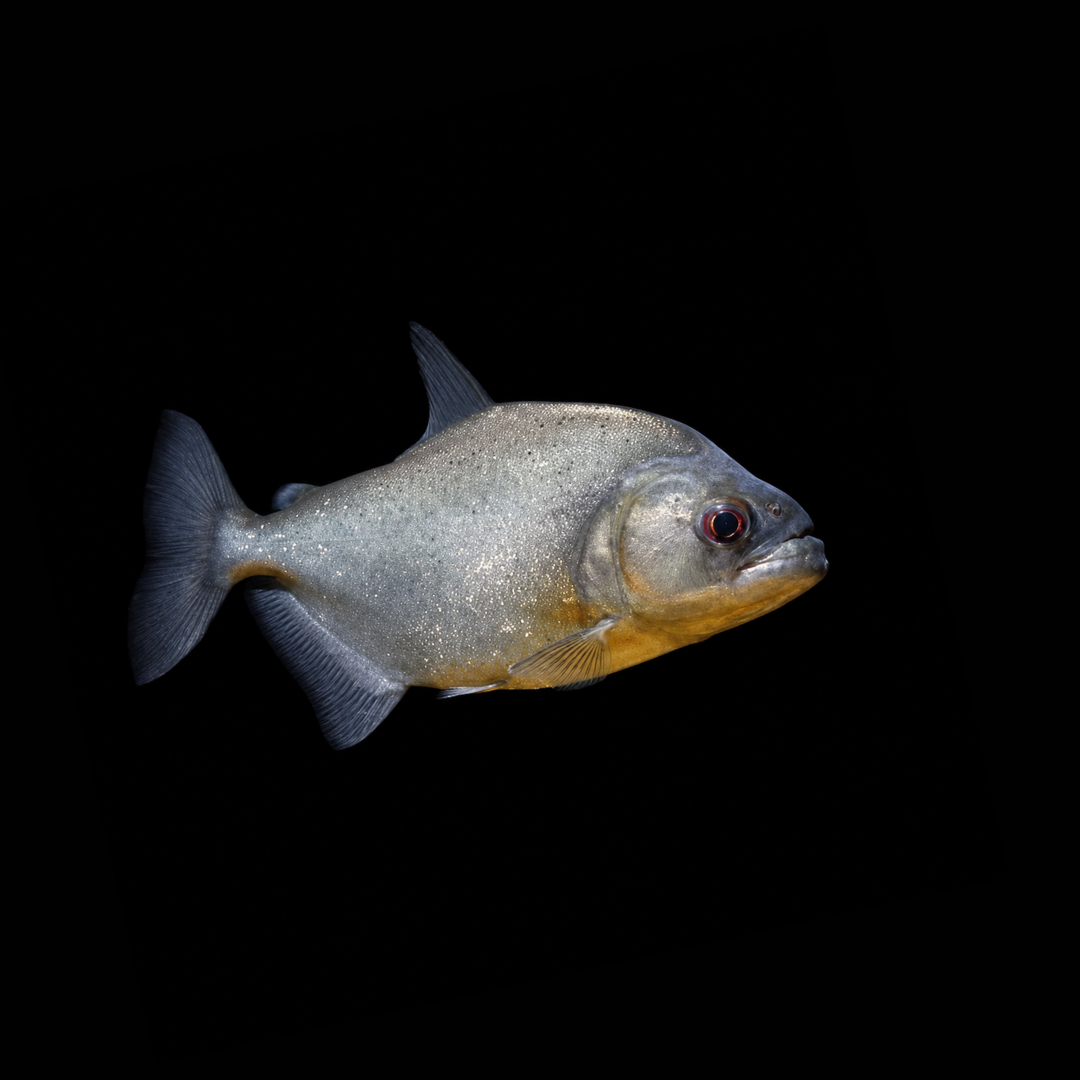
解説 / Description
ブラックピラニアは、南米のアマゾン川流域やオリノコ川流域を中心に分布する大型の肉食性カラシンです。成長とともに体色が暗くなり、赤みを帯びた眼、厚みのある体、鋭い歯が相まって、静かな迫力を感じさせます。ピラニアという名前から荒々しい魚を想像されがちですが、実際には警戒心が強く、落ち着ける場所で周囲をよく観察する個体も多く見られます。 The Black Piranha is a large predatory characin distributed mainly in South American river systems such as the Amazon and Orinoco basins. As it matures, the body often darkens, and its reddish eyes, thick body, and sharp teeth create a quiet but powerful presence. Although the name piranha may suggest a constantly aggressive fish, many individuals are cautious and spend much of their time watching their surroundings from a secure position.
一方で、強い顎と鋭利な歯を備えた大型肉食魚であることに変わりはありません。日本の家庭水槽で飼育する場合は、単独飼育を基本とし、十分な水量、強力な濾過、しっかり固定できる蓋、保護されたヒーターやコード類を用意する必要があります。設備、管理、安全意識がそろってはじめて、本種の魅力を長く安定して楽しむことができます。 At the same time, it remains a large predatory fish with powerful jaws and sharp teeth. In a home aquarium, it should be kept alone and provided with sufficient water volume, strong filtration, a secure lid, and protected heaters and cables. Only when equipment, husbandry, and safety awareness are properly prepared can the species be enjoyed steadily over the long term.
基本情報 / Basic Information
| 学名 / Scientific Name | Serrasalmus rhombeus (Linnaeus, 1766) |
|---|---|
| 通称 / Common Name | ブラックピラニア、レッドアイ・ピラニア、ホワイト・ピラニアBlack Piranha, Redeye Piranha, White Piranha |
| 分類 / Family | カラシン目 セルラサルムス科 セルラサルムス属Order Characiformes, family Serrasalmidae, genus Serrasalmus |
| 英名 / English Name | Redeye Piranha, Black Piranha, White Piranha |
| 分布 / Distribution | 南米のアマゾン川流域、オリノコ川流域、ギアナシールド北部から東部の河川群、ブラジル北東部の沿岸河川などに分布します。流れのある河川、深場、湖沼、水没林周辺など、幅広い環境で記録されています。Distributed in South America, including the Amazon Basin, Orinoco Basin, northern and eastern Guiana Shield rivers, and coastal rivers of northeastern Brazil. It is recorded from a wide range of habitats, including flowing rivers, deeper river zones, lakes, and areas around flooded forests. |
| 最大体長 / Max Size | 公表記録では標準体長41.5cm、最大公表重量は約3.8kgとされます。飼育下でも30cm以上に育つ可能性があるため、成長後の体格を前提に設備を選ぶ必要があります。Published records list a maximum standard length of 41.5 cm and a maximum published weight of about 3.8 kg. In captivity, it may still exceed 30 cm, so equipment should be selected with the adult size in mind. |
| 寿命 / Lifespan | 寿命には個体差があり、統一された明確な年数は示しにくい魚です。ただし大型肉食魚として長期飼育を前提に迎えるべき生体であり、安定した水質、適切な給餌、事故防止を継続することが長く健康を保つ基本になります。Lifespan varies by individual and a single definitive figure is difficult to state. However, it should be treated as a long-term large predatory fish, and stable water quality, appropriate feeding, and accident prevention are the foundations of keeping it healthy for many years. |
飼育環境 / Aquarium Environment
| 水槽サイズ / Tank Size | 最低でも90cm規格水槽以上を用意し、終生飼育を考えるなら120cm水槽から150cm水槽を推奨します。成魚は体に厚みがあり、旋回にも空間を使うため、幅だけでなく奥行きも重要です。余裕を持って管理する場合は、120cmワイド水槽以上を基準にすると安心です。A standard 90 cm aquarium is the minimum, while a 120 to 150 cm aquarium is recommended for lifelong care. Adults have a thick body and need space to turn, so depth is as important as length. For more comfortable long-term management, a wide 120 cm aquarium or larger is a safer standard. |
|---|---|
| 水温 / Temperature | 25から27℃前後を基本に、急変を避けて安定させます。資料によっては23から27℃が目安として示されるため、極端な高温や低温を避け、日常管理では26℃前後を保つと扱いやすくなります。 Maintain the water at around 25 to 27°C and avoid sudden changes. Some references indicate 23 to 27°C as a guideline, so avoiding extremes and keeping the aquarium near 26°C is a practical approach. |
| 水質 / Water Quality | 弱酸性から中性の水質を目安にし、pHはおおむね6.0から7.0に保ちます。アンモニアと亜硝酸は0ppmを維持し、硝酸塩はできるだけ低く抑えます。肉食魚は排泄物と食べ残しが多いため、上部式フィルターと外部式フィルターの併用、またはオーバーフロー式など、余裕のある生物濾過を用意してください。Aim for slightly acidic to neutral water, roughly pH 6.0 to 7.0. Ammonia and nitrite must remain at 0 ppm, and nitrate should be kept as low as practical. Because predatory fish produce heavy waste and food debris, generous biological filtration is important, such as combining an overhead filter with a canister filter or using a sump system. |
| レイアウト / Layout | 広い遊泳スペースを確保しながら、流木や暗がりで落ち着ける場所を作ります。水槽内に適度な水流を作ると、溶存酸素量を保ちやすく、運動不足の予防にもつながります。器具をかじることがあるため、ヒーター、サーモスタットのセンサー、電源コードはガードや塩ビパイプなどで必ず保護します。Provide open swimming space while also creating calm areas with driftwood and shaded zones. Moderate internal flow helps maintain dissolved oxygen and can reduce inactivity. Because the fish may bite equipment, heaters, thermostat sensors, and electrical cables must be protected with guards, PVC pipe, or similar sturdy barriers. |
| 注意点 / Precautions | 急な点灯、振動、大きな物音に驚いて突進することがあります。厚手の蓋をしっかり固定し、飛び出しを防いでください。メンテナンス時は不用意に手を入れず、長いピンセットや専用器具を使うと安全です。また、飼えなくなった個体を河川や池に放すことは、生態系に深刻な影響を与えるおそれがあるため絶対に避けます。The fish may dash suddenly when startled by lights, vibration, or loud sounds. Use a thick, securely fixed lid to prevent jumping. During maintenance, avoid placing hands carelessly in the aquarium and use long tweezers or dedicated tools whenever possible. Releasing unwanted individuals into rivers or ponds must never be done, as it may seriously affect local ecosystems. |
餌と給餌 / Feeding
| 餌の種類 / Diet | 冷凍ワカサギ、キビナゴ、アジなどの小魚類、大型肉食魚用の人工ペレット、クリル、冷凍赤虫、脂肪分の少ない鶏ささみなどを組み合わせます。野生下では小魚や甲殻類などを食べる肉食性の強い魚ですが、飼育下では単食を避け、栄養の偏りを防ぐことが大切です。牛肉や豚肉などの哺乳類の肉は、消化や脂肪分の面で負担になりやすいため基本的に避けます。Use a combination of frozen small fish such as smelt, Japanese silver-stripe round herring, and horse mackerel, along with pellets for large carnivorous fish, krill, frozen bloodworms, and lean chicken breast as a supplementary food. In the wild it is a strongly carnivorous fish that eats small fish and crustaceans, but in captivity a varied diet is important to prevent nutritional imbalance. Mammalian meats such as beef and pork are generally best avoided because they can be burdensome in terms of digestion and fat content. |
|---|---|
| 給餌のポイント / Feeding Tips | 幼魚期は成長に合わせて毎日1から2回、食べ切れる量を与えます。成魚では代謝が落ちるため、3日に1回または週2回程度を目安にし、腹八分目を保ちます。ワカサギなどを単食にすると栄養が偏るおそれがあるため、早い段階から人工飼料にも慣らしておくと管理が安定します。生餌を使う場合は、病原体や寄生虫の持ち込みを避けるため、事前の隔離と観察を行います。Juveniles may be fed once or twice daily in amounts they can finish. Adults have a slower metabolism, so feeding once every three days or about twice a week is often sufficient. Avoid relying on a single food such as smelt; introducing prepared pellets early makes long-term feeding more stable. If live food is used, quarantine and observation beforehand are important to reduce the risk of introducing parasites or pathogens. |
性格と混泳 / Temperament and Tank Mates
| 性格 / Temperament | 鋭い歯から獰猛な印象を持たれやすい魚ですが、人間を積極的に襲う魚というより、警戒心が強く、刺激に敏感な大型肉食魚として理解するほうが適切です。落ち着いた環境では定位置でじっとしていることも多い一方、驚いたときの突進や、餌や異物への噛みつきには十分な注意が必要です。Its sharp teeth often give it a ferocious image, but it is better understood as a cautious, stimulus-sensitive large predatory fish rather than a fish that actively attacks humans. In a calm aquarium it may stay in a fixed position for long periods, but sudden dashing when startled and biting at food or objects require careful attention. |
|---|---|
| 混泳の相性 / Compatibility | 原則として単独飼育です。同種同士でも他種でも、噛み傷、ヒレや体の欠損、死亡につながる可能性があるため、混泳はすすめられません。プレコや装甲ナマズのような硬い体を持つ魚であっても、尾部や体の隙間を狙われることがあり、安全な同居相手とは言えません。Solitary keeping is the rule. Whether with its own kind or with other species, tank mates may suffer bite wounds, missing fins or body parts, or death, so community keeping is not recommended. Even fish with hard armor, such as plecos or armored catfish, may be attacked at the tail or vulnerable gaps and should not be considered safe companions. |
病気と対策 / Diseases and Prevention
| かかりやすい病気 / Common Diseases | 水質悪化、水温の急変、導入直後のストレスが重なると、白点病などの寄生虫疾患が発生することがあります。大型肉食魚では食べ残しによる水質悪化が起こりやすく、硝酸塩の蓄積、濾過不足、急な環境変化が体調不良の原因になります。Poor water quality, sudden temperature changes, and stress immediately after introduction can lead to parasitic diseases such as ich. In large predatory fish, uneaten food can quickly degrade water quality, and nitrate buildup, insufficient filtration, and abrupt environmental changes can all cause health problems. |
|---|---|
| 対策と予防 / Prevention | 週1回を目安に3分の1から2分の1程度の換水を行い、底に食べ残しを残さないようにします。新しい餌魚や生体を持ち込む場合は、事前に隔離して状態を確認します。白点病が疑われる場合は、換水で水中の遊離寄生虫を減らし、魚病薬や0.5%前後の塩水浴、水温28から30℃への段階的な調整を、魚の状態を見ながら慎重に行います。Perform water changes of about one-third to one-half weekly and remove uneaten food from the bottom. New feeder fish or livestock should be isolated and observed before being introduced. If ich is suspected, reduce free-swimming parasites through water changes, then carefully use appropriate medication, a salt bath of around 0.5 percent, and a gradual temperature adjustment to 28 to 30°C while monitoring the fish closely. |
増やし方(繁殖) / Breeding
| 雌雄の判別 / Sexing | 外見だけで雌雄を確実に判別することは難しく、一般的な飼育環境で使える明確な判別法は知られていません。成熟や体型の差が見られる場合もありますが、個体差が大きいため、見た目だけで判断するのは避けたほうがよいでしょう。Reliable sexing by appearance alone is difficult, and no clear method is widely available for ordinary aquarium keeping. Differences in maturity or body shape may appear, but individual variation is large, so visual judgment alone should not be relied upon. |
|---|---|
| 繁殖形態 / Reproduction | 卵を産む魚です。自然下では季節的な水位変化や水没林などの環境が繁殖に関わると考えられます。アクアリウムでの繁殖情報は限られており、一般家庭で安定して狙える魚ではありません。This is an egg-laying fish. In the wild, seasonal water-level changes and flooded forest habitats are thought to be involved in reproduction. Aquarium breeding information is limited, and it is not a species that can be reliably bred in ordinary home aquariums. |
| 繁殖のポイント / Breeding Tips | 強い咬合力と同居リスクがあるため、繁殖目的であっても安易な複数飼育は危険です。繁殖を考える場合は、非常に広い水槽、逃げ場、隔離手段、成熟個体の見極めが必要になります。一般的には、鑑賞目的の単独飼育を前提に考えるほうが安全です。Because of its strong bite and the risks of cohabitation, keeping multiple individuals together casually is dangerous even for breeding attempts. Breeding would require a very large aquarium, refuges, a way to separate fish quickly, and careful judgment of maturity. For most aquarists, solitary display keeping is the safer assumption. |
雑学と豆知識 / Trivia and Fun Facts
| 1. リンネが記載した歴史ある種 / 1. A historically important species described by Linnaeus | ブラックピラニアは、1766年にリンネによって記載された歴史ある魚です。現在はSerrasalmus属に置かれていますが、当初はSalmo rhombeusとして扱われました。成長段階や産地によって体色や体型に変化が大きく、過去には別名やシノニムが多く生まれました。近年も、地域集団の違いや隠れた多様性に注目する研究があり、単に「黒いピラニア」と呼ぶだけでは語り尽くせない奥行きを持っています。The Black Piranha is a historically important fish described by Linnaeus in 1766. It is now placed in the genus Serrasalmus, but it was originally treated as Salmo rhombeus. Because body color and body shape can vary greatly with age and locality, many names and synonyms have appeared in its taxonomic history. Recent studies also draw attention to differences among regional populations and hidden diversity, showing that this fish has more depth than the simple name black piranha suggests. |
|---|---|
| 2. 小さな体に凝縮された咬合力 / 2. Bite force concentrated in a relatively small body | ブラックピラニアの代表的な科学的トピックが、体の大きさに対して非常に強い咬合力です。野生個体を対象にした研究では、体重約1.1kgの個体で320ニュートンの前部咬合力が記録されました。この数値は、大きな顎筋、効率的なテコの構造、鋭い三角形の歯が組み合わさることで生まれます。水槽内ではその力を見せびらかす魚ではありませんが、器具の保護やメンテナンス時の安全対策が必要な理由はここにあります。One of the most notable scientific topics about the Black Piranha is its extremely strong bite relative to body size. In a study of wild individuals, a specimen weighing about 1.1 kg produced an anterior bite force of 320 newtons. This force comes from the combination of large jaw muscles, efficient leverage, and sharp triangular teeth. In the aquarium it does not display this power constantly, but this is why protected equipment and safe maintenance practices are essential. |
| 3. 静かに待つ捕食者としての魅力 / 3. The appeal of a predator that waits quietly | ブラックピラニアは、常に獲物を追い回す魚ではありません。自然下では河川の深場や流れのある場所にも見られ、餌を待つような行動をとることがあります。水槽内でお気に入りの位置にとどまり、わずかな動きに反応する姿は、活発に泳ぐ魚とは異なる見どころです。派手さではなく、緊張感のある静けさがこの魚の魅力です。The Black Piranha is not a fish that constantly chases prey. In nature it is found in deeper river zones and flowing areas, and it may behave like a waiting predator. In the aquarium, its habit of holding a favored position and reacting to subtle movements is a different kind of appeal from that of active schooling fish. Its charm lies not in constant motion, but in a tense stillness. |
| 4. 産地差が価値を生む一方で、断定は慎重に / 4. Locality differences add value, but caution is needed | 日本の観賞魚市場では、ペルー産、ブラジル産、シングー川、ネグロ川、トカンティンス川など、産地名が注目されることがあります。黒くなりやすさ、体高、鱗の光沢、エラ蓋周辺の色合いなどに違いが見られることがあり、愛好家にとっては大きな楽しみです。ただし、外見だけで産地や分類を厳密に判断することは難しく、流通名と学術的な分類が完全に一致しない場合もあります。産地表記は魅力の一部として楽しみつつ、信頼できる販売情報を確認する姿勢が大切です。In the Japanese aquarium trade, locality names such as Peru, Brazil, Xingu, Negro, and Tocantins often attract attention. Differences may be seen in how readily the fish darkens, body height, scale sheen, or coloration around the gill cover, making localities a major point of interest for enthusiasts. However, strict identification of locality or taxonomy by appearance alone is difficult, and trade names do not always perfectly match scientific classification. Locality information should be enjoyed as part of the fish’s appeal while checking reliable sales information. |
| 5. 放流禁止は飼育者の最低限の責任 / 5. Never releasing the fish is a basic responsibility | 海外では、ピラニア類が人為的に持ち込まれ、一時的に定着した後に駆除された記録があります。資料によって同定や扱いに注記がある事例も含まれるため、単純な話として受け止めるべきではありませんが、観賞魚の放流が大きな問題につながることを示す重要な例です。日本でも、温排水や局所的に暖かい水域など、通常の河川とは異なる環境が存在します。法的な指定の有無にかかわらず、飼育魚を野外に放す行為は絶対に避けなければなりません。There are overseas records of piranhas being introduced by humans, becoming temporarily established, and later being eradicated. Some of these cases include notes about identification and interpretation, so they should not be treated too simplistically, but they remain important examples of how aquarium releases can become serious problems. Even in Japan, warm-water discharge areas and other locally warm habitats exist. Regardless of the exact legal status, aquarium fish must never be released into the wild. |
| 6. 法規制は「現在の確認」が前提 / 6. Legal status should be checked as current information | ブラックピラニアのような肉食性の強い外来魚は、国や地域によって輸入、所持、販売の扱いが異なります。日本国内でも、国の制度、自治体の条例、販売店の説明、輸入時の手続きなどを個別に確認する必要があります。観賞魚として流通しているからといって、将来にわたって扱いが変わらないとは限りません。購入前には、最新の法令情報と終生飼育できる環境の両方を確認することが大切です。For strongly predatory non-native fish such as the Black Piranha, rules on importation, possession, and sale differ by country and region. In Japan, national systems, local ordinances, retailer guidance, and import procedures may all need to be checked individually. The fact that a fish is available in the aquarium trade does not guarantee that its status will remain unchanged in the future. Before purchase, both current legal information and the ability to provide lifelong care should be confirmed. |
まとめ / Conclusion
ブラックピラニアは、漆黒に近づく体色、赤い眼、厚みのある体、強い咬合力を備えた、南米を代表する大型肉食魚の一つです。その魅力は派手に泳ぎ回る姿ではなく、落ち着いた水槽の中で放たれる重厚な存在感にあります。 The Black Piranha is one of South America’s representative large predatory fish, with a body that may darken toward black, reddish eyes, a thick build, and powerful biting ability. Its appeal is not constant flashy movement, but the weighty presence it brings to a calm aquarium.
飼育には、大型水槽、強力な濾過、単独飼育、安全対策、そして終生飼育の責任が欠かせません。十分な準備のもとで迎えられた個体は、アマゾンの捕食者らしい緊張感と美しさを水槽にもたらし、飼育者に長く深い印象を残す存在になります。 Keeping this species requires a large aquarium, strong filtration, solitary housing, safety measures, and a commitment to lifelong care. When introduced with proper preparation, it brings the tension and beauty of an Amazonian predator into the aquarium and leaves a lasting impression on the aquarist.

気になる道具や飼い方を見つけてみませんか?
 アイのアクアグッズ案内水草用ソイルの選び方|土・砂の違いとおすすめ商品道具の特徴や使い方、選ぶときのポイントをアイが紹介します。記事はコチラ →
 アイのアクアグッズ案内水草の肥料の選び方|底床用・液肥・メネデールの使い分け道具の特徴や使い方、選ぶときのポイントをアイが紹介します。記事はコチラ →
 アイのアクアグッズ案内テトラミンって、こんなにあるの? アイとコタロウのごはん探究旅道具の特徴や使い方、選ぶときのポイントをアイが紹介します。記事はコチラ →
 アイのアクアグッズ案内水槽用ヒーターの選び方|固定式・温度調節式と、水量に合うW数の考え方水槽の魚は冬に寒くない? アイとコタロウが水温計から固定式・温度調節式・分離式ヒーターまで比較。水量と室温に合うW数、設置場所、水換えや交換の注意点を、国内メーカーの商品とともに紹介します。記事はコチラ →
さまざまな飼育テーマをご紹介。リンク先の記事には広告・商品紹介が含まれます。
案内・紹介記事一覧へ →分布マップ
ブラックピラニアは、南米のアマゾン川流域、オリノコ川流域、ギアナシールド北部から東部の河川群、ブラジル北東部の沿岸河川などに広く分布するとされています。
Google Earthで開くこの地図は分布欄の内容をもとにした概略イメージです。マーカーはアマゾン川流域を代表する概略地点であり、実際の採集地点や厳密な生息範囲を示すものではありません。
参考文献・根拠資料
ブラックピラニアの記事内容を支える資料として、分類、分布、生息環境、飼育条件、繁殖、病気、放流リスクに関係する信頼性の高い文献・公的資料を選定しました。店舗、通販、個人ブログ、一般的なまとめサイトは除外しています。
確認日:2026年7月5日
種の分類・分布・生息環境を支える資料
-
Froese, R. and Pauly, D. editors. FishBase: Serrasalmus rhombeus, Redeye piranha.
分類、学名、分布、最大体長、体重、pH、水温、生息環境、食性、注意点の基礎資料として参照。
https://www.fishbase.se/summary/Serrasalmus-rhombeus.html -
Fricke, R., Eschmeyer, W. N. and van der Laan, R. editors. Eschmeyer’s Catalog of Fishes: Salmo rhombeus / Serrasalmus rhombeus.
原記載、命名者、タイプ産地、シノニム、現在の分類上の扱いを確認するための資料として参照。
https://researcharchive.calacademy.org/research/ichthyology/catalog/fishcatget.asp?spid=4141 -
Jégu, M. 2003. Serrasalminae. In: Reis, R. E., Kullander, S. O. and Ferraris, C. J. Jr. editors. Checklist of the Freshwater Fishes of South and Central America.
セルラサルムス亜科、Serrasalmus属、タイプ種、分類学的背景を補強する文献として参照。
https://horizon.documentation.ird.fr/exl-doc/pleins_textes/divers19-12/010036914.pdf -
Thomas, A. et al. 2025. Low Genetic Diversity and Complex Population Structure in Black Piranha Serrasalmus rhombeus, a Key Amazonian Predator.
地域集団差、遺伝的多様性、産地差や種複合体的な扱いを慎重に説明するための補助資料として参照。
https://pmc.ncbi.nlm.nih.gov/articles/PMC11831006/
咬合力・行動・危険性の表現を支える資料
-
Grubich, J. R. et al. 2012. Mega-Bites: Extreme jaw forces of living and extinct piranhas. Scientific Reports.
ブラックピラニアの320Nという咬合力、顎の力学的特徴、絶滅種メガピラニアとの比較に関する根拠資料として参照。
https://pmc.ncbi.nlm.nih.gov/articles/PMC3526859/ -
U.S. Geological Survey, Nonindigenous Aquatic Species Database: Serrasalmus rhombeus, white piranha.
人への危険性の過度な誇張を避ける表現、フロリダでの記録、外来魚としての注意点を支える資料として参照。
https://nas.er.usgs.gov/queries/FactSheet.aspx?speciesID=431 -
U.S. Fish and Wildlife Service. Ecological Risk Screening Summary: Redeye Piranha Serrasalmus rhombeus.
外来種リスク、米国内の規制例、導入記録、観賞魚として扱う際の注意点を確認するための公的資料として参照。
https://www.fws.gov/sites/default/files/documents/Ecological-Risk-Screening-Summary-Redeye-Piranha.pdf
飼育条件・水質管理・疾病対策を支える資料
-
Francis-Floyd, R. et al. University of Florida IFAS Extension: Ammonia in Aquatic Systems.
閉鎖水槽におけるアンモニア、亜硝酸、硝酸塩、検査、濾過管理の重要性を支える資料として参照。
https://ask.ifas.ufl.edu/publication/FA031 -
Svobodová, Z. et al. FAO: Water Quality and Fish Health.
水温、pH、溶存酸素、アンモニア毒性など、魚類の健康維持に関わる水質項目を補強する資料として参照。
https://openknowledge.fao.org/server/api/core/bitstreams/185abd2a-fe7d-49dc-86ff-a6a1174566c7/content -
Francis-Floyd, R. and Yanong, R. P. E. University of Florida IFAS Extension: Ichthyophthirius multifiliis White Spot Infections in Fish.
白点病の原因、生活環、治療が遊走期を狙う必要がある点、清掃や反復処置の考え方を支える資料として参照。
https://ask.ifas.ufl.edu/publication/FA006 -
Merck Veterinary Manual: Parasitic Diseases of Fish.
観賞魚の寄生虫症、症状、薬浴を含む魚病管理の一般的な獣医学的根拠として参照。
https://www.merckvetmanual.com/exotic-and-laboratory-animals/aquarium-fish/parasitic-diseases-of-fish
繁殖・法令確認・放流防止に関する補助資料
-
Agostinho, C. S. et al. 2003. Reproductive aspects of piranhas Serrasalmus spilopleura and Serrasalmus marginatus. Brazilian Journal of Biology.
Serrasalmus rhombeusそのものの家庭水槽繁殖資料ではなく、近縁ピラニア類の繁殖研究として参照。記事内では繁殖情報を断定しすぎないための補助資料として扱います。
https://www.scielo.br/j/bjb/a/McYVQ75ZsRxPS4qWvVR5tps/ -
環境省 自然環境局:特定外来生物等一覧。
日本国内での外来生物法上の指定状況を確認するための公的資料として参照。法令情報は変更される可能性があるため、購入・譲渡前には最新版の確認が必要です。
https://www.env.go.jp/nature/intro/2outline/list.html -
環境省 自然環境局:生態系被害防止外来種リスト。
放流防止、外来種リスク、自治体や国の情報確認を促すための公的資料として参照。
https://www.env.go.jp/nature/intro/2outline/iaslist.html
注記:飼育条件のうち水槽サイズ、単独飼育、ヒーターや蓋の安全対策などは、種の生態、最大サイズ、咬合力、閉鎖水槽の水質管理に関する資料を組み合わせて導いた飼育上の実務的推奨です。




コメント