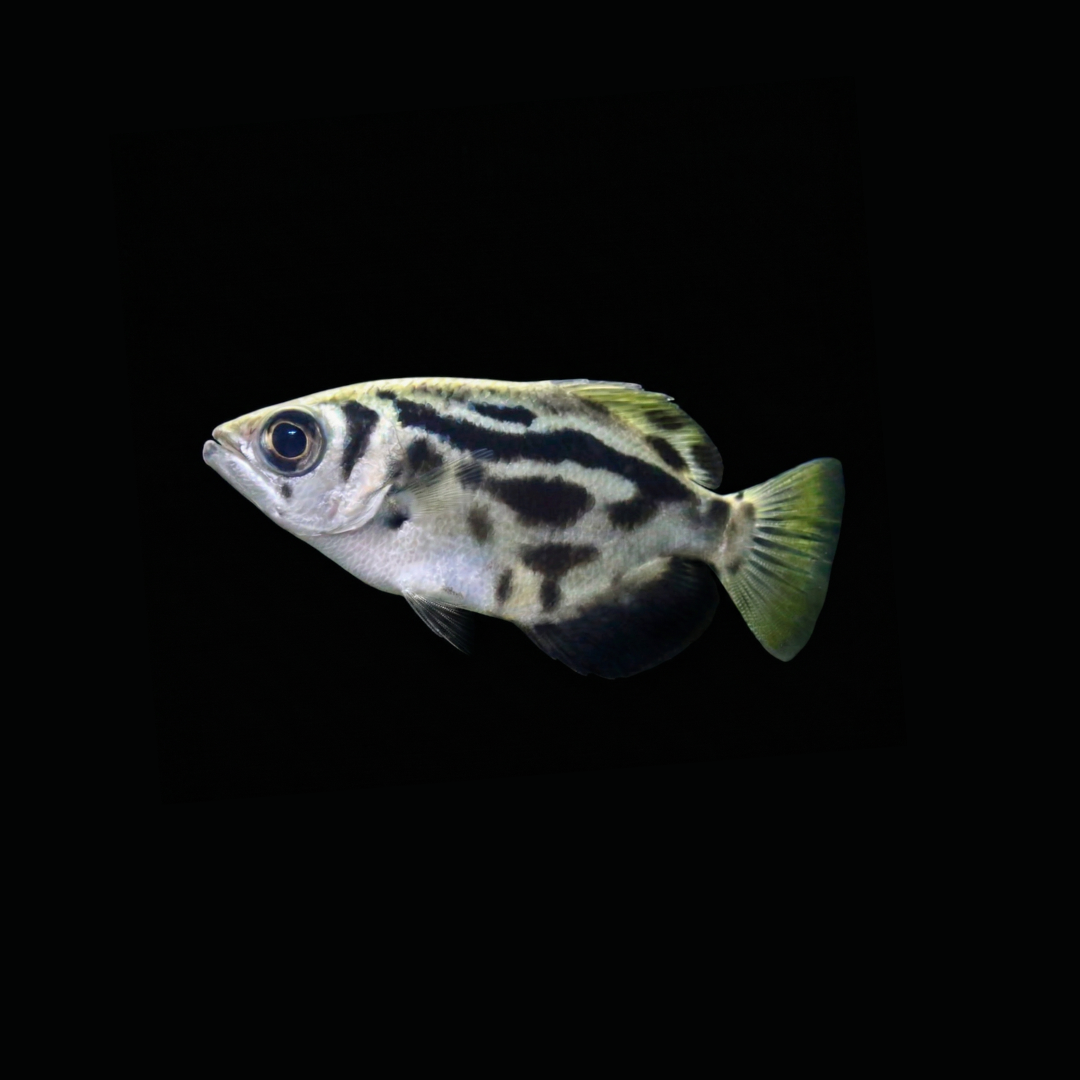
ゼブラアーチャーフィッシュは、ミャンマーの限られた河川系にのみ生息する、極めて特異なテッポウウオの仲間です。体側に入る不規則な黒色のシマ模様(ゼブラ柄)と、金属的な光沢を持つ美しい体表が最大の特徴で、観賞魚としての価値が非常に高い種です。一般的なテッポウウオが汽水域に依存するのに対し、本種は生涯を純淡水で過ごすという生態学的特異性を持っており、日本の家庭用アクアリウム設備や水草レイアウト水槽での飼育に非常に適しています。口から放たれる精密な水鉄砲で空中の獲物を撃ち落とす「水中の狙撃手」としての能力に加え、高度な学習能力や社会的な駆け引きを行う知能を併せ持っています。The Zebra Archerfish (Toxotes blythii) is a unique species of archerfish found exclusively in specific river systems in Myanmar. It is characterized by its irregular black zebra-like patterns and metallic silvery scales, making it highly prized in the aquarium trade. Unlike most archerfish species that inhabit brackish waters, T. blythii is a strictly freshwater fish, making it exceptionally well-suited for Japanese home aquariums and planted tanks. Known as the “sniper of the water,” it uses a precise water jet to hunt terrestrial insects, but it also possesses remarkable cognitive abilities for learning and social strategy.
水面付近の浮き草や、アクアテラリウム形式の水上植物で隠れ家を作ると落ち着きます。泳ぐスペースも重要です。Provide floating plants or emersed vegetation for shade. Open swimming space is also crucial.
注意点 / Precautions
驚異的な跳躍力を持つため、隙間のない頑丈な蓋が必須です。水鉄砲による周辺機器の漏電事故にも注意が必要です。Heavy, gap-free lids are mandatory due to their jumping ability. Protect electronics from water jets.
餌と給餌 / Feeding
餌の種類 / Diet
生きたコオロギ、ミルワーム、イサザアミ、乾燥クリル。慣れれば浮上性の人工飼料(ペレット)も食べます。Live crickets, mealworms, mysis shrimp, dried krill. Can be trained to eat floating pellets.
給餌のポイント / Feeding Tips
水面上の獲物を狙う習性があるため、浮上性の餌が適しています。獲物を丸呑みにするため、餌のサイズには注意してください。Floating food is best due to their natural surface-hunting behavior. Be mindful of food size as they swallow whole.
性格と混泳 / Temperament and Tank Mates
性格 / Temperament
同種間では強い縄張り意識を持ちますが、群れを作ることで攻撃性が分散されます。他種に対しては比較的温和です。Strongly territorial with conspecifics but forms social groups. Generally peaceful toward other species.
混泳の相性 / Compatibility
本種の口に入らないサイズの中・低層魚(レインボーフィッシュ、クラウンローチ、プレコなど)と好相性です。Good with middle/bottom dwellers too large to swallow (Rainbowfish, Clown Loaches, Plecos).
病気と対策 / Diseases and Prevention
かかりやすい病気 / Common Diseases
白点病、ウーディニウム症(ベルベット病)、導入時の拒食。Ich (White spot), Velvet disease, and anorexia during acclimatization.
対策と予防 / Prevention
0.5%程度の塩水浴が有効です。導入時のストレスを軽減し、高水温(28℃前後)で安定させることが予防に繋がります。Salt baths (0.5%) are effective. Reduce stress during introduction and maintain stable temperatures around 28°C.
増やし方(繁殖) / Breeding
雌雄の判別 / Sexing
外見からの判別は不可能(性的二形なし)。成熟した個体の解剖学的観察でのみ判別可能とされています。Visually impossible (no sexual dimorphism). Only anatomical observation of mature gonads works.
繁殖形態 / Reproduction
完全な謎。野生下での産卵プロセスや場所、時期についての学術的データが不足しています。A complete mystery. Academic data on spawning sites and timing in the wild is severely lacking.
繁殖のポイント / Breeding Tips
現在まで国内外で水槽内の繁殖成功例はありません。流通する個体はすべて野生採集個体です。No successful captive breeding reported to date. All commercial individuals are wild-caught.
雑学と豆知識 / Trivia and Fun Facts
1. 学名の由来とエドワード・ブライスの功績 / 1. Scientific Name Origin and Edward Blyth
種小名の「blythii」は、19世紀のインド・東南アジア生物学に多大な貢献をしたイギリスの動物学者エドワード・ブライスに献名されたものです。彼はベンガル王立アジア協会の学芸員として、数多くの新種を体系化しました。この魚が正式に記載された1892年、彼のアジア動物学への圧倒的な貢献を讃え、この美しい模様を持つテッポウウオに彼の名が冠されました。The specific epithet “blythii” honors Edward Blyth, a British zoologist who laid the foundations of Asian biodiversity research in the 19th century. As the curator of the Asiatic Society of Bengal, he cataloged countless species. In 1892, this striking archerfish was named after him to commemorate his monumental contributions to the zoology of the region.
2. 物理学の壁:スネルの法則を克服する脳 / 2. Physics Challenge: Overcoming Snell’s Law
水の中から空中の獲物を狙う際、光の屈折によって「獲物の見かけの位置」は実際の位置から最大で25度もズレてしまいます。ゼブラアーチャーフィッシュはこの物理現象を脳内で瞬時に補正します。彼らは可能な限り獲物の真下へと移動し、水面に対する視線の角度を垂直に近づけることで屈折の影響を最小限に抑えるとともに、残ったズレに対しても三次元的な座標補正を行ってから正確に水を放ちます。When aiming from underwater at airborne prey, light refraction causes the perceived position to shift by up to 25 degrees. The Zebra Archerfish compensates for this “Snell’s Law” shift instantly. They move directly beneath the prey to minimize refraction and calculate 3D spatial corrections in their brain before firing.
3. 「吹き矢」の生体力学:溝のある舌の秘密 / 3. Biomechanics of the Blowpipe: Secret of the Tongue
最新の研究により、テッポウウオの水鉄砲は「吹き矢」のような構造であることが判明しました。上顎(口蓋)には深い溝が走っており、そこに溝のついた舌を力強く押し当てることで、口腔内に即席のチューブを形成します。そして鰓蓋を急速に閉じることで発生した強力な水圧を、このチューブを通して発射します。舌の先端はバルブ(弁)の役割を果たし、水の放出タイミングや圧力をミリ秒単位で制御しています。Recent research reveals that the archerfish’s water jet acts like a “blowpipe.” A longitudinal groove in the palate, combined with a grooved tongue pressed against it, creates a temporary tube. By rapidly contracting gill covers, water is pressurized through this tube. The tongue’s tip acts as a valve, controlling pressure and timing with millisecond precision.
4. 高度な社会性と「労働寄生」の駆け引き / 4. Social Strategy and Kleptoparasitism
アーチャーフィッシュの群れの中では、他人が撃ち落とした獲物を横取りする「労働寄生」が頻繁に起こります。射手は自分がエネルギーを使って水を撃った際、獲物が水面に落ちた瞬間に、周囲のライバルよりも早く到達できるかを計算しています。もし横取りされるリスクが高いと判断した場合、彼らはあえて射撃を見送るという高度な社会的判断を下しています。Archerfish exhibit “kleptoparasitism,” where group members steal prey shot down by others. To combat this, a shooter calculates whether they can reach the fallen prey before their rivals. If the risk of theft is too high, they may choose not to fire at all, demonstrating sophisticated social decision-making.
5. 運動適応能力:風さえも計算に入れる狙撃手 / 5. Motor Adaptation: Sniping Against the Wind
実験により、アーチャーフィッシュは風(気流)による水弾のズレさえも学習して補正できることが証明されました。横風で弾道が逸れた際、彼らは数回の試行の間にそのエラーを視覚的にフィードバックし、発射角度を微調整して再び命中させることに成功します。これは高等脊椎動物に匹敵する「運動適応」の能力であり、彼らの脳が極めて柔軟に学習できることを示しています。Studies have shown that archerfish can learn to compensate for wind interference. If a crosswind deflects their jet, they use visual feedback to adjust their aim over several attempts until they hit the target again. This level of motor adaptation is comparable to higher vertebrates, highlighting their brain’s flexibility.
まとめ / Conclusion
ゼブラアーチャーフィッシュは、その類まれな美しさと「水中の狙撃手」としての高度な生態を兼ね備えた、アクアリウムの主役にふさわしい魚です。特に「純淡水で終生飼育が可能」という特性は、日本のアクアリストにとってこれ以上ない魅力であり、従来の汽水種では難しかった緑豊かな水草レイアウト水槽との共演を可能にしてくれました。The Zebra Archerfish is a masterpiece of evolution, combining stunning aesthetics with the advanced behavior of an aquatic sniper. Its ability to live strictly in freshwater is a game-changer for aquarists, allowing them to integrate this fascinating predator into lushly planted tanks—a feat nearly impossible with traditional brackish species.
飼育にあたっては、強力なジャンプによる飛び出しや漏電事故、そして同種間の縄張り争いといった課題もありますが、適切な設備と群れでの管理を行うことで、彼らの驚くべき知能や社会性を目の当たりにすることができます。野生個体の保護や繁殖の謎といった学術的な側面も含め、本種は私たちに自然の神秘を教えてくれる素晴らしいパートナーとなってくれるでしょう。While challenges like powerful jumping risks, electrical safety, and territorial disputes exist, proper setup and social group management allow us to witness their incredible intelligence firsthand. From conservation efforts to the mysteries of their reproduction, T. blythii serves as a remarkable partner that brings the wonder of natural science directly into our homes.
Girard, M. G., Davis, M. P., Tan, H. H., Wedd, D. J., Chakrabarty, P., Ludt, W. B., & Smith, W. L. (2022).
Phylogeny of Archerfishes (Toxotidae) and Evolution of the “Archer” Phenotype.
Integrative Organismal Biology, Volume 4, Issue 1.
Gerullis, P., & Schuster, S. (2014).
From plans to predictions: the basis of open-loop control in archer fish shooting.
eLife, 3, e02151.
Schuster, S., Rossel, S., Schmidt, V., & Jäger, I. (2006).
Archer fish learn to pronounce novel objects as “prey” by observing others.
Current Biology, 16(4), 378-382.
■ 分類学・歴史的記載(Taxonomy & History)
Boulenger, G. A. (1892).
Description of a new siluroid fish from Burma.
Annals and Magazine of Natural History, Series 6, Volume 9. (Note: Including Toxotes blythii formal description).
Linnaeus, C. (1767).
Systema Naturae per regna tria naturae, secundum classes, ordines, genera, species.
Editio duodecima, reformata. Holmiae.
Schlosser, J. A. (1764).
An Account of a Fish from Batavia, Called Jaculator.
Philosophical Transactions of the Royal Society of London.
■ 公的データベース・保全状況(Databases & Conservation)
IUCN Red List of Threatened Species.
Toxotes blythii (Clouded Archerfish).
Assessment by Vidthayanon, C.
FishBase.org.
Toxotes blythii summary page.
Edited by Froese, R. and Pauly, D.
■ 飼育技術・市場動向(Husbandry & Market)
日本国内観賞魚流通統計資料(2010-2024)および輸入商社トリートメントプロトコル。
ミャンマー河川系における淡水魚類相調査報告書(Irrawaddy & Salween River systems)。



 アイのアクアグッズ案内水草用ソイルの選び方|土・砂の違いとおすすめ商品道具の特徴や使い方、選ぶときのポイントをアイが紹介します。記事はコチラ →
 アイのアクアグッズ案内おとひめ物語|養殖生まれの餌を、わが家の魚に合う一粒へ道具の特徴や使い方、選ぶときのポイントをアイが紹介します。記事はコチラ →
 アイのアクアグッズ案内アカヒレの仲間に合わせる飼育用品|無加温・混泳・繁殖の水槽とろ過道具の特徴や使い方、選ぶときのポイントをアイが紹介します。記事はコチラ →
 アイのアクアグッズ案内小型カラシンの群れを楽しむ|餌と水換えから考える飼育用品ガイド小型カラシンの群れを眺める時間を、もっと楽しく。泳ぐ余白、餌の食べ方、続けやすい水換えを軸に、日本で揃えやすい用品の選び方を紹介します。記事はコチラ →




コメント