


解説 / Description
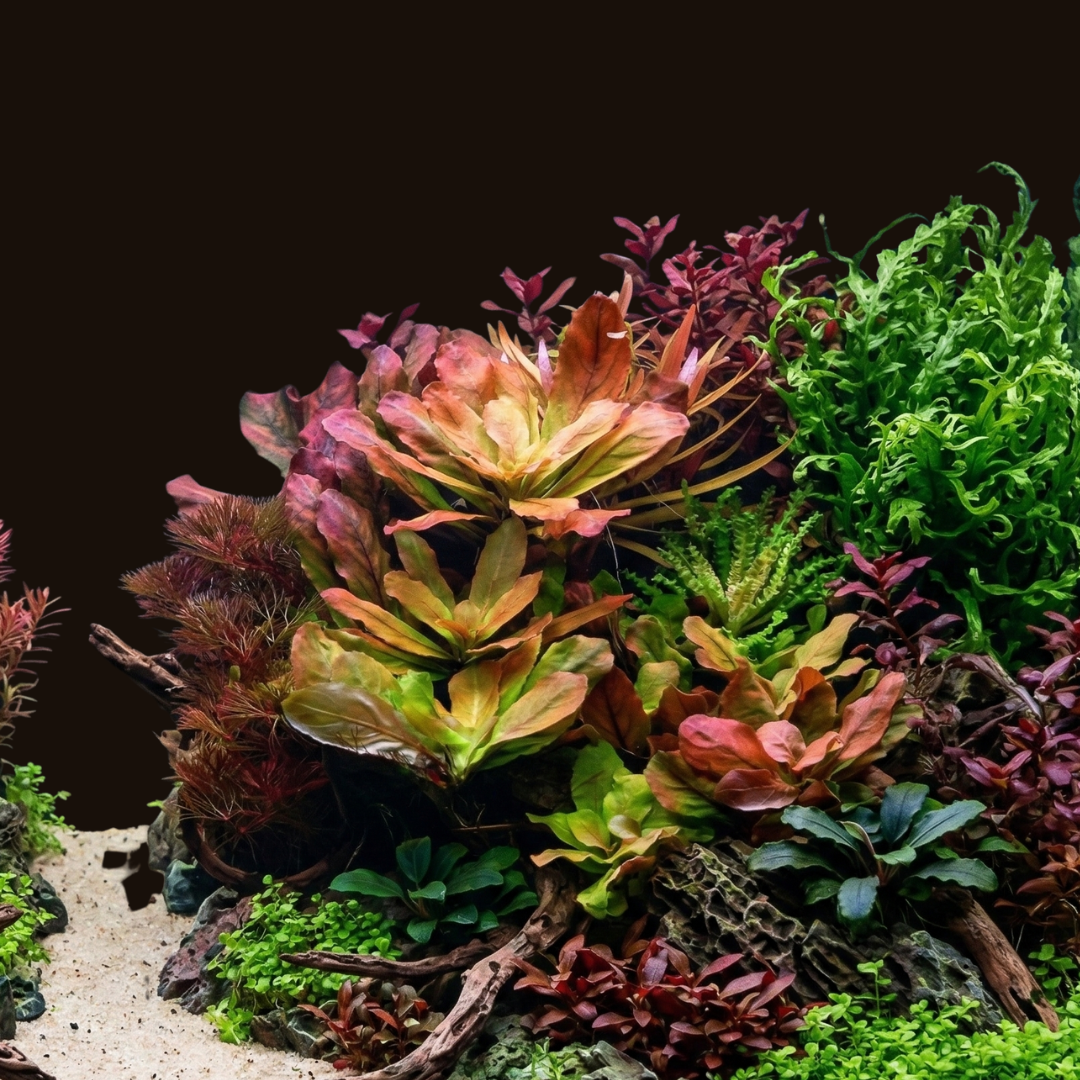
ルドウィジア・スファエロカルパは、北米東部の湿地に自生するアカバナ科の水辺植物です。野外や水上で育った姿は、細長い葉をつけたごく地味な草にしか見えません。ところが水槽に沈めて強い光の下で育てると、印象ががらりと変わります。太くしっかりした茎に、肉厚でつやのある葉が節を詰めて幾重にも重なり、色もオリーブグリーンからオレンジ、銅色、さらに深い赤褐色へと移り変わっていきます。一般的なルドウィジアのように軽やかに上へ伸びるのではなく、低めの位置でどっしりと構えるように育つため、ほかの赤系有茎草にはない重厚感があります。 Ludwigia sphaerocarpa is a wetland plant of the evening primrose family (Onagraceae), native to eastern North America. Grown emersed or seen in the wild, it looks like an unremarkable weed with narrow leaves. Submerged under strong light, however, it changes completely: thick, sturdy stems carry fleshy, glossy leaves packed closely along the nodes, and the color shifts from olive green through orange and copper to a deep reddish brown. Rather than shooting upward like most Ludwigia, it grows in a low, solid manner, giving it a weighty presence that sets it apart from other red stem plants.
成長はゆっくりで、光・CO2・栄養のバランスが崩れると色があせたりコケが付いたりしやすく、手をかけずに育つ水草ではありません。そのぶん、条件が整ったときの燃えるような暖色と存在感は格別で、中景のアクセントに使えば水景全体が引き締まります。現在は無農薬の組織培養カップでの流通が中心で、エビ水槽にも導入しやすくなりました。腰を据えてじっくり育てたい中級者以上の方におすすめです。 It grows slowly and readily loses color or collects algae when light, CO2 and nutrients fall out of balance, so it is not a plant that thrives on neglect. In return, its fiery warm tones and strong presence when conditions are right are exceptional, and as a midground accent it pulls the whole layout together. Today it is mostly sold as pesticide-free tissue culture, which makes it easy to add even to shrimp tanks. It is recommended for intermediate and advanced hobbyists who enjoy taking their time.
基本情報 / Basic Information
| 学名 / Scientific Name | Ludwigia sphaerocarpa Elliott 1817年に記載された種です。アクアリウムに導入された当初は、近縁のLudwigia pilosa(ルドウィジア・ピローサ)と誤って同定されたまま流通していました。現在でも「ピローサ」の名が併記されることがありますが、正しい学名はL. sphaerocarpaです。Described in 1817. When first introduced to the hobby, it was misidentified as the related Ludwigia pilosa and traded under that name. “Pilosa” still sometimes appears alongside it, but the correct name is L. sphaerocarpa. |
|---|---|
| 通称 / Common Name | ルドウィジア・スファエロカルパ、ルドウィジア・スフェロカルパ、ルドウィジア sp. ピローサ(旧流通名)Globefruit primrose-willow, roundfruit primrose-willow; formerly sold as Ludwigia sp. “Pilosa” |
| 分類 / Family | アカバナ科 ルドウィジア属(チョウジタデ属)ミクロカルピウム節Onagraceae, genus Ludwigia, section Microcarpium |
| 分布 / Distribution | 北アメリカ東部。マサチューセッツ州からフロリダ州にかけての大西洋岸と、テキサス州東部までのメキシコ湾岸に広く分布し、五大湖周辺などにも離れた産地があります。流れの穏やかな川岸、池や沼、湿地、潮の干満の影響を受ける淡水湿地など、常に水に浸かっているか湿っている場所に生えます。分布の北の端にあたる州のなかには、生息地の減少によって保護の対象になっているところもあります。Eastern North America, along the Atlantic coast from Massachusetts to Florida and along the Gulf Coast west to eastern Texas, with separate outlying populations around the Great Lakes and elsewhere. It grows where the ground is always flooded or saturated: slow river margins, ponds, swamps, marshes and tidal freshwater wetlands. Some states near the northern edge of its range protect it because of habitat loss. |
| 育成難易度 / Difficulty | やや難しい(中級〜上級)。成長が遅いためコケに負けやすく、強い光、CO2添加、栄養豊富な底床がそろわないと本来の姿になりません。高水温も苦手なので、夏場の水温管理が欠かせません。Moderately difficult (intermediate to advanced). Its slow growth makes it vulnerable to algae, and it will not reach its true form without strong light, CO2 injection and a nutrient-rich substrate. It also dislikes heat, so summer temperature control is essential. |
育成環境 / Cultivation Environment
| 光量 / Light | 強い光が必要です。光量が十分にあると節と節の間が詰まり、葉がオレンジ〜赤に色づきます。光が弱いと緑色のまま茎が間延びし、この種らしさが失われてしまいます。水槽の中でも、光がよく届く位置に植えましょう。Strong light is required. With ample light the internodes stay short and the leaves turn orange to red; in weak light the plant stays green and stretches, losing its character. Plant it where light reaches well within the tank. |
|---|---|
| CO2添加 / CO2 Injection | しっかりと添加することをおすすめします。CO2が不足すると光合成が追いつかずに成長が止まり、葉にコケが付きやすくなります。ドロップチェッカーが緑〜黄緑を示す程度を目安に、安定して供給してください。Steady, generous injection is recommended. Without enough CO2, photosynthesis falls behind, growth stalls and algae settle on the leaves. Aim for a drop checker reading of green to yellow-green and keep the supply stable. |
| 水質 / Water Quality | 水温は20〜26℃前後が目安で、22〜25℃くらいで安定させると調子よく育ちます。北米の温帯に自生する植物のため高水温は苦手で、28℃を超える状態が続くと先端から傷みやすくなります。夏場はクーラーや冷却ファンで対策しましょう。pHは弱酸性〜中性(6.0〜7.5程度)が適し、軟水からやや硬めの水まで適応しますが、強いアルカリ性では生育が鈍ります。A temperature of roughly 20–26 °C is suitable, with 22–25 °C ideal. As a plant of temperate North America it does not tolerate heat well, and the growing tips tend to deteriorate when the water stays above 28 °C, so use a chiller or cooling fan in summer. Slightly acidic to neutral water (about pH 6.0–7.5) suits it, and it adapts to soft through moderately hard water, though growth slows in strongly alkaline conditions. |
| 底床 / Substrate | 栄養系ソイルを強くおすすめします。太く丈夫な根をよく張り、養分の多くを根から吸収するため、底床の栄養が尽きると少しずつ衰えていきます。長く維持するなら、株元に固形肥料を追加しましょう。赤い発色を引き出すには、水中の窒素分(硝酸塩)をやや控えめにしながら、鉄分を含む液肥やカリウム、リン酸は切らさない管理が効果的とされています。ただし、窒素を極端に絞ると新芽が白っぽくなったり葉が落ちたりします。底床の栄養は保ったまま、水中の窒素だけを控えめにするイメージで調整してください。A nutrient-rich aqua soil is strongly recommended. The plant develops a thick, vigorous root system and takes up much of its nutrition through the roots, so it gradually declines once the substrate is exhausted. For long-term growth, add root tabs near the base. To bring out red coloration, keeping nitrate in the water on the lean side while never running out of iron-containing liquid fertilizer, potassium and phosphate is considered effective. Cutting nitrogen too far, however, leads to pale new growth and leaf loss. Keep the substrate rich and restrict only the nitrogen in the water. |
レイアウト / Layout
| 配置 / Positioning | 草丈はそれほど高くならず、横や斜め上へボリュームを増していくため、中景のフォーカルポイントに最適です。60cm規格水槽(約57L)以上なら、数本をまとめて植えて小さな茂みにすると見応えが出ます。ダッチアクアリウムでは、細葉の緑の有茎草の手前に置くと、太い茎と暖色の葉が鮮やかなコントラストを生みます。ネイチャーアクアリウムでは、流木の陰や石組みのすき間に差し込むように植えると、ヘアーグラスのような繊細な緑の水草のなかで自然な色のアクセントになります。It does not grow very tall and instead fills out sideways and diagonally, making it ideal as a midground focal point. In a standard 60 cm tank (about 57 L) or larger, planting several stems together as a small clump is very effective. In Dutch-style layouts, placing it in front of fine-leaved green stem plants creates vivid contrast between its thick stems and warm-colored leaves. In nature-style aquascapes, tucking it into the shade of driftwood or between rocks gives a natural accent of color among delicate green plants such as hairgrass. |
|---|---|
| 注意点 / Precautions | 成長が遅いため、周囲に成長の早い有茎草を詰めて植えると光を奪われ、色が出にくくなります。上からしっかり光が当たるよう、まわりの水草とは少し間隔をあけましょう。植栽時は根をしっかり埋め、根付くまでは何度も抜き差ししないことも大切です。Because it grows slowly, crowding it with fast-growing stem plants robs it of light and dulls its color. Leave some space from neighboring plants so it receives full light from above. When planting, bury the roots well and avoid pulling it up and replanting it repeatedly until it has rooted. |
増やし方(トリミング) / Propagation & Trimming
| 増やし方 / Propagation | 伸びた茎の先端部分を切り取り、底床に挿して増やします。下に残した茎から脇芽が出ることもありますが、一般的なルドウィジアに比べると芽吹く力が弱く、時間もかかります。確実に数を増やしたいときは、状態のよい先端部を挿し穂として使いましょう。Propagate by cutting off the tops of grown stems and planting them in the substrate. The remaining lower stems may produce side shoots, but they sprout far less readily and more slowly than in common Ludwigia. To increase your stock reliably, use healthy tops as cuttings. |
|---|---|
| トリミング / Trimming | 茎を途中で切って脇芽を出させる一般的なトリミングは、この種にはあまり向きません。深く切り詰めると、残した茎がうまく回復しなかったり、見栄えの悪い古い茎が長く残ったりしがちです。おすすめは「差し戻し」です。背が高くなった株をそっと引き抜き、色づきのよい先端部を残して下の古い茎を切り捨て、先端部を植え直します。こうすることで、きれいに色づいた頂芽を、いつも狙った高さに保てます。Conventional trimming, cutting stems partway to encourage side shoots, does not suit this species well. Cutting back hard often leaves stems that fail to recover, or unsightly old stems that linger. Replanting is the recommended approach: gently pull up tall stems, keep the well-colored tops, discard the old lower sections and plant the tops again. This keeps the colorful growing tips at the height you intend. |
病気と対策(コケなど) / Pests & Algae
| かかりやすい病気 / Common Issues | いちばんの悩みはコケです。成長が遅く、同じ葉が長く残るため、緑藻や黒ひげゴケが付きやすくなります。葉がコケに覆われると光合成ができなくなり、さらに成長が止まるという悪循環に陥ります。また、水上葉の株を水中に植えると、最初の1〜3週間ほどで元の葉が透けて溶け落ちることがあります。これは水中用の葉に切り替わるための自然な反応で、枯れたわけではありません。ほかに、高水温が続いたときの先端の傷みや、窒素不足による新芽の白化にも注意が必要です。Algae is the main problem. Because it grows slowly and keeps the same leaves for a long time, green algae and black beard algae settle easily. Once the leaves are covered, the plant cannot photosynthesize and growth stalls even further, creating a vicious cycle. When emersed-grown plants are submerged, the original leaves may turn translucent and melt within the first one to three weeks. This is a natural response as the plant switches to underwater leaves, not a sign that it has died. Also watch for damaged tips during prolonged high temperatures and pale new growth caused by nitrogen deficiency. |
|---|---|
| 対策と予防 / Prevention | 導入するなら、スネールやコケの胞子、農薬の心配がない組織培養カップの株がおすすめです。水上葉の鉢植えを使う場合は、植栽前によく洗い、必要に応じて残留農薬やスネールへの下処理を行ってください。葉が溶けても、株元と茎の芯が生きていれば新しい水中葉が出てきます。慌てて抜かずに、傷んだ葉だけをピンセットで取り除き、水を汚さないようにしましょう。植栽直後からCO2をしっかり添加し、根付くまでは大規模な水換えや肥料の急な変更、植え替えを避けると、水中葉への移行がスムーズに進みます。コケ対策としては、光・CO2・栄養のバランスを保つことに加え、ヤマトヌマエビやオトシンクルスなどのコケ取り生体の力を借りるのも有効です。Tissue culture plants, free of snails, algae spores and pesticides, are the best way to start. If using emersed potted plants, rinse them well before planting and treat them for pesticide residue and snails as needed. Even if the leaves melt, new underwater leaves will emerge as long as the base and stem core are alive. Do not pull the plant in a panic; simply remove damaged leaves with tweezers to keep the water clean. Injecting CO2 properly from the start and avoiding large water changes, sudden fertilizer changes and replanting until it roots will help the transition go smoothly. Against algae, keep light, CO2 and nutrients in balance, and enlist algae eaters such as Amano shrimp or Otocinclus. |
雑学と豆知識 / Trivia and Fun Facts
| 1. 名前に込められた「まるい実」 / 1. The “Round Fruit” in Its Name | 種小名のsphaerocarpaは、ギリシャ語で「球」を意味するsphairaと「果実」を意味するkarposを組み合わせた言葉で、「球形の果実をもつ」という意味です。その名のとおり、本種は長さ2.5〜4mmほどの丸みを帯びた小さな実をつけ、実の表面は細かな毛に覆われることが多いとされます。英名のGlobefruit primrose-willowも、同じ特徴に由来しています。野外では、同じ地域に生える姿の似たL. polycarpaと見分ける際に、この実の形や毛の有無、実の付け根にある小さな苞の長さが手がかりになります。なお、属名のLudwigiaは、リンネが18世紀ドイツの植物学者クリスティアン・ゴットリープ・ルートヴィヒにちなんで名付けたものです。本種そのものは、1817年にアメリカ南東部の植物を研究したスティーブン・エリオットによって記載されました。The species epithet sphaerocarpa combines the Greek sphaira (sphere) and karpos (fruit), meaning “with round fruit.” True to its name, the plant bears small, rounded fruits about 2.5–4 mm long, usually described as finely hairy, and the English name “globefruit primrose-willow” reflects the same feature. In the wild, fruit shape, hairiness and the length of the tiny bracteoles at the fruit’s base help distinguish it from the similar L. polycarpa, which grows in the same regions. The genus Ludwigia was named by Linnaeus after the 18th-century German botanist Christian Gottlieb Ludwig, while this species was described in 1817 by Stephen Elliott, who studied the flora of the southeastern United States. |
|---|---|
| 2. 「ピローサ」と呼ばれていた時代 / 2. The Years It Was Called “Pilosa” | 本種がアクアリウムで注目されるようになったのは、2000年代後半のことです。アメリカ・テキサス州の愛好家が野外で採集した株を水槽で育てたところ、一般的な有茎草とは違う、葉の詰まった美しい水中葉を見せたことから、新しい水草として紹介されたといわれています。ところが当初は、同じグループに属し、水上での姿がよく似たL. pilosaだと考えられ、その名で広まりました。のちに花の特徴を詳しく調べた結果、正体がL. sphaerocarpaだと判明し、名前が改められています。古い資料や流通名に「ピローサ」の名が残っているのは、こうした経緯があるためです。花びらがないか、あってもごく小さい地味な花のわずかな違いが決め手になったというのも、目立たない野草ならではのエピソードです。The species began attracting attention in the aquarium hobby in the late 2000s. Hobbyists in Texas reportedly collected plants in the wild and found that, in the aquarium, they produced beautiful, densely packed underwater foliage unlike typical stem plants, and the plant was introduced as something new. At first, though, it was believed to be L. pilosa, a member of the same group with a similar emersed form, and it spread under that name. Later, a close look at its flowers revealed its true identity as L. sphaerocarpa, and the name was corrected. This is why “pilosa” still lingers in older references and trade names. That the decisive clues lay in tiny flowers with absent or minute petals is a fitting story for such an unassuming wild plant. |
| 3. 冬越しの芽と水中での姿 / 3. Winter Buds and the Underwater Form | 本種は多年草で、秋から冬にかけて株元から地表を這う茎(匍匐茎)を伸ばし、その先に葉がぎっしり重なった冬越し用の芽をつくります。葉を密に重ねて成長点を包み込むことで、寒さや凍結から大切な芽を守っていると考えられています。水槽の中で見られる、節と節の間が詰まって葉が幾重にも重なる草姿は、この冬越しの芽によく似ています。湿地の季節の移り変わりを生き抜くための性質と、水槽で楽しむ姿とに共通点があると思って眺めると、いつもの水景にも少し違った面白さが感じられるかもしれません。This perennial sends out creeping stems (stolons) along the ground from its base in autumn and winter, and forms overwintering buds at their tips with leaves packed tightly together. Wrapping the growing point in densely layered leaves is thought to protect the vital bud from cold and freezing. The form seen in the aquarium, with short internodes and leaves stacked layer upon layer, closely resembles these winter buds. Keeping in mind this resemblance between a trait for surviving the seasons of a wetland and the plant you enjoy in your tank may add a little extra interest to a familiar aquascape. |
| 4. 交雑から生まれた四倍体 / 4. A Tetraploid Born of Hybridization | 本種が属するミクロカルピウム節は、北米南東部を中心に分布する、小さな花をつける種が集まったグループです。本種の染色体数は2n=32で、これは基本となる染色体のセットを4組もつ「四倍体」にあたります。このグループの多くの種は、異なる祖先種どうしが自然に交雑し、その後に染色体の数が倍になることで新しい種として生まれたと考えられています。つまり、親から子へ一本の線でたどれる単純な系統ではなく、別々の系統が途中で合流しながら枝分かれしてきた、網の目のような進化の歴史をもつということです。湿地の片隅でひっそり暮らす地味な植物の背景に、こうした入り組んだ生い立ちが隠れているのも興味深いところです。Section Microcarpium, to which this species belongs, is a group of small-flowered species centered in the southeastern United States. L. sphaerocarpa has 2n = 32 chromosomes, which makes it a tetraploid, carrying four of the group’s basic chromosome sets. Many species in this group are thought to have arisen when different ancestral species hybridized naturally and then doubled their chromosome number, becoming new species. In other words, their history is not a simple line from parent to offspring but a web in which separate lineages merged and branched again. It is intriguing that such a tangled ancestry lies behind a modest plant living quietly at the edge of a wetland. |
まとめ / Conclusion
自生地では目立たない野草にすぎないルドウィジア・スファエロカルパは、水槽の中でこそ本領を発揮する水草です。太い茎に葉が詰まって重なり、オレンジから深い赤へと染まっていく姿は、中景に置くだけで水景にしっかりとした重心をつくってくれます。強い光、十分なCO2、栄養のある底床と、求める条件は少なくありませんが、ひとつずつ整えていくほど葉の色と形がはっきりと応えてくれるのも、この水草ならではの魅力です。 An inconspicuous weed in its native wetlands, Ludwigia sphaerocarpa truly comes into its own in the aquarium. Its thick stems, closely layered leaves and colors that deepen from orange to rich red give a layout a solid center of gravity when placed in the midground. It asks for quite a lot, from strong light and ample CO2 to a nourishing substrate, but part of its appeal is how clearly its leaf color and form respond as each condition is met.
育成のいちばんのコツは、焦らないことです。水中葉に切り替わるまでの溶けを見守り、夏の高水温を避け、伸びてきたら差し戻しで整える。そのゆっくりとしたペースに寄り添い、少しずつ色を深めていく過程を楽しめる人にとって、長く手元に置きたくなる一株になるはずです。 The most important key is patience: wait out the melt while it switches to underwater leaves, protect it from summer heat, and keep it in shape by replanting the tops. For anyone who enjoys keeping pace with its slow rhythm and watching its colors deepen little by little, it is a plant well worth keeping for years.

困りごとの解決から、用品えらび、水槽づくり、生き物えらびまで。飼育に役立つ案内です。
分布マップ
ルドウィジア・スファエロカルパ(Ludwigia sphaerocarpa)は北アメリカ東部に分布し、マサチューセッツ州からフロリダ州にかけての大西洋岸を中心に、メキシコ湾岸沿いにテキサス州東部まで点在します。五大湖周辺やテネシー州中南部にも、主な分布域から離れた個体群が見られます。
※地図は分布域全体の位置関係を示す概略表示であり、実際の生息範囲を正確に示すものではありません。マーカーは分布域の中央付近に置いた代表地点で、実際の採集地点ではありません。地図データ © OpenStreetMap contributors
参考文献
分類・命名・記載
- Elliott, S. (1817). A Sketch of the Botany of South-Carolina and Georgia, Vol. 1: 214. Charleston.
- Plants of the World Online (POWO). Ludwigia sphaerocarpa Elliott. Royal Botanic Gardens, Kew. https://powo.science.kew.org/taxon/613441-1
- Wagner, W. L., Hoch, P. C. & Raven, P. H. (2007). Revised classification of the Onagraceae. Systematic Botany Monographs 83: 1–240.
- Flora of North America Editorial Committee (eds.) (2021). Flora of North America North of Mexico, Vol. 10: Magnoliophyta: Proteaceae to Elaeagnaceae (Onagraceae: Ludwigia, treatment by P. C. Hoch). Oxford University Press, New York and Oxford.
染色体・倍数性・進化
- Raven, P. H. & Tai, W. (1979). Observations of chromosomes in Ludwigia (Onagraceae). Annals of the Missouri Botanical Garden 66: 862–879.
- Peng, C.-I. (1988). The biosystematics of Ludwigia sect. Microcarpium (Onagraceae). Annals of the Missouri Botanical Garden 75: 970–1009.
- Peng, C.-I. (1989). The systematics and evolution of Ludwigia sect. Microcarpium (Onagraceae). Annals of the Missouri Botanical Garden 76: 221–302.
- Liu, S.-H., Yang, H.-A., Kono, Y., Hoch, P. C., Barber, J. C., Peng, C.-I. & Chung, K.-F. (2020). Disentangling reticulate evolution of North Temperate haplostemonous Ludwigia (Onagraceae). Annals of the Missouri Botanical Garden.
- Liu, S.-H., Hung, K.-H., Hsu, T.-W., Hoch, P. C., Peng, C.-I. & Chiang, T.-Y. (2023). New insights into polyploid evolution and dynamic nature of Ludwigia section Isnardia (Onagraceae). Botanical Studies. https://doi.org/10.1186/s40529-023-00387-8
分布・生息環境・保全状況
- USDA, NRCS. The PLANTS Database: Ludwigia sphaerocarpa Elliott (globefruit primrose-willow). https://plants.sc.egov.usda.gov/plant-profile/LUSP
- U.S. Fish and Wildlife Service (2022). Globefruit Primrose-willow (Ludwigia sphaerocarpa) Ecological Risk Screening Summary. https://www.fws.gov/sites/default/files/documents/Ecological-Risk-Screening-Summary-Globefruit-Primrose-willow.pdf
- New England Plant Conservation Program / Native Plant Trust. Ludwigia sphaerocarpa Elliott: Conservation and Research Plan for New England. https://www.nativeplanttrust.org/documents/81/Ludwigiasphaerocarpa.pdf
- NatureServe Explorer. Ludwigia sphaerocarpa. NatureServe, Arlington, Virginia. https://explorer.natureserve.org/
水草としての育成・発色
- Flowgrow Aquatic Plant Database. Ludwigia sphaerocarpa. https://flowgrow.de/db/aquaticplants/ludwigia-sphaerocarpa
- Gould, K. S. (2004). Nature’s Swiss army knife: the diverse protective roles of anthocyanins in leaves. Journal of Biomedicine and Biotechnology 2004(5): 314–320.



コメント