
解説 / Description
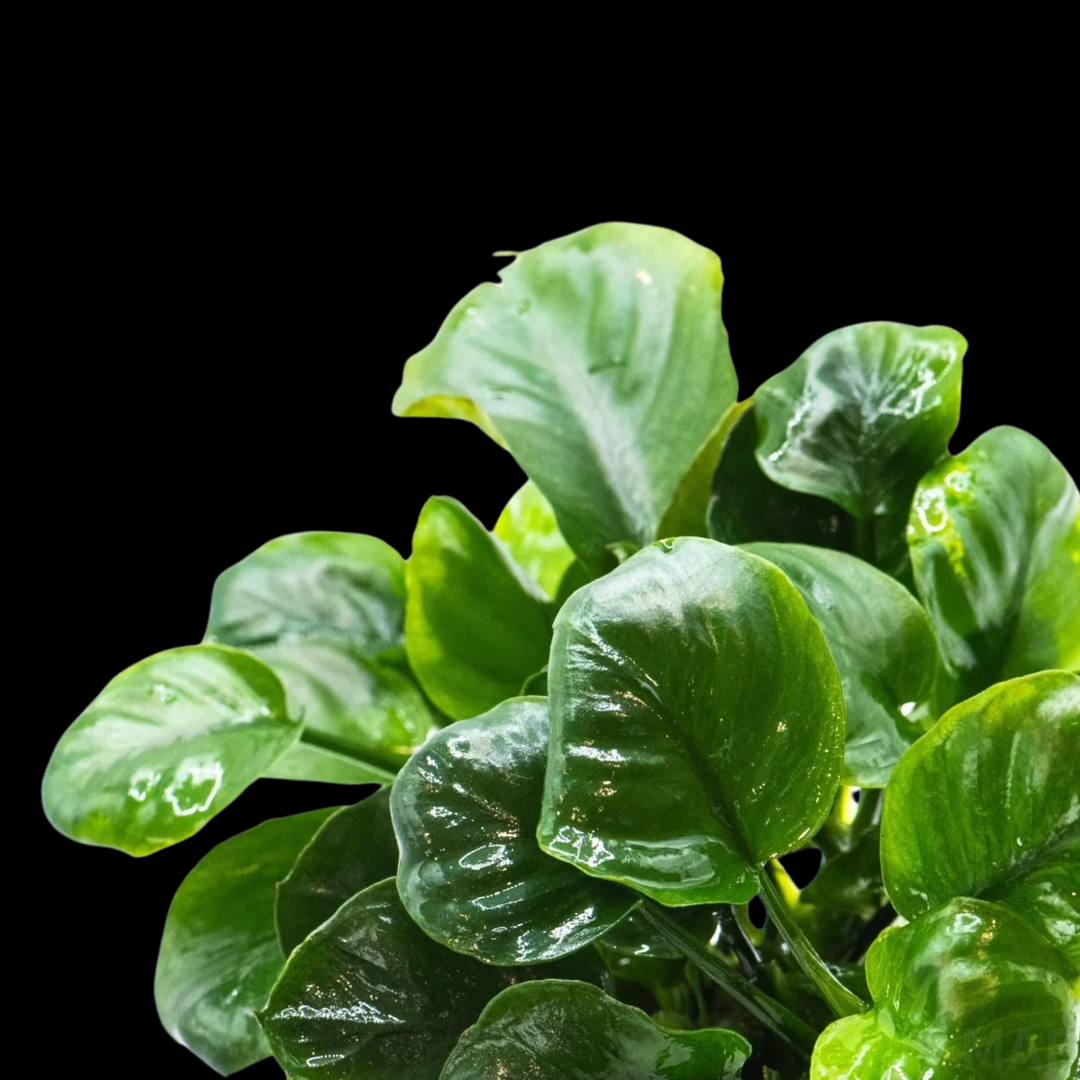
アヌビアス・ナナ・コインリーフは、西アフリカ原産のアヌビアス・バルテリーから選び出された園芸品種で、アヌビアス・バルテリー’コインリーフ’の名前でも流通しています。ナナはバルテリーの仲間として扱われているため、どちらの名前で呼ばれていても同じ植物です。名前のとおり、硬貨を思わせるころんとした丸い葉がいちばんの魅力。厚みのある革質の葉は深い緑色で、葉脈の模様もくっきりと浮かびます。太い根茎を横へ這わせながら一枚ずつ葉を重ねていく成長はとてもゆっくりで、水槽に入れたあとも長くレイアウトの印象を保ってくれます。強い光もCO2添加も必要としないため、はじめての水草としても安心して迎えられます。 Anubias nana ‘Coin Leaf’ is a cultivar selected from Anubias barteri, a plant native to West Africa, and is also sold as Anubias barteri ‘Coin Leaf’. Because nana is treated as part of barteri, both names refer to the same plant. As the name suggests, its greatest charm is the plump, rounded leaf that looks just like a coin. The thick, leathery leaves are a deep green with clearly visible veins. It grows very slowly, creeping a thick rhizome sideways and adding leaves one at a time, so a layout keeps its look for a long time after planting. Because it needs neither strong light nor CO2 injection, it is a reassuring choice even for a first aquarium plant.
草丈はおおむね5〜15cmほどで、流木や石に活着させると中景の主役として存在感を発揮します。シダ類のような尖った葉の水草の隣に置くと、丸い葉のやわらかさがいっそう引き立ちます。葉がさらに小さい’ミニコイン’や定番のナナと比べると、’コインリーフ’は丸さとほどよい大きさを兼ね備えており、30cm規格水槽(約12L)から60cm規格水槽(約57L)まで幅広く使いやすい品種です。湿度を保てる水上環境ではさらに伸びやかに育つため、アクアテラリウムやパルダリウムでも活躍します。 It usually stays around 5–15 cm tall, and when attached to driftwood or rock it becomes a striking midground centerpiece. Placed next to sharp-leaved plants such as ferns, its soft round leaves stand out even more. Compared with the even smaller-leaved ‘Mini Coin’ or the classic var. nana, ‘Coin Leaf’ combines roundness with a moderate size, making it easy to use in tanks from a standard 30 cm tank (about 12 L) up to a standard 60 cm tank (about 57 L). It grows even more vigorously in humid emersed conditions, so it also shines in aquaterrariums and paludariums.
基本情報 / Basic Information
| 学名 / Scientific Name | Anubias barteri ‘Coin Leaf’ ‘Coin Leaf’は園芸品種名で、Anubias barteri var. nana ‘Coin Leaf’ と表記されることもあります。ナナはもともと独立した種 Anubias nana として記載されましたが、1979年にクルシオが行った分類の見直しで、葉の形や大きさの異なる複数のタイプとともに一つの種 A. barteri にまとめられ、var. barteri、var. nana、var. glabra などの変種に整理されました。現在の植物名のチェックリストでは、これらの変種を区別せず A. barteri として扱う例もあります。‘Coin Leaf’ is a cultivar name, and it is also written as Anubias barteri var. nana ‘Coin Leaf’. Nana was originally described as a separate species, Anubias nana, but in Crusio’s 1979 revision it was combined with several forms differing in leaf shape and size into a single species, A. barteri, organized into varieties such as var. barteri, var. nana and var. glabra. Some current plant name checklists treat these varieties simply as A. barteri without distinguishing them. |
|---|---|
| 通称 / Common Name | アヌビアス・ナナ・コインリーフ、アヌビアス・バルテリー’コインリーフ’、コインリーフ、アヌビアス・コインAnubias Nana Coin Leaf, Anubias ‘Coin Leaf’, Anubias Coin, Coin Leaf Anubias |
| 分類 / Family | サトイモ科 アヌビアス属Araceae, genus Anubias |
| 分布 / Distribution | 園芸品種のため、野生の自生地はありません。原種のアヌビアス・バルテリーは、ナイジェリア南東部、カメルーン、赤道ギニアのビオコ島など西アフリカに分布し、熱帯林の日陰を流れる渓流沿いで、岩や倒木に根を張って暮らしています。As a cultivar, it has no wild habitat. The parent species, Anubias barteri, is found in West Africa, including southeastern Nigeria, Cameroon and Bioko Island in Equatorial Guinea, where it grows along shaded forest streams with its roots clinging to rocks and fallen wood. |
| 育成難易度 / Difficulty | 易しい。低光量・CO2無添加でも育つ丈夫な水草です。ただし、根茎を底床に埋めると傷みやすいほか、導入直後の環境変化や、高水温で起こりやすい「芋腐れ」には注意が必要です。Easy. A hardy plant that grows under low light without CO2. However, the rhizome tends to deteriorate if buried in the substrate, and care is needed with stress right after introduction and with rhizome rot, which is more likely at high temperatures. |
育成環境 / Cultivation Environment
| 光量 / Light | 弱〜中程度の光量で十分に育ちます。成長がゆっくりなぶん、強い光を長時間当てると、葉の表面に斑点状のコケ(いわゆるスポットゴケ)が付きやすくなります。光の強い水槽では、背の高い水草や流木の陰になる位置に置くと、葉をきれいに保ちやすくなります。Low to moderate light is plenty. Because it grows slowly, long hours under strong light make the leaf surface prone to green spot algae. In brightly lit tanks, placing it in the shade of taller plants or driftwood helps keep the leaves clean. |
|---|---|
| CO2添加 / CO2 Injection | 不要です。添加しなくても問題なく育ちますが、少量を加えると新しい葉の展開がやや早まり、株も密に茂りやすくなります。Not required. It grows well without it, though a modest amount of CO2 can speed up new leaf production slightly and help the plant grow more densely. |
| 水質 / Water Quality | 水温22〜28℃、pH6.0〜7.5程度が目安です。弱酸性から弱アルカリ性、軟水から硬水まで適応範囲が広く、日本の水道水で無理なく育てられます。20℃を下回ると成長がほぼ止まり、30℃前後の高水温が続くと芋腐れのリスクが高まります。冬はヒーターで20℃以上を保ち、夏場は冷却ファンやクーラーで水温を抑えてあげると安心です。Aim for 22–28°C and a pH of roughly 6.0–7.5. It adapts to a wide range from slightly acidic to slightly alkaline and from soft to hard water, so ordinary tap water in Japan works fine. Growth nearly stops below 20°C, and prolonged temperatures around 30°C raise the risk of rhizome rot. Keeping the water above 20°C with a heater in winter and using a cooling fan or chiller in summer is reassuring. |
| 底床 / Substrate | 本来は着生植物なので、流木や石に活着させて育てるのが基本です。ソイルや砂、砂利に植える場合は根だけを差し込み、根茎は必ず表面に出しておきます。活着させた株は水中の養分を利用して育つため、肥料は液体肥料を控えめに与える程度で十分です。底床に根を張らせている場合は、根元の近くに固形肥料を少量置くのも効果的です。As a natural epiphyte, it is best grown attached to driftwood or rock. If planting in soil, sand or gravel, push in only the roots and always leave the rhizome exposed. Attached plants grow on nutrients in the water, so light doses of liquid fertilizer are sufficient. If roots are growing into the substrate, a small amount of root tab placed nearby can also help. |
レイアウト / Layout
| 配置 / Positioning | 流木や岩に活着させて中景に置くのが定番です。丸い葉は自然と目を引くため、ミクロソリウムやボルビティスなど、尖った葉のシダ類と組み合わせると形のコントラストが際立ちます。30cm規格水槽(約12L)では主役級として、60cm規格水槽(約57L)では流木の根元や石組みの隙間を彩る名脇役として活躍します。アクアテラリウムやパルダリウムでは、水際の岩や流木に着けると自然な雰囲気に仕上がります。The classic use is attached to driftwood or rock in the midground. Round leaves naturally draw the eye, so pairing it with sharp-leaved ferns such as Microsorum or Bolbitis creates a strong contrast in shape. In a standard 30 cm tank (about 12 L) it can be the star, while in a standard 60 cm tank (about 57 L) it works beautifully as a supporting plant at the base of driftwood or in gaps between rocks. In aquaterrariums and paludariums, attaching it to rocks or wood at the waterline gives a natural look. |
|---|---|
| 注意点 / Precautions | 活着させる方法には、木綿糸やテグス、ウッドタイで縛る方法と、ゼリー状の瞬間接着剤で留める方法があります。糸で縛るときは、根茎に食い込まない程度のやさしい力加減を心がけましょう。1〜2か月ほどで根が素材に張りつきます。接着剤は固まると白く目立ち、付けすぎると根茎を傷める原因にもなるため、葉で隠れる位置にごく少量だけ使うのがコツです。根茎をソイルや砂利に埋めると腐る原因になるので避けてください。To attach the plant, you can tie it with cotton thread, fishing line or plant ties, or fix it with gel-type superglue. When tying, use gentle pressure so the thread does not cut into the rhizome; roots will grip the surface in one to two months. Superglue turns visibly white once cured, and too much can damage the rhizome, so use only a small dab in a spot hidden by leaves. Avoid burying the rhizome in soil or gravel, as this can cause it to rot. |
増やし方(トリミング) / Propagation & Trimming
| 増やし方 / Propagation | 根茎の株分けで増やします。根茎がある程度伸びて葉が4〜5枚以上ついたら、清潔なハサミやカッターで切り分けます。切り分けたそれぞれに数枚の葉と根が残るようにすると、その後の生育が安定します。成長がゆっくりな品種なので、気長に付き合うことがいちばんの近道です。Propagate by dividing the rhizome. Once the rhizome has lengthened and carries four or five leaves or more, cut it apart with clean scissors or a blade. Leaving a few leaves and roots on each piece helps the divisions establish well. This is a slow grower, so patience is the surest path. |
|---|---|
| トリミング / Trimming | 頻繁なトリミングはほとんど必要ありません。古くなった葉やコケの付いた葉を、葉柄の付け根から切り取る程度で十分です。根茎を切る際は、切り口から傷みが広がらないよう、消毒した刃物で一度にすっぱり切るようにしましょう。Frequent trimming is rarely needed. Simply remove old or algae-covered leaves at the base of the petiole. When cutting the rhizome, use a sterilized blade and make one clean cut to keep damage from spreading from the wound. |
病気と対策(コケなど) / Pests & Algae
| かかりやすい病気 / Common Issues | いちばん気をつけたいのは、根茎がブヨブヨに柔らかくなって腐る「芋腐れ」です。植物の細胞どうしをつなぐペクチンを分解する細菌の関与が指摘されており、進行すると強い腐敗臭を放って株全体が崩れてしまいます。根茎の傷、底床に埋めたことによる酸欠、高水温が引き金になりやすいと考えられています。また、導入直後に水上葉から水中葉への切り替えがうまくいかず、葉が落ちたり根茎が変色したりすることもあります。成長の遅いアヌビアスでは、葉の表面に付く斑点状のコケや、葉のふちに生える黒髭苔もよく見られるトラブルです。The issue to watch most closely is rhizome rot, in which the rhizome turns mushy and decays. Bacteria that break down pectin, the substance binding plant cells together, have been implicated; as it progresses, the plant gives off a strong rotten smell and can collapse entirely. Wounds on the rhizome, oxygen shortage from being buried, and high water temperature are considered common triggers. Right after introduction, the plant may also struggle to transition from emersed to submerged leaves, dropping leaves or showing a discolored rhizome. Green spot algae on the leaf surface and black brush algae along the leaf edges are also frequent problems with slow-growing Anubias. |
|---|---|
| 対策と予防 / Prevention | 芋腐れを見つけたら、すぐに水槽から取り出し、消毒した刃物で柔らかくなった部分を少し余裕をもって切り落とします。硬く緑色の健全な部分だけを残すのがポイントです。切り口に瞬間接着剤を薄く塗って保護する方法も、アクアリストの間でよく使われています。予防には、根茎を埋めずに水流の当たる場所へ置くこと、夏場の水温管理、残り餌や枯れ葉をこまめに取り除くことが効果的です。コケ対策としては、照明を強くしすぎないことと定期的な水換えが基本で、ヤマトヌマエビなどのコケ取り生体を入れておくのも役立ちます。黒髭苔が広がった葉は、早めに切り取ってしまうのが確実です。 海外ファームで水上栽培されたポット苗には、エビ類に強い毒性を示す農薬が残っている場合があります。エビと同居させるなら、焼成カルシウムを主成分とする水草用の下処理剤に短時間浸け、よくすすいでから導入しましょう。浸けすぎると株を傷めるため、製品に表示された時間を守ることが大切です。より慎重を期すなら、バケツで毎日水を替えながら数週間ほど様子を見ると安心です。最初から農薬の心配がない組織培養カップの株を選ぶのもおすすめです。If you find rhizome rot, remove the plant at once and cut away the soft section with a sterilized blade, leaving a margin. The key is to keep only firm, green, healthy tissue. Coating the cut with a thin layer of superglue is a protective method widely used among aquarists. For prevention, keep the rhizome unburied in a spot with good water flow, manage summer temperatures, and promptly remove leftover food and dead leaves. To control algae, avoid excessive light and change water regularly; algae-eating animals such as Amano shrimp also help. Leaves heavily covered in black brush algae are best removed early. Potted plants grown emersed on overseas farms may carry pesticide residues that are highly toxic to shrimp. If you keep shrimp, soak the plant briefly in a plant pre-treatment product based on calcined calcium, then rinse thoroughly before adding it to the tank. Soaking too long can damage the plant, so follow the time indicated on the product. To be extra careful, keep it in a bucket with daily water changes for a few weeks. Choosing tissue-culture cups, which are free of pesticide concerns from the start, is also a good option. |
雑学と豆知識 / Trivia and Fun Facts
| 1. 名前に込められた「影の神」と、ひとりの植物採集家 / 1. A God of Shadows and a Plant Collector Behind the Name | アヌビアス属は、サトイモ科の分類に大きな足跡を残したオーストリアの植物学者ショットによって、19世紀半ばに記載されました。属名は、エジプト神話で冥界を司るジャッカル頭の神アヌビスに由来するといわれます。熱帯林の薄暗い水辺でひっそりと育つ姿を、影の世界の神になぞらえたというわけです。一方、種小名の barteri は、スコットランド出身の園芸家・植物学者チャールズ・バルターへの献名です。彼は1857年、イギリス政府が後援したニジェール川遠征に植物担当として加わり、西アフリカで植物を採集しました。しかし遠征中に病に倒れ、1859年に帰国することなく現地で亡くなっています。手のひらにのる小さな’コインリーフ’の名前には、そうした探検時代の記憶も刻まれているのです。The genus Anubias was described in the mid-19th century by the Austrian botanist Schott, who left a lasting mark on the classification of the arum family. The name is said to come from Anubis, the jackal-headed Egyptian god of the underworld, likening a plant that grows quietly along dim tropical forest streams to a god of the realm of shadows. The species name barteri honors Charles Barter, a Scottish gardener and botanist. In 1857 he joined a British government-sponsored expedition up the Niger River as its botanist and collected plants in West Africa, but he fell ill during the expedition and died there in 1859 without ever returning home. The name of the little ‘Coin Leaf’ that fits in your palm carries a memory of that age of exploration. |
|---|---|
| 2. 「ナナ」と「バルテリー」は同じ種 / 2. Nana and Barteri Are the Same Species | アヌビアスは葉の形や大きさの個体差が大きく、かつては種の境界があいまいな状態が続いていました。おなじみのナナも、19世紀末には独立した種 Anubias nana として記載されています。1979年、オランダの研究者クルシオが属全体を見直し、葉の形が少しずつ連続して変化するいくつものタイプを一つの種 A. barteri にまとめ、それぞれを変種として整理しました。ナナが「アヌビアス・バルテリー var. ナナ」と表記されるのはこのためです。同じ品種が「ナナ・コインリーフ」とも「バルテリー・コインリーフ」とも呼ばれるのも、どちらの呼び名も同じ種を指しているからなのです。Anubias vary greatly in leaf shape and size, and for a long time the boundaries between species were unclear. The familiar nana itself was described as a separate species, Anubias nana, in the late 19th century. In 1979, the Dutch researcher Crusio revised the whole genus, uniting several forms whose leaf shapes grade gradually into one another into a single species, A. barteri, and organizing them as varieties. That is why nana is written as Anubias barteri var. nana. It is also why the same cultivar is called both ‘Nana Coin Leaf’ and ‘Barteri Coin Leaf’: both names point to the same species. |
| 3. 渓流に生きる「レオファイト」 / 3. A Rheophyte Built for Streams | 原種のアヌビアス・バルテリーは、増水すると水に沈み、水位が下がると水面から顔を出すような渓流沿いの岩場に暮らす「渓流植物(レオファイト)」です。厚く硬い葉、岩にしがみつく丈夫な根、流れに洗われる場所を好む根茎は、どれも激しい水の流れの中で生きるための特徴です。アクアリウムで「根茎を埋めない」「水流を当てる」とよくいわれるのは、まさにこの暮らしぶりを水槽で再現するためです。水上でも水中でも育つ柔軟さも、水位が大きく変わる環境に適応してきた証といえるでしょう。The wild Anubias barteri is a rheophyte, living on rocky stream banks where it is submerged when the water rises and exposed when the level drops. Its thick, tough leaves, strong clinging roots and a rhizome that prefers to be washed by moving water are all traits for life in powerful currents. The common aquarium advice to keep the rhizome unburied and give it some flow is really about recreating this lifestyle in the tank. Its ability to grow both above and below water can likewise be seen as a sign of adaptation to habitats with dramatically changing water levels. |
| 4. 水の中でも咲く、サトイモ科の花 / 4. An Arum Flower That Can Bloom Underwater | アヌビアスは、ミズバショウやカラーと同じサトイモ科の植物で、白っぽい仏炎苞が棒状の肉穂花序を包む、この科らしい花を咲かせます。水上で咲くことが多いものの、環境が安定した水槽では水中で開花することもあり、アクアリストにとってはうれしいご褒美です。ただし水中には花粉を運ぶ昆虫がいないため、種子ができることはまずありません。サトイモ科には雌しべが雄しべより先に熟す性質を持つものが多く、種子を得るには、咲く時期のずれた花どうしで人の手による受粉を行う必要があります。Anubias belongs to the arum family, like skunk cabbage and calla lilies, and produces the family’s typical flower: a pale spathe wrapped around a rod-like spadix. It usually blooms above water, but in a stable aquarium it may even flower underwater, a welcome reward for the aquarist. Underwater, however, there are no insects to carry pollen, so seeds are almost never formed. Many arums mature their female flowers before the male ones, so obtaining seed requires hand-pollinating between flowers that bloom at different times. |
| 5. 小さなカップの中で生まれるクローン / 5. Clones Born in a Small Cup | 成長がとてもゆっくりなアヌビアスを、株分けだけで大量に増やすのは至難の業です。そこで現在は、茎の先端にある成長点の組織を無菌の培地で育てる組織培養が広く使われています。培地に加える植物ホルモンのバランスを段階ごとに切り替え、まず芽をたくさん作らせ、次に根を出させて一人前の株に育てる仕組みです。アヌビアス・バルテリーの染色体数は2n=48と報告されており、ナナを使った研究では、5年間培養を続けた株でも親株と同じ二倍体のまま、倍数性に変化が見られなかったとされています。つまり、組織培養で長く増やし続けても、親株の性質が変わりにくいということです。ショップで見かける培養カップの小さな株は、こうして親株と同じ姿を受け継いだクローンたちなのです。Mass-producing such a slow grower by division alone would be nearly impossible, so tissue culture, in which tissue from the growing point at the stem tip is raised on sterile media, is now widely used. The balance of plant hormones in the medium is switched by stage, first encouraging many shoots and then inducing roots to produce complete plants. Anubias barteri has been reported to have 2n=48 chromosomes, and a study using var. nana found that plants kept in culture for five years remained diploid like the mother plant, with no change in ploidy. In other words, the plant’s characteristics are unlikely to change even after long periods of propagation in culture. The tiny plants in tissue-culture cups at the shop are clones that inherit the same form as their parent plant. |
まとめ / Conclusion
アヌビアス・ナナ・コインリーフは、まんまるの葉と落ち着いた深緑で、水景にやわらかな表情を添えてくれる水草です。弱い光でもCO2がなくても育つ手軽さがありながら、その成長はゆっくりで、新しい葉が一枚開くたびに小さな喜びを感じさせてくれます。流木や岩に寄り添う姿には、西アフリカの渓流で岩にしがみついて生きる原種の面影が重なります。 Anubias nana ‘Coin Leaf’ brings a gentle expression to any aquascape with its perfectly round leaves and calm deep green. It is easy enough to grow under low light without CO2, yet its slow growth makes every new leaf a small joy. Nestled against driftwood or stone, it echoes its wild ancestor clinging to rocks in West African streams.
根茎を埋めずに水の流れが届く場所へ置き、季節ごとの水温に気を配る。渓流植物らしいこの暮らし方を守れば、長いあいだ水槽の中景を静かに支え続けてくれます。尖った葉の水草と組み合わせたり、パルダリウムで水上の姿を楽しんだりと、小さな丸い葉が広げてくれるレイアウトの可能性をじっくり味わってみてください。 Keep the rhizome unburied where water can flow around it, and keep an eye on water temperature through the seasons. Respect this stream-dwelling nature, and it will quietly anchor your midground for a long time. Whether paired with sharp-leaved plants or enjoyed in its emersed form in a paludarium, these little round leaves open up layout possibilities well worth exploring at your own pace.

困りごとの解決から、用品えらび、水槽づくり、生き物えらびまで。飼育に役立つ案内です。
分布マップ
Anubias barteri ‘Coin Leaf’ は園芸品種のため、野生の自生地はありません。地図には原種のアヌビアス・バルテリーの分布域として、ナイジェリア南東部、カメルーン、赤道ギニアのビオコ島を含む西アフリカの一帯を示しています。熱帯林の日陰を流れる渓流沿いで、岩や倒木に根を張って暮らしています。
※地図は分布域のおおよその範囲を示す概略表示です。マーカーは範囲の目安として置いた代表地点で、実際の採集地点や自生地を示すものではありません。
参考文献
- Schott, H. W. (1857). Aroideen-Skizzen. Österreichisches Botanisches Wochenblatt, 7(50), 398–399. https://doi.org/10.1007/BF02071618
- Crusio, W. (1979). A revision of Anubias Schott (Araceae) (Primitiae Africanae XII). Mededelingen Landbouwhogeschool Wageningen, 79(14), 1–48. https://edepot.wur.nl/165228
- Crusio, W. E. (1987). Die Gattung Anubias SCHOTT (Araceae). Aqua Planta, Sonderheft 1, 1–44.
- Mayo, S. J., Bogner, J., & Boyce, P. C. (1997). The Genera of Araceae. Royal Botanic Gardens, Kew.
- Royal Botanic Gardens, Kew. Anubias barteri Schott. Plants of the World Online. https://powo.science.kew.org/taxon/urn:lsid:ipni.org:names:85520-1
- Royal Botanic Gardens, Kew. Anubias Schott. Plants of the World Online. https://powo.science.kew.org/taxon/urn:lsid:ipni.org:names:2697-1
- Hepper, F. N. (2005). Charles Barter: Botanist on the 1857 Niger Expedition. The Nigerian Field, 70, 147–159. https://archaeologydataservice.ac.uk/catalogue/adsdata/arch-3436-1/dissemination/pdf/Vol_70/TNF_70_2_147-159_Charles_Barter.pdf
- Arends, J. C., & van der Laan, F. M. (1982). Somatic chromosome numbers in Anubias Schott. Aroideana, 5, 3–7.
- Kanchanapoom, K., Chunui, P., & Kanchanapoom, K. (2012). Micropropagation of Anubias barteri var. nana from shoot tip culture and the analysis of ploidy stability. Notulae Botanicae Horti Agrobotanici Cluj-Napoca, 40(2), 148–151. https://doi.org/10.15835/nbha4027520
- EPPO Global Database. Dickeya dianthicola (ERWICD): Datasheet. European and Mediterranean Plant Protection Organization. https://gd.eppo.int/taxon/ERWICD/datasheet



コメント