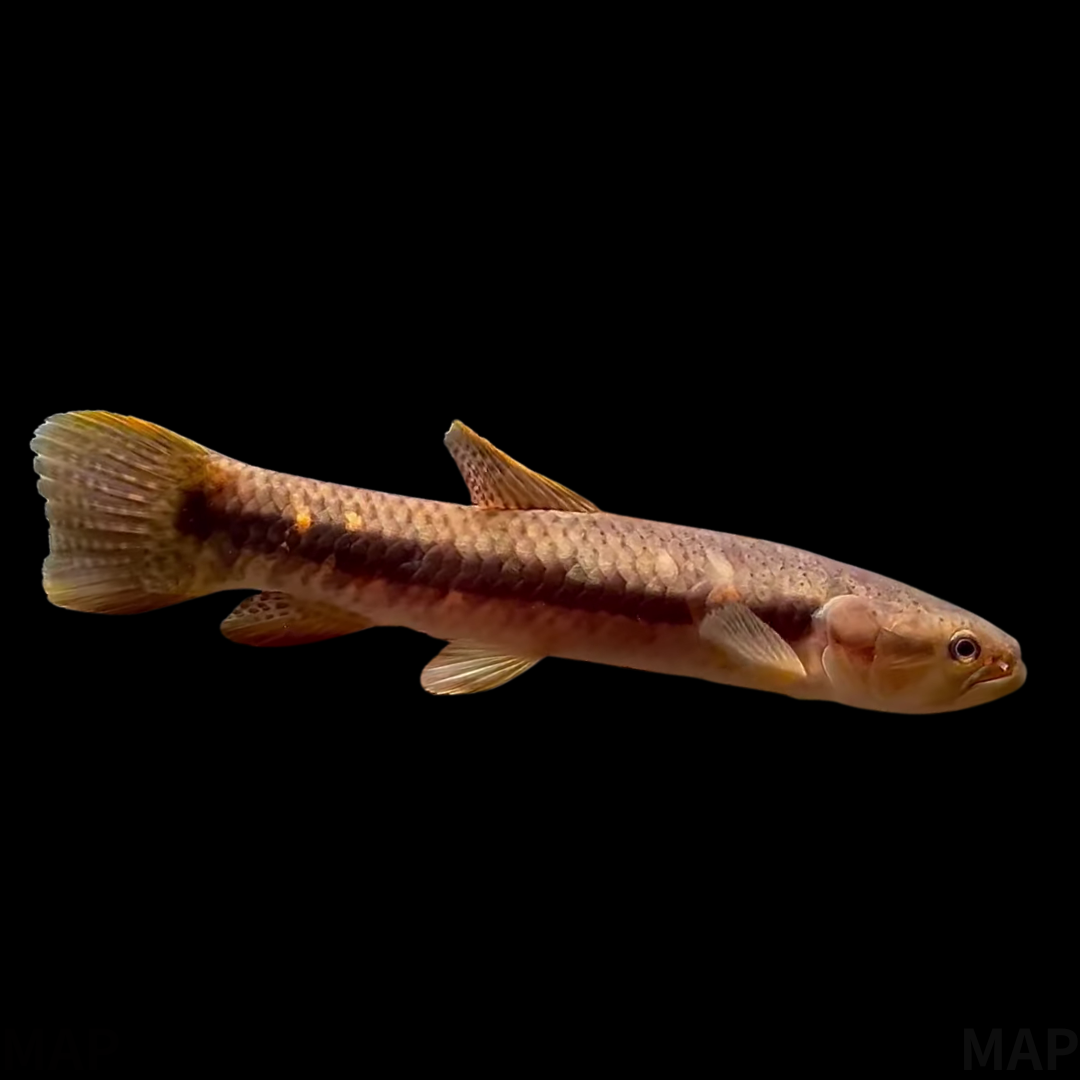
オレンジフィンキリーホーリー(学名:エリスリヌス・エリスリヌス)は、南米のアマゾン川やオリノコ川水系に広く分布するエリュトリヌス科の一種です。この魚は、各鰭に宿る鮮烈なオレンジ色と、卵生メダカ(キリーフィッシュ)を彷彿とさせる円筒形の美しいフォルムを最大の特徴としています。オレンジフィンキリーホーリーは、その観賞価値の高い姿とは裏腹に、非常に強健で野性味あふれる性格を備えており、低酸素環境下での空気呼吸や、湿った陸上を這って移動する驚異的な適応能力を誇ります。中型カラシンの代表格として、オレンジフィンキリーホーリーが見せるダイナミックな捕食行動と知的な生態は、世界中の熱帯魚愛好家を魅了し続けています。The Orange-fin Killi-wolffish (Scientific name: Erythrinus erythrinus) is a species of the family Erythrinidae, widely distributed in the Amazon and Orinoco river basins of South America. This fish is best known for the vivid orange coloration of its fins and its beautiful cylindrical body shape, which resembles that of a killifish. Despite its high ornamental value, the Orange-fin Killi-wolffish possesses a robust and wild temperament, boasting extraordinary adaptations such as air-breathing in low-oxygen environments and the ability to crawl across damp land. As a prominent medium-sized characin, the dynamic predatory behavior and intelligent ecology of the Orange-fin Killi-wolffish continue to captivate tropical fish enthusiasts worldwide.
基本情報 / Basic Information
学名 / Scientific Name
Erythrinus erythrinus
通称 / Common Name
オレンジフィンキリーホーリー、ペルー産小型ホーリーOrange-fin Killi-wolffish, Peru Dwarf Wolffish
分類 / Family
カラシン目エリュトリヌス科Characiformes, Erythrinidae
英名 / English Name
Red Wolf Fish, Rainbow Wolf Fish, High Fin Wolf Fish
分布 / Distribution
アマゾン川、オリノコ川水系、ギアナ沿岸河川Amazon and Orinoco basins, coastal rivers of the Guianas
最大体長 / Max Size
オレンジフィンキリーホーリーは約20cmから25cmに達します。The Orange-fin Killi-wolffish reaches approximately 20cm to 25cm.
寿命 / Lifespan
オレンジフィンキリーホーリーの寿命は約10年程度です。The lifespan of the Orange-fin Killi-wolffish is approximately 10 years.
飼育環境 / Aquarium Environment
水槽サイズ / Tank Size
オレンジフィンキリーホーリーは、単独飼育であれば90cm規格水槽(90×30×36cm / 約90L)以上で管理することが推奨されます。個体の成長に伴い、120cmワイド水槽などゆとりのある環境への移行も検討してください。なお、幼魚期であれば20L以上の環境でも飼育可能ですが、早期の大型化を見越した設備が必要です。The Orange-fin Killi-wolffish is recommended to be kept in at least a 90cm standard tank (90x30x36cm / approx. 90L) for solitary housing. Consider moving it to a more spacious environment as it grows. While juveniles can be kept in tanks over 20L, equipment anticipating rapid growth is necessary.
水温 / Temperature
オレンジフィンキリーホーリーには22℃から28℃の水温が適しています。熱帯雨林の環境を再現するため、ヒーターによる安定した温度管理が不可欠です。A water temperature of 22°C to 28°C is suitable for the Orange-fin Killi-wolffish. Stable temperature control with a heater is essential.
水質 / Water Quality
オレンジフィンキリーホーリーはpH 6.0から7.5の弱酸性から中性の水質を好みます。適応範囲は広いですが、この範囲内を維持することが健康維持のポイントとなります。The Orange-fin Killi-wolffish prefers water with a pH of 6.0 to 7.5 (slightly acidic to neutral). While it is adaptable, maintaining this range is key to its health.
レイアウト / Layout
オレンジフィンキリーホーリーは物陰に潜む性質があるため、流木や石で隠れ家を作ります。底砂には滑らかな川砂を敷き、浮草などで光量を抑えた落ち着いた環境を構築してください。Since the Orange-fin Killi-wolffish tends to hide, provide hiding spots with driftwood and stones. Use smooth river sand and floating plants to create a calm, dimly lit environment.
注意点 / Precautions
オレンジフィンキリーホーリーは極めて高いジャンプ能力を持っており、わずかな隙間からも脱走します。水槽の蓋を隙間なく密閉し、重石を乗せるなどの厳重な飛び出し防止策が必須となります。The Orange-fin Killi-wolffish has exceptional jumping ability. A tightly sealed lid with weights is mandatory to prevent escapes.
餌と給餌 / Feeding
餌の種類 / Diet
オレンジフィンキリーホーリーは生粋の肉食魚です。ミミズ、イサザアミ、エビ、魚の切り身などの生餌や冷凍餌を好みますが、沈下性の人工飼料にも慣れさせることができます。The Orange-fin Killi-wolffish is a strictly carnivorous fish. It prefers live or frozen foods such as earthworms, mysis shrimp, and fish fillets, but can be acclimated to sinking pellets.
給餌のポイント / Feeding Tips
オレンジフィンキリーホーリーは成長とともに偏食しやすくなる傾向があります。若魚のうちから多様な餌をバランスよく与え、食の幅を広げておくことが重要です。The Orange-fin Killi-wolffish tends to become a pickier eater as it matures. Providing a variety of foods from a young age is important.
性格と混泳 / Temperament and Tank Mates
性格 / Temperament
オレンジフィンキリーホーリーは非常に攻撃的で、強い縄張り意識を持っています。他魚に対して執拗に攻撃を仕掛けるため、その性質は極めて獰猛と言えます。The Orange-fin Killi-wolffish is extremely aggressive and territorial. It is known to be very ferocious towards other fish.
混泳の相性 / Compatibility
オレンジフィンキリーホーリーにとって、混泳は死闘を意味することが少なくありません。他魚を殺傷するリスクが非常に高いため、終生にわたる完全な単独飼育が唯一の正解となります。For the Orange-fin Killi-wolffish, tank mates often mean a fight to the death. Permanent solitary housing is the only recommended approach.
病気と対策 / Diseases and Prevention
かかりやすい病気 / Common Diseases
オレンジフィンキリーホーリーは白点病や、輸送時のスレ傷からくる水カビ病に注意が必要です。Susceptible to Ich (White Spot Disease) and fungal infections from abrasions.
対策と予防 / Prevention
オレンジフィンキリーホーリーの高い再生能力を活かすためにも、定期的な換水で水を清潔に保つことが最善の予防策です。また、活餌からの寄生虫持ち込みにも細心の注意を払ってください。The best prevention is keeping the water clean. Be cautious of introducing parasites via live food.
増やし方(繁殖) / Breeding
繁殖形態 / Reproduction
オレンジフィンキリーホーリーは卵生の繁殖形態を持ちます。自然界では水底にピット状の巣を作り、植物質を利用して産卵を行うと推測されています。Oviparous. In the wild, they are believed to build pit-like nests using plant matter.
繁殖のポイント / Breeding Tips
オレンジフィンキリーホーリーの飼育下での繁殖例はほとんど報告されていません。ペアを同じ水槽に入れた瞬間に激しい殺し合いが始まることが、繁殖を困難にしている最大の要因です。Breeding reports in captivity are virtually non-existent due to extreme intra-species aggression.
雑学と豆知識 / Trivia and Fun Facts
1. 種複合体:オレンジフィンキリーホーリーの隠された多様性 / 1. Species Complex: Hidden Diversity
オレンジフィンキリーホーリーは、長年単一の種と考えられてきましたが、Bertolloら(2004)の研究により、複数の染色体グループ(A〜D)を持つ「種複合体」であることが明らかになりました。産地によって染色体数が異なり、性染色体システムすら違う個体群が混在しています。これらは、隔離された環境で独自の進化を遂げた結果であり、将来的に複数の新種へと再分類されることが確実視されている神秘的な存在です。The Orange-fin Killi-wolffish was long thought to be a single species, but research by Bertollo et al. (2004) revealed it is a species complex with multiple chromosome groups (A-D). These populations evolved independently in isolated environments and are expected to be reclassified into several new species in the future.
2. 驚異の生存本能:陸上を移動する「歩く魚」 / 2. Survival Instinct: The “Walking Fish”
オレンジフィンキリーホーリーは、乾季に水場が消失するという極限状態を生き抜くため、驚くべき適応を遂げました。FishBaseなどでも記録されている通り、彼らは鰾(うきぶくろ)を肺のように使って空気呼吸を行い、湿った地面の上を這い進んで新しい水場を探し当てます。飼育下で見られる力強いジャンプや脱走行動も、この過酷な自然を生き抜くための生存本能の表れなのです。As documented in FishBase, the Orange-fin Killi-wolffish uses its swim bladder for air-breathing to survive dry seasons. They can crawl across damp ground to find new water sources, a survival instinct that also drives their powerful jumping and escape attempts in aquariums.
3. 巧妙な戦略:キリーフィッシュの群れへの紛れ込み / 3. Clever Strategy: Blending into Killifish Schools
オレンジフィンキリーホーリーの幼魚は、Brosset(1997)の研究により、同所に生息するキリーフィッシュの群れに紛れ込むような体色や行動をとる「攻撃的擬態」を行うことが確認されています。この擬態によって獲物となる魚たちの警戒心を解き、その群れの一員であるかのように振る舞いながら、隙を見て捕食を行います。成長とともにこの模様は消失し、単独で獲物を狙う純粋なプレデターとしての姿を現していきます。Research by Brosset (1997) confirmed that juvenile Orange-fin Killi-wolffish perform “aggressive mimicry” by blending into killifish schools. This allows them to approach prey without causing alarm. As they mature, this mimicry fades, and they transition into their role as pure, solitary predators.
4. 人間の文化に深く関わるアイコン / 4. A Deeply Connected Cultural Icon
オレンジフィンキリーホーリーは、南米の先住民文化においても特異な位置づけを占めています。Alvesら(2007)の調査によれば、ブラジルの伝統医療ではその強靭な生命力にあやかって喘息の治療薬として利用されてきました。一方で、ペルーの一部地域では食べると皮膚炎を起こすと信じられ、食用のタブーとされるなど、単なる野生動物としてだけでなく、人間の信仰や生活に密接に結びついた存在でもあります。According to research by Alves et al. (2007), the Orange-fin Killi-wolffish is used in traditional Brazilian medicine to treat asthma. Conversely, in parts of Peru, it is a dietary taboo believed to cause dermatitis, showing its deep connection to human beliefs and lifestyles.
まとめ / Conclusion
オレンジフィンキリーホーリーは、南米の過酷な熱帯雨林が生んだ、進化の神秘と美しさを兼ね備えた唯一無二の存在です。その飼育においては、単独飼育の徹底や堅牢な飛び出し防止策、そしてpH 6.0-7.5程度の安定した水質維持といった、この魚の性質への深い理解が求められます。The Orange-fin Killi-wolffish is a unique entity born from the harsh rainforests, combining evolutionary mystery with beauty. Keeping them requires deep understanding of their nature, including strict solitary housing, robust anti-escape measures, and maintaining stable water quality (pH 6.0-7.5).
肉食魚としての力強い生命力を持ち、知的な戦略まで備えたオレンジフィンキリーホーリーを水槽に迎えることは、アクアリストにとって至高の体験となるはずです。日々の管理を通じて、彼らが見せる鮮烈な色彩の変化と、自然界を生き抜くための知恵をぜひその目で見届けてください。Keeping the Orange-fin Killi-wolffish, a powerful carnivore with intelligent strategies, offers a supreme experience for any aquarist. Witness their vivid color changes and survival wisdom through dedicated daily care.
Bloch, M. E. & Schneider, J. G. (1801) Systema Ichthyologiae iconibus cx illustratum.(学名の初記載および分類学的基礎資料)
Brosset, A. (1997) Aggressive mimicry by the characid fish Erythrinus erythrinus (Characidae). Ethology, 103(11), 926-934.(幼魚期の攻撃的擬態に関する主要論文)
Bertollo, L. A. C., et al. (2004) Karyotype evolution and chromosomal relationships of Erythrinidae (Teleostei, Characiformes).(染色体グループA-Dおよび種複合体に関する細胞遺伝学的研究)
Alves, R. R. N. & Rosa, I. L. (2007) Zootherapy goes to town: The use of animal-based remedies in urban areas of NE and N Brazil.(ブラジルにおける伝統的医療への利用に関する調査記録)



 アイのアクアグッズ案内水槽のコケ掃除|道具の選び方とお掃除生体の得意・不得意道具の特徴や使い方、選ぶときのポイントをアイが紹介します。記事はコチラ →
 アイのアクアグッズ案内コケを食べるコイの仲間に合わせる飼育用品|フライングフォックス・アルジイーター・ガラ道具の特徴や使い方、選ぶときのポイントをアイが紹介します。記事はコチラ →
 アイのアクアグッズ案内ショップで見かけるカラフルなバケツ。いったい何が入ってる?道具の特徴や使い方、選ぶときのポイントをアイが紹介します。記事はコチラ →
 アイのアクアグッズ案内エンゼルフィッシュの飼育用品|高さのある水槽・ろ過・水草・餌の選び方道具の特徴や使い方、選ぶときのポイントをアイが紹介します。記事はコチラ →



コメント