

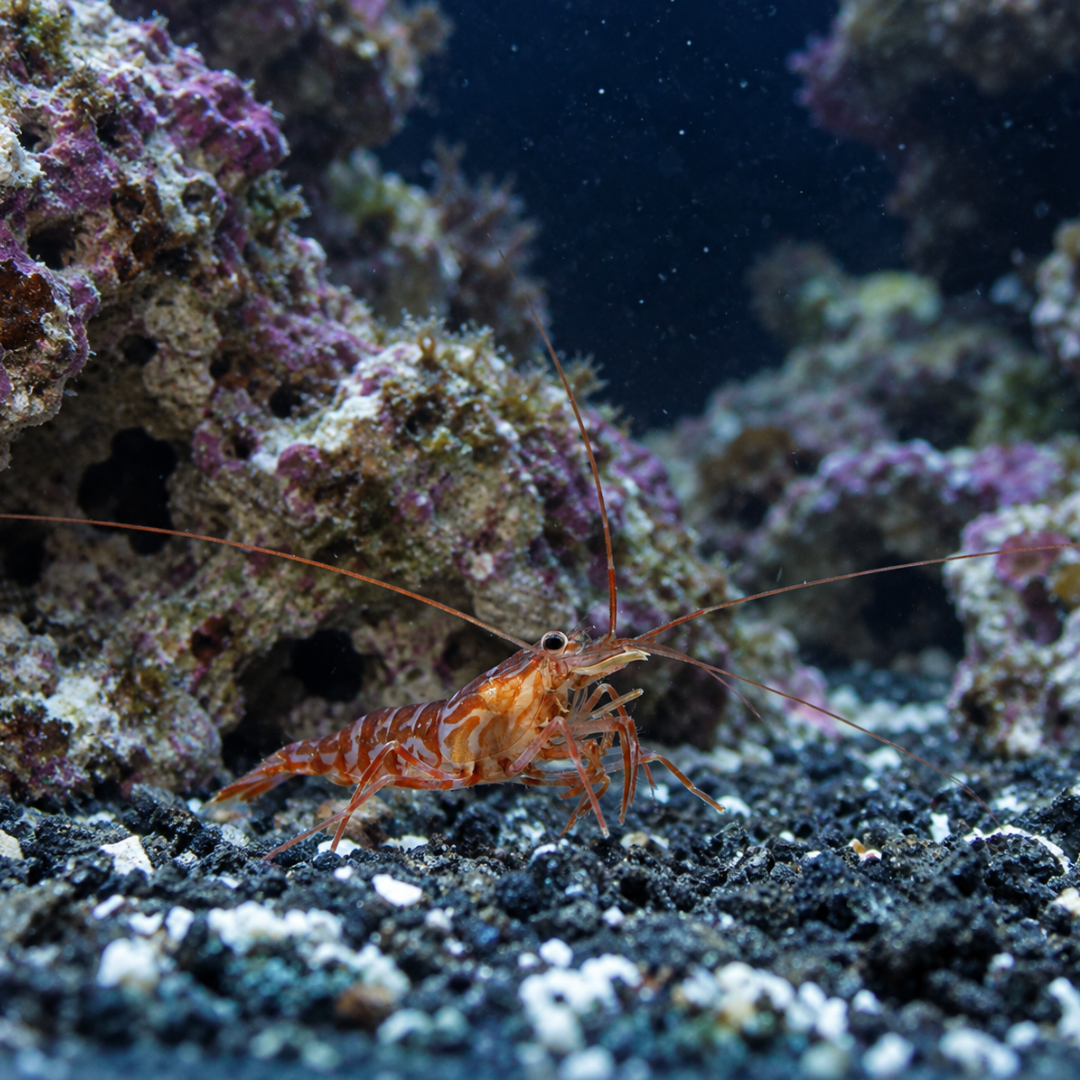
解説 / Description
アカモエビは、インド・西太平洋に分布するLysmata属の海産エビです。半透明の体に赤色から赤褐色の複雑な模様が入り、岩陰などに身を潜めながら生活します。日本のマリンアクアリウムでは「カーリーシュリンプ」の流通名でも知られ、水槽内で増殖するカーリーと呼ばれるイソギンチャク類を食べることがあるため、その対策を目的として導入されることがあります。 Lysmata kuekenthali is a marine shrimp of the genus Lysmata distributed in the Indo-West Pacific. Its translucent body is marked with complex red to reddish-brown patterns, and it commonly spends much of its time sheltered among rocks and crevices. In the Japanese marine aquarium trade it is also known as the “Aiptasia shrimp” because individuals are known to feed on pest anemones commonly called Aiptasia in reef aquaria.
ただし、カーリーを食べるかどうかや、その駆除速度には個体差や飼育環境による差があります。そのため、導入すれば必ずカーリーを完全に駆除できる生体と考えるのではなく、生物を利用した対策のひとつとして捉えるのが適切です。また、Lysmata属では、若い時期には雄として繁殖し、成長後には雄としての機能を残したまま卵を作る側としても機能する「雄性先熟同時雌雄同体」という珍しい繁殖様式が知られています。 Its effectiveness against Aiptasia varies among individuals and aquarium conditions, so it should be regarded as one form of biological control rather than a guaranteed method of complete eradication. The genus Lysmata is also notable for a reproductive system known as protandric simultaneous hermaphroditism: individuals initially reproduce as males and later develop female reproductive function while retaining the ability to function as males.
基本情報 / Basic Information
| 学名 / Scientific Name | Lysmata kuekenthali (De Man, 1902) |
|---|---|
| 通称 / Common Name | アカモエビ、カーリーシュリンプ(アクアリウム流通名)Kükenthal’s cleaner shrimp, striped shrimp |
| 分類 / Family | 十脚目・コエビ下目・Lysmatidae・Lysmata属。現在の国際的な分類データベースではLysmatidaeに置かれています。一方、日本のBISMaLでは従来の分類体系に基づき、モエビ科(Hippolytidae)・ヒゲナガモエビ属として掲載されています。Order Decapoda, Infraorder Caridea, Family Lysmatidae, Genus Lysmata. Current international taxonomic databases place the genus in Lysmatidae, while some older or regional classifications retain it within Hippolytidae. |
| 英名 / English Name | Kükenthal’s Cleaner Shrimp |
| 分布 / Distribution | インド・西太平洋の熱帯海域から知られています。Known from tropical waters of the Indo-West Pacific. |
| 最大体長 / Max Size | 資料によって数値に差があります。生物データベースには最大全長3.5cmの記録がある一方、アクアリウム分野では5cm前後まで成長するとされることが多く、5~6cm程度とする飼育情報もあります。Reported size varies among sources. A biological database records a maximum total length of 3.5 cm, while aquarium references commonly describe adults around 5 cm and occasionally up to approximately 5–6 cm. |
| 寿命 / Lifespan | 飼育情報では2~3年程度とされることがありますが、本種について十分に確立された寿命データは限られています。水質、餌、導入時の状態などによっても変化します。Aquarium references sometimes estimate a lifespan of around 2–3 years, although well-established species-specific longevity data are limited. Actual lifespan varies with water quality, nutrition, and the condition of the individual. |
飼育環境 / Aquarium Environment
| 水槽サイズ / Tank Size | 単独から少数の飼育では、50~60L程度以上が一般的な目安です。日本の規格水槽では60cm規格水槽前後から扱いやすくなります。複数匹を飼育する場合や魚と混泳させる場合は、水量だけでなく、岩組みの広さや隠れ家の数にも余裕を持たせます。Around 50–60 liters or more is a commonly cited guideline for one or a small number of individuals. A standard aquarium of approximately 60 cm in length provides a practical starting point. When maintaining a group or housing them with fish, adequate rockwork and numerous shelters are as important as total water volume. |
|---|---|
| 水温 / Temperature | 23~27℃前後を目安にし、短時間で大きく変化させないように管理します。 Approximately 23–27°C is a practical range. Sudden temperature changes should be avoided. |
| 水質 / Water Quality | 一般的なリーフタンクと同様に、安定した海水環境を維持します。比重1.023~1.025前後、pH8.1~8.4程度がひとつの目安です。アンモニアや亜硝酸塩が検出される不安定な水槽への導入は避け、十分に立ち上がった環境で飼育します。Maintain stable marine conditions similar to those used for a typical reef aquarium. A specific gravity of approximately 1.023–1.025 and pH around 8.1–8.4 are practical guidelines. Avoid introducing the shrimp into an immature aquarium where ammonia or nitrite is detectable. |
| レイアウト / Layout | ライブロックや岩を組み、暗い割れ目、洞窟、岩棚の下など、体を隠せる場所を複数用意します。明るい時間帯には岩陰にいることが多く、特に脱皮直後は外敵から身を守れる狭い隙間が重要になります。Provide live rock or other suitable rockwork with several dark crevices, caves, and shaded overhangs. The shrimp often remains sheltered during brighter periods, and secure narrow refuges are particularly valuable immediately after molting. |
| 注意点 / Precautions | 甲殻類は急激な塩分や水温の変化に弱いため、導入時は時間をかけて水合わせを行います。点滴法などで水槽の水質へ徐々に慣らす方法が適しています。また、銅を含む魚病薬はエビなどの無脊椎動物に有害となるため、アカモエビを収容した水槽では使用しないようにします。Crustaceans are sensitive to abrupt changes in salinity and temperature, so new specimens should be acclimated gradually. Drip acclimation is a useful method. Copper-containing fish medications can be harmful to shrimp and other invertebrates and should not be used in an aquarium containing this species. |
餌と給餌 / Feeding
| 餌の種類 / Diet | 雑食性で、水槽内ではカーリーのほか、魚の食べ残しや動物質の餌を利用します。冷凍イサザアミ、ブラインシュリンプ、細かな海産物、甲殻類向けの沈下性人工飼料などを与えることができます。カーリーだけを餌として維持する種類ではありません。This species is an opportunistic omnivore. In aquaria it may feed on Aiptasia as well as leftover fish food and other animal-based foods. Frozen mysids, brine shrimp, finely chopped marine foods, and sinking diets for crustaceans can be offered. It should not be maintained on Aiptasia alone. |
|---|---|
| 給餌のポイント / Feeding Tips | 魚への給餌で十分な餌が回っている場合は追加給餌が少量で済むこともありますが、カーリーが減った後は痩せていないかを確認しながら餌を補います。暗くなってから活動が目立つことが多いため、消灯前後に沈下性の餌を少量与えると摂餌を確認しやすくなります。食べ残しが蓄積するほどの過剰給餌は避けます。Additional feeding may be minimal when sufficient food reaches the shrimp during regular fish feeding, but once Aiptasia becomes scarce, its body condition should be monitored and supplemental food provided as needed. Activity often increases after the lights dim, making the period around lights-out convenient for offering small amounts of sinking food. Avoid excessive feeding that leaves uneaten food in the aquarium. |
性格と混泳 / Temperament and Tank Mates
| 性格 / Temperament | 基本的にはおとなしく、岩陰を中心に生活するエビです。導入直後は姿を見せないこともありますが、環境に慣れると給餌時などに岩陰から出てくることがあります。同種を複数飼育することも可能ですが、それぞれが隠れられる場所を十分に確保します。Generally peaceful and secretive, this shrimp spends much of its time around rocky shelters. Newly introduced individuals may remain hidden, although they often become more visible at feeding time once acclimated. Several individuals can be kept together when sufficient shelter is available. |
|---|---|
| 混泳の相性 / Compatibility | 小型で温和な海水魚とは比較的合わせやすい一方、エビを捕食する大型のベラ類、ゴンベ類、ハタ類などとの混泳は避けます。サンゴ水槽でも飼育されていますが、完全な意味でサンゴに無関心とは限りません。餌を与えたサンゴから餌を奪ったり、空腹時にポリプへ触れたりする例が飼育者から報告されているため、特にカーリーが減った後は十分な給餌と観察が必要です。It is generally compatible with small peaceful marine fishes, but should not be housed with predatory wrasses, hawkfish, groupers, or other fishes that readily eat shrimp. It is kept successfully in many reef aquaria, although it should not be assumed to ignore corals under all circumstances. Aquarium observations include stealing food from corals and occasionally picking at polyps, especially when other food is scarce. |
病気と対策 / Diseases and Prevention
| かかりやすい病気 / Common Diseases | アクアリウムで本種に特有の病気として確立された情報は多くありません。実際の飼育では、病名のある感染症よりも、急激な水質変化、輸送ストレス、水質悪化、脱皮時のトラブルなどによる衰弱に注意します。状態を崩した個体では、動きが鈍くなったり、餌への反応が低下したりすることがあります。There is limited information on diseases specifically established for this species in aquaria. In practice, problems associated with sudden changes in water chemistry, transport stress, poor water quality, and molting are generally of greater concern than named infectious diseases. Affected shrimp may become inactive or show reduced interest in food. |
|---|---|
| 対策と予防 / Prevention | 十分に立ち上がった水槽へ導入し、塩分、水温、pHなどを急変させないことが基本です。定期的な換水と適切な給餌で環境を安定させ、脱皮時に身を隠せる場所も確保します。新規導入時には慎重に水合わせを行い、銅を含む薬剤を使用しないようにします。Introduce the shrimp only into a mature aquarium and avoid abrupt changes in salinity, temperature, and pH. Stable conditions should be maintained through regular water changes and appropriate feeding, with secure shelters available during molting. Newly acquired shrimp should be acclimated carefully, and copper-containing medications should be avoided. |
増やし方(繁殖) / Breeding
| 雌雄の判別 / Sexing | 一般的な雌雄異体のエビのように、成熟個体を恒久的な「雄」と「雌」に分けて考える種類ではありません。Lysmata属では、若い個体はまず雄として成熟し、その後、雄としての生殖機能を残したまま卵を作り抱える機能も持つ段階へ移行する雄性先熟同時雌雄同体が知られています。そのため、卵を抱える成熟個体も雄としての機能を完全に失ったわけではありません。Mature individuals should not be viewed simply as permanent males and females in the way typical separate-sex shrimp are. Lysmata species are known for protandric simultaneous hermaphroditism: young individuals first mature as males and later develop the ability to produce and brood eggs while retaining male reproductive function. An egg-bearing mature individual has therefore not necessarily lost its ability to function as a male. |
|---|---|
| 繁殖形態 / Reproduction | 卵生で、交尾後は腹部の遊泳脚に卵を抱えます。発生が進んだ卵から幼生が孵化すると、親と同じ形の小さなエビがすぐに底へ降りるのではなく、水中を漂う浮遊幼生として生活します。その後、複数の幼生段階を経て稚エビへ変態します。The shrimp is oviparous, carrying developing eggs beneath the abdomen on the pleopods after mating. The hatchlings are not miniature bottom-dwelling adults. They enter a planktonic larval phase and pass through multiple developmental stages before transforming into juvenile shrimp. |
| 繁殖のポイント / Breeding Tips | 成熟個体を複数飼育していると抱卵を観察できる場合がありますが、孵化後の幼生を稚エビまで育てる難易度は高くなります。通常の混泳水槽では幼生が魚に捕食されたり、濾過装置へ吸い込まれたりしやすいため、本格的な繁殖では幼生専用の育成容器が必要です。幼生を強く壁面へ打ち付けない穏やかな水流を作り、成長段階に合わせて孵化直後のブラインシュリンプなどの微小な餌を安定して供給します。本種に対する家庭飼育向けの標準化された育成手順は十分に確立されていないため、固定した日数や単一の方法で考えないことが大切です。Egg carrying may be observed when several mature shrimp are maintained together, but raising the larvae through settlement is considerably more difficult. In a community aquarium, larvae are easily eaten by fish or drawn into filtration equipment, so serious propagation attempts require a dedicated larval-rearing container. Gentle circulation should prevent delicate larvae from repeatedly striking hard surfaces, while appropriately sized foods such as newly hatched Artemia nauplii are supplied according to developmental stage. A standardized home-aquarium protocol for this species is not firmly established, so development should not be assumed to follow one fixed timetable. |
雑学と豆知識 / Trivia and Fun Facts
| 1. 1902年に記載された歴史あるエビ / 1. A species described in 1902 | アカモエビは1902年、オランダの甲殻類研究者J.G. de Manによって記載されました。記載のもとになったのは、ドイツの動物学者ヴィリー・キューケンタールがモルッカ諸島やボルネオを含むインドネシア地域で行った調査によって集められた標本です。当初はHippolyte kükenthaliとして扱われ、その後の分類変更を経て現在のLysmata kuekenthaliという学名になりました。種小名には、標本をもたらしたKükenthalの名が残されています。Lysmata kuekenthali was described in 1902 by the Dutch carcinologist J.G. de Man from material collected during zoological work associated with German zoologist Willy Kükenthal in the Indonesian Archipelago, including the Moluccas and Borneo. It was originally described under Hippolyte and was later transferred to Lysmata. The species name preserves Kükenthal’s name. |
|---|---|
| 2. HippolysmataがLysmataへまとめられた背景 / 2. Why Hippolysmata was merged into Lysmata | Lysmata属とHippolysmata属は、かつて第1触角にある副枝の発達状態を重要な区別点として分けられていました。しかし、この形質には変異があり、Chaceは1972年にHippolysmataをLysmataの異名として扱いました。一方、その後の分子系統研究では、副枝の構造が系統関係を考えるうえで依然として重要な情報を持つことも示されています。つまり、「副枝には意味がなかったから二属が統合された」という単純な話ではなく、形態だけで分類していた時代から、形態とDNAの双方を使って関係を見直す時代へ研究が進んできたと理解するのが適切です。Lysmata and Hippolysmata were historically separated largely by differences in the accessory branch of the first antennule. Because this character appeared variable, Chace treated Hippolysmata as a synonym of Lysmata in 1972. Later molecular studies, however, showed that accessory-branch morphology still contains useful phylogenetic information. The history therefore does not simply mean that the character was useless; instead, it illustrates how classification has progressed from morphology alone toward interpretations that combine morphology and DNA evidence. |
| 3. 「雄から雌へ変わる」だけではない繁殖システム / 3. More than a simple male-to-female sex change | Lysmata属で知られる雄性先熟同時雌雄同体は、一般的な「性転換」と少し違います。若い時期には雄として繁殖しますが、成長後は雄としての機能を捨てて完全な雌になるのではなく、卵を作る機能を獲得した後も雄として交尾できる能力を残します。つまり成熟個体は、繁殖の場面によって雄側と卵を抱える側の双方の役割を担える可能性があります。この仕組みが、Lysmata属を繁殖生態や進化研究の興味深い対象にしている理由のひとつです。Protandric simultaneous hermaphroditism in Lysmata differs from a simple permanent male-to-female sex change. Young shrimp initially reproduce as males. Later they acquire the ability to produce eggs, but do not completely lose male reproductive function. Mature individuals can therefore potentially perform both reproductive roles depending on the mating situation. This unusual system is one reason Lysmata has attracted considerable interest in studies of reproductive and evolutionary biology. |
| 4. カーリー対策で知られている理由 / 4. Why it is known as an Aiptasia-control shrimp | カーリーはライブロックなどと一緒に水槽へ入り込み、条件が整うと増えてサンゴへ接触することがあるため、リーフタンクでは厄介な存在として扱われます。アカモエビはカーリーを食べることがあるため、アクアリウムでは生物を利用した対策として利用されています。ただし、すべての個体が同じように捕食するわけではなく、大きなカーリーを残す例や、ほかの餌を優先する例も報告されています。したがって、「必ず食べる」「必ず根絶できる」と断定するのは適切ではありません。Aiptasia can enter aquaria on live rock and other materials and may multiply under favorable conditions, sometimes irritating nearby corals. Lysmata kuekenthali is used as a biological control because individuals are known to consume these anemones. The response is not identical in every shrimp, however: some aquarium observations report large Aiptasia being left untouched or other foods being preferred. It should therefore not be described as a guaranteed eradication method. |
| 5. 「ペパーミントシュリンプ」という名前だけでは種類を特定できない / 5. “Peppermint shrimp” does not identify a single species | アクアリウムで使われる「ペパーミントシュリンプ」という呼び名は、赤い模様を持つ複数のLysmata属のエビに使われることがあります。そのため、販売名だけではアカモエビであると判断できない場合があります。Lysmata属には外見の似た種類が多く、正確な同定では額角の歯の数や歩脚、触角の副枝など、細かな形態を確認する必要があります。カーリー対策を目的に購入する場合は、単に「ペパーミントシュリンプ」と表示された個体より、学名を確認して販売している個体を選ぶ方が種類を把握しやすくなります。The aquarium name “peppermint shrimp” is applied to several red-patterned species of Lysmata and does not by itself identify L. kuekenthali. Many species in the genus are superficially similar. Reliable identification may require close examination of characters such as rostral dentition, walking legs, and the accessory branch of the antennule. When the goal is Aiptasia control, purchasing shrimp identified by scientific name provides better information than relying on the generic trade name alone. |
| 6. よく似た近縁種を同じ種類と決めつけない / 6. Similar-looking relatives are not necessarily the same species | アカモエビの周辺には、形態や色彩がよく似たLysmata属の種類が存在します。たとえばカリブ海から記載されたLysmata hochiはアカモエビによく似ていますが、現在も別種として扱われています。一方、南アフリカからHippolysmata marleyiとして記載されたものは、現在のWoRMSではアカモエビの異名として整理されています。外見が似ているから同じ種、離れた地域にいるから別種、と単純には判断できないことが、この仲間の分類の難しさをよく表しています。Several Lysmata species resemble L. kuekenthali in morphology and coloration. Lysmata hochi, described from the Caribbean, is morphologically similar but continues to be treated as a separate species. In contrast, Hippolysmata marleyi, originally described from southern Africa, is currently listed by WoRMS as a synonym of L. kuekenthali. These examples illustrate why external similarity or geographic separation alone is not enough to establish species identity in this group. |
| 7. カーリーが減った後も飼育は続く / 7. Care continues after the Aiptasia declines | カーリー対策として導入されたアカモエビも、目的を達成した時点で役目を終えるわけではありません。カーリーだけを食べる専食性の動物ではなく、その後も魚の食べ残しや人工飼料などを利用して生活します。カーリーが減った後は、体が痩せていないかを観察しながら餌を補うことが大切です。十分な餌を与えることは長期飼育につながるだけでなく、サンゴに与えた餌を必要以上に奪うといった行動を減らすうえでも役立ちます。A shrimp introduced for Aiptasia control does not become unnecessary once the pest population declines. It is not an obligate Aiptasia specialist and can continue feeding on leftover fish food and prepared diets. Once Aiptasia becomes scarce, the shrimp’s body condition should be monitored and supplemental food provided when needed. Adequate feeding supports long-term health and may also reduce excessive attempts to steal food from corals. |
| 8. 抱卵と幼生育成は難易度が大きく異なる / 8. Carrying eggs and raising larvae are very different challenges | 成熟したLysmata属のエビでは、腹部に卵を抱えた姿を水槽内で観察できることがあります。しかし、卵を持つことと、その幼生を稚エビまで育てることは別の難しさがあります。孵化した幼生はしばらく水中を漂って生活するため、通常の混泳水槽では魚に食べられたり、濾過装置へ吸い込まれたりしやすくなります。繁殖を目指す場合は幼生専用の容器、穏やかな水流、適切な大きさの餌を長期間安定して用意する必要があり、成体の飼育よりも高い管理技術が求められます。Mature Lysmata shrimp may sometimes be observed carrying eggs beneath the abdomen in aquaria, but producing eggs and successfully raising the larvae are very different challenges. Newly hatched larvae remain suspended in the water column and are easily eaten by fish or drawn into filtration systems in a community tank. Successful propagation requires dedicated larval housing, gentle circulation, and a sustained supply of appropriately sized foods, making larval culture considerably more demanding than maintaining adults. |
まとめ / Conclusion
アカモエビは、赤い模様を持つ小型の海産エビとして観察を楽しめるだけでなく、カーリーを食べることがあるためリーフタンクでも利用されている種類です。安定した海水環境と十分な隠れ家を用意し、急激な水質変化を避ければ、成体の飼育は比較的取り組みやすいといえます。一方、カーリーへの反応には個体差があり、サンゴ水槽でも餌を奪うなどの行動が見られる場合があるため、導入後も状態を観察しながら適切に給餌することが大切です。 Lysmata kuekenthali is an attractive small marine shrimp with distinctive red markings, and it is also valued in reef aquaria because some individuals feed on Aiptasia. Adults are relatively manageable when provided with stable marine conditions, gradual acclimation, and ample shelter. Its response to Aiptasia varies, however, and individuals may sometimes steal food from corals, so appropriate feeding and continued observation remain important after introduction.
その背景には、1902年から続く分類学の歴史や、Lysmata属に見られる雄性先熟同時雌雄同体、浮遊幼生を経て成長する繁殖過程など、観賞や害虫対策だけでは分からない興味深い生態があります。岩陰から姿を現して餌を探し、脱皮や抱卵を繰り返しながら暮らす様子を観察すると、単なる「カーリー対策のエビ」ではない本来の魅力が見えてきます。役割だけでなく一匹の海洋生物として長く付き合うことが、アカモエビを楽しむうえで大切です。 Behind its aquarium role lies a long taxonomic history dating to 1902, the unusual reproductive biology characteristic of Lysmata, and a life cycle that includes planktonic larvae. Watching the shrimp emerge from rockwork to forage, molt, and sometimes carry eggs reveals far more than its usefulness as an Aiptasia-control animal. Its greatest value in the aquarium comes from treating it not simply as a pest-control tool, but as a marine animal to be maintained and observed over the long term.

気になる道具や飼い方を見つけてみませんか?
 アイのアクアグッズ案内水槽の流木の選び方|枝・マングローブ・アク抜きとおすすめ商品水槽に小さな森を作る流木。枝流木やマングローブという名前の違いから、魚の隠れ家、水草の取り付け、浮く・水が茶色くなるときの準備まで、アイとコタロウが商品とともに案内します。記事はコチラ →
 アイのアクアグッズ案内金魚を長く楽しむ飼育用品|水槽・フィルター・エアレーション・水換え道具の特徴や使い方、選ぶときのポイントをアイが紹介します。記事はコチラ →
 アイのアクアグッズ案内アカヒレの仲間に合わせる飼育用品|無加温・混泳・繁殖の水槽とろ過道具の特徴や使い方、選ぶときのポイントをアイが紹介します。記事はコチラ →
 アイのアクアグッズ案内海水魚の底砂の選び方|サンゴ砂・ライブサンドとおすすめ商品道具の特徴や使い方、選ぶときのポイントをアイが紹介します。記事はコチラ →
さまざまな飼育テーマをご紹介。リンク先の記事には広告・商品紹介が含まれます。
案内・紹介記事一覧へ →分布マップ
アカモエビ(Lysmata kuekenthali)は、インド洋から西太平洋にかけての熱帯海域に分布する海産エビです。地図では、その広い分布域を把握しやすいよう概略範囲を表示しています。
※この地図は分布地域を分かりやすく示すための概略表示です。マーカーは分布域を代表する便宜上の地点であり、実際の採集地点や特定個体の確認地点を示すものではありません。
参考文献
- DecaNet eds. (2026). Lysmata kuekenthali (De Man, 1902). World Register of Marine Species (WoRMS). AphiaID 515372. https://www.marinespecies.org/aphia.php?p=taxdetails&id=515372
- De Man, J. G. (1902). Die von Herrn Professor Kükenthal im Indischen Archipel gesammelten Dekapoden und Stomatopoden. Abhandlungen herausgegeben von der Senckenbergischen Naturforschenden Gesellschaft, 25, 465–929, pls. 19–27. https://doi.org/10.5962/bhl.title.10409
- Biological Information System for Marine Life (BISMaL). Lysmata kuekenthali (de Man, 1902) アカモエビ. Japan Agency for Marine-Earth Science and Technology (JAMSTEC). https://www.godac.jamstec.go.jp/bismal/j/view/9004574
- Ashrafi, H., Dehghani, A., Sari, A. & Naderloo, R. (2020). An updated checklist of caridean shrimps of the Persian Gulf and Gulf of Oman. Zootaxa, 4747(3), 521–534. https://doi.org/10.11646/zootaxa.4747.3.6
- Baeza, J. A. (2010). Molecular systematics of peppermint and cleaner shrimps: phylogeny and taxonomy of the genera Lysmata and Exhippolysmata (Crustacea: Caridea: Hippolytidae). Zoological Journal of the Linnean Society, 160, 254–265. https://doi.org/10.1111/j.1096-3642.2009.00605.x
- Baeza, J. A. & Anker, A. (2008). Lysmata hochi n. sp., a new hermaphroditic shrimp from the southwestern Caribbean Sea (Caridea: Hippolytidae). Journal of Crustacean Biology, 28(1), 148–155. https://doi.org/10.1651/07-2839R.1
- Calado, R., Narciso, L., Morais, S., Rhyne, A. L. & Lin, J. (2003). A rearing system for the culture of ornamental decapod crustacean larvae. Aquaculture, 218(1–4), 329–339. https://doi.org/10.1016/S0044-8486(02)00583-5
- Calado, R., Figueiredo, J., Rosa, R., Nunes, M. L. & Narciso, L. (2005). Effects of temperature, density, and diet on development, survival, settlement synchronism, and fatty acid profile of the ornamental shrimp Lysmata seticaudata. Aquaculture, 245(1–4), 221–237. https://doi.org/10.1016/j.aquaculture.2004.11.034
- Duarte, R. C., Acebes, D., Madeira, D., Silva, R. X. G., Fernandes, J. F., Ricardo, F. & Calado, R. (2025). Examination of post-hatching starvation on oxidative stress response and larval life span in the marine ornamental shrimp, Lysmata seticaudata. Aquaculture, 609, 742783. https://doi.org/10.1016/j.aquaculture.2025.742783
- Lignot, J.-H., Charmantier, G. & Desdouets, C. (1995). Effect of copper on survival and osmoregulation of various developmental stages of the shrimp Penaeus japonicus Bate (Crustacea, Decapoda). Aquatic Toxicology, 33(2), 125–139. https://doi.org/10.1016/0166-445X(95)00011-R




コメント