

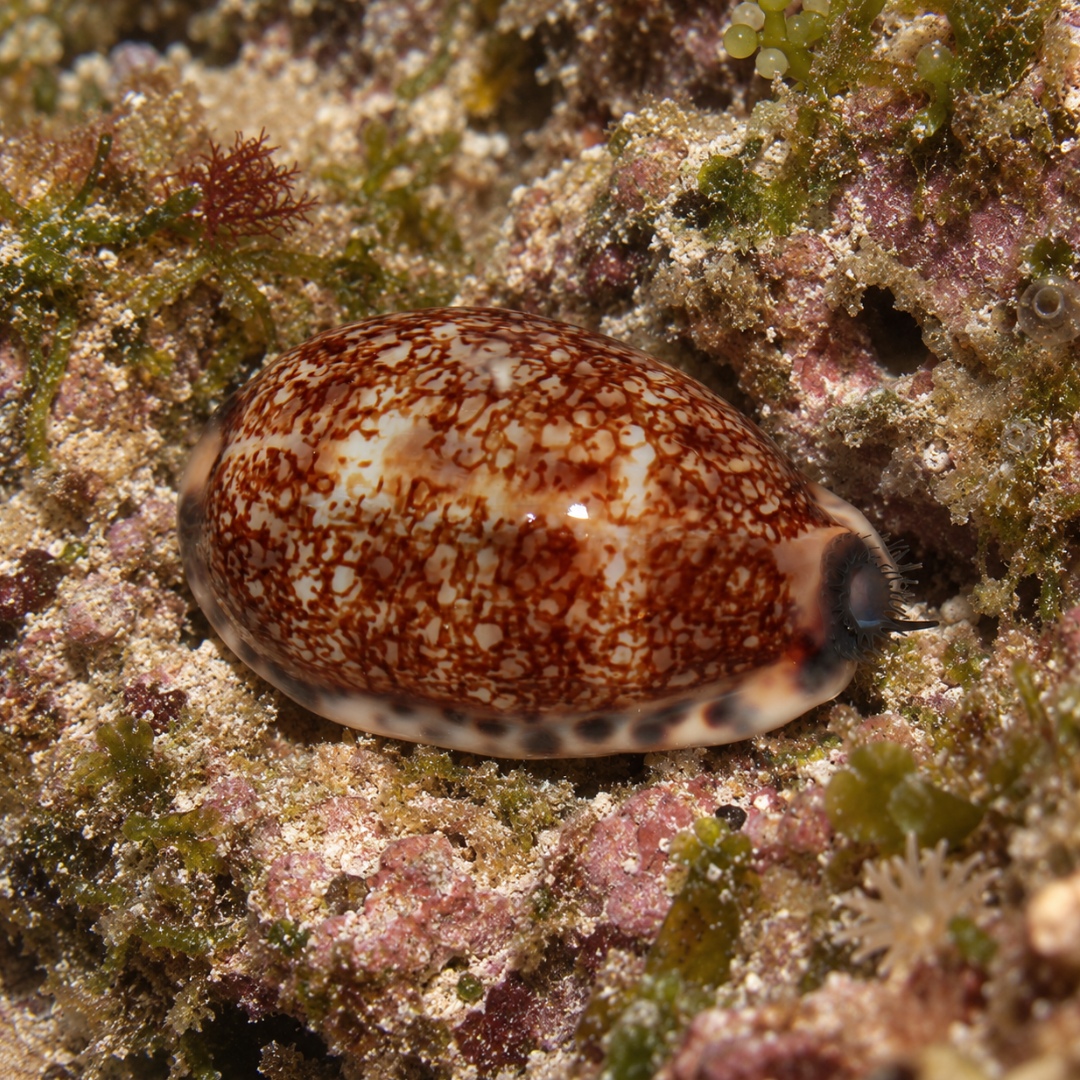
解説 / Description
ホソヤクシマダカラは、インド太平洋の熱帯・亜熱帯域に広く分布するタカラガイ科の海産巻貝です。成貝の殻は細長い楕円形で、茶褐色の地に細かな網目状の模様が走り、表面は磨き上げた陶器のような強い光沢を帯びます。日中は岩やサンゴ片の下に潜み、夜になると外套膜を殻の上へ広げて活動する夜行性の生き物です。水槽内ではライブロックやガラス面に生える微細藻類や付着物を削り取るため、お掃除生体として役立つことがあります。一方で、長期飼育には安定した海水環境、十分な付着藻類、捕食者のいない混泳環境が必要です。美しい殻だけでなく、殻を覆う外套膜の動きや独特の生活史まで観察できる点に、本種ならではの魅力があります。 Mauritia eglantina is a marine cowry widely distributed through tropical and subtropical parts of the Indo-Pacific. Adults have an elongated oval shell patterned with fine brown reticulation and a naturally polished, porcelain-like surface. The species is primarily nocturnal, hiding beneath rocks or coral rubble by day and extending its mantle over the shell when active at night. In aquaria it may graze on microalgae and surface growth on live rock and glass, making it useful as a clean-up animal in suitable systems. Long-term care, however, depends on stable marine water conditions, a continuing food supply, and protection from predators. Its appeal lies not only in the shell, but also in the unusual mantle behavior and life history characteristic of cowries.
基本情報 / Basic Information
| 学名 / Scientific Name | Mauritia eglantina (Duclos, 1833) |
|---|---|
| 通称 / Common Name | ホソヤクシマダカラ。海水アクアリウムでは、タカラガイ類としてお掃除生体に含めて扱われることがあります。Dog-rose cowry; Eglantine cowry. In the marine aquarium trade it may also be grouped with cowries used as grazing clean-up animals. |
| 分類 / Family | 軟体動物門・腹足綱・タカラガイ上科・タカラガイ科・ハチジョウダカラ属Phylum Mollusca, Class Gastropoda, Superfamily Cypraeoidea, Family Cypraeidae, Genus Mauritia |
| 英名 / English Name | Dog-rose cowry / Eglantine cowry |
| 分布 / Distribution | インド洋東部から西太平洋にかけての熱帯・亜熱帯海域に分布し、ポリネシア、ミクロネシア、ニューカレドニア、東南アジア、インドネシア、フィリピン、オーストラリア北部などで知られます。日本では九州南部以南などの暖海域で記録されています。浅いサンゴ礁や岩礁で、転石やサンゴ片の下などを主な生活場所とします。This species occurs in tropical and subtropical waters from the eastern Indian Ocean to the western Pacific, including Polynesia, Micronesia, New Caledonia, Southeast Asia, Indonesia, the Philippines and northern Australia. In Japan, records are known from warm-water areas from southern Kyushu southward. It mainly inhabits shallow coral and rocky reefs, often sheltering beneath stones or coral rubble. |
| 最大体長 / Max Size | 殻長は最大約8.5cmに達するとされます。個体差があり、6cm前後の個体も多く見られます。Shell length can reach about 8.5 cm. Size varies among individuals, and specimens around 6 cm are also commonly encountered. |
| 寿命 / Lifespan | 本種について、飼育下寿命を種単位で示した信頼できる標準値は情報不足です。長期飼育では急変の少ない水質と継続的な餌環境の維持が重要です。A reliable species-specific standard for captive lifespan is not well established. Stable water conditions and a continuous food supply are important for long-term maintenance. |
飼育環境 / Aquarium Environment
| 水槽サイズ / Tank Size | 45〜60cm規格水槽程度を一つの目安とし、水質の安定性と十分な採餌面積を確保します。付着藻類が少ない環境や複数個体を飼育する場合は、より余裕のある水量と広い岩面を用意します。A Japanese 45–60 cm standard aquarium can be used as a practical guideline, with priority given to stable water conditions and sufficient grazing surface. Systems with little natural algal growth, or those housing multiple animals, should provide greater water volume and more rock surface. |
|---|---|
| 水温 / Temperature | 22〜26℃を目安とし、25℃前後で急激な変化を避けて安定させます。 Maintain approximately 22–26°C, with stable conditions around 25°C and minimal sudden temperature changes. |
| 水質 / Water Quality | 海水比重はおおむね1.020〜1.025、pHは8.1〜8.4を目安に安定させます。アンモニアや亜硝酸が検出される未成熟な水槽は避け、急激な塩分・pH変化を起こさないことが重要です。殻を持つ無脊椎動物のため、酸性化した水や銅を含む薬剤の使用にも注意が必要です。Keep specific gravity around 1.020–1.025 and pH around 8.1–8.4. Avoid immature aquaria with detectable ammonia or nitrite, and prevent sudden changes in salinity or pH. Because this is a calcifying marine invertebrate, chronically acidic conditions and copper-containing medications should also be avoided. |
| レイアウト / Layout | ライブロックを複雑に組み、日中に隠れられる岩陰や隙間を十分に作ります。底床は腹足を傷つけにくい細粒のサンゴ砂が扱いやすく、表面に自然な藻類やバイオフィルムが育つ環境が適します。ガラス面をよく登るため、水槽上部にはフタや脱走防止対策を施します。Provide a complex arrangement of live rock with shaded crevices and sheltered spaces for daytime hiding. Fine coral sand is suitable as a gentle substrate, and surfaces that support natural algae and biofilm are beneficial. Because the animal can climb aquarium glass, use a lid or other escape-prevention measures. |
| 注意点 / Precautions | 導入時は水温や塩分の急変を避け、点滴法などで時間をかけて飼育水へ合わせます。輸送水は本水槽へ入れず、生体だけを移します。また、水槽内の付着藻類が減りすぎると餌不足になるため、夜間の活動、岩やガラス面への吸着、摂食の様子を継続して確認します。During introduction, avoid abrupt changes in temperature or salinity and acclimate the animal gradually, using methods such as drip acclimation. Transfer the animal without adding shipping water to the display tank. Because food shortages can occur when natural surface growth becomes depleted, continue to monitor nighttime activity, attachment to rock or glass, and feeding behavior. |
餌と給餌 / Feeding
| 餌の種類 / Diet | 自然下では草食性が強く、岩やサンゴ表面の付着藻類を主に削り取ります。海綿を食べることもあるとされています。水槽でも、ガラス面やライブロックに生える藻類や表面の付着物が主な餌になります。補助給餌を行う場合は、少量ずつ与え、実際に摂食しているか確認します。In nature it is primarily herbivorous, grazing attached algae from rock and coral surfaces, and it has also been reported to feed on sponges. In aquaria, algae and other natural surface growth on glass and live rock form the main food source. If supplementary food is offered, provide only small amounts and confirm that the animal actually consumes it. |
|---|---|
| 給餌のポイント / Feeding Tips | 本種は夜行性なので、消灯後に活動と摂食の様子を確認します。水槽を過度に清掃して付着藻類を一度に取り除くと、主要な餌場まで失われます。コケ取り能力だけを期待して多数導入せず、水槽内に実際にある餌量に合わせて飼育数を調整します。飼育例では、藻類が乏しい環境でサンゴ類をかじる例も報告されているため、餌不足を避けることが重要です。Because the species is nocturnal, check its activity and feeding after the lights go out. Excessive cleaning can remove not only nuisance algae but also its main feeding surfaces. Do not stock large numbers simply for algae control; the number kept should match the food actually available. Aquarium reports also describe coral grazing where algal growth is scarce, so avoiding prolonged food shortage is important. |
性格と混泳 / Temperament and Tank Mates
| 性格 / Temperament | 他の生体を積極的に追い回すような性格ではなく、基本的には温和な底生性の巻貝です。夜間に水槽内を広く移動し、岩やガラス面を這いながら採餌します。外套膜を殻全体へ広げた姿は繊細に見えますが、刺激を受けると素早く殻の内側へ引き込みます。It is generally a peaceful benthic snail and does not actively pursue other aquarium animals. At night it may roam widely while grazing over rocks and glass. Although the fully extended mantle looks delicate, it can be withdrawn rapidly into the shell when disturbed. |
|---|---|
| 混泳の相性 / Compatibility | 温和な小型魚や、多くの非捕食性無脊椎動物とは同居させやすい一方、モンガラカワハギ類など貝を捕食する魚、大型のカニ類、強力な甲殻類捕食者との混泳は避けます。大型ヤドカリは殻を利用する目的で生きた巻貝を襲うことがあるため特に注意が必要です。ヤドカリを同居させる場合でも、十分な数と大きさの空き殻を用意し、本種への攻撃が見られたら分離します。It can often be kept with peaceful small fishes and many non-predatory invertebrates, but avoid shell-crushing or mollusc-eating fishes such as triggerfishes, large crabs and other strong predators. Large hermit crabs deserve particular caution because they may attack living snails for access to shells. If hermits are present, provide ample empty shells of suitable sizes and separate the animals if aggression is observed. |
病気と対策 / Diseases and Prevention
| かかりやすい病気 / Common Diseases | ホソヤクシマダカラについて、観賞魚の白点病のように飼育現場で共通して呼ばれる特定疾病の情報は多くありません。実際の飼育では、急激な塩分・pH変化による衰弱、アンモニアなどの水質悪化、飢餓、殻の侵食や外傷、捕食者による損傷が主なトラブルになります。There is limited information on species-specific aquarium diseases comparable to the commonly named diseases of ornamental fishes. In practice, major problems are more often associated with rapid salinity or pH changes, poor water quality such as ammonia exposure, starvation, shell erosion, physical injury and attacks by predators. |
|---|---|
| 対策と予防 / Prevention | 成熟した水槽へ慎重に導入し、水温・塩分・pHを安定させます。殻の状態と夜間の活動量を定期的に確認し、長期間動かない、腹足が弱く張り付けない、殻表面が著しく荒れるなどの変化があれば、水質と餌量を優先して見直します。無脊椎動物に有害となる銅を含む魚病薬は同じ水槽で使用しないようにします。Introduce the animal carefully into a mature aquarium and keep temperature, salinity and pH stable. Check shell condition and nighttime activity regularly. If the animal remains inactive for unusually long periods, loses its ability to cling with the foot, or shows marked shell deterioration, review water quality and food availability first. Copper-containing fish medications should not be used in the same system with this invertebrate. |
増やし方(繁殖) / Breeding
| 雌雄の判別 / Sexing | 雌雄異体ですが、殻の外見だけから確実に雌雄を見分けることは難しく、一般的な飼育下で使える簡便な外見的判別法は確立していません。交尾行動や産卵・抱卵行動を観察することで性別が判明する場合があります。The sexes are separate, but reliable sexing from shell appearance alone is difficult and there is no simple external method commonly used in aquaria. Sex may become apparent through observed mating, egg laying or brooding behavior. |
|---|---|
| 繁殖形態 / Reproduction | 雌雄異体で、交尾による体内受精を行います。メスは岩やサンゴ片の裏などの基質へ卵嚢をまとまって産み付けます。タカラガイ類ではメスが卵塊を覆って保護する行動が知られ、本種でも卵塊とともにいる個体が観察されています。孵化後はベリジャー幼生として浮遊生活を送り、その後に着底します。The sexes are separate and fertilization is internal. Females deposit clusters of egg capsules on hard substrate, often beneath rocks or coral material. Female cowries are known to cover and protect their egg masses, and individuals of this species have also been observed with egg masses. After hatching, the young pass through a planktonic veliger stage before settling. |
| 繁殖のポイント / Breeding Tips | 卵塊を守っているメスを見つけた場合は無理に動かさず、岩ごとの移動や大きな水流変更も避けます。孵化後の幼生は小さな浮遊幼生で、通常の水槽ではろ過装置へ吸い込まれたり、適切な微小餌を確保できなかったりするため、繁殖の難易度は高いと考えられます。計画的な繁殖には、幼生を分けて管理できる環境と微細餌料の準備が必要です。If a female is found guarding an egg mass, avoid forcibly moving her, relocating the supporting rock, or making major changes in water flow. The newly hatched larvae are tiny and planktonic, so in a normal display aquarium they may be lost to filtration or fail to obtain suitable microscopic food. Captive propagation is therefore difficult and requires a separate larval environment and preparation of appropriately small foods. |
雑学と豆知識 / Trivia and Fun Facts
| 1. 「eglantina」の由来は断定できない / 1. The origin of “eglantina” is uncertain | 英名にはDog-rose cowryやEglantine cowryという呼び名があり、名前からはエグランタインと呼ばれるバラを連想します。ただし、種小名「eglantina」をDuclosがどのような意図で付けたのかは明確ではなく、バラに由来すると断定できる根拠は確認されていません。1833年にCypraea eglantinaとして記載された本種は、その後の分類学的整理を経て、現在はMauritia eglantinaとして扱われています。名前の印象と実際の命名由来を分けて考えることも、学名を読み解く面白さの一つです。English common names include Dog-rose cowry and Eglantine cowry, which naturally suggest the flower known as eglantine. However, the original intent behind Duclos’s specific name “eglantina” is not clearly established, so a direct derivation from the rose should not be stated as certain. The species was described in 1833 as Cypraea eglantina and is now accepted as Mauritia eglantina following later taxonomic revision. Distinguishing an evocative name from a documented etymology is part of reading scientific names carefully. |
|---|---|
| 2. 光沢は「磨いた殻」ではなく、生きた外套膜が作る / 2. The gloss is produced by the living mantle | タカラガイの殻が特別に艶やかなのは、外套膜が殻の左右から大きく伸び、背面を覆うようにして殻の外側へ新しい殻質や色素を加えるためです。多くの巻貝では成長線や殻皮が目立ちますが、タカラガイではこの成長様式によって表面が滑らかに保たれます。夜間に外套膜を広げた個体を観察すると、標本で見る「殻」と、生き物としてのタカラガイの姿がまったく違うことに気づかされます。The exceptional gloss of cowry shells is linked to the mantle, which extends from both sides of the body and can cover the outer shell surface while depositing new shell material and pigments. Many gastropods show obvious growth lines or an external periostracum, but cowries maintain a remarkably smooth exterior through this unusual growth pattern. Observing a living animal with the mantle fully extended at night reveals a form very different from the familiar empty shell seen in collections. |
| 3. 幼貝は成貝と別物のような姿 / 3. Juveniles look strikingly different from adults | 若いタカラガイは、最初から丸く厚い成貝型の殻を持っているわけではありません。幼貝の殻は薄く、螺旋の名残が目立つ巻貝らしい姿をしています。成長の終盤になると外唇が内側へ巻き込み、殻口に歯が形成され、外套膜による殻表面の仕上げが進むことで、よく知られたタカラガイ型へ変化します。この大きな形態変化は、同じ個体の成長過程とは思えないほど劇的です。Young cowries do not begin life with the thick, rounded adult shell. Juveniles have thinner, more obviously coiled shells that look much more like those of typical gastropods. Late in growth, the outer lip turns inward, teeth develop along the aperture and the mantle finishes the exterior surface, producing the familiar adult cowry form. The transformation is so pronounced that juvenile and adult stages can appear almost unrelated at first glance. |
| 4. ヤクシマダカラとの見分け方 / 4. Distinguishing it from Mauritia arabica | よく似たヤクシマダカラとは、殻の輪郭だけでは迷うことがあります。ホソヤクシマダカラでは、殻頂近くに暗褐色の斑が見られることが重要な識別点の一つです。また、殻の腹面側の輪郭はヤクシマダカラより丸みが弱いとされます。ただし殻形や模様には個体差があるため、一つの特徴だけで決めず、暗色斑の有無や殻全体の形を合わせて確認するのが適切です。The similar Mauritia arabica can be difficult to distinguish by overall outline alone. In M. eglantina, a dark brown blotch near the spire is one of the useful identification characters, and the outline of the shell base is described as less rounded than in M. arabica. Because shell shape and pattern vary among individuals, identification is best based on several characters rather than a single feature. |
| 5. ニューカレドニアの黒化と嘴状化 / 5. Melanism and rostration in New Caledonia | ニューカレドニアの一部では、殻が非常に黒くなったり、前後端が嘴のように伸びたりするホソヤクシマダカラが知られています。こうした黒化や嘴状化については、鉱山活動のある地域で重金属を含む環境との関連が指摘されていますが、原因は完全には解明されていません。そのため、汚染が直接この形態を生むと断定することはできません。特異な殻の変異としてだけでなく、環境条件と殻形成の関係を考える上でも興味深い現象です。In parts of New Caledonia, Mauritia eglantina with unusually dark shells or elongated, beak-like ends are known. A possible association between this melanism or rostration and heavy-metal environments in mining areas has been suggested, but the cause has not been fully resolved. It is therefore not appropriate to state that pollution directly produces these shell forms. The phenomenon is notable both as unusual shell variation and as a reason to consider how environmental conditions may interact with shell formation. |
| 6. 小さな歯の帯で岩肌を削る / 6. A ribbon of teeth scrapes the substrate | ホソヤクシマダカラが硬い岩肌から藻類を食べられるのは、口の中に「歯舌」と呼ばれる帯状の摂食器官を持つためです。歯舌には多数の微小な歯が並び、前方の歯が摩耗すると後方から新しい歯が送られてきます。ガラス面に張り付いてゆっくり進む姿は静かですが、口元では絶えず微細な歯が働き、表面の付着物を削り取っています。Mauritia eglantina can graze hard surfaces because it possesses a ribbon-like feeding organ called the radula. Numerous microscopic teeth are arranged along the radula, and worn teeth at the front are continually replaced from behind. The animal may appear to glide quietly across aquarium glass, but at the mouth a highly specialized scraping apparatus is constantly removing surface growth. |
| 7. タカラガイと人の長い歴史 / 7. Cowries and a long human history | タカラガイ類は、丈夫で美しく、似た大きさの殻を大量に集めやすかったことから、世界各地で装飾品や儀礼具、そして貝貨として利用されてきました。歴史上の貝貨の中心はキイロダカラやハナビラダカラなど別の種でしたが、タカラガイ科というグループ全体が、人の交易や文化と深く関わってきたことは確かです。水槽の中を歩く一匹を眺めると、その仲間の殻が何千年ものあいだ人間社会の価値や象徴と結び付いてきたという、思いがけない時間の広がりを感じられます。Cowries have been used in many parts of the world as ornaments, ritual objects and shell currency because their shells are durable, attractive and relatively uniform in size. The best-known currency species were other cowries such as Monetaria moneta and Monetaria annulus, so it would be inaccurate to attribute the whole history of shell money specifically to M. eglantina. Even so, the family Cypraeidae has an unusually deep connection with human trade and culture, giving the living animal in an aquarium a historical context far beyond its role as a grazer. |
まとめ / Conclusion
ホソヤクシマダカラは、艶やかな網目模様の殻と、夜になると殻の上へ広がる外套膜という二つの異なる表情を見せる海産巻貝です。安定した海水、自然に生じる付着藻類、昼間に身を隠せる岩陰がそろうことで、夜行性の本来の行動を観察しやすくなります。 Mauritia eglantina shows two very different appearances: the polished, reticulated shell and the living mantle that spreads over it after dark. Stable seawater, naturally growing surface food and sheltered daytime hiding places make it easier to observe the species’ normal nocturnal behavior.
コケ取り役としてだけ扱わず、餌不足と捕食者との混泳を避けながら、一匹の海洋無脊椎動物として環境を整えることが長期飼育につながります。消灯後に静かに動き出す姿を観察すると、磨かれた殻の美しさだけでは分からない、タカラガイならではの暮らし方が見えてきます。 Long-term care depends on treating the animal as a marine invertebrate rather than simply as an algae cleaner, while preventing food shortage and exposure to predators. Watching it become active after lights-out reveals a way of life that cannot be understood from the polished shell alone.

気になる道具や飼い方を見つけてみませんか?
 アイのアクアグッズ案内水槽の底砂の選び方|砂・砂利の違いとおすすめ商品道具の特徴や使い方、選ぶときのポイントをアイが紹介します。記事はコチラ →
 アイのアクアグッズ案内水槽のコケ掃除|道具の選び方とお掃除生体の得意・不得意道具の特徴や使い方、選ぶときのポイントをアイが紹介します。記事はコチラ →
 アイのアクアグッズ案内グッピー・プラティ・モーリーを親子で楽しむ飼育用品|水槽・稚魚保護・ろ過・餌・水草道具の特徴や使い方、選ぶときのポイントをアイが紹介します。記事はコチラ →
 アイのアクアグッズ案内水槽用浄水器の選び方|水換えを楽にするタイプとROの違い道具の特徴や使い方、選ぶときのポイントをアイが紹介します。記事はコチラ →
さまざまな飼育テーマをご紹介。リンク先の記事には広告・商品紹介が含まれます。
案内・紹介記事一覧へ →分布マップ
ホソヤクシマダカラ(Mauritia eglantina)は、インド洋東部から西太平洋にかけての熱帯・亜熱帯海域に広く分布し、日本では九州南部以南などの暖海域で記録されています。
この地図は、記録されている分布地域をもとにした概略表示です。地図上のマーカーは分布範囲を把握しやすくするための代表地点であり、実際の採集地点や特定個体の確認地点を示すものではありません。
参考文献
- MolluscaBase eds. (2026). Mauritia eglantina (Duclos, 1833). MolluscaBase, accessed through the World Register of Marine Species (WoRMS), AphiaID 527783. WoRMS 学名、分類、異名関係の確認。
- Carpenter, K. E. & Niem, V. H. (eds.) (1998). The Living Marine Resources of the Western Central Pacific. Volume 1: Seaweeds, corals, bivalves and gastropods. FAO Species Identification Guide for Fishery Purposes. Food and Agriculture Organization of the United Nations, Rome, 686 pp. 資料 分布、浅海の岩礁・サンゴ礁環境、殻長などの種情報。
- Mitel, C., Sittler, A.-P. & Müller, Y. (2024). Mauritia eglantina (Duclos, 1833) — Porcelaine églantine. DORIS, Fédération Française d’Études et de Sports Sous-Marins. DORIS 分布、生息環境、夜行性、食性、雌雄異体・体内受精・卵嚢形成などの生態情報。
- Tay, T. S., Lee, H. R. S. & Neo, M. L. (2023). “Spawning and larval development of two tropical cowries (Gastropoda: Cypraeidae), Cypraea tigris and Mauritia arabica under laboratory conditions.” Royal Society Open Science, 10(4), 221332. DOI タカラガイ科における抱卵、ベリジャー幼生、浮遊幼生期と飼育下繁殖の難しさを確認するための比較資料。
- Bartlett, T. C. (2013). Small Scale Experimental Systems for Coral Research: Considerations, Planning, and Recommendations. NOAA Technical Memorandum NOS NCCOS 165 / CRCP 18. NOAA 海水飼育系における水温、塩分、pH、アンモニアなどの水質管理と、輸送後の段階的な順化方法の一般的参考。
- Yanong, R. P. E. Use of Copper in Marine Aquaculture and Aquarium Systems. University of Florida IFAS Extension, FA165. UF/IFAS 銅が多くの海産無脊椎動物に強い毒性を示すこと、魚病薬を含む銅使用時の注意、水質条件による毒性変化の確認。




コメント