

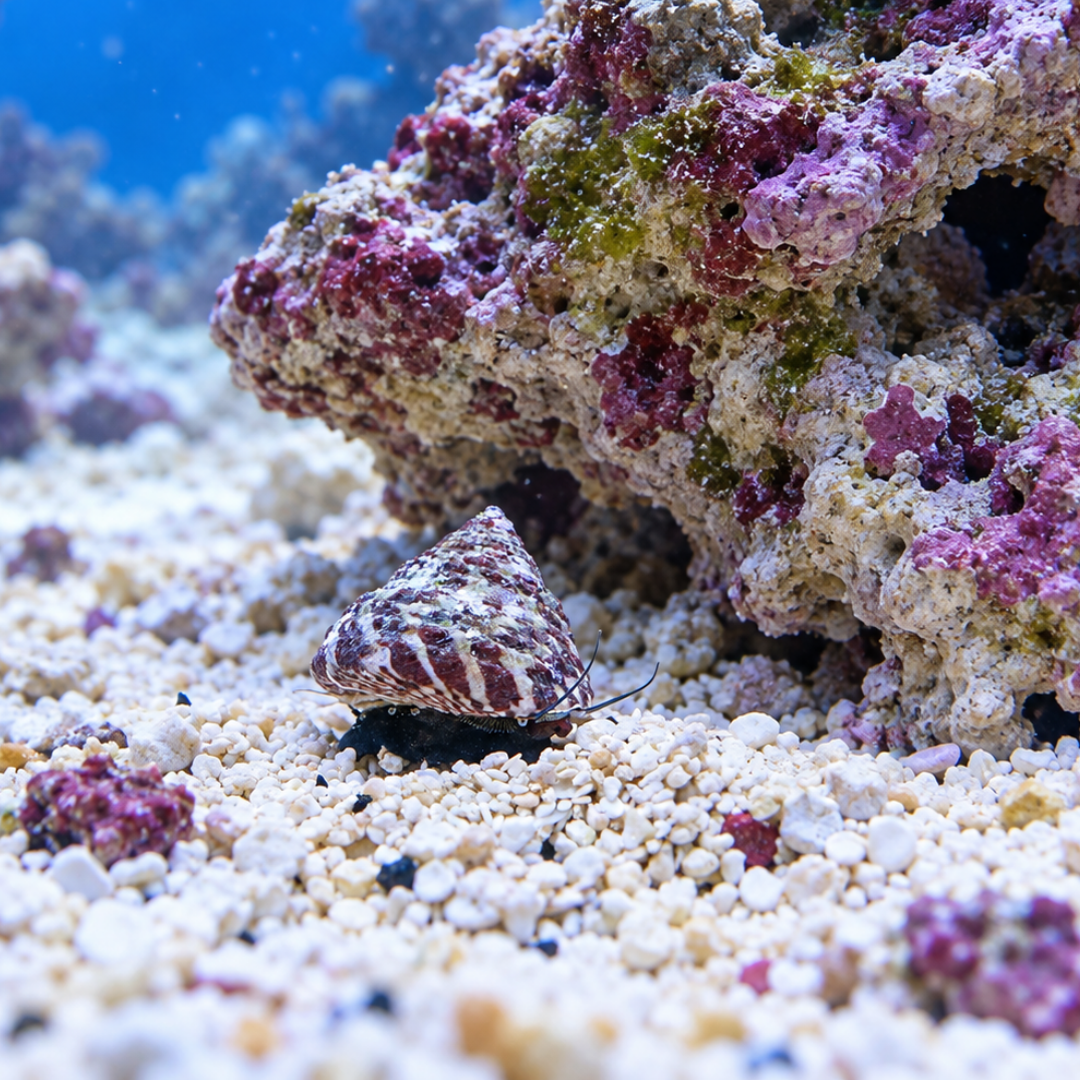
解説 / Description
ニシキウズは、インド西太平洋の熱帯から亜熱帯の浅いサンゴ礁や岩礁に暮らすニシキウズガイ科の巻貝です。厚く円錐形に盛り上がる殻には赤褐色、紫、ピンク、オリーブ色などが複雑に入り、個体ごとの模様の違いも大きな魅力です。水槽内ではガラス面やライブロックに付着した珪藻、薄い藻類、バイオフィルムなどを歯舌で削り取って食べるため、リーフタンクのコケ取り役として親しまれています。筋肉質の足を大きく伸ばせるため、転倒した際に周囲の岩などをつかんで自力で姿勢を戻せることが多い点も、本種が扱いやすい理由のひとつです。一方で、急激な塩分や水温の変化、銅を含む薬剤、餌不足には弱いため、導入時の慎重な水合わせと成熟した水槽環境が長期飼育の鍵になります。 Trochus maculatus is a trochid marine snail inhabiting shallow tropical and subtropical reefs and rocky shores across the Indo-West Pacific. Its heavy conical shell may display intricate combinations of reddish brown, purple, pink, olive, and pale tones, with considerable variation among individuals. In aquariums it is valued as an algae-grazing snail because it scrapes diatoms, thin algal films, and biofilm from glass and live rock with its radula. Its strong muscular foot also gives it a relatively good ability to regain an upright position after being overturned when it can reach nearby rockwork. However, it remains sensitive to sudden changes in salinity and temperature, copper-based medications, and prolonged food shortage, so careful acclimation and a mature aquarium are important for long-term success.
基本情報 / Basic Information
| 学名 / Scientific Name | Trochus maculatus Linnaeus, 1758 流通個体では同定上の幅を含めて Trochus cf. maculatus と表記されることがあります。Aquarium specimens are sometimes sold as Trochus cf. maculatus when identification is not fully certain. |
|---|---|
| 通称 / Common Name | ニシキウズ、ニシキウズガイ、コケ取り貝Trochus snail, maculated top shell, algae-grazing snail |
| 分類 / Family | 軟体動物門 腹足綱 古腹足亜綱 ニシキウズガイ目 ニシキウズガイ科 ニシキウズガイ属Phylum Mollusca, Class Gastropoda, Subclass Vetigastropoda, Order Trochida, Family Trochidae, Genus Trochus |
| 英名 / English Name | Maculated Top Shell / Trochus Snail |
| 分布 / Distribution | インド西太平洋の熱帯・亜熱帯域。紅海、東アフリカ、インド洋、東南アジア、オーストラリア、ミクロネシア、ポリネシア、日本を含む西太平洋などに広く分布します。主に潮間帯下部から浅いサンゴ礁、岩礁、ラグーンの硬い基質上で見られます。Widely distributed through tropical and subtropical Indo-West Pacific waters, including the Red Sea, East Africa, the Indian Ocean, Southeast Asia, Australia, Micronesia, Polynesia, and the western Pacific including Japan. It mainly occurs on hard substrates in lower intertidal zones, shallow reefs, rocky areas, and lagoons. |
| 最大体長 / Max Size | 殻高およそ6〜7cm前後。流通個体はこれより小さいことが多く、地域や個体によって大きさには幅があります。Approximately 6–7 cm in shell height at the larger end of the species range. Aquarium specimens are often smaller, and size varies among localities and individuals. |
| 寿命 / Lifespan | 本種の寿命については資料によって記載に幅があり、飼育下で一律に示せる確かな年数は明確ではありません。実際の寿命は、導入時の状態、水質の安定性、餌の確保などに左右されます。Published lifespan estimates for this species vary, and there is no single well-established figure that can be applied reliably to aquarium specimens. Actual longevity depends on factors such as condition at introduction, water-quality stability, and continued access to food. |
飼育環境 / Aquarium Environment
| 水槽サイズ / Tank Size | 小型個体1匹なら45cm規格水槽(約35L)以上をひとつの目安とし、成熟個体や複数飼育では60cm規格水槽(約55〜60L)以上が扱いやすくなります。水量そのものより、十分な付着藻類が育つ面積と安定した海水環境を確保できることが重要です。For one small individual, a 45 cm standard aquarium of roughly 35 L can be used as a practical minimum guideline, while a 60 cm standard aquarium of about 55–60 L or larger is easier for adult or multiple specimens. More important than volume alone is having enough mature grazing surface and stable marine conditions. |
|---|---|
| 水温 / Temperature | 24〜28℃を中心に管理します。短期間の変動よりも、急激な温度変化を避けて安定させることが重要です。 Maintain mainly around 24–28°C. Avoiding rapid temperature swings is more important than chasing a single exact value. |
| 水質 / Water Quality | 一般的なリーフタンクの安定した海水条件が適します。比重はおおむね1.023〜1.026、pHは8.0〜8.4を目安とし、アンモニアと亜硝酸は検出されない状態を維持します。無脊椎動物のため急な塩分変化に弱く、導入時は水温と塩分を慎重に合わせます。銅を含む治療薬は使用しないでください。Stable reef-aquarium conditions are suitable. A specific gravity of about 1.023–1.026 and pH around 8.0–8.4 are useful targets, with ammonia and nitrite kept undetectable. As a marine invertebrate it is vulnerable to abrupt salinity changes, so temperature and salinity should be matched carefully during acclimation. Do not expose it to copper-based medications. |
| レイアウト / Layout | ライブロックやサンゴ礫など、表面を歩いて採餌できる硬い基質を多めに用意します。ガラス面と岩組みの両方に移動できる配置が理想的です。砂地だけの広い空間は採餌面として利用しにくいため、岩組みとのバランスを取ります。力のある足で移動するため、サンゴのフラグや軽い装飾は転倒しないよう固定してください。Provide abundant hard surfaces such as live rock and coral rubble for grazing. A layout that allows easy movement between glass and rockwork is ideal. Large bare sand areas provide relatively little grazing surface, so balance them with structured rockwork. Because the snail moves with a strong foot, securely attach coral frags and lightweight decorations. |
| 注意点 / Precautions | 導入直後の急変を避けるため、水温合わせに加えて塩分差が大きい場合は点滴式などでゆっくり水合わせを行います。ただし長時間の水合わせでは容器内の酸素低下や水質悪化にも注意し、輸送水の状態を見ながら過度に引き延ばさないことが大切です。銅を含む薬剤は避け、入荷個体は殻口や殻の裏側に小型の寄生性巻貝や卵塊が付着していないか確認します。また、藻類を食べ尽くした水槽では餓死することがあるため、個体数の入れ過ぎにも注意します。To avoid abrupt changes after arrival, match temperature and, when salinity differs substantially, acclimate gradually such as by a controlled drip method. Do not prolong acclimation unnecessarily if oxygen or water quality in the container is deteriorating. Avoid copper-based medications, and inspect new arrivals around the shell opening and underside for tiny parasitic snails or egg masses. Over-stocking can also lead to starvation once natural algal films are depleted. |
餌と給餌 / Feeding
| 餌の種類 / Diet | ガラス面や岩に付着する珪藻、薄い緑藻、微細な糸状藻類、バイオフィルムなどを主に食べます。自然発生する餌が不足する場合は、植物質を多く含む沈下性タブレットや無添加の乾燥海苔などを少量補助的に与えることができます。It mainly grazes diatoms, thin green algal films, fine filamentous algae, and biofilm growing on glass and rock. If natural growth becomes insufficient, small amounts of algae-based sinking food or plain dried seaweed can be offered as supplemental food. |
|---|---|
| 給餌のポイント / Feeding Tips | 本種は水槽内を移動しながら長時間にわたって少しずつ採餌するため、毎日の定時給餌だけに頼るより、付着藻類やバイオフィルムが継続して得られる環境が向きます。ガラス面やライブロックに食べられる藻膜がほとんど残らない状態が続く場合は、餌不足を疑い、補助給餌を検討します。残餌は水質悪化につながるため、与え過ぎないことが大切です。This species grazes gradually for long periods while moving through the aquarium, so a continuing supply of natural algal films and biofilm is more useful than relying only on scheduled feeding. If edible films remain scarce on both glass and live rock, food limitation should be considered and supplemental feeding may be appropriate. Avoid overfeeding because uneaten food can degrade water quality. |
性格と混泳 / Temperament and Tank Mates
| 性格 / Temperament | 非常に温和で、他の魚やサンゴを積極的に攻撃することはありません。主に夜間から薄暗い時間帯に活発になり、ガラス面や岩の表面をゆっくり移動しながら採餌します。大型個体は移動時の物理的な力が強いため、小さなサンゴ片を押してしまうことがあります。Very peaceful and does not actively attack fish or corals. It often becomes more active at night or in dim conditions, moving slowly over glass and rock while grazing. Larger individuals can exert enough physical force to push unsecured coral frags. |
|---|---|
| 混泳の相性 / Compatibility | 一般的なリーフフィッシュ、サンゴ、他の温和なクリーナー生体と合わせやすい種類です。マガキガイなど底砂を主に掃除する生体とは役割が競合しにくく、水槽内の清掃範囲を分担できます。一方、巻貝を捕食するモンガラカワハギ類、大型ベラ類、フグ類、強い捕食性を持つカニやヤドカリとは相性に注意が必要です。Generally compatible with reef-safe fishes, corals, and other peaceful cleaner organisms. Sand-grazing snails such as conchs often occupy a different cleaning niche and can complement its rock-and-glass grazing. Avoid or use caution with snail-eating triggerfishes, large wrasses, puffers, and strongly predatory crabs or hermit crabs. |
病気と対策 / Diseases and Prevention
| かかりやすい病気 / Common Diseases | 魚類のように名称が定着した病気が問題になることは比較的少ない一方、急激な塩分変化による浸透圧ストレス、銅などの重金属、長期的な餌不足、輸送ダメージが主な不調要因になります。また、トウガタガイ科などの小型寄生性巻貝が殻口周辺や軟体部に付着し、衰弱の原因になる可能性があります。Named infectious diseases are less commonly discussed than in aquarium fishes, while osmotic stress from rapid salinity changes, copper or other heavy metals, prolonged starvation, and shipping damage are major causes of decline. Tiny parasitic pyramidellid snails may also attach around the shell opening or soft tissues and can contribute to weakening. |
|---|---|
| 対策と予防 / Prevention | 導入前に殻の表裏と殻口周辺を目視し、小さな白い巻貝や卵塊が付いていないか確認します。見つけた場合は生体を傷つけないようピンセットや柔らかめのブラシなどで物理的に除去し、別容器で経過観察します。水槽では水温・塩分を安定させ、銅系薬剤を使用しないこと、餌となる藻類を完全に枯渇させないことが基本です。動かない個体は直ちに死亡と判断せず、臭い、軟体部の反応、殻への保持力などを総合して状態を確認します。Inspect both sides of the shell and the area around the aperture before introduction, looking for tiny pale snails or egg masses. If found, remove them physically with care using tweezers or a soft brush and observe the animal separately. Keep temperature and salinity stable, avoid copper-based treatments, and do not allow all grazing food to disappear. A motionless snail should not be assumed dead immediately; check odor, soft-body response, and its grip on the shell or substrate together. |
増やし方(繁殖) / Breeding
| 雌雄の判別 / Sexing | 雌雄異体ですが、外見だけで雌雄を判別するのは困難です。成熟個体の生殖腺の色や産卵時の行動で判断できる場合がありますが、通常の観賞飼育では確実な判別法とはいえません。The species has separate sexes, but males and females are difficult to distinguish externally. Gonad coloration or spawning behavior may provide clues in mature animals, but these are not convenient or fully reliable methods for routine aquarium keeping. |
|---|---|
| 繁殖形態 / Reproduction | 雌雄が水中へ精子と卵を放出する放卵放精型です。野外では新月や満月の前後、上げ潮の時間帯に産卵が観察された例があり、月齢や潮汐が産卵のきっかけに関わる可能性が示唆されています。受精後はトロコフォア幼生、続いてベリジャー幼生となって浮遊生活を送り、適切な硬い基質に着底して稚貝へ変態します。Reproduction occurs by broadcast spawning, with males and females releasing sperm and eggs into the water. Field observations have recorded spawning around new- and full-moon periods during rising tides, suggesting that lunar and tidal conditions may contribute to spawning cues. Fertilized embryos develop through trochophore and then veliger stages, spend a planktonic period in the water column, and later settle onto suitable hard substrate before metamorphosing into juveniles. |
| 繁殖のポイント / Breeding Tips | 水槽内で放卵放精が起きることはありますが、幼生を成貝まで育てるには親貝の維持とは別の技術が必要です。複数の成熟個体を良好な栄養状態で維持し、安定した水質と自然に近い明暗周期を保つことが第一歩です。幼生期はろ過装置への吸い込みや水質変化の影響を受けやすく、着底後の稚貝には珪藻や微細なバイオフィルムが形成された育成面が必要になります。Broadcast spawning may occur in aquariums, but raising larvae to juveniles requires techniques beyond ordinary adult care. Maintaining several mature animals in good nutritional condition with stable water quality and a natural light-dark cycle is the first step. Larvae are vulnerable to filtration intake and water-quality changes, and newly settled juveniles require surfaces carrying diatoms and fine biofilm. |
雑学と豆知識 / Trivia and Fun Facts
| 1. 「cf.」が付く理由 / 1. Why “cf.” Appears in the Name | アクアリウム流通では「Trochus cf. maculatus」という表記を見かけることがあります。この「cf.」はラテン語の confer に由来し、「この種と比較せよ」という意味を持つ分類学上の補助表記です。ニシキウズの仲間は殻の色彩や凹凸に個体差・地域差が大きく、外見だけでは厳密な同定が難しいことがあります。そのため、T. maculatus に非常によく似ているものの、種レベルの確定に慎重を期す場合に「cf.」が添えられます。なお、現行の海洋生物分類データベースでは Trochus maculatus Linnaeus, 1758 が有効名として扱われ、過去に用いられた Tectus maculatus は異名として整理されています。長い分類史そのものが、この貝の多彩な姿を物語っています。In the aquarium trade the name Trochus cf. maculatus is sometimes used. The abbreviation “cf.” comes from the Latin confer, meaning “compare with,” and signals that the specimen closely resembles the named species but has not been identified with complete certainty. Trochus snails show substantial geographic and individual variation in shell color and sculpture, making strict identification from appearance alone difficult. Current marine taxonomic databases treat Trochus maculatus Linnaeus, 1758 as the accepted name, while the former combination Tectus maculatus is treated as a synonym. The complicated naming history reflects the remarkable variability of these shells. |
|---|---|
| 2. 岩肌を磨く「扇舌型歯舌」 / 2. The Fan-Like Rhipidoglossan Radula | ニシキウズの口には、人間の歯とはまったく異なる「歯舌」という帯状の器官があります。古腹足類に特徴的な扇舌型歯舌では、中央の歯の左右に多数の細長い歯が扇のように並び、岩やガラスの表面を細かくこするようにして微小藻類を削り取ります。水槽で静かにガラス面を進む姿はのんびりしていますが、その足元では非常に精巧な「生きたスクレーパー」が働き続けています。この摂食方式が、珪藻や薄い藻膜を効率よく減らす能力につながっています。Inside the mouth is a ribbon-like feeding organ called the radula, very different from vertebrate teeth. In the rhipidoglossan type characteristic of many vetigastropods, numerous slender teeth spread outward on either side of the central teeth like a fan. These teeth repeatedly scrape microscopic algae from hard surfaces. The snail may look slow as it moves across the glass, but beneath it a remarkably intricate biological scraper is working continuously. This feeding mechanism is the basis of its ability to remove diatoms and thin algal films. |
| 3. 転倒しても起き上がりやすい / 3. A Useful Self-Righting Ability | 巻貝にとって転倒は意外に大きな問題です。殻の形や足の可動範囲によっては、砂の上で仰向けになると足場をつかめず、長時間動けなくなる種類もいます。ニシキウズは足を大きく伸ばして周囲の岩や底面をつかみ、殻をひねるようにして自力で姿勢を戻せることが多く、リーフタンクでは頼もしい性質です。ただし、完全に平坦で滑りやすい場所や衰弱した個体では必ず成功するとは限りません。見かけたときにそっと起こしてあげることは、今でも安全な管理方法です。Being overturned can be a serious problem for marine snails. Depending on shell shape and foot mobility, some species may be unable to find leverage when upside down on open sand. Trochus snails often extend the foot, grip nearby rock or substrate, and twist themselves upright, which is useful in reef aquariums. This ability is not infallible, however, especially on very smooth open surfaces or when the animal is weakened. If an overturned snail is noticed, gently placing it upright remains a sensible precaution. |
| 4. 月と潮に関わる産卵 / 4. Spawning Linked with Moon and Tide | ニシキウズでは、野外で新月や満月の1〜3日後、上げ潮の時間帯に集団で放卵放精する様子が観察されています。オスが先に精子を放出し、その後にメスが放卵した例も報告されています。ただし、観察例は限られており、特定の月齢だけで必ず産卵するという意味ではありません。月齢や潮汐が産卵のきっかけに関わる可能性があると考えると、水槽で静かに暮らす一匹の貝にも、海の大きな周期と結びついた生活史があることが見えてきます。Field observations of Trochus maculatus have recorded group spawning one to three days after new or full moon during rising tides. In some observations, males released sperm before females released eggs. These records are limited, however, and do not mean that spawning occurs only at a particular lunar phase. Rather, they suggest that lunar and tidal conditions may contribute to the cues that coordinate reproduction, linking the life history of this seemingly quiet aquarium grazer to broader oceanic cycles. |
| 5. 稚サンゴを支える「生きた草刈り役」 / 5. A Living Grazer in Coral Restoration | ニシキウズが注目されるのは家庭の水槽だけではありません。サンゴの種苗を育てる施設では、成長の速い藻類が稚サンゴを覆い、管理の負担になることがあります。そこで草食性の生物に藻類を食べてもらい、薬品に頼らず付着藻類を抑える方法が研究されています。Trochus maculatus を用いた飼育実験では、藻類の被度や量が抑えられ、稚サンゴの成長や色調、組織の状態が改善したことが報告されています。つまり、水槽では「コケ取り役」として知られる摂食行動が、サンゴの育成環境を整える手段としても利用できるということです。Trochus maculatus is of interest beyond home aquariums. In coral nurseries, fast-growing algae can overgrow juvenile corals and increase maintenance demands. Researchers have therefore tested herbivorous grazers as a way to control fouling without relying on chemical treatments. In culture experiments using T. maculatus, algal cover and biomass were reduced while juvenile corals showed improved growth, coloration, and tissue condition. In other words, the same grazing behavior valued in aquariums can also help maintain a more favorable environment for young corals in culture. |
| 6. 日本の貝ボタン産業へつながる殻の文化史 / 6. Shells and Japan’s Mother-of-Pearl Button History | ニシキウズと同じニシキウズガイ科には、貝ボタンの原料としてよく知られるタカセガイも含まれます。日本では明治期に神戸や大阪を経て奈良県へ貝ボタン加工が広がり、とくに川西町では家内工業として大きく発展しました。川西町が紹介する代表的な原貝のひとつもタカセガイです。一方、Trochus maculatus 自体が同地の主要原料だったと断定できる資料は限られるため、ここでは近縁なニシキウズガイ科の貝が持つ真珠層と、日本の貝ボタン文化とのつながりとして捉えるのが適切です。水槽で見る美しい殻は、同じ仲間の貝が人の暮らしに利用されてきた歴史にも目を向けさせてくれます。The family Trochidae, which includes Trochus maculatus, also includes large top shells such as the commercial top shell used as a traditional raw material for shell buttons. In Japan, shell-button production spread from Kobe and Osaka into Nara during the Meiji era and developed strongly as a cottage industry in Kawanishi. Kawanishi Town identifies top shell among the representative raw shell materials used for button making. Evidence that T. maculatus itself was a principal material there is limited, so the more accurate connection is through its close relatives in the same family and their thick nacreous shells. The attractive shell seen in an aquarium therefore also points toward a broader cultural history of related marine shells in Japanese craftsmanship. |
| 7. 温暖化だけでは語れない気候ストレス / 7. Climate Stress Is More Than Temperature Alone | ニシキウズを12週間、高水温や高二酸化炭素条件にさらした実験では、高水温だけの区では最大代謝率を示す温度が上昇し、生理的な順化がみられました。ただし、致死温度の上限そのものはほとんど上がっていません。さらに、高水温と高二酸化炭素が重なる条件では、その上限が大きく低下しました。つまり、ある程度「暑さに慣れる」反応が起きても、極端な高温への安全域まで広がるとは限らないということです。水槽飼育でも、上限ぎりぎりの水温を目指すのではなく、安定した水温と水質を保つことが重要です。In a 12-week experiment, Trochus maculatus exposed to elevated temperature alone showed a shift in the temperature at which maximum metabolic rate occurred, indicating physiological acclimation. However, the upper lethal temperature itself changed very little. When elevated temperature and elevated carbon dioxide were combined, that upper limit fell substantially. In practical terms, an animal may show some capacity to acclimate metabolically without gaining a wider safety margin against extreme heat. For aquarium care, this supports maintaining stable temperature and water quality rather than operating close to an upper thermal limit. |
まとめ / Conclusion
ニシキウズは、厚く美しい殻を持つ温和な巻貝で、ガラス面やライブロックの付着藻類を少しずつ削り取って食べます。転倒しても自力で姿勢を戻せることが多く、リーフタンクでは扱いやすいコケ取り生体のひとつです。ただし、安定して飼うには、十分な採餌面がある成熟した水槽と、急変の少ない水温・塩分が欠かせません。銅を含む薬剤を避け、天然の付着藻類が不足したときは補助給餌で支えることが大切です。 Trochus maculatus is a peaceful marine snail with a heavy, attractive shell that gradually grazes algal films from glass and live rock. Because it can often right itself after being overturned, it is a practical algae grazer for many reef aquariums. Long-term care still depends on a mature tank with adequate grazing surfaces, stable temperature and salinity, avoidance of copper-based medications, and supplemental food when natural growth becomes insufficient.
ゆっくりと岩肌を進む姿の内側には、付着藻類を削り取る精巧な歯舌があり、繁殖には月齢や潮汐との関わりをうかがわせる行動も見られます。サンゴ育成の場でも、その摂食行動を藻類管理に生かす研究が行われてきました。目立ちすぎることなく水槽の一角で働き続けるニシキウズは、飼育を楽しみながら、サンゴ礁で草食性の巻貝が果たす役割にも目を向けさせてくれる存在です。 Behind its slow movement is an intricate radula adapted for scraping growth from hard surfaces, while observations of spawning suggest links with lunar and tidal conditions. Its grazing behavior has also been studied as a tool for algae control in coral culture. By quietly working across rock and glass, Trochus maculatus offers aquarium keepers a direct view of the ecological role that grazing snails can play on coral reefs.

気になる道具や飼い方を見つけてみませんか?
 アイのアクアグッズ案内水槽のエアーポンプの選び方|水深・音・泡で選ぶおすすめ用品道具の特徴や使い方、選ぶときのポイントをアイが紹介します。記事はコチラ →
 アイのアクアグッズ案内カルキ抜き・水質調整剤の選び方|水換えと水槽の種類に合わせて選ぶ道具の特徴や使い方、選ぶときのポイントをアイが紹介します。記事はコチラ →
 アイのアクアグッズ案内マジックリーフ物語|一枚の葉がアクアリウム用品になるまで道具の特徴や使い方、選ぶときのポイントをアイが紹介します。記事はコチラ →
 アイのアクアグッズ案内水草用ライトの選び方|緑の絨毯と赤い水草を楽しむ照明・植栽用品道具の特徴や使い方、選ぶときのポイントをアイが紹介します。記事はコチラ →
さまざまな飼育テーマをご紹介。リンク先の記事には広告・商品紹介が含まれます。
案内・紹介記事一覧へ →分布マップ
ニシキウズ(Trochus maculatus)は、紅海や東アフリカからインド洋、東南アジア、オーストラリア、ミクロネシア、ポリネシア、日本を含む西太平洋まで、インド西太平洋の熱帯・亜熱帯域に広く分布します。
この地図は分布地域を把握するための概略表示です。表示範囲はインド西太平洋における主な分布域を大まかに示したもので、すべての生息地点や分布境界を示すものではありません。マーカーは分布域を見やすくするためにフィリピン周辺へ設定した代表地点であり、実際の採集地点や特定個体の産地を示すものではありません。
参考文献
-
分類
World Register of Marine Species (WoRMS). Trochus maculatus Linnaeus, 1758.
https://www.marinespecies.org/aphia.php?p=taxlist&tName=Trochus+maculatus -
分布・日本国内の出現記録
海洋研究開発機構(JAMSTEC)Biological Information System for Marine Life(BISMaL). Trochus maculatus ニシキウズ.
https://www.godac.jamstec.go.jp/bismal/j/view/9000745 -
分布・生息環境
Ocean Biodiversity Information System (OBIS). Trochus maculatus Linnaeus, 1758. WoRMS AphiaID 216349.
https://obis.org/taxon/216349 -
生息環境・水温ストレス
Minuti, J. J., Corra, C. A., Helmuth, B. S., & Russell, B. D. (2021). Increased Thermal Sensitivity of a Tropical Marine Gastropod Under Combined CO2 and Temperature Stress. Frontiers in Marine Science, 8, 643377.
https://doi.org/10.3389/fmars.2021.643377 -
繁殖
Maboloc, E. A., & Mingoa-Licuanan, S. S. (2013). Spawning in Trochus maculatus: field observations from Bolinao, Pangasinan (Philippines). Coral Reefs, 32, 1141.
https://doi.org/10.1007/s00338-013-1060-y -
飼育上の注意・塩分変化・銅
Elfwing, T., & Tedengren, M. (2002). Effects of copper and reduced salinity on grazing activity and macroalgae production: a short-term study on a mollusc grazer, Trochus maculatus, and two species of macroalgae in the inner Gulf of Thailand. Marine Biology, 140(5), 913–919.
https://doi.org/10.1007/s00227-001-0763-8 -
摂食・飼育環境
Toh, T. C., Ng, C. S. L., Guest, J., & Chou, L. M. (2013). Grazers improve health of coral juveniles in ex situ mariculture. Aquaculture, 414–415, 288–293.
https://doi.org/10.1016/j.aquaculture.2013.08.025 -
幼生飼育・餌・繁殖管理
Nguyễn Xuân Sinh, Đào Minh Đông, Lương Hữu Toàn, & Đỗ Mạnh Dũng (2022). Effects of density and diet on growth and survival rate of top shell (Trochus maculatus Linnaeus, 1758) in the stage of larvae to juvenile. Journal of Science and Technology, The University of Danang, 20(1), 53–55.
https://jst-ud.vn/jst-ud/issue/view/212 -
寄生性巻貝に関する注意
Fretter, V., & Graham, A. (1949). The Structure and Mode of Life of the Pyramidellidae, Parasitic Opisthobranchs. Journal of the Marine Biological Association of the United Kingdom, 28(2), 493–532.
https://doi.org/10.1017/S0025315400023377




コメント