

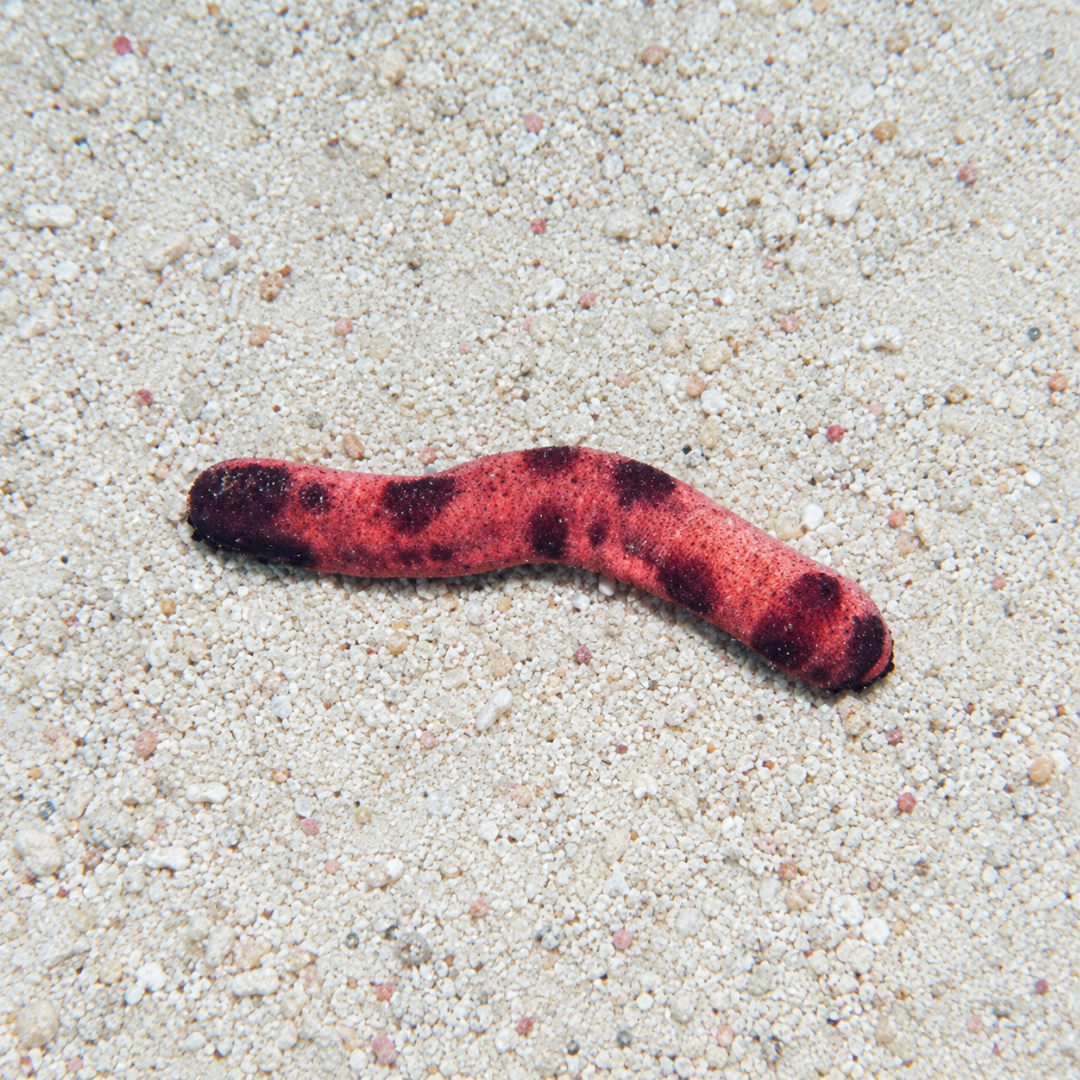
解説 / Description
アカミシキリは、インド太平洋の熱帯域に広く分布するクロナマコ科のナマコで、日本では奄美・琉球諸島以南で見られます。背側上部は濃褐色から黒色、腹側はピンク色から淡赤色になる、はっきりとしたツートンカラーが特徴です。水槽内では底砂を口に取り込み、砂粒の表面にあるデトリタスや微細藻類、微生物、バイオフィルムなどを利用しながら移動します。そのため底砂を攪拌する生体として知られますが、単なる「掃除屋」ではなく、十分に成熟した砂底を餌場として暮らす生き物です。立ち上げ直後など餌資源の乏しい水槽では徐々に痩せることがあります。また、体内にはサポニン類が含まれるため、強い損傷や死滅時には水槽内のほかの生体へ影響する可能性があります。広い砂面と安定した海水環境を用意し、物理的なストレスを避けて飼育することが重要です。 Holothuria edulis is a sea cucumber in the family Holothuriidae, widely distributed across the tropical Indo-Pacific. In Japan, it is recorded from the Amami and Ryukyu Islands southward. Its most distinctive feature is its strong two-tone coloration, with a dark brown to black upper surface and a pink to pale reddish underside. In aquaria, it slowly ingests substrate and obtains nutrition from detritus, microalgae, microorganisms, and biofilm associated with the sand grains. It is therefore known as a useful substrate-processing animal, but it should not be treated as a simple “clean-up” organism: a mature sand bed is also its feeding ground. Newly established systems with little available food can lead to progressive weight loss and shrinkage. The animal also contains defensive saponins, so severe injury or death may pose a risk to other aquarium livestock. Successful long-term care depends on a broad mature sand bed, stable seawater conditions, and protection from physical injury.
基本情報 / Basic Information
| 学名 / Scientific Name | Holothuria (Halodeima) edulis Lesson, 1830 |
|---|---|
| 通称 / Common Name | アカミシキリ、アカワタ(沖縄での地方名)Pinkfish, Edible sea cucumber, Pink-and-black sea cucumber |
| 分類 / Family | 棘皮動物門・ナマコ綱・クロナマコ科・クロナマコ属(クロナマコ亜属 Halodeima)Phylum Echinodermata, Class Holothuroidea, Family Holothuriidae, Genus Holothuria, subgenus Halodeima |
| 英名 / English Name | Pinkfish / Edible sea cucumber |
| 分布 / Distribution | インド太平洋の熱帯域に広く分布します。日本では奄美・琉球諸島以南で見られ、浅いサンゴ礁の礁池や礁斜面、砂泥底、海草藻場などに生息します。Widely distributed across the tropical Indo-Pacific. In Japan, it occurs from the Amami and Ryukyu Islands southward. Typical habitats include shallow reef flats and slopes, sandy or muddy-sandy bottoms, and seagrass beds. |
| 最大体長 / Max Size | 通常20〜30cm程度。SeaLifeBaseでは最大35cm、日本の沿岸生物資料では15〜40cm程度とされます。ナマコ類は体の伸縮が大きいため、測定時の状態によって見かけの体長には幅があります。Usually about 20–30 cm. SeaLifeBase lists a maximum length of 35 cm, while a Japanese coastal-fauna guide gives a range of about 15–40 cm. Because sea cucumbers are highly contractile, apparent body length varies with the animal’s condition when measured. |
| 寿命 / Lifespan | 信頼できる種別の寿命データは十分に確立されていません。長期飼育では、成熟した底砂から継続的に餌を得られるかどうかが生存期間を大きく左右します。Reliable species-specific lifespan data are not well established. In captivity, long-term survival is strongly influenced by the continued availability of natural food within a mature sand bed. |
飼育環境 / Aquarium Environment
| 水槽サイズ / Tank Size | 飼育資料では最低水量の目安が約190〜380L以上と幅があります。日本の規格水槽では90cm規格水槽が下限に近く、成長個体を長期飼育するなら120cmクラスの方が広い餌場を確保しやすくなります。ただし、水量だけでなく、十分に成熟した細砂の面積を確保できることを優先してください。Published aquarium guidance varies, with minimum volumes commonly ranging from roughly 50 to 100 US gallons (about 190–380 L). A 90 cm-class aquarium is near the lower end of that range, while a 120 cm-class system generally provides a more practical feeding area for an adult. Substrate area and biological maturity are more important than volume alone. |
|---|---|
| 水温 / Temperature | 22〜28℃程度。急変を避け、24〜27℃前後で安定させると管理しやすいです。 About 22–28°C. Avoid rapid fluctuations; maintaining a stable temperature around 24–27°C is a practical aquarium target. |
| 水質 / Water Quality | 海水比重1.023〜1.026、pH 8.0〜8.4程度を目安に、アンモニアと亜硝酸が検出されない安定した海水環境を維持します。本種に固有のカルシウム濃度やアルカリ度の要求値が確立されているわけではないため、リーフ水槽として適正な範囲を安定して保つことを重視します。特に急激な比重変化を避け、導入時は時間をかけて水合わせを行います。Maintain stable marine water with a specific gravity of about 1.023–1.026 and pH around 8.0–8.4, with undetectable ammonia and nitrite. Species-specific calcium and alkalinity requirements are not established, so the priority is to keep these parameters stable within normal reef-aquarium ranges. Avoid abrupt salinity changes and acclimate the animal gradually. |
| レイアウト / Layout | 十分に熟成した細かいサンゴ砂やライブサンドを広く敷き、デトリタスとバイオフィルムが維持される砂面を確保します。岩組みには体が入り込める隙間を残し、鋭利な石や不安定なサンゴ片は避けます。強い直線的な水流よりも穏やかな循環を作り、水流ポンプやオーバーフローの吸入口にはスポンジやガードを装着して吸い込み事故を防ぎます。Provide a broad area of well-established fine coral sand or live sand where detritus and biofilm can develop. Leave safe gaps among rocks for shelter and avoid sharp stones or unstable coral fragments. Gentle circulation is preferable to strong direct flow, and pump intakes and overflow openings should be fitted with guards or sponge covers to prevent the animal from being drawn in. |
| 注意点 / Precautions | 最重要なのは餓死と物理的な損傷を防ぐことです。体が長期間縮んだままになる、痩せていく、体表が裂けたり崩れたりするといった変化は危険信号です。本種はキュビエ器官を欠きますが、体内にはホロチュリン類を含むサポニンが存在します。強い損傷や死滅時にはこれらが水槽内へ漏出し、魚類やほかの無脊椎動物へ影響する可能性があるため、弱った個体は早めに隔離します。輸送水は本水槽へ入れず、銅を含む薬剤の使用や、体をつつく・噛む生体との同居は避けてください。The highest priorities are preventing starvation and physical injury. Persistent shrinkage, progressive thinning, tears, or body-wall deterioration should be treated as warning signs. This species lacks Cuvierian tubules, but its tissues contain saponins including holothurin-type compounds. Severe injury or death may allow these compounds to enter the aquarium water and affect fishes or other invertebrates, so a deteriorating specimen should be isolated promptly. Do not add shipping water to the display tank, avoid copper-based medications, and avoid tank mates that peck or bite the animal. |
餌と給餌 / Feeding
| 餌の種類 / Diet | 底砂中のデトリタス、有機物の微粒子、微細藻類、バクテリア、バイオフィルムなどを砂ごと取り込んで利用する堆積物食者です。天然餌が不足する場合は、沈下性の藻類系ペレットやエビ用ペレットなどを少量補助的に与えます。A deposit feeder that ingests sediment and extracts detritus, fine organic matter, microalgae, bacteria, and biofilm. If natural food is insufficient, small amounts of sinking algae-based pellets or shrimp pellets can be offered as supplemental food. |
|---|---|
| 給餌のポイント / Feeding Tips | 「底砂を食べるので無給餌でよい」と考えないことが重要です。立ち上げ直後の水槽や、底砂を頻繁に洗浄・交換する環境では餌資源が不足しやすくなります。体が徐々に細くなる、縮んだ状態が続くといった変化が見られた場合は、餌不足を含めて飼育環境を見直します。補助餌を使う場合は一度に多量に与えず、沈下性の藻類系ペレットなどをごく少量から試し、残餌による水質悪化を避けます。Do not assume that no feeding is necessary simply because the animal processes sand. Newly established aquaria, or systems in which the substrate is frequently washed or replaced, may contain too little natural food. Progressive thinning or prolonged shrinkage should prompt a review of food availability and overall husbandry. If supplemental food is used, offer only small amounts of sinking algae-based food at first and avoid uneaten food that could degrade water quality. |
性格と混泳 / Temperament and Tank Mates
| 性格 / Temperament | 非常に温和で、魚やサンゴを積極的に攻撃することはありません。ゆっくりと底砂上を移動し、岩陰や砂地を巡回します。ただし、移動時に固定が甘い小さなサンゴ片などを押して倒すことがあります。Very peaceful and not actively aggressive toward fishes or corals. It moves slowly over the substrate and through sheltered areas. However, it may accidentally dislodge small or poorly secured coral fragments while moving. |
|---|---|
| 混泳の相性 / Compatibility | 穏やかな小型〜中型の海水魚、サンゴ、刺激の少ない無脊椎動物との混泳に向きます。体をつついたり噛んだりする魚、強く干渉する大型甲殻類との混泳は避けます。複数飼育は水槽内の底砂餌資源を奪い合いやすいため、大型で十分に成熟したシステム以外では単独飼育が無難です。Compatible with peaceful small to medium-sized marine fishes, corals, and non-aggressive invertebrates. Avoid animals that peck, bite, or repeatedly disturb the body, as well as large aggressive crustaceans. Multiple specimens can compete for the limited food contained in the substrate, so a single specimen is generally safer unless the aquarium is very large and biologically mature. |
病気と対策 / Diseases and Prevention
| かかりやすい病気 / Common Diseases | 魚類の白点病のように本種で一般化された「代表的な病名」は多くありません。飼育下では、外傷、細菌性の体表悪化、輸送や急変による衰弱、長期的な餓死、強いストレスに伴う内臓放出や体壁崩壊などが実際のトラブルとして重要です。There are few well-defined, commonly cited disease names for this species comparable to typical fish diseases such as marine ich. In captivity, the more important problems are physical injury, bacterial deterioration of damaged tissue, transport or water-parameter stress, chronic starvation, evisceration, and body-wall breakdown associated with severe stress. |
|---|---|
| 対策と予防 / Prevention | 比重と水温を安定させ、アンモニアや亜硝酸の発生を避け、体を傷つけるレイアウトやポンプ吸入口をなくします。導入個体は体表の裂け、潰れ、変色、異臭がないか確認し、無理に持ち上げたり強く触ったりしません。銅系薬剤は使用できないため、魚病治療が必要な場合は魚を別水槽へ移して治療します。ナマコが急速に崩れ始めた場合は隔離し、必要に応じて大換水や活性炭による吸着を行い、同居生体への影響を抑えます。Keep salinity and temperature stable, prevent ammonia and nitrite accumulation, and eliminate sharp structures and unprotected pump intakes. Before introduction, check the body for tears, crushing damage, discoloration, or abnormal odor, and avoid unnecessary handling or squeezing. Copper medications should not be used in the display system; if fish require treatment, move them to a separate treatment aquarium. If a sea cucumber begins rapidly deteriorating, isolate it and consider a large water change and activated-carbon filtration to reduce risks to other livestock. |
増やし方(繁殖) / Breeding
| 雌雄の判別 / Sexing | 雌雄異体ですが、通常の外見だけで確実に雌雄を見分けることは困難です。成熟した生殖腺の観察など専門的な確認が必要になります。The species is gonochoric, with separate males and females, but the sexes cannot normally be distinguished reliably from external appearance alone. Definitive sexing generally requires examination of mature gonadal tissue or other specialist methods. |
|---|---|
| 繁殖形態 / Reproduction | 有性生殖では、成熟個体が水中へ卵と精子を放出する放卵放精型で、受精後は浮遊幼生期を経て着底します。また、体を横方向に分裂し、それぞれが欠損部を再生する横分体分裂による無性生殖も知られています。Sexual reproduction occurs by broadcast spawning, with mature animals releasing eggs and sperm into the water. Fertilized eggs develop through planktonic larval stages before settlement. Asexual reproduction by transverse fission is also known, with each body section regenerating missing structures. |
| 繁殖のポイント / Breeding Tips | 一般家庭の水槽で計画的に繁殖させるのは難しく、有性生殖を狙う場合は成熟個体を複数収容できる設備に加え、放出された配偶子や浮遊幼生を扱うための専用の育成環境が必要になります。横分体分裂は本種で確認されていますが、人工的な切断は自然な分裂とは異なり、研究でも前後の断片で生存率に差が報告されています。観賞飼育で意図的に切断して増やす方法は推奨されません。Planned breeding in a typical home aquarium is difficult. Sexual propagation requires multiple mature animals and dedicated facilities for handling released gametes and planktonic larvae. Transverse fission is documented in this species, but artificial cutting is not equivalent to natural fission, and experimental studies have reported different survival rates between anterior and posterior fragments. Intentional cutting is therefore not recommended in ornamental aquaria. |
雑学と豆知識 / Trivia and Fun Facts
| 雑学・豆知識 / Trivia & Fun Facts | 学名の種小名「edulis」はラテン語で「食用になる」という意味を持ち、英名では Pinkfish や Edible sea cucumber と呼ばれます。アカミシキリの興味深さは、色彩だけでなく、砂を食べて暮らすその生活そのものにあります。砂粒の表面に付着した有機物や微生物を利用し、処理した砂を排出しながら海底を少しずつ動かす行動は「生物攪拌」と呼ばれます。自然のサンゴ礁では、この地道な活動が底質の状態や物質循環に関わっており、水槽で見られる砂の処理も同じ摂餌行動の延長にあります。 分類学的な同定では、体色だけでなく、体壁に含まれる微小な石灰質の骨片も重要です。本種ではテーブル状骨片やロゼット状骨片などが知られています。また、多くのナマコで防御器官として知られる粘着性のキュビエ器官を本種は欠いています。その一方で、体内にはホロチュリン類を含むサポニンが存在し、化学的な防御に関わる物質として研究されています。 砂と消化管を行き来する微生物にも研究の目が向けられています。沖縄・石垣島を含む調査では、アカミシキリを含むナマコ類の消化過程で、底砂由来の細菌群集が選択的に変化することが示されています。つまり、砂を単純にふるい分けているのではなく、砂粒表面の微生物を含む複雑な餌環境を利用していると考える方が実態に近いといえます。このような堆積物食性は、ナマコ類が統合的多栄養段階養殖の候補として研究される理由の一つでもありますが、アカミシキリを家庭水槽へ入れれば残餌や糞だけで十分に維持できる、という意味ではありません。 アカミシキリからは複数のトリテルペン配糖体が単離され、培養細胞を用いた研究で細胞毒性などが調べられています。これらは抽出物や単離化合物を用いた実験上の知見であり、アカミシキリを食べたり飼育したりすることで人の病気を治療できることを示すものではありません。アクアリウムでは、こうしたサポニン類が強い損傷や死滅時に同居生体へ影響し得る点の方が、飼育者にとって重要です。 日本ではナマコは漁業法上の「特定水産動植物」に指定されており、漁業権や漁業の許可などの適法な根拠がない採捕は原則として禁止されています。違反した場合は3年以下の拘禁刑または3,000万円以下の罰金が科される可能性があります。海で見つけた個体を自己判断で持ち帰らず、観賞用として適法に流通した個体を入手することが大切です。The species name “edulis” is Latin for “edible,” and English common names include Pinkfish and Edible sea cucumber. The biological interest of this species extends well beyond its coloration. By ingesting sediment, using organic material and microorganisms associated with the grains, and then expelling the processed sediment, it gradually reworks the seafloor. This process is known as bioturbation and contributes to sediment processes and nutrient cycling on natural reefs. The trails of processed sand seen in an aquarium are part of the same feeding strategy. Taxonomic identification also depends on microscopic calcareous ossicles embedded in the body wall. Holothuria edulis is known to possess table-like and rosette-like ossicles. It also lacks the adhesive Cuvierian tubules found in many other sea cucumbers. At the same time, its tissues contain saponins, including holothurin-type compounds, which are studied as part of the chemical defenses of holothurians. Research has also examined the relationship between sea cucumbers and sediment-associated microbes. Studies including Holothuria edulis from Ishigaki Island have shown selective changes in sediment-derived bacterial communities during passage through sea-cucumber digestive systems. In practical terms, the animal is not merely sieving inert sand: it is exploiting a complex food environment that includes microorganisms on and among sediment grains. This deposit-feeding ecology is one reason sea cucumbers are studied as potential components of integrated multi-trophic aquaculture, but it does not mean that an H. edulis in a home aquarium can be sustained on fish waste or uneaten food alone. Several triterpene glycosides have been isolated from Holothuria edulis, and laboratory studies have examined their cytotoxic activity in cultured cells. These findings concern extracts and isolated compounds under experimental conditions; they do not show that eating or keeping the animal can treat human disease. For aquarists, the more immediate point is that these defensive saponins may become a risk to tank mates if the animal is severely injured or dies. In Japan, sea cucumbers are designated as “specified aquatic animals and plants” under the Fisheries Act. Collection is generally prohibited unless it is based on a lawful fishery right, permit, or other applicable exception. Violations may be punishable by up to three years of imprisonment or a fine of up to 30 million yen. Wild specimens should therefore not be taken home casually; aquarium animals should be obtained through legitimate trade channels. |
|---|
まとめ / Conclusion
アカミシキリは、黒とピンクの印象的な体色を持ち、砂粒の表面にある有機物や微生物を利用して暮らす静かな底生動物です。成熟した砂底をゆっくりと進みながら砂を処理する姿には、サンゴ礁の底質に働きかけるナマコ本来の暮らし方がよく表れています。 Holothuria edulis combines striking black-and-pink coloration with the quiet lifestyle of a sediment-feeding reef animal. Its slow processing of biologically mature sand reflects the way sea cucumbers interact with reef sediments in nature.
長期飼育には、安定した比重、十分な餌資源を保つ成熟した底砂、吸い込み事故を防ぐ設備、そして体を傷つけない混泳環境が欠かせません。条件が整った水槽では、派手に泳ぐ魚とは異なる穏やかな存在感で、砂底にも絶えず生き物の営みがあることを感じさせてくれます。 Long-term care depends on stable salinity, a mature sand bed with a continuing food supply, protected pump intakes, and tank mates that will not injure the animal. In a well-prepared aquarium, it has a quiet presence very different from that of active fishes and makes the biological activity of the sand bed easy to appreciate.

気になる道具や飼い方を見つけてみませんか?
 アイのアクアグッズ案内アカヒレの仲間に合わせる飼育用品|無加温・混泳・繁殖の水槽とろ過道具の特徴や使い方、選ぶときのポイントをアイが紹介します。記事はコチラ →
 アイのアクアグッズ案内水槽のエアーポンプの選び方|水深・音・泡で選ぶおすすめ用品道具の特徴や使い方、選ぶときのポイントをアイが紹介します。記事はコチラ →
 アイのアクアグッズ案内ダニオの仲間に合わせる飼育用品|ゼブラダニオから超小型種まで水槽・ろ過・餌を選ぶ道具の特徴や使い方、選ぶときのポイントをアイが紹介します。記事はコチラ →
 アイのアクアグッズ案内マジックリーフ物語|一枚の葉がアクアリウム用品になるまで道具の特徴や使い方、選ぶときのポイントをアイが紹介します。記事はコチラ →
さまざまな飼育テーマをご紹介。リンク先の記事には広告・商品紹介が含まれます。
案内・紹介記事一覧へ →分布マップ
アカミシキリはインド太平洋の熱帯域に広く分布し、日本では奄美・琉球諸島以南で見られます。浅いサンゴ礁の礁池や礁斜面、砂泥底、海草藻場などが主な生息環境です。
この地図は、インド太平洋の熱帯域という分布情報をもとにした概略表示です。マーカーは分布域を把握しやすくするために設定した代表地点であり、実際の採集地点や個体の確認地点を示すものではありません。
参考文献
-
World Register of Marine Species (WoRMS). Holothuria edulis Lesson, 1830.
分類・学名・シノニムの確認。
https://www.marinespecies.org/aphia.php?p=taxlist&tName=Holothuria+edulis -
海洋研究開発機構(JAMSTEC)BISMaL. Holothuria (Halodeima) edulis Lesson, 1830 アカミシキリ.
国内で用いられる分類、和名、日本周辺を含む出現記録の確認。
https://www.godac.jamstec.go.jp/bismal/j/view/9005219 -
Dissanayake, D.C.T. & Stefansson, G. (2012). Habitat preference of sea cucumbers: Holothuria atra and Holothuria edulis in the coastal waters of Sri Lanka. Journal of the Marine Biological Association of the United Kingdom, 92(3), 581–590.
浅海域での分布、生息水深、海草藻場・岩礁・底質との関係。
https://doi.org/10.1017/S0025315411000051 -
Harriott, V.J. (1985). Reproductive biology of three congeneric sea cucumber species, Holothuria atra, H. impatiens and H. edulis, at Heron Reef, Great Barrier Reef. Australian Journal of Marine and Freshwater Research, 36(1), 51–57.
アカミシキリの生殖腺成熟、有性生殖、横分体分裂による無性生殖。
https://doi.org/10.1071/MF9850051 -
Dolmatov, I.Y. (2014). Asexual Reproduction in Holothurians. The Scientific World Journal, 2014, 527234.
ナマコ類の横分体分裂と、分裂後の器官再生に関する総説。
https://doi.org/10.1155/2014/527234 -
Karim, R.A., Hartati, R. & Widianingsih, W. (2013). Kemampuan Fission Teripang Holothuria edulis dan Holothuria leucospilota (Holothuridae) Ukuran Yang Berbeda Di Kepulauan Karimunjawa. Journal of Marine Research, 2(1), 154–160.
アカミシキリの分裂・再生と、人工的な分裂後にみられる前後断片の生存差。
https://doi.org/10.14710/jmr.v2i1.2068 -
Yamazaki, Y., Sakai, Y., Mino, S., Suda, W., Hattori, M., Meirelles, P.M., Thompson, F. & Sawabe, T. (2019). Repeated selective enrichment process of sediment microbiota occurred in sea cucumber guts. Environmental Microbiology Reports, 11(6), 797–807.
石垣島のアカミシキリを含むナマコ類について、底砂由来微生物と消化管を通過する細菌群集の関係を検討した研究。
https://doi.org/10.1111/1758-2229.12791 -
Altamirano, J.P. & Rodriguez, J.C. Jr. (2022). Hatchery Production of Sea Cucumbers (Sandfish Holothuria scabra). Aquaculture Extension Manual No. 69. SEAFDEC Aquaculture Department.
熱帯性ナマコの親個体管理、水質管理、産卵、幼生飼育など飼育・繁殖管理の一般的な参照資料。
https://repository.seafdec.org.ph/handle/10862/6336 -
Becker, P., Gillan, D., Lanterbecq, D., Jangoux, M., Rasolofonirina, R., Rakotovao, J. & Eeckhaut, I. (2004). The skin ulceration disease in cultivated juveniles of Holothuria scabra (Holothuroidea, Echinodermata). Aquaculture, 242(1–4), 13–30.
飼育下のナマコでみられる細菌性の体表潰瘍・体壁悪化を理解するための比較資料。
https://doi.org/10.1016/j.aquaculture.2003.11.018 -
Kamyab, E., Rohde, S., Kellermann, M.Y. & Schupp, P.J. (2020). Chemical Defense Mechanisms and Ecological Implications of Indo-Pacific Holothurians. Molecules, 25(20), 4808.
アカミシキリを含むインド太平洋産ナマコ類のサポニンと化学的防御、同居生物への影響を考える際の基礎資料。
https://doi.org/10.3390/molecules25204808 -
水産庁. 密漁を許さない ~水産庁の密漁対策~.
日本国内でナマコを採捕する際の特定水産動植物制度と罰則に関する公的資料。
https://www.jfa.maff.go.jp/j/enoki/mitsuryotaisaku.html




コメント