

解説 / Description
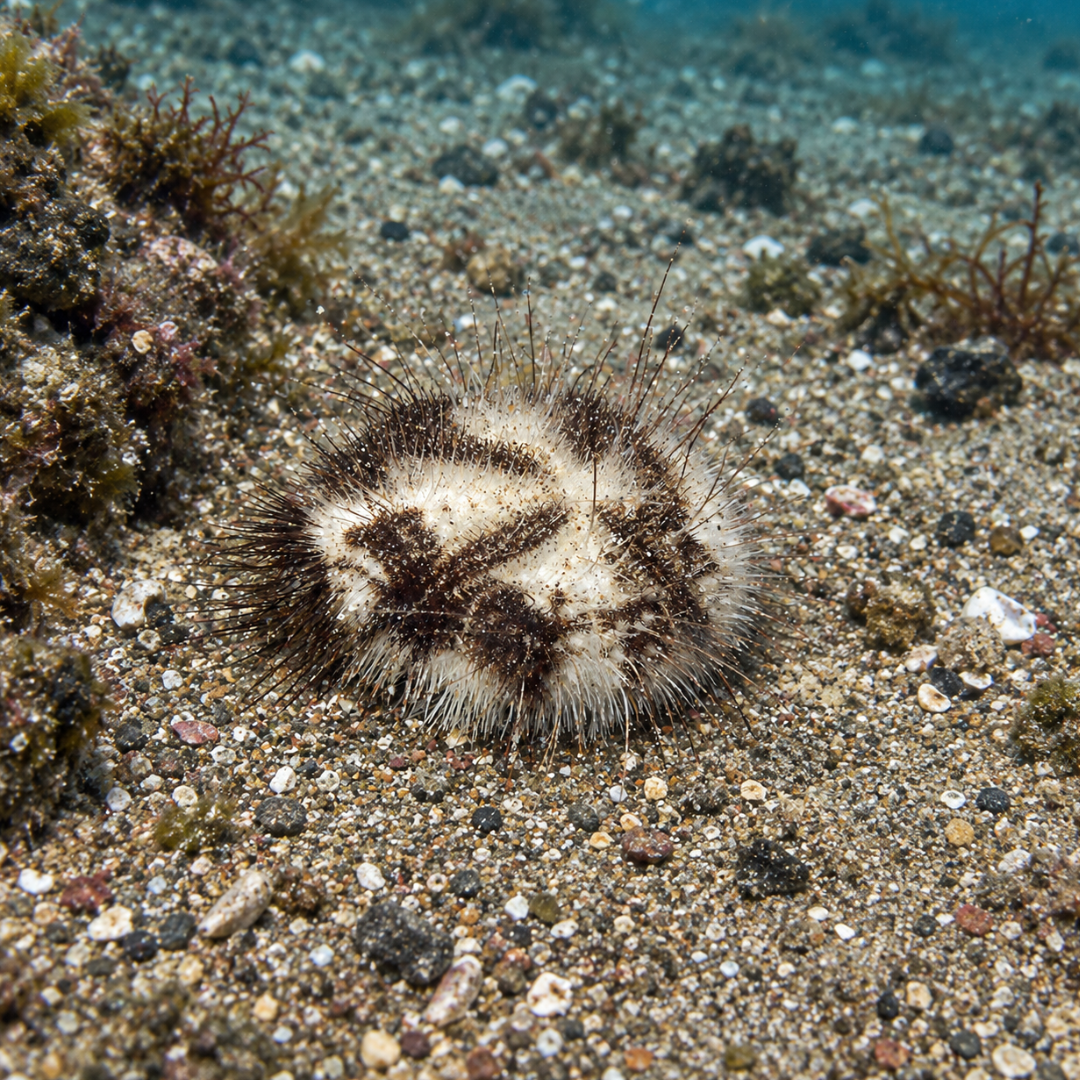
オニヒメブンブクは、砂の中を生活の中心にするブンブク目の不正形ウニです。一般的な球形のウニとは異なり、前後方向がはっきりした扁平な殻をもち、位置によって形の異なる棘を使いながら砂中を掘り進みます。自然下では堆積物を取り込み、その中の有機物を利用する堆積物食者として暮らしています。水槽では姿を見せる時間は多くありませんが、砂中を移動する過程で底砂を攪拌します。一方、底砂そのものが住みかであり餌場でもあるため、十分な面積と厚みのある細粒底砂と、長期間安定した海水環境を用意することが飼育の前提になります。 Maretia planulata is an irregular heart urchin of the order Spatangoida that spends most of its life within sandy sediment. Unlike the familiar spherical form of many sea urchins, it has a flattened body with a clear front-to-back axis and regionally specialized spines that help it move through the substrate. In nature it is a deposit feeder, ingesting sediment and using the organic material contained within it. In aquaria it may remain hidden for long periods, but its movement through the substrate continually disturbs and mixes the sand. Because the sand bed serves as both habitat and feeding ground, successful long-term care depends on providing a broad, sufficiently deep layer of fine substrate and maintaining stable marine water conditions over time.
基本情報 / Basic Information
| 学名 / Scientific Name | Maretia planulata (Lamarck, 1816) |
|---|---|
| 通称 / Common Name | オニヒメブンブク、ハートウニの仲間Heart urchin, Tiny maretia heart urchin, Longspine heart urchin |
| 分類 / Family | 棘皮動物門・ウニ綱・ブンブク目・Maretiidae・オニヒメブンブク属Phylum Echinodermata, Class Echinoidea, Order Spatangoida, Family Maretiidae, Genus Maretia |
| 英名 / English Name | Heart urchin / Tiny maretia heart urchin / Longspine heart urchin |
| 分布 / Distribution | 熱帯から亜熱帯のインド西太平洋に広く分布し、日本近海からも記録があります。砂底・砂泥底や海草藻場などに生息し、一般的な生態資料では潮間帯付近から水深60m程度までの範囲が示されています。Widely distributed through tropical and subtropical parts of the Indo-West Pacific, with records from waters around Japan. It occurs on sandy to sandy-muddy bottoms and in seagrass habitats. General ecological references place it from near the intertidal zone to depths of about 60 m. |
| 最大体長 / Max Size | 殻長は6cm前後がひとつの目安ですが、8cmを超える標本も報告されています。個体差があり、流通個体ではこれより小さいものも見られます。A test length of around 6 cm is a useful general guide, although specimens exceeding 8 cm have also been reported. Size varies, and animals offered in the aquarium trade may be smaller. |
| 寿命 / Lifespan | 本種単独の信頼できる寿命データは乏しく、自然下・飼育下ともに明確な年数は確立されていません。Reliable species-specific lifespan data are scarce, and a clear lifespan has not been established for either wild or captive individuals. |
飼育環境 / Aquarium Environment
| 水槽サイズ / Tank Size | 長期飼育では水量そのものより、広い底砂面積と砂中に維持される餌資源の量が重要です。目安として90cm規格水槽(約180L)以上、できれば120cm規格水槽(約240L)前後以上の、十分に成熟した水槽が適しています。小型水槽ほど底砂内の餌資源を使い切りやすいため、余裕のある底面積を優先します。For long-term care, sand-bed area and the amount of food naturally maintained within the substrate are more important than volume alone. As a practical guide, a mature 90 cm standard aquarium of roughly 180 L or larger is preferable, with a 120 cm standard aquarium of about 240 L or more offering a safer margin. Smaller systems can deplete available food in the sand more quickly. |
|---|---|
| 水温 / Temperature | 飼育情報では22〜28℃程度が目安とされています。実際の管理では、適正範囲内で大きく変動させず、24〜26℃前後を安定して維持すると管理しやすくなります。 Husbandry references commonly use about 22–28°C as a practical range. In day-to-day care, keeping the temperature stable within that range, often around 24–26°C, is generally easier to manage. |
| 水質 / Water Quality | 一般的なリーフアクアリウム相当の安定した海水を維持します。比重1.025〜1.026前後、pH 8.1〜8.4、アルカリ度8.0〜9.5 dKHは、本種固有の最適値というより安定した海水水槽を管理するための目安です。数値を追うこと以上に、塩分・水温・pHを急変させないことが重要です。銅を含む薬剤や重金属は棘皮動物に有害なため使用しません。Maintain stable reef-aquarium seawater. A specific gravity around 1.025–1.026, pH 8.1–8.4, and alkalinity of about 8.0–9.5 dKH are practical reef-system targets rather than experimentally established species-specific optima. Stability is more important than chasing exact numbers, especially for salinity, temperature, and pH. Copper-based medications and other heavy-metal treatments should not be used with echinoderms. |
| レイアウト / Layout | 最重要なのは、潜行しやすい細粒の底砂です。パウダー状から細粒のサンゴ砂やアラゴナイトサンドを使い、少なくとも5cm程度、可能なら5〜10cm程度の厚みを確保します。広い砂地を残し、岩組みはウニが周囲を掘っても崩れないよう、底面に安定させて配置します。A fine, burrowable substrate is the most important feature. Use powder-fine to fine coral or aragonite sand, with at least about 5 cm of depth and preferably around 5–10 cm where practical. Leave broad open sandy areas, and place rockwork on a stable base so burrowing around it cannot cause collapse. |
| 注意点 / Precautions | 底砂を敷かない水槽や、潜るのが難しい粗い底床主体の環境には向きません。導入時は急激な塩分・水温差が生じないよう丁寧に水合わせを行い、体を乱暴に扱わずに移動させます。立ち上げ直後で砂中の有機物や微小な餌資源が乏しい水槽、底砂を過度に掃除する環境では餌不足になりやすいため注意が必要です。This species is unsuitable for bare-bottom systems or tanks dominated by substrate too coarse for effective burrowing. Acclimate carefully to avoid abrupt differences in salinity and temperature, and handle the animal gently during transfer. Newly established or aggressively cleaned aquaria may contain too little organic material and other fine food resources in the sand, increasing the risk of starvation. |
餌と給餌 / Feeding
| 餌の種類 / Diet | 砂を取り込みながら、その中に含まれるデトリタスやその他の微細な有機物を利用する堆積物食者です。採餌は底砂そのものと密接に結びついており、砂中を移動しながら継続的に餌資源を取り込みます。A deposit feeder that ingests sediment and uses detritus and other fine organic material contained within it. Feeding is closely tied to the substrate itself, and the animal acquires food continuously as it moves through the sand. |
|---|---|
| 給餌のポイント / Feeding Tips | 人工飼料による補助給餌は確立された方法ではないため、基本は成熟した底砂そのものを餌場として維持します。日中に長く砂上を徘徊する、ガラス面へ登ろうとする、棘の脱落が目立つといった変化が続く場合は、餌不足だけでなく水質や底床環境を含めて見直します。補助給餌を試す場合は、沈下性の海水魚用フードや微粒子状の餌をごく少量だけ砂面付近へ与え、食べ残しによる水質悪化を避けます。Supplemental feeding with prepared foods is not an established method for this species, so the main strategy is to maintain a mature, biologically active sand bed. Prolonged daytime wandering, attempts to climb the glass, or noticeable spine loss should prompt a review of food availability, water quality, and substrate conditions rather than being treated as proof of a single cause. If supplemental feeding is attempted, offer only a very small amount of sinking marine food or fine particulate feed near the sand surface and avoid leftovers that could degrade water quality. |
性格と混泳 / Temperament and Tank Mates
| 性格 / Temperament | 温和で、魚やサンゴを積極的に攻撃する性質はありません。多くの時間を砂中で過ごし、ゆっくりと底砂を掘り進みます。行動は目立ちにくいものの、砂面の盛り上がりや移動跡から活動を確認できます。Peaceful and not known to actively attack fish or corals. It spends much of its time buried, moving slowly through the substrate. Although often hidden, its activity can be detected from shifting sand, small ridges, and tracks at the surface. |
|---|---|
| 混泳の相性 / Compatibility | 一般的な小型の温和な海水魚や多くのサンゴとは合わせやすい一方、大型ヤッコ、モンガラカワハギ類、フグ類、一部の大型ベラ類、大型の肉食性カニなど、ウニをつついたり捕食したりする可能性のある生体との混泳は避けます。また、砂上へ直接置いた不安定な小型サンゴ片は、砂の移動で埋まることがあります。Usually compatible with small peaceful marine fishes and many corals, but should not be kept with animals likely to nip at or prey on echinoderms, including large angelfishes, triggerfishes, puffers, some large wrasses, and large predatory crabs. Unsecured coral fragments placed directly on the sand may also be partially buried by substrate movement. |
病気と対策 / Diseases and Prevention
| かかりやすい病気 / Common Diseases | 本種について、観賞魚の病気のように整理された特定の疾病情報はほとんどありません。飼育上は、急な塩分変化や水質悪化によるストレス、外傷、棘の脱落、体表組織の損傷、餌不足に伴う衰弱が主なトラブルになります。Few species-specific diseases are formally documented in the way common fish diseases are. In captivity, the major concerns are stress from rapid salinity changes or poor water quality, physical injury, spine loss, damage to body tissues, and progressive weakness associated with inadequate food. |
|---|---|
| 対策と予防 / Prevention | 安定した塩分・水温・pHを保ち、導入時の水合わせを丁寧に行うことが最大の予防策です。銅を含む薬剤は使用せず、別水槽で魚病治療を行います。棘の急激な脱落や長時間の砂上徘徊が見られた場合は、水質だけでなく底砂の粒度、砂層の厚さ、餌資源の不足まで含めて環境全体を見直します。The best prevention is stable salinity, temperature, and pH together with careful acclimation. Do not use copper medications in the display system; treat fish separately when necessary. If rapid spine loss or prolonged wandering over the sand occurs, review not only water chemistry but also sand grain size, bed depth, and the availability of food within the substrate. |
増やし方(繁殖) / Breeding
| 雌雄の判別 / Sexing | 外見から雌雄を確実に判別する方法は一般的ではありません。成熟個体でも殻の形や棘だけで雌雄を見分けるのは困難です。There is no widely practical method for reliably sexing this species by external appearance. Even mature individuals are difficult to distinguish by test shape or spines alone. |
|---|---|
| 繁殖形態 / Reproduction | 本種に限定した繁殖生態の詳しい情報は多くありません。ブンブク目を含む多くのウニ類では雌雄が配偶子を海中へ放出して体外受精し、浮遊幼生期を経て海底へ着底・変態する生活史をとります。本種も同様の繁殖様式をとると考えられますが、繁殖時期や幼生期間などの詳細は明確ではありません。Detailed reproductive information specific to Maretia planulata is limited. Many sea urchins, including spatangoids, release gametes into the water for external fertilization and pass through a planktonic larval stage before settlement and metamorphosis. M. planulata is expected to follow this general pattern, but species-specific details such as spawning season and larval duration are not well established. |
| 繁殖のポイント / Breeding Tips | 一般家庭で安定して繁殖させる方法は確立されていません。仮に産卵が起きても、浮遊幼生を維持し、適切な餌・水流・着底条件を整える必要があります。成体を長期飼育できる環境と、幼生を育成できる環境は別に考える必要があります。A reliable method for breeding this species in the home aquarium has not been established. Even if spawning occurs, planktonic larvae would require suitable food, controlled flow, and appropriate settlement conditions. Maintaining adults successfully and rearing larvae through metamorphosis should therefore be treated as separate husbandry challenges. |
雑学と豆知識 / Trivia and Fun Facts
| 1. 1816年から続く学名の歴史 / 1. A taxonomic story dating back to 1816 | オニヒメブンブクは1816年、ラマルクによって最初は Spatangus planulatus の名で記載されました。その後、1855年に Gray が Maretia 属を設け、現在は Maretia planulata として扱われています。分類体系は時代とともに更新されており、日本の資料の一部ではホンブンブク科 Spatangidae とされる一方、現在の国際的な主要データベースでは Maretiidae に置かれています。同じ生き物でも、古い文献と新しいデータベースを照らし合わせると、分類学そのものが更新され続ける学問であることが見えてきます。The species was originally described by Lamarck in 1816 as Spatangus planulatus. After Gray established the genus Maretia in 1855, the accepted name became Maretia planulata. Classification has continued to change over time: some Japanese references still place the species in Spatangidae, while major current international databases place it in Maretiidae. Comparing older literature with modern databases offers a clear example of taxonomy as an evolving scientific framework rather than a permanently fixed list of names. |
|---|---|
| 2. 球形のウニとは違う「不正形ウニ」の体 / 2. The unusual body plan of an irregular urchin | 多くの人がウニと聞いて思い浮かべるのは、ほぼ放射相称の丸い体です。しかしブンブク類は、砂中生活への適応の過程で前後方向が明瞭になり、左右相称性の強い体へと変化しました。オニヒメブンブクも殻を上から見ると前端と後端が区別でき、背面には呼吸に関わる花紋状の管足域が並びます。成体では一般的な岩礁性ウニに見られる典型的な咀嚼装置が発達せず、砂粒とともに微細な有機物を取り込む生活に適した体へ専門化しています。The sea urchin most people imagine is a nearly radial, spherical animal. Heart urchins followed a different evolutionary path: adaptation to life within sediment produced a body with a clear front and rear and much stronger bilateral symmetry. Viewed from above, Maretia planulata has an obvious anteroposterior axis, while petal-like ambulacral areas on the upper surface are associated with respiration. Adults are specialized for deposit feeding rather than the typical grazing apparatus of many rock-dwelling sea urchins. |
| 3. 砂の中で呼吸を続けるための「帯線」 / 3. Fascioles help maintain life beneath the sand | 砂中生活では、細かな堆積物が呼吸に関わる管足を塞がないようにすることが重要です。ブンブク類の体表には帯線と呼ばれる特殊な帯状部があり、そこには繊毛を備えた細かな棘が密集しています。これらの棘と粘液は周囲の砂をまとめて坑道の壁を保ち、呼吸に関わる管足へ泥が入り込みにくい状態をつくります。見た目には細かな毛のように見える構造も、砂中生活を支える重要な仕組みの一つです。Living below the sand creates a major challenge: fine sediment must be kept from clogging the tube feet involved in respiration. Heart urchins possess specialized bands called fascioles, where minute ciliated spines are densely arranged. Together with mucus, these structures help consolidate the surrounding sediment and maintain burrow walls while reducing the entry of fine mud onto respiratory tube feet. What looks like a simple coat of tiny spines is therefore part of an important adaptation to life beneath the substrate. |
| 4. 海底の砂を耕す生物攪拌者 / 4. A powerful bioturbator of marine sediment | オニヒメブンブクは、砂を取り込むだけでなく、移動・摂食・排泄を繰り返すことで底質を継続的に動かします。この働きは生物攪拌と呼ばれ、堆積物中の物質移動に影響する重要な生態作用です。エニウェトク環礁に関する1986年の報告では、局所的な季節集群として1平方メートルあたり100〜200個体に達する場合があり、大量の堆積物を処理すると記載されています。ただし、これは特定地域での高密度な観察例であり、本種が常にその密度で暮らすことを意味するものではありません。水槽で砂面が少しずつ変化していく様子は、こうした砂中生活者としての性質を小さなスケールで感じさせます。Maretia planulata does more than simply ingest sand. By moving, feeding, and defecating through the substrate, it continually redistributes sediment. This process, known as bioturbation, influences the movement of material within the seabed. A 1986 report from Enewetak Atoll described local seasonal aggregations reaching about 100–200 individuals per square meter and noted that the animals processed massive amounts of sediment. This was a high-density observation from a particular locality, not a typical density for the species everywhere. In an aquarium, gradual changes in the sand surface offer a small-scale view of its sediment-dwelling lifestyle. |
| 5. 殻に含まれるキノノイド色素 / 5. Quinonoid pigments in the test | ウニ類の殻や棘にはスピノクロム類やエキノクロムAなどのキノノイド色素が含まれることがあり、近年は化学組成や生理作用の研究が進んでいます。2021年にはオニヒメブンブクの殻に含まれるキノノイド色素組成が詳しく分析され、エキノクロムAを主要成分とする組成が報告されました。一方で、殻全体に含まれる総色素量は研究対象となった一部のウニ類に比べ低い値でした。目立たない砂中生活者であっても、その体内には生態学だけでなく天然物化学の視点からも研究対象となる特徴が隠れています。Sea urchin tests and spines can contain quinonoid pigments such as spinochromes and echinochrome A, compounds that have become subjects of chemical and physiological research. In 2021, the quinonoid pigment composition of Maretia planulata was analyzed in detail, with echinochrome A reported as a major component of the pigment profile. At the same time, the total pigment content of the test was relatively low compared with some other sea urchin species examined. Even an inconspicuous sediment-dweller can therefore attract scientific interest not only in ecology but also in natural-products chemistry. |
まとめ / Conclusion
オニヒメブンブクは、砂の中で暮らすことに特化した姿と行動をもつ不正形ウニです。細かな底砂を掘り進みながら堆積物中の有機物を利用し、その移動によって砂を攪拌します。十分に成熟した海水水槽では、目立たない場所で活動を続ける底生生物として独特の存在感があります。 Maretia planulata is an irregular urchin whose form and behavior are highly specialized for life beneath the sand. As it moves through fine substrate and feeds on organic material within the sediment, it also disturbs and redistributes the sand. In a mature marine aquarium, it becomes a distinctive benthic animal that carries out most of its activity out of sight.
長期飼育では、十分な面積と厚みをもつ細粒の底砂、急変のない安定した海水、そして砂中の餌資源を維持することが欠かせません。姿を見せる機会が少なくても、砂面に残る移動の跡やわずかな盛り上がりから、砂の中で続く活動を感じ取ることができます。 Long-term success depends on a broad and sufficiently deep bed of fine sand, stable seawater without abrupt changes, and the continued availability of natural food within the substrate. Even when the animal remains hidden, tracks and subtle shifts in the sand can reveal the activity continuing below the surface.

気になる道具や飼い方を見つけてみませんか?
 アイのアクアグッズ案内ローチの仲間に合わせる飼育用品|クーリー・流水性・ボーシャの水槽と底砂道具の特徴や使い方、選ぶときのポイントをアイが紹介します。記事はコチラ →
 アイのアクアグッズ案内コケを食べるコイの仲間に合わせる飼育用品|フライングフォックス・アルジイーター・ガラ道具の特徴や使い方、選ぶときのポイントをアイが紹介します。記事はコチラ →
 アイのアクアグッズ案内ラスボラ・ボララスの群泳を楽しむ飼育用品|水槽・ろ過・ヒーター・餌・水草道具の特徴や使い方、選ぶときのポイントをアイが紹介します。記事はコチラ →
 アイのアクアグッズ案内海水魚初心者の必需品|水槽・人工海水・比重計・水質検査道具の特徴や使い方、選ぶときのポイントをアイが紹介します。記事はコチラ →
さまざまな飼育テーマをご紹介。リンク先の記事には広告・商品紹介が含まれます。
案内・紹介記事一覧へ →分布マップ
オニヒメブンブク(Maretia planulata)は、熱帯から亜熱帯のインド西太平洋に広く分布し、日本近海からも記録されています。砂底・砂泥底や海草藻場などに生息します。
この地図は、既知の分布地域をもとにインド西太平洋全体を見渡せるよう設定した概略表示です。マーカーは分布域を把握しやすくするための代表地点であり、実際の採集地点や個体の確認地点を示すものではありません。
参考文献
- Kroh, A. & Mooi, R. World Echinoidea Database. Maretia planulata (Lamarck, 1816). World Register of Marine Species (WoRMS). 対応項目:学名・分類・シノニム World Register of Marine Species
- Lane, D. J. W., Marsh, L. M., VandenSpiegel, D. & Rowe, F. W. E. (2000). Echinoderm fauna of the South China Sea: an inventory and analysis of distribution patterns. The Raffles Bulletin of Zoology, Supplement No. 8, 459–493. 対応項目:分布・水深・インド西太平洋域の記録 National University of Singapore 掲載PDF
- Norris, D. R. (1994). Associations between three irregular urchins and cone-and-funnel topography in a tropical soft-bottom community. Master of Science thesis, University of Guam. 対応項目:砂底での生息、底質粒径・有機物と分布、砂中生活 University of Guam 掲載PDF
- Hibino, T., Minokawa, T. & Yamazaki, A. (2019). Cidaroids, clypeasteroids, and spatangoids: Procurement, culture, and basic methods. Methods in Cell Biology, 150, 81–103. https://doi.org/10.1016/bs.mcb.2018.09.012 対応項目:ブンブク目を含むウニ類の成体維持・飼育管理・胚培養 PubMed
- Hodin, J., Heyland, A., Mercier, A., Pernet, B., Cohen, D. L., Hamel, J.-F., Allen, J. D., McAlister, J. S., Byrne, M., Cisternas, P. & George, S. B. (2019). Culturing echinoderm larvae through metamorphosis. Methods in Cell Biology, 150, 125–169. https://doi.org/10.1016/bs.mcb.2018.11.004 対応項目:浮遊幼生の育成、給餌、着底・変態までの繁殖管理 PubMed
- University of Washington. Sea Urchin Embryology: Care of Adult Sea Urchins. 対応項目:導入時の温度順応、塩分管理、水質悪化時のストレス兆候 University of Washington
- Yanong, R. P. E. Use of Copper in Marine Aquaculture and Aquarium Systems. University of Florida IFAS Extension, FA165. 対応項目:銅薬の無脊椎動物への毒性、魚病治療時の注意 University of Florida IFAS Extension




コメント