

解説 / Description
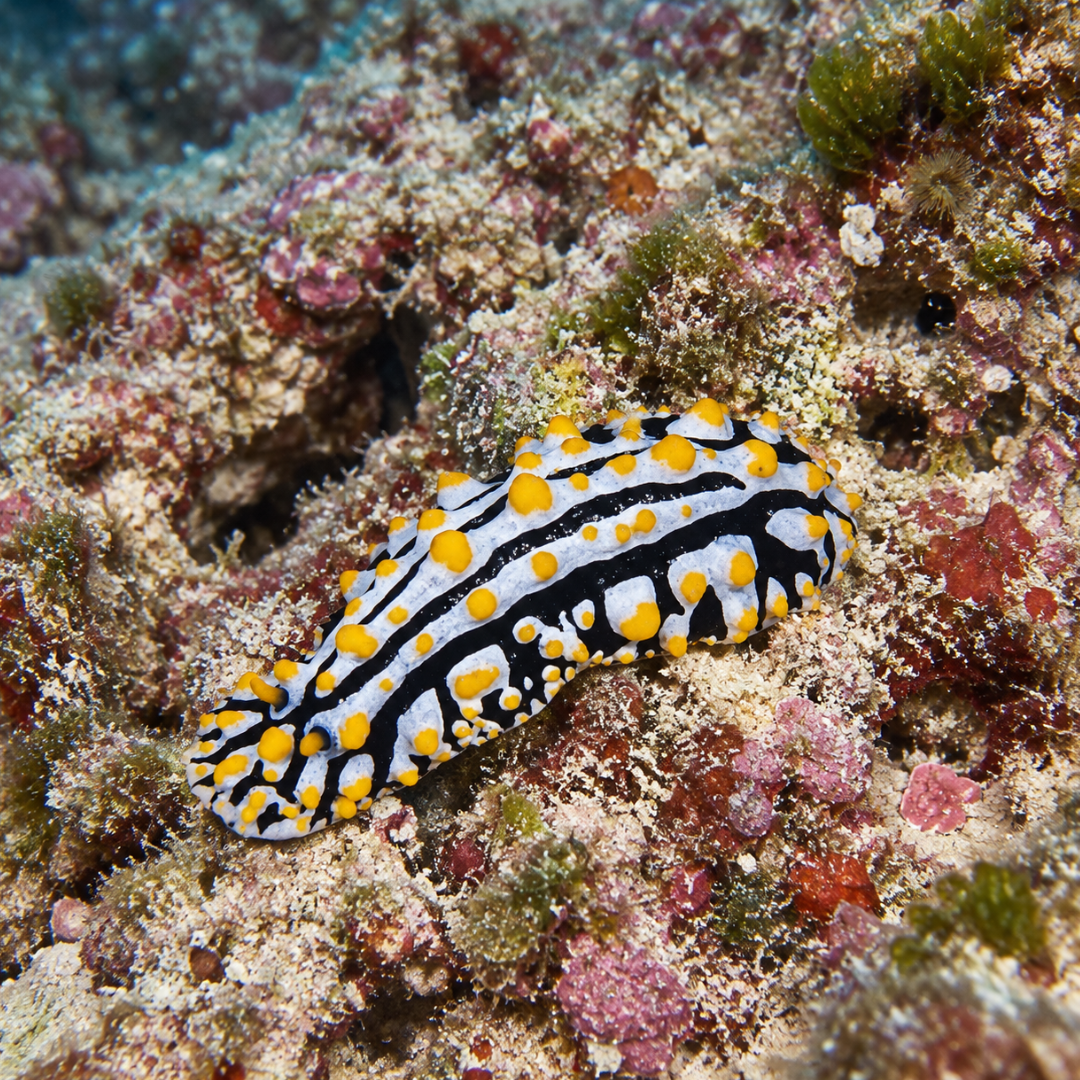
タテヒダイボウミウシは、青灰色の縦方向の隆起、鮮やかな黄色のイボ、黒い線模様が強いコントラストをつくる大型のウミウシです。インド・西太平洋に広く分布し、日本からも記録されています。目立つ体色は、捕食者に対する警告色として機能すると考えられており、その背景には餌の海綿から取り込む化学物質を利用した防御があります。非常に美しい生き物ですが、限られた海綿を餌とするため、一般的なマリンアクアリウムでの長期飼育はきわめて困難です。水槽内を動いていても十分に摂食できているとは限らないため、飼育を検討する際は、まず食性の特殊さを理解する必要があります。 Phyllidia varicosa is a large nudibranch marked by blue-gray longitudinal ridges, bright yellow tubercles, and bold black lines. It is widely distributed in the Indo-West Pacific and has also been recorded from Japan. Its conspicuous coloration is thought to function as a warning to predators, supported by chemical defenses derived in part from compounds obtained through its sponge diet. Although visually striking, it is extremely difficult to maintain long term in a typical marine aquarium because it depends on a specialized sponge diet. An animal that continues to crawl around the tank is not necessarily feeding successfully, so its dietary specialization must be understood before captive maintenance is considered.
基本情報 / Basic Information
| 学名 / Scientific Name | Phyllidia varicosa Lamarck, 1801 |
|---|---|
| 通称 / Common Name | タテヒダイボウミウシVaricose phyllidia, swollen phyllidia |
| 分類 / Family | 軟体動物門・腹足綱・裸鰓目・イボウミウシ科(Phyllidiidae)・タテヒダイボウミウシ属(Phyllidia)Phylum Mollusca, Class Gastropoda, Order Nudibranchia, Family Phyllidiidae, Genus Phyllidia |
| 英名 / English Name | Varicose Phyllidia |
| 分布 / Distribution | 紅海を含むインド・西太平洋に広く分布し、東アフリカから東南アジア、オーストラリア、中部太平洋、日本まで記録があります。Widely distributed across the Indo-West Pacific, including the Red Sea, with records extending from East Africa through Southeast Asia and Australia to the central Pacific and Japan. |
| 最大体長 / Max Size | 最大約11.5cm。イボウミウシ科の中では大型になる種です。Up to about 11.5 cm. It is one of the larger phyllidiid nudibranchs. |
| 寿命 / Lifespan | 本種について、野外・飼育下ともに標準的な寿命を示す十分なデータはありません。ウミウシ類には比較的短い生活史をもつ種が多いものの、本種の寿命を一律に「何年」と断定することはできません。Reliable species-specific lifespan data are not available. Many nudibranchs have relatively short life cycles, but a fixed lifespan in years should not be stated for this species without stronger evidence. |
飼育環境 / Aquarium Environment
| 水槽サイズ / Tank Size | 本種について、長期飼育を前提とした信頼性の高い推奨水槽サイズは確認できません。60cm規格水槽や90cm規格水槽など、水槽の大きさだけで飼育の可否を判断できる生き物ではなく、適切な餌海綿を継続して確保できるかどうかが最も大きな制約になります。やむを得ず一時的に管理する場合は、他の生体とは分けた専用環境が適します。No well-supported tank size recommendation has been established for long-term care of this species. Whether the aquarium is a 60 cm or 90 cm standard tank does not resolve the central husbandry problem: the continuing availability of the correct prey sponge. If temporary captive maintenance is unavoidable, a separate dedicated system is preferable. |
|---|---|
| 水温 / Temperature | 本種固有の推奨飼育水温を示す十分なデータは確認できません。広いインド・西太平洋に分布するため、由来する海域の環境を踏まえ、急激な温度変化を避けて安定させることが重要です。 There is not enough species-specific husbandry evidence to give a single recommended aquarium temperature. Because the species occurs widely across the Indo-West Pacific, temperature should be kept stable and appropriate to the geographic origin of the individual, avoiding abrupt changes. |
| 水質 / Water Quality | 本種だけに適用できる水質の許容範囲は十分に示されていません。飼育下では、採集地に近い清浄な海水環境を安定して維持し、急激な比重や水質の変化を避けることが基本になります。Species-specific tolerance ranges for aquarium water chemistry are not well established. In captivity, the basic requirement is stable, clean seawater appropriate to the animal’s origin, while avoiding abrupt changes in salinity or overall water quality. |
| レイアウト / Layout | 岩や基質の表面を這って生活するため、移動できる岩面を確保します。ただし、レイアウトの見た目よりも、実際に摂食できる海綿を維持できることの方が重要です。吸水口や水流ポンプへの巻き込みは大きな負担になるため、接触を防げる配置にします。Provide rock and substrate surfaces over which the animal can crawl. The visual style of the aquascape is less important than maintaining sponge prey that the nudibranch will actually eat. Pump intakes and other moving equipment should be arranged so that the animal cannot be drawn into them. |
| 注意点 / Precautions | 最大の問題は、限られた海綿を餌とすることです。一般的な人工飼料、冷凍餌、コケ、残餌などを代替餌として期待することはできません。また、本種の防御分泌物には魚類や甲殻類に作用する成分が含まれることが報告されています。閉鎖された水槽内での影響を一律に予測することはできませんが、他の生体との混泳は避けるのが安全です。The main difficulty is its dependence on a limited range of sponge prey. Standard prepared foods, frozen foods, algae, and leftover fish food cannot be expected to replace its natural diet. Defensive secretions from this species have also been reported to contain compounds toxic to fish and crustaceans. The effect in any particular closed aquarium cannot be predicted uniformly, so keeping it with other animals is best avoided. |
餌と給餌 / Feeding
| 餌の種類 / Diet | 海綿を主な餌とし、Hymeniacidon属やAxinyssa属の海綿との摂食関係が研究で示されています。Axinyssa aculeataと本種の双方から同じ系統のププケアナン類が検出された例もあり、餌から得た化学物質を体内に取り込み、防御に利用する関係が支持されています。重要なのは「海綿なら何でも食べる」という意味ではない点で、市販の海綿やライブロックに生えた海綿がそのまま代替餌になるとは限りません。Sponges are its principal food, and feeding relationships with sponges in the genera Hymeniacidon and Axinyssa have been documented. Related pupukeanane compounds have also been detected in both P. varicosa and its sponge prey Axinyssa aculeata, supporting a dietary origin for compounds used in defense. This does not mean that any sponge will be accepted, and aquarium sponges or incidental sponge growth on live rock cannot be assumed to be suitable food. |
|---|---|
| 給餌のポイント / Feeding Tips | 購入後に餌を探すのではなく、導入前から摂食可能な海綿を継続供給できる体制が必要です。海綿表面への摂食痕、体の張り、体長の減少などを観察し、単に水槽内を歩き回っていることを「餌を探して元気に活動している」と判断しないようにします。適切な餌海綿の同定と維持ができない場合は、飼育を始めないことが最も確実です。A continuous supply of confirmed edible sponge should be secured before the animal is obtained, not afterward. Watch for feeding marks on sponge surfaces and changes in body fullness or size. Continuous crawling should not be interpreted as proof that the animal is feeding successfully. If the correct prey sponge cannot be identified and maintained, the most reliable husbandry decision is not to begin captive maintenance. |
性格と混泳 / Temperament and Tank Mates
| 性格 / Temperament | 他の生物を積極的に攻撃する性質はなく、ゆっくりと岩や底面を這って移動します。ただし、捕食されにくい化学防御を備えているため、見た目のおとなしい印象だけで安全な混泳種と判断することはできません。It is not an actively aggressive animal and usually crawls slowly across rock and substrate. However, its peaceful appearance should not be mistaken for complete community-tank safety because it possesses potent chemical defenses that discourage predators. |
|---|---|
| 混泳の相性 / Compatibility | 魚、エビ、カニなどを飼育する一般的なコミュニティ水槽には向きません。本種の防御分泌物が魚類や甲殻類に有害であることは研究で示されていますが、実際の水槽内でどの程度の影響が生じるかを一律に示すデータは限られています。飼育する場合は、他の生体と分けた専用環境が適します。It is not well suited to a typical community aquarium containing fish, shrimp, or crabs. Research has shown that its defensive secretions can be harmful to fish and crustaceans, but the magnitude of the effect in a particular aquarium is not well quantified. If maintained at all, it is preferable to keep the animal in a separate dedicated system. |
病気と対策 / Diseases and Prevention
| かかりやすい病気 / Common Diseases | 本種について、観賞飼育下で特に多い感染症や寄生虫症を体系的に示した情報は確認できません。飼育上は、病名の付く疾病よりも、適切な餌を得られないことによる衰弱をまず警戒する必要があります。There is no well-established list of infectious or parasitic diseases that commonly affect this species in aquaria. In captive care, progressive decline caused by failure to obtain the correct food is a more clearly documented concern than a specific named disease. |
|---|---|
| 対策と予防 / Prevention | 予防で最も重要なのは、摂食できる海綿を継続して確保し、環境を急変させないことです。体が痩せる、動きが弱くなる、体表の状態が崩れるなどの変化が見られた場合は、まず餌を実際に摂取できているかと水質の安定性を確認します。本種について確立した薬物治療法は情報が乏しいため、原因が分からないまま薬剤を使用することは避けます。The most important preventive measure is to maintain a continuing supply of sponge prey that the animal actually consumes and to avoid abrupt environmental changes. If the body becomes thinner, movement weakens, or the body surface deteriorates, first confirm whether the animal is truly feeding and whether water conditions remain stable. Because species-specific drug treatments are not well established, medication should not be used without a clear reason. |
増やし方(繁殖) / Breeding
| 雌雄の判別 / Sexing | 雌雄同体のため、外見からオスとメスに分けて判別することはできません。成熟個体は一個体の中に雄性・雌性の両方の生殖機能を備えます。This species is hermaphroditic, so individuals cannot be separated into male and female based on external appearance. A mature animal possesses both male and female reproductive functions. |
|---|---|
| 繁殖形態 / Reproduction | 雌雄同体の個体同士が交尾し、リボン状の卵塊を基質に産み付けます。ウミウシ類では孵化後にベリジャー幼生として浮遊する発生型が知られていますが、本種の幼生飼育や着底条件については、一般飼育に利用できるほど十分な情報が整っていません。Hermaphroditic individuals mate and deposit ribbon-like egg masses on a substrate. Nudibranch development commonly includes a planktonic veliger stage after hatching, but species-specific information on larval culture and settlement in P. varicosa is not sufficiently established for routine aquarium propagation. |
| 繁殖のポイント / Breeding Tips | 家庭水槽での計画的な繁殖方法は確立されていません。卵塊が得られても、それだけで繁殖成功とはいえず、孵化した幼生を育て、着底・変態後まで継続して生存させる必要があります。幼生期から稚体期までの条件が十分に分かっていないことも、大きな難点です。A reliable method for planned breeding in the home aquarium has not been established. Producing an egg mass alone does not constitute successful propagation; the larvae must be reared through settlement and metamorphosis and kept alive afterward. The limited species-specific knowledge of these early life stages remains a major obstacle. |
雑学と豆知識 / Trivia and Fun Facts
| 1. 「varicosa」という名前は背中の隆起から生まれた / 1. The name “varicosa” comes from its raised dorsal ridges | 種小名のvaricosaは、ラテン語で「静脈瘤のような」「膨れた静脈をもつ」といった意味につながる語です。タテヒダイボウミウシの背中には青灰色の隆起が縦方向に走り、その上に黄色いイボが並びます。海中で見ると、この隆起が体表に浮き上がった太い脈のように見えるため、その特徴がそのまま学名の印象的な部分になりました。学名は難解に見えますが、由来を知ると、目の前の形態を言葉に置き換えた非常に視覚的な名前であることが分かります。The specific epithet varicosa is related to the Latin idea of being varicose or having swollen veins. Blue-gray longitudinal ridges run across the dorsum, with yellow tubercles rising above them. Underwater these ridges can resemble thick, raised veins, so one of the animal’s most obvious visual traits became embedded in its scientific name. What first appears to be an obscure Latin label is actually a remarkably visual description of the body. |
|---|---|
| 2. 歯舌を捨て、「吸う」ことに特化したウミウシ / 2. A nudibranch that lost the radula and specialized in suction feeding | 多くの腹足類は、細かな歯が並ぶ歯舌を使って餌を削り取ります。ところがイボウミウシ類では歯舌と顎を欠き、代わりに筋肉質の咽頭部を使う吸引型の摂食に特化しています。タテヒダイボウミウシは咽頭部を反転させて海綿の表面から組織を取り込みます。つまり、一般的なウミウシとは異なる摂食器官が、海綿食という専門化した食性を支えているのです。この特殊化は、本種を家庭水槽で飼いにくくする理由ともつながっています。Many gastropods scrape food with a radula bearing rows of minute teeth. Phyllidiid nudibranchs, however, lack both the radula and jaws and instead are specialized for suction feeding with a muscular pharyngeal apparatus. P. varicosa can evert this structure against the sponge surface and take in tissue. In other words, a feeding system unlike that of many other nudibranchs supports its specialized sponge diet, and that specialization is also one reason the species is so difficult to maintain in a home aquarium. |
| 3. 餌から借りた化学物質を、自分の防御へ転用する / 3. Chemicals obtained from prey are repurposed for defense | タテヒダイボウミウシの化学防御を語るうえで重要なのが、9-イソシアノププケアナンです。1975年に本種から報告され、1979年には防御分泌物に含まれるイソシアノセスキテルペンがHymeniacidon属の海綿に由来することが示されました。さらに2003年には、本種と餌海綿Axinyssa aculeataの双方から同じ9-チオシアナトププケアナン類が検出されています。つまり、餌として取り込んだ海綿由来の成分を体内に保持し、防御に利用するという関係が、化学分析から確かめられてきたのです。An important compound in the chemical-defense history of P. varicosa is 9-isocyanopupukeanane, reported from the species in 1975. A 1979 study showed that isocyanosesquiterpenes in its defensive secretion originated from a Hymeniacidon sponge. In 2003, the same 9-thiocyanatopupukeanane compounds were isolated from both P. varicosa and its sponge prey Axinyssa aculeata. Chemical analyses therefore support a clear relationship in which sponge-derived compounds are retained by the nudibranch and used in defense. |
| 4. 「ププケアナン」の名にはハワイの地名が残っている / 4. “Pupukeanane” preserves the name of a Hawaiian place | 9-イソシアノププケアナンという長い化合物名には、ハワイ・オアフ島北岸のププケアという地名が残されています。この化合物が報告された研究では、ププケアで採集された生物試料が用いられ、その採集地にちなんで「ププケアナン」と呼ばれる骨格名が生まれました。タテヒダイボウミウシの化学防御を調べた研究が、海辺の地名を天然物化学の用語として残すことになったのです。The long name 9-isocyanopupukeanane preserves the place name Pūpūkea on the north shore of Oʻahu, Hawaiʻi. The biological material used in the work that identified this compound was collected at Pūpūkea, and the unusual carbon skeleton was consequently named the pupukeanane skeleton after that locality. Research into the chemistry associated with P. varicosa thus left a Hawaiian place name embedded in the language of natural-products chemistry. |
| 5. 幼いクロフチシカクナマコが似た姿を見せる / 5. Juvenile Pearsonothuria sea cucumbers show a striking resemblance | クロフチシカクナマコの幼体は、淡い地色に黒い模様と黄色い突起をもち、タテヒダイボウミウシを思わせる姿になることで知られています。この類似は、捕食者が嫌う警告色をまねる擬態の例としてしばしば紹介されます。興味深いのは、ナマコが成長するとその姿が大きく変わり、ウミウシらしい印象が薄れていくことです。小さな時期だけ別の生物の「危険そうな外見」を借りるように見えるこの関係は、サンゴ礁で色彩が生存戦略に深く結び付いていることを感じさせます。Juvenile Pearsonothuria graeffei sea cucumbers are well known for a pale body patterned with dark markings and yellow projections that can resemble P. varicosa. This resemblance is often discussed as a form of mimicry involving warning coloration avoided by predators. As the sea cucumber grows, however, its appearance changes dramatically and the nudibranch-like resemblance fades. The temporary similarity illustrates how strongly color and pattern can become tied to survival strategies on coral reefs. |
| 6. 美しさと飼いやすさは、まったく別の性質 / 6. Beauty and aquarium suitability are entirely different traits | タテヒダイボウミウシは、海水水槽に入れれば強烈な存在感を放つ生き物です。しかし、その美しさは「観賞魚と同じように飼える」ことを意味しません。むしろ、限られた海綿に依存する食性と化学防御という二つの特徴によって、一般的な水槽ほど長期維持が難しくなります。海で出会ったときに写真を撮り、自然の中でその姿を楽しむことが、本種の生態を損なわずに魅力を味わえる最も確実な方法の一つです。P. varicosa would be visually spectacular in a marine aquarium, but beauty does not imply suitability for captivity. Its dependence on a narrow range of sponges and its chemical defense system make long-term maintenance especially difficult in ordinary aquaria. Observing and photographing the animal in its natural habitat is therefore one of the most reliable ways to appreciate its remarkable appearance without compromising the biological conditions on which it depends. |
まとめ / Conclusion
タテヒダイボウミウシは、黄色いイボと青灰色の隆起、黒い線模様が目を引くだけでなく、歯舌と顎を欠く独特の摂食構造や、餌の海綿から得た化学物質を防御に利用する生態をもつウミウシです。外見の鮮やかさと、海綿食に特化した体の仕組み、化学防御が互いにつながっているところに、この種ならではの特徴があります。 Phyllidia varicosa is notable not only for its yellow tubercles, blue-gray ridges, and bold black patterning, but also for its unusual feeding anatomy, which lacks a radula and jaws, and for its use of sponge-derived compounds in chemical defense. Its conspicuous appearance, specialized sponge diet, and defensive chemistry are closely connected features of the species.
その専門化は、飼育の難しさにも直結しています。実際に摂食できる海綿を継続して用意できなければ、安定した長期飼育は期待できません。鮮やかな姿だけで飼育のしやすさを判断せず、まずこの種がどのような餌と環境に依存して生きているのかを理解することが大切です。 That specialization also explains the difficulty of captive care. Without a continuing supply of sponge prey that the animal actually accepts, stable long-term maintenance cannot be expected. Its striking appearance should not be mistaken for ease of care; understanding the food and environmental conditions on which it depends is essential.

気になる道具や飼い方を見つけてみませんか?
 アイのアクアグッズ案内水草水槽のCO₂添加|3つの方式の選び方とおすすめ用品道具の特徴や使い方、選ぶときのポイントをアイが紹介します。記事はコチラ →
 アイのアクアグッズ案内水草の肥料の選び方|底床用・液肥・メネデールの使い分け道具の特徴や使い方、選ぶときのポイントをアイが紹介します。記事はコチラ →
 アイのアクアグッズ案内ダニオの仲間に合わせる飼育用品|ゼブラダニオから超小型種まで水槽・ろ過・餌を選ぶ道具の特徴や使い方、選ぶときのポイントをアイが紹介します。記事はコチラ →
 アイのアクアグッズ案内マジックリーフ物語|一枚の葉がアクアリウム用品になるまで道具の特徴や使い方、選ぶときのポイントをアイが紹介します。記事はコチラ →
さまざまな飼育テーマをご紹介。リンク先の記事には広告・商品紹介が含まれます。
案内・紹介記事一覧へ →分布マップ
タテヒダイボウミウシ(Phyllidia varicosa)は、紅海を含むインド・西太平洋に広く分布し、東アフリカから東南アジア、オーストラリア、中部太平洋、日本まで記録があります。
この地図は分布地域を大まかに示した概略図です。表示しているマーカーは分布域を把握しやすくするための代表地点であり、実際の採集地点や特定個体の確認地点を示すものではありません。
参考文献
- World Register of Marine Species (WoRMS). Phyllidia varicosa Lamarck, 1801. 主な参照範囲:現在の学名、分類、シノニム。 WoRMSで確認
- 海洋研究開発機構(JAMSTEC)/国際海洋環境情報センター(GODAC). Biological Information System for Marine Life(BISMaL)「Phyllidia varicosa タテヒダイボウミウシ」. 主な参照範囲:和名、日本を含む出現記録、分布確認。 BISMaLで確認
- Brunckhorst, D. J. (1993). The systematics and phylogeny of phyllidiid nudibranchs (Doridoidea). Records of the Australian Museum, Supplement, 16, 1–107. DOI: 10.3853/j.0812-7387.16.1993.79. 主な参照範囲:イボウミウシ科の分類、形態、分布、生態、歯舌と顎を欠く摂食器官、海綿食。 Australian Museumで確認
- Mehrotra, R., Caballer Gutiérrez, M. A., Scott, C. M., Arnold, S., Monchanin, C., Viyakarn, V., & Chavanich, S. (2021). An updated inventory of sea slugs from Koh Tao, Thailand, with notes on their ecology and a dramatic biodiversity increase for Thai waters. ZooKeys, 1042, 73–188. DOI: 10.3897/zookeys.1042.64474. 主な参照範囲:インド太平洋域の分布、サンゴ礁での生息、水深記録。 論文を確認
- van Alphen, J., de Voogd, N. J., & Hoeksema, B. W. (2011). Differential feeding strategies in phyllidiid nudibranchs on coral reefs at Halmahera, northern Moluccas. Coral Reefs, 30, 59. DOI: 10.1007/s00338-010-0698-y. 主な参照範囲:海綿食、吸引型の摂食器官、Axinyssa類への摂食行動。 論文を確認
- Hagadone, M. R., Burreson, B. J., Scheuer, P. J., Finer, J. S., & Clardy, J. (1979). Defense allomones of the nudibranch Phyllidia varicosa Lamarck 1801. Helvetica Chimica Acta, 62, 2484–2494. DOI: 10.1002/hlca.19790620742. 主な参照範囲:防御分泌物、9-イソシアノププケアナン類、餌海綿由来の化学防御。 論文を確認
- Yasman, Edrada, R. A., Wray, V., & Proksch, P. (2003). New 9-thiocyanatopupukeanane sesquiterpenes from the nudibranch Phyllidia varicosa and its sponge-prey Axinyssa aculeata. Journal of Natural Products, 66(11), 1512–1514. DOI: 10.1021/np030237j. 主な参照範囲:Axinyssa aculeataとの摂食関係、餌と本種に共通するププケアナン系化合物。 論文を確認
- Alqudah, A., Saad, S., Susanti, D., Hadry, N. F., Khodzori, M. F. A., Yusof, M. H., & Rani, M. H. (2016). Observations on nudibranch behaviour patterns under laboratory conditions. Jurnal Teknologi (Sciences & Engineering), 78(11), 167–171. 主な参照範囲:雌雄同体、交尾、螺旋状の卵塊、飼育下でのストレス反応と防御分泌物に関する注意点。 UTM Pressで確認




コメント