
解説 / Description
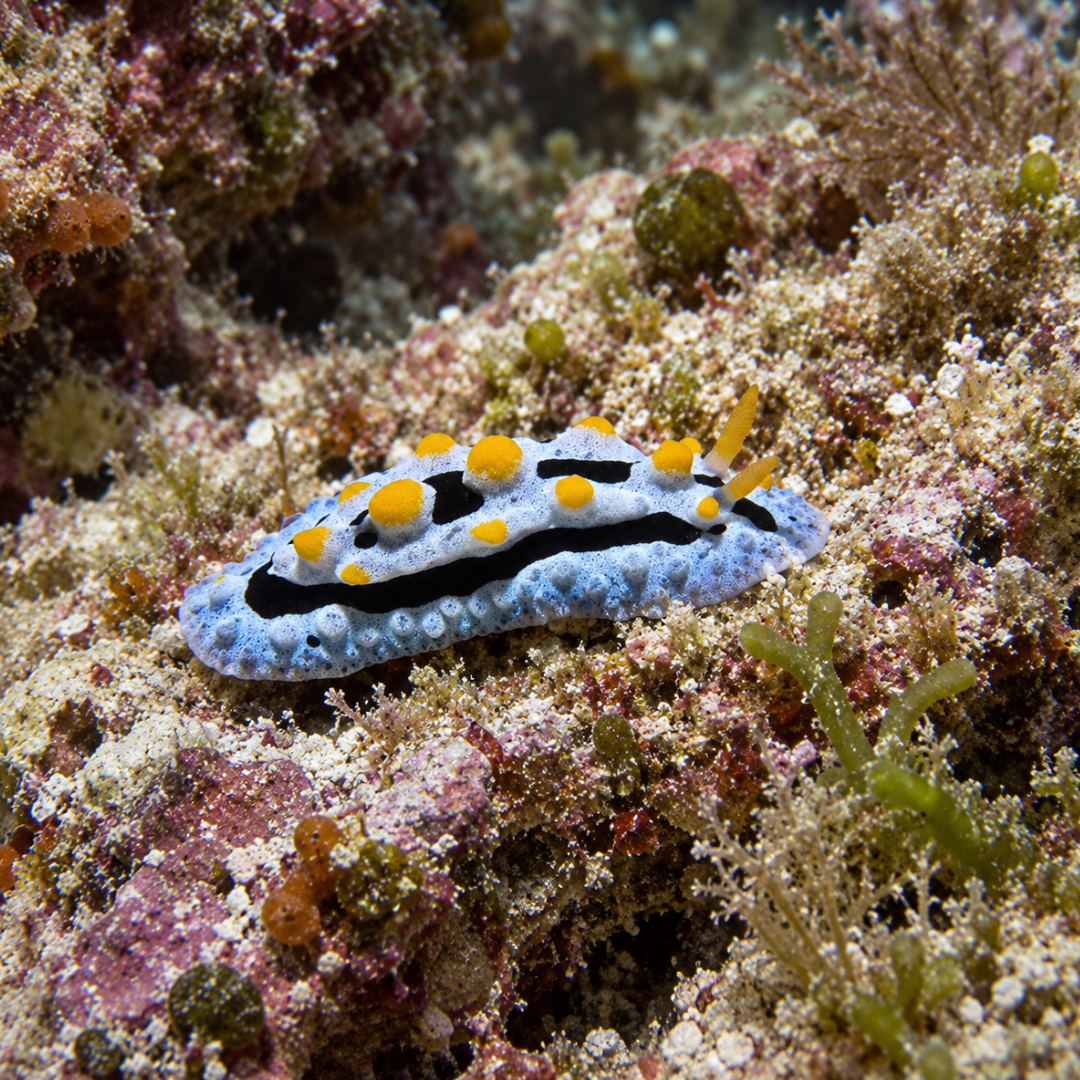
ソライロイボウミウシは、灰青色の体に黒い縦線と黄色い突起を配した、インド・西太平洋のサンゴ礁域に暮らす裸鰓類です。背面中央の黒線が頭部付近でY字状になる模様は、本種を見分ける重要な手掛かりです。鮮やかな色彩は単なる装飾ではなく、捕食者に対して食べにくさや化学防御の存在を知らせる警告色として働くと考えられています。観賞上は非常に魅力的ですが、特定の海綿に強く依存する食性と化学防御物質を持つため、一般的な海水魚やサンゴと同じ感覚で長期飼育できる生体ではありません。 Phyllidia coelestis is an Indo-West Pacific nudibranch found on coral reefs, recognized by its blue-gray body, black longitudinal markings, and yellow-tipped tubercles. The median black marking forms a characteristic Y-shaped pattern near the front of the body, which is an important identification feature. Its vivid coloration is thought to function as aposematic warning coloration associated with chemical defense rather than merely as ornamentation. Although highly attractive in an aquarium, its specialized dependence on sponge prey and its defensive chemistry make it unsuitable for routine long-term husbandry in a typical mixed reef system.
基本情報 / Basic Information
| 学名 / Scientific Name | Phyllidia coelestis Bergh, 1905 |
|---|---|
| 通称 / Common Name | ソライロイボウミウシHeavenly Wart Slug, Celestial Phyllidia |
| 分類 / Family | 軟体動物門・腹足綱・裸鰓目(Nudibranchia)・イボウミウシ科(Phyllidiidae)・タテヒダイボウミウシ属(Phyllidia)Phylum Mollusca, Class Gastropoda, Order Nudibranchia, Family Phyllidiidae, Genus Phyllidia |
| 英名 / English Name | Heavenly Wart Slug |
| 分布 / Distribution | インド洋から西太平洋の熱帯・亜熱帯海域に分布します。日本では沖縄本島、宮古島、八重山諸島など南西諸島を中心に観察記録があります。Distributed across tropical and subtropical waters of the Indian and western Pacific oceans. In Japan, records are concentrated in the Nansei Islands, including Okinawa, Miyako, and the Yaeyama Islands. |
| 最大体長 / Max Size | 約5〜6cm。個体差があります。Approximately 5–6 cm, with some individual variation. |
| 寿命 / Lifespan | 本種について、自然下・飼育下ともに標準的な寿命を示す信頼できる定量データは確認されておらず、明確には分かっていません。飼育下では適切な餌を継続して確保すること自体が難しく、長期飼育の大きな制約になります。No reliable quantitative standard for the lifespan of this species in the wild or in captivity has been established. In aquaria, the difficulty of maintaining an appropriate food source is itself a major limitation on long-term care. |
飼育環境 / Aquarium Environment
| 水槽サイズ / Tank Size | 本種について、科学的に確立された最低飼育水量は確認されていません。飼育を試みる場合は、60cm規格水槽(約60L)のような小容量より、90cm規格水槽(約180L)など水量に余裕のある専用水槽の方が、水質を安定させやすく、異常時にも対応しやすくなります。ただし、水槽の大きさだけでは飼育条件を満たせず、適切な餌となる海綿を維持できることが前提です。No scientifically established minimum tank volume is available for this species. If husbandry is attempted, a larger dedicated system, such as a standard 90 cm aquarium of roughly 180 L, is easier to keep stable than a small 60 cm standard aquarium of about 60 L and provides more margin during emergencies. Tank volume alone is not sufficient, however; maintaining an appropriate sponge food source remains essential. |
|---|---|
| 水温 / Temperature | 24〜27℃を実務上の目安とし、急変を避けて安定させます。これは熱帯・亜熱帯のサンゴ礁環境や観察記録を踏まえた目安で、本種固有の最適水温として実験的に確立された範囲ではありません。 Approximately 24–27°C can be used as a practical reference, with rapid fluctuations avoided. This range reflects tropical and subtropical reef conditions and field observations rather than an experimentally established species-specific optimum. |
| 水質 / Water Quality | 清浄で安定した海水環境を維持します。pH 8.1〜8.4は一般的なサンゴ礁水槽で用いられる管理目安ですが、本種だけを対象に確立された数値ではありません。硝酸塩やリン酸塩などを過度に蓄積させず、十分なろ過と定期的な換水によって急激な水質変化を避けることが重要です。Maintain clean and stable seawater. A pH of 8.1–8.4 is a commonly used reef-aquarium management range, not a species-specific value established for P. coelestis. Avoid excessive nutrient accumulation and minimize abrupt changes through adequate filtration and regular water changes. |
| レイアウト / Layout | ライブロックなどを使い、移動できる岩面と餌となる海綿を安定して維持できる場所を確保します。強い流れで生体が設備へ押し流されないようにし、ポンプやオーバーフローの吸入口には保護カバーを設けてください。Use stable rockwork that provides crawling surfaces and locations where the required sponge food can be maintained. Avoid flow strong enough to push the animal into equipment, and protect pump and overflow intakes against accidental suction. |
| 注意点 / Precautions | 飼育難易度は非常に高く、一般的な観賞用ウミウシとして長期維持しやすい種ではありません。最大の問題は、その個体が利用できる海綿を継続して確保することです。本種からは捕食を抑える作用を持つ防御関連物質も確認されているため、強い刺激を与えたり、死亡個体を水槽内に放置したりすることは避けます。混泳より専用水槽での管理を優先し、活性炭と緊急換水用の海水を準備しておくと対応しやすくなります。Husbandry is extremely difficult, and this is not a species that is readily maintained long term as an ornamental nudibranch. The main challenge is continuously providing a sponge that the individual can actually use as food. Defensive metabolites with feeding-deterrent activity have been demonstrated from this species, so avoid severe physical stress and do not leave a dead specimen in the aquarium. A dedicated system is preferable to mixed housing, with activated carbon and prepared replacement seawater available for emergencies. |
餌と給餌 / Feeding
| 餌の種類 / Diet | イボウミウシ科は海綿を食べることで知られ、本種も海綿食と考えられています。ただし、ソライロイボウミウシが自然下で利用する海綿の種は十分に確定していません。南シナ海産個体の化学研究では、Acanthella cavernosaやAcanthella variabilisとの共通成分から、これらが餌候補として推定されていますが、すべての地域・個体群に当てはまると断定できる情報ではありません。人工飼料、冷凍餌、魚介の切り身を代替餌として期待することはできません。Phyllidiid nudibranchs are known to feed on sponges, and P. coelestis is likewise regarded as a sponge feeder. However, the exact sponge species used in nature are not fully established. Chemical studies of South China Sea specimens have inferred Acanthella cavernosa and Acanthella variabilis as possible prey from shared metabolites, but this should not be generalized to every population. Prepared foods, frozen feeds, and pieces of seafood should not be expected to substitute for the natural diet. |
|---|---|
| 給餌のポイント / Feeding Tips | 入手時に、その個体が採集時または販売前に接していた海綿を確認できることが理想です。種類の合わない海綿を入れても摂餌するとは限らず、海綿が傷めば水質悪化の原因にもなります。長期飼育を試みるなら、候補となる海綿を安定して維持できる環境まで含めて準備し、摂餌痕や体の張りなどを継続して観察します。Ideally, determine which sponge the individual was associated with at collection or before sale. An unsuitable sponge may not be eaten and can degrade water quality if it deteriorates. If long-term care is attempted, the candidate sponge itself must be maintained in stable condition, while feeding marks and body condition are monitored over time. |
性格と混泳 / Temperament and Tank Mates
| 性格 / Temperament | 他生体を積極的に攻撃するタイプではなく、岩や海綿の表面をゆっくり移動する底生性のウミウシです。自然下では日中に活動する姿も観察されます。行動は穏やかですが、化学防御を持つため「無害な混泳生体」という意味での温和さとは分けて考える必要があります。It is not an actively aggressive animal and typically crawls slowly over rock and sponge surfaces. It can be observed moving during daylight in the wild. Its behavior is gentle, but this should not be confused with being chemically harmless in a mixed aquarium because phyllidiids possess defensive secondary metabolites. |
|---|---|
| 混泳の相性 / Compatibility | 基本的には専用水槽での管理が無難です。ウミウシをつつく魚、攻撃性のある甲殻類、吸い込み事故を起こしやすい設備との組み合わせは避けます。本種自身が魚を捕食するわけではありませんが、防御関連物質を持つことが確認されているため、傷害や死亡が起きた際の影響を考えると、一般的なコミュニティ水槽へ安易に導入する生体ではありません。A dedicated aquarium is the safer approach. Avoid fish that peck at nudibranchs, aggressive crustaceans, and equipment that presents a suction hazard. This species does not prey on fish, but defensive compounds are documented, so the possible consequences of injury or death make casual introduction into a community aquarium inappropriate. |
病気と対策 / Diseases and Prevention
| かかりやすい病気 / Common Diseases | 本種について、観賞飼育下で頻発する特定の感染症や標準的な治療法は十分に整理されていません。実際の飼育では、感染症よりも餌不足による衰弱、水質悪化、輸送ストレス、ポンプへの吸い込みや岩組みによる外傷などが大きなリスクになります。Specific infectious diseases commonly seen in aquarium-kept P. coelestis, along with standardized treatments, are not well documented. In practice, starvation, deteriorating water quality, transport stress, pump intake accidents, and physical injuries are likely to be more important husbandry risks than a particular named disease. |
|---|---|
| 対策と予防 / Prevention | 十分に立ち上がった水槽で水質と水温を安定させ、導入時の急激な比重・温度変化を避けます。摂餌できる海綿が確保できない状態で購入しないことが最も重要な予防策の一つです。状態悪化時に一般的な魚病薬を自己判断で使用するのは避け、特に無脊椎動物へ強い毒性を示す薬剤は使用しないでください。異常時は原因となる水質、餌、外傷、設備事故を優先して点検します。Use a mature aquarium with stable temperature and water quality, and avoid abrupt salinity or temperature changes during acclimation. One of the most important preventive measures is simply not acquiring the animal unless an appropriate sponge food source can be maintained. Avoid treating it empirically with standard fish medications, especially compounds known to be harmful to marine invertebrates. When problems occur, first investigate water quality, food availability, physical injury, and equipment-related accidents. |
増やし方(繁殖) / Breeding
| 雌雄の判別 / Sexing | 裸鰓類は基本的に同時的雌雄同体で、本種も雌雄を別個体として見分ける生き物ではありません。1個体が雄性・雌性の両方の生殖機能を持つため、外見から「オス」「メス」を判別する一般的な方法はありません。Nudibranchs are generally simultaneous hermaphrodites, and this species is not divided into externally distinguishable males and females. Each individual possesses both male and female reproductive functions, so conventional visual sexing does not apply. |
|---|---|
| 繁殖形態 / Reproduction | イボウミウシ科では、別個体同士が体の右側にある生殖器を合わせて交接し、リボン状の卵塊を産むことが知られています。一方、ソライロイボウミウシについては、卵から幼生、着底までの発生過程を詳細に追った情報が乏しく、本種固有の生活史を一般的な裸鰓類の知見だけで断定することはできません。Phyllidiid nudibranchs are known to mate by bringing the reproductive openings on the right side of the body together and to produce ribbon-like egg masses. For P. coelestis itself, however, detailed information tracing development from egg through larval stages to settlement is limited, so its complete life history should not be stated solely from general nudibranch biology. |
| 繁殖のポイント / Breeding Tips | 本種について、再現性の高い水槽内繁殖手順は確立されていません。親個体の餌となる海綿を維持するだけでも難しく、発生や幼生飼育に必要な条件も十分には分かっていないため、家庭水槽で繁殖を目的に維持するのは現実的ではありません。No reproducible aquarium breeding protocol has been established for this species. Maintaining the adults’ sponge food is already difficult, and the conditions required for development and larval culture are insufficiently known, making breeding in a home aquarium impractical at present. |
雑学と豆知識 / Trivia and Fun Facts
| 1. 「空色」を名に宿す1905年記載種 / 1. A Species Described in 1905 with “Celestial” in Its Name | ソライロイボウミウシは1905年、デンマークの動物学者ルドルフ・ベルグによってPhyllidia coelestisとして記載されました。種小名coelestisはラテン語で「天の」「天空の」といった意味を持ち、灰青色の体を思わせる印象的な名前です。1984年に別種として記載されたPhyllidia aliaは、現在では本種の異名として扱われています。古い文献と新しいデータベースを読み比べると、同じ生き物が分類学の進歩によって一つの名前へ整理されていく過程を見ることができます。Phyllidia coelestis was described in 1905 by the Danish zoologist Rudolph Bergh. The Latin epithet coelestis means “heavenly” or “celestial,” an evocative match for the animal’s blue-gray appearance. Phyllidia alia, described as a separate species in 1984, is now treated as a synonym of P. coelestis. Comparing older literature with modern taxonomic databases reveals how apparently separate names can be brought together as classification improves. |
|---|---|
| 2. Y字模様はよく似た仲間を見分ける鍵 / 2. The Y-Shaped Marking Is a Key Identification Clue | よく似たタテヒダイボウミウシと区別するとき、背面中央の黒い模様が頭部側でY字状になるかどうかは重要な観察点です。ソライロイボウミウシでは正中の黒線が黄色い突起によって途切れながら走り、前方で特徴的なY字形を作ります。さらに腹足はほぼ一様な灰色で、タテヒダイボウミウシの腹足中央に見られる明瞭な黒線がありません。色だけを見るのではなく「線がどこを走り、どこで枝分かれするか」を追うと、同定がぐっと立体的になります。When distinguishing this species from the similar Phyllidia varicosa, the black median marking that forms a Y-shaped pattern toward the front is particularly useful. In P. coelestis, the median black line is interrupted by yellow-capped tubercles and produces the characteristic anterior Y. The foot is also largely uniform gray and lacks the conspicuous dark median stripe seen in P. varicosa. Identification becomes far more reliable when the course and branching of the lines are examined instead of relying on color alone. |
| 3. 背中に「花びら状の鰓」が見えない理由 / 3. Why There Is No Obvious Gill Plume on the Back | 多くのドーリス型ウミウシでは背面後方に花びらのような二次鰓が目立ちますが、イボウミウシ科ではその姿が見えません。呼吸に関わる葉状構造は外套膜の縁と腹足の間、体の側面下側に並んでいます。背面をすっきりした「イボのある盾」のようにできる体のつくりは、この仲間の外見を特徴づける大きな要素です。美しい色模様に目を奪われがちですが、鰓の位置に注目すると分類群そのものの個性が見えてきます。Many dorid nudibranchs display a conspicuous flower-like gill plume on the rear of the back, but phyllidiids do not. Their respiratory leaflets are arranged along the lower sides of the body between the mantle margin and the foot. This anatomy helps give phyllidiids their distinctive shield-like dorsal surface covered with tubercles. Looking at where the gills are positioned reveals a deeper structural feature behind the animal’s striking appearance. |
| 4. 食べた海綿の化学物質が「鎧」になる / 4. Sponge Chemistry Becomes Part of the Animal’s Armor | ソライロイボウミウシの面白さは、食事と防御が密接につながっている点にあります。研究では、本種からイソニトリル基やホルムアミド基を持つテルペノイドが複数見つかり、その多くは餌に由来する可能性が高いと考えられています。特に外套部で多く検出された化合物の一つには、捕食者の摂餌を抑える作用が実験で示されました。つまり、海綿は栄養源であるだけでなく、防御に利用される化学物質の供給源にもなり得ます。鮮やかな体色とこうした化学防御をあわせて見ると、殻を持たないウミウシが別の方法で身を守る仕組みが見えてきます。One of the most interesting aspects of P. coelestis is the close connection between feeding and defense. Researchers have isolated several terpenoids containing isonitrile or formamido groups from this species, and many are considered likely to be dietary in origin. One compound abundant in the mantle has experimentally been shown to deter feeding by a generalist predator. Sponge prey can therefore serve not only as nutrition but also as a source of chemicals used in defense. Seen together with the vivid body coloration, this chemistry illustrates how a shell-less nudibranch can rely on a different protective strategy. |
| 5. 創薬研究で注目されるが、そのまま「薬」ではない / 5. Interesting to Drug Discovery, but Not a Medicine in Itself | 本種や餌候補の海綿から得られた窒素を含むテルペノイドの一部は、培養したヒトがん細胞株に対する細胞毒性が研究されています。こうした結果は海洋天然物から新しい生理活性物質を探す研究では重要ですが、試験管内で細胞に作用したことと、人に安全で有効な抗がん薬であることはまったく別の段階です。複雑な分子を安定して供給できるか、正常細胞への毒性をどう抑えるか、体内で狙った場所へ届けられるかなど、医薬品になるまでには多くの検証が必要です。小さなウミウシの化学防御が、基礎研究の入口として人間の創薬研究につながっている点こそが、この話の本当の面白さです。Some nitrogen-containing terpenoids isolated from this nudibranch and its possible sponge prey have been studied for cytotoxic activity against cultured human cancer cell lines. Such results are valuable in marine natural-product research, but activity in a laboratory cell assay is very different from being a safe and effective anticancer medicine in humans. Drug development would still require reliable compound supply, selectivity over normal cells, delivery to the correct tissues, and extensive safety and efficacy testing. The real fascination is that chemical defenses evolved by a small sea slug can become a starting point for broader biomedical research. |
| 6. 現代の分類は「見た目」だけで決めない / 6. Modern Taxonomy Looks Beyond Appearance | イボウミウシ科は色彩や突起、線の配置が分類に大きく使われてきましたが、似た外見を持つ種や個体差の大きさが分類を難しくしてきました。近年は外部形態だけでなく、ミトコンドリアDNAなどの分子情報や体内の二次代謝産物の組成も組み合わせる統合的分類が進んでいます。ソライロイボウミウシも、2020年代の研究で多数個体を比較しながら典型的なY字模様と遺伝情報、化学的特徴が検討されています。水槽で眺める一本の黒線が、実は遺伝子と化学のデータにつながる分類学上の手掛かりでもあるのです。Color pattern, tubercles, and line arrangement have long been central to phyllidiid taxonomy, but similar-looking species and individual variation can make identification difficult. Modern integrative taxonomy increasingly combines external morphology with molecular data such as mitochondrial DNA and profiles of secondary metabolites. Research in the 2020s has examined many P. coelestis specimens while comparing its typical Y-shaped pattern with genetic and chemical evidence. A single black line visible in an aquarium can therefore be part of a much larger taxonomic story linking morphology, genes, and chemistry. |
まとめ / Conclusion
ソライロイボウミウシは、灰青色の体に黄色い突起とY字状の黒い模様を備えた、ひと目で印象に残るウミウシです。海綿を食べ、餌に由来すると考えられる化学物質の一部を防御に利用する生態は、殻を持たない裸鰓類が身を守る仕組みの一端をよく示しています。 Phyllidia coelestis is a memorable nudibranch, with a blue-gray body, yellow-tipped tubercles, and a characteristic Y-shaped black marking. Its sponge-feeding ecology and use of at least some likely dietary compounds in defense illustrate one of the ways shell-less nudibranchs protect themselves.
その一方で、長期飼育では「何を食べる個体なのか」を確かめ、利用できる海綿を継続して維持するという大きな課題があります。安定した海水環境と事故を避ける管理まで含めて準備できる飼育者にとって、ソライロイボウミウシは、サンゴ礁で営まれる食物関係と化学防御のつながりを身近に感じさせる奥深い存在です。 Long-term care, however, is constrained by the difficult task of determining and continuously maintaining a sponge that the individual can actually eat. For a keeper able to provide stable seawater and careful risk management, P. coelestis offers a close view of the connection between feeding relationships and chemical defense on coral reefs.
気になる道具や飼い方を見つけてみませんか?
 アイのアクアグッズ案内金魚を長く楽しむ飼育用品|水槽・フィルター・エアレーション・水換え道具の特徴や使い方、選ぶときのポイントをアイが紹介します。記事はコチラ →
 アイのアクアグッズ案内コケを食べるコイの仲間に合わせる飼育用品|フライングフォックス・アルジイーター・ガラ道具の特徴や使い方、選ぶときのポイントをアイが紹介します。記事はコチラ →
 アイのアクアグッズ案内水槽の底砂の選び方|砂・砂利の違いとおすすめ商品道具の特徴や使い方、選ぶときのポイントをアイが紹介します。記事はコチラ →
 アイのアクアグッズ案内水槽のコケ掃除|道具の選び方とお掃除生体の得意・不得意道具の特徴や使い方、選ぶときのポイントをアイが紹介します。記事はコチラ →
さまざまな飼育テーマをご紹介。リンク先の記事には広告・商品紹介が含まれます。
案内・紹介記事一覧へ →分布マップ
ソライロイボウミウシ(Phyllidia coelestis)は、インド洋から西太平洋の熱帯・亜熱帯海域に分布します。日本では、沖縄本島、宮古島、八重山諸島など南西諸島を中心に観察記録があります。
この地図は、インド洋から西太平洋にかけての分布域を把握するための概略表示です。表示しているマーカーは地図上で分布域を確認しやすくするための代表地点であり、実際の採集地点や特定個体の確認地点を示すものではありません。
参考文献
-
MolluscaBase eds. (2026). Phyllidia coelestis Bergh, 1905. World Register of Marine Species (WoRMS).
分類、学名、記載者、異名の確認。
World Register of Marine Species -
Brunckhorst, D. J. (1989). Redescription of Phyllidia coelestis Bergh, 1905 (Opisthobranchia: Nudibranchia: Doridoidea). Journal of the Malacological Society of Australia, 10(1), 35–45.
本種の形態、識別形質、分類学的整理、インド太平洋域での分布。
https://doi.org/10.1080/00852988.1989.10674003 -
Brunckhorst, D. J. (1993). The systematics and phylogeny of phyllidiid nudibranchs (Doridoidea). Records of the Australian Museum, Supplement 16, 1–107.
イボウミウシ科の分類、解剖、生息環境、海綿食、化学防御、繁殖に関する基礎資料。
https://doi.org/10.3853/j.0812-7387.16.1993.79 -
Papu, A., Bogdanov, A., Bara, R., Kehraus, S., König, G. M., Yonow, N., et al. (2022). Phyllidiidae (Nudibranchia, Heterobranchia, Gastropoda): an integrative taxonomic approach including chemical analyses. Organisms Diversity & Evolution, 22, 585–629.
本種を含むイボウミウシ科の形態比較、Y字状斑紋、分子系統、種同定、化学成分。
https://doi.org/10.1007/s13127-021-00535-7 -
海洋研究開発機構(JAMSTEC). Biological Information System for Marine Life(BISMaL): Phyllidia coelestis ソライロイボウミウシ.
日本周辺を含む出現記録、緯度・経度、水深、分類情報。
BISMaL 生物情報ページ -
Mehrotra, R., Caballer Gutiérrez, M. A., Scott, C. M., Arnold, S., Monchanin, C., Viyakarn, V., & Chavanich, S. (2021). An updated inventory of sea slugs from Koh Tao, Thailand, with notes on their ecology and a dramatic biodiversity increase for Thai waters. ZooKeys, 1042, 73–188.
ソライロイボウミウシのサンゴ礁環境での出現、水深、インド太平洋域の分布記録。
https://doi.org/10.3897/zookeys.1042.64474 -
Carbone, M., Ciavatta, M. L., Manzo, E., Li, X.-L., Mollo, E., Mudianta, I. W., Guo, Y.-W., & Gavagnin, M. (2019). Amphilectene Diterpene Isonitriles and Formamido Derivatives from the Hainan Nudibranch Phyllidia Coelestis. Marine Drugs, 17(11), 603.
本種の二次代謝産物、食餌由来と考えられる化合物、捕食抑制作用と化学防御。
https://doi.org/10.3390/md17110603 -
Dionísio, G., Faleiro, F., & Rosa, R. (2017). Snails, Slugs and Cephalopods. In Marine Ornamental Species Aquaculture, pp. 536–563. Wiley.
観賞用海産軟体動物、裸鰓類の飼育、給餌、繁殖、幼生飼育が難しい背景に関する専門的概説。
https://doi.org/10.1002/9781119169147.ch23b -
LaDouceur, E. E. B., Wynne, J., Garner, M. M., Nyaoke, A., & Keel, M. K. (2016). Lesions of Copper Toxicosis in Captive Marine Invertebrates With Comparisons to Normal Histology. Veterinary Pathology, 53(3), 648–658.
飼育下の海産無脊椎動物における銅中毒の危険性と、魚病薬などを安易に使用しないための根拠。
https://doi.org/10.1177/0300985815603431
コメント