

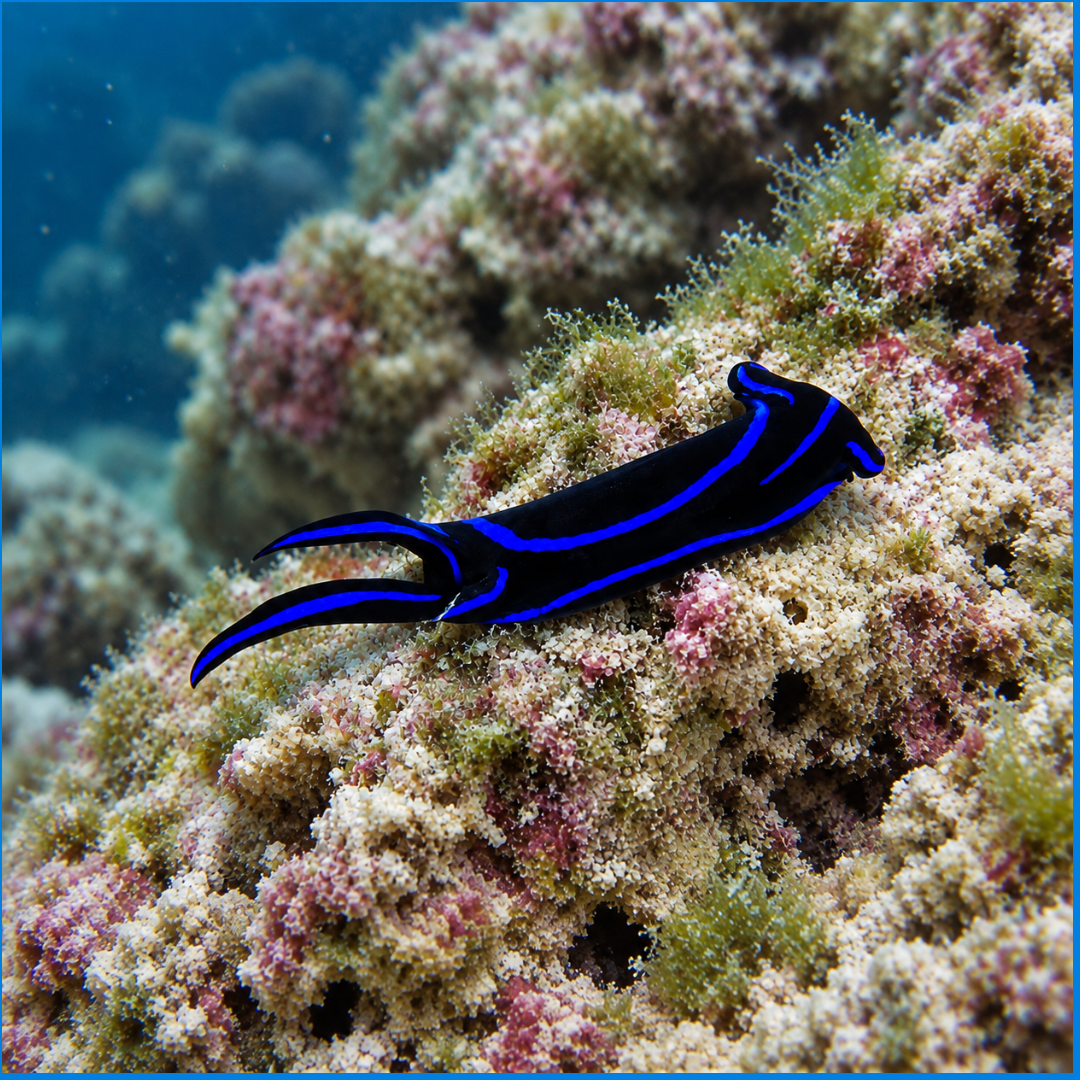
解説 / Description
Chelidonura varians は、漆黒の体を鮮やかな青い線が縁取る、インド・西太平洋の熱帯域に分布するカノコキセワタガイ科の頭楯類です。国内ではゲンノウツバメガイの名が用いられ、近年の図鑑ではアオスジツバメガイの名も採用されています。アクアリウムではブルーベルベット・ヘッドシールド・スラッグなどの名で知られ、サンゴ水槽で「ヒラムシ」と呼ばれる小型の無腸動物などを捕食することから注目されます。一方で、一般的な人工飼料を代替餌として長期維持する方法は確立されておらず、餌生物が減った後は飢餓の危険が高まります。飼育下で安定して長期維持できない例も多いため、導入前から餌を継続して確保できるか、餌が減った後に別の飼育環境へ移せるかまで計画しておきたい、上級者向けの海産無脊椎動物です。 Chelidonura varians is an Indo-West Pacific headshield slug in the family Aglajidae, instantly recognizable by its deep black body edged with vivid electric-blue lines. In Japan, the name Genno-tsubamegai is used, while the more recent name Aosuji-tsubamegai has also been adopted in Japanese field literature. In the aquarium trade it is commonly known as the Blue Velvet Headshield Slug and is valued for preying on small acoels and other organisms commonly called “flatworms” in reef aquariums. There is no reliably established prepared-food substitute for long-term maintenance, and starvation becomes a serious risk as suitable prey declines. Because long-term captive survival is often poor even under aquarium conditions, care should be planned around a continuing prey supply and a safe transfer to another suitable system if that food source disappears.
基本情報 / Basic Information
| 学名 / Scientific Name | Chelidonura varians Eliot, 1903 |
|---|---|
| 通称 / Common Name | ゲンノウツバメガイ、アオスジツバメガイ、ブルーベルベット・ヘッドシールド・スラッグ。流通上「ブルーベルベットウミウシ」などの名で扱われることもあります。なお、ニシキツバメガイは国内では通常 Chelidonura hirundinina を指すため、購入時は和名だけでなく学名も確認すると取り違えを防げます。Genno-tsubamegai; Aosuji-tsubamegai; Blue Velvet Headshield Slug; Blue Velvet Sea Slug. The trade name “Blue Velvet Nudibranch” is also used, although the species is not a true nudibranch. In Japan, Nishiki-tsubamegai normally refers to Chelidonura hirundinina, so checking the scientific name is the safest way to avoid confusion. |
| 分類 / Family | 軟体動物門・腹足綱・異鰓類・頭楯目・カノコキセワタガイ科・Chelidonura 属Phylum Mollusca; Class Gastropoda; Heterobranchia; Order Cephalaspidea; Family Aglajidae; Genus Chelidonura |
| 英名 / English Name | Blue Velvet Headshield Slug |
| 分布 / Distribution | インド洋から西太平洋の熱帯・亜熱帯域に広く分布します。サンゴ礁のラグーンや浅い砂泥底、礫混じりの底質などで見られ、日本では南西諸島を中心に記録があります。Widely distributed across tropical and subtropical waters of the Indo-West Pacific. It occurs in reef lagoons, shallow sandy or muddy bottoms, and mixed rubble habitats. In Japan, records are concentrated mainly in the southwestern islands. |
| 最大体長 / Max Size | 最大約7cm。Up to about 7 cm. |
| 寿命 / Lifespan | 自然下での寿命を示す確かなデータは乏しく、正確な寿命は不明です。飼育下では餌不足などによって早期に衰弱することがあるため、短期間で死亡した飼育例をそのまま本来の寿命とみなすことはできません。Reliable data on its natural lifespan are scarce, and the true lifespan is unknown. In captivity, individuals may decline prematurely because of food shortage and other husbandry stresses, so short aquarium survival should not be treated as the species’ natural lifespan. |
飼育環境 / Aquarium Environment
| 水槽サイズ / Tank Size | 飼育情報では約110L以上が一つの目安として示されており、日本の規格では60cmワイド水槽クラスに相当します。ただし、本種について学術的に確立された最低水槽容量はありません。水槽の大きさそのものより、比重や水温を安定させられることと、餌となる生物を継続して確保できることが重要です。Aquarium references commonly give roughly 110 L or more as a practical guideline, comparable to a Japanese 60 cm wide aquarium. However, no scientifically established minimum tank volume is known for this species. Stable salinity and temperature, together with a continuing prey supply, are more important than tank size alone. |
|---|---|
| 水温 / Temperature | 飼育情報では22〜28℃程度が目安として示されています。範囲内であっても急激な温度変化は避け、安定させてください。 Aquarium references commonly suggest a range of about 22–28°C. Even within that range, avoid rapid temperature changes and keep conditions stable. |
| 水質 / Water Quality | 比重1.023〜1.025、pH 8.0〜8.4が飼育上の目安としてよく示されています。特に比重の急変には注意し、アンモニアや亜硝酸が蓄積しない、安定した海水環境を維持してください。Specific gravity of 1.023–1.025 and pH 8.0–8.4 are commonly given as aquarium guidelines. Sudden salinity changes are a particular concern, and the aquarium should remain stable with no accumulation of ammonia or nitrite. |
| レイアウト / Layout | 細かな砂地とライブロックを組み合わせ、ヒラムシが生息する面を本種が這って探索できる構成が向きます。水流は弱〜中程度とし、強い直線的な流れが直接当たらないようにします。ウェーブポンプやオーバーフローの吸入口には細かなメッシュやスポンジを装着し、柔らかな体が吸い込まれないよう保護してください。A layout combining fine sand with live rock works well, giving the slug accessible surfaces on which to track flatworm prey. Use gentle to moderate flow and avoid directing strong jets at the animal. Cover wavemaker and overflow intakes with fine mesh or sponge guards to prevent the soft-bodied slug from being sucked in. |
| 注意点 / Precautions | 主要な注意点の一つは餌不足です。「ヒラムシ」と呼ばれる餌生物が十分にいる水槽へ目的を持って導入し、餌が減った後は別水槽への移動や愛好家同士でのリレー飼育など、次の飼育先をあらかじめ考えておきます。導入時は比重差を確認し、急変を避けてゆっくり水合わせを行ってください。また、柔らかな体がポンプやオーバーフローへ吸い込まれないよう、吸入口を保護します。死亡個体は水質悪化を防ぐため速やかに取り出し、必要に応じて換水など基本的な水質管理を行います。One of the main husbandry risks is food shortage. Introduce this species only to a system with an adequate population of the small organisms commonly called “flatworms,” and plan in advance for transfer or responsible relay care once that prey declines. During introduction, check for salinity differences and acclimate slowly to avoid abrupt change. Protect pump and overflow intakes so the soft-bodied slug cannot be drawn in. Remove dead individuals promptly and respond to any resulting water-quality deterioration with normal corrective maintenance such as water changes. |
餌と給餌 / Feeding
| 餌の種類 / Diet | 肉食性で、小型のヒラムシ類や、アクアリウムで「ヒラムシ」と呼ばれる無腸動物を捕食することが知られています。リーフ水槽では、赤褐色に増殖する Convolutriloba 属の無腸動物などが代表的な餌として挙げられます。一般的な人工飼料、海藻、魚肉、アサリなどを安定した代替餌として利用する方法は確立されていません。Carnivorous. It is known to prey on small flatworms as well as acoels that are commonly called “flatworms” in the aquarium hobby. In reef aquariums, reddish-brown acoels such as species of Convolutriloba are among the best-known prey. No reliable long-term substitute based on prepared foods, algae, fish meat, or bivalve flesh has been established. |
|---|---|
| 給餌のポイント / Feeding Tips | 水槽内に餌生物がいるだけで安心せず、実際に本種が捕食しているか、体が目立って痩せていないかを観察します。餌生物が減り始めた段階で次の飼育環境を考え、完全に食べ尽くしてから対策を始めるのは避けてください。別容器で餌生物を維持する場合は、サンゴ水槽へ再侵入させないよう隔離管理を徹底する必要があります。Do not assume that the presence of prey organisms alone guarantees adequate feeding. Confirm that the slug is actually feeding and watch for obvious thinning or reduced activity. Plan the next suitable system as prey begins to decline rather than waiting until it has been completely exhausted. If prey organisms are maintained separately, strict isolation is necessary to prevent accidental reintroduction into the reef aquarium. |
性格と混泳 / Temperament and Tank Mates
| 性格 / Temperament | 魚やサンゴを主な餌とする種ではなく、アクアリウムでは温和な生体として扱われます。一方で、小型のヒラムシ類や無腸動物に対しては専門化した捕食者で、餌を見つけると追跡して捕食します。It is not known as a predator of fish or corals and is generally treated as peaceful in aquariums. Toward small flatworms and acoels, however, it is a specialized predator that actively tracks and consumes suitable prey. |
|---|---|
| 混泳の相性 / Compatibility | サンゴや温和な魚と同居させる例はありますが、柔らかな無脊椎動物をついばむ魚や、捕食性の強い甲殻類との組み合わせは避けるのが無難です。本種自身が攻撃することより、他の生体から傷つけられることを警戒します。混泳相手だけでなく、ポンプやオーバーフローへの吸い込みも重要な事故要因です。It is kept with corals and peaceful reef fish in some aquariums, but tank mates that nip soft-bodied invertebrates or strongly predatory crustaceans are best avoided. The greater concern is injury to the slug rather than aggression from the slug itself. Pump and overflow intakes are also important physical hazards. |
病気と対策 / Diseases and Prevention
| かかりやすい病気 / Common Diseases | 本種に特有の感染症について、アクアリウム向けに確立された情報はほとんどありません。実際の飼育では、餌不足による衰弱、比重や水温の急変によるストレス、ポンプ吸い込みや他生体による外傷などが問題になりやすいと考えられます。There is little established aquarium information on species-specific infectious diseases. In practice, more common concerns are decline from food shortage, stress caused by abrupt salinity or temperature changes, and physical injury from pumps or tank mates. |
|---|---|
| 対策と予防 / Prevention | 安定した比重と水温、良好な水質、十分な餌量を維持することが基本です。導入時は急な環境変化を避け、吸水口を保護します。日常的には活動量、体の張り、色調、外傷の有無を確認し、急に痩せる、動かなくなる、体色が濁るなどの変化が見られた場合は、まず餌の有無、水質、比重、物理的損傷を確認してください。Prevention is based on stable salinity and temperature, good water quality, and adequate prey. Avoid abrupt environmental changes during introduction and protect all intakes. Check activity, body condition, coloration, and injuries regularly. If the slug suddenly thins, becomes inactive, or loses normal coloration, first review prey availability, water quality, salinity, and possible physical damage. |
増やし方(繁殖) / Breeding
| 雌雄の判別 / Sexing | 雌雄同体で、成熟個体は雄・雌両方の生殖機能を持つため、外見からオスとメスに分けることはできません。雄性の交尾器は頭部右側、雌性の生殖孔は体の後方右側に位置します。Simultaneous hermaphrodite. Mature individuals possess both male and female reproductive functions, so they cannot be separated into male and female by external appearance. The male copulatory organ lies on the right side near the head, while the female opening is positioned farther back on the right side of the body. |
|---|---|
| 繁殖形態 / Reproduction | 複数個体が一列につながる交尾チェーンを形成することがあります。Chelidonura varians の卵塊は、卵紐が重なった層状の円盤状で、細い粘液糸によって基質に固定されます。本属では浮遊性のベリジャー幼生を経る発生が知られています。Several individuals may form mating chains. In Chelidonura varians, the egg mass is a layered disc composed of densely packed egg strings and anchored to the substrate by a fine mucous thread. Species of Chelidonura are known to develop through a planktonic veliger larval stage. |
| 繁殖のポイント / Breeding Tips | 成体の交尾や産卵は水槽内でも観察されていますが、幼生を成体まで育てることが大きな難関です。親個体を複数維持するための餌と安定した水質に加え、浮遊幼生を管理する専用環境が必要になります。一般家庭で安定して累代飼育する方法は確立されていません。Mating and spawning have been observed in aquariums, but raising the larvae through to settled juveniles and adults remains a major challenge. In addition to enough prey and stable water quality for multiple adults, larval rearing requires a dedicated culture environment. A reliable method for routine multigenerational culture in home aquariums has not been established. |
雑学と豆知識 / Trivia and Fun Facts
| 1. 「ウミウシ」と呼ばれても裸鰓類ではない / 1. A sea slug, but not a nudibranch | ショップではブルーベルベットウミウシという名で販売されることがありますが、分類上は裸鰓目ではなく頭楯目の仲間です。頭部の前方が平たい盾のように広がる体形は、砂泥底を這ったり潜ったりする生活に適した構造です。「ウミウシ」は幅広い海産腹足類に使われる呼び名ですが、分類上は一般的なミノウミウシやイロウミウシとは異なる系統に属します。Aquarium shops may sell it as a “Blue Velvet Nudibranch,” but taxonomically it belongs to Cephalaspidea rather than Nudibranchia. Its flattened, shield-like anterior body is well suited to moving across and into sandy or muddy bottoms. “Sea slug” is a broad common term, but evolutionarily this species belongs to a different lineage from familiar aeolid and dorid nudibranchs. |
|---|---|
| 2. 日本名は学名確認がいちばん確実 / 2. Scientific names prevent Japanese-name confusion | 国内では Chelidonura varians にゲンノウツバメガイの名が用いられており、近年の図鑑ではアオスジツバメガイの名も採用されています。一方、ニシキツバメガイは通常、別種の Chelidonura hirundinina を指します。和名が資料によって異なる状況では、Chelidonura varians という学名を確認することが、取り違えを防ぐ最も確実な方法です。In Japan, Chelidonura varians is known as Genno-tsubamegai, while the more recent name Aosuji-tsubamegai has also been adopted in field literature. Nishiki-tsubamegai, by contrast, normally refers to the different species Chelidonura hirundinina. Where Japanese common names differ among references, checking the scientific name Chelidonura varians is the most reliable way to avoid confusion. |
| 3. 左右で長さが違う二本の「尾」 / 3. Two tail-like lobes of unequal length | 後端にはツバメの尾のように二本へ分かれた尾葉が伸び、左側が右側より長くなるのが本種らしい特徴です。黒い体の輪郭に沿う青い線はこの尾葉まで続き、泳がずに底を滑るように進む姿を際立たせます。近縁種との識別では、色だけでなく、この尾の形や青いラインの走り方を見ることが重要です。The rear of the body forms two elongated, swallow-tail-like lobes, with the left typically longer than the right. The electric-blue margin continues onto these lobes, accentuating the animal’s gliding movement over the substrate. When separating this species from similar relatives, the shape of the posterior lobes and the course of the blue lines are more useful than color alone. |
| 4. ヒラムシを追うために選び抜かれた捕食者 / 4. A predator specialized for tracking flatworms | 頭部前縁には感覚毛が発達し、獲物が残した粘液などの化学的な手掛かりをたどるのに役立つと考えられています。カノコキセワタガイ科は肉食性で、Chelidonura 属ではヒラムシ類を捕食することが知られています。本属の口球は同科の一部の属より小さく、反転して大きく突出する構造ではありません。また歯舌を欠くため、獲物を削り取るのではなく、小さな獲物を吸い込むように取り込む食べ方に適した構造と理解できます。Sensory bristles along the front edge of the head are thought to help the slug follow chemical cues, including mucus trails left by prey. Aglajids are carnivorous, and species of Chelidonura are known to feed on flatworms. Their buccal bulb is smaller than that of some related genera and is not a large eversible structure. Because Chelidonura also lacks a radula, its feeding anatomy is better suited to drawing in small prey than to rasping food from a surface. |
| 5. 雌雄同体だから生まれる交尾チェーン / 5. Hermaphroditism enables mating chains | 雄性器官が頭側、雌性の開口部が体の後方に離れているため、複数個体が集まると前後につながった交尾チェーンが形成されることがあります。列の中央にいる個体は、前の個体に対して雄として、後ろの個体に対して雌として同時に関わることができます。単に「雌雄同体」という言葉だけでは想像しにくい、生殖器の配置と行動が直結した見事な例です。Because the male organ is located near the head while the female opening lies farther back on the body, several individuals can link together in a mating chain. An animal in the middle of the chain can function as a male toward the individual ahead and as a female toward the one behind. It is a striking example of how reproductive anatomy directly shapes behavior. |
| 6. 「駆除して成功」がそのまま飼育失敗につながる / 6. Successful pest control can become a husbandry failure | 本種をヒラムシ対策として導入すると、捕食が進むほど水槽内の餌は減っていきます。飼育者にとって駆除の成功に見える状況が、本種にとっては餌不足の始まりになる点が大きな難しさです。そのため、餌が減った後に別の飼育環境へ移すなど、導入前からその先を考えておくことが大切です。駆除能力だけでなく、この狭い食性まで含めて理解することで、本種をより適切に扱うことができます。When this species is introduced for flatworm control, successful predation steadily reduces its own food supply. What looks like success to the aquarist can therefore become the beginning of food shortage for the slug. Planning for transfer to another suitable system before prey is exhausted is an important part of responsible care. Its usefulness as a predator should always be considered together with the limitations imposed by its narrow diet. |
まとめ / Conclusion
Chelidonura varians は、黒い体を縁取る青い線と、ヒラムシ類や無腸動物を追って捕食する特殊な食性をあわせ持つ頭楯類です。魚やサンゴを主な餌とする生き物ではありませんが、小さな底生の獲物に対しては専門化した捕食者として行動し、独特の生態を観察できます。 Chelidonura varians combines striking black-and-blue coloration with a specialized diet focused on small flatworms and acoels. It is not a typical predator of fish or corals, yet it behaves as a highly specialized hunter toward suitable benthic prey, making its feeding ecology especially distinctive.
飼育では、安定した海水環境とポンプへの吸い込みを防ぐ工夫に加え、餌が減った後まで見通しておくことが重要です。十分な餌を継続して確保するか、適切な次の飼育先へ移せる準備があれば、単なる「駆除役」としてではなく、特異な食性を持つ海洋生物としてその姿と行動を丁寧に観察できます。 Successful care depends on stable seawater, protection from pump intakes, and planning for what happens as prey declines. If suitable food can be maintained or the animal can be transferred responsibly to another appropriate system, it can be observed not merely as a form of pest control but as a marine animal with an unusually specialized feeding ecology.

気になる道具や飼い方を見つけてみませんか?
 アイのアクアグッズ案内水草用ライトの選び方|緑の絨毯と赤い水草を楽しむ照明・植栽用品道具の特徴や使い方、選ぶときのポイントをアイが紹介します。記事はコチラ →
 アイのアクアグッズ案内海水魚初心者の必需品|水槽・人工海水・比重計・水質検査道具の特徴や使い方、選ぶときのポイントをアイが紹介します。記事はコチラ →
 アイのアクアグッズ案内コリドラスのもふもふ時間を楽しむ|餌・底砂・お掃除用品の選び方コリドラスのもふもふする食事風景を楽しむために。沈む餌2種類の違い、口元に配慮した底砂、食べ残しを回収する道具を、アクアグッズナビゲーターのアイが紹介します。記事はコチラ →
 アイのアクアグッズ案内ダニオの仲間に合わせる飼育用品|ゼブラダニオから超小型種まで水槽・ろ過・餌を選ぶ道具の特徴や使い方、選ぶときのポイントをアイが紹介します。記事はコチラ →
さまざまな飼育テーマをご紹介。リンク先の記事には広告・商品紹介が含まれます。
案内・紹介記事一覧へ →分布マップ
Chelidonura varians は、インド洋から西太平洋にかけての熱帯・亜熱帯域に広く分布し、日本では南西諸島を中心に記録されています。
この地図は、インド洋から西太平洋にかけての分布域を把握しやすくするための概略表示です。マーカーは分布域を示すために設定した代表地点であり、実際の採集地点や個体の確認地点を示すものではありません。
参考文献
- 分類・学名: MolluscaBase eds. “Chelidonura varians Eliot, 1903.” World Register of Marine Species (WoRMS), AphiaID 599344. WoRMSで確認
- 分類体系: Zamora-Silva, A. & Malaquias, M. A. E. (2018). “Molecular phylogeny of the Aglajidae head-shield sea slugs (Heterobranchia: Cephalaspidea): new evolutionary lineages revealed and proposal of a new classification.” Zoological Journal of the Linnean Society, 183(1), 1–51. DOI
- 国内記録・和名: 海洋研究開発機構(JAMSTEC)GODAC, Biological Information System for Marine Life (BISMaL). “Chelidonura varians ゲンノウツバメガイ.” BISMaLで確認
- 分布・生息環境・形態: Warren, L., Corolla, J.-P. & Sittler, A.-P. (2021). “Chelidonura varians Eliot, 1903.” DORIS — Données d’Observations pour la Reconnaissance et l’Identification de la faune et la flore Subaquatiques, FFESSM. DORISで確認
- 食性・捕食器官: Zamora-Silva, A. & Malaquias, M. A. E. (2016). “Diet preferences of the Aglajidae: a family of cephalaspidean gastropod predators on tropical and temperate shores.” Journal of the Marine Biological Association of the United Kingdom, 96(5), 1101–1112. DOI
- 繁殖・交尾・産卵: Anthes, N. & Michiels, N. K. (2007). “Reproductive morphology, mating behavior, and spawning ecology of cephalaspid sea slugs (Aglajidae and Gastropteridae).” Invertebrate Biology, 126(4), 335–365. DOI
- 飼育時の注意・餌切れ・環境変化: Rudman, W. B. Australian Museum, Sea Slug Forum. “Chelidonura varians Eliot, 1903” species factsheet and aquarium-related notes. 種情報 / 餌切れに関する記録 / 環境変化・輸送ストレスに関する記録
- 海産無脊椎動物の一般的な飼育水質管理: Henry, J. Q., Lesoway, M. P. & Perry, K. J. (2020). “An automated aquatic rack system for rearing marine invertebrates.” BMC Biology, 18, 46. DOI




コメント