

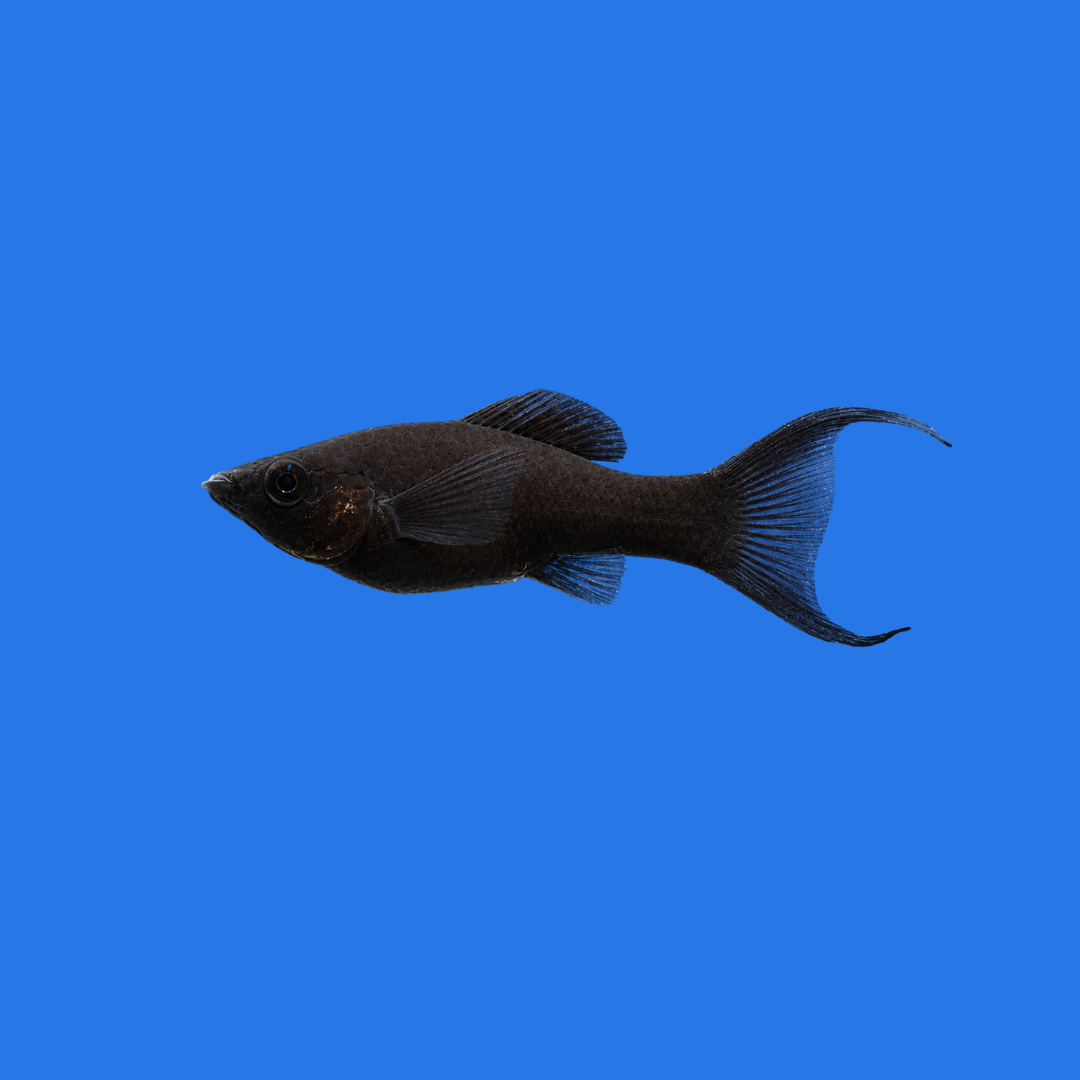
解説 / Description
ブラックライヤーモーリーは、全身を覆う深い黒色と、尾びれの上下が優雅に伸びるライヤーテールが印象的なモーリーの改良品種です。水草の緑や明るい底床の中では輪郭がくっきりと浮かび上がり、活発に泳ぐ姿が水槽内で強い存在感を生み出します。一般にはブラックモーリーのライヤーテール型として流通しますが、流通する改良モーリーには複数のポエキリア属系統が関与したものがあり、すべての個体を単一の野生種だけで説明できるわけではありません。 The Black Lyretail Molly is a domesticated molly strain distinguished by a deep black body and a graceful lyre-shaped caudal fin with elongated upper and lower rays. Its dark silhouette stands out especially well against green aquatic plants and pale substrates, while its active swimming gives it a strong visual presence in the aquarium. It is commonly sold as a lyretail form of the Black Molly, but ornamental mollies in the trade can involve multiple Poecilia lineages, so not every commercial fish can be explained as a domesticated form of a single wild species.
基本情報 / Basic Information
| 学名 / Scientific Name | Poecilia spp. hybrid(流通上はPoecilia sphenops系として扱われることが多い) |
|---|---|
| 通称 / Common Name | ブラックライヤーテールモーリー、ブラックモーリー・ライヤーテールBlack Lyretail Molly, Lyretail Black Molly |
| 分類 / Family | カダヤシ目・カダヤシ科・ポエキリア属Order Cyprinodontiformes, Family Poeciliidae, Genus Poecilia |
| 英名 / English Name | Black Lyretail Molly |
| 分布 / Distribution | 改良品種のため自然分布はありません。基盤となるモーリー類は北米南部からメキシコ、中米、南米北部にかけて分布し、淡水から汽水まで幅広い環境に生息します。特にショートフィンモーリー Poecilia sphenops はメキシコからコロンビアにかけて知られ、流通するブラックライヤー系統にはセルフィンモーリー類の血統が関与している場合もあります。As a domesticated strain, it has no natural distribution of its own. The wild molly lineages behind ornamental strains occur from the southern United States through Mexico and Central America to northern South America, occupying habitats ranging from freshwater to brackish water. The shortfin molly Poecilia sphenops is known from Mexico to Colombia, while some commercial Black Lyretail lines may also include ancestry from sailfin mollies. |
| 最大体長 / Max Size | 通常は6~10cm前後。系統によって差があり、セルフィン系の血統が強い個体ではさらに大きくなることがあります。ライヤーテールの伸長部を含めると見かけの全長は長くなります。Usually around 6–10 cm, although size varies by strain and individuals with stronger sailfin ancestry may grow larger. The elongated lyretail rays can make the apparent total length noticeably greater. |
| 寿命 / Lifespan | 飼育下では一般に3~5年程度がひとつの目安とされます。実際の寿命は、水質、過密、繁殖による負担、系統差などによって左右されます。In aquariums, about 3–5 years is commonly used as a general guide. Actual lifespan varies with water conditions, crowding, reproductive demands, and differences among strains. |
飼育環境 / Aquarium Environment
| 水槽サイズ / Tank Size | 少数飼育でも60cm規格水槽(約55~60L)以上を基本に考えると管理しやすくなります。活発に泳ぎ、排泄量も比較的多いため、複数匹を長期飼育する場合や大きく育つ系統では75cm~90cmクラスの水槽がより安定します。For a small group, a standard 60 cm aquarium of roughly 55–60 L is a practical minimum. Mollies are active swimmers and produce a relatively high bioload, so 75–90 cm aquariums are more comfortable for larger groups or strains that grow particularly large. |
|---|---|
| 水温 / Temperature | 24~28℃を目安に安定させます。急激な低下や大きな日較差は体調不良のきっかけになりやすいため、季節の変わり目は特に注意します。 Maintain a stable temperature of about 24–28°C. Sudden cooling or large daily temperature swings can trigger stress and health problems, especially during seasonal transitions. |
| 水質 / Water Quality | 中性~弱アルカリ性で、ミネラルを十分に含む硬水寄りの水が適します。目安としてpH 7.5~8.2、GH 11~30°dH程度が参考になります。日本の軟水環境では、必要に応じてサンゴ砂やアラゴナイトなどを少量利用し、pHだけでなくGHとKHを確認しながら徐々に調整します。淡水飼育でも十分に健康を維持できるため、塩分添加は常時必須ではありません。Neutral to mildly alkaline, mineral-rich hard water is ideal. A useful reference range is pH 7.5–8.2 with roughly 11–30°dH general hardness. In naturally soft water, small amounts of crushed coral or aragonite can be used when needed, but adjustments should be gradual and based on GH and KH as well as pH. Permanent salt addition is not required when the fish are maintained in suitable hard freshwater. |
| レイアウト / Layout | 中央から前面に遊泳空間を確保し、後景や側面に水草や流木を配置すると落ち着きやすくなります。稚魚を残したい場合はマツモ、ウィローモス、細葉の有茎草などを密に植えると隠れ家になります。ライヤーテールを傷めないよう、尖った石や強いフィンニッパーとの組み合わせは避けます。Leave open swimming space in the center and front while placing plants and driftwood toward the back and sides. If fry survival is desired, dense growths of hornwort, Java moss, or fine-leaved stem plants provide useful cover. Avoid sharp decorations and fin-nipping tank mates that may damage the elongated lyretail rays. |
| 注意点 / Precautions | 丈夫という印象だけで弱酸性・軟水の水槽へ無理に合わせると、長期的なストレスにつながることがあります。導入時は温度だけでなくpH、GH、KHの差も確認し、急変を避けて水合わせします。繁殖力が高いため、雌雄を混ぜる場合は稚魚が増えることを前提に飼育計画を立ててください。オスの追尾が激しい場合は、オス1匹に対してメス2~3匹を目安にすると負担を分散しやすくなります。Although often described as hardy, mollies can suffer chronic stress when forced into soft, acidic community conditions. During acclimation, consider differences in pH, GH, and KH as well as temperature, and avoid abrupt changes. Their reproductive rate is high, so mixed-sex groups require a plan for fry. A ratio of about one male to two or three females helps distribute persistent male courtship pressure. |
餌と給餌 / Feeding
| 餌の種類 / Diet | 雑食性で、植物質をしっかり含む食事が向いています。スピルリナなどを配合したフレークや小粒ペレットを主食にし、茹でたホウレンソウやズッキーニなどの野菜類、ブラインシュリンプ、ミジンコ、冷凍アカムシなどを補助的に組み合わせると栄養の偏りを抑えられます。水槽内の藻類や表面の微生物もついばみます。This is an omnivorous fish that benefits from a substantial plant component in its diet. Use flakes or small pellets containing ingredients such as spirulina as the staple food, supplemented with blanched vegetables such as spinach or zucchini and occasional foods such as brine shrimp, daphnia, or frozen bloodworms. It will also graze algae and microorganisms from aquarium surfaces. |
|---|---|
| 給餌のポイント / Feeding Tips | 1日1~2回、短時間で食べ切れる量を与えます。油膜やコケを食べる姿が見られても、それだけで必要な栄養を満たせるとは限りません。コケ取り目的で導入した個体にも必ず通常の餌を与えてください。過剰給餌は水質悪化と肥満につながるため、腹部の張りや残餌を見ながら量を調整します。Feed once or twice daily in portions that are consumed quickly. Even if the fish is seen eating surface films or algae, these foods alone are not nutritionally complete. Mollies introduced for grazing should still receive regular prepared food. Avoid overfeeding, which can contribute to poor water quality and obesity, and adjust portions according to body condition and uneaten food. |
性格と混泳 / Temperament and Tank Mates
| 性格 / Temperament | 基本的には温和で活発です。水槽の中層から上層をよく泳ぎ、藻類や付着物をついばみながら常に動き回る姿が見られます。ただし繁殖期のオスはメスをしつこく追うことがあり、オス同士でも軽い順位争いをする場合があります。Generally peaceful and active. It spends much of its time in the middle and upper levels of the aquarium, moving constantly while grazing surfaces. Breeding males may pursue females persistently, and males can also engage in mild dominance contests with one another. |
|---|---|
| 混泳の相性 / Compatibility | プラティ、ソードテール、グッピーなど、比較的硬めで中性~弱アルカリ性の水を受け入れられる温和な魚と合わせやすい種類です。逆に、強い弱酸性・軟水を必要とする魚と同居させ、水質をどちらかに無理に合わせる飼育は避けた方が安全です。ライヤーテールをかじる魚、大型魚、攻撃性の強い魚との混泳にも注意します。It mixes well with peaceful species that tolerate moderately hard, neutral to alkaline water, including platies, swordtails, and guppies. Avoid forcing mollies to share strongly acidic, very soft conditions solely to suit soft-water specialists. Also avoid aggressive species, large predators, and persistent fin nippers that may damage the lyretail. |
病気と対策 / Diseases and Prevention
| かかりやすい病気 / Common Diseases | 水質の不適合や輸送ストレスなどで体調を崩すと、白点病、ベルベット病、カラムナリス病、尾ぐされ症状などが見られることがあります。また、モーリーでよく知られる「シミー」は特定の感染症を示す病名ではなく、その場で前進せず体を左右に揺らす状態を指します。原因を一つに決めつけず、水温、水質の悪化や急変、硬度を含む飼育条件、外部寄生虫など、ほかの症状とあわせて確認することが大切です。When unsuitable water conditions or transport stress weaken the fish, white spot disease, velvet disease, columnaris, fin erosion, and other problems may occur. The well-known “shimmy” in mollies is not the name of a specific infectious disease; it describes a condition in which the fish rocks from side to side without moving forward. Rather than assigning it to a single cause, check temperature, deteriorating or abruptly changing water conditions, hardness and other husbandry factors, and possible external parasites together with any other signs. |
|---|---|
| 対策と予防 / Prevention | 最も重要なのは、導入時の十分な水合わせ、安定した硬度とpH、過密を避けたろ過、定期的な換水です。新しい魚は可能であれば隔離観察し、呼吸の速さ、ヒレを閉じる、体をこする、食欲低下などの初期変化を確認します。ベルベット病など外部寄生虫が疑われる場合は、隔離水槽で観賞魚用治療薬の使用説明に従って治療します。銅剤は有効な場合がありますが、淡水ではアルカリ度によって毒性が大きく変わり、エビや貝にも強い毒性があるため、濃度を自己判断で決めず慎重に扱います。塩浴を補助的に行う場合も、水草や混泳魚への影響を避けるため別容器で行う方が管理しやすく、病原体の診断や適切な治療の代わりにはなりません。The best prevention is careful acclimation, stable hardness and pH, adequate filtration without overcrowding, and regular water changes. Quarantine new fish when possible and watch for early changes such as rapid breathing, clamped fins, flashing, or reduced appetite. If an external parasite such as velvet is suspected, treat in a quarantine aquarium according to the directions of an aquarium medication intended for the condition. Copper can be effective in some situations, but its toxicity in freshwater changes greatly with alkalinity and it is highly toxic to shrimp and snails, so it should never be dosed by guesswork. Salt baths may be used as supportive care in selected cases, preferably in a separate container, but they do not replace diagnosis or appropriate treatment. |
増やし方(繁殖) / Breeding
| 雌雄の判別 / Sexing | オスは尻びれが細長い交接器であるゴノポディウムに変化します。メスの尻びれは扇状で、成熟すると腹部がふっくらし、一般にオスより大きくなる傾向があります。ライヤーテールでは各ヒレが伸びるため、体型だけでなく尻びれの形を確認すると確実です。Males have a narrow, elongated anal fin modified into a gonopodium. Females retain a fan-shaped anal fin and usually develop a fuller abdomen and larger body as they mature. Because lyretail strains may have elongated fins, the shape of the anal fin is a more reliable sexing feature than overall fin length. |
|---|---|
| 繁殖形態 / Reproduction | 観賞魚分野では一般に「卵胎生」と呼ばれる繁殖様式で、メスの体内で胚が発生し、遊泳できる稚魚として産まれます。魚類学ではカダヤシ科のこうした繁殖を広く胎生として扱います。妊娠期間は水温や系統によっておおむね4~6週間程度です。1回の出産数は親魚のサイズや状態で大きく変わり、数十匹が一般的ですが、大型のメスでは100匹を超えることもあります。This is a livebearing reproductive mode, often referred to as “ovoviviparity” in the aquarium hobby, in which embryos develop inside the female and are born as free-swimming fry. In biological literature, this form of reproduction in poeciliids is generally treated within viviparity. Gestation is typically around 4–6 weeks depending on temperature and strain. Brood size varies greatly with female size and condition; several dozen fry are common, while very large females may produce more than 100. |
| 繁殖のポイント / Breeding Tips | オス1匹にメス2~3匹を基本にし、メスへの追尾ストレスを分散します。親魚は稚魚を捕食することがあるため、確実に残したい場合は出産前後のメスを別水槽へ移すか、マツモやウィローモスなどの密な隠れ家を用意します。稚魚は生まれた直後から細かく砕いた人工飼料やブラインシュリンプ幼生を食べられます。メスは精子を体内に保存できるため、オスを取り除いた後でも複数回出産する場合があります。A ratio of one male to two or three females helps reduce courtship pressure on individual females. Adults may eat newborn fry, so move a gravid female to a separate aquarium around parturition or provide dense cover such as hornwort or Java moss if you want high fry survival. Newborns can eat finely crushed prepared foods and newly hatched brine shrimp. Females can store sperm internally, so additional broods may occur even after males have been removed. |
雑学と豆知識 / Trivia and Fun Facts
| 1. 一つの学名では語り切れない改良品種 / 1. A Domesticated Strain That Does Not Fit Neatly Under One Species Name | ブラックライヤーモーリーは、ショップではしばしば Poecilia sphenops の改良品種として紹介されます。しかし観賞魚のモーリーは長い品種改良の過程で系統間交配が重ねられてきました。実際、北米の外来魚データベースでもライヤーテール・ブラックモーリーは Poecilia 属の交雑系統として扱われ、特に P. latipinna と P. sphenops の関与が示されています。水槽の中の一匹を見て「この野生種そのもの」と断定するより、複数のモーリー系統を背景に持つ観賞用品種と考える方が、体格や背びれの個体差を理解しやすくなります。Black Lyretail Mollies are often labeled in the aquarium trade as domesticated Poecilia sphenops. In reality, ornamental mollies have been crossed among strains and species for generations. The U.S. Nonindigenous Aquatic Species database likewise treats the lyretail black molly as a Poecilia hybrid, with P. latipinna and P. sphenops considered likely contributors. Thinking of the fish as a domesticated hybrid strain rather than a perfect copy of one wild species helps explain why adult size and dorsal-fin form vary so much among commercial lines. |
|---|---|
| 2. 「モーリー」という名前に残る昔の分類 / 2. The Name “Molly” Preserves an Older Taxonomic History | 現在はポエキリア属に含められるモーリー類ですが、かつては Mollienesia という属名が広く使われていました。この名前は1821年に記載され、「Monsieur Mollien」にちなむ名称として成立したものです。のちに分類体系が整理され、Mollienesia は Poecilia の同物異名、または分類体系によっては亜属として扱われるようになりました。それでも観賞魚の世界では「molly」という呼び名が生き残りました。日常的な魚名の中に、200年以上にわたる分類学の歴史がひっそり残っているわけです。Mollies are now placed in the genus Poecilia, but the name Mollienesia was historically used for many of these fishes. The genus was established in 1821 and named in honor of “Monsieur Mollien.” Later taxonomic revisions merged Mollienesia into Poecilia, although it is still treated as a subgenus in some classifications. The aquarium name “molly” survived the taxonomic change, leaving more than two centuries of taxonomic history embedded in an everyday common name. |
| 3. 漆黒は一つの単純な遺伝子だけでは説明しにくい / 3. Solid Black Color Is More Complex Than a Single Simple Gene | 野生のモーリー類は灰緑色や銀色を基調とし、黒い斑点を持つ個体が現れることがあります。20世紀前半にはアメリカの複数のブリーダーが黒色個体の選抜を進め、現在につながるブラックモーリー系統が形づくられました。古い遺伝研究では P. sphenops のメラニズムに複数の遺伝因子が関与するモデルが報告され、別系統との交雑研究でも黒色の発現は単純な一対の優性・劣性だけでは説明しきれない結果が示されています。そのため「ブラック遺伝子を一つ持てば必ず漆黒になる」と考えるより、複数の色素関連遺伝子と選抜の積み重ねで成立した形質として見る方が実態に近いと考えられます。Wild mollies are typically gray-green or silvery, although individuals with dark spotting can occur. During the early twentieth century, several American breeders selected increasingly melanistic fish, helping establish the black strains familiar today. Earlier genetic work on melanism in P. sphenops proposed the involvement of multiple genetic factors, and later hybrid studies likewise found that black coloration could not always be reduced to one simple dominant-versus-recessive pair. The velvet-black phenotype is therefore better understood as the result of interacting pigmentation genes refined through long-term selective breeding rather than a single universal “black gene.” |
| 4. ライヤーテールは繁殖を続けやすい形質 / 4. The Lyretail Trait Can Be Maintained Through Normal Breeding | 実用的なブリーディング資料では、モーリーのライヤーテール形質はノーマルテールに対して優性として扱われています。興味深いのは、同じ卵胎生メダカのソードテールやプラティで見られるライヤー形質とは生殖への影響が異なる点です。ソードテール類ではライヤー形質によってオスの交接器まで過剰に伸び、自然交配が難しくなる系統がありますが、モーリーでは正常なゴノポディウムを保つライヤーテール雄が繁殖に利用できます。この違いが、優雅な尾びれを持つ系統を比較的維持しやすくしてきた理由の一つです。Practical livebearer breeding literature generally treats the molly lyretail trait as dominant over the normal tail. A particularly interesting difference appears when mollies are compared with lyretail swordtails and platies. In some Xiphophorus lyretail strains, the male gonopodium becomes excessively elongated and natural mating becomes difficult. Lyretail male mollies, by contrast, can retain a functional, normally proportioned gonopodium and reproduce naturally. This difference has made the elegant lyretail form comparatively straightforward to maintain in molly breeding programs. |
| 5. 近縁種アマゾンモーリーが見せる驚異の雌性発生 / 5. The Amazon Molly and Its Extraordinary Gynogenetic Reproduction | ポエキリア属の奥深さを象徴する魚がアマゾンモーリー Poecilia formosa です。この魚はほぼメスだけで構成され、近縁種のオスと交尾して精子を受け取りますが、通常は父親側の遺伝情報を子に取り込みません。精子は胚発生を始める合図として働き、子は母系の遺伝情報をほぼそのまま受け継ぎます。さらに、ごくまれに父親由来DNAの一部が微小なB染色体として取り込まれ、複数世代にわたり受け継がれる例も知られています。完全な「遺伝的孤立」ではなく、普段はクローン繁殖をしながら例外的に外部の遺伝情報を取り込む余地があることが、進化研究の題材として大きな注目を集めています。The Amazon molly, Poecilia formosa, reveals just how unusual the genus can be. This nearly all-female species mates with males of related species and requires sperm to initiate embryonic development, yet the paternal genome is normally excluded from the offspring. The young therefore inherit essentially the maternal clonal genome. In rare cases, however, fragments of paternal DNA can enter the lineage as tiny B chromosomes, some of which can be inherited stably over several generations. This combination of routine clonal reproduction with occasional paternal genetic introgression has made the Amazon molly an important model for studies of vertebrate reproduction and evolution. |
| 6. 油膜や藻類を食べるが、「掃除係」だけではない / 6. A Grazer, but Not Simply a “Cleanup Fish” | モーリーは水面の有機物や付着藻類をよくついばむため、水草水槽では油膜や柔らかい藻類を食べる姿が目立ちます。ただし、すべての油膜や藻類を確実に消してくれるわけではなく、藍藻のような厄介な発生物に対しても万能な対策ではありません。水槽の景観維持に役立つ行動はあくまで本来の採餌行動の副産物です。十分な人工飼料を与え、ろ過や水換えを適切に行ったうえで、その自然なグレージングを楽しむのが健全な付き合い方です。Mollies readily graze organic films at the surface and soft algae growing on aquarium surfaces, so they are often noticed “cleaning” planted tanks. They are not guaranteed to remove every surface film or algae problem, and they should not be relied upon as a universal control for difficult growths such as cyanobacterial mats. Their useful grazing is simply a by-product of normal feeding behavior. The healthiest approach is to provide proper prepared food and maintain filtration and water changes while enjoying their natural grazing activity as an added benefit. |
| 7. 「塩が必要」ではなく、「ミネラル環境が重要」 / 7. The Key Is Mineral-Rich Water, Not a Universal Requirement for Salt | モーリーは汽水にも進出できる高い浸透圧調節能力を持つため、古くから「塩を入れる魚」と説明されてきました。しかし、硬度とアルカリ度が十分な淡水であれば、常時塩を加えなくても健康に飼育できます。日本では地域によって水道水がかなり軟らかいため、問題の本質は塩化ナトリウム不足というより、カルシウムやマグネシウムなどを含むミネラル環境とpHの安定性にある場合が少なくありません。塩分に頼る前にGH、KH、pHを測ることが、ブラックライヤーモーリーを長く楽しむ近道です。Because mollies have excellent osmoregulatory ability and can inhabit brackish environments, older aquarium advice often described them simply as fish that “need salt.” In reality, they can remain healthy in freshwater when hardness and alkalinity are appropriate. In areas with naturally soft tap water, the deeper issue is often not a lack of sodium chloride but insufficient mineral content, including calcium and magnesium, together with unstable pH. Measuring GH, KH, and pH before reaching for salt provides a more accurate path to long-term success with Black Lyretail Mollies. |
まとめ / Conclusion
ブラックライヤーモーリーは、漆黒の体色と伸びやかな尾びれに加え、活発な採餌行動や繁殖の様子まで観察できる魅力の多い魚です。その丈夫さを生かして長く飼うためには、極端な軟水や低いpHに無理に合わせず、モーリーの性質に合ったミネラルを含む安定した水質を保つことが大切です。 The Black Lyretail Molly combines dramatic black coloration and an elegant tail with active feeding behavior and readily observed reproduction. To make the most of its natural hardiness over the long term, avoid forcing it into extremely soft or low-pH conditions and maintain stable, mineral-containing water suited to mollies.
水質と給餌を丁寧に整え、オスとメスのバランスや増えすぎにも目を配れば、黒いシルエットが水草の間を行き交う姿を長く楽しめます。華やかな外見だけでなく、環境への適応力や胎生魚ならではの繁殖行動にも目を向けると、日々の飼育の中でこの魚の奥深さがいっそう感じられます。 With careful water management, balanced feeding, an appropriate sex ratio, and attention to population growth, their dark silhouettes can remain a striking presence among aquatic plants for years. Looking beyond their ornamental appearance to their environmental adaptability and livebearing behavior also reveals more of the character that makes these fish rewarding to observe.
気になる道具や飼い方を見つけてみませんか?
 アイのアクアグッズ案内金魚を長く楽しむ飼育用品|水槽・フィルター・エアレーション・水換え道具の特徴や使い方、選ぶときのポイントをアイが紹介します。記事はコチラ →
 アイのアクアグッズ案内バクテリアって、結局なんなんだ? タマスとアイのボトル探究ロック好きのカバ・タマスが初登場。サイクル、ベストバイオ、バイコムのボトルから、菌の役割と保存の工夫、二本組の歴史をアイと探ります。記事はコチラ →
さまざまな飼育テーマをご紹介。リンク先の記事には広告・商品紹介が含まれます。
案内・紹介記事一覧へ →分布マップ
ブラックライヤーモーリーは改良品種のため固有の自然分布を持ちません。この地図では、基盤となるモーリー類が分布する北米南部からメキシコ、中米、南米北部にかけての地域を概略表示しています。特に流通上の主要な系統とされるショートフィンモーリー(Poecilia sphenops)は、メキシコからコロンビアにかけて知られています。
※ この地図は記事中の分布情報をもとに分布地域全体が見えるよう設定した概略表示です。マーカーは分布域を把握しやすくするための代表地点であり、実際の採集地点・観察地点を示すものではありません。
参考文献
-
U.S. Geological Survey, Nonindigenous Aquatic Species Database: Poecilia spp. hybrid (lyretail black molly)
U.S. Geological Survey. Species Profile. Revision date: 2019.対応範囲:ブラックライヤーモーリーの交雑系統としての扱い、Poecilia latipinna・P. sphenopsなど複数系統の関与。
-
FishBase: Poecilia sphenops Valenciennes, 1846
FishBase. Species Summary and Reproduction Summary.対応範囲:分類、メキシコからコロンビアにかけての分布、淡水・汽水環境、pH・硬度・水温、食性、60cm水槽の目安、胎生・妊娠期間・仔魚数。
-
Gómez-Márquez, J. L., Peña-Mendoza, B. & Guzmán-Santiago, J. L. (2016). Reproductive biology of Poecilia sphenops Valenciennes, 1846 (Cyprinidontiformes: Poeciliidae) at the Emiliano Zapata Reservoir in Morelos, Mexico.
Neotropical Ichthyology, 14(2), e140127. DOI: 10.1590/1982-0224-20140127.対応範囲:自然下の生息環境、雌雄差、ゴノポディウム、成熟、繁殖期、雌の体サイズと繁殖力、仔魚数の変動。
-
Olivera-Tlahuel, C., Villagrán-Santa Cruz, M., Moreno-Mendoza, N. A. & Zúñiga-Vega, J. J. (2017). Morphological structures for potential sperm storage in poeciliid fishes. Does superfetation matter?
Journal of Morphology, 278(7), 907–918. DOI: 10.1002/jmor.20684.対応範囲:カダヤシ科の胎生魚における雌の精子貯蔵機構と、交尾後も受精能力を維持できる繁殖上の仕組み。
-
Petty, B. D., Francis-Floyd, R. & Yanong, R. P. E. Parasitic Diseases of Fish.
Merck Veterinary Manual. Full review: 2022; last updated: 2024.対応範囲:白点病、Piscinoodiniumによるベルベット病、エラ・皮膚への寄生、フラッシングや呼吸異常などの症状、診断と治療の基本。
-
Yanong, R. P. E., Francis-Floyd, R. & Petty, B. D. Bacterial Diseases in Aquaculture.
Merck Veterinary Manual. Full review: 2021; last updated: 2026.対応範囲:Flavobacterium columnareによるカラムナリス病、皮膚・エラの病変、外傷・有機物負荷・水質悪化などのリスク要因と予防。
-
Petty, B. D., Francis-Floyd, R. & Yanong, R. P. E. Management of Aquarium Fish.
MSD Veterinary Manual. Full review: 2022; last updated: 2026.対応範囲:水質管理、導入・隔離、温度や浸透圧に関する基礎、アンモニア・亜硝酸などの管理、淡水で銅剤を使用する際にアルカリ度を確認すべき理由。




コメント