

解説 / Description
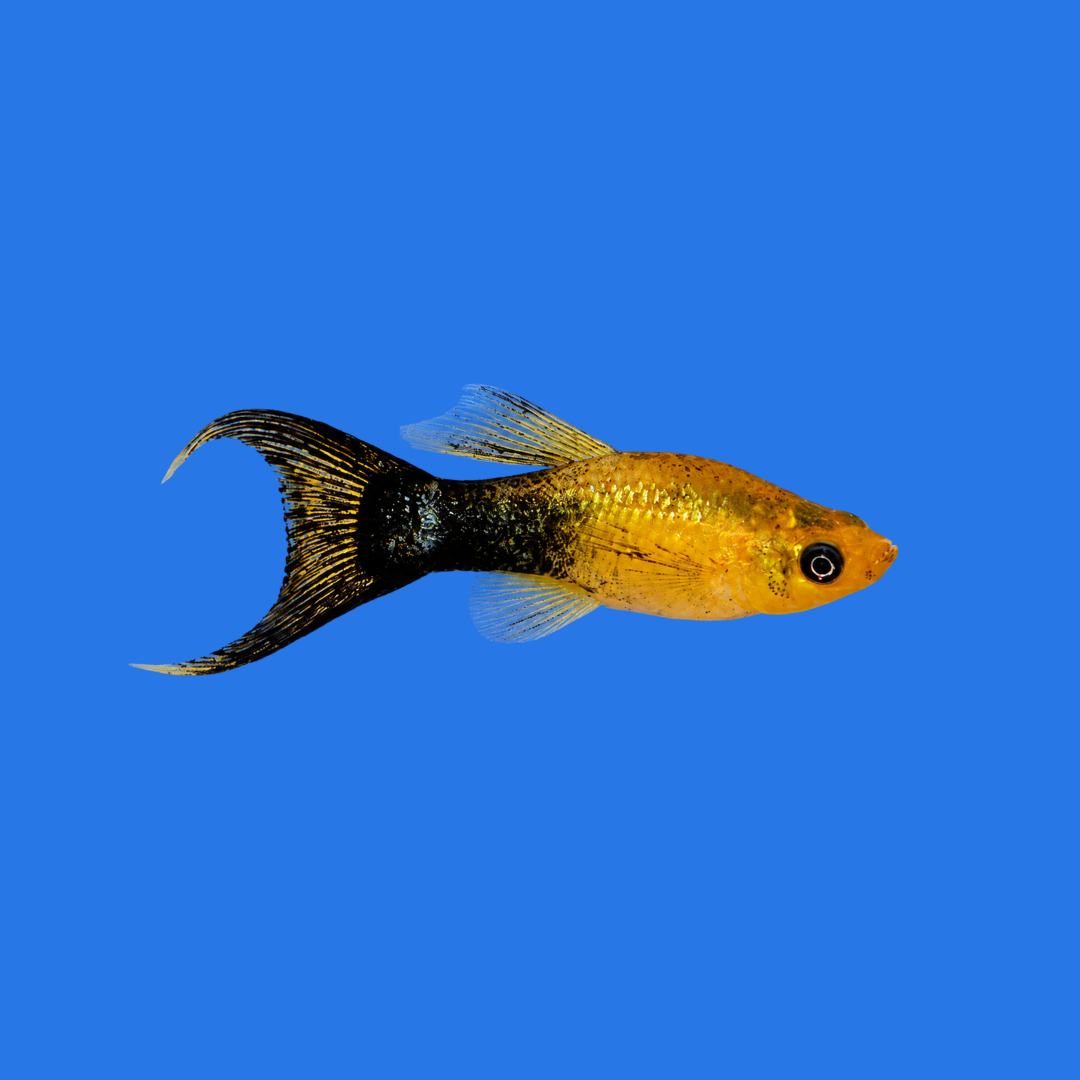
ゴールデンブラックライヤーモーリーは、頭部から体の前半を彩る黄金色からオレンジ色と、後半に広がる深い黒色のコントラスト、そして尾鰭の上下がすらりと伸びるライヤーテールを組み合わせた改良モーリーです。野生に同じ姿の個体群が存在するわけではなく、選択交配によって色彩とヒレ形が組み合わされてきた観賞用品種として楽しまれています。黄金色と黒色の境界や黒い細かな斑点の入り方には個体差があり、一匹ごとに印象が異なることも魅力です。活発で人の気配によく反応し、水槽内では付着藻類をついばむ姿も見られます。一方で、水質が合わない状態や急激な環境変化では調子を崩すことがあります。日本では水道水の硬度に地域差があるため、特に軟水の地域では飼育水の硬度を確認し、急な変化を避けて管理することが長期飼育のポイントになります。 The Golden Black Lyretail Molly is an ornamental molly strain combining a vivid golden to orange front half, a deep black rear half, and a lyre-shaped caudal fin whose upper and lower rays extend gracefully. No wild population naturally occurs in exactly this form; its color pattern and fin shape have been combined through selective breeding. The boundary between the gold and black areas varies among individuals, and fine dark speckling may occur in the lighter region, giving each fish a distinctive appearance. They are active, responsive aquarium fish and are often seen grazing on attached algae. However, mollies can lose condition when water chemistry is unsuitable or when environmental conditions change abruptly. Because tap-water hardness varies by region, aquarists in soft-water areas should check mineral content and avoid sudden changes during long-term care.
基本情報 / Basic Information
| 学名 / Scientific Name | Poecilia spp. hybrid (改良品種。単一種としての正式学名はなし) (ornamental hybrid; no single-species scientific name applies) |
|---|---|
| 通称 / Common Name | ゴールデンブラックライヤーモーリー、ゴールデンブラックモーリーGolden Black Lyretail Molly |
| 分類 / Family | カダヤシ目・カダヤシ科・ポエキリア亜科・ポエキリア属Order Cyprinodontiformes, family Poeciliidae, subfamily Poeciliinae, genus Poecilia |
| 英名 / English Name | Golden Black Lyretail Molly |
| 分布 / Distribution | 改良品種のため自然分布はありません。系統の基礎となったモーリー類はメキシコから中米・南米北部にかけての淡水域や汽水域に分布し、現在の観賞用品種は東南アジアを含む各地の養殖場で生産されています。This ornamental strain has no natural distribution. The wild molly species that contributed to fancy strains occur from Mexico through Central America and into northern South America in freshwater and brackish habitats. Modern ornamental mollies are produced by fish farms in many regions, including Southeast Asia. |
| 最大体長 / Max Size | 一般的には6〜10cm前後が目安です。メスや大型になる系統ではこれを上回ることもあり、体格には系統差があります。A general guide is about 6–10 cm, although large females and some lines may grow beyond this range. Body size varies among ornamental strains. |
| 寿命 / Lifespan | 飼育下でおおむね3〜5年程度が目安です。水質、栄養、繁殖負担、系統の体質によって差が出ます。Typically around 3–5 years in captivity, with considerable variation depending on water quality, nutrition, reproductive stress, and the robustness of the particular strain. |
飼育環境 / Aquarium Environment
| 水槽サイズ / Tank Size | 複数匹を安定して飼うなら60cm規格水槽(約55〜65L程度)以上を目安にします。繁殖で個体数が増える場合や、より大きな群れを維持する場合は、90cm規格水槽(約150〜180L程度。製品寸法により異なります)など、さらに余裕のある水量を確保すると管理しやすくなります。小型水槽では水温や水質が変動しやすいため、長期飼育には余裕のある水槽が適しています。For a small group, a standard 60 cm aquarium of roughly 55–65 L or larger is a practical starting point. If the population grows through breeding or a larger group is maintained, a roomier aquarium such as a standard 90 cm tank of roughly 150–180 L, depending on its dimensions, is easier to keep stable. Very small tanks fluctuate more quickly in temperature and water quality, so additional water volume is preferable for long-term care. |
|---|---|
| 水温 / Temperature | 24〜28℃を目安に、急変させず安定させます。22℃前後でも維持できることはありますが、輸入直後や体力が落ちた個体では低温への急変が負担になりやすいため、サーモスタット付きヒーターで一定に保つのが安全です。 Maintain a stable temperature of about 24–28°C. Healthy mollies may tolerate somewhat cooler conditions, but sudden drops can be stressful, especially after transport or when fish are weakened. A thermostatically controlled heater is recommended for stable care. |
| 水質 / Water Quality | 中性から弱アルカリ性で、ミネラルを含む中程度〜高めの硬度の水を好みます。観賞用モーリー全般の実用的な目安としてはpH 7.0〜8.0、GH 8〜18 dH程度が参考になりますが、系統や導入前の飼育環境によって適応範囲には幅があります。重要なのは弱酸性・低硬度へ大きく傾けず、測定しながら水質を安定させることです。軟水の地域では、必要に応じてサンゴ砂や硬度調整用ミネラル剤を少量ずつ使います。通常飼育で塩分添加は必須ではなく、適切な硬度と水質が保たれていれば淡水で維持できます。They generally do best in neutral to mildly alkaline water with moderate to high mineral content. As a practical guide for ornamental mollies, around pH 7.0–8.0 and GH 8–18 dH is a useful reference range, although tolerance varies among strains and according to the water in which the fish were previously maintained. The priority is to avoid persistently acidic, very soft conditions and to keep water chemistry stable. In soft-water areas, small amounts of crushed coral or a measured remineralizing product can be used when necessary. Routine salt addition is not essential when suitable hardness and good water quality are maintained in freshwater. |
| レイアウト / Layout | 遊泳スペースを広めに確保しつつ、流木や石、水草で休める場所を作ります。底床は砂利や砂が扱いやすく、強く酸性へ傾けるタイプのソイルは水質条件と相性がよくありません。繁殖も楽しむ場合は、マツモ、アナカリス、ウィローモスなどを密に配置すると稚魚の隠れ家になります。ろ過はやや余裕のある能力を選び、水面を軽く動かして酸素供給も確保します。Provide generous open swimming space together with plants, rocks, or wood that create resting and refuge areas. Sand or inert gravel is easy to manage, while strongly acidifying aquasoils are generally a poor match for the preferred water chemistry. For breeding, dense stands of fine or bushy plants such as hornwort, Egeria, or Java moss give newborn fry places to hide. Use filtration with some spare capacity and maintain gentle surface movement for good oxygenation. |
| 注意点 / Precautions | 最も注意したいのは、軟水・低硬度への急な移行、急激な水温変化、導入直後の水質差です。購入時の飼育水と自宅の水槽で差が大きい場合は、温度だけでなくpHや硬度も急変させないように水合わせします。非常に食欲が強く排泄量も多いため、過密飼育や過剰給餌では水質が崩れやすくなります。週1回を目安に20〜30%程度の換水を行い、アンモニアと亜硝酸は常に検出されない状態を保ちます。繁殖力が高いため、雌雄を一緒に飼う場合は将来の個体数増加も見越しておきます。The main risks are abrupt transfer into soft, low-mineral water, sudden temperature changes, and major differences in water chemistry after purchase. If the water at the point of purchase differs substantially from the aquarium, acclimate the fish in a way that avoids abrupt changes in temperature, pH, and hardness. Mollies have strong appetites and produce a substantial waste load, so overcrowding and overfeeding can quickly reduce water quality. As a general routine, change roughly 20–30% of the water weekly and keep ammonia and nitrite undetectable. Their high reproductive rate should also be considered whenever males and females are housed together. |
餌と給餌 / Feeding
| 餌の種類 / Diet | 雑食性ですが植物質もよく利用するため、スピルリナや藻類原料を含むフレーク・顆粒を主食にすると安定します。補助的に植物性タブレット、茹でた野菜を少量、冷凍アカムシ、ブラインシュリンプ、ミジンコ類などを組み合わせると栄養に幅が出ます。水槽内では付着藻類をついばむこともありますが、それだけで必要な栄養を満たすことはできません。They are omnivorous and make good use of plant material, so a quality flake or small pellet containing spirulina or other algal ingredients works well as the staple diet. Vegetable-based wafers, small amounts of blanched vegetables, frozen bloodworms, brine shrimp, and daphnia can be rotated as supplementary foods. They may also graze on attached algae in the aquarium, but this does not replace a complete diet. |
|---|---|
| 給餌のポイント / Feeding Tips | 成魚は1日1〜2回、数分で食べ切れる量を基本にします。食欲が強いため、欲しがるだけ与えると肥満や水質悪化を招きやすくなります。植物質を毎日の軸にし、高タンパクな動物質の餌は補助的に使うと体型と消化のバランスを取りやすくなります。稚魚は一度に多く与えるより、細かく砕いた人工飼料や孵化直後のブラインシュリンプを少量ずつ複数回与える方が成長を促しやすくなります。Feed adults once or twice daily, offering only what they can finish within a few minutes. Their strong feeding response makes overfeeding easy, which can lead to obesity and deteriorating water quality. Keep plant-rich foods as the daily foundation and use protein-rich animal foods as supplements. Fry grow well when finely crushed prepared food or newly hatched brine shrimp is offered in several small meals rather than one large feeding. |
性格と混泳 / Temperament and Tank Mates
| 性格 / Temperament | 活発で好奇心が強く、基本的には温和なコミュニティフィッシュです。ただしオスはメスを頻繁に追いかけて交尾を試みるため、少数飼育ではメスに負担が集中することがあります。繁殖を前提にするなら、オス1匹に対してメス2〜3匹程度を目安にすると追尾の圧力を分散しやすくなります。オス同士は軽い張り合いを見せることがありますが、十分な空間があれば深刻な争いにならないことが多い魚です。Active and inquisitive, they are generally peaceful community fish. Males, however, frequently pursue females and attempt to mate, so a small group can place excessive pressure on a single female. For breeding groups, a ratio of about one male to two or three females helps distribute male attention. Males may display or compete with one another, but serious fighting is uncommon when adequate space is provided. |
|---|---|
| 混泳の相性 / Compatibility | プラティ、ソードテール、グッピーなど、同じく中性〜弱アルカリ性の水に適応しやすい穏やかな魚とは合わせやすい傾向があります。ただしグッピーを含む近縁のポエキリア属とは求愛行動が交錯することがあるため、純粋な系統繁殖を重視する場合は分けて管理します。ヒレをかじる魚、極端に攻撃的な魚、弱酸性の軟水を強く要求する魚との混泳は避けた方が安全です。小型のエビや生まれたばかりの稚エビは捕食されることがあります。They generally mix well with peaceful fishes that also tolerate neutral to mildly alkaline water, including platies, swordtails, and guppies. Closely related Poecilia may show overlapping courtship behavior, so breeders who want to preserve a strain should keep lines separate. Avoid fin-nipping species, highly aggressive fishes, and species that strongly require acidic, very soft water. Tiny shrimp and newborn shrimplets may be eaten. |
病気と対策 / Diseases and Prevention
| かかりやすい病気 / Common Diseases | 白点病、細菌性の皮膚・鰭の感染症、内部寄生虫など、一般的な観賞魚の病気に注意します。またモーリーでは、その場で体を小刻みに左右へ振る「シミー」と呼ばれる異常遊泳が知られています。シミーは特定の病原体による病名ではないため、水質、水温、導入時の環境変化などを含めて体調不良の原因を確認する必要があります。白い糸状便だけで病気を断定することはできませんが、餌を食べても痩せ続ける、腹部が著しくくぼむなどの症状が重なる場合は、内部寄生虫を含む消化器系の異常も疑います。Watch for common aquarium-fish problems such as white spot disease, bacterial infections of the skin or fins, and internal parasites. Mollies are also known for an abnormal rocking or trembling behavior commonly called “shimmying.” Shimmying is not the name of a specific infectious disease, so water quality, temperature, recent environmental changes, and other possible causes of poor condition should be reviewed. Pale or stringy feces alone are not enough to diagnose a disease, but when they occur together with continuing weight loss despite feeding or a markedly sunken abdomen, internal parasites or other digestive problems should be considered. |
|---|---|
| 対策と予防 / Prevention | 予防の中心は、安定した水質と適正な水温を保ち、過密や過剰給餌を避けることです。新しい個体は可能なら別水槽で観察し、食欲、糞、体表、呼吸状態などを確認してから合流させます。シミーが出た場合は、まず水温、pH、GH、アンモニア、亜硝酸などを確認し、環境上の問題があれば優先して修正します。塩分は状況によって補助的に利用されることがありますが、シミーに対する一律の治療法ではありません。症状が続く場合や感染症が疑われる場合は隔離し、原因を絞ったうえで対象魚に使用できる魚病薬を表示どおりに使います。予防目的で薬剤を常用するのは避けます。Prevention centers on stable water quality, appropriate temperature, and avoiding overcrowding and overfeeding. Whenever possible, observe new fish in a separate tank and check appetite, feces, skin condition, and respiration before introduction. If shimmying appears, first test temperature, pH, GH, ammonia, and nitrite and correct any environmental problem that is found. Salt may be used as a supportive measure in some situations, but it is not a universal treatment for shimmying. If signs persist or an infection is suspected, isolate the fish, narrow down the likely cause, and use only medications suitable for the species and according to the product directions. Routine preventive medication should be avoided. |
増やし方(繁殖) / Breeding
| 雌雄の判別 / Sexing | 成熟したオスは尻鰭が細長い交接器「ゴノポディウム」に変化し、メスは扇形の尻鰭を保つため比較的容易に見分けられます。メスは成熟するとオスよりふっくらした体型になりやすく、妊娠すると腹部が大きく張ります。妊娠斑は観察の手がかりになりますが、ゴールデンブラック系では腹部の黒色が強い個体も多く、必ずしも明瞭には見えません。Adult males develop a narrow, rod-like anal fin called a gonopodium, while females retain a fan-shaped anal fin, making sexing relatively straightforward. Mature females are often fuller-bodied than males and become noticeably swollen when gravid. A gravid spot can sometimes be useful, but it may be difficult to see in Golden Black individuals with heavy dark pigmentation on the abdomen. |
|---|---|
| 繁殖形態 / Reproduction | 観賞魚の世界では「卵胎生メダカ」と呼ばれるグループに含められる胎生性の魚で、メスの体内で胚が発育し、自力で泳げる稚魚を直接産みます。妊娠期間は水温や個体差によって変わりますが、おおむね4〜6週間が目安です。1回の産仔数は数十匹になることが多く、体格や系統、飼育状態によって大きく変わります。またメスは交尾後の精子を体内に貯蔵できるため、オスを分けた後も複数回出産することがあります。Mollies are livebearing fishes and are commonly grouped in the aquarium trade with the livebearers traditionally called “ovoviviparous.” Embryos develop inside the female and she gives birth to free-swimming fry. Gestation varies with temperature and the individual but is commonly around four to six weeks. Brood size is often in the tens and can vary substantially with body size, strain, and husbandry. Females can also store sperm after mating, so additional broods may be produced even after the male has been removed. |
| 繁殖のポイント / Breeding Tips | 繁殖群はオス1匹に対してメス2〜3匹を目安にし、メスが追われ続けないよう隠れ場所を用意します。出産直前のメスを狭い産卵箱へ長期間閉じ込めるとストレスになるため、可能なら別の繁殖水槽へ移すか、本水槽にマツモやウィローモスなどを密生させて稚魚の逃げ場を作ります。親魚は稚魚を食べることがあるため、確実に残したい場合は出産後に親を分けます。稚魚は孵化直後のブラインシュリンプや細かく砕いた人工飼料をすぐに食べられます。系統繁殖ではメスの精子貯蔵を考慮し、目的のオスと確実に組み合わせたい場合は幼魚期から雌雄を分け、未交尾のメスを用いることが重要です。A breeding group of about one male to two or three females reduces constant pressure on individual females. Avoid keeping a near-term female confined in a small breeding box for long periods, as this can be stressful; a separate breeding tank or dense plant cover such as hornwort or Java moss is usually gentler and gives fry places to escape. Adults may eat newborn fry, so separate the parents if maximum survival is desired. Fry can take newly hatched brine shrimp and finely powdered prepared food almost immediately. For controlled strain breeding, remember that females can store sperm; if a specific male is to sire the brood, females should be separated from males while still immature and bred before any previous mating occurs. |
雑学と豆知識 / Trivia and Fun Facts
| 1. 野生には存在しない「完成された組み合わせ」 / 1. A Combination Created by Selective Breeding | ゴールデンブラックライヤーモーリーの面白さは、黄金色、黒色、ライヤーテールという、それぞれ別方向の美しさが一匹の体にまとめられている点にあります。野生のモーリーにも黒い斑や黄色味の強い個体は見られますが、現在流通するような明瞭なツートンカラーと伸長した尾鰭は、自然界でひとつの地域集団として成立したものではありません。ブリーダーが世代ごとに望ましい個体を選び、色の境界、黒色の濃さ、尾鰭の伸び方を少しずつ揃えていった結果です。そのため同じ商品名でも個体差は残り、そのばらつきこそが改良品種の歴史を目で見て楽しめる部分でもあります。The fascination of the Golden Black Lyretail Molly lies in the combination of several independently attractive traits: golden coloration, deep black pigmentation, and an extended lyre-shaped tail. Wild mollies can show yellowish tones or dark blotches, but the crisp two-tone pattern and elongated caudal fin seen in the aquarium strain did not arise as a single natural population. Breeders selected desirable fish generation after generation, gradually refining the color boundary, intensity of black pigmentation, and fin shape. Individual variation therefore remains even under the same trade name, and that variation is a visible reminder of the strain’s selective-breeding history. |
|---|---|
| 2. 学名の「Poecilia」は色彩豊かな魚を思わせる名前 / 2. The Name “Poecilia” Evokes Varied Color | 属名のPoeciliaは、ギリシャ語で「多彩な」「まだらの」といった意味を持つpoikilosに由来するとされています。野生のポエキリア属は、派手な改良品種ほど均一な色ではありませんが、反射光、細かな斑紋、体側の色素細胞がつくる変化に富んだ表情を持っています。その後、ポエキリア属の研究と観賞魚としての選択交配が重なり、現在ではブラック、シルバー、ゴールド、ダルメシアン、バルーン、セルフィン、ライヤーテールなど、多彩なモーリーが知られるようになりました。The genus name Poecilia is generally traced to the Greek word poikilos, meaning varied, many-colored, or mottled. Wild Poecilia are not uniformly brilliant in the same way as modern fancy strains, yet they often show complex reflections, fine patterning, and shifting combinations of pigment cells. Taxonomic study of Poecilia and generations of ornamental selection have since been accompanied by black, silver, gold, dalmatian, balloon, sailfin, and lyretail forms, creating the remarkable variety associated with mollies today. |
| 3. ライヤーテールとオスの繁殖 / 3. Lyretail Fins and Male Reproduction | ライヤーテールでは尾鰭の上下が長く伸びますが、モーリーのオスが交尾に使うのは尻鰭が変形したゴノポディウムです。モーリーでは、ライヤーテールのオスでも通常形のゴノポディウムを持ち、自然交尾に使える系統が知られています。ただし、改良形質の現れ方には系統差や個体差があるため、繁殖に使う個体は商品名だけで判断せず、実際の体型、泳ぎ方、ゴノポディウムの形を確認する方が確実です。In a lyretail molly, the upper and lower portions of the caudal fin extend dramatically, while the male reproductive organ is the gonopodium, a modified anal fin. Lyretail molly lines are known in which males retain a normally formed gonopodium and can mate naturally. However, expression of ornamental traits varies among lines and individuals, so breeding fish should be selected by examining actual body conformation, swimming ability, and gonopodium structure rather than relying on the trade name alone. |
| 4. 一度オスと分けても出産する「精子貯蔵」 / 4. Sperm Storage Can Produce Later Broods | モーリーの繁殖で初心者を驚かせるのが、メスだけの水槽にしたはずなのに稚魚が生まれる現象です。これはメスが交尾で受け取った精子を生殖器官内に保存し、その後の複数回の受精に利用できるために起こります。ショップで購入した成熟メスがすでに交尾済みであれば、オスを一度も飼っていなくても出産する可能性があります。この性質は野生では繁殖機会を逃しにくくする優れた仕組みですが、品種改良では父親を特定しにくくする要因になります。血統を管理したいブリーダーが幼魚の段階から雌雄を分けるのは、この「見えない過去の交尾」を排除するためです。One of the most surprising aspects of molly breeding is that a female-only tank can still suddenly contain fry. Females can retain sperm received during mating and use it for later fertilization events. A mature female purchased from a shop may therefore produce broods even if the aquarist has never kept a male with her. In nature, this is an efficient way to preserve reproductive opportunity, but in selective breeding it makes paternity difficult to control. This is why breeders who need known parentage separate males and females while the fish are still immature. |
| 5. 同じポエキリア属には、精子を借りても父親のDNAをほぼ使わない魚がいる / 5. A Related Molly Uses Sperm Without Usually Using the Father’s DNA | モーリーの仲間をさらに掘り下げると、アマゾンモーリーPoecilia formosaという非常に特異な種に行き着きます。この魚はほぼメスだけで集団をつくり、近縁種のオスの精子を利用して胚発生のスイッチを入れます。ところが通常、その精子のDNAは子のゲノムに組み込まれません。結果として娘は母親とほぼ同じ遺伝情報を持つクローンとして生まれます。この繁殖様式は雌性発生と呼ばれ、脊椎動物では珍しい現象です。華やかな改良モーリーを入口にして同じ属をたどると、観賞魚の世界のすぐ隣に、進化学の教科書に登場するほど特殊な生殖戦略が存在していることが分かります。Looking deeper into the molly lineage leads to an extraordinary relative, the Amazon molly, Poecilia formosa. Its populations are composed almost entirely of females, and they use sperm from males of related species to trigger embryonic development. Normally, however, the sperm DNA is not incorporated into the offspring’s genome. The resulting daughters are therefore essentially maternal clones. This reproductive system is called gynogenesis and is rare among vertebrates. Following the family tree from a colorful ornamental molly thus leads directly into one of the most unusual reproductive strategies studied in evolutionary biology. |
まとめ / Conclusion
ゴールデンブラックライヤーモーリーは、鮮やかな黄金色と深い黒色、優雅な尾鰭、そして活発で人の気配によく反応する姿を楽しめる改良モーリーです。比較的飼いやすい魚ですが、安定して状態を保つには水温だけでなく、pHや硬度を含めた水質にも目を向けることが大切です。特に軟水の環境では、飼育水の硬度を確認し、急な水質変化を避けることが導入後の不調を防ぐ助けになります。 The Golden Black Lyretail Molly combines brilliant gold, deep black, an elegant tail, and lively behavior that readily responds to activity around the aquarium. It is generally manageable in captivity, but long-term condition depends on stable water chemistry as well as temperature. In soft-water environments, checking hardness and avoiding abrupt changes can help reduce problems after introduction.
植物質を含むバランスのよい食事、余裕のあるろ過、安定した中性〜弱アルカリ性の水質、そしてメスへの追尾を分散できる群れづくりが整えば、水槽の中で活発な姿を見せてくれます。繁殖した稚魚に親とは少し違う色の入り方や尾鰭の伸び方が現れることもあり、改良品種ならではの個体差を身近に観察できます。鮮やかな色彩と優雅なヒレ、日々よく動く存在感を備え、適した環境でじっくり付き合えるモーリーです。 With a balanced diet that includes plant material, generous filtration, stable neutral to mildly alkaline water, and a group structure that reduces pressure on females, these mollies remain active and engaging aquarium residents. Fry may sometimes develop slightly different color boundaries or fin shapes from their parents, allowing the variation typical of selectively bred strains to be observed at close range. Their vivid coloration, elegant fins, and constant activity make them rewarding fish to keep when their environmental needs are met.
気になる道具や飼い方を見つけてみませんか?
 アイのアクアグッズ案内水合わせの道具とやり方|魚を迎える前にそろえたい容器・点滴キット・ネット買ってきた魚はすぐ水槽に入れていい? 水温合わせと水合わせの違いから、透明ケース・点滴キット・ネットの選び方、時間をかけすぎない注意点まで、アイとコタロウが紹介します。記事はコチラ →
 アイのアクアグッズ案内テトラミンって、こんなにあるの? アイとコタロウのごはん探究旅道具の特徴や使い方、選ぶときのポイントをアイが紹介します。記事はコチラ →
さまざまな飼育テーマをご紹介。リンク先の記事には広告・商品紹介が含まれます。
案内・紹介記事一覧へ →分布マップ
ゴールデンブラックライヤーモーリーは改良品種のため自然分布を持ちません。系統の基礎となったモーリー類は、メキシコから中央アメリカを経て南アメリカ北部にかけての淡水域・汽水域に分布します。
※この地図は、記事に記載された「メキシコから中米・南米北部」という分布情報をもとにした概略表示です。マーカーは分布域を把握しやすくするための代表地点であり、実際の採集地点や本品種の自然生息地点を示すものではありません。
参考文献
-
分類・改良品種の位置づけ
U.S. Geological Survey. lyretail black molly (Poecilia spp. hybrid) – Species Profile. Nonindigenous Aquatic Species Database. ゴールデンブラック系を含む観賞用ライヤーテール・ブラックモーリーの背景として、複数の Poecilia 属魚類が関与する交雑系統であることを確認する資料。 -
分類・分布・生息環境・食性
Froese, R. & Pauly, D. (eds.). Poecilia sphenops Valenciennes, 1846. FishBase. カダヤシ科・ポエキリア亜科という分類、メキシコからコロンビアにかけての分布、淡水・汽水環境、水温・pH・硬度、食性、体長などの基礎情報を確認する資料。 -
分布・生息環境・食性
Froese, R. & Pauly, D. (eds.). Poecilia latipinna (Lesueur, 1821). FishBase. セルフィン系モーリーの自然分布、淡水・汽水・沿岸域での生息、植生のある止水・緩流環境、藻類を中心とした食性などを確認する資料。 -
飼育条件・給餌・混泳・繁殖
Ornamental Aquatic Trade Association (OATA). How to look after guppies and mollies. 水温20〜28℃、pH 7.0〜8.0、GH 8〜18 dH、アンモニア・亜硝酸0 mg/Lを含む飼育水の目安、群れの性比、給餌、換水、繁殖など、家庭での飼育管理を確認する資料。 -
繁殖・雌雄判別
Gómez-Márquez, J. L., Peña-Mendoza, B. & Guzmán-Santiago, J. L. (2016). Reproductive biology of Poecilia sphenops Valenciennes, 1846 (Cyprinodontiformes: Poeciliidae) at the Emiliano Zapata Reservoir in Morelos, Mexico. Neotropical Ichthyology, 14(2), e140127. DOI: 10.1590/1982-0224-20140127. オスの尻鰭がゴノポディウムへ変化する性的二型や、繁殖生態を確認する査読論文。 -
繁殖・精子貯蔵
Hankison, S., Gangloff, E. J., Fry, B., et al. (2022). Effects of reliance on stored sperm on reproduction in the sailfin molly Poecilia latipinna. Journal of Fish Biology, 101(6), 1628-1633. DOI: 10.1111/jfb.15228. メスが交尾後に貯蔵した精子を後の繁殖に利用できることを、モーリーで検証した査読研究。 -
水質・環境性疾患・注意点
Francis-Floyd, R., Yanong, R. P. E. & Petty, B. D. Environmental Diseases of Aquatic Animals in Aquatic Systems. Merck Veterinary Manual, Professional Version. アンモニア、亜硝酸、塩素、水温、pH、硬度などの水質要因と魚の健康との関係、水質検査を優先する考え方を確認する獣医学資料。 -
白点病・内部寄生虫
Petty, B. D., Francis-Floyd, R. & Yanong, R. P. E. Parasitic Diseases of Fish. Merck Veterinary Manual, Professional Version. 淡水魚の白点病を起こす Ichthyophthirius multifiliis、消化管寄生虫を含む各種寄生虫の症状・診断・治療原則を確認する獣医学資料。 -
隔離・治療・予防
Petty, B. D., Francis-Floyd, R. & Yanong, R. P. E. Management of Aquarium Fish. Merck Veterinary Manual, Professional Version. 新規導入魚の隔離、診断に基づく治療、予防目的での薬剤常用を避ける方針など、病気への実務的な注意点を確認する獣医学資料。




コメント