

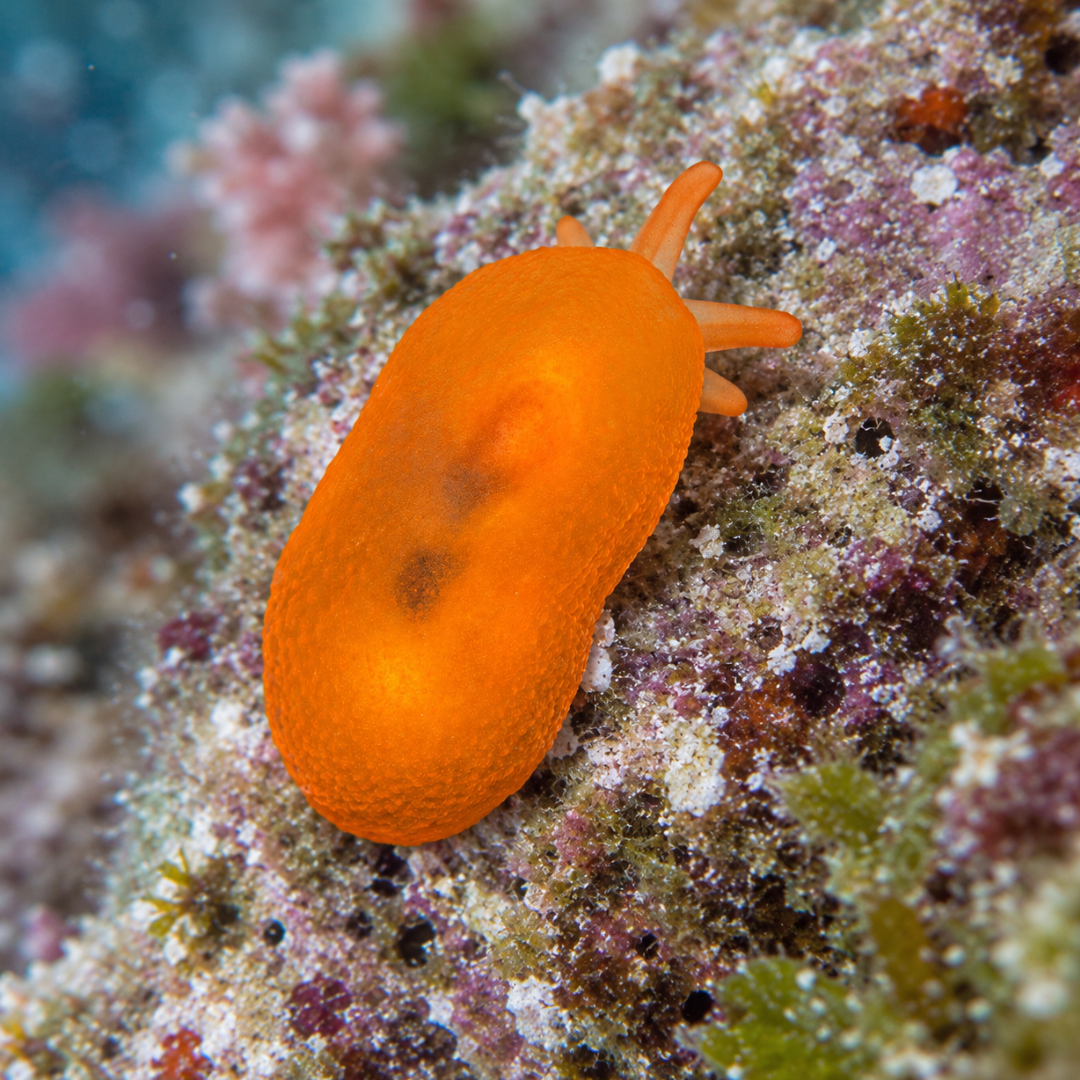
解説 / Description
ホオズキフシエラガイは、丸みを帯びた半透明の体と、黄色から橙色、赤橙色まで変化する鮮やかな体色が印象的な側鰓類です。一般に「ウミウシ」の仲間として親しまれますが、分類学的には側鰓目カメノコフシエラガイ科に属し、外套膜の内側には小さな内在殻を残しています。日中は転石の下や岩の隙間などに隠れ、主に夜間に活動します。刺激を受けると乳白色の防御分泌を放つことが知られていますが、その化学組成については、近縁のBerthellina citrinaを対象とした強酸性分泌の研究結果と区別して扱う必要があります。カイメン類や一部のサンゴ類を利用する特殊な食性もあり、観賞目的での長期飼育は非常に難しい生体です。 Berthellina delicata is a side-gilled sea slug notable for its smooth, rounded, translucent body and vivid coloration ranging from yellow and orange to reddish orange. It belongs to the order Pleurobranchida and family Pleurobranchidae and retains a small internal shell beneath the mantle. During the day it usually hides beneath stones or in rock crevices and becomes more active at night. The species is known to release a milky defensive secretion when disturbed, but the chemistry of that secretion should not be assumed to be identical to the strongly acidic secretion studied in the related Berthellina citrina. Its specialized feeding on sponges and some corals also makes long-term aquarium maintenance exceptionally difficult.
基本情報 / Basic Information
| 学名 / Scientific Name | Berthellina delicata (Pease, 1861) |
|---|---|
| 通称 / Common Name | ホオズキフシエラガイ。国内では「ホウズキフシエラガイ」と表記されることもあります。Orange gumdrop side-gilled slug; also referred to generally as a Berthellina side-gilled sea slug. |
| 分類 / Family | 軟体動物門・腹足綱・異鰓亜綱・側鰓目・カメノコフシエラガイ科・ホオズキフシエラガイ属Phylum Mollusca, Class Gastropoda, Subclass Heterobranchia, Order Pleurobranchida, Family Pleurobranchidae, Genus Berthellina |
| 英名 / English Name | Orange gumdrop side-gilled slug |
| 分布 / Distribution | インド洋から西・中部太平洋の暖海域に広く分布し、日本では本州沿岸、伊豆諸島、南西諸島などから記録されています。岩礁やサンゴ礁、転石の多い環境などで見られ、浅場だけでなく比較的深い海域からの記録もあります。Widely distributed through warm waters of the Indian Ocean and the western to central Pacific. In Japan it has been recorded from coastal Honshu, the Izu Islands, the Nansei Islands and other localities. It occurs on rocky and coral reefs and in areas with abundant stones, with records from shallow water as well as deeper habitats. |
| 最大体長 / Max Size | 多くは2〜4cm程度で、最大約5cmに達する記録があります。Commonly about 2–4 cm long, with records reaching approximately 5 cm. |
| 寿命 / Lifespan | 本種を長期追跡した確実な寿命データは乏しく、野外・飼育下ともに標準的な寿命は明らかになっていません。Reliable long-term lifespan data for this species are scarce, and no standard lifespan has been established for either wild or captive animals. |
飼育環境 / Aquarium Environment
| 水槽サイズ / Tank Size | 本種について確立した推奨水槽サイズはありません。飼育を試みる場合は、水質を安定させやすく緊急時の換水にも余裕を持てるよう、単独飼育を前提に60cm規格水槽(約60L)以上を保守的な目安とします。小型水槽ほど水質変化の影響を受けやすく、長期維持の難しさが増します。No species-specific minimum aquarium size has been established. If captive maintenance is attempted, a species-only standard 60 cm tank of roughly 60 L or larger can be used as a conservative baseline because a larger water volume is easier to keep stable and allows more flexibility for emergency water changes. Very small aquaria are less forgiving of rapid water-quality changes. |
|---|---|
| 水温 / Temperature | 本種固有の至適飼育水温は確立していません。流通個体の由来が不明な場合は22〜25℃程度を便宜上の目安とし、急激な温度変化を避けて安定させます。野外ではこれより低い水温での観察記録もあります。 No species-specific optimum captive temperature has been established. When the origin of an aquarium specimen is unknown, about 22–25°C can be used as a practical reference range, with priority placed on stability and avoidance of rapid changes. Wild observations also exist from substantially cooler water. |
| 水質 / Water Quality | 本種固有の至適水質は確立していません。一般的な海水水槽として安定した比重とpHを保ち、アンモニアや亜硝酸を生じさせず、硝酸塩やリン酸塩の過度な蓄積も避けます。十分な生物ろ過、プロテインスキマー、定期換水などにより、水質の安定を優先します。No species-specific optimum water chemistry has been established. Maintain stable normal marine conditions, prevent detectable ammonia and nitrite, and avoid excessive accumulation of nitrate and phosphate. Reliable biological filtration, protein skimming and regular water changes should be used to prioritize overall stability. |
| レイアウト / Layout | 強い光を避けられるよう、オーバーハング、岩の亀裂、洞窟状の暗所を多く用意します。カイメン類などの付着生物が生きた成熟ライブロックは行動面では適していますが、餌生物を長期的に供給できる保証にはなりません。吸水口やポンプにはスポンジカバーを付け、柔らかな体が吸い込まれないようにします。Provide abundant shaded retreats, overhangs, deep crevices and cave-like spaces where the animal can avoid strong light. Mature live rock rich in encrusting life suits its natural behavior, although it does not guarantee a sustainable food supply. Protect pump and overflow intakes with guards or sponge covers to prevent the soft-bodied animal from being drawn in. |
| 注意点 / Precautions | 最大の問題は、特殊な食性による餓死と、強い刺激を受けた際の防御分泌です。触ったり追い回したりせず、サンゴや魚、甲殻類との混泳は避け、基本的には種専用水槽で管理します。分泌が疑われる場合は速やかに十分量の換水を行い、pHなどの水質を確認します。活性炭は有機性の分泌成分への補助として利用できますが、換水の代わりにはなりません。体表の分泌物には不用意に触れず、メンテナンス時は手袋を使用すると安全です。The two major concerns are starvation caused by its specialized diet and defensive secretion released under strong disturbance. Avoid handling or chasing the animal, and do not routinely keep it with corals, fish or crustaceans; a species-only system is preferable. If a discharge is suspected, perform a substantial water change and check water parameters such as pH. Activated carbon may be used as a supplementary measure for organic components of the secretion, but it is not a substitute for water changes. Avoid unnecessary skin contact with the secretion and use gloves during maintenance. |
餌と給餌 / Feeding
| 餌の種類 / Diet | 自然下ではカイメン類を食べることが確認されており、ハワイなどでは一部の硬質サンゴを摂食した記録もあります。一般的な人工飼料、フレーク、ペレット、冷凍ブラインシュリンプ、アサリなどに安定して餌付くことを示す確実な情報はありません。In the wild it has been confirmed feeding on sponges, and records from Hawaii and other localities also document feeding on some stony corals. There is no reliable evidence that it consistently adapts to ordinary aquarium pellets, flakes, frozen brine shrimp or clam meat. |
|---|---|
| 給餌のポイント / Feeding Tips | 飼育前に実際に食べている餌生物を確認し、その餌を継続的に確保できることが最重要です。付着カイメンなどを含むライブロックを入れるだけでは、必要な種類が存在するとは限りません。食痕、排泄、夜間の活動量、体の厚みを継続して観察し、摂食が確認できなければ長期維持は難しいと判断します。サンゴを餌として利用する個体では、サンゴ水槽へ導入すると食害につながる可能性があります。The most important requirement is to identify what the individual is actually eating before acquisition and to secure a continuous supply of that prey. Simply adding live rock with encrusting organisms does not ensure that the required sponge or other prey is present. Monitor feeding marks, feces, nighttime activity and body condition. If feeding cannot be confirmed, long-term maintenance is unlikely. Individuals that consume coral can also damage reef displays. |
性格と混泳 / Temperament and Tank Mates
| 性格 / Temperament | おとなしく、他の生物を追い回すような性質はありません。反面、強い光や物理的な刺激を嫌う隠伏性・夜行性の傾向が強く、日中はほとんど姿を見せないことがあります。野外では同種個体が近接して見つかる例もあります。Generally non-aggressive and does not actively chase other animals. It is, however, strongly cryptic and nocturnal, avoiding bright light and physical disturbance, and may remain hidden for most of the day. Multiple individuals are sometimes found close together in the wild. |
|---|---|
| 混泳の相性 / Compatibility | 基本的には単独飼育向きです。捕食やつつき行動を行う魚、甲殻類との混泳は本種へのストレスとなり、防御分泌を誘発するおそれがあります。また、本種自身がカイメンや一部のサンゴなどを摂食するため、リーフタンクの「お掃除役」として扱うこともできません。水量の大きな施設水槽であっても、混泳は十分な観察と緊急時のろ過・換水体制を前提とします。Best kept alone. Fish or crustaceans that peck, nip or attempt to prey on it can cause severe stress and may trigger defensive secretion. Because the slug itself may feed on sponges and some corals, it should not be treated as a reef-safe “clean-up” animal. Even in large public or research systems, mixed-species housing requires close observation and strong emergency filtration and water-change capacity. |
病気と対策 / Diseases and Prevention
| かかりやすい病気 / Common Diseases | 本種に特有の飼育下疾病について体系的な情報はほとんどありません。実際の飼育でより大きな問題になりやすいのは、餌不足による慢性的な衰弱、水質悪化、移送や接触による外傷、ポンプへの吸い込みなどです。活動低下や体の縮みが見られた場合も、感染症と決めつけず、まず摂食状況と水質を確認します。There is little systematic information on species-specific captive diseases. In practice, the more common threats are chronic starvation, poor water quality, transport or handling injuries, and damage from pumps or intakes. Reduced activity or body shrinkage should not automatically be interpreted as infection; feeding status and water quality should be checked first. |
|---|---|
| 対策と予防 / Prevention | 安定した海水環境、適切な餌生物の継続供給、隠れ場所の確保、接触ストレスの回避が予防の中心です。一般的な魚病薬を安易に使用せず、とくに無脊椎動物に有害な銅を含む薬剤は使用しません。異常が見られた場合は、まず隔離できる海水環境で水質・摂食・外傷の有無を確認し、薬剤処置が必要な場合は軟体動物への安全性を確認してから対応します。Prevention centers on stable marine conditions, continuous access to appropriate prey, ample shelter and minimal handling stress. Do not use standard fish medications indiscriminately, and avoid copper-containing treatments, which are hazardous to marine invertebrates. If problems occur, first assess water quality, feeding and physical injury in a suitable isolated marine setup; any medication should only be considered after confirming safety for mollusks. |
増やし方(繁殖) / Breeding
| 雌雄の判別 / Sexing | 雌雄同体のため、外見からオス・メスに分けて判別する生き物ではありません。成熟した個体同士が交尾し、互いに精子を交換する繁殖様式をとります。This species is hermaphroditic, so individuals are not separated into externally distinguishable males and females. Mature animals mate and exchange sperm. |
|---|---|
| 繁殖形態 / Reproduction | 雌雄同体の個体同士が交尾し、黄色から橙色の卵塊を基質上に産み付ける様子が知られています。一方、本種の幼生発生を種単位で詳しく追跡した資料は限られており、ふ化後の発生過程を飼育情報として断定できるだけのデータは十分ではありません。Hermaphroditic individuals mate and produce yellow to orange egg masses on the substrate. Detailed species-specific studies following larval development in Berthellina delicata are limited, so the post-hatching developmental sequence should not be presented as established aquarium information. |
| 繁殖のポイント / Breeding Tips | 水槽内で卵塊が得られても、本種について家庭水槽で再現可能な幼生飼育法や繁殖手順は確立していません。卵塊を確認した場合も、親個体の維持とは別に発生条件を管理する必要があり、現状では観賞飼育で安定した繁殖を目指せる生体とはいえません。Even if egg masses are produced in captivity, no standardized home-aquarium method has been established for larval rearing or reliable reproduction of this species. Egg development would need to be managed separately from routine adult maintenance, and Berthellina delicata should not currently be regarded as a species that can be bred predictably in ornamental aquaria. |
雑学と豆知識 / Trivia and Fun Facts
| 1. 貝殻を捨て切らなかった「ウミウシ」 / 1. A sea slug that never completely abandoned its shell | 一見すると完全に殻を失ったウミウシのように見えますが、ホオズキフシエラガイの外套膜の内部には、薄く小さな内在殻が残っています。腹足類の進化では、外から見える硬い殻を小さくし、やがて体内へ包み込む方向へ進んだ系統がいくつも知られています。本種はその途中経過を現在の姿に残したような生き物で、柔らかな外見の奥に「かつての貝」の痕跡を隠しています。外からはほとんど見えないこの殻は、側鰓類が貝類からどのように姿を変えてきたのかを想像させる、小さな進化の証拠でもあります。At first glance this animal appears to have completely lost its shell, yet a small, thin internal shell remains buried beneath the mantle. Several gastropod lineages followed an evolutionary path in which the external shell became reduced and was eventually enclosed by the body. Berthellina delicata therefore carries a quiet reminder of its shelled ancestry beneath an apparently shell-less form, offering a vivid glimpse into the evolutionary transition from a typical snail-like body plan to that of a sea slug. |
|---|---|
| 2. 「B. citrina」と呼ばれてきた長い歴史 / 2. A long history under the name “B. citrina” | 黄色から橙色のBerthellina属は外見だけでは区別しにくく、かつてインド太平洋の広い範囲の個体が、紅海から記載されたBerthellina citrinaの名で扱われてきました。現在、日本の個体は一般にBerthellina delicataとして整理され、B. citrinaは紅海の種として扱われる資料が増えています。ただし、Berthellina属には外見だけでは判別しにくい種が含まれるため、古い記録を読むときは採集地や同定根拠まで確認する必要があります。Yellow and orange species of Berthellina can be very difficult to separate by external appearance, and Indo-Pacific animals were long reported under Berthellina citrina, a species described from the Red Sea. Japanese populations are now generally treated as Berthellina delicata, while many modern references restrict B. citrina to the Red Sea. Because external similarity remains a taxonomic challenge within the genus, locality and the basis of identification are important when interpreting older records. |
| 3. 柔らかな体を守る、強酸性の化学防御 / 3. Highly acidic chemical defense in a soft-bodied animal | ホオズキフシエラガイは、刺激を受けると乳白色の防御分泌を放つことが観察されています。側鰓類では酸を利用した化学防御が広く知られ、近縁のBerthellina citrinaでは硫酸・塩酸に由来する成分を含む非常に酸性の強い分泌が研究されています。ただし、そのpHや成分値をB. delicataにそのまま当てはめることはできません。水槽内では、組成が何であれ大量の分泌が起きれば他の生体や水質への負担になり得るため、強い刺激を避けることが重要です。Berthellina delicata has been observed releasing a milky defensive secretion when disturbed. Acid-based chemical defense is widespread among pleurobranchs, and the related Berthellina citrina has been studied for a very strongly acidic secretion containing sulfate- and chloride-associated acids. Those measured pH values and chemical concentrations should not, however, be transferred directly to B. delicata. In an aquarium, any substantial defensive discharge can still place stress on other animals and water quality, so strong physical disturbance should be avoided. |
| 4. 暗闇を好むのに、なぜ鮮やかな橙色なのか / 4. Why be bright orange if you prefer darkness? | ホオズキフシエラガイは昼間、岩の裏や狭い亀裂に隠れることが多く、強い光を避ける傾向があります。それにもかかわらず、体は海中でもよく目立つ黄色や橙色、赤橙色です。この色彩は有害な分泌を持つことを捕食者に知らせる警戒色として解釈されることがあります。一方、暗い場所で同種が集まって見つかることもあるため、色や化学的な手掛かりが同種認識や繁殖機会に関係している可能性も考えられています。ただし、こうした機能のすべてが実験的に確定しているわけではなく、夜行性と鮮色が同居する理由は本種の生態を面白くしている未解明部分の一つです。Berthellina delicata often spends daylight hours beneath rocks or deep in crevices and shows a strong tendency to avoid bright illumination. Yet its body can be conspicuously yellow, orange or reddish orange. Such coloration is often interpreted as warning coloration advertising an unpleasant chemical defense. Because multiple individuals may also occur close together in dark refuges, visual or chemical cues could potentially aid recognition and reproductive encounters. Not every proposed function has been experimentally demonstrated, however, and the coexistence of nocturnal behavior and vivid color remains one of the intriguing questions surrounding its ecology. |
| 5. 「ホオズキ」の名が似合う理由 / 5. Why the Japanese name evokes a winter cherry | 和名の「ホオズキ」は、丸みのある半透明の体と暖色系の色合いが、植物のホオズキの実を思わせることに由来するとされています。古い文献では「ほおづきふしえらがひ」のような歴史的表記も見られ、現在は「ホオズキフシエラガイ」が学術的な和名として使われる一方、流通や一般向けの記録では「ホウズキフシエラガイ」という表記も見かけます。ひとつの生き物の名前に、古い日本語表記、分類学、流通名が重なっている点も興味深いところです。The Japanese name “Hoozuki-fushieragai” is thought to refer to the animal’s rounded translucent form and warm orange coloration, reminiscent of the fruit of the Japanese winter cherry, or hoozuki. Historical literature used older orthography, while the spelling “Houzuki-fushieragai” also appears in popular and trade usage. The coexistence of historical spelling, formal taxonomy and aquarium-market naming makes the name itself a small record of how people have encountered and described the species over time. |
| 6. 防御分泌は天然物研究の対象にもなる / 6. Defensive secretions as a subject of natural-products research | 側鰓類の防御分泌は天然物化学の研究対象にもなっています。近縁のBerthellina citrinaでは、分泌物の抗菌活性や培養細胞への細胞毒性、実験動物への影響を調べた研究があります。ただし、これらはB. delicataそのものについて同じ作用が確認されたことを意味せず、まして人への治療効果を示すものでもありません。分類が見直された生き物では、過去の研究名と現在の種名を区別して読むことが、研究結果を正しく理解するうえで重要です。Pleurobranch defensive secretions are also subjects of marine natural-products research. In the related Berthellina citrina, studies have examined antimicrobial activity, cytotoxicity toward cultured cells and effects in experimental animals. These results do not demonstrate the same effects in B. delicata, nor do they establish therapeutic benefit in humans. In a genus whose taxonomy has changed over time, keeping historical study names separate from current species identifications is essential for interpreting such research correctly. |
まとめ / Conclusion
ホオズキフシエラガイは、ホオズキの実を思わせる暖かな色彩、岩陰に潜む夜行性の暮らし、体内に残る小さな殻、刺激に対する乳白色の防御分泌など、側鰓類らしい特徴を備えた生き物です。外見だけでは区別しにくい近縁種との分類史や、カイメン・サンゴ類を利用する食性を知ると、その小さな体が自然環境に合わせてきた姿がより具体的に見えてきます。 Berthellina delicata combines several characteristic features of pleurobranchs in a small body: warm translucent coloration, a secretive nocturnal life, a reduced internal shell and a milky defensive secretion released when disturbed. Its appearance becomes more meaningful when considered together with its difficult taxonomic history and its specialized feeding on sponges and some corals.
一方、観賞飼育では小型だから扱いやすいとはいえません。最大の壁は、実際に食べる餌生物を継続して確保することです。さらに、強い刺激を避けられる静かな環境と安定した水質も求められます。自然下での暮らしと食性を理解し、無理に一般的な海水生体と同じ方法で飼おうとしないことが、ホオズキフシエラガイと向き合ううえで最も大切です。 In captivity, however, its small size does not make it easy to keep. The greatest obstacle is maintaining a continuous supply of the prey an individual actually accepts. It also requires stable water and a quiet environment that minimizes strong disturbance. Understanding its natural habits and feeding ecology, rather than treating it like a typical marine aquarium animal, is essential to keeping its unusual biology in proper perspective.

気になる道具や飼い方を見つけてみませんか?
 アイのアクアグッズ案内バルブの仲間に合わせる飼育用品|チェリーバルブ・スマトラ・中型種の水槽とろ過道具の特徴や使い方、選ぶときのポイントをアイが紹介します。記事はコチラ →
 アイのアクアグッズ案内水草水槽のCO₂添加|3つの方式の選び方とおすすめ用品道具の特徴や使い方、選ぶときのポイントをアイが紹介します。記事はコチラ →
 アイのアクアグッズ案内水槽のコケ掃除|道具の選び方とお掃除生体の得意・不得意道具の特徴や使い方、選ぶときのポイントをアイが紹介します。記事はコチラ →
 アイのアクアグッズ案内アフリカンシクリッドの飼育用品|水槽・ろ過・底砂・岩組み・餌の選び方道具の特徴や使い方、選ぶときのポイントをアイが紹介します。記事はコチラ →
さまざまな飼育テーマをご紹介。リンク先の記事には広告・商品紹介が含まれます。
案内・紹介記事一覧へ →分布マップ
ホオズキフシエラガイ(Berthellina delicata)は、インド洋から西・中部太平洋の暖海域に広く分布し、日本では本州沿岸、伊豆諸島、南西諸島などから記録されています。
この地図は分布域を把握するための概略表示です。表示範囲は既知の分布地域を大まかに示したもので、すべての生息地点を示すものではありません。また、地図上のマーカーは分布を見やすくするために設定した代表地点であり、実際の採集地点や観察地点を示すものではありません。
参考文献
- Ocean Biodiversity Information System (OBIS). Berthellina delicata (Pease, 1861), Taxon ID 863427. OBISで確認 分類・学名・海洋生物分布記録の確認。
- Moustafa, A. Y., Golestani, H. & Valdés, Á. (2018). A review of the genus Berthellina (Mollusca: Heterobranchia: Pleurobranchidae) in the Red Sea based on molecular and anatomical data. Marine Biodiversity, 48, 1121–1134. DOI Berthellina属の分類、近縁種との識別、分子・解剖学的背景。
- Moles, J., Brenzinger, B., Berning, M. I., Martynov, A., Korshunova, T. & Schrödl, M. (2024). Systematic rearrangements in an all-genus phylogeny of side-gilled slugs (Heterobranchia: Pleurobranchida). Zoological Journal of the Linnean Society, 202(2), zlad162. DOI 側鰓類の最新の系統分類と生殖器系を含む形態学的背景。
- Tibiriçá, Y., Pola, M. & Cervera, J. L. (2017). Astonishing diversity revealed: an annotated and illustrated inventory of Nudipleura (Gastropoda: Heterobranchia) from Mozambique. Zootaxa, 4359(1), 1–133. DOI Berthellina delicataの分布、生息環境、体サイズ、および同定上の注意。
- Nakano, R. (2011). Opisthobranchs (Mollusca: Gastropoda) from Nishidomari, Otsuki, Kochi Prefecture, Japan. Kuroshio Biosphere, 7, 1–35 + 20 pls. PDF 日本での記録、体色、夜行性、転石下での隠伏、防御分泌。
- Ong, R., Tan, S. K., Toh, C. H., Low, M. E. Y. & Woo, H. P. M. (2017). First record of side-gilled slug, Berthellina delicata, in Singapore. Singapore Biodiversity Records, 2017, 45–46. Lee Kong Chian Natural History Museum, National University of Singapore. PDF サンゴ礁・転石環境、カイメン食、飼育下での摂食選択性と隠伏行動。
- Wägele, H., Knezevic, K. & Moustafa, A. Y. (2017). Distribution and morphology of defensive acid-secreting glands in Nudipleura (Gastropoda: Heterobranchia), with an emphasis on Pleurobranchomorpha. Journal of Molluscan Studies, 83(4), 422–433. DOI 側鰓類およびBerthellina属の防御性酸分泌腺と、防御分泌に関する形態学的根拠。
- MSD Veterinary Manual. Therapeutic Considerations in Aquaculture. MSD Veterinary Manual 海水飼育での薬剤使用上の注意、とくに無脊椎動物に対する銅の高い毒性。
- Livengood, E. J. & Chapman, F. A. (rev. 2023). The Ornamental Fish Trade: An Introduction with Perspectives for Responsible Aquarium Fish Ownership. UF/IFAS Extension, FA124. UF/IFAS Extension 観賞用海水生物の飼育における水質維持、適切な栄養、検疫、移送ストレスなどの一般的管理原則。




コメント