

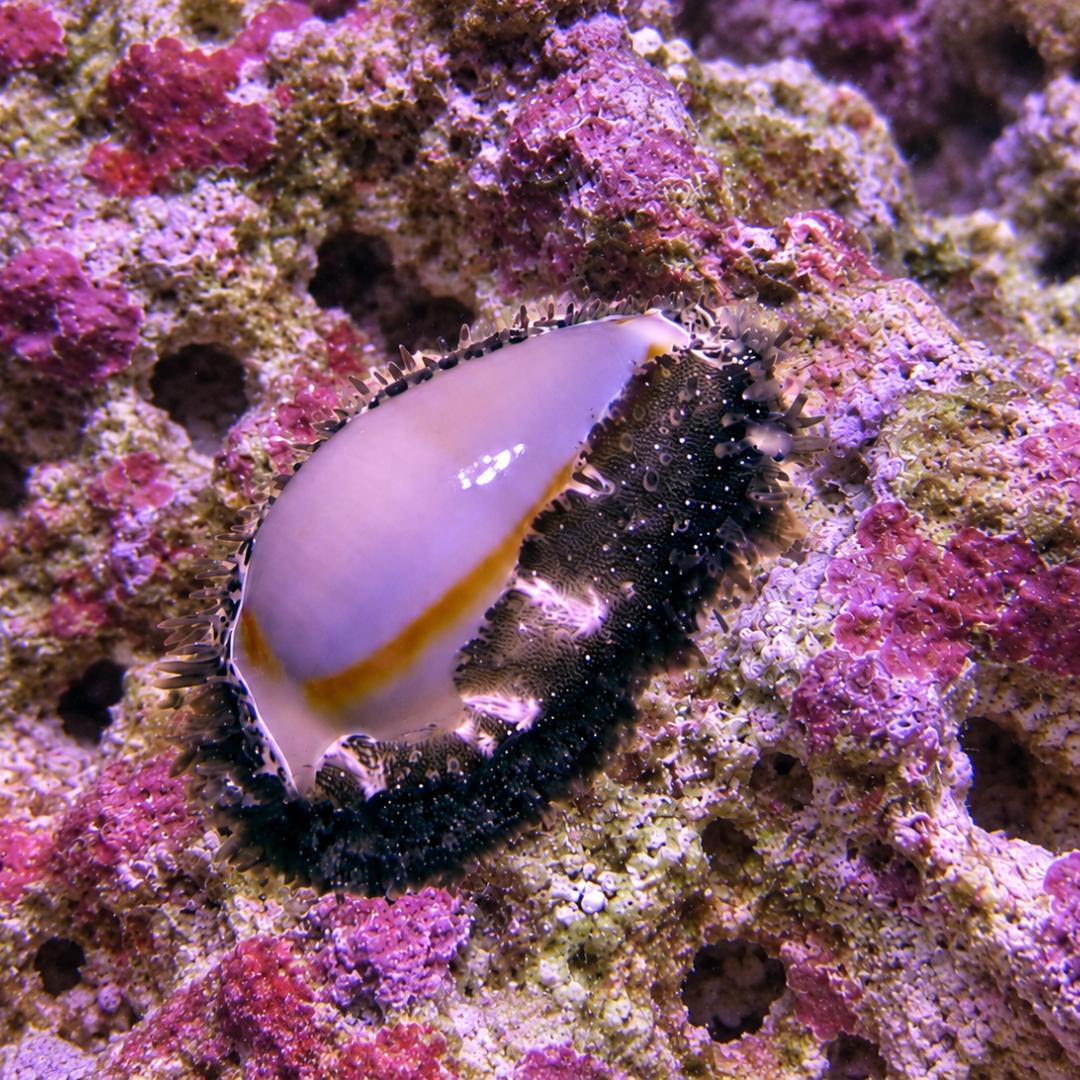
解説 / Description
ハナビラダカラは、インド太平洋の暖かい浅海域に広く分布する小型のタカラガイです。白から淡い灰色の殻に浮かぶ黄色から橙色の輪状模様が美しく、夜間には模様の入った外套膜で殻全体を覆う独特の姿も観察できます。海水水槽では岩やガラス面に付く藻類やデトリタスをついばむ性質から、景観を整える補助生体として親しまれています。 Monetaria annulus is a small cowrie widely distributed in warm shallow waters of the Indo-Pacific. Its shell is beautifully marked with a yellow to orange ring on a white to pale gray background, and at night it often covers the shell with its patterned mantle. In marine aquariums, it is appreciated as a helpful clean-up animal because it grazes on algae and detritus on rocks and glass surfaces.
基本情報 / Basic Information
| 学名 / Scientific Name | Monetaria annulus |
|---|---|
| 通称 / Common Name | ハナビラダカラ、リングタカラガイRing cowrie |
| 分類 / Family | 軟体動物門 腹足綱 吸腔目 タカラガイ科Phylum Mollusca, Class Gastropoda, Order Littorinimorpha, Family Cypraeidae |
| 英名 / English Name | Ring cowrie |
| 分布 / Distribution | インド洋から太平洋の熱帯・亜熱帯海域に広く分布し、日本では房総半島以南の暖流域で見られます。It is widely distributed in tropical and subtropical waters of the Indo-Pacific, and in Japan it occurs mainly south of the Boso Peninsula in warm current areas. |
| 最大体長 / Max Size | 一般的な殻長は2cm前後で、大きい個体では3cm前後に達することがあります。The shell is commonly around 2 cm long, and large individuals may reach about 3 cm. |
| 寿命 / Lifespan | 明確な定説は多くありませんが、飼育下では数年単位で維持される例があります。There is no firmly established lifespan, but in captivity it may be maintained for several years. |
飼育環境 / Aquarium Environment
| 水槽サイズ / Tank Size | 30cmキューブ水槽以上が目安です。水量では約25〜40L以上に相当し、安定性を考えると45cm水槽や60cm規格水槽でより管理しやすくなります。A 30 cm cube tank or larger is recommended. This generally corresponds to about 25-40 liters or more, and a 45 cm or standard 60 cm tank provides better stability and easier management. |
|---|---|
| 水温 / Temperature | 22〜26℃が目安です。急激な変化は避け、サンゴ水槽では24〜25℃前後での安定管理が向いています。 A range of 22-26°C is recommended. Avoid sudden fluctuations, and in reef tanks stable maintenance around 24-25°C is suitable. |
| 水質 / Water Quality | 海水魚・サンゴ水槽に準じた清浄な海水環境が適しています。比重1.021〜1.025、pH 8.1〜8.5を目安に、殻の維持のためカルシウムやアルカリ度も大きく崩さないようにします。Clean marine water conditions similar to those used for marine fish and coral tanks are suitable. A specific gravity of 1.021-1.025 and pH 8.1-8.5 are good targets, and calcium and alkalinity should remain reasonably stable for shell maintenance. |
| レイアウト / Layout | ライブロックを多めに組み、昼間に身を隠せる岩陰を作ると落ち着きやすくなります。底砂はアラゴナイトサンドなど一般的な海水用底砂で問題ありません。A layout with plenty of live rock and shaded hiding places helps it settle in. Standard marine substrates such as aragonite sand are suitable. |
| 注意点 / Precautions | 導入時は温度合わせと水合わせを丁寧に行い、餌となる藻類や付着物が少なすぎる環境では長期維持が難しくなります。また、甲殻類や貝類を捕食する生体との同居には注意が必要です。Acclimate carefully to temperature and water chemistry when introducing it. Long-term maintenance becomes difficult if there is too little natural grazing material, and caution is needed with animals that prey on crustaceans or snails. |
餌と給餌 / Feeding
| 餌の種類 / Diet | 自然下では藻類、バイオフィルム、デトリタスなどを食べます。水槽ではガラス面やライブロックに付くコケ類を主に利用し、不足する場合は沈下性の草食性人工飼料や甲殻類用ペレットを補助的に与えます。In nature it feeds on algae, biofilm, and detritus. In aquariums it mainly grazes on algae growing on glass and live rock, and if that is insufficient, sinking herbivorous prepared foods or pellets for crustaceans can be offered as supplements. |
|---|---|
| 給餌のポイント / Feeding Tips | もっとも注意したいのは餓餌不足です。小型水槽に複数導入すると短期間で自然発生する藻類を食べ尽くすことがあるため、動きが鈍る、ガラス面のコケが消えるといった変化が見られたら早めに補助給餌へ切り替えます。The most important point is preventing food shortage. If several individuals are added to a small tank, they may quickly consume naturally growing algae, so if they become less active or visible algae disappears from the glass, supplemental feeding should be started promptly. |
性格と混泳 / Temperament and Tank Mates
| 性格 / Temperament | おだやかで、ほかの生体を攻撃する性質はほとんどありません。昼間は岩陰で休み、夜間に活発に動き回る傾向があります。It is peaceful and rarely shows any aggression toward other tank inhabitants. It often rests in crevices during the day and becomes more active at night. |
|---|---|
| 混泳の相性 / Compatibility | 一般的なリーフタンクでは導入しやすい生体ですが、ヤドカリ類の一部や、貝を食べるベラ類などには捕食されるおそれがあります。サンゴそのものを食害する例は一般的ではありませんが、導入後は個体ごとの行動を観察すると安心です。It is generally easy to keep in a reef tank, but some hermit crabs and wrasses that feed on snails may prey on it. It is not generally known to feed on corals themselves, but observing each individual after introduction is still advisable. |
病気と対策 / Diseases and Prevention
| かかりやすい病気 / Common Diseases | 魚類のように病名がはっきり整理されることは少なく、衰弱の主因は水質悪化、急変、飢餓、捕食被害など環境要因によることが多いです。Specific diseases are less clearly categorized than in fish, and decline is often caused by environmental factors such as poor water quality, sudden changes, starvation, or predation. |
|---|---|
| 対策と予防 / Prevention | 急な水温・比重変化を避け、安定した海水環境を維持することが基本です。あわせて十分な隠れ家と摂餌面を確保し、捕食性の強い混泳相手を避けることで、長期維持しやすくなります。Avoid sudden changes in temperature and salinity, and maintain a stable marine environment. Providing enough hiding places and grazing surfaces, while avoiding strongly predatory tank mates, helps with long-term maintenance. |
増やし方(繁殖) / Breeding
| 雌雄の判別 / Sexing | 外見だけで確実に判別するのは容易ではありません。研究上は雌のほうがやや大きくなる傾向が示されていますが、水槽内での実用的な判別点としては使いにくい面があります。Reliable sexing by appearance alone is not easy. Studies suggest females may tend to be somewhat larger, but this is not always practical as a routine aquarium method. |
|---|---|
| 繁殖形態 / Reproduction | 卵を基質に産み付ける卵生です。雌は卵塊を保護する行動を示すことがあり、ふ化後はベリジャー幼生として海中を漂う生活段階を経ます。It is an egg-laying species that deposits eggs on hard substrates. Females may guard the egg mass, and after hatching the larvae pass through a planktonic veliger stage. |
| 繁殖のポイント / Breeding Tips | 繁殖生態自体は興味深いものの、幼生期が海中を漂うため、一般的な家庭用水槽で次世代を安定して育て上げるのは難しい部類です。情報なしではなく、挑戦例が限られるため難易度が高いと考えられます。Its breeding biology is fascinating, but raising the next generation in a typical home aquarium is difficult because the larvae spend time drifting in the water column. It is best regarded as challenging due to the limited number of successful examples. |
雑学と豆知識 / Trivia and Fun Facts
| 1. 学名に刻まれた歴史 / 1. History Embedded in the Scientific Name | ハナビラダカラの属名である Monetaria は「貨幣」を意味し、種小名 annulus は「輪」や「指輪」を意味します。これは、背面の輪状模様という見た目の特徴と、近縁種を含むタカラガイ類がかつて貝貨として重用された歴史の両方を映し出しています。小さな巻貝の名前に、人と海との長い関わりが静かに刻まれている点は、この種ならではの面白さです。The genus name Monetaria means “money,” while the species name annulus means “ring.” Together they reflect both the shell’s ring-like marking and the history of cowries, including close relatives, being used as shell money. It is fascinating that such a small mollusk carries both visual and cultural meaning in its name. |
|---|---|
| 2. 殻を守る外套膜の役割 / 2. The Protective Role of the Mantle | タカラガイ類の魅力としてよく語られるのが、夜になると殻を覆う外套膜です。この柔らかな組織は単なる飾りではなく、殻の表面を保護し、あの陶器のような光沢を保つ役割を担っていると考えられています。昼間に見えるつるりとした殻と、夜間に現れる生きた模様との対比は、観察するほどに印象深いものです。One of the most striking features of cowries is the mantle that often covers the shell at night. This soft tissue is not merely decorative; it is thought to help protect and maintain the shell’s glossy surface. The contrast between the polished shell seen by day and the living patterned mantle seen at night makes the species especially rewarding to observe. |
| 3. 海のクリーナーとしての実力 / 3. Its Role as a Marine Clean-Up Animal | 海水水槽でハナビラダカラが重宝されるのは、見た目の美しさだけが理由ではありません。岩やガラス面に付着した藻類や汚れを少しずつ食べ進めるため、水槽の景観維持に役立ちます。ただし、よく働くからこそ小型水槽では餌不足になりやすく、長く付き合うには見た目以上に飼育者の観察力が求められます。Monetaria annulus is valued in marine aquariums not only for its beauty but also for its steady grazing on algae and surface films. This makes it useful for keeping the tank tidy. At the same time, its efficiency means that in small tanks food can run short quickly, so successful long-term care depends greatly on the keeper’s observation. |
| 4. 人類史に残る貝貨の記憶 / 4. A Shell Remembered in Human History | タカラガイ類は、古くから装身具や交易品、そして地域によっては通貨として用いられてきました。ハナビラダカラもその流れの中で語られる種のひとつであり、海辺の小さな生き物が人の経済や文化と結びついてきた歴史を思い起こさせます。アクアリウムの中で見る一個体にも、自然史だけでは終わらない奥行きが感じられます。Cowries have long been used as ornaments, trade goods, and in some regions even as currency. Monetaria annulus is one of the species discussed within that historical tradition, reminding us that a small shoreline mollusk can also be connected to human economy and culture. Even a single aquarium specimen can evoke a story that reaches beyond natural history alone. |
| 5. 日本文化とのやわらかな接点 / 5. A Gentle Connection to Japanese Culture | 日本ではタカラガイ類が古くから装身具や呪術的な品として扱われてきた例が知られています。また、子安貝という呼び名で親しまれてきたタカラガイ類は、安産や護符と結びつくこともありました。ハナビラダカラを眺めていると、単なる水槽の添え物ではなく、人の暮らしや祈りに寄り添ってきた存在としての表情も見えてきます。In Japan, cowries have long been known as ornaments and sometimes as objects with ritual meaning. Cowries known as koyasugai were also associated with safe childbirth and amuletic use. Looking at Monetaria annulus in an aquarium, one can sense that it is more than a decorative tank inhabitant; it also belongs to a longer story of human life and belief. |
まとめ / Conclusion
ハナビラダカラは、美しい輪状模様と夜の外套膜の姿が印象的なだけでなく、海水水槽では藻類や付着物をついばむ頼もしい存在でもあります。小型で扱いやすい一方、長く元気に過ごしてもらうには、安定した水質と十分な餌場、そして捕食者を避ける配慮が欠かせません。 Monetaria annulus is impressive not only for its beautiful ring pattern and the mantle it reveals at night, but also for its helpful role in grazing algae and surface films in marine aquariums. Although small and manageable, it still requires stable water conditions, adequate feeding surfaces, and protection from predators for long-term well-being.
その小さな殻の中には、生態の巧みさ、海辺の暮らしへの適応、そして人との長い歴史が静かに重なっています。観察を重ねるほど、水槽の中で過ごす一匹の存在感が深まり、海の世界とのつながりを身近に感じさせてくれるでしょう。 Within its small shell lies a quiet layering of ecological adaptation, shoreline life, and a long relationship with people. The more closely it is observed, the more its presence deepens, offering a tangible connection to the wider world of the sea.

気になる道具や飼い方を見つけてみませんか?
 アイのアクアグッズ案内コリドラスのもふもふ時間を楽しむ|餌・底砂・お掃除用品の選び方コリドラスのもふもふする食事風景を楽しむために。沈む餌2種類の違い、口元に配慮した底砂、食べ残しを回収する道具を、アクアグッズナビゲーターのアイが紹介します。記事はコチラ →
 アイのアクアグッズ案内水槽用ヒーターの選び方|固定式・温度調節式と、水量に合うW数の考え方水槽の魚は冬に寒くない? アイとコタロウが水温計から固定式・温度調節式・分離式ヒーターまで比較。水量と室温に合うW数、設置場所、水換えや交換の注意点を、国内メーカーの商品とともに紹介します。記事はコチラ →
 アイのアクアグッズ案内金魚を長く楽しむ飼育用品|水槽・フィルター・エアレーション・水換え道具の特徴や使い方、選ぶときのポイントをアイが紹介します。記事はコチラ →
 アイのアクアグッズ案内水合わせの道具とやり方|魚を迎える前にそろえたい容器・点滴キット・ネット買ってきた魚はすぐ水槽に入れていい? 水温合わせと水合わせの違いから、透明ケース・点滴キット・ネットの選び方、時間をかけすぎない注意点まで、アイとコタロウが紹介します。記事はコチラ →
さまざまな飼育テーマをご紹介。リンク先の記事には広告・商品紹介が含まれます。
案内・紹介記事一覧へ →分布マップ
ハナビラダカラ(Monetaria annulus)は、インド洋から太平洋の熱帯・亜熱帯海域に広く分布し、日本では房総半島以南の暖流域で見られます。
※この地図は分布域を把握するための概略表示です。マーカーは分布域を示すために設定した代表地点であり、実際の採集地点や特定個体の確認地点を示すものではありません。
参考文献
-
WoRMS Editorial Board. Monetaria annulus (Linnaeus, 1758). World Register of Marine Species.
分類・学名
https://www.marinespecies.org/aphia.php?p=taxdetails&id=216875 -
JAMSTEC(海洋研究開発機構). 「Monetaria annulus ハナビラダカラ」Biological Information System for Marine Life(BISMaL).
分類・日本周辺の分布記録
https://www.godac.jamstec.go.jp/bismal/j/view/9042291 -
SeaLifeBase. Monetaria annulus, Gold ring cowrie.
分布・生息環境・水深
https://www.sealifebase.org/summary/Monetaria-annulus.html -
Katoh, M. (1989). Life history of the golden ring cowry Cypraea annulus (Mollusca: Gastropoda) on Okinawa Island, Japan. Marine Biology, 101, 227–234. DOI: 10.1007/BF00391462.
成長・繁殖・産卵・抱卵・飼育下での観察
https://doi.org/10.1007/BF00391462 -
Villamor, S. & Yamamoto, T. (2015). Reproductive seasonality of Monetaria annulus (Linnaeus, 1758) (Mollusca: Gastropoda: Cypraeidae) in a temperate area. Molluscan Research, 35(2), 95–101. DOI: 10.1080/13235818.2014.954660.
生息環境・繁殖期・雌雄判別・性的サイズ差
https://doi.org/10.1080/13235818.2014.954660 -
Villamor, S. & Yamamoto, T. (2015). Population characteristics of Monetaria annulus (Linnaeus, 1758) (Gastropoda: Cypraeidae) from temperate to tropical areas. Aquaculture Science, 63(3), 273–282. DOI: 10.11233/aquaculturesci.63.273.
日本・フィリピンの個体群、生育段階、雌雄差
https://www.jstage.jst.go.jp/article/aquaculturesci/63/3/63_273/_article -
Irie, T. & Morimoto, N. (2016). Intraspecific variations in shell calcification across thermal window and within constant temperatures: Experimental study on an intertidal gastropod Monetaria annulus. Journal of Experimental Marine Biology and Ecology, 483, 130–138. DOI: 10.1016/j.jembe.2016.07.006.
飼育温度・殻形成・成長段階
https://doi.org/10.1016/j.jembe.2016.07.006 -
Jiang, Z., Huang, D., Fang, Y., Cui, L., Zhao, C., Liu, S., Wu, Y., Chen, Q., Ranvilage, C. I. P. M., He, J., et al. (2020). Home for Marine Species: Seagrass Leaves as Vital Spawning Grounds and Food Source. Frontiers in Marine Science, 7, 194. DOI: 10.3389/fmars.2020.00194.
食性・海草藻場での生息・産卵場所
https://doi.org/10.3389/fmars.2020.00194




コメント