

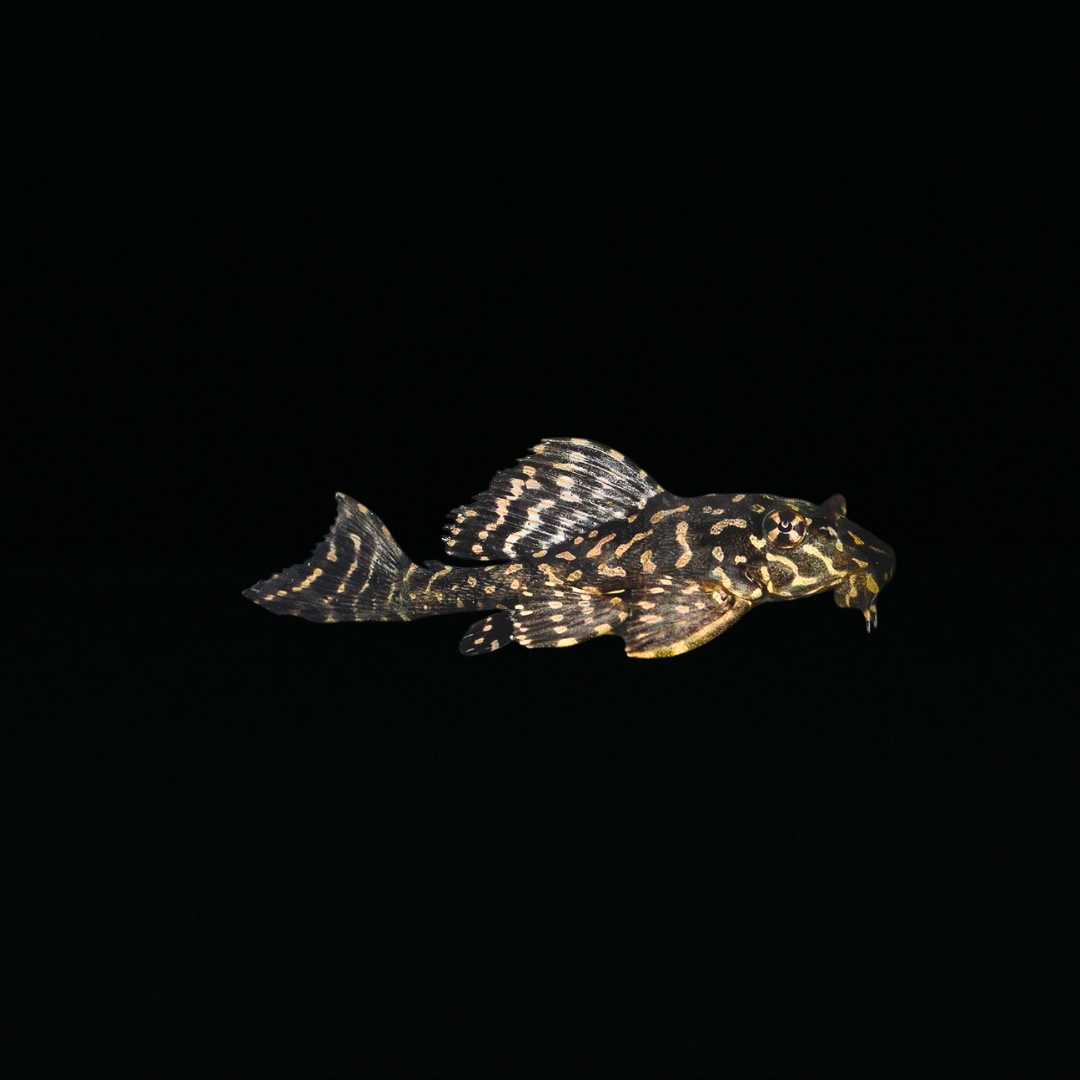
解説 / Description
オレンジスポットセルフィンプレコは、暗褐色の体に金色から黄白色のスポットが入る、ロリカリア科の大型プレコです。観賞魚の世界では「L001」として知られ、Lナンバー史の初期を象徴する種類としても親しまれています。幼魚は安価なコケ取り魚として販売されることがありますが、本来は30〜40cm級に成長する大型魚です。終生飼育には広い底面積を持つ水槽、強力なろ過、流木、そして大型魚としての長期管理が欠かせません。 The Orange Spot Sailfin Pleco is a large loricariid catfish with golden to yellowish-white spots over a dark brown body. In the aquarium hobby it is well known as “L001,” a historically important pleco from the early days of the L-number system. Although juveniles are sometimes sold inexpensively as algae eaters, this is a large fish that commonly reaches the 30–40 cm class. Lifelong care requires a spacious tank footprint, strong filtration, driftwood, and long-term management as a large aquarium fish.
基本情報 / Basic Information
| 学名 / Scientific Name | Pterygoplichthys joselimaianus |
|---|---|
| 通称 / Common Name | オレンジスポットセルフィンプレコ、ゴールドスポットプレコ、L001、L022Orange Spot Sailfin Pleco, Gold Spot Pleco, L001, L022 |
| 分類 / Family | ナマズ目ロリカリア科ヒポストムス亜科Order Siluriformes, family Loricariidae, subfamily Hypostominae |
| 英名 / English Name | Gold Spot Pleco / Orange Spot Sailfin Pleco / Marbled Sailfin Pleco |
| 分布 / Distribution | 南米ブラジルのトカンチンス川水系に分布します。観賞魚情報では、同水系のアラグアイア川流域を含めて語られることがあります。Native to the Tocantins River basin in Brazil, South America. Aquarium references often discuss it together with localities within the Tocantins-Araguaia system. |
| 最大体長 / Max Size | 資料上の最大値は約39.5cm SLです。飼育下では30cmを超える大型魚として扱い、尾ビレを含めた見た目の全長や体格を考えると、かなり広い水槽が必要です。The recorded maximum is about 39.5 cm SL. In aquaria it should be treated as a fish that can exceed 30 cm, and its apparent total length and heavy body require a very spacious tank. |
| 寿命 / Lifespan | 10年以上を見込む長期飼育対象です。寿命は水槽サイズ、水質、給餌、混泳ストレスによって大きく左右されます。A long-term aquarium fish that should be expected to live for more than 10 years. Lifespan depends greatly on tank size, water quality, diet, and social stress. |
飼育環境 / Aquarium Environment
| 水槽サイズ / Tank Size | 幼魚期のみ60cm規格水槽で育成できますが、15cm前後になったら90cm規格水槽以上へ移行します。成魚の終生飼育では最低でも120cm水槽、できれば120cmワイド水槽から150cm水槽を用意したい魚です。底生魚なので、水量だけでなく底面積の広さが重要です。Juveniles can be raised temporarily in a standard 60 cm tank, but around 15 cm they should be moved to at least a 90 cm tank. Adult lifelong care should be planned around at least a 120 cm tank, preferably a 120 cm wide tank or a 150 cm tank. As a bottom-dwelling fish, it needs floor space as much as water volume. |
|---|---|
| 水温 / Temperature | 24〜29℃を目安に、急変を避けて安定させます。冬季はヒーターで管理し、長時間の低水温にさらさないようにします。 Aim for a stable 24–29°C and avoid sudden changes. Use a heater in winter and do not expose the fish to prolonged low temperatures. |
| 水質 / Water Quality | 弱酸性から中性、pH6.5〜7.5前後を目安にします。比較的適応力は高いものの、大量の糞で硝酸塩が蓄積しやすいため、週1〜2回、30%程度の換水を基本にします。Slightly acidic to neutral water, around pH 6.5–7.5, is a good target. Although adaptable, it produces heavy waste, so a 30% water change once or twice a week is a practical baseline. |
| レイアウト / Layout | 大型化後はベアタンクが管理しやすく、糞の回収にも向きます。消化の助けと隠れ家を兼ねて、大きめの流木を必ず入れます。糞を集めるためにフィッシュレットや強めの水流を組み合わせると、日常管理が楽になります。A bare-bottom layout is easiest to manage once the fish grows large and is helpful for waste removal. Provide large driftwood as both shelter and a source of fiber. A bottom waste collector and planned water flow can make routine maintenance much easier. |
| 注意点 / Precautions | 「小型水槽のコケ取り係」として終生飼育できる魚ではありません。成長が早く、糞の量も多いため、強力な上部式フィルターや外部式フィルターを余裕を持って用意します。90cm以上の水槽では、ろ過器を複数台で運用する考え方が安全です。This is not a fish that can be kept for life as a small-tank algae cleaner. It grows quickly and produces heavy waste, so oversized overhead or canister filtration is strongly recommended. In tanks of 90 cm or larger, running multiple filters is often the safer approach. |
餌と給餌 / Feeding
| 餌の種類 / Diet | プレコ用タブレット、沈下性の人工飼料、ゆでた野菜、流木を中心に与えます。状態や成長段階に応じて、冷凍アカムシなどの動物性タンパク質を少量補助的に使うこともあります。幼魚は藻類をよく食べますが、成長後はコケだけでは栄養不足になります。Offer pleco tablets, sinking prepared foods, blanched vegetables, and driftwood as the main diet. Depending on condition and growth stage, small supplemental portions of animal protein such as frozen bloodworms may also be used. Juveniles graze algae readily, but algae alone is not enough for adults. |
|---|---|
| 給餌のポイント / Feeding Tips | 薄暗い時間帯から活発になるため、消灯前の給餌が有効です。1日〜2日に1回を目安に、食べ残しが出ない量を与えます。腹部がへこんでいる場合は栄養不足、逆に食べ残しが多い場合は水質悪化の原因になります。Feeding shortly before lights out is effective because the fish becomes active in dimmer conditions. Offer an amount it can finish without leftovers, usually once every one or two days. A sunken belly may indicate underfeeding, while excess leftovers quickly degrade water quality. |
性格と混泳 / Temperament and Tank Mates
| 性格 / Temperament | 幼魚期は比較的おとなしいものの、成長に伴って縄張り意識が出ます。同種や体型の近いプレコに対しては、体当たりや威嚇を行うことがあります。Juveniles are relatively calm, but territorial behavior appears as they grow. It may shove or threaten other plecos, especially those with a similar body shape or ecological niche. |
|---|---|
| 混泳の相性 / Compatibility | アロワナ、ダトニオ、オスカーなど、遊泳層が異なり体力のある大型魚とは相性がよい場合があります。一方、ディスカス、ポリプテルス、淡水エイなど、動きが緩慢で体表面積が広い魚は、体表の粘膜を舐められる危険があるため避けるのが無難です。小型魚は直接の捕食対象になりにくいものの、水槽サイズや水質管理の面で長期混泳には向きません。It can work well with robust large fish such as arowanas, datnioides, and oscars when swimming zones differ. Avoid slow-moving or broad-bodied fish such as discus, bichirs, and freshwater stingrays, as the pleco may rasp their mucus coating. Small fish are not usually direct prey, but long-term mixing is often unsuitable because of tank size and water-quality demands. |
病気と対策 / Diseases and Prevention
| かかりやすい病気 / Common Diseases | 丈夫な魚ですが、輸入直後、急な水温低下、水質悪化が重なると白点病や体表の荒れを起こすことがあります。ヒレの損傷や擦れ傷から細菌感染につながることもあります。It is a hardy fish, but newly imported individuals, sudden temperature drops, or poor water quality can lead to white spot disease or skin irritation. Fin damage or abrasions may also lead to bacterial infection. |
|---|---|
| 対策と予防 / Prevention | 安定した水温、強力なろ過、こまめな換水が最良の予防です。プレコ類は薬に敏感な場合があるため、治療時は薬品の種類と投薬量に注意し、使用前に製品説明を確認して慎重に対応します。Stable temperature, strong filtration, and regular water changes are the best prevention. Plecos can be sensitive to some medications, so choose treatments carefully, check product instructions, and dose cautiously. |
増やし方(繁殖) / Breeding
| 雌雄の判別 / Sexing | 成熟個体では、オスの方がヒレが大きく見える傾向があり、特に背ビレや胸ビレ周辺に差が出るとされます。ただし幼魚での判別は難しく、外見だけでの確実な判断はできません。In mature fish, males may appear to have larger fins, especially around the dorsal and pectoral fins. However, juveniles are difficult to sex, and visual identification is not fully reliable. |
|---|---|
| 繁殖形態 / Reproduction | 卵生です。Pterygoplichthys属の多くは自然下で岸辺に巣穴を掘って産卵し、オスが卵や稚魚を守る行動で知られます。Oviparous. Many Pterygoplichthys species are known to dig burrows in banks under natural conditions and for males to guard eggs and young. |
| 繁殖のポイント / Breeding Tips | 家庭水槽での繁殖は現実的には難しく、観賞魚流通では東南アジアなどの屋外池で繁殖された個体が多く出回ります。水槽内で狙う場合は、成熟サイズのペア、非常に広いスペース、巣穴に相当する構造物、安定した水質が必要になります。Breeding in a home aquarium is generally difficult. In the aquarium trade, many individuals are pond-bred in regions such as Southeast Asia. Attempting it in aquaria would require mature pairs, very large space, burrow-like structures, and stable water quality. |
雑学と豆知識 / Trivia and Fun Facts
| 1. Lナンバーの歴史を語るうえで欠かせない存在 / 1. An essential species in L-number history | 本種は、観賞魚流通で有名なLナンバーにおいて「L001」として知られる歴史的なプレコです。南米から多くの未記載・未整理のプレコが輸入され、学名だけでは市場での識別が追いつかなくなった時代に、Lナンバーは流通名と分類情報の橋渡しとして役立ちました。L001という番号は、オレンジスポットセルフィンプレコがアクアリウム史の中で早くから注目されていたことを示しています。This species is historically important because it is known in the aquarium trade as “L001.” When many undescribed or poorly sorted South American plecos entered the hobby and scientific names could not keep pace with commercial identification, L-numbers helped bridge trade names and taxonomic information. The number L001 shows how early this species attracted attention in aquarium history. |
|---|---|
| 2. L001とL022の関係 / 2. The relationship between L001 and L022 | L001とL022は、流通上はどちらもPterygoplichthys joselimaianusとして扱われることが多い番号です。愛好家向けの資料では、L001は黒っぽい地色、L022は褐色寄りの地色として紹介されることがあります。ただし、これは観賞魚流通上の色彩タイプの区別であり、番号が違うからといって別種とは限りません。L001 and L022 are often treated in the trade as forms of Pterygoplichthys joselimaianus. Hobby references may describe L001 as having a darker base color and L022 as a browner form. However, this is a trade-oriented distinction, so it is safest to understand them as color forms often treated as the same species or species-equivalent in the hobby. |
| 3. 旧学名が残ることがある理由 / 3. Why older scientific names may still appear | 本種は1991年にGlyptoperichthys joselimaianusとして記載されましたが、現在はPterygoplichthys joselimaianusとして扱われます。観賞魚の世界では、輸入名や販売名が長く残るため、古い書籍、ショップのリスト、海外サイトでは旧学名で見つかることもあります。学名の変遷を知っておくと、資料を読み比べるときに混乱しにくくなります。This species was described in 1991 as Glyptoperichthys joselimaianus, but it is currently treated as Pterygoplichthys joselimaianus. In the aquarium world, import names and trade names often persist for years, so older books, stock lists, and websites may still use the former name. Knowing this taxonomic history helps avoid confusion when comparing references. |
| 4. 低酸素への強さと空気呼吸 / 4. Tolerance of low oxygen and air breathing | 本種は補助的に空気呼吸を行う魚として扱われています。Pterygoplichthys属の仲間では、低酸素環境で空気を取り込み、消化管の一部をガス交換に利用することが知られています。これは乾季に水位が下がる環境で生き残るための優れた適応ですが、水槽内で水質悪化を放置してよいという意味ではありません。丈夫な魚ほど「死なないから大丈夫」と思われがちですが、健康に長生きさせるには清潔な水と十分な酸素供給が必要です。This species is regarded as a facultative air-breathing fish. In the genus Pterygoplichthys, members are known to take in air under low-oxygen conditions and use part of the digestive tract for gas exchange. This is an excellent adaptation for surviving seasonal low-water conditions, but it does not mean poor aquarium water quality is acceptable. Hardy fish are often misunderstood as being fine simply because they do not die easily, but clean water and adequate oxygenation are essential for long-term health. |
| 5. 「コケ取り魚」として買う前に知りたいこと / 5. What to know before buying it as an algae eater | 幼魚はよくコケを食べ、価格も手頃なため、初心者向けのお掃除役として販売されることがあります。しかし、成長すると体は大きく、糞も非常に多くなり、コケ取り能力よりも水槽への存在感の方が目立つようになります。本種は「便利な清掃係」ではなく、「長く付き合う大型プレコ」と考えて迎えるのが正しい向き合い方です。Juveniles graze algae readily and are often inexpensive, so they may be sold as beginner-friendly cleaners. As they grow, however, they become large, produce heavy waste, and their visual presence becomes far more important than their algae-eating role. This species should be approached not as a convenient maintenance tool, but as a large pleco to keep responsibly for many years. |
まとめ / Conclusion
オレンジスポットセルフィンプレコは、L001として知られる歴史的背景、美しいスポット模様、迫力ある背ビレを持つ魅力的な大型プレコです。丈夫で飼育しやすい面はありますが、それは小型水槽で気軽に終生飼育できるという意味ではありません。 The Orange Spot Sailfin Pleco is an attractive large pleco with the historical importance of L001, beautiful spotting, and an impressive dorsal fin. It is hardy and adaptable, but that does not mean it can be kept casually for life in a small aquarium.
長期飼育を考えるなら、120cm以上の水槽、強力なろ過、流木、定期的な換水、混泳相手への配慮が必要です。適切な設備で育てれば、単なるお掃除役ではなく、水槽の主役として長く楽しめる存在になります。 For long-term care, it needs a tank of 120 cm or larger, powerful filtration, driftwood, regular water changes, and careful selection of tank mates. With suitable equipment, it becomes not merely a cleaner fish, but a long-lived centerpiece with impressive presence.

気になる道具や飼い方を見つけてみませんか?
 アイのアクアグッズ案内水槽の中に波がある!? コタロウと探る、サンゴがゆらゆら揺れる秘密道具の特徴や使い方、選ぶときのポイントをアイが紹介します。記事はコチラ →
 アイのアクアグッズ案内金魚を長く楽しむ飼育用品|水槽・フィルター・エアレーション・水換え道具の特徴や使い方、選ぶときのポイントをアイが紹介します。記事はコチラ →
さまざまな飼育テーマをご紹介。リンク先の記事には広告・商品紹介が含まれます。
案内・紹介記事一覧へ →参考文献・参照資料
この記事では、分類、分布、生息環境、飼育条件、繁殖、病気や注意点を確認するため、店舗・通販サイト、個人ブログ、一般的なまとめサイトを除外し、魚類データベース、分類データベース、学術論文、獣医・大学系資料を中心に参照しました。
-
Froese, R. and Pauly, D. Editors. FishBase: Pterygoplichthys joselimaianus.
https://www.fishbase.se/summary/Pterygoplichthys-joselimaianus
分類、分布、淡水・底生という生息環境、熱帯域の水温、最大体長、通性空気呼吸、IUCN評価の確認に使用しました。この記事の基本情報と飼育水温の主要根拠です。 -
GBIF Secretariat. GBIF Backbone Taxonomy: Pterygoplichthys joselimaianus (Weber, 1991).
https://www.gbif.org/species/2339955
現在の受容学名、分類階級、旧学名 Glyptoperichthys joselimaianus の扱い、英名 Gold Spot Pleco などの確認に使用しました。 -
Weber, C. 1991. Nouveaux taxa dans Pterygoplichthys sensu lato (Pisces, Siluriformes, Loricariidae). Revue Suisse de Zoologie 98(3):637-643.
https://www.gbif.org/species/2339956
本種の原記載に関わる文献情報として参照しました。記事内では、記載年、旧属名、分類史の補助根拠として扱っています。 -
Scharpf, C. and Lazara, K. J. The ETYFish Project: Family Loricariidae, Subfamily Hypostominae.
https://etyfish.org/hypostominae/
属名 Pterygoplichthys と種小名 joselimaianus の語源・献名の確認に使用しました。雑学・豆知識内の学名解説を支える資料です。 -
ScotCat. Pterygoplichthys joselimaianus (Weber, 1991).
https://www.scotcat.com/loricariidae/pterygoplichthys_joselimaianus.htm
L001・L022の流通上の扱い、旧学名が残る点、成長後の縄張り性、大型水槽を前提とする飼育注意点、餌の幅広さを確認するために使用しました。商業販売サイトではないナマズ類専門データベースとして、趣味家向け情報の補助資料に限定して採用しています。 -
da Cruz, A. L., Fernandes, M. N., et al. 2016. What is the most efficient respiratory organ for the loricariid air-breathing fish Pterygoplichthys anisitsi, gills or stomach? Zoology.
https://www.sciencedirect.com/science/article/abs/pii/S0944200616300848
同属魚の鰓呼吸と胃を用いた空気呼吸の比較研究として参照しました。本種そのものではなく、Pterygoplichthys属の近縁種を対象とした研究です。 -
Orfinger, A. B. and Goodding, D. D. 2018. The Global Invasion of the Suckermouth Armored Catfish Genus Pterygoplichthys (Siluriformes: Loricariidae): Annotated List of Species, Distributional Summary, and Assessment of Impacts. Zoological Studies 57:7.
https://pmc.ncbi.nlm.nih.gov/articles/PMC6517723/
同属魚の外来化、強い環境適応、底生環境への影響、河岸の巣穴形成などの注意点を支える総説として参照しました。飼育放棄や放流を避けるべき理由の背景資料です。 -
Hossain, M. Y., et al. 2018. Amazon Sailfin Catfish Pterygoplichthys pardalis in Bangladesh: A Critical Review of Its Invasive Threat to Native and Endemic Aquatic Species. Fishes 3(1):14.
https://www.mdpi.com/2410-3888/3/1/14
同属近縁種の繁殖習性、巣穴形成、観賞魚由来の放流リスク、生態系影響を確認するために参照しました。本種そのものの繁殖記録としてではなく、Pterygoplichthys属に共通しやすい生態的注意点の補助資料として扱っています。 -
Merck Veterinary Manual. Parasitic Diseases of Fish.
https://www.merckvetmanual.com/exotic-and-laboratory-animals/aquarium-fish/parasitic-diseases-of-fish
白点病を含む魚類の寄生虫病、症状、治療時に複数回処置が必要になる理由を確認するために参照しました。病気と対策セクションの医学的背景資料です。 -
University of Florida IFAS Extension. Ichthyophthirius multifiliis (White Spot) Infections in Fish.
https://ask.ifas.ufl.edu/publication/FA006
白点病の生活環、水温と治療間隔の関係、薬剤使用時の注意、隔離・予防の考え方を確認するために参照しました。記事内の「薬品の種類と投薬量に注意し、慎重に対応する」という表現の根拠です。
注:飼育水槽サイズ、混泳可否、給餌量などは、魚の成長段階、個体差、水槽の底面積、ろ過能力、混泳魚の性格によって変わります。上記資料のうち、近縁種・同属種を扱う文献は、本種に直接断定せず、Pterygoplichthys属の生態的傾向を補助する目的で参照しています。




コメント