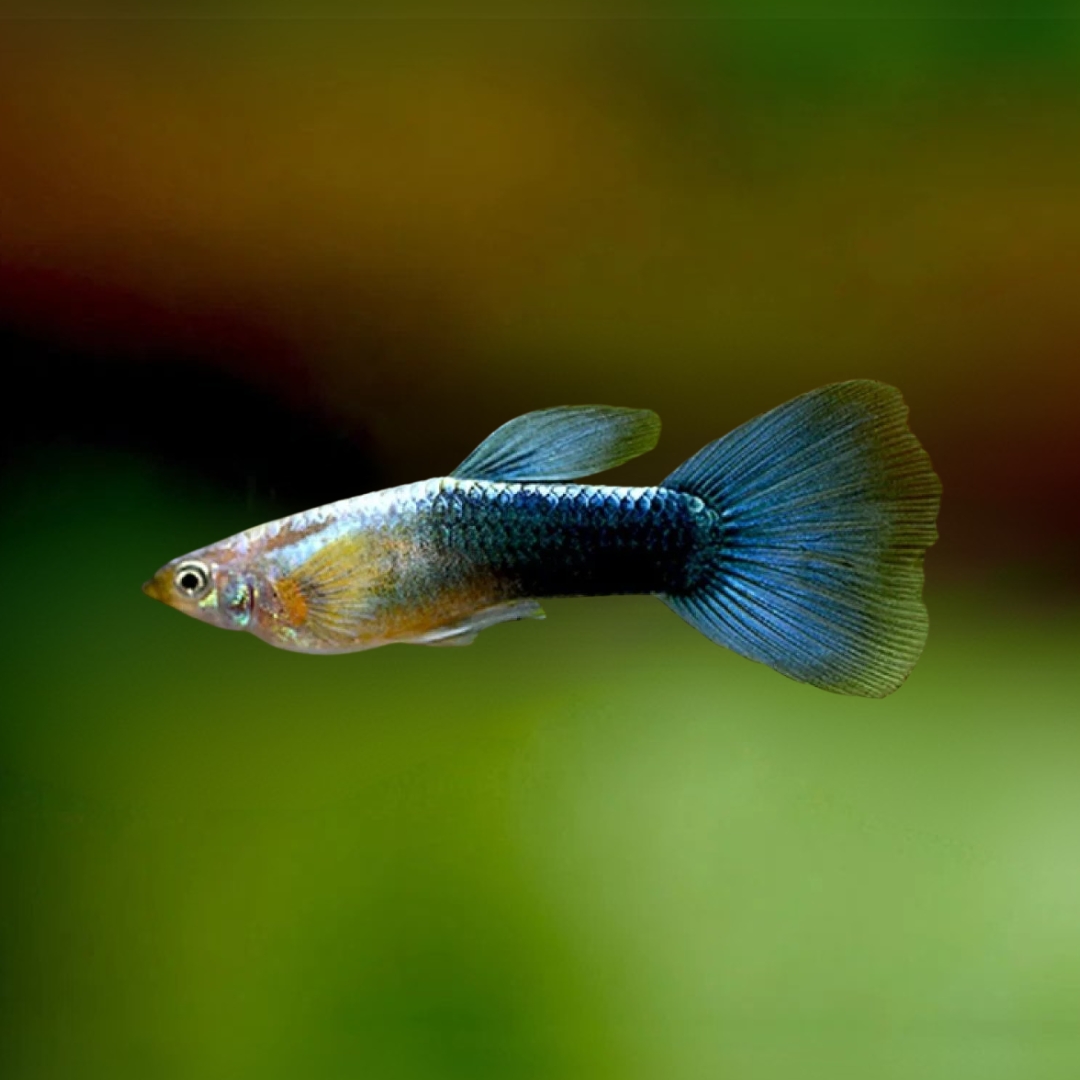
ネオンタキシードグッピーは、体の前半に見られる青緑からメタリックブルーの輝きと、体の後半を黒く引き締めるタキシード模様が印象的な改良グッピーです。光を受ける角度によって青い反射が変化し、水槽内を泳ぐ姿には小型魚らしい軽やかさと、改良品種ならではの華やかさがあります。一般的なグッピーと同じく飼育しやすい部類に入りますが、色彩を安定して楽しむには、水温の安定、清潔な水、導入時の隔離観察、由来の異なるグッピーを安易に混ぜない管理が大切です。The Neon Tuxedo Guppy is a selectively bred guppy known for its metallic blue to blue-green sheen on the front half of the body and a dark tuxedo-like pattern on the rear half. Its reflective coloration changes with the angle of light, giving the fish a vivid and elegant appearance in the aquarium. Like many guppies, it is generally easy to keep, but stable temperature, clean water, quarantine of new arrivals, and careful source management are important for maintaining its color and health.
カダヤシ目カダヤシ科グッピー属Order Cyprinodontiformes, family Poeciliidae, genus Poecilia
英名 / English Name
Neon Tuxedo Guppy
分布 / Distribution
原種のグッピーは南米北部からカリブ海周辺に分布します。本品種は観賞魚として作出・累代維持されている改良品種で、ネオンタキシードという名称のまま自然分布する野生型ではありません。Wild guppies are native to northern South America and parts of the Caribbean region. This strain is a selectively bred aquarium variety and does not occur in the wild under the name Neon Tuxedo.
最大体長 / Max Size
オス約3〜4cm、メス約4〜6cm。メスの方が大きく、体つきもふっくらしやすい傾向があります。Males grow to about 3–4 cm, while females grow to about 4–6 cm. Females are usually larger and fuller-bodied.
寿命 / Lifespan
およそ1〜2年。水温を高めに維持すると代謝が上がり、成長や繁殖は進みやすくなりますが、寿命はやや短くなる傾向があります。Approximately 1–2 years. Warmer water can promote growth and breeding, but it may also shorten the fish’s lifespan by increasing metabolism.
飼育環境 / Aquarium Environment
水槽サイズ / Tank Size
ペアや少数飼育なら30cm規格水槽から可能ですが、水質の安定や繁殖を考えると45cm規格水槽以上が扱いやすいです。複数ペアで楽しむ場合は60cm規格水槽を用意すると、泳ぐ余裕と稚魚の隠れ場所を確保しやすくなります。A 30 cm standard tank can work for a pair or small group, but a 45 cm standard tank or larger is easier to manage for stable water quality and breeding. For multiple pairs, a 60 cm standard tank provides more swimming space and better hiding areas for fry.
水温 / Temperature
23〜26℃前後が扱いやすい範囲です。20〜28℃程度まで適応しますが、急な温度変化は白点病や細菌性トラブルのきっかけになりやすいため、季節に応じてヒーターや冷却ファンを使い水温を安定させることが重要です。Around 23–26°C is a practical range. The fish can tolerate roughly 20–28°C, but sudden temperature swings can trigger ich or bacterial problems, so heaters or cooling fans should be used as needed.
水質 / Water Quality
中性から弱アルカリ性を好み、pH6.8〜7.8前後を目安にすると安定しやすいです。極端に酸性へ傾く環境や、立ち上げ直後でアンモニア・亜硝酸が出やすい環境は避けます。低pHに傾きやすいソイル環境では調子を崩すことがあるため、地域の水道水が非常に軟らかい場合は、サンゴ砂やミネラル添加剤を少量使い、急変させずに調整すると安心です。Neutral to slightly alkaline water is preferred, with a practical target around pH 6.8–7.8. Avoid strongly acidic conditions and newly set up tanks where ammonia or nitrite may appear. Soil-based planted tanks that drift toward low pH can be unsuitable, so in very soft tap water areas, a small amount of coral sand or mineral supplement can help, but changes should be gradual.
レイアウト / Layout
遊泳スペースを残しつつ、マツモ、ウィローモス、浮き草、細かい葉の水草を入れると稚魚や弱い個体の隠れ家になります。青い体色と黒いタキシード模様を引き立てるには、明るすぎない底床や水草を背景にしたレイアウトがよく合います。Keep open swimming space while adding plants such as hornwort, Java moss, floating plants, or fine-leaved plants for fry and weaker individuals to hide. A planted layout with a moderately dark substrate can enhance the blue sheen and black tuxedo pattern.
注意点 / Precautions
グッピーは丈夫な魚として知られますが、由来の異なる個体を急に混ぜると、環境差や常在菌への耐性差で体調を崩すことがあります。国産・外国産という区分だけでなく、別の店や別の水槽で管理されていた個体を合流させる場合も、十分な隔離観察を行うことが大切です。Guppies are known as hardy fish, but suddenly mixing fish from different sources can cause problems due to differences in environment and tolerance to resident bacteria. Quarantine is important not only between domestic and imported strains, but also between fish from different shops or tanks.
餌と給餌 / Feeding
餌の種類 / Diet
雑食性で、グッピー用のフレークフード、細かい顆粒飼料、冷凍アカムシ、冷凍ミジンコ、ブラインシュリンプなどを食べます。主食は栄養バランスのよい人工飼料にし、補助的に冷凍飼料やブラインシュリンプを与えると、成長やコンディション維持に役立ちます。This omnivorous guppy accepts guppy flakes, fine granules, frozen bloodworms, frozen daphnia, and brine shrimp. A balanced prepared food should be the staple, with frozen or live foods used as supplements to support growth and condition.
給餌のポイント / Feeding Tips
1日1〜2回、数分で食べ切れる量を与えます。食べ残しは水質悪化の原因になり、グッピーの尾腐れや体調不良につながりやすいため、少量をこまめに与える方が安定します。稚魚には細かく砕いた人工飼料やブラインシュリンプの幼生を与えると育てやすいです。Feed once or twice a day, only as much as the fish can finish within a few minutes. Leftover food can quickly degrade water quality and increase the risk of fin rot or poor condition. Fry do well on finely crushed prepared food and newly hatched brine shrimp.
性格と混泳 / Temperament and Tank Mates
性格 / Temperament
基本的には温和で、活発に泳ぐ小型魚です。オス同士で軽い追いかけ合いをすることはありますが、通常は深刻な争いにはなりにくいです。ただし、メスが少ない環境ではオスの求愛が集中しやすいため、繁殖を狙う場合はオス1に対してメス2〜3程度の比率にすると負担を分散しやすくなります。It is generally peaceful and active. Males may chase each other lightly, but serious fighting is uncommon. If breeding is intended, keeping one male with two or three females helps reduce pressure from constant courtship.
混泳の相性 / Compatibility
同じく温和で中性付近の水質を好む小型魚、コリドラス、オトシンクルスなどとは混泳しやすいです。一方で、ベタやスマトラのようにヒレをかじる可能性がある魚、大型魚、強い酸性水を好む魚との混泳は避けた方が無難です。他系統のグッピーと混泳させると同種内で交雑し、ネオンタキシードらしい表現を維持しにくくなるため、品種維持を目的とする場合は単独系統で管理することが重要です。It is compatible with peaceful small fish that prefer near-neutral water, as well as Corydoras and Otocinclus. Avoid fin-nipping fish such as tiger barbs, aggressive or large fish, and species that require strongly acidic water. If strain maintenance is important, do not mix it with other guppy strains because interbreeding within the species will make the Neon Tuxedo traits difficult to preserve.
病気と対策 / Diseases and Prevention
かかりやすい病気 / Common Diseases
白点病、尾腐れ病、カラムナリス症、水カビ病、ハリ病と呼ばれるヒレを閉じる不調などに注意します。また、国内のグッピー飼育では「グッピーエイズ」と俗称される急性の不調が語られることがありますが、これは正式な単一病名として断定するよりも、由来の異なるグッピーを混ぜた際に起こり得る重い感染性・環境性トラブルの総称として、慎重に理解しておく方が安全です。Watch for ich, fin rot, columnaris-like bacterial problems, fungal infections, and clamped fins. In Japanese guppy keeping, the informal term “guppy AIDS” is sometimes used, but it is safer to understand it cautiously as a broad description of severe infectious or environmental problems that may occur when guppies from different sources are mixed, rather than as a single formal disease name.
対策と予防 / Prevention
新しく迎えた個体は、すぐに本水槽へ入れず、別容器で1〜2週間ほど状態を観察すると安心です。水温の急変、過密、餌の与えすぎ、濾過不足を避け、週1回を目安に20〜30%の部分換水を行います。初期の体調不良では隔離して0.3〜0.5%程度の塩水浴を検討できますが、水草、エビ、貝には負担が大きいため、本水槽ではなく治療用の容器で行うことが必要です。症状が進んでいる場合は、原因を見極めながら観賞魚用の抗菌薬や白点病薬を適切に使います。New fish should be observed in a separate quarantine container for about one to two weeks before introduction. Avoid sudden temperature changes, overcrowding, overfeeding, and insufficient filtration, and perform a 20–30% partial water change about once a week. For early signs of stress, a separate 0.3–0.5% salt bath may be considered, but it should not be done in a planted or invertebrate tank. If symptoms progress, appropriate aquarium medications should be used according to the likely cause.
増やし方(繁殖) / Breeding
雌雄の判別 / Sexing
オスは体が小さく、尾ビレや体色が鮮やかで、尻ビレが交接器であるゴノポディウムに変化しています。メスは体が大きく、色彩は控えめで、腹部がふっくらしやすいです。妊娠が進むと腹部後方の黒っぽい妊娠斑が目立つことがあります。Males are smaller, more colorful, and have a modified anal fin called a gonopodium. Females are larger, less colorful, and fuller-bodied. A dark gravid spot near the rear of the abdomen may become visible as pregnancy progresses.
繁殖形態 / Reproduction
卵胎生として扱われる繁殖形態です。メスの体内で受精卵が発育し、卵ではなく泳げる状態の稚魚を産みます。条件が合うと約1ヶ月前後の周期で出産し、個体の大きさやコンディションによって一度に十数匹から数十匹の稚魚を産むことがあります。It is generally described as a livebearing or ovoviviparous fish in aquarium keeping. Fertilized eggs develop inside the female, and she gives birth to free-swimming fry rather than laying eggs. Under good conditions, females may give birth roughly every month, producing from a dozen to several dozen fry depending on size and condition.
繁殖のポイント / Breeding Tips
親魚は稚魚を食べることがあるため、繁殖を重視する場合は産卵箱や育成水槽を使うか、浮き草やモスを多めに入れて隠れ家を作ります。ネオンタキシードらしい色彩を維持したい場合は、同じ表現の個体を選別しながら累代し、他系統のグッピーと交雑させない管理が必要です。ただし、青みや黒の入り方は個体差が出やすいため、次世代の中から目的に近い個体を残す選別が大切です。Adults may eat fry, so use a breeder box, a separate rearing tank, or dense floating plants and moss if fry survival is important. To maintain the Neon Tuxedo appearance, breed only selected individuals from the same strain and avoid crossing with other guppy strains. The intensity of blue and the black tuxedo pattern can vary, so selecting the best young fish is important.
雑学と豆知識 / Trivia and Fun Facts
1. ネオンの輝きは「青い色素」だけでは語れない / 1. The neon sheen is not simply a blue pigment
ネオンタキシードグッピーの青い輝きは、単に青い絵の具を塗ったような色ではありません。グッピーの体表には、光を反射する虹色素胞が関わっており、光の当たり方によって青緑から金属的なブルーへと見え方が変化します。この構造的な輝きに、尾筒から後半部へ入る黒いタキシード模様が重なることで、前半は明るく、後半は引き締まって見える独特のコントラストが生まれます。水草の陰から明るい場所へ泳ぎ出た瞬間に印象が変わるのは、この反射性の色彩が強く関わっているためです。The blue sheen of the Neon Tuxedo Guppy is not just a simple blue pigment. Reflective iridophores in the skin help create a metallic blue to blue-green appearance that changes with the angle of light. When this reflective front half is combined with the dark tuxedo pattern on the rear body, the fish gains its distinctive contrast. This is why the fish can look different as it swims from shade into brighter light.
2. タキシード模様は品種の印象を決める重要な要素 / 2. The tuxedo pattern defines the strain’s impression
グッピーの「タキシード」とは、体の後半部が黒く染まる表現を指す流通・品種上の呼び名です。ネオンタキシードでは、この黒い領域が濃く、境目が整っているほど、前半のメタリックな輝きとの対比が強くなります。ブリードでは尾ビレの形や色も重要ですが、タキシード部分の濃さや入り方は、品種名らしさを左右する大きな見どころです。In guppies, “tuxedo” refers to a strain pattern in which the rear part of the body is dark. In the Neon Tuxedo Guppy, a deeper and cleaner dark area creates stronger contrast with the metallic front half. Tail shape and color are important in breeding, but the density and placement of the tuxedo pattern are key features that define the strain.
3. グッピーは小さくても社会性のある魚 / 3. Guppies are small but socially aware fish
グッピーは単に繁殖しやすい小型魚というだけでなく、行動研究の対象としてもよく知られています。オス同士の距離感、メスへの求愛、群れの中での反応などを観察すると、個体ごとに行動の強さや慎重さが異なることに気づきます。水槽内でも、よく泳ぐ個体、餌にすぐ反応する個体、やや控えめな個体が見られ、飼い込むほど「同じ品種でも一匹ずつ違う」と感じられる魚です。Guppies are not only easy-to-breed small fish; they are also well known in behavioral studies. When observing male interactions, courtship, and group responses, differences in boldness and activity can be seen among individuals. In the aquarium, some fish are active, some respond quickly to food, and others are more cautious, making each individual feel distinct over time.
4. 国産と外国産を分けて考える理由 / 4. Why domestic and imported guppies are often managed separately
日本のグッピー飼育では、国産系統と外国産系統を安易に混ぜないという考え方がよく語られます。これは優劣の問題ではなく、育ってきた環境、輸送歴、持っている常在菌、病原体への耐性が異なるためです。見た目には元気でも、別の系統と合流した後に一方だけが急に崩れることがあり、特に大切に維持している系統では大きな損失になります。ネオンタキシードグッピーを長く楽しむには、購入元をそろえる、導入時に隔離する、器具の使い回しに注意するという基本的な防疫が重要です。In Japan, aquarists often avoid mixing domestic and imported guppy lines. This is not about one being superior to the other, but about differences in rearing environment, transport history, resident bacteria, and disease resistance. Even healthy-looking fish can cause problems when mixed with a different source. To keep Neon Tuxedo Guppies successfully, it is important to buy from consistent sources, quarantine new fish, and avoid careless sharing of equipment between tanks.
5. 「var.」を付けずに学名を書く理由 / 5. Why the strain name is not added to the scientific name
観賞魚の資料では、改良品種であることを示すために Poecilia reticulata var. のような書き方が見られることがあります。ただし、ネオンタキシードグッピーは正式な分類学上の亜種や変種として記載されたものではなく、観賞魚流通上の品種名・系統名として扱うのが自然です。そのため図鑑記事では、学名は種としての Poecilia reticulata にとどめ、品種名は通称や解説で示す形にしています。Aquarium materials sometimes write names such as Poecilia reticulata var. to indicate a selectively bred form. However, the Neon Tuxedo Guppy is not a formally described taxonomic variety or subspecies. It is better treated as a trade strain name, so this article keeps the scientific name as Poecilia reticulata and explains the strain name separately.
まとめ / Conclusion
ネオンタキシードグッピーは、メタリックな青い輝きと黒いタキシード模様の対比が美しい、改良グッピーらしい魅力を持つ品種です。小型で飼育しやすく、繁殖も狙いやすい一方で、系統を維持するには他のグッピーと混ぜず、良い個体を選びながら累代していく意識が必要です。The Neon Tuxedo Guppy is a beautiful selectively bred guppy with a striking contrast between metallic blue sheen and a dark tuxedo pattern. It is small, relatively easy to keep, and suitable for breeding, but maintaining the strain requires avoiding crosses with other guppies and selecting good individuals over generations.
飼育では、水温と水質を安定させ、餌を与えすぎず、導入時の隔離観察を行うことが大切です。派手さだけでなく、光の角度で変化する体色や、個体ごとの行動の違いをじっくり観察すると、ネオンタキシードグッピーの魅力をより深く楽しめます。For successful care, keep temperature and water quality stable, avoid overfeeding, and quarantine new arrivals. Beyond its showy appearance, careful observation of its changing reflective colors and individual behavior makes this strain even more rewarding to keep.
Sogawa, S., Kohda, M. and colleagues. 2023. Male Guppies Recognize Familiar Conspecific Males by Their Face Rather Than Body Coloration. Zoological Science.
https://pubmed.ncbi.nlm.nih.gov/37042696/
Declercq, A. M., Haesebrouck, F., Van den Broeck, W., Bossier, P. and Decostere, A. 2013. Columnaris disease in fish: a review with emphasis on bacterium-host interactions. Veterinary Research.
https://pmc.ncbi.nlm.nih.gov/articles/PMC3648355/



 アイのアクアグッズ案内バルブの仲間に合わせる飼育用品|チェリーバルブ・スマトラ・中型種の水槽とろ過道具の特徴や使い方、選ぶときのポイントをアイが紹介します。記事はコチラ →
 アイのアクアグッズ案内ベタの一匹飼いを楽しむ|水槽・ヒーター・ふた・フィルターの選び方ベタの一匹飼いに向く水槽容量、ふたと空気層、ヒーターと水温計、弱い水流のフィルターを、コタロウとアイの会話で分かりやすく解説します。記事はコチラ →



コメント