

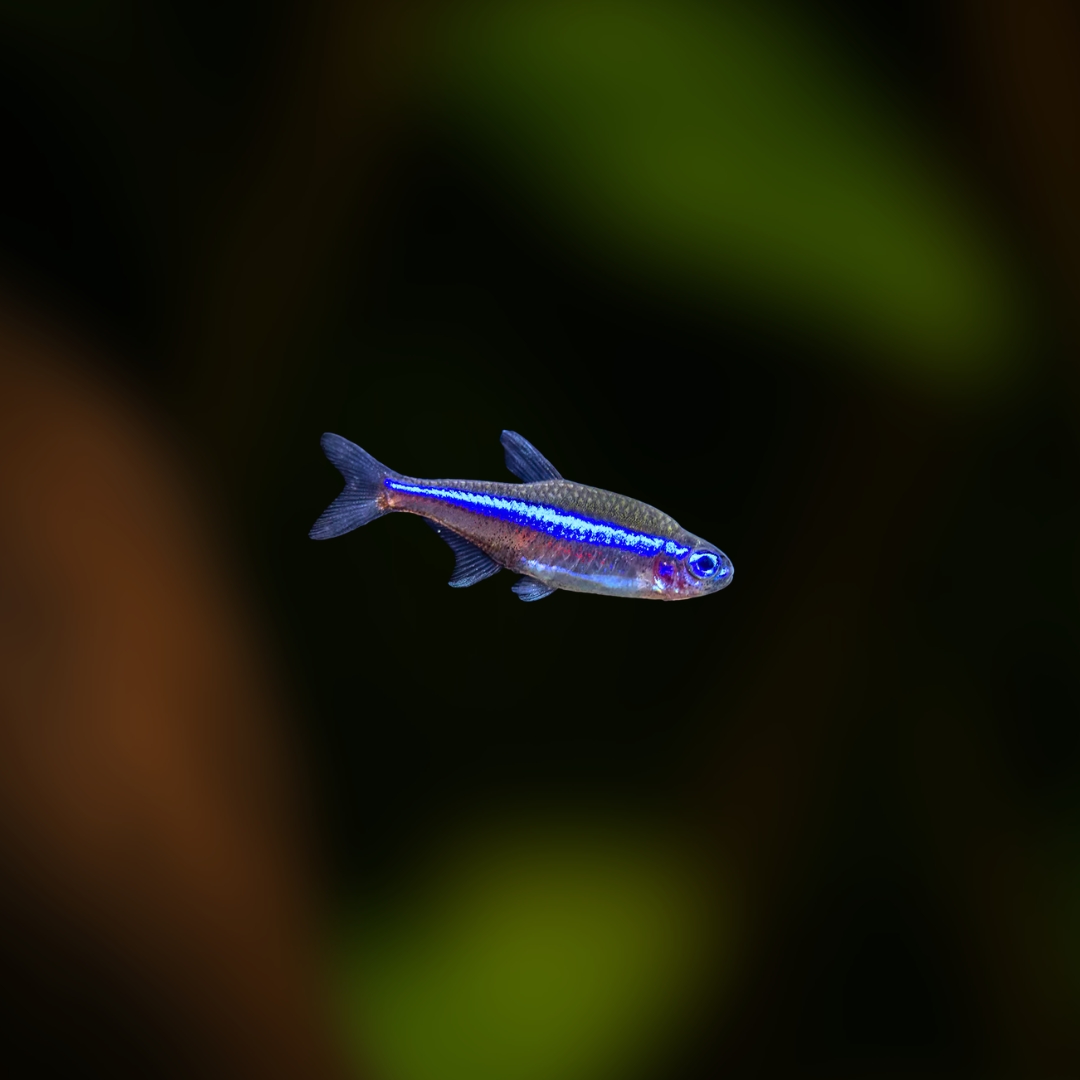
解説 / Description
グリーンネオンテトラは、南米のネグロ川水系やオリノコ川水系に分布する小型カラシンです。ネオンテトラやカージナルテトラに近い仲間ですが、成魚でも約3.0〜3.5cmほどとより小柄で、体側の青緑色のラインが尾びれの付け根近くまで長く伸びる点が大きな魅力です。赤い色彩は控えめで、水草レイアウトの緑や流木の影とよくなじみ、群泳させると繊細な光の筋が水景の中を流れるように見えます。 The Green Neon Tetra is a small characin native to the Negro and Orinoco river systems of South America. It is closely related to the Neon Tetra and Cardinal Tetra, but it remains smaller at about 3.0–3.5 cm as an adult. Its most attractive feature is the long blue-green lateral stripe that extends close to the base of the tail. Because the red coloration is subdued, it blends beautifully with aquatic plants and driftwood shadows, creating the impression of delicate streaks of light moving through a planted aquascape.
基本情報 / Basic Information
| 学名 / Scientific Name | Paracheirodon simulans |
|---|---|
| 通称 / Common Name | グリーンネオンテトラ、パラケイロドン・シムランスGreen Neon Tetra |
| 分類 / Family | カラシン目 カラシン科 パラケイロドン属Order Characiformes, family Characidae, genus Paracheirodon |
| 英名 / English Name | Green Neon Tetra |
| 分布 / Distribution | ブラジルのネグロ川上中流域、コロンビアおよびベネズエラにまたがるオリノコ川流域。主にブラックウォーターの支流、イガラッペ、水没林周辺の穏やかな浅瀬に生息します。Upper to middle reaches of the Rio Negro in Brazil and the Orinoco basin across Colombia and Venezuela. It is mainly found in calm, shallow blackwater tributaries, forest streams, and flooded forest habitats. |
| 最大体長 / Max Size | 約3.0〜3.5cmAbout 3.0–3.5 cm |
| 寿命 / Lifespan | 飼育下では一般に2〜3年程度。安定した水質と適切な給餌管理のもとでは、さらに長く維持できる場合があります。Usually about 2–3 years in aquaria. With stable water quality and careful feeding, some individuals may live longer. |
飼育環境 / Aquarium Environment
| 水槽サイズ / Tank Size | 最低限は20L前後、30cm規格水槽相当から飼育可能です。ただし本種の魅力は群泳にあるため、10匹以上、できれば20匹以上で、60cm規格水槽程度の水量を確保すると行動も発色も安定しやすくなります。A small group can be kept from around 20 L, roughly equivalent to a standard 30 cm tank. However, its real appeal is schooling behavior, so a group of 10 or more, ideally 20 or more, in a standard 60 cm tank provides better stability and display. |
|---|---|
| 水温 / Temperature | 23〜27℃を目安に管理します。生存可能範囲はおおむね20〜28℃ですが、急激な変化は避け、夏場の高水温と冬場の低水温には注意します。 Maintain around 23–27°C. Although it can generally tolerate about 20–28°C, sudden changes should be avoided, with attention to overheating in summer and chilling in winter. |
| 水質 / Water Quality | 弱酸性から中性寄りの軟水を好みます。長期飼育ではpH5.5〜6.5、GH1〜10程度を目安にするとよく、日本の多くの地域の水道水はベースとして使いやすい水質です。水草用ソイルや流木を用いると、自然に弱酸性へ寄せやすくなります。It prefers soft water from mildly acidic to near neutral. For long-term care, aim for roughly pH 5.5–6.5 and GH 1–10. Tap water in many parts of Japan is often a suitable base. Aquatic plant soil and driftwood can help keep the water mildly acidic. |
| レイアウト / Layout | 密に茂った水草、流木、暗めの背景、適度な影を組み合わせると落ち着きやすくなります。ブラックウォーターを再現する場合はマジックリーフやヤシャブシの実も有効ですが、水の黄ばみを避けたい水草レイアウトでは、ソイルや流木で弱酸性を保つ方法が扱いやすいです。Dense aquatic plants, driftwood, a darker background, and shaded areas help the fish feel secure. Indian almond leaves or alder cones can be used for a blackwater effect, but in planted aquascapes where tinted water is not desired, soil and driftwood are often easier ways to maintain mildly acidic conditions. |
| 注意点 / Precautions | 導入初期は水質変化に敏感です。ショップの水と自宅の水槽水を点滴法などで時間をかけて合わせ、pHショックや浸透圧ストレスを避けてください。また、ろ過が未成熟な水槽ではアンモニアや亜硝酸の影響を受けやすいため、十分に立ち上げた水槽へ導入することが大切です。Newly introduced fish can be sensitive to changes in water chemistry. Use slow acclimation, such as the drip method, to reduce pH shock and osmotic stress. Because immature filtration can expose them to ammonia and nitrite, introduce them only to a well-cycled aquarium. |
餌と給餌 / Feeding
| 餌の種類 / Diet | 小型カラシン用の微細な顆粒フード、細かく砕いたフレークフードを主食にできます。発色やコンディションを高めたいときは、孵化したてのブラインシュリンプ、冷凍ミジンコ、冷凍サイクロプス、冷凍ベビーアカムシなどを補助的に与えるとよいでしょう。Fine granules for small characins and finely crushed flake foods work well as staples. To improve condition and coloration, newly hatched brine shrimp, frozen daphnia, frozen cyclops, or frozen baby bloodworms can be offered as supplementary foods. |
|---|---|
| 給餌のポイント / Feeding Tips | 口が小さく、痩せやすい傾向もあるため、1日1回にまとめて大量に与えるより、1日2〜3回、2〜3分で食べ切れる少量を与える方法が向いています。残餌は水質悪化の原因になるため、食べ残しが出る量は避けてください。Because the mouth is very small and the fish can become thin if underfed, it is better to offer small meals 2–3 times per day rather than one large feeding. Each meal should be eaten within 2–3 minutes, and uneaten food should be avoided to protect water quality. |
性格と混泳 / Temperament and Tank Mates
| 性格 / Temperament | 非常に温和で、他魚を攻撃したりヒレをかじったりすることはほとんどありません。臆病な面があるため、少数飼育よりも群れで飼育した方が落ち着きやすく、自然な群泳行動も観察しやすくなります。It is very peaceful and rarely attacks tank mates or nips fins. Because it can be shy, it feels more secure in a group than in very small numbers, and schooling behavior becomes easier to observe. |
|---|---|
| 混泳の相性 / Compatibility | ラスボラ・エスペイ、ペンシルフィッシュ、レッドファントムテトラなどの温和な小型魚、コリドラス、オトシンクルス、ヤマトヌマエビなどと相性が良好です。エンゼルフィッシュやディスカスなど口の大きな魚、アベニーパファーのようにヒレをかじりやすい魚との混泳は避けます。Good tank mates include peaceful small fish such as Harlequin Rasboras, pencilfish, and Red Phantom Tetras, as well as Corydoras, Otocinclus, and Amano shrimp. Avoid larger fish with big mouths, such as angelfish or discus, and fin-nipping species such as dwarf puffers. |
病気と対策 / Diseases and Prevention
| かかりやすい病気 / Common Diseases | 導入時のストレスや水温変化、水質悪化があると、白点病、尾腐れ病、カラムナリス症、いわゆるネオン病に似た退色や遊泳異常が見られることがあります。青緑のラインの一部が白く濁る、群れから離れる、体をこすりつける、ヒレが溶けるように欠けるといった変化は早期対応のサインです。Stress during introduction, temperature swings, or declining water quality can lead to ich, fin rot, columnaris, or symptoms resembling neon tetra disease, such as fading and abnormal swimming. Warning signs include whitening of the blue-green stripe, leaving the school, rubbing against objects, or fraying fins. |
|---|---|
| 対策と予防 / Prevention | 新規導入魚は可能であれば1〜2週間トリートメント水槽で観察し、本水槽へ病原体を持ち込まないようにします。水換えは1〜2週間に1回、全水量の4分の1〜3分の1程度を目安にし、大量換水による急変は避けます。白点病では水温を急に上げず段階的に調整し、症状に応じて観賞魚用薬を使います。細菌性の症状では隔離、清潔な水、適切な薬浴が基本です。Whenever possible, observe new fish in a quarantine tank for 1–2 weeks before adding them to the main aquarium. Change about one-quarter to one-third of the water every 1–2 weeks, avoiding sudden large changes. For ich, adjust temperature gradually and use aquarium medications as needed. For bacterial symptoms, isolation, clean water, and appropriate medication baths are the basic approach. |
増やし方(繁殖) / Breeding
| 雌雄の判別 / Sexing | 成熟したメスは抱卵すると腹部がふっくらし、オスは比較的スレンダーで色彩が締まって見える傾向があります。ただし小型で差がわずかなため、単独の外見だけで確実に判別するのは難しい魚です。Mature females become rounder in the abdomen when carrying eggs, while males tend to be slimmer and may appear more sharply colored. However, because the fish are small and the differences are subtle, sexing by appearance alone is not always reliable. |
|---|---|
| 繁殖形態 / Reproduction | 水草や産卵モップの周辺に細かな卵をばらまく散乱型です。親魚は卵を保護せず、産卵後に卵を食べることがあるため、繁殖を狙う場合は産卵後すぐに親を取り出す、または卵だけが落ちるメッシュを使うなどの対策が必要です。It is an egg-scattering species that releases tiny eggs among plants or spawning mops. The adults do not guard the eggs and may eat them after spawning, so breeders should remove the adults immediately or use a mesh that allows eggs to fall out of reach. |
| 繁殖のポイント / Breeding Tips | 家庭水槽での繁殖はかなり難しい部類です。RO水などを用いた超軟水、pH4.5〜5.5程度の酸性水、暗い環境、雨季を思わせる水質変化が鍵になります。卵と初期稚魚は光に弱いとされるため遮光が重要です。孵化後しばらくはヨークサックで過ごし、遊泳開始後はブラインシュリンプ幼生も大きすぎる場合があるため、インフゾリアやワムシなど極小の初期飼料を用意します。Breeding in a home aquarium is very difficult. Key factors include extremely soft water prepared with RO water, acidic conditions around pH 4.5–5.5, dim lighting, and water changes that imitate the rainy season. Eggs and early fry are considered sensitive to light, so shading is important. After hatching, fry live on the yolk sac for a short period; once free-swimming, they may still be too small for brine shrimp nauplii, so infusoria or rotifers are needed as first foods. |
雑学と豆知識 / Trivia and Fun Facts
| 1. 青緑の輝きは色素ではなく構造色 / 1. The blue-green glow is structural coloration | グリーンネオンテトラの体側に走る光のラインは、単に青や緑の色素で塗られているわけではありません。体表のイリドフォアと呼ばれる細胞内の微細構造が光を反射し、角度や明るさによって青から緑へと印象を変えます。薄暗いブラックウォーターの中では、この指向性のある輝きが仲間同士の位置確認に役立つ一方、捕食者から見ると輪郭を曖昧にする効果もあると考えられています。The shining lateral line of the Green Neon Tetra is not simply blue or green pigment. Microscopic structures inside iridophore cells reflect light, making the color appear to shift from blue to green depending on the angle and brightness. In dim blackwater habitats, this directional glow may help individuals keep track of their school while also making their outline less obvious to predators. |
|---|---|
| 2. ネオンテトラ、カージナルテトラとの見分け方 / 2. How to distinguish it from Neon and Cardinal Tetras | よく似た3種の中で、グリーンネオンテトラは最も小型で、赤い色が最も控えめです。ネオンテトラは腹部後半に赤が入り、カージナルテトラはエラの後方から尾まで赤が広く入ります。一方、本種は青緑のラインが尾びれの付け根まで長く伸び、赤は薄く局所的です。この控えめな赤こそ、水草水槽で涼しげに見える理由のひとつです。Among the three similar species, the Green Neon Tetra is the smallest and has the least red coloration. Neon Tetras show red mainly on the rear half of the body, while Cardinal Tetras have a broad red band from behind the gills to the tail. In contrast, Green Neon Tetras have a long blue-green stripe reaching the tail base and only faint, localized red. This restrained red is one reason they look so cool and refined in planted aquariums. |
| 3. ワイルド個体の流通とアマゾン保全 / 3. Wild collection and Amazon conservation | 本種を含む小型カラシンの野生採集は、原産地の人々にとって重要な収入源です。アマゾンの一部地域では、乾季になると浅い水域が干上がり、多くの小魚が自然に命を落とします。その前に一部を観賞魚として採集する営みは、適切に管理されれば個体群への影響が小さい持続的利用になり得ると考えられています。魚の生息環境を守ることが地域の収入を守ることにもつながるため、観賞魚の流通が森林伐採や水質汚染を伴う産業への転換を抑える力になる可能性があります。Wild collection of small characins, including this species, is an important source of income for local communities in its native range. In parts of the Amazon, many shallow habitats dry out during the dry season, and huge numbers of small fish naturally die. Collecting a portion of these fish for the aquarium trade before that happens can, when properly managed, be a form of sustainable use with limited impact on populations. Protecting fish habitats also helps protect local livelihoods, which may reduce pressure to shift toward more destructive activities such as deforestation or polluting extraction. |
| 4. 日本の水草レイアウトで人気が高い理由 / 4. Why it is popular in Japanese planted aquascapes | グリーンネオンテトラは、魚そのものが強く主張しすぎない名脇役でもあります。水草の緑を邪魔しない青緑の光、小柄な体、整った群泳は、奥行きやスケール感を大切にする水草レイアウトと相性がよい組み合わせです。カージナルテトラの赤い華やかさとは違い、水景全体を静かに引き締めるような魅力があります。The Green Neon Tetra is also an excellent supporting actor in aquascapes. Its blue-green light does not compete with the green of aquatic plants, and its small body and orderly schooling suit layouts where depth and scale are important. Unlike the bright red drama of Cardinal Tetras, it brings a quieter, more refined sense of movement to the entire aquascape. |
まとめ / Conclusion
グリーンネオンテトラは、青緑の構造色と小柄な体、温和な性格を備えた、水草レイアウトにとてもよく合う小型カラシンです。十分に立ち上がった水槽、弱酸性寄りの軟水、落ち着けるレイアウト、丁寧な水合わせを意識すれば、飼育自体は比較的取り組みやすく、群泳の美しさを長く楽しめます。 The Green Neon Tetra is a small characin with blue-green structural coloration, a delicate body, and a peaceful temperament, making it an excellent choice for planted aquascapes. With a well-cycled aquarium, soft water leaning mildly acidic, a secure layout, and careful acclimation, it is relatively approachable to keep and rewards the aquarist with beautiful schooling behavior.
一方で、繁殖は水質、光、初期飼料の条件が非常に厳しく、上級者向けの挑戦です。観賞魚として迎える際は、ブリード個体の扱いやすさと、ワイルド個体が持つ原産地の生態系や地域社会とのつながりの両面を理解すると、この小さな魚の魅力をさらに深く味わえるでしょう。 Breeding, however, is an advanced challenge because the requirements for water chemistry, light control, and first foods are demanding. When choosing this species, understanding both the ease of captive-bred individuals and the ecological and social context behind wild-caught fish can make appreciation of this tiny tetra even deeper.

気になる道具や飼い方を見つけてみませんか?
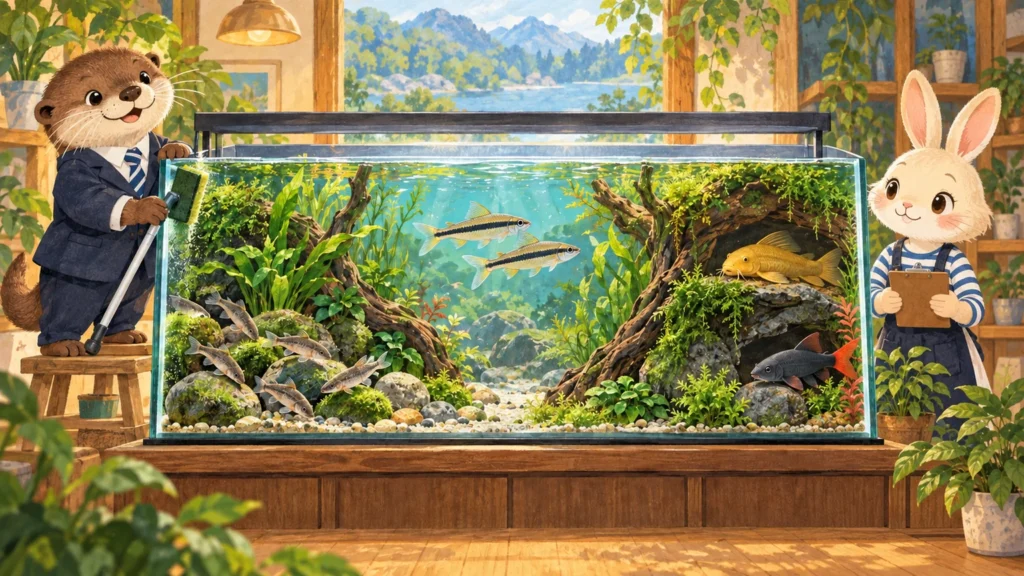 アイのアクアグッズ案内コケを食べるコイの仲間に合わせる飼育用品|フライングフォックス・アルジイーター・ガラ道具の特徴や使い方、選ぶときのポイントをアイが紹介します。記事はコチラ →
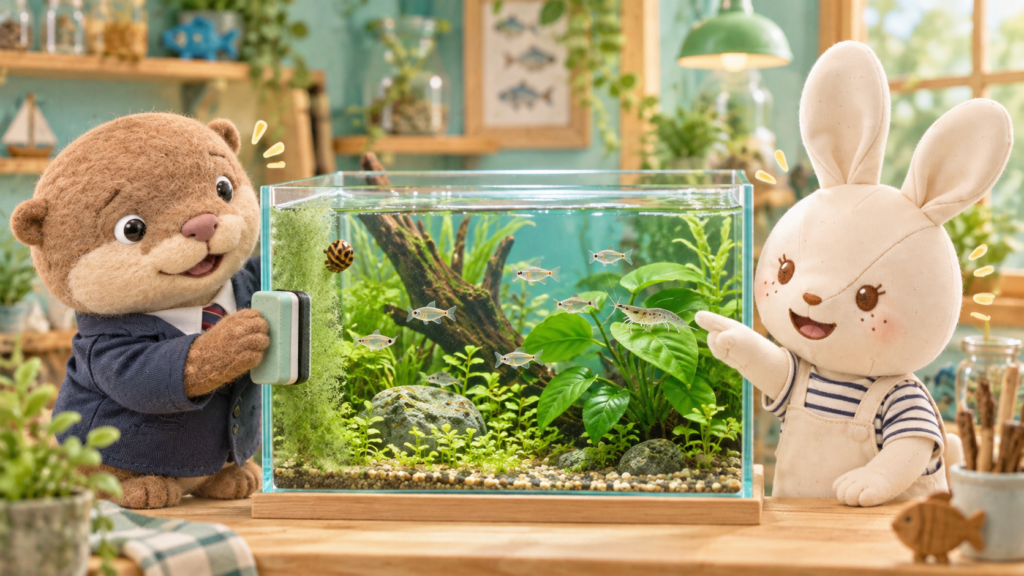 アイのアクアグッズ案内水槽のコケ掃除|道具の選び方とお掃除生体の得意・不得意道具の特徴や使い方、選ぶときのポイントをアイが紹介します。記事はコチラ →
さまざまな飼育テーマをご紹介。リンク先の記事には広告・商品紹介が含まれます。
案内・紹介記事一覧へ →分布マップ
グリーンネオンテトラ(Paracheirodon simulans)は、南米のブラジルにあるネグロ川上中流域から、コロンビア・ベネズエラにまたがるオリノコ川流域に分布します。主にブラックウォーターの支流やイガラッペ、水没林周辺の穏やかな浅瀬に生息します。
※この地図は、記事に記載されたネグロ川上中流域およびオリノコ川流域を見渡せるよう設定した概略表示です。マーカーは分布域の位置関係を示すための代表地点であり、実際の採集地点・観察地点を示すものではありません。
参考文献
本記事では、分類、分布、生息環境、飼育条件、繁殖、病気や注意点の根拠として、学術データベース、博物館系データベース、査読論文、大学・獣医学系資料、専門保全団体の資料を中心に参照しました。店舗、通販ページ、個人ブログ、一般的なまとめサイトは参考文献から除外しています。
- Fricke, R., Eschmeyer, W. N. & Van der Laan, R. (eds.). Eschmeyer’s Catalog of Fishes: Paracheirodon simulans.
California Academy of Sciences. 学名の有効性、記載者、現行分類、分布表記の確認に使用。
https://researcharchive.calacademy.org/research/ichthyology/catalog/fishcatget.asp?spid=24609 - Froese, R. & Pauly, D. (eds.). FishBase: Paracheirodon simulans, Green neon tetra.
FishBase. 分布、最大サイズ、水温、pH、硬度、淡水魚としての生態的概要、学名の語源確認に使用。
https://www.fishbase.se/summary/Paracheirodon-simulans - Weitzman, S. H. & Fink, W. L. (1983). Relationships of the neon tetras, a group of South American freshwater fishes (Teleostei, Characidae), with comments on the phylogeny of New World characiforms.
Bulletin of the Museum of Comparative Zoology, 150, 339–395. パラケイロドン属、ネオンテトラ類の分類学的・形態学的背景の確認に使用。
https://www.biodiversitylibrary.org/part/28701 - FishBase. Reproduction Summary: Paracheirodon simulans.
FishBase. 外部受精、卵散布型、親による保護を行わないこと、ペアより群れで産卵しやすいという繁殖情報の確認に使用。
https://fishbase.se/Reproduction/12394 - Chao, N. L. (1997). Project Piaba — towards a sustainable ornamental fishery in Amazonia.
Aquarium Sciences and Conservation, 1, 105–111. リオネグロ流域の観賞魚漁業、地域経済、持続可能な資源利用の背景確認に使用。
https://link.springer.com/article/10.1023/A:1018339718743 - Project Piaba. Collaborating for Conservation.
Project Piaba official site. リオネグロの観賞魚漁業、漁業保全、地域社会と生息地保全に関する現在の活動概要確認に使用。
https://projectpiaba.org/ - Merck Veterinary Manual. Parasitic Diseases of Fish.
Merck & Co., Inc. 白点病の原因となる Ichthyophthirius multifiliis、感染性、淡水魚での注意点の確認に使用。
https://www.merckvetmanual.com/exotic-and-laboratory-animals/aquarium-fish/parasitic-diseases-of-fish - Declercq, A. M., Haesebrouck, F., Van den Broeck, W., Bossier, P. & Decostere, A. (2013). Columnaris disease in fish: a review with emphasis on bacterium-host interactions.
Veterinary Research, 44, 27. カラムナリス病の原因菌 Flavobacterium columnare と淡水魚における病理・注意点の確認に使用。
https://pmc.ncbi.nlm.nih.gov/articles/PMC3648355/




コメント