

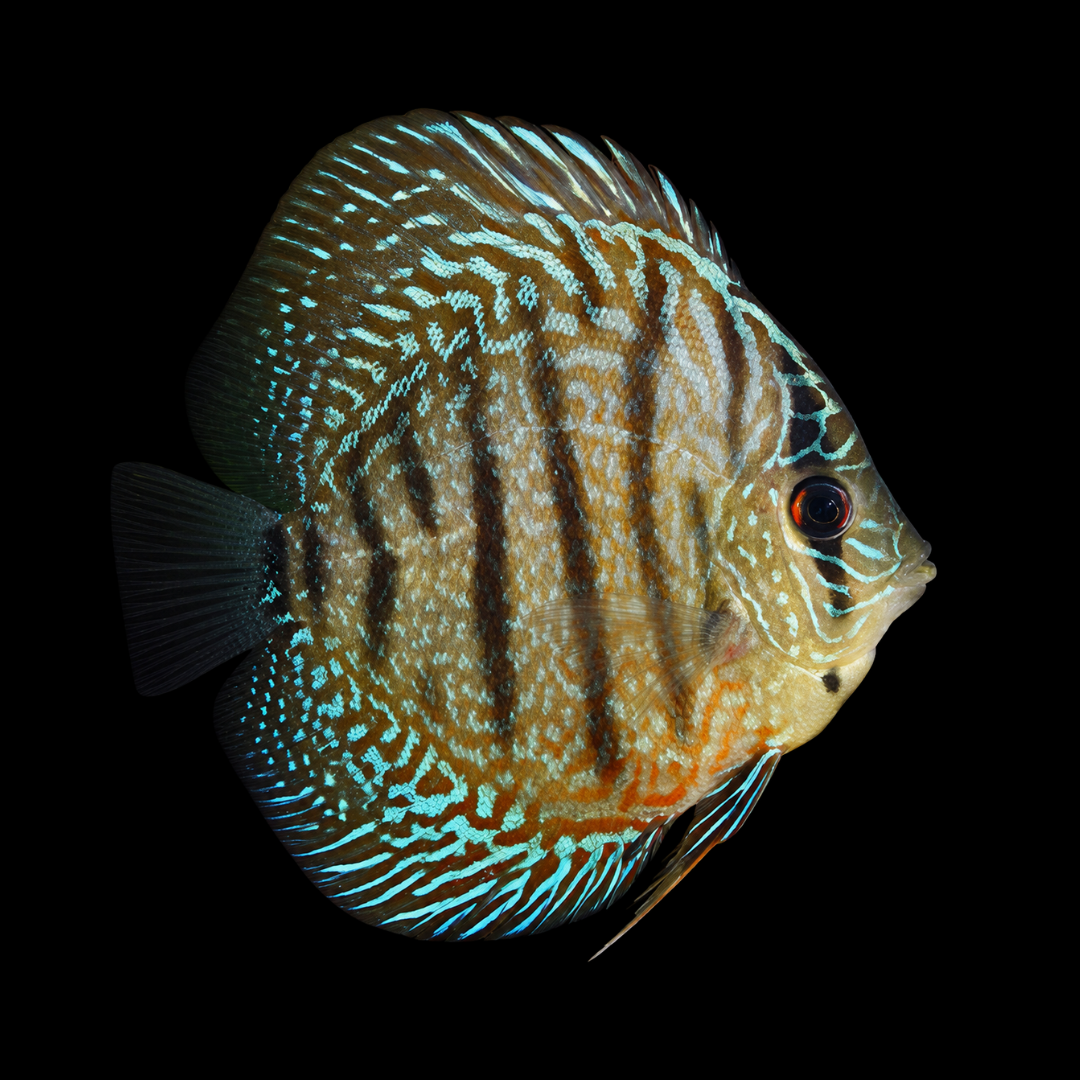
解説 / Description
ブルーチェッカーボードディスカスは、南米原産のディスカス属をもとに選択交配されてきた観賞用の改良品種です。青〜青緑色の金属的な光沢を基調に、赤〜赤褐色の線状模様が途切れたり交差したりして、網目状・格子状に見えることが大きな特徴です。ただし、改良ディスカスの品種名は学術的な分類名ではなく流通上のトレードネームで、ブリーダーや系統によって地色や模様の密度、線の太さには幅があります。幼魚では模様がまだ粗く、成長に伴って色彩や模様の見え方が変化するため、その変化を見守ることも飼育の楽しみの一つです。 Blue Checkerboard Discus is a selectively bred ornamental strain derived from South American discus of the genus Symphysodon. Its characteristic appearance combines metallic blue to blue-green iridescence with red to reddish-brown linear markings that break, cross, and reconnect into a net-like or checkerboard pattern. Domestic discus strain names are trade names rather than formal taxonomic designations, so base color, pattern density, and line thickness can vary among breeders and lineages. Juveniles often show a less resolved pattern, and the overall appearance can change as the fish grows, making development itself part of the appeal of keeping this strain.
基本情報 / Basic Information
| 学名 / Scientific Name | Symphysodon spp. |
|---|---|
| 通称 / Common Name | ブルーチェッカーボードディスカスBlue Checkerboard Discus |
| 分類 / Family | シクリッド目(Cichliformes)シクリッド科(Cichlidae)シムフィソドン属(Symphysodon)の改良品種Order Cichliformes, family Cichlidae, genus Symphysodon; a domesticated ornamental strain |
| 英名 / English Name | Blue Checkerboard Discus |
| 分布 / Distribution | 改良品種のため自然分布はありません。祖先となるディスカス属の野生個体群は南米アマゾン川流域に分布し、流れの穏やかな水域や水没木の周辺などを利用します。As a domesticated strain, it has no natural geographic distribution. Wild populations of its ancestral genus Symphysodon occur in the Amazon Basin of South America, especially in calm waters around submerged wood and sheltered habitats. |
| 最大体長 / Max Size | 約15〜20cm。体長だけでなく体高も大きく、良好に育った成魚は円盤に近いシルエットになります。Approximately 15–20 cm. Well-grown adults are also very deep-bodied, producing the near-circular silhouette characteristic of discus. |
| 寿命 / Lifespan | ブルーチェッカーボード固有の寿命データはありません。適切な水質・水温・栄養管理のもとでは、ディスカスは数年以上にわたって飼育されます。実際の寿命は個体差や成長期の管理、慢性的なストレス、疾病の有無などに左右されます。There are no strain-specific lifespan data for Blue Checkerboard Discus. Under stable water quality, appropriate temperature, and good nutrition, discus can be kept for many years, although actual lifespan varies with the individual, juvenile husbandry, chronic stress, and disease history. |
飼育環境 / Aquarium Environment
| 水槽サイズ / Tank Size | 若魚5〜6匹の育成なら90cm規格水槽(90×45×45cm級、約180L)以上を出発点とし、成魚5〜6匹を長期飼育するなら120cmクラス(約250〜300L級)以上を目安にします。成立した繁殖ペアだけを管理する場合は60cm規格水槽を用いることもありますが、群れで飼う場合は水量に余裕があるほど水質を安定させやすく、逃げ場も確保しやすくなります。For five to six juveniles, a standard 90 cm aquarium measuring roughly 90 × 45 × 45 cm, about 180 L nominal volume, is a practical starting point. For long-term housing of five to six adults, use a 120 cm-class aquarium of roughly 250–300 L or more. An established breeding pair may be managed in a standard 60 cm breeding tank, but larger group aquariums provide greater water-volume stability and more room for subordinate fish to avoid pressure. |
|---|---|
| 水温 / Temperature | 通常飼育では28〜30℃が広く用いられる目安です。人工繁殖個体にはある程度の許容幅がありますが、購入元の管理温度も確認し、急な温度変化を避けることが重要です。高水温では溶存酸素が低下しやすいため、十分なエアレーションと濾過を確保します。 A range of 28–30°C is widely used for normal husbandry. Captive-bred fish can show some tolerance outside this range, but it is important to check the temperature used by the seller and avoid rapid changes. Because warm water holds less dissolved oxygen, provide ample aeration and reliable filtration. |
| 水質 / Water Quality | pH6.0〜7.0を中心とした弱酸性〜中性の軟水は一つの扱いやすい目安です。アンモニアと亜硝酸は常に0mg/Lを維持し、硝酸塩も低く保ちます。人工繁殖個体はより幅広い水質に適応することもあるため、数値を無理に追い込むより、購入元の水質との差を小さくし、急変させないことが重要です。Soft, slightly acidic to neutral water around pH 6.0–7.0 is one practical target. Ammonia and nitrite should remain at 0 mg/L and nitrate should be kept low. Captive-bred discus may adapt to a broader range, so minimizing the difference from the seller’s water and avoiding sudden changes is more important than forcing the aquarium to an exact number. |
| レイアウト / Layout | 育成や繁殖を重視する場合は、残餌とフンをすぐ除去できるベアタンクが管理しやすく、スポンジフィルターとの相性にも優れます。観賞を重視する場合は、細かい砂、縦方向の流木、丈夫な水草、浮草などを使い、中央には群れがゆったり泳げる空間を残します。強い水流と強すぎる照明は避け、陰になる場所を作ると落ち着きやすくなります。For intensive grow-out or breeding, a bare-bottom tank is easy to keep clean and works especially well with sponge filtration. For a display aquarium, fine sand, vertical driftwood, hardy plants, and floating plants can be used while leaving open swimming space in the center. Avoid excessive current and overly intense lighting, and provide shaded areas where the fish can retreat. |
| 注意点 / Precautions | 通常の群飼育では5〜6匹程度以上を目安にし、特定の個体へ追尾や威嚇が集中していないか観察します。導入時は販売元と自宅水槽の水温・pH・硬度の差を確認し、袋水の状態が良好で差が大きい場合は段階的に水合わせします。一方、長時間輸送で袋水にアンモニアが蓄積している可能性がある場合は、開封後に長時間の点滴水合わせを続けるとかえって負担を増やすことがあるため、販売元の導入手順を優先してください。輸送袋の水は水槽へ入れず、新魚は可能なら隔離水槽で状態を確認してから合流させます。頻回給餌を行う場合は換水と清掃の頻度も高め、水質測定で状態を確認します。For normal group husbandry, keep roughly five to six fish or more and watch for persistent chasing or social pressure directed at one individual. When introducing new fish, compare temperature, pH, and hardness between the seller’s water and the home aquarium. If transport water is in good condition and the difference is substantial, acclimate gradually. After long transport, however, ammonia may have accumulated in the bag, and prolonged drip acclimation after opening can increase stress; in that situation, follow the seller’s arrival protocol. Do not add transport water to the aquarium, and quarantine new fish when possible. Frequent feeding should be matched by more frequent cleaning, water changes, and water testing. |
餌と給餌 / Feeding
| 餌の種類 / Diet | ディスカス用に栄養設計された顆粒・ペレットを軸に、冷凍赤虫やブラインシュリンプなどを組み合わせると、単一の餌に偏りにくくなります。日本では牛ハツを主原料とした「ディスカスハンバーグ」も古くから利用されていますが、栄養組成は製品や配合によって異なり、水を汚しやすいため、これだけに偏らず給餌量と清掃を管理します。Use a nutritionally formulated discus granule or pellet as the base and combine it with foods such as frozen bloodworms and brine shrimp to reduce dependence on a single food type. In Japan, beef-heart-based “discus hamburger” mixtures have long been used, but their nutritional composition varies by product or recipe and they can pollute the water rapidly. They should not be the only food offered, and portion size and tank cleaning need careful control. |
|---|---|
| 給餌のポイント / Feeding Tips | 成魚は1日2〜3回を目安に、数分で食べ切れる量を小分けにします。若魚は成長のためにより頻回の給餌が有効ですが、その分だけ換水と残餌除去を徹底します。餌を急に切り替えると食べなくなる個体もいるため、新しい餌は従来の餌に少量ずつ混ぜて慣らします。発色用飼料は補助的に利用し、色だけを目的とした過剰給餌は避けます。Feed adults about two to three small meals per day, offering only what they can consume within a few minutes. Juveniles benefit from more frequent feeding, but this must be matched by more frequent water changes and removal of uneaten food. Some discus refuse sudden diet changes, so introduce new foods gradually. Color-enhancing foods can be used as a supplement, but should not replace balanced nutrition or encourage overfeeding. |
性格と混泳 / Temperament and Tank Mates
| 性格 / Temperament | 基本的には穏やかで群れを作るシクリッドですが、群れの中には順位関係があり、弱い個体が追われることがあります。成熟してペアが成立すると縄張り意識が強くなり、産卵場所の周囲から他魚を激しく追い払うことがあります。給餌時には人の接近や水槽周辺の動きに反応し、水槽前面へ集まる行動が見られることもあります。Discus are generally peaceful, social cichlids, but groups develop a hierarchy and weaker individuals may be chased. Once a mature pair forms, territorial behavior can increase sharply and the pair may drive other fish away from the spawning site. At feeding time they often react to nearby movement and may gather at the front of the aquarium. |
|---|---|
| 混泳の相性 / Compatibility | 同じ高水温と穏やかな水流に適応でき、餌を奪いすぎない温和な魚が向きます。カージナルテトラ、ラミーノーズテトラ、コリドラス・ステルバイ、小型のラミレジィ類などが候補になります。一方、活発すぎる魚、ヒレをかじる魚、低水温を好む魚、大型で攻撃的なシクリッドは不向きです。プレコ類は個体によってディスカスの体表を吸うことがあるため、清掃役として安易に導入せず、行動をよく観察します。Choose calm tank mates that tolerate the same warm water and gentle flow without overwhelming discus at feeding time. Cardinal tetras, rummy-nose tetras, Sterbai corydoras, and some small ram cichlids are common candidates. Avoid very active fish, fin nippers, cool-water species, and large aggressive cichlids. Plecos require caution because some individuals may rasp or suck on the discus’ body surface. |
病気と対策 / Diseases and Prevention
| かかりやすい病気 / Common Diseases | ブルーチェッカーボードという品種だけに特有の病気はありません。水質悪化や輸送・混泳によるストレスの後には、白点病、細菌性の皮膚・ヒレの感染症、鰓の寄生虫、消化管の鞭毛虫などが問題になることがあります。体色の急な黒化、ヒレをたたむ、呼吸が速い、食欲低下、白い糞、群れから離れるといった変化は異常を疑う手掛かりですが、これらだけで病名を決めることはできません。There is no disease unique to the Blue Checkerboard strain. After poor water quality or stress from transport or social conflict, discus may develop problems such as ich, bacterial skin or fin infections, gill parasites, and intestinal flagellates. Sudden darkening, clamped fins, rapid breathing, appetite loss, pale or stringy feces, or withdrawal from the group are signs that something is wrong, but they do not identify a specific disease by themselves. |
|---|---|
| 対策と予防 / Prevention | 最優先は清潔で安定した飼育水です。アンモニア・亜硝酸を0に保ち、定期換水、残餌除去、適切な濾過、十分な酸素供給を徹底します。新魚は隔離して観察し、器具の共用も避けると持ち込み感染のリスクを下げられます。異常時はまず水質と水温を確認し、原因を推定せずに一律の高温化や薬浴を行うのではなく、症状と病原体に応じた対応を選びます。高水温へ変更する場合は溶存酸素の低下にも十分注意します。The most important prevention is clean, stable water. Keep ammonia and nitrite at zero, perform regular partial water changes, remove waste promptly, maintain effective filtration, and provide ample aeration. Quarantine new arrivals and avoid sharing equipment between tanks when possible. If symptoms appear, check water quality and temperature first, then choose treatment according to the likely cause rather than applying heat or medication indiscriminately. Any increase in temperature must be accompanied by careful attention to oxygen availability. |
増やし方(繁殖) / Breeding
| 雌雄の判別 / Sexing | 若魚の外見だけで確実に判別するのは困難です。成熟すると体格や頭部形状に傾向が出ることがありますが個体差が大きく、実用上はペア形成後の産卵行動と産卵直前の繁殖管を確認するのが判断しやすい方法です。雌の産卵管は比較的太く丸みを帯び、雄はより細く尖って見える傾向があります。Reliable sexing by appearance alone is difficult, especially in juveniles. Mature fish may show tendencies in body size or head shape, but these are inconsistent. In practice, pairing behavior and the genital papilla immediately before spawning are easier clues to use; females generally show a broader, blunter ovipositor while males tend to have a narrower, more pointed papilla. |
|---|---|
| 繁殖形態 / Reproduction | 基質産卵型で、成立したペアが産卵筒、塩ビパイプ、流木、水槽ガラス面などの垂直面を掃除してから卵を産み付けます。雌雄とも卵と仔魚を保護し、孵化後に自由遊泳を始めた稚魚は両親の体表から分泌される栄養性の粘液を摂食します。この両親による粘液給餌はディスカス属を象徴する繁殖生態です。Discus are substrate spawners. A bonded pair cleans a vertical surface such as a spawning cone, PVC pipe, driftwood, or aquarium glass before laying eggs. Both parents guard the eggs and larvae, and once the fry become free-swimming they feed on nutritive epidermal mucus produced by both parents. This biparental mucus feeding is one of the defining reproductive behaviors of discus. |
| 繁殖のポイント / Breeding Tips | 若魚を6匹前後から育てて自然にペアができるのを待つ方法が一般的です。ペアが成立したら60cm規格水槽などの専用繁殖水槽へ移し、水温28〜30℃を目安に、親魚が慣れている安定した水質、穏やかなエアレーション、スポンジフィルター、産卵筒を用意します。孵化は水温によりますが約3〜4日が目安で、自由遊泳後の稚魚は親の体表粘液を主に利用しながら、成長に合わせて孵化したてのブラインシュリンプなどを併用していきます。ブルーチェッカーボードは流通名で系統ごとの固定度も異なるため、同名同士の交配でも模様が均一になるとは限りません。狙った表現を揃えるには、世代を重ねた選別が必要になります。A common method is to raise a group of around six juveniles and allow compatible pairs to form naturally. Once bonded, move the pair to a dedicated breeding aquarium such as a standard 60 cm tank and provide a temperature around 28–30°C, stable water matching the parents’ established conditions, gentle aeration, a sponge filter, and a spawning cone. Hatching commonly takes about three to four days depending on temperature. After the fry become free-swimming they rely heavily on parental mucus, while newly hatched brine shrimp can be introduced gradually as they grow. Because Blue Checkerboard is a trade name and the degree of line-breeding varies among lineages, offspring from two fish sold under the same name are not guaranteed to show a uniform pattern. Producing a consistent expression requires selection over generations. |
雑学と豆知識 / Trivia and Fun Facts
| 1. 「チェッカーボード」は学名ではない / 1. “Checkerboard” is not a scientific name | ブルーチェッカーボードディスカスという名前は、野生に存在する独立種を指すものではなく、観賞魚の育種と流通の中で使われてきた品種名です。ディスカスの改良品種は国際動物命名規約で統一される対象ではないため、似た表現の魚が別名で販売されたり、逆に同じ名称でもブリーダーごとに模様の密度や地色が異なったりします。そのため、名前だけで血統を断定するより、実際の個体の模様、親魚の情報、成長後の写真などを合わせて見ることが、この魚を選ぶうえでは大切です。Blue Checkerboard Discus is not a naturally occurring species name but a strain name created within the ornamental fish breeding and trade. Domestic discus strains are not standardized by zoological nomenclature, so similar-looking fish may be sold under different names, while fish sharing the same trade name can differ in pattern density or base color among breeders. For this reason, the actual phenotype, parental background, and images of mature fish are often more informative than the trade name alone. |
|---|---|
| 2. 線と点のあいだに生まれる模様 / 2. A pattern between stripes and spots | 改良ディスカスを見た目の模様で比べると、ターコイズ系では線状の模様が目立ち、レオパード系では赤い模様が点状に見える個体が多くなります。チェッカーボード系は、途切れながらもつながる線が網目や格子のように見えることが特徴です。これは正式な遺伝学上の中間分類を意味するものではなく、あくまで観賞魚としての模様の見え方を表した呼び分けです。線のつながり方や地色との対比が個体ごとに異なるため、同じ品種名でも一匹ずつ印象が変わります。When domestic discus are compared by visible pattern, turquoise-type fish tend to emphasize linear markings, while leopard-type fish more often show red markings as separate spots. Checkerboard fish are characterized by broken but connected lines that resemble a net or grid. This does not represent a formal genetic intermediate category; it is a descriptive way of grouping ornamental patterns. Because line continuity and contrast with the base color vary from fish to fish, individuals sold under the same strain name can still look noticeably different. |
| 3. 近代ディスカス育種が積み重ねた色彩 / 3. Color built by generations of discus breeding | 現代の改良ディスカスは、長い選択交配の積み重ねによって多様な色彩と模様が作られてきました。愛好家の育種史では、エドゥアルド・シュミット=フォッケやジャック・ワトリーがターコイズ系の発展に大きく関わった人物として知られ、1991年前後にピジョンブラッド系統が広まったことも、その後の色彩表現を広げた節目として語られています。一方、ブルーチェッカーボードという流通名について、成立過程を一つの交配式で示せる公式な系譜は確認できません。特定の祖先系統を断定するより、複数の改良ディスカスの中から青系の光沢と複雑な網目状・格子状模様を選別してきた品種群として捉えるほうが適切です。Modern domestic discus developed through many generations of selective breeding rather than a single cross. In hobby breeding history, Eduard Schmidt-Focke and Jack Wattley are widely associated with the development of turquoise lines, and the spread of Pigeon Blood around 1991 is often described as another important turning point in discus color breeding. The trade name Blue Checkerboard, however, does not have a single official pedigree that can be reduced to one documented cross. It is more accurate to view it as a group of domestic lines selected for blue iridescence and complex net-like or checkerboard patterning than to assign every fish to one fixed ancestry. |
| 4. 稚魚は両親の「体表粘液」を食べて育つ / 4. Fry feed on both parents’ skin mucus | ディスカスの繁殖で最も印象的なのは、自由遊泳を始めた稚魚が親魚の体表へ集まり、皮膚から分泌される粘液をついばんで成長することです。この粘液給餌は雌雄の両方が担い、親魚は稚魚をまとわせながら交代するように群れを誘導します。研究では、繁殖期の体表粘液でタンパク質や代謝物の組成が変化することも確認されており、単なる保護粘液ではなく、仔魚の初期成長を支える特別な親子関係の一部であることが分かっています。哺乳類の授乳とは仕組みが異なりますが、親が自ら分泌した物質を子へ直接与えるという点で、魚類の中でもきわめて珍しい育児戦略です。One of the most remarkable features of discus breeding begins when free-swimming fry gather on the parents and graze directly on epidermal mucus. Both male and female parents participate, carrying clouds of fry and alternating their contact with the young. Scientific studies have shown that the protein and metabolite composition of parental mucus changes during the breeding period, supporting the view that this is more than ordinary protective slime and forms part of a specialized parent-offspring nutritional relationship. It is physiologically different from mammalian lactation, but it remains an unusually direct form of parental provisioning among fishes. |
| 5. 青は「色素」だけではない / 5. The blue is not produced by pigment alone | ブルーチェッカーボードの金属的な青は、絵の具のような青色色素だけで作られているわけではありません。魚の皮膚には光を反射する虹色素胞があり、内部のプリン系結晶などが光を反射することで、青や緑の金属的なきらめきが生まれます。赤系の模様は別の色素細胞による色彩が重なって見えるため、照明や見る角度によって全体の印象も変化します。また、赤や黄の色彩は餌に含まれるカロテノイドの影響を受けることが研究で確認されており、遺伝的な素質だけでなく栄養状態も発色に関わります。The metallic blue of a Blue Checkerboard is not produced by blue pigment alone. Fish skin contains reflective cells called iridophores, and purine-based crystals within them reflect light to create blue or green metallic iridescence. Red patterning comes from other pigment cells, so lighting and viewing angle can change the overall impression of the fish. Research on discus also shows that dietary carotenoids can influence red and yellow coloration, meaning that final coloration reflects both inherited traits and nutritional condition. |
| 6. 若魚を選ぶ楽しみは「完成前」を読むこと / 6. Choosing juveniles means reading an unfinished pattern | 改良ディスカスは、完成した成魚だけでなく、模様が発達途中の若魚として販売されることもあります。ブルーチェッカーボードも幼魚期から成魚と同じ模様が出そろうとは限らず、成長につれて線の密度や地色との対比が変わります。そのため若魚を選ぶときは、現在の派手さだけでなく、体型のバランス、目と体格の釣り合い、ヒレの状態、食欲、泳ぎ方など、健康状態を含めて見ることが大切です。完成した模様だけを選ぶ楽しみとは別に、成長とともに外見が変わる過程を見守れることも、この品種の魅力です。Domestic discus are often sold not only as fully patterned adults but also as juveniles whose markings are still developing. Blue Checkerboard juveniles do not necessarily display the same pattern they will show as adults, and line density and contrast with the base color can change with growth. When choosing a young fish, current brightness should therefore be considered alongside balanced body shape, eye-to-body proportion, intact fins, appetite, and swimming behavior. Watching the appearance change as the fish matures is one of the distinctive pleasures of keeping this strain. |
まとめ / Conclusion
ブルーチェッカーボードディスカスは、青〜青緑の金属的な光沢と赤系の網目状・格子状模様、円盤状の体型が組み合わさった改良ディスカスです。模様の出方には個体差があり、成長に伴って見え方も変化します。美しい状態を保つうえで大切なのは、強い色揚げに頼ることではなく、安定した温水、清潔な水、十分な酸素、偏りの少ない食事、落ち着いて過ごせる広さを継続して整えることです。 Blue Checkerboard Discus combines blue to blue-green metallic iridescence, red net-like or checkerboard markings, and the rounded body shape of domestic discus. Pattern expression varies among individuals and can change as the fish grows. Maintaining the fish in good condition depends less on aggressive color enhancement than on stable warm water, clean conditions, ample oxygen, balanced nutrition, and enough space for calm social behavior.
群れの中の関係や成長による模様の変化を観察し、ペアが成立すれば、稚魚が親魚の体表粘液を摂食する独特の子育てまで見ることができます。給餌時に人の接近へ反応して水槽前面に集まる姿も含め、色彩だけでなく行動の変化を長く楽しめる魚です。水質と給餌の管理に手間はかかりますが、その分、日々の小さな変化を丁寧に観察する面白さがあります。 Its pattern continues to change as it grows, and a bonded pair may eventually reveal the unusual sight of fry clustering on the parents to feed from skin mucus. At feeding time, discus may also react to a person approaching and gather at the front of the aquarium, making changes in behavior as interesting to observe as changes in color. Their water-quality and feeding requirements demand consistent care, but they offer many small day-to-day changes for an attentive aquarist to notice.

気になる道具や飼い方を見つけてみませんか?
 アイのアクアグッズ案内水槽ライトの選び方|魚の見え方・水草・海水で選ぶおすすめ照明道具の特徴や使い方、選ぶときのポイントをアイが紹介します。記事はコチラ →
 アイのアクアグッズ案内エーハイムはおもちゃから始まった? 小さな噴水から水槽へ、アイとコタロウの探訪道具の特徴や使い方、選ぶときのポイントをアイが紹介します。記事はコチラ →
 アイのアクアグッズ案内海水魚初心者の必需品|水槽・人工海水・比重計・水質検査道具の特徴や使い方、選ぶときのポイントをアイが紹介します。記事はコチラ →
 アイのアクアグッズ案内アフリカンシクリッドの飼育用品|水槽・ろ過・底砂・岩組み・餌の選び方道具の特徴や使い方、選ぶときのポイントをアイが紹介します。記事はコチラ →
さまざまな飼育テーマをご紹介。リンク先の記事には広告・商品紹介が含まれます。
案内・紹介記事一覧へ →分布マップ
ブルーチェッカーボードディスカスは改良品種のため自然分布を持ちません。以下の地図では、祖先となるディスカス属(Symphysodon spp.)の野生個体群が分布する南米アマゾン川流域を概略表示しています。
※この地図はアマゾン川流域におけるディスカス属の分布を示す概略表示です。マーカーは分布域を把握しやすくするために設定した代表地点であり、実際の採集地点や特定個体の生息地点を示すものではありません。
参考文献
-
Fricke, R., Eschmeyer, W. N. & Van der Laan, R. (eds.). Eschmeyer’s Catalog of Fishes: Symphysodon aequifasciatus Pellegrin, 1904.California Academy of Sciences, Online Version. 分類・学名・分布の確認。Eschmeyer’s Catalog of Fishes (2026年8月21日閲覧)
-
Amado, M. V., Farias, I. P. & Hrbek, T. (2011). A Molecular Perspective on Systematics, Taxonomy and Classification Amazonian Discus Fishes of the Genus Symphysodon.International Journal of Evolutionary Biology, 2011, 360654. 分類体系、アマゾン川流域における系統群と分布の確認。
-
Crampton, W. G. R. (2008). Ecology and life history of an Amazon floodplain cichlid: the discus fish Symphysodon (Perciformes: Cichlidae).Neotropical Ichthyology, 6(4), 599–612. 自然下の生息環境、群れ形成、食性、季節変動、繁殖と親による保護行動の確認。
-
Ribeiro, M. W. S., Carvalho, T. B., Aride, P. H. R., Lima, T. P. & Oliveira, A. T. (2025). Overview of the discus fish (Symphysodon spp.): narrative review combined with potential for ornamental aquaculture.Brazilian Journal of Biology, 85, e296151. ディスカス属の生物学、温暖で酸性寄りの生息水、水質、飼育・繁殖管理に関する総説。
-
Froese, R. & Pauly, D. (eds.). FishBase: Symphysodon aequifasciatus / Symphysodon discus.分布、淡水環境、水温・pHの範囲、体サイズ、群れ飼育や繁殖行動などの基礎情報の確認。
-
Buckley, J., Maunder, R. J., Foey, A., Pearce, J., Val, A. L. & Sloman, K. A. (2010). Biparental mucus feeding: a unique example of parental care in an Amazonian cichlid.Journal of Experimental Biology, 213, 3787–3795. 稚魚が雌雄両方の親魚の体表粘液を摂食する繁殖生態の確認。
-
Francis-Floyd, R. & Petty, B. D. Routine Health Care of Fish.Merck Veterinary Manual. 水質、栄養、衛生管理、隔離を中心とした疾病予防と、外見・行動変化を異常の手掛かりとして扱う際の基本事項の確認。Merck Veterinary Manual (2026年8月21日閲覧)
-
Petty, B. D., Francis-Floyd, R. & Yanong, R. P. E. Parasitic Diseases of Fish.Merck Veterinary Manual. 白点病、鰓・皮膚の寄生虫、シクリッドで問題となる消化管鞭毛虫、症状だけでは確定診断できないことなどの確認。Merck Veterinary Manual (2026年8月21日閲覧)
-
Crosby, T. C., Hill, J. E., Martinez, C. V., Watson, C. A., Pouder, D. B. & Yanong, R. P. E. On-Farm Transport of Ornamental Fish.UF/IFAS Extension, FA-119. 輸送時の温度・pH・溶存酸素、アンモニア毒性、水合わせと輸送ストレスに関する注意点の確認。UF/IFAS Extension FA-119 (2026年8月21日閲覧)




コメント