

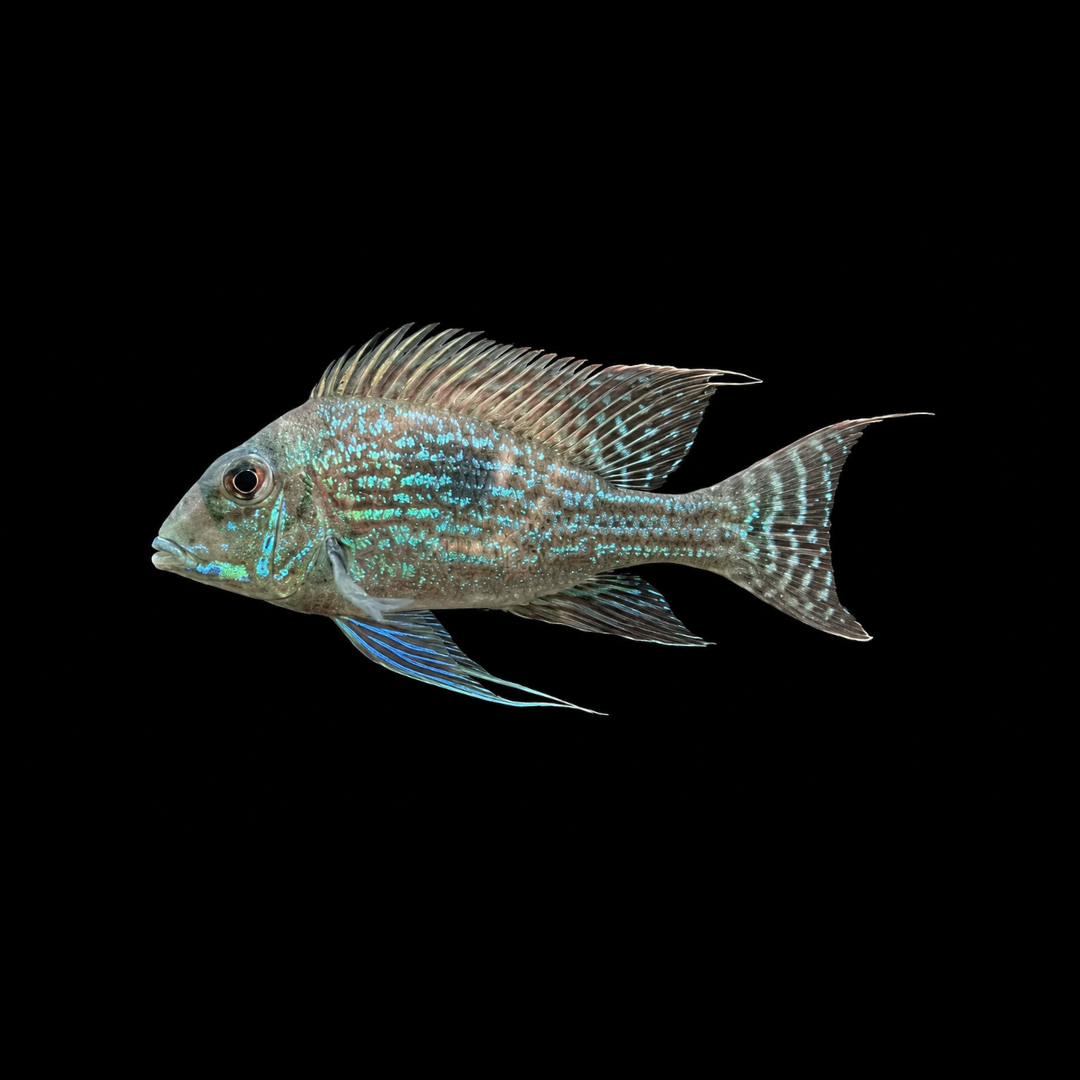
解説 / Description
ゲオファーガス・スベニは、ブラジルのトカンチンス川水系を原産とする南米シクリッドです。ゲオファーガスの名が示すように、細かな底砂を口に含み、そこからデトリタスや小さな餌生物を選り分け、不要な砂をエラから排出する独特の採餌行動を見せます。幼魚は比較的落ち着いた色合いですが、成長すると金属光沢を帯びた体側に赤や青の模様が発達し、各ヒレも伸長して優雅な姿になります。シクリッドとしては比較的穏やかな一方、同種間には順位関係が生じ、繁殖期には縄張り性も強まります。十分な広さ、細かな砂底、安定した水質を整えることで、本種らしい採餌や社会行動、両親による子育てを観察できます。 Geophagus sveni is a South American cichlid native to the Rio Tocantins drainage in Brazil. True to the name Geophagus, it takes fine substrate into its mouth, separates detritus and small food organisms, and expels the remaining sand through the gills. Juveniles are comparatively subdued in color, but adults develop red and blue markings over a metallic body and increasingly elongated fins. It is relatively peaceful for a cichlid, although social ranking develops among conspecifics and territoriality increases during breeding. With ample space, fine sand, and stable water quality, its characteristic foraging, social behavior, and biparental care can be observed in the aquarium.
基本情報 / Basic Information
| 学名 / Scientific Name | Geophagus sveni Lucinda, Lucena & Assis, 2010 |
|---|---|
| 通称 / Common Name | ゲオファーガス・スベニ、スベニGeophagus sveni, Sveni eartheater |
| 分類 / Family | シクリッド目 Cichliformes/シクリッド科 Cichlidae/シクリッド亜科 Cichlinae/ゲオファーガス族 Geophagini/ゲオファーガス属 GeophagusOrder Cichliformes / Family Cichlidae / Subfamily Cichlinae / Tribe Geophagini / Genus Geophagus |
| 英名 / English Name | Sveni Eartheater |
| 分布 / Distribution | 原産地はブラジルのトカンチンス川水系です。上部パラナ川流域やアルゼンチンのヤシレタ貯水池では移入個体群が確認されています。Native to the Rio Tocantins drainage in Brazil. Introduced populations have been confirmed in the upper Paraná River basin and in the Yacyretá Reservoir in Argentina. |
| 最大体長 / Max Size | 最大標準体長は約20cmが報告されています。飼育では成魚の体高やヒレの伸長、複数飼育時に必要な床面積も考え、余裕のある設備を用意します。A maximum standard length of about 20 cm has been reported. In captivity, allow additional room for the adult body depth, elongated fins, and the floor area required when more than one fish is kept. |
| 寿命 / Lifespan | 本種に限定した信頼性の高い寿命データは情報不足です。中大型シクリッドとして長期飼育を前提に、安定した水質と十分な遊泳空間を維持することが重要です。Reliable species-specific lifespan data are insufficient. It should be treated as a long-term commitment typical of medium-sized cichlids, with stable water quality and adequate swimming space maintained throughout adulthood. |
飼育環境 / Aquarium Environment
| 水槽サイズ / Tank Size | 幼魚期は90cm規格水槽でも管理できますが、成魚を長期飼育する場合は、飼育上の目安として120cm規格水槽以上、複数飼育では120cmワイド水槽など約300L以上の余裕ある環境を推奨します。個体数が増えるほど、水量だけでなく底面積と退避スペースを広く確保することが重要です。Juveniles can be managed in a standard 90 cm aquarium. For long-term adult care, a 120 cm tank or larger is a practical minimum, while keeping several adults is better suited to a wide 120 cm-class aquarium of around 300 L or more. As the number of fish increases, floor area and retreat space become as important as total water volume. |
|---|---|
| 水温 / Temperature | 23〜28℃。急変を避け、年間を通して安定した熱帯魚向けの水温を保ちます。 23–28°C. Avoid sudden fluctuations and maintain a stable tropical temperature throughout the year. |
| 水質 / Water Quality | 弱酸性〜中性を基本とし、pH5.8〜7.0程度を飼育上の目安とします。清潔で安定した水を保つため、十分なろ過と定期換水を行い、硝酸塩や有機物を蓄積させないよう管理します。水質の数値を急に合わせるより、急変を避けて安定させることが重要です。Slightly acidic to neutral water is suitable, with about pH 5.8–7.0 as a practical husbandry range. Maintain clean, stable water with adequate filtration and regular water changes, avoiding the accumulation of nitrate and organic waste. Stability is more important than rapidly forcing the aquarium toward exact numerical targets. |
| レイアウト / Layout | 底床には角のない細粒の川砂や田砂などを数cm敷き、砂を口に含んでふるい分ける行動を妨げないことが最重要です。流木や滑らかな岩を配置して視線を遮る場所と退避場所を作りつつ、中央には砂を掘り返せる広い開放部を残します。底床を頻繁に動かすため、根張りの弱い水草は抜かれやすく、植栽する場合は流木活着系や鉢植えなどの工夫が向きます。Use several centimeters of fine, smooth river sand or similar rounded substrate so the fish can perform its natural sifting behavior safely. Arrange driftwood and smooth stones to break lines of sight and create retreats, while leaving a broad open sandy area for foraging. Because the substrate is constantly disturbed, delicate rooted plants may be uprooted; epiphytes attached to wood or protected potted plants are more practical. |
| 注意点 / Precautions | 粗く角張った砂利は口腔やエラを傷つける恐れがあるため避けます。また、砂を巻き上げるため外部式フィルターの吸水口から細砂が入りやすく、インペラーやシャフトを摩耗させることがあります。吸水口に目の細かいスポンジプレフィルターを装着し、底床から少し高い位置に設置すると、砂を吸い込むリスクを減らせます。野外への放流は、生態系への影響につながるため絶対に行わないでください。Avoid coarse or sharp gravel, which can injure the mouth and gills during sifting. Fine sand may also be drawn into canister-filter intakes and wear the impeller or shaft. A fine sponge prefilter and an intake positioned slightly above the substrate can reduce the risk of sand entering the filter. Never release aquarium fish into natural waters, as introduced populations can affect local ecosystems. |
餌と給餌 / Feeding
| 餌の種類 / Diet | 雑食性。主食には沈下性またはゆっくり沈む良質なシクリッド用ペレットや顆粒飼料を用い、補助的に冷凍アカムシ、冷凍ブラインシュリンプなどを与えます。自然界では底砂中のデトリタスや水生昆虫、小型無脊椎動物などを選別して食べます。Omnivorous. Use high-quality sinking or slowly sinking cichlid pellets and granules as the staple, supplemented with foods such as frozen bloodworms and frozen brine shrimp. In nature it sifts detritus, aquatic insects, and other small invertebrates from the substrate. |
|---|---|
| 給餌のポイント / Feeding Tips | 底床を探りながら食べる性質に合わせ、砂上に広く行き渡るよう少量ずつ与えます。群れでは強い個体が餌場を占有することがあるため、一か所に集中させず複数地点へ分散させると均等に食べやすくなります。食べ残しが砂中に蓄積すると水質悪化につながるため、腹八分を意識し、人工飼料を中心に冷凍餌を補助として組み合わせます。Feed small portions that spread across the sandy bottom, matching the fish’s natural foraging style. Dominant fish may control a single feeding spot, so distributing food among several areas helps all group members eat. Uneaten food can accumulate in the sand and degrade water quality, so avoid overfeeding and use frozen foods as supplements rather than the sole diet. |
性格と混泳 / Temperament and Tank Mates
| 性格 / Temperament | シクリッドとしては比較的温和ですが、同種間では順位関係が生じ、狭い環境や少数飼育では弱い個体に攻撃が集中することがあります。複数飼育では十分な床面積を確保し、流木や岩で視線を切って退避場所を設けます。繁殖期のペアは縄張り意識が強まり、普段より攻撃的になります。Relatively peaceful for a cichlid, but a social hierarchy develops among conspecifics, and aggression may become focused on subordinate fish in cramped conditions or very small groups. When several are kept together, provide ample floor area and use wood or rocks to break lines of sight and create retreats. A breeding pair becomes more territorial than usual. |
|---|---|
| 混泳の相性 / Compatibility | 口に入らない大きさで、極端に攻撃的ではない中型魚と相性が良好です。セベラム、エレクトリックブルーアカラ、エンゼルフィッシュ、十分な遊泳力のある大型テトラ類、条件が合えば他の温和なアースイーター類などが候補になります。ただし水槽の広さと個体差が最優先です。小型カラシン、稚魚、小型エビ類などは捕食される可能性が高く、小型底生魚は砂上の生活圏が重なりやすいため慎重に判断します。It generally mixes well with medium-sized fish that are too large to swallow and are not excessively aggressive. Possible companions include severums, electric blue acaras, angelfish, robust larger tetras, and, in sufficiently large aquaria, other peaceful eartheaters. Tank dimensions and individual temperament always take priority. Small characins, fry, and small shrimp may be eaten, while small bottom dwellers can face heavy competition for the same substrate zone. |
病気と対策 / Diseases and Prevention
| かかりやすい病気 / Common Diseases | ゲオファーガス・スベニだけに特有の代表的な疾病は情報が限られています。飼育下では一般的な熱帯魚と同様に、白点病、細菌性の体表トラブル、ヒレの損傷後の二次感染などに注意します。特に有機物の蓄積や高い硝酸塩、慢性的な同種間ストレスは体調を崩す要因になります。There is limited information on diseases uniquely characteristic of Geophagus sveni. In captivity, watch for common tropical-fish problems such as ich, bacterial skin infections, and secondary infections following fin damage. Accumulated organic waste, chronically elevated nitrate, and prolonged social stress can all weaken the fish. |
|---|---|
| 対策と予防 / Prevention | 強力なろ過、底床表面の清掃、過密を避けた飼育、定期換水を基本とします。新規導入魚は可能であれば別水槽で状態を観察してから合流させます。口やエラを傷つけない細砂を使い、同種間で追われ続ける個体がいないか毎日確認してください。治療が必要な場合は症状を見極め、水温や水質、薬剤に対するシクリッドの反応を確認しながら慎重に行います。Prevention centers on strong filtration, routine cleaning of the substrate surface, avoiding overcrowding, and regular water changes. Whenever possible, observe new fish in a separate quarantine tank before introduction. Use smooth fine sand to protect the mouth and gills, and check daily that no individual is being persistently harassed. If treatment is required, identify the symptoms first and proceed carefully while monitoring temperature, water quality, and medication tolerance. |
増やし方(繁殖) / Breeding
| 雌雄の判別 / Sexing | 外見からの確実な雌雄判別は難しく、研究でも明瞭な外部性的二型は確認されていません。ヒレの伸び方や発色だけで性別を決めつけるのは避け、繁殖を狙う場合は複数の幼魚を育て、自然に形成されるペアを待つ方法が現実的です。Reliable visual sexing is difficult, and research has reported no clear external sexual dimorphism. Fin extension or coloration alone should not be used to assign sex. For breeding, a practical approach is to raise several juveniles together and allow a compatible pair to form naturally. |
|---|---|
| 繁殖形態 / Reproduction | 基質産卵の後に口内保育へ移行する遅延型マウスブルーダーです。ペアは平らな石や流木、掘り下げた砂地などを産卵場所として利用し、産卵直後は基質上の卵を守ります。その後、孵化前後の卵や仔魚を口内へ移して保護する段階へ移行し、両親による保護行動が知られています。A delayed mouthbrooder that begins with substrate spawning and later shifts to oral brood care. The pair uses a flat stone, piece of wood, or excavated sandy site for spawning and initially guards the eggs on the substrate. Around hatching, the eggs or larvae are transferred to the mouth for protection, and biparental care is known in this species. |
| 繁殖のポイント / Breeding Tips | 十分に成熟した自然形成ペアを落ち着いた環境に置き、平らな産卵面と細砂を用意します。繁殖期はペアの縄張り性が強くなるため、混泳水槽では他魚が逃げられる空間を確保し、必要に応じて繁殖ペアを隔離します。産卵後は過度な刺激や大幅なレイアウト変更を避け、親魚の保護行動を妨げないことが大切です。稚魚が自由遊泳を始めたら、孵化したてのブラインシュリンプなど細かな餌を少量ずつ複数回与えます。Place a mature, naturally formed pair in a calm environment with fine sand and a clean flat spawning surface. Territoriality increases during breeding, so community tanks must provide escape space for other fish, and the pair may need to be separated. After spawning, avoid excessive disturbance or major layout changes so parental care can proceed normally. Once the fry become free-swimming, offer small foods such as newly hatched brine shrimp in several modest feedings per day. |
雑学と豆知識 / Trivia and Fun Facts
| 1. 種小名「sveni」に込められた敬意 / 1. The dedication behind the name sveni | ゲオファーガス・スベニが正式に新種として記載されたのは2010年です。種小名の「sveni」は、新熱帯区のシクリッド研究に大きな足跡を残した魚類学者スヴェン・O・クランダーに献名されたものです。水槽の中で一匹の魚として眺めていると忘れがちですが、その名前には南米魚類の分類を積み重ねてきた研究史そのものが刻まれています。Geophagus sveni was formally described as a new species in 2010. The specific name sveni honors ichthyologist Sven O. Kullander, whose work made major contributions to the taxonomy of Neotropical cichlids. What looks like a simple aquarium name therefore carries a direct connection to the history of scientific exploration and classification of South American fishes. |
|---|---|
| 2. 「土を食べる魚」ではなく、砂の中から食べ物を選ぶ魚 / 2. An earth-eater that is really a highly selective sifter | 属名Geophagusは、ギリシャ語で「大地」を表す語と「食べる」を表す語に由来し、しばしば「アースイーター」と呼ばれます。しかし実際には砂そのものを栄養にしているわけではありません。口に含んだ底砂を咽頭部でふるい、デトリタスや昆虫の幼虫などの食べられるものだけを残して、砂をエラから排出します。この一連の動きは単なる癖ではなく、生存のために進化した専門的な採餌技術です。そのため、細砂を与えることは見た目の演出ではなく、本種の本来の行動を成立させる飼育条件の一部といえます。The name Geophagus combines roots meaning earth and eater, hence the familiar term eartheater. Yet the fish does not obtain nutrition from sand itself. It processes mouthfuls of substrate through the pharyngeal region, retains edible items such as detritus and insect larvae, and expels the remaining grains through the gills. This is not a decorative habit but a specialized feeding strategy shaped by evolution. Fine sand in the aquarium is therefore not merely aesthetic; it enables a core part of the species’ natural behavioral repertoire. |
| 3. 脳にも表れている「見る力」と「ふるい分ける力」 / 3. Vision and sifting are reflected in the brain | 2020年に報告された脳形態研究では、調べられたすべての個体で中脳視蓋が脳の中でもっとも大きな構造として確認されました。中脳視蓋は視覚情報処理と深く関わる領域で、底床で餌を探すことだけでなく、縄張り、防衛、親子の動きといったシクリッドらしい社会行動にも視覚が重要であることをうかがわせます。また、味覚や咽頭部の運動と関係する迷走神経葉もよく発達しており、砂の中から食べ物を選り分ける巧みな行動と解剖学的特徴が美しく結びついています。A 2020 study of brain morphology found that the tectum mesencephali was the largest major brain structure in every specimen examined. This region is closely involved in visual processing, suggesting the importance of vision not only while searching the substrate but also during territorial defense, brood guarding, and other social interactions typical of cichlids. The vagal lobe, associated with gustatory information and pharyngeal function, is also unusually developed. The anatomy therefore mirrors the fish’s two most recognizable skills: seeing its social world and precisely sorting food from sand. |
| 4. 近縁種と見分ける鍵は、頭部と体側と尾ビレにある / 4. The identification key is written across the head, flank, and tail | ゲオファーガス類は似た体型と色彩を持つ種が多く、生体写真だけでは混同しやすい仲間です。スベニは頭部に明瞭な眼下条や前鰓蓋部の黒斑を欠き、体側には5本の淡い垂直帯が見られ、さらに尾ビレには縦方向に明暗の帯が走ります。パラナ川水系では過去に近縁のG. proximusと混同された例もあり、華やかな色彩だけでなく、斑紋の位置や方向を読むことが分類上の重要な手がかりになります。Many Geophagus species share similar body shapes and colors, so live photographs alone can be misleading. G. sveni lacks a strong infraorbital stripe and dark preopercular mark, has five faint vertical bars on the flank, and carries vertically oriented light and dark barring on the caudal fin. Populations in the Paraná system were historically confused with the related G. proximus, illustrating why the position and direction of markings matter when identifying these fishes. |
| 5. 「産む・守る・口内保育へ移る」という段階的な子育て / 5. Parenting proceeds through several carefully timed stages | 本種の繁殖は、最初から卵を口に入れるタイプではありません。まず平らな場所に産卵し、基質上で卵を守った後、孵化前後になると卵や仔魚を口内へ移して保護します。こうした段階の切り替えが「遅延型マウスブルーディング」の特徴です。さらに両親による保護行動が知られており、繁殖では産卵場所を守る行動と口内保育の両方が見どころになります。This species does not place the eggs in the mouth from the outset. It first spawns on a prepared surface and guards the brood there, then around hatching transfers the eggs or larvae to the mouth for protection. This change in care stage is the defining feature of delayed mouthbrooding. Biparental care is also known, making both substrate guarding and oral brood care important parts of the breeding behavior. |
| 6. 高い適応力は、魅力であると同時に放流厳禁の理由でもある / 6. Adaptability is impressive, but it is also a reason never to release the fish | 本来のトカンチンス川水系を離れたパラナ川水系でも定着例が知られ、高い環境適応力を示しています。2023年の比較研究では、原産地のトカンチンス川個体群に比べ、移入地の上部パラナ川個体群で内部寄生虫が著しく少なく、「敵の解放仮説」と整合する結果が報告されました。また別の研究では、養殖網生簀の周辺で人工飼料を利用することも確認されています。こうした柔軟性は生態学的には注目すべき性質ですが、飼育魚を自然水域へ放す理由には決してなりません。最後まで責任を持って飼育することが必要です。Established populations are known in the Paraná system outside the native Tocantins drainage, demonstrating substantial ecological flexibility. A 2023 comparison found markedly fewer endoparasites in the introduced upper Paraná population than in fish from the native Tocantins River, a result consistent with the enemy release hypothesis. Separate research has also documented the use of pelleted feed around cage fish farms. This flexibility is ecologically noteworthy, but it is also a clear reason never to release aquarium fish into natural waters. Responsible lifelong captive care is essential. |
まとめ / Conclusion
ゲオファーガス・スベニの魅力は、成魚の赤や青の色彩だけではありません。細砂を口に含んで丁寧にふるい分ける採餌、同種間で生まれる距離感や順位関係、繁殖期に見せる両親の保護行動まで、日々の振る舞いに南米シクリッドらしい個性があります。広い床面積と清潔な細砂、安定した水質を用意することが、その姿と行動を長く楽しむための基本になります。 The appeal of Geophagus sveni goes beyond its adult red and blue coloration. Careful sand-sifting, social spacing and hierarchy among conspecifics, and biparental care during breeding all give the species a distinctive South American cichlid character. Generous floor space, clean fine sand, and stable water quality are the foundation for enjoying both its appearance and behavior over the long term.
幼魚から育てると、成長に伴う発色やヒレの変化だけでなく、個体同士の関係も少しずつ見えてきます。完成した成魚の美しさだけを眺めるのではなく、砂を探り、仲間と距離を取り、やがて繁殖行動を見せるまでの過程を観察できることが、本種を飼う大きな魅力です。大きな水槽の砂地を悠然と進み、口に含んだ砂をエラからこぼす姿は、アースイーターという名を実感させてくれます。 When raised from a juvenile, changes in coloration and fin shape are joined by the gradual emergence of relationships between individuals. The appeal lies not only in the finished adult appearance, but also in watching the fish sift sand, negotiate space with tank mates, and eventually display breeding behavior. An adult moving calmly over a broad sandy bottom and releasing sifted grains through its gills makes the name eartheater immediately understandable.

気になる道具や飼い方を見つけてみませんか?
 アイのアクアグッズ案内水槽のエアーポンプの選び方|水深・音・泡で選ぶおすすめ用品道具の特徴や使い方、選ぶときのポイントをアイが紹介します。記事はコチラ →
 アイのアクアグッズ案内旅行中、お魚のごはんはどうする? 自動給餌器・使える餌・スマート水槽の選び方旅行中の魚の餌やりを助ける自動給餌器を、アイとコタロウが紹介。時間指定、おかわり給餌、対応するフレークや顆粒、設置台、スマホ管理、一体型水槽、留守番フードまで、使いどころと選び方を案内します。記事はコチラ →
 アイのアクアグッズ案内ダニオの仲間に合わせる飼育用品|ゼブラダニオから超小型種まで水槽・ろ過・餌を選ぶ道具の特徴や使い方、選ぶときのポイントをアイが紹介します。記事はコチラ →
 アイのアクアグッズ案内エーハイムはおもちゃから始まった? 小さな噴水から水槽へ、アイとコタロウの探訪道具の特徴や使い方、選ぶときのポイントをアイが紹介します。記事はコチラ →
さまざまな飼育テーマをご紹介。リンク先の記事には広告・商品紹介が含まれます。
案内・紹介記事一覧へ →分布マップ
ゲオファーガス・スベニ(Geophagus sveni)は、ブラジルのトカンチンス川水系を原産とします。また、上部パラナ川流域やアルゼンチンのヤシレタ貯水池では移入個体群が確認されています。
※この地図は、記事に記載された原産地と移入地域の位置関係を示す概略表示です。記事には採集地点の緯度・経度が記載されていないため、マーカーはトカンチンス川水系を示すための代表地点として設定しており、実際の採集地点を示すものではありません。
参考文献
-
Lucinda, P. H. F., Lucena, C. A. S. & Assis, N. C. (2010). Two new species of cichlid fish genus Geophagus Heckel from the Rio Tocantins drainage (Perciformes: Cichlidae).Zootaxa, 2429(1), 29–42. DOI: 10.11646/zootaxa.2429.1.2対応項目:原記載、分類、識別形質、原産分布、体サイズ、外部性的二型
-
Ota, R. R., Deprá, G. C., Graça, W. J. & Pavanelli, C. S. (2018). Peixes da planície de inundação do alto rio Paraná e áreas adjacentes: revised, annotated and updated.Neotropical Ichthyology, 16(2), e170094. DOI: 10.1590/1982-0224-20170094対応項目:上部パラナ川流域での分布、形態、最大体長、食性、基質産卵と親による保護
-
Benitez, M. F., Cerutti, J. C., Aichino, D. R. & Baldo, D. (2018). Morphological and molecular identification of Geophagus sveni Lucinda, Lucena & Assis, 2010 (Cichlidae, Cichliformes) from the Paraná river basin, Argentina.Check List, 14(6), 1053–1058. DOI: 10.15560/14.6.1053対応項目:アルゼンチンを含むパラナ川水系での移入記録、形態・分子同定
-
de Oliveira, R. C. & da Graça, W. J. (2020). Encephalon gross morphology of the cichlid Geophagus sveni (Cichlidae: Geophagini): Comparative description and ecological perspectives.Journal of Fish Biology, 97(5), 1363–1374. DOI: 10.1111/jfb.14495対応項目:砂をふるい分ける採餌生態、外部性的二型の乏しさ、両親による保護行動
-
Orlandi Neto, A., Franceschini, L., Dias, J. H. P., Ribeiro, C. S. & Ramos, I. P. (2024). Endoparasitic helminth fauna and diet of Geophagus sveni (Pisces) in Upper Paraná River basin.Parasitology Research, 123(5), 208. DOI: 10.1007/s00436-024-08222-0対応項目:自然下の食性、底生採餌、野生個体群で確認された内部寄生虫
-
Nordiska Ciklidsällskapet. Geophagus sveni — Artregister.対応項目:砂底を中心とする生息環境、飼育水温・pH、大型水槽での飼育目安
-
Petty, B. D., Francis-Floyd, R. & Yanong, R. P. E. Management of Aquarium Fish.Merck Veterinary Manual.対応項目:水質管理、ろ過、導入魚の隔離、バイオセキュリティ、病気予防
-
Francis-Floyd, R. & Petty, B. D. Disorders and Diseases of Fish.Merck Veterinary Manual.対応項目:一般的な観賞魚の疾病、寄生虫・細菌性トラブル、過密・水質悪化・ストレスと疾病リスク
-
環境省 中国四国地方環境事務所「あなたが飼っている魚を放流しないでください」対応項目:飼育魚を自然水域へ放流しないこと、外来魚による生態系への影響




コメント