

解説 / Description
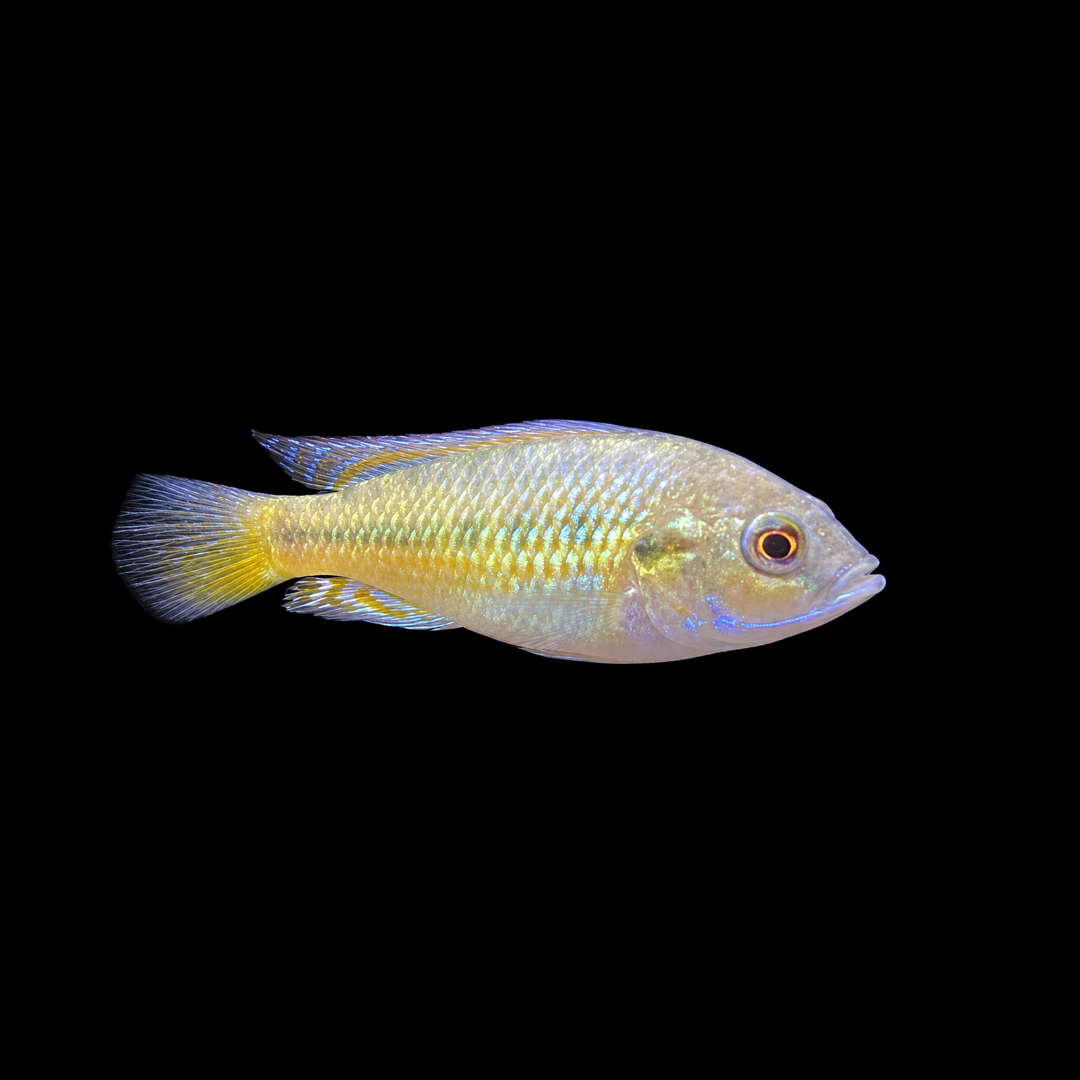
エジプシャンマウスブルーダー SP.RUAHAは、タンザニア中南部のルアハ川上流域に由来するとされる小型の河川産シクリッドです。Pseudocrenilabrus sp. ‘Ruaha’という暫定名で流通していますが、この型自体はまだ正式な種として記載・研究されていません。成熟したオスは黄色味を帯びた体に青い金属光沢を見せ、下唇からエラ蓋周辺の青色、青黒いヒレ、縞模様のある臀ビレが目を引きます。臀ビレ先端付近には赤い斑も見られますが、この斑の構造や機能はルアハ型について科学的に確認されていません。メスはより控えめな体色で、口元に淡い青色が現れることがあります。小型ながら縄張り行動や求愛、メスによる口内保育を観察でき、外見と行動の両方に見どころがある魚です。Egyptian Mouthbrooder SP.RUAHA is a small riverine cichlid believed to originate from the upper Ruaha River drainage in south-central Tanzania. It circulates under the provisional name Pseudocrenilabrus sp. ‘Ruaha’, but this form has not yet been formally described or scientifically studied as a species. Mature males show a yellowish body with blue metallic iridescence, blue coloration around the lower lip and gill cover, dark fins, and a distinctly striped anal fin. A red mark may also be visible near the tip of the anal fin, although its structure and function have not been scientifically established for the Ruaha form. Females are more subdued and may show faint blue coloration around the mouth. Despite its small size, it offers characteristic cichlid territorial and courtship behavior as well as maternal mouthbrooding, making both its appearance and behavior rewarding to observe.
基本情報 / Basic Information
| 学名 / Scientific Name | Pseudocrenilabrus sp. ‘Ruaha’ (未記載型の暫定呼称) (provisional designation for an undescribed form) |
|---|---|
| 通称 / Common Name | エジプシャンマウスブルーダー SP.RUAHA、シュードクレニラブルス sp. ルアハEgyptian Mouthbrooder SP.RUAHA, Pseudocrenilabrus sp. ‘Ruaha’ |
| 分類 / Family | カワスズメ科(シクリッド科)・シュードクレニラブルス属Family Cichlidae, genus Pseudocrenilabrus |
| 英名 / English Name | 確立した英名は確認されていません。No established English common name has been confirmed. |
| 分布 / Distribution | タンザニア中南部、ルアハ川上流域に由来するとされています。正式な分布調査が行われた型ではないため、詳細な自然分布は未確定です。Believed to originate from the upper Ruaha River drainage in south-central Tanzania. Because this form has not been formally surveyed taxonomically, its precise natural distribution remains unresolved. |
| 最大体長 / Max Size | 明確な最大体長は確認されていません。オスは5〜6cmほどで十分に発色し性的に成熟し、メスは通常それより1〜2cmほど小型です。大型水槽ではさらに成長する可能性があります。A confirmed maximum size is not available. Males are fully colored and sexually mature at about 5–6 cm, while females are usually 1–2 cm smaller. Individuals may grow somewhat larger in spacious aquaria. |
| 寿命 / Lifespan | 信頼できる具体的な寿命データは確認されていません。No reliable species-specific lifespan data have been confirmed. |
飼育環境 / Aquarium Environment
| 水槽サイズ / Tank Size | 相性の安定したペアであれば30cmキューブ水槽(約27L)で飼育・繁殖される例があります。ただし、繁殖期のオスはメスを強く追うことがあるため、長期飼育では60cm規格水槽(約57〜65L)など、逃げ場と視線を遮る空間を確保しやすい水槽のほうが安全です。複数のメスを飼う場合も、十分な隠れ家とスペースを優先します。Compatible pairs have been kept and bred in 30 cm cube aquaria of about 27 L. However, breeding males can pursue females intensely, so for long-term maintenance a standard 60 cm aquarium of about 57–65 L, or another tank that provides more retreat space and visual barriers, is the safer choice. When keeping multiple females, prioritize ample shelters and space. |
|---|---|
| 水温 / Temperature | 22〜28℃程度を目安に、急な変化を避けて安定させます。ルアハ型そのものについて厳密な適温範囲を示した研究データは確認されていないため、20〜30℃を種固有の確立した耐性範囲として扱うのは避けます。A stable temperature of roughly 22–28°C is a practical target, with sudden changes avoided. No rigorous species-specific temperature range has been established for the Ruaha form, so 20–30°C should not be treated as a scientifically confirmed tolerance range for this fish. |
| 水質 / Water Quality | pH6.5〜7.5、総硬度5〜15dH程度が飼育上の目安として用いられています。ただし、ルアハ型に固有の水質条件が研究で確立されているわけではありません。数値を絶対条件とするより、急変を避け、十分なろ過と定期的な換水で安定した清浄な水を保つことを優先します。Aquarium guidelines commonly use around pH 6.5–7.5 and 5–15 dH. These values have not been established as species-specific requirements for the Ruaha form. Rather than treating them as absolute limits, prioritize stable conditions, effective filtration, and regular water changes. |
| レイアウト / Layout | 流木、素焼き鉢や土管、水草などで視線を遮り、複数の隠れ場所を作ります。アヌビアスやミクロソリウムなどの丈夫な陰性水草も利用できます。繁殖期のオスは底床に浅い窪みを作るため、底床には角のない細かな砂や砂利が向いています。Use driftwood, clay pots or tubes, and aquatic plants to break lines of sight and create several retreats. Hardy shade-tolerant plants such as Anubias and Microsorum can also be used. Breeding males may make shallow depressions in the substrate, so fine sand or smooth gravel is suitable. |
| 注意点 / Precautions | 繁殖期のオスは縄張り意識が強まり、産卵準備のできていないメスを追い続けることがあります。隠れ家と退避スペースを十分に用意し、必要に応じて個体を分けられるようにします。また、同属の別種・別地域型との混泳は、交雑や系統の混同を避けるため控えるのが無難です。Breeding males may become strongly territorial and repeatedly chase females that are not ready to spawn. Provide abundant retreats and be prepared to separate fish when necessary. Keeping different Pseudocrenilabrus species or geographic forms together is best avoided to reduce the risk of hybridization and loss of lineage identity. |
餌と給餌 / Feeding
| 餌の種類 / Diet | 飼育下では、口に合うサイズのフレーク、ペレット、冷凍飼料、生餌などを利用できます。ルアハ型そのものの野外での食性は十分に研究されていないため、特定の自然食を断定せず、複数タイプの餌を組み合わせて与えます。In captivity it can be offered appropriately sized flakes, pellets, frozen foods, and live foods. The natural diet of the Ruaha form itself has not been adequately studied, so it is better not to assign a specific wild diet and instead provide a varied aquarium diet. |
|---|---|
| 給餌のポイント / Feeding Tips | 食欲が強いため、短時間で食べ切れる量を基本にし、与えすぎと食べ残しを避けます。特定の高栄養飼料だけへ偏らせず、餌の種類を変えながら体型と状態を見て量を調整します。Because it feeds eagerly, offer portions that are consumed promptly and avoid both overfeeding and leftovers. Do not rely on a single rich food; vary the diet and adjust quantity according to body condition and overall health. |
性格と混泳 / Temperament and Tank Mates
| 性格 / Temperament | 小型のシクリッドですが、縄張り意識は明確です。特に繁殖期のオスは底床付近に産卵場所を設け、そこへ入る魚を追い払うことがあります。普段の大きさだけで「おとなしい魚」と判断せず、十分なスペースと視線を遮るレイアウトを用意します。Although small, it is clearly territorial. Breeding males may establish a spawning area near the bottom and drive away fish entering that space. Its size should not be taken to mean that it is always peaceful; adequate room and visual barriers are important. |
|---|---|
| 混泳の相性 / Compatibility | 中層〜上層を泳ぐ同程度以上の大きさの魚とは、十分なスペースがあれば混泳できる場合があります。一方、口に入るほど小さな魚、動きが遅く逃げにくい魚、繁殖期に底床の縄張りへ入りやすい魚はトラブルになりやすいため注意が必要です。混泳の成否は水槽サイズや個体差にも左右されるため、特定の魚種を一律に「安全」とは考えず、追尾やヒレ傷が続く場合は分けます。同属の近縁種は交雑防止のため避けます。Fish of similar or larger size that mainly occupy the middle and upper water layers may coexist when enough space is provided. Very small potential prey, slow fish with limited escape ability, and bottom-oriented fish that enter the male’s breeding territory require caution. Compatibility depends on tank size and individual temperament, so no tank mate should be considered universally safe; separate fish if persistent chasing or fin damage occurs. Related Pseudocrenilabrus forms should be avoided to prevent hybridization. |
病気と対策 / Diseases and Prevention
| かかりやすい病気 / Common Diseases | ルアハ型に特有の「かかりやすい病気」は、信頼できる資料からは確認できません。一般の淡水魚と同様に、過密、食べ残し、水質悪化、外傷などで状態を崩すと、細菌性の症状や外部寄生虫などのトラブルが起こる可能性があります。No disease has been reliably established as a particular predisposition of the Ruaha form. As with other freshwater aquarium fish, poor water quality, crowding, excess food, or injuries can weaken condition and increase the chance of bacterial signs or external parasite problems. |
|---|---|
| 対策と予防 / Prevention | ろ過を安定させ、定期的な換水と適量の給餌で水質を維持することが基本です。新しく導入した個体は、体表、ヒレ、呼吸、食欲、排せつの変化をよく観察します。飼育下繁殖個体であっても病原体の持ち込みが完全になくなるわけではないため、産地や繁殖形態だけで安全と判断しないようにします。Stable filtration, regular water changes, and moderate feeding are the foundations of prevention. Observe newly introduced fish closely for changes in skin, fins, breathing, appetite, and waste. Captive breeding does not eliminate all disease or parasite risk, so origin alone should not be treated as a guarantee of health. |
増やし方(繁殖) / Breeding
| 雌雄の判別 / Sexing | オスは成熟すると黄色味のある体に青い金属光沢が強まり、下唇からエラ蓋周辺にも青色が現れます。臀ビレには明瞭な縞模様があり、先端付近に赤い斑が見られることがあります。メスは銀灰色〜黄褐色を基調とする控えめな体色で、口元に淡い青色が現れる場合があります。メスの臀ビレには、オスのような明瞭な縞模様がありません。Mature males develop stronger yellow and blue metallic coloration, with blue also appearing around the lower lip and gill cover. The anal fin is distinctly striped, and a red mark may be visible near its tip. Females are more subdued, generally silver-gray to yellow-brown, and may show faint blue around the mouth. The female anal fin lacks the male’s distinct striping. |
|---|---|
| 繁殖形態 / Reproduction | メスが卵と稚魚を口内で保護する母性口内保育型で、ペアを長く維持するタイプではありません。オスは底床に浅い窪みを作って求愛し、メスは産んだ卵を口へ取り込みます。近縁のP. multicolorでは口内保育がおよそ10日前後続き、ルアハ型でも10日〜2週間ほどが飼育上の目安として扱われています。稚魚を最初に放した後も、危険を感じると再び口へ戻す行動が見られることがあります。This is a maternal mouthbrooder in which the female protects eggs and fry in her mouth, without forming a long-term pair bond. The male makes a shallow depression in the substrate and courts the female, which picks up the eggs after laying. In the related P. multicolor, mouthbrooding lasts about ten days under studied conditions, and roughly 10 days to two weeks is commonly used as an aquarium guideline for the Ruaha form. After the fry are first released, the female may take them back into her mouth when disturbed. |
| 繁殖のポイント / Breeding Tips | 産卵後、抱卵したメスがオスから繰り返し追われる場合は、静かな別水槽へ分ける方法があります。ただし移動自体もストレスになるため、追尾の程度とメスの状態を見て判断します。稚魚が独立した後は、消耗したメスに十分な休息と給餌の時間を与えてからオスと再同居させます。稚魚にはブラインシュリンプ幼生、マイクロワーム、細かく砕いた人工飼料などを利用できます。If a holding female is repeatedly harassed by the male after spawning, she may be moved to a quiet separate aquarium. Moving a brooding female can itself be stressful, so base the decision on the intensity of chasing and her condition. After the fry become independent, allow the female time to feed and recover before reintroducing her to the male. Fry can be raised on newly hatched brine shrimp, microworms, and finely crushed prepared foods. |
雑学と豆知識 / Trivia and Fun Facts
| 1. 「エジプシャン」なのにタンザニア由来 / 1. “Egyptian” despite its Tanzanian origin | 「エジプシャンマウスブルーダー」は本来Pseudocrenilabrus multicolorに使われる呼び名ですが、日本の流通ではルアハ型にも「エジプシャンマウスブルーダー SP.RUAHA」という名称が付される例があります。ルアハ型はタンザニアのルアハ川上流域に由来するとされるため、名称と産地は一致しません。飼育や系統管理では、流通名だけでなくPseudocrenilabrus sp. ‘Ruaha’という暫定呼称も併せて確認すると混同を避けやすくなります。“Egyptian Mouthbrooder” properly refers to Pseudocrenilabrus multicolor, yet the Ruaha form is also sold in Japan under the trade name “Egyptian Mouthbrooder SP.RUAHA.” Because the Ruaha form is believed to originate from the upper Ruaha River in Tanzania, the trade name and geographic origin do not match. For identification and lineage management, the provisional designation Pseudocrenilabrus sp. ‘Ruaha’ is therefore useful alongside the trade name. |
|---|---|
| 2. まだ正式な種名を持たないルアハ型 / 2. The Ruaha form still lacks a formal species name | Pseudocrenilabrus sp. ‘Ruaha’の「sp.」は、シュードクレニラブルス属の魚として扱われているものの、正式な種名が付けられていないことを示します。1996年のタンザニア調査でローター・ゼーガースがルアハ川上流域から見いだした可能性が高いとされますが、この型自体は現在も科学的に十分研究されていません。現在流通する系統が当時の採集個体の直接の子孫かどうかも不明で、飼育魚として知られている一方、分類学上の位置づけには未解決の部分が残っています。The “sp.” in Pseudocrenilabrus sp. ‘Ruaha’ indicates that it is treated as a member of the genus without a formally described species name. It was probably encountered in the upper Ruaha drainage during Lothar Seegers’ 1996 Tanzania expedition, but the form itself remains insufficiently studied scientifically. It is also unclear whether present captive stocks descend directly from those early collections, leaving its taxonomic identity unresolved despite its presence in the aquarium hobby. |
| 3. 1902年から続く「マウスブルーダー」の観賞魚史 / 3. Aquarium history of the mouthbrooder since 1902 | 近縁のP. multicolorは1902年にエジプトからドイツへ導入された記録があり、その後100年以上にわたって観賞魚として飼育されてきました。メスが卵や稚魚を口の中で守る行動は、現在ではアフリカンシクリッドで広く知られていますが、観賞魚史の初期には強い印象を与えた繁殖様式でした。ルアハ型も同じ母性口内保育を見せるため、小型水槽でこの特徴的な繁殖行動を観察できます。The related P. multicolor is recorded as having been introduced from Egypt to Germany in 1902 and has remained an aquarium fish for more than a century. Maternal mouthbrooding is now well known among African cichlids, but it was a striking reproductive behavior in the early history of the hobby. The Ruaha form shows the same broad maternal mouthbrooding pattern, allowing this behavior to be observed in a comparatively small aquarium. |
| 4. 赤い臀ビレ斑を「真のエッグスポット」と断定しない / 4. Why the red anal-fin mark should not be assumed to be a true egg-spot | ルアハ型のオスでは、縞模様のある臀ビレの先端付近に赤い斑が見られます。観賞魚の説明ではこの斑が「エッグスポット」と呼ばれることがありますが、ルアハ型そのものは科学的に研究されておらず、派生的なハプロクロミス類で研究されている「真のエッグスポット」と同じ構造・起源・機能を持つかは確認されていません。見た目の似た斑点があることと、進化学的に同じ形質であることは分けて考える必要があります。Males of the Ruaha form may show a red mark near the tip of the striped anal fin. Aquarium descriptions sometimes call this an “egg-spot,” but the Ruaha form itself has not been scientifically studied, and it has not been shown that this mark shares the same structure, evolutionary origin, or function as the true egg-spots studied in derived haplochromine cichlids. A visually similar marking should therefore not automatically be treated as the same evolutionary trait. |
| 5. 「感覚便乗」研究が示したこと / 5. What sensory-exploitation research actually showed | 2011年の研究では、典型的なエッグスポットを持たない基部系統のP. multicolorのメスが、画像上で人工的なエッグスポットを加えたオスを、同じ画像から斑点を除いたオスより好むことが示されました。さらに、多くの東アフリカ産シクリッドが黄色・橙色・赤色の斑点に反応することから、既存の色への感覚的な好みが、後のエッグスポット進化に利用された可能性が提案されています。これはハプロクロミス類のエッグスポットの起源を考える研究であり、ルアハ型の赤い斑の機能を直接実証したものではありません。A 2011 study showed that females of the basal, typically egg-spot-less P. multicolor preferred an image of a male with an artificial egg-spot over an otherwise identical image without one. The study also found widespread responses to yellow, orange, and red spots among East African cichlids, supporting the idea that a pre-existing sensory bias could have been exploited during the evolution of haplochromine egg-spots. This work addresses the evolutionary origin of true egg-spots and does not directly demonstrate the function of the red mark in the Ruaha form. |
| 6. ルアハ川の環境と飼育耐性は分けて考える / 6. River conditions and aquarium tolerance are not the same evidence | ルアハ川流域には乾季と雨季による大きな季節変動がありますが、その環境だけを根拠に、ルアハ型が特定の高水温や低酸素、水質悪化に強いと断定することはできません。由来地域の環境は飼育を考える手掛かりにはなりますが、本型の生理的な耐性範囲を直接測定した研究とは別のものです。水槽では、過酷な環境を再現するのではなく、急変を避けた安定した水温と清浄な水を維持することが基本になります。The Ruaha River basin undergoes pronounced seasonal changes between wet and dry periods, but those environmental conditions alone do not prove that the Ruaha form has a particular tolerance for high temperatures, low oxygen, or deteriorating water quality. Habitat context can inform husbandry, but it is not the same as a direct physiological study of this fish. In the aquarium, the priority should be stable temperature and clean water rather than recreating environmental extremes. |
まとめ / Conclusion
エジプシャンマウスブルーダー SP.RUAHAは、オスが5〜6cmほどで成熟する小型のシクリッドで、青い口元や金属光沢、縞模様のある臀ビレなど、近くで見るほど細かな色彩が楽しめます。未記載型のため、分布や最大体長、適温などに未確定の部分があり、流通情報をそのまま科学的な確定事項として扱わないことが大切です。一方、飼育では安定した水質、十分な隠れ家、繁殖期のオスへの配慮という基本を押さえることで、その行動をじっくり観察できます。Egyptian Mouthbrooder SP.RUAHA is a small cichlid whose males mature at around 5–6 cm, with subtle details such as blue around the mouth, metallic iridescence, and a striped anal fin. Because it remains an undescribed form, aspects such as its precise distribution, maximum size, and temperature limits are not fully established, so aquarium-trade information should not automatically be treated as settled scientific fact. In practice, stable water quality, ample retreats, and careful management of breeding-male aggression provide a sound basis for keeping it successfully.
最大の見どころは、メスが卵と稚魚を口の中で守る母性口内保育です。産卵後のメスの行動や、稚魚を危険時に再び口へ迎え入れる様子は、小型水槽でもシクリッド特有の繁殖戦略を実感させてくれます。分類学的な謎を残す魚だからこそ、確かな情報と未確認の推測を分けながら飼育し、その姿と行動を丁寧に観察することが、このルアハ型の魅力を最も自然に味わう方法です。Its greatest attraction is maternal mouthbrooding: the female protects eggs and fry inside her mouth and may take young back in when disturbed. These behaviors make characteristic cichlid reproductive strategies visible even in a relatively compact aquarium. Precisely because the Ruaha form still carries taxonomic uncertainty, its appeal is best appreciated by separating confirmed information from untested assumptions and observing the fish itself with care.

気になる道具や飼い方を見つけてみませんか?
 アイのアクアグッズ案内グッピー・プラティ・モーリーを親子で楽しむ飼育用品|水槽・稚魚保護・ろ過・餌・水草道具の特徴や使い方、選ぶときのポイントをアイが紹介します。記事はコチラ →
 アイのアクアグッズ案内水草用ソイルの選び方|土・砂の違いとおすすめ商品道具の特徴や使い方、選ぶときのポイントをアイが紹介します。記事はコチラ →
 アイのアクアグッズ案内水槽のろ材の選び方|ウール・リング・活性炭の違いとおすすめ商品フィルターの中の綿や石は何をしている? アイとコタロウが、ウール・スポンジ・セラミック・焼結ガラス・活性炭・ゼオライトを比較。機種との相性、入れ方、洗い方と交換まで商品とともに紹介します。記事はコチラ →
 アイのアクアグッズ案内金魚を長く楽しむ飼育用品|水槽・フィルター・エアレーション・水換え道具の特徴や使い方、選ぶときのポイントをアイが紹介します。記事はコチラ →
さまざまな飼育テーマをご紹介。リンク先の記事には広告・商品紹介が含まれます。
案内・紹介記事一覧へ →分布マップ
タンザニア中南部のルアハ川上流域に由来するとされる未記載型です。詳細な自然分布は未確定のため、地図ではルアハ川上流域を中心とした概略範囲を表示しています。
※この地図は分布地域を把握するための概略表示です。マーカーはルアハ川上流域を示すために設定した代表地点であり、実際の採集地点を示すものではありません。記事では本型の正確な自然分布は未確定とされています。
-
Katongo, C., Seehausen, O. & Snoeks, J. (2017)A new species of Pseudocrenilabrus (Perciformes: Cichlidae) from Lake Mweru in the Upper Congo River System. Zootaxa, 4237(1), 181–190.分類・属内比較・分布の基礎資料
-
Schedel, F. D. B., Friel, J. P. & Schliewen, U. K. (2014)Haplochromis vanheusdeni, a new haplochromine cichlid species from the Great Ruaha River drainage, Rufiji basin, Tanzania. Spixiana, 37(1), 135–149.ルアハ川水系の地理・淡水魚相・生息環境の背景資料
-
McDonnell, L. H., Reemeyer, J. E. & Chapman, L. J. (2019)Independent and Interactive Effects of Long-Term Exposure to Hypoxia and Elevated Water Temperature on Behavior and Thermal Tolerance of an Equatorial Cichlid. Physiological and Biochemical Zoology, 92(3), 253–265.近縁のPseudocrenilabrus multicolorにおける水温・低酸素耐性の研究。ルアハ型の適温を直接示す資料ではない
-
Mrowka, W. (1984)Brood care motivation and hunger in the mouthbrooding cichlid Pseudocrenilabrus multicolor. Behavioural Processes, 9(2–3), 181–190.母性口内保育・抱卵中の摂餌抑制・口内保育期間の基礎資料
-
Egger, B., Klaefiger, Y., Theis, A. & Salzburger, W. (2011)A Sensory Bias Has Triggered the Evolution of Egg-Spots in Cichlid Fishes. PLoS ONE, 6(10), e25601.エッグスポットの感覚バイアス仮説とP. multicolorを用いた選好実験
-
Santos, M. E., Braasch, I., Boileau, N., Meyer, B. S., Sauteur, L., Böhne, A., Belting, H.-G., Affolter, M. & Salzburger, W. (2014)The evolution of cichlid fish egg-spots is linked with a cis-regulatory change. Nature Communications, 5, 5149.ハプロクロミス類のエッグスポット形成とfhl2b周辺のシス制御変化に関する研究
-
Walter, I., Přikrylová, I., Barson, M. & Luus-Powell, W. J. (2023)Monogenean parasites of Pseudocrenilabrus philander (Weber, 1897) (Teleostei: Cichlidae) in the middle Limpopo River basin, southern Africa. African Journal of Aquatic Science, 48(3), 327–337.同属魚に確認されている単生類など外部寄生虫の基礎資料
-
MSD Veterinary Manual水質悪化・過密・有機物負荷などと魚病リスク、換水・水質管理・導入時観察に関する一般的な魚類医療・飼育管理資料




コメント